Year: 2021

15 May 2021

This Week in Apps: Apple talks App Store fraud, responds to antitrust complaints; Facebook growth is slipping

Welcome back to This Week in Apps, the weekly TechCrunch series that recaps the latest in mobile OS news, mobile applications and the overall app economy.

The app industry continues to grow, with a record 218 billion downloads and $143 billion in global consumer spend in 2020. Consumers last year also spent 3.5 trillion minutes using apps on Android devices alone. And in the U.S., app usage surged ahead of the time spent watching live TV. Currently, the average American watches 3.7 hours of live TV per day, but now spends four hours per day on their mobile devices.

Apps aren’t just a way to pass idle hours — they’re also a big business. In 2019, mobile-first companies had a combined $544 billion valuation, 6.5x higher than those without a mobile focus. In 2020, investors poured $73 billion in capital into mobile companies — a figure that’s up 27% year-over-year

This week we’re diving into how Apple is defending its App Store fees amid the Epic lawsuit and how it responded to the other complaints raised by Spotify, Match and Tile in the Senate antitrust hearing. We’re also looking at new data that implies Facebook’s grip on social is starting to loosen, TikTok’s new features, tests and plans for e-commerce, security issues with Twitter’s Tip Jar and more.

This Week in Apps will soon be a newsletter! Sign up here: techcrunch.com/newsletters

Top Stories

Apple talks App Store fraud

Apple wants developers to know what they’re paying for with those App Store commissions. The company this week announced it stopped more than $1.5 billion in potentially fraudulent transactions in 2020, preventing theft of customers’ “money, information and time,” it said. And it kept nearly a million “risky and vulnerable” apps out of customers’ hands — meaning it rejected them from the App Store following their review. It also terminated 470,000 developer accounts in 2020 and rejected an additional 205,000 developer enrollments over fraud concerns. On the customer side, Apple deactivated 244 million customer accounts due to fraudulent and abusive activity, it said, and rejected 424 million attempted account creations because they “displayed patterns consistent with fraudulent and abusive activity.”

The company, of course, didn’t just randomly decide to post these figures. Its App Store fees and their legality, of sorts, are on trial as part of Epic Games’ lawsuit. The Fortnite maker alleges Apple is behaving as a monopolist by forcing app developers to use only Apple’s own payment mechanism — and by not even allowing developers to tell their customers where else they can make purchases, such as on the developer’s website, where App Store fees wouldn’t apply.

By publishing this data, Apple is attempting to position all the stories of fraudulent apps on the App Store as those that fell through the cracks of its much larger anti-fraud operation. That is, for all the mistakenly published fraudulent apps that Apple either internally fretted over, or those that have now come to light in the press (often now thanks to developer Kosta Eleftheriou‘s ongoing efforts), there were much, much larger numbers that Apple had stopped from making it through app review.

Where Apple’s case falls apart, however, is when Eleftheriou exposes how easy it is to find those scam apps after they mistakenly get approved. On his own, he’s building a tool that finds scams across the entire App Store. The question is, why can’t a multibillion-dollar company do the same — or even do more? A system that’s able to retroactively review apps that have both high revenues and a suspicious number of five-star reviews (amid a sizable amount of one-star reviews calling the app a scam), would give Apple’s app review team a good place to start a cleanup. The company has done widespread App Store sweeps in years past to get rid of junk, after all — maybe it needs another?

Facebook’s dominance is slipping

There are some signs that Facebook’s hold on the social app ecosystem is slipping. Already getting beat by TikTok and others as the most-downloaded apps of 2020, new data from Appfigures indicates Facebook’s app has been seeing an increasingly smaller number of monthly downloads over the past 12 months.

The Facebook app and Facebook Lite saw 15 million installs per week in May 2020, which dropped to 13 million in June 2020. As of April 2021, the number is now under 11 million — a loss of 23% of downloads in around 12 months. Meanwhile, a social app gaining downloads during this time has been TikTok, which saw 52 million downloads in April 2021.

Image Credits: Appfigures

In addition, eMarketer reported this week that Gen Z users now use TikTok more than Instagram in the U.S. This year, TikTok will have 37.3 million monthly active Gen Z users compared with 33.3 million Gen Z MAUs on Instagram. Snapchat is still leading, however, with 42.0 million MAUs this year. However, TikTok is on pace to surpass Snapchat as well, with 89.7 million total MAUs by 2023, compared with Snapchat’s 98.5 million.

Weekly News

Platforms: Apple

Apple expands its Apple Developer Academy to Detroit and Korea. The program provides training and tools to aspiring iOS developers and designers. Apple already runs programs in more than a dozen other sites in Brazil, Indonesia and Italy.

Apple releases third developer beta and public beta of iOS 14.6 and iPadOS 14.6, and the third developer beta and public beta of watchOS 7.5 The betas include under-the-hood improvements and fixes, as well as small changes like the ability to use an email address to put AirTags and other items into Lost Mode. Apple is also now no longer signing iOS 14.5, blocking downgrades.

Apple is being hit with a class-action suit in the U.K over App Store commissions. The group alleges Apple is behaving like a monopolist over its excessive collection of fees, and is asking for damages of around £1.5 billion ($2.1 billion).

Platforms: Google

Google announced the winners of its #AndroidDevChallenge, which showcased apps built with Android’s new UI toolkit, Jetpack Compose. In later rounds, winners received a Google Pixel 5.

Augmented Reality

Pokémon GO’s developer, Niantic Labs, is rebranding its development platform as Niantic Lightship and opening to more developers as it enters private beta. The goal of Lightship will be to allow more developers to use the company’s tech that powers apps like Pokémon GO and Harry Potter: Wizards Unite to build their own immerse, multiplayer AR games.

New game studio Sequoia Games is planning to launch a tabletop AR game to capitalize on NBA Top Shot fever. The game has elements of trading cards, NFTs and AR.

Fintech

Coinbase hit No. 1 on the U.S. App Store for the first time since 2017 on May 10. The app had broken into the top 10 in mid-April, climbing as high as No. 2 on April 14, its IPO day.

Google Pay makes its first push into the remittances market. Users in the U.S. can now send money to users in India and Singapore.

PayPal ranked No. 2 for MAUs in finance apps in Q1 2021 in the U.S., behind PayPal-owned Venmo. It was No. 1 in the U.K. and No. 4 in France. The company is preparing to make PayPal a “super app” that will enable shopping, bill pay, check cashing, investing, crypto buying and selling, and more.
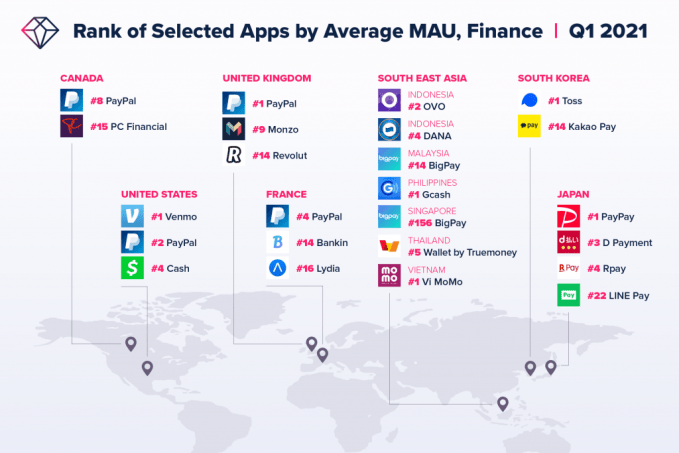
Image Credits: App Annie

Social

Snap suspends anonymous Q&A apps YOLO and LMMK following a lawsuit over a teen’s death. (TW: suicide). The mother of an Oregon teen is suing Snap, YOLO and LMK after her son took his own life in 2020. The teen had received bullying messages on YOLO and LMK for months leading up to his death. The suit alleges that anonymous messaging apps facilitate bullying to such an extent that they should be considered dangerous products.

TikTok is testing a system that will allow creators to pay to promote their own videos to the For You Page, according to reports. TikTok told us the new self-serve advertising tool is not widely available, but will allow users and brands to promote their TikTok videos and foster engagement with the community more easily. The user can center their promotions around campaign objectives like video views or visits to a landing page or website.

TikTok rolls out a Green Screen Duet feature and a new way to browse videos. The Green Screen Duet feature combines two of TikTok’s most popular editing tools to allow creators to use another video from TikTok as the background in their new video. The company also confirmed the test of a new way to discover videos. Called “Topics,” these are dedicated interest-based feeds featuring the top, trending videos in a given category.
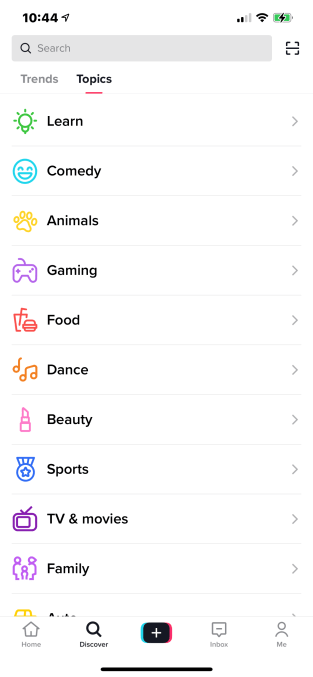
Image Credits: TikTok

Facebook has begun testing its recently announced Clubhouse rival, Live Audio Rooms. The test was spotted being used by public figures in Taiwan, reported Bloomberg.

TikTok to take on LinkedIn? The video app is launching a job service that will offer a tool for brands to recruit employees. The platform isn’t integrated into the LinkedIn app, but is rather a separate web page for posting jobs and uploading video resumes.

TikTok also added a revamped Safety Center which includes a new section for parents and guardians that teaches them how to get started on the app and use its safety features, like Family Pairing. It also offers bully education and prevention resources, and details on safety and privacy tools, among other things.

Instagram is adding a dedicated spot for your pronouns in your Instagram bio. The company said it’s only available in a few countries right now, but is rolling out to others soon.

Facebook is testing new pop-up messages in its app that tell people to read a link before they share it, following the launch of a similar feature on Twitter. The goal is to encourage people to read through the article, rather than impulsively reshare potentially inflammatory content based on headlines.

Discord’s Clubhouse competitor, Stage Channels, will begin to surface events like open mic nights, book clubs, and more through a new portal called Stage Discovery starting in June. The company is also planning to add threaded conversations and ticketed events in the future.
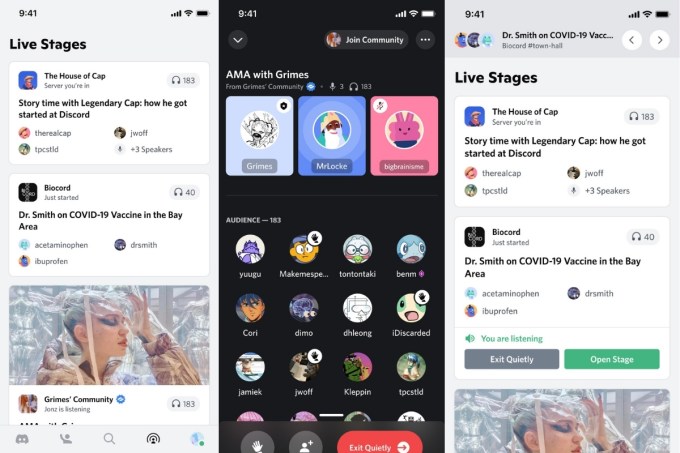
discord-stage-discovery

Image Credits: Discord

Nearly half of TikTok users are buying from the brands they see on the platform. TikTok is preparing to double down on that trend, Bloomberg reports, noting it saw a brand testing special shopping features on its profile. TikTok also told us it’s running tests in select regions, including Southeast Asia, that will pave the way for its broader expansion into e-commerce. (But you already know about these, right? Because we told you back in February!)

Messaging

WhatsApp will gradually stop you from being able to call or message your contacts if you don’t agree to its new privacy policy. After a few weeks, users will lose access to their chat lists. In a few more weeks, they won’t receive notifications and calls.

Twitter DMs will be easier to search. Nearly two years after the search feature arrived on iOS, Twitter rolled out the DM search bar to Android. It also said that later this year users will be able to search DMs for message content, too.

Signal’s beta (v5.11.0) adds a feature that allows users to share 4K images by tapping a button and selecting “High” for the image quality.

Streaming & Entertainment

Clubhouse for Android launched in the U.S. on Sunday, a year after the iOS debut. It then rolled out to the U.K., Canada, Australia and New Zealand.

Podcast streaming app Castbox was found to be streaming dozens of subscription-only shows via leaked feeds. The podcasts offer their paying subscribers private feeds to listen. But these feeds can be easily shared, then accessed by any podcast app that supports RSS.

Dating

Bumble’s shares fell sharply after its first-quarter earnings, falling below the IPO price of $43 to $38.91. Investors were spooked by Bumble’s cautious H2 guidance. Bumble reported revenue of $170.7 million in Q1 2021, up from $79.1 million in Q1 2021. Paying users increased 30% to 2.8 million.

Gaming

Roblox reported its revenue grew 140% YoY in its first earnings report since the company went public. The company reported $387 million in revenue and a loss per share of $0.46. The net loss for the quarter was $134.2 million. DAUs rose 79% YoY to 42.1 million, with users spending 9.7 billion hours on the platform, up 98% YoY.

The top five IP-based gaming titles generated $1.4 billion in the U.S. in 2020, reports Sensor Tower. The games included Pokémon GO, PUBG Mobile, Call of Duty: Mobile, Marvel Strike Force and Dragon Ball Z: Dokkan Battle. Pokémon GO led with $480 million.

Health & Fitness

Facebook shared updates on its vaccination efforts, saying more than 3.3 million people in the U.S. have used its vaccine finder since its March 11 launch. It has also given out $30 million in ad credits to governments, NGOs and other orgs to reach people with vaccine info. More than 5 million people globally have added the profile frame that shows support for vaccines, and more than 7 million people have used Instagram stickers for vaccines. Over 50% of people in the U.S. on Facebook have seen someone use the COVID-19 vaccine profile frames so far.

Uber and Lyft are giving free rides to COVID-19 vaccine sites in a deal with the White House. The free rides will last through July 4, the date when President Joe Biden wants 70% of U.S. adults to be vaccinated.

The NHS contact-tracing app had a significant impact on lowering the spread of the coronavirus in the U.K., a peer-reviewed report states. The app was “used regularly” by 16.5 million people, or roughly 28% of the U.K. population.

Apple is again seeking to dismiss an $800 million COVID app lawsuit. Apple rejected the app last year on the grounds that it didn’t come from a recognized health authority or institution.

Government & Policy

Apple’s Chief Compliance Officer Kyle Andeer responded to complaints made by Spotify, Match and Tile during the hearing held by the Senate Judiciary Committee Subcommittee on Competition Policy, Antitrust, and Consumer Rights. In a letter, Andeer reiterates Apple’s arguments, including that its commission structure is fair (e.g. it drops to 15% in year two for subscription apps; a 70/30 split is an industry standard); that the commission pays for far more than processing payments; that it doesn’t prohibit developers from communicating with customers — it only asks them to not do so inside their iOS app; and that it will provide access to UWB for Tile and others in its space, among other things.

Apple dealt some notable blows in the letter, too: it said Match had tried to implement shady pricing in Tinder that would have made an upfront six-month payment look like a subscription at one point, which is why it rejected its app update. And it refuted the idea that it used data from Tile’s retail sales inside stores to inform AirTag pricing, noting Tile “did not sell well” at Apple Stores.

Apple’s Senate Subcommittee Letter May 2021 by TechCrunch on Scribd

Facebook is ordered not to apply its controversial WhatsApp T&Cs in Germany. The Hamburg data protection agency is blocking Facebook from processing the additional WhatsApp user data it was granting itself through the T&C change.

State Attorneys General representing 44 U.S. states and territories are pressuring Facebook to walk away from its plans to launch a version of Instagram aimed at children under the age of 13, citing the potential harm to children’s privacy and development health, as well as Facebook’s track record of prioritizing growth over the well-being of users.

TikTok removed over 500,000 accounts in Italy after the country’s data protection watchdog asked the company to recheck the ages of all Italian users and block access to those under the age of 13.

Google was fined just over €100 million (~$123 million) by Italy’s antitrust watchdog for its abuse of a dominant market position related to Android Auto. Google had restricted access to the platform to electric car charging app JuicePass, made by energy company Enel X Italia.

Security & Privacy

Twitter’s new Tip Jar feature, which lets users tip others via PayPal, Venmo, Cash App and others, was quickly found to have a privacy issue. Sending PayPal payments would reveal the recipient’s home address. And even without a transaction, it would reveal a user’s email. Twitter, meanwhile, permits users to be anonymous — but PayPal would expose them.

The FTC finalized its settlement with photo app Everalbum, which misled users of its Ever app saying that it would not apply facial recognition unless users opted in. But the company did activate the feature for all users except those in three U.S. states and the E.U. It also didn’t delete users’ photos and videos when accounts were deactivated. The company must now delete the users’ content and must obtain consent before using facial recognition.

A survey from SellCell found that 73% of respondents agree with Apple’s privacy changes around App Tracking Transparency, compared with 18% who opposed it and 9% who weren’t sure. Additionally, 36% said ATT was their favorite iOS 14.5 feature.

Funding and M&A

? Apptopia raised $20 million to expand its competitive intelligence platform beyond mobile to include data coming from smartwatches, desktop and connected TVs.

? Sanlo raised $3.5 million co-led by Index Ventures and Initial Capital to help apps and games gain access to financial insights and capital. The company will ingest select data from the developer’s account related to customer acquisition costs, retention, marketing data and a subset of financial data. It will then offer insights as to when to smartly deploy capital and even offer the financing.

? Blind, a social networking app for verified, but pseudonymous employees, raised $37 million in Series C funding led by South Korean venture firm Mainstreet Investment. The app now has 5 million users and is building out its hiring platform, “Talent by Blind.”

? Snack, a “Tinder meets TikTok”-style dating app, opens up to Gen Z investors in latest round. The startup will allow Gen Z community members, influencers, creators and others to invest in the company’s upcoming $2 million SAFE, alongside other funds and angels.

? SightCall raised $42 million for its AR-based visual assistance platform for field service teams and their customers to carry out technical and mechanical maintenance or repairs. The core of its service is AR technology, which comes embedded in their apps or the service apps used by customers.

? Lili, a neobank aimed at freelancers, raised $55 million in Series B funding after seeing usage grow 1,500% in a year. The service has topped 200K users.

? Fair, a multilingual neobank, is launching to the public after raising $20 million earlier this year. The app targets people new to the U.S., have no credit or need access to interest-free loans.

? Enterprise Apple device management company Jamf acquired zero trust security startup Wandera for $400 million.

? U.K. fashion app Lyst raised $85 million in a pre-IPO round at a $700 million valuation. The company now has 150 million users, and a catalog of 8 million products from 17,000 brands and retailers.

? Vietnamese flexible pay startup Nano raised $3 million in seed funding led by returning investors Golden Gate Ventures and Venturra Discovery. Its app, VUI, now serves more than 20,000 employees from companies like GS25, LanChi Mart and Annam Gourmet.

? Korea’s Kakao buys serialized fiction app Radish as well as Tapas Media’ storytelling apps, which have more than 3 million readers, for a combined total of $950 million. The former was valued at $440 million and the latter at $510 million.

? The $600 million acquisition of reading community app Wattpad by South Korean internet giant Naver has now formally closed. Wattpad will continue to operate from Toronto, Canada, with co-founder Allen Lau remaining CEO and reporting to the CEO of Naver’s Webtoon, Jun Koo Kim.

? Astrology app Sanctuary raised $3 million in seed funding led by BITKRAFT Ventures to grow its live, on-demand astrology, tarot and psychic readings business.

Downloads

GasBuddy
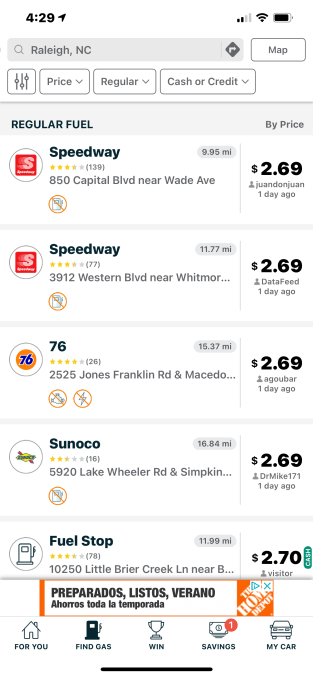
Image Credits: GasBuddy app screenshot

The GasBuddy app, which has been around for over a decade, hit the No. 1 spot on the U.S. App Store for the first time ever due the Colonial pipeline attack. The app became a must-have app for finding gas stations nearby that aren’t out of fuel or diesel, following a surge of panic-buying across over a dozen U.S. states reporting outages. The company told TechCrunch it counted 313,001 total downloads on Wednesday, to give you an idea of how many users it’s been gaining as a result of the crisis.

Waitlist this: Pok Pok Playroom

Image Credits: Snowman

Snowman, the small studio behind award-winning iOS games Alto’s Adventure, Alto’s Odyssey, Skate City and others, is spinning out a new company, Pok Pok, that will focus on educational children’s entertainment. Later this month, Pok Pok will debut its first title, Pok Pok Playroom, aimed at inspiring creative thinking through play for the preschool crowd. The app will feature a range of creative “digital toys” grounded in the real world — no unicorns or fairies or talking animals here. Rather it will feature a diverse range of characters that represent the real world as it is. The subscription-based app will have no ads or in-app purchases, so kids are encouraged to play, not pressured to buy things. The company has pre-announced its May 20th launch, but users can sign up on the website now to get an email when the app arrives.


15 May 2021

Rocket Lab’s 20th Electron launch ends in failure with the loss of its payload

Rocket Lab flew its 20th Electron mission on Saturday morning, but the launch ran into a significant issue just after its second stage engine ignited. The engine appeared to shut down just after the ignition, which is not what it’s supposed to do, and which is likely the result of an automated emergency shutdown process that would trigger in case of a system failure. Rocket Lab confirmed that the issue happened shortly after the ignition of the second stage and resulted in the loss of the vehicle and its payload.

The company last encountered a mission failure in July 2020, when the vehicle and its payloads on Rocket Lab’s 13th Electron flight were lost after an engine failure that occurred during the second stage burn. That issue similarly resulted from a triggered safety shutdown, meaning that while the rocket and its cargo didn’t explode, the spacecraft simply stopped operating, but didn’t reach its target orbit or release its payload.

This flight, called “Running Out of Toes,” was Rocket Lab’s third this year, and a paid, dedicated launch for customer BlackSky, meant to deliver an Earth observation satellite for that company to help power its global monitoring and intelligence platform. This mission profile also included a key test of Rocket Lab’s rocket reusability program, with a planned recovery of the first-stage booster used in the Electron vehicle that carried the satellite to space.

This was to be the second time that Rocket Lab performed a rocket recovery, after picking one up post-launch back in November. The company had created a lot of improvements for this second try, including upgrades to Electron itself, with a better thermal protection system and upgraded heat shield to protect the Rutherford engines that power the booster, which are designed to help the final reusable design keep those in good shape for future reuse post-recovery.


It doesn’t look like the first-stage recovery is happening based on Rocket Lab’s statements thus far, but the company says that it will be providing more information on the failed launch once that becomes available.

15 May 2021

Amazon launches ad-free video streaming service miniTV in India

Amazon, which already charges some of the world’s lowest fee for Prime Video in India, is ready to go a step further to win more users in the world’s second largest internet market.
The e-commerce giant on Saturday launched miniTV, an ad-supported video streaming service that is available within the Amazon shopping app and is completely free.

miniTV is currently available only in India, Amazon said.

miniTV features web-series, comedy shows, and content around tech news, food, beauty, fashion, Amazon said. Some of the titles currently available have been produced by leading studios such as TVF, Pocket Aces — two of the largest web studios in India — and comedians such as Ashish Chanchlani, Amit Bhadana, Round2Hell, Harsh Beniwal, Shruti Arjun Anand, Elvish Yadav, Prajakta Koli, Swagger Sharma, Aakash Gupta and Nishant Tanwar.

“Viewers will be informed on latest products and trends by tech expert Trakin Tech, fashion and beauty experts such as Sejal Kumar, Malvika Sitlani, Jovita George, Prerna Chhabra and ShivShakti. Food lovers can enjoy content from Kabita’s Kitchen, Cook with Nisha, and Gobble. In the coming months, miniTV will add many more new and exclusive videos,” the company said.

miniTV is currently available on Amazon’s Android app, and will arrive on the iOS counterpart and mobile web over the coming months, Amazon said.

Amazon’s move follows a similar step by Walmart’s Flipkart, the company’s chief rival, which rolled out video streaming service within its app in 2019. In recent years, scores of firms including Zomato have added video streaming offering in their own apps.

This is a developing story. More to follow…

15 May 2021

European AI needs strategic leadership, not overregulation

The EU Commission recently proposed a new set of stringent rules to regulate AI, citing an urgent need. With the global race to regulate AI officially on, the EU published a detailed proposal on how AI should be regulated, explicitly banning some uses and defining those it considers “high-risk,” planning to ban the use of AI that threatens people’s rights and safety.

We can all agree with the sentiment of Margrethe Vestager, the European Commission executive vice president, when she said that when it comes to “artificial intelligence, trust is a must, not a nice to have,” but is regulation the most effective and efficient way to secure this reality?

The takeaways from the commission are incredibly in-depth, but the ones that make the most sense to me are those that stress regulated AI should aim to increase human well-being. However, regulation should not overly constrain experimentation and development of AI systems.

High-risk AI systems should always have unalterable built-in human oversight and control mechanisms. AI systems intended to interact with people or to generate content, whether high-risk or not, should be subject to specific transparency obligations. In addition, AI-based remote biometric systems in publicly accessible places shall be only authorized by EU or member state law and serve the objective of preventing, detecting or investigating serious crime and terrorism.

Partnership between AI and humanity

The set of laws and legal framework enacted in Europe will have a profound impact on AI regulation around the world, similar to the effects the GDPR regulations created over the past decade. But will these laws assist us in moving away from the EU-wide haphazard regulatory approach toward a singularity of common classification?

In my opinion, this will cripple AI development in the EU while China and the United States leap forward. It would limit the use cases and innovation of artificial intelligence and put the EU in a technologically inferior position globally. In the U.S, AI is being optimized to maximize corporate profitability and efficiency. In China, AI is being optimized to maximize the government’s grip on the population with the preservation of power. The overly regulated environment in the EU will lead to complete chaos when regulations in various EU bodies start contradicting.

Negative effects on EU entrepreneurship

A lack of investment in AI in the EU is a major factor why the EU is losing the AI race to the U.S. and China. There are currently about 446 million people living in the EU and 331 million people living in the U.S. But in the EU, $2 billion was invested in AI in 2020, while in the U.S., $23.6 billion was invested.

If the EU continues pushing with aggressive regulations and lack of funding, it will enjoy global leadership in AI regulations, but I won’t be surprised if many European entrepreneurs decide to launch their startups in more AI-friendly countries.

To create an EU that is friendly to innovation and entrepreneurs, we must create a collaborative network of AI pioneers to lead the way.

In turn, other nations will take advantage of the EU’s push toward strict regulations by fostering innovation and generating a stronger hold on the future of global technology. A recent World Bank report showed the EU launched 38% of investigations into data compliance in 2019, compared to only 12% in North America. With policies this stringent and burdensome to companies, it should be no surprise if innovators and entrepreneurs begin to move to more business-friendly parts of the globe.

Regulation leads to relegation

The regulation proposal suggests fines of up to €20 million, or up to 4% of total annual turnover of the AI provider for noncompliance. If we consider prior EU legislation and subsequent lack of digital innovation, these proposed regulations will cause chronic stagnation of digital innovation and adoption in the EU bloc.

In short, if these regulations become law, the EU will not become a pioneer but a laggard. The “real” use cases of AI are yet to emerge, uncovering the true potential of AI. The massive bureaucracy for high-risk use cases will undercut any entrepreneurship or bottom-up innovation efforts. With historical markers trending to the EU heading to a recession, now is not the time to stifle innovation.

Put a human face on global AI … and show its value

If AI is to be broadly accepted, we need a human face showing AI helping people solve their problems and challenges. We must highlight engaging stories that are true and showcase the real people behind them. For the population at large to accept the potential of AI, they must see people like themselves benefiting from the goodness of AI.

AI funding means, above all, startup funding. Startups form the bridge between the discovery and development of disruptive technologies to their everyday use by the general public. Europe is already doing a significant amount of planning, but must accelerate.

European venture capital is lagging behind the U.S. model. Fast-growing startups are mostly dependent on American and Asian investors. This requires a rethinking of the investment culture and sensible promotion of a dynamic investment environment; for example, through the targeted relaxation of investment restrictions on the part of institutional investors.

We’re living during the age of “moonshots,” a time when entrepreneurs and scientists are able to go further than ever before. Competing in the next economy requires playing a new innovation game, one whose goal is to boost innovation tenfold.

In order to reach this level, incremental optimizations do not help. The focus needs to pivot to big innovations — moonshots. Taking risk is acceptable and implementation of a large and risky idea should become normal.

To create an EU that is friendly to innovation and entrepreneurs, we must create a collaborative network of AI pioneers to lead the way. Entrepreneurs and data science leaders must use their energies to focus on AI for good to improve the world in the longer term and advocate for deregulation. To accomplish this, we need to set up a global AI pioneers council on AI for good, consisting of participants from leading research institutions, businesses, the public sector and civil society to develop a shared understanding of best practices.

AI is no longer just a tool for optimizing corporate systems and societal infrastructures; its potential reaches much further into solving the various crises facing mankind, from climate change to uncontrolled pandemics. Responsible AI and AI for good application across all the world’s superpowers can address these crises.

The EU cannot afford to be the region of the globe disincentivizing innovation and discouraging entrepreneurship. The EU must move not toward super regulation, but toward strategic leadership of AI based on AI for good. The path of overregulation leads to the depths of stagnation. It is up to the EU to decide what it wants its future to look like.

15 May 2021

Solana, a blockchain platform followed by top crypto investors, says it’s a lot faster than Ethereum

Solana isn’t known yet outside of the crypto community. But insiders think the blockchain platform is interesting for a wide variety of reasons, beginning with its amiable founder, Anatoly Yakovenko, who spent more than a dozen years as an engineer working on wireless protocols at Qualcomm and who says he had a lightbulb moment at a San Francisco cafe several years ago following two coffees and a beer.

His big idea centered on creating an historical record to speed along “consensus,” which is how decisions are made on blockchains, which are themselves peer-to-peer systems. Right now, consensus is reached on various blockchains when members solve a mathematical puzzle, a mechanism that’s called “proof of work.” These miners are rewarded for their efforts with cryptocurrency, but process takes work hours in Bitcoin’s case and days in the case of Ethereum, and it’s insanely energy intensive, which is why neither Bitcoin nor Ethereum has proved very scalable. (Bitcoin’s heavy reliance on fossil fuel is the reason Elon Musk cited earlier this week to explain why Tesla is no longer accepting Bitcoin as payment for the company’s electric cars.)

But there is another way. Indeed, crypto watchers and developers are excited about Ethereum and other currencies that are transitioning to a new system called “proof of stake,” wherein people who agree to lock up a certain amount of their cryptocurrency — say it’s Ether — are invited to activate so-called validator software that enables them to store data, process transactions, and add new blocks to the Ethereum blockchain. Like miners, “validators” do what they do to earn more cryptocurrency, but they need far less sophisticated equipment, which opens up the opportunity to more people. Meanwhile, because more validators can participate in a network, consensus can be reached faster.

Yakovenko is enthusiastic about the shift.  We talked with him yesterday, and he said it would “devastating for the entire industry” if Ethereum weren’t able to pull off its objective, given its mindshare and its roughly $500 billion market cap.

Still, he argues that not even proof of stake is good enough. His biggest concern, he says, is that even with proof of stake, miners — and bots — have advance access to transaction information that allows them to exploit users, or front run transactions, because they can control transaction ordering and profit from that power.

Enter Yakovenko big idea, which he calls “proof of history,” wherein the Solana blockchain has developed a kind of synchronized clock that, in essence, assigns a timestamp for each transaction and disables the ability for miners and bots to decide the order of which transactions get recorded onto the blockchain. It also, says Yakovenko, allows for faster block finalization and much faster consensus because the timestamps of previous transactions no longer need to be computed. “Basically, the speed of light is how fast we can make this network go,” he says.

Certainly, Solana — which has sold tokens to investors but never equity in the company — has many excited about its prospects. In recent interviews with both investor Garry Tan of Initialized Capital and CEO Joe Lallouz of the blockchain infrastructure company Bison Trails, both mentioned Solana as among the projects that they find most interesting right now. (We assume both hold its tokens.)

Others say on background that while they understand the developer benefits and need for more scaleable blockchains than Ethereum — and they think Solana is a contender for this market — Solana still needs to more developer mindshare to prove its long-term worth and it’s not there yet. According to Solana itself, there are currently 608 validators helping secure the Solana Network and 47 decentralized applications (or “dapps”) powered by Solana. Meawhile, they were reportedly 33,700 active validators helping to secure “Eth 2.0” as of late December and 3,000 dapps running on the Ethereum blockchain as of February.

In fairness, the Ethereum network went live in 2015, so it has a three-year head start on Solana. In the meantime, Solana has a lead of its own, says Yakovenko, who is based in San Francisco and has assembled a distributed team of 50 employees, including numerous former colleagues from Qualcomm. Asked about other projects that have embraced a proof of history approach, he says that while it’s “all open source” and “anybody can go do it,” there “isn’t a set of our biggest competitors saying they’re going to rework their system and use this.”

The likely reason is that it’s almost comically complicated. “It just takes a lot of work to build these systems,” Yakovenko says. “It takes two to three years to build a new layer one, and you can’t really take an idea for one and stuff it in the other one. If you try to do that, you’re going to set yourself back by six to nine months at the least and potentially introduce bugs and vulnerabilities.” Either way, he adds, “We’re the only ones that are really building this proof-of-history thing, that use a verifiable delay function as a source of time.”

Either way, Solana, which itself has a $12 billion market cap, isn’t interested in competing with Ethereum and other cryptocurrencies on every front anyway, suggests Yakovenko. All it really wants is to disrupt Wall Street and the rest of the global markets, even if he doesn’t put it that way exactly.

He knows it sounds crazy. But the way he sees it, what Solana is building is “an open, fair, censorship-resistant global marketplace” that’s better than anything inside of the New York Stock Exchange or any other means of settling trades. It’s certainly a much bigger opportunity than he imagined, backed at that cafe. As he said yesterday: “Everything that we do to make this thing faster and faster results in this better censorship resistance, and therefore better markets. And price discovery is what I imagine is the killer use case for decentralized public networks. Can we be the world’s price discovery engine? That’s an interesting question to ask.”

Pointing to the wild swings in cryptocurrency prices right now, he says he suspects that “part of that is just developers and folks discovering the network and building cool applications on it.” It’s exciting when people can “self serve and build stuff that they want to go to market,” he adds. “It’s the secret weapon of decentralized networks versus any incumbents like Bank of America or Visa or whatever. Those big companies can’t iterate and move as fast as global set of engineers who can just come together and code whenever they want to.”

He saw the same dynamics play at Qualcomm. “Working in a big company, it seems like there’s a ton of resources, right? They can accomplish anything. But you saw us working on proprietary operating systems while the Linux guys were just working first for fun, right? And it seemed like it was just a weird hobby that people had; they were coding operating systems at night; they were coding over the weekend. Then all of a sudden, Linux is the de facto mobile iOS for Android.”

If you’re curious to learn more about Solana, we’ll have a podcast coming out soon with our longer conversation with Yakovenko. In the meantime, the outlet Decrypt today published an explainer titled “What is Solana?” that you might check out here.

14 May 2021

Extra Crunch roundup: Selling SaaS to developers, cracking YC after 13 tries, all about Expensify

Before Twilio had a market cap approaching $56 billion and more than 200,000 customers, the cloud-communications platform developed a secret sauce to fuel its growth: a developer-focused model that dispensed with traditional marketing rules.

Software companies that sell directly to end users share a simple framework for managing growth that leverages discoverability, desirability and do-ability — the “aha!” moment where a consumer is able to incorporate a new product into their workflow.

Data show that traditional marketing doesn’t work on developers, and it’s not because they’re impervious to a sales pitch. Builders just want reliable tools that are easy to use.

As a result, companies that are looking to create and sell software to developers at scale must toss their B2B playbooks and meet their customers where they are.


Attorney Sophie Alcorn, our in-house immigration law expert, submitted two columns: On Monday, she analyzed a decision by the U.S. Department of Homeland Security not to cancel the International Entrepreneur Parole program, which potentially allows founders from other countries to stay in the U.S. for as long as 60 months.

On Wednesday, she responded to a question from an entrepreneur who asked whether it made sense to sponsor visas for workers who are working remotely inside the U.S.

Thanks very much for reading Extra Crunch this week, and have a great weekend.

Walter Thompson
Senior Editor, TechCrunch
@yourprotagonist

4 lessons I learned about getting into Y Combinator (after 13 applications)

Image of a chair and a trash can in an office, with the bin surrounded by crumpled paper, representing persistence.

Image Credits: Peter Finch (opens in a new window) / Getty Images

Can you imagine making 13 attempts at something before attaining a successful outcome?

Alex Circei, CEO and co-founder of Git analytics tool Waydev, applied 13 times to Y Combinator before his team was accepted. Each year, the accelerator admits only about 5% of the startups that seek to join.

“Competition may be fierce, but it’s not impossible,” says Circei. “Jumping through some hoops is not only worth the potential payoff but is ultimately a valuable learning curve for any startup.”

In an exclusive exposé for TechCrunch, he shares four key lessons he learned while steering his startup through YC’s stringent selection process.

The first? “Put your business value before your personal vanity.”

The Expensify EC-1

The Expensify EC-1

Image Credits: Illustration by Nigel Sussman, art design by Bryce Durbin

In March, TechCrunch Daily Reporter Anna Heim was interviewing executives at Expensify to learn more about the company’s history and operations when they unexpectedly made themselves less available.

Our suspicions about their change of heart were confirmed on May 3 when the expense report management company confidentially filed to go public.

With a founding team comprised mainly of P2P hackers, it’s perhaps inevitable that Expensify doesn’t look and feel like something an MBA might envision.

“We hire in a super different way. We have a very unusual internal management structure,” said founder and CEO David Barrett. “Our business model itself is very unusual. We don’t have any salespeople, for example.”

Similar to the way companies must file a Form S-1 that describes their operations and how they plan to spend capital, TechCrunch EC-1s are part origin story, part X-ray. We published the first article in a series on Expensify on Monday:

We’ll publish the remainder of Anna’s series on Expensify in the coming weeks, so stay tuned.

As Procore looks to nearly double its private valuation, the IPO market shows signs of life

Construction tech unicorn Procore Technologies this week set a price range for its impending public offering. The news comes after the company initially filed to go public in February of 2020, a move delayed by the pandemic.

In March 2021, Procore filed again for a public offering, but its second shot ran into a cooling IPO market. The company filed another S-1/A in April, and then another in early May. This week’s filing is the first that sets a price for the Carpinteria, California-based software upstart.

But Procore is not the only company that filed and later put on hold an IPO to get back to work on floating. Kaltura, a software company focused on video distribution, also recently got its IPO back on track. Are we seeing a reacceleration of the IPO market? Perhaps.

3 golden rules for health tech entrepreneurs

Family physician Bobbie Kumar lays out the golden rules to ensure your healthcare product, service or innovation is on the right track.

Rule 1: “It’s not enough to develop a ‘new tool’ to use in a health setting,” Dr. Kumar writes. “Maybe it has a purpose, but does it meaningfully address a need, or solve a problem, in a way that measurably improves outcomes? In other words: Does it have value?”

Dear Sophie: How does the International Entrepreneur Parole program work?

lone figure at entrance to maze hedge that has an American flag at the center

Image Credits: Bryce Durbin/TechCrunch

Dear Sophie,

I’m the founder of an early-stage, two-year-old fintech startup. We really want to move to San Francisco to be near our lead investor.

I heard International Entrepreneur Parole is back. What is it, and how can I apply?

— Joyous in Johannesburg

Digging into digital mortgage lender Better.com’s huge SPAC

If you have heard of Better.com but really had no idea what it does before this moment, welcome to the club. Mortgage tech is like pre-kindergarten applications — it applies to a very specific set of folks at a very particular moment. And they care a lot about it. But the rest of us aren’t really aware of its existence.

Better.com, a venture-backed digital mortgage lender, announced this week that it will combine with a SPAC, taking itself public in the second half of 2021. The unicorn’s news comes as the American IPO market is showing signs of fresh life after a modest April.

As tech offices begin to reopen, the workplace could look very different

Colleagues in the office working while wearing medical face mask during COVID-19

Image Credits: filadendron (opens in a new window) / Getty Images

The pandemic forced many employees to begin working from home, and, in doing so, may have changed the way we think about work. While some businesses have slowly returned to the office, depending on where you live and what you do, many information workers remain at home.

That could change in the coming months as more people get vaccinated and the infection rate begins to drop in the U.S.

Many companies have discovered that their employees work just fine at home. And some workers don’t want to waste time stuck on congested highways or public transportation now that they’ve learned to work remotely. But other employees suffered in small spaces or with constant interruptions from family. Those folks may long to go back to the office.

On balance, it seems clear that whatever happens, for many companies, we probably aren’t going back whole-cloth to the prior model of commuting into the office five days a week.


For unicorns, how much does the route to going public really matter?

4 progressively larger balls of US $1 bills, studio shot

Image Credits: PM Images (opens in a new window) / Getty Images

On a recent episode of TechCrunch’s Equity podcast, hosts Natasha Mascarenhas and Alex Wilhelm invited Yext CFO Steve Cakebread and Latch CFO Garth Mitchell on to discuss when companies should go public, the costs and benefits of the process, and when a SPAC can make sense. Yext pursued a traditional IPO a few years back; Latch is now going public via a blank-check company combination.

The chat was more than illustrative, as we got to hear two CFOs share their views on delayed public offerings and when different types of debuts can make the most sense. While the TechCrunch crew has, at times, made light of certain SPAC-led deals, the pair argued that the transactions can make good sense.

Undergirding the conversation was Cakebread’s recent IPO-focused book, which not only posited that companies going public earlier rather than later is good for their internal operations but also because it can provide the public with a chance to participate in a company’s success.

In today’s hypercharged private markets and frothy public domain, his argument is worth considering.


The truth about SDK integrations and their impact on developers

Image of three complex light trails converging against a white background to represent integration.

Image Credits: John Lund (opens in a new window) / Getty Images

Ken Harlan, the founder and CEO of Mobile Fuse, writes about the perks and pitfalls of software development kits.

“The digital media industry often talks about how much influence, dominance and power entities like Google and Facebook have,” Harlan writes. “Generally, the focus is on the vast troves of data and audience reach these companies tout. However, there’s more beneath the surface that strengthens the grip these companies have on both app developers and publishers alike.

“In reality, SDK integrations are a critical component of why these monolith companies have such a prominent presence.”

Don’t hate on low-code and no-code

The Exchange caught up with Appian CEO Matt Calkins after his enterprise app software company reported its first-quarter performance to discuss the low-code market and what he’s hearing in customer meetings. To round out our general thesis — and shore up our somewhat bratty headline — we’ve compiled a list of recent low-code and no-code venture capital rounds, of which there are many.

As we’ll show, the pace at which venture capitalists are putting funds into companies that fall into our two categories is pretty damn rapid, which implies that they are doing well as a cohort. We can infer as much because it has become clear in recent quarters that while today’s private capital market is stupendous for some startups, it’s harder than you’d think for others.

Bird’s SPAC filing shows scooter-nomics just don’t fly

A pair of Bird e-scooters parked in Barcelona. Image Credits: Natasha Lomas/TechCrunch

Historically — and based on what we’re seeing in this fantastical filing — Bird proved to be a simply awful business. Its results from 2019 and 2020 describe a company with a huge cost structure and unprofitable revenue, per filings. After posting negative gross profit in both of the most recent full-year periods, Bird’s initial model appears to have been defeated by the market.

What drove the company’s hugely unprofitable revenues and resulting net losses? Unit economics that were nearly comically destructive.

Dear Sophie: Does it make sense to sponsor immigrant talent to work remotely?

lone figure at entrance to maze hedge that has an American flag at the center

Image Credits: Bryce Durbin/TechCrunch

Dear Sophie,

My startup is in big-time hiring mode. All of our employees are currently working remotely and will likely continue to do so for the foreseeable future — even after the pandemic ends. We are considering individuals who are living outside of the U.S. for a few of the positions we are looking to fill.

Does it make sense to sponsor them for a visa to work remotely from somewhere in the United States?

— Selective in Silicon Valley

The hamburger model is a winning go-to-market strategy

Follow the Hamburger model for your go-to-market strategy

Image Credits: ivan101 / Getty Images

“Today, we live in a world of product-led growth, where engineers (and the software they have built) are the biggest differentiator,” says Coatue Management general partner Caryn Marooney and investor David Cahn. “If your customers love what you’re building, you’re headed in the right direction. If they don’t, you’re not.

“However, even the most successful product-led growth companies will reach a tipping point, because no matter how good their product is, they’ll need to figure out how to expand their customer base and grow from a startup into a $1 billion+ revenue enterprise.

“The answer is the hamburger model. Why call it that? Because the best go-to-market (GTM) strategies for startups are like hamburgers:

  • The bottom bun: Bottom-up GTM.
  • The burger: Your product.
  • The top bun: Enterprise sales.”

Software subscriptions are eating the world: Solving billing and cash flow woes simultaneously

the recycle logo recreated in folded US currency no visible serial numbers/faces etc.

Image Credits: belterz (opens in a new window) / Getty Images

Krish Subramanian, the co-founder and CEO of Chargebee, writes that while subscription business models are attractive, there are two major pitfalls: First, payment.

“Regardless of company size, there’s an ongoing need to convince customers to sign up long term,” Subramanian writes. “The second issue: How do businesses cover the funding gap between when customers sign up and when they pay?”

Is there a creed in venture capital?

Scott Lenet, the president of Touchdown Ventures, asks how deal-makers should think about how to handle themselves when counter-parties attempt to change an agreement. “When is it OK to modify terms, and when should deal-makers stand firm?” he asks.

“Entrepreneurs and investors should recognize that contracts are worth very little without the ongoing relationship management that keeps all parties aligned. Enforcement is so unusual in the world of startups that I consider it a mostly dead-end path. In my experience, good communication is the only reliable remedy. This is the way.”


Even startups on tight budgets can maximize their marketing impact

Maximize the impact of your marketing strategy

Image Credits: Ray Massey / Getty Images

“Search engine optimization, PR, paid marketing, emails, social — marketing and communications is crowded with techniques, channels, solutions and acronyms,” writes Dominik Angerer, CEO and co-founder of Storyblok, which provides best practice guidance for startups on how to build a sustainable approach to marketing their content. “It’s little wonder that many startups strapped for time and money find defining and executing a sustainable marketing campaign a daunting prospect.

“The sheer number of options makes it difficult to determine an effective approach, and my view is that this complexity often obscures the obvious answer: A startup’s best marketing asset is its story.”

14 May 2021

Daily Crunch: Stripe buys Y Combinator alum Bouncer for undisclosed sum

To get a roundup of TechCrunch’s biggest and most important stories delivered to your inbox every day at 3 p.m. PDT, subscribe here.

Wrapping the week here at Daily Crunch with a big thanks to Henry for taking over yesterday and a fist bump to everyone who has written in with notes on its format. We’re still tinkering, so your notes are read and (mostly) appreciated, even if we can’t respond to everyone.

Stick with us as we get this fully figured out. — Alex

TechCrunch Top 3

Coding school drama: The market for coding schools and bootcamps is not going to go away so long as there is an outsized market demand for developers that current educational methods can’t fulfill. But not every player in the market is doing well. Lambda School, for example, is in even more hot water this week.

VCs love edtech: While private investors are happily pouring capital into the edtech startup market, the share prices of many public edtech companies are under fire. That’s a sentiment gap that TechCrunch is keeping close tabs on. More here on the edtech venture market.

Apply to Startup Battlefield: There’s not a lot of time left to apply to the upcoming Disrupt Startup Battlefield. And we want to hear from you. Really. Many startups that have taken part in our free and fun and very public pitch-off have gone on to raise lots of capital or even go public. So hang out with us; we think you’re great!

Startups and VC

Stripe buys Bouncer: The progress of the yet-private Stripe as an online finance behemoth continued today with its purchase of Bouncer, a startup based in Brooklyn that TechCrunch reports has “built a platform to automatically run card authentications and detect fraud in card-based online transactions.” Fraud detection is a point of product differentiation among online payment companies, so this is a deal to watch.

Why aren’t more African startups going public? The SPAC boom is taking a host of American startups public, but not upstart tech companies from Africa. The real issue could simply be one of scale, it turns out. TechCrunch investigates.

SoftBank makes piles of money: Some of the bets that SoftBank has made on its own, and via its Vision Fund 1 and 2, have been clunkers. WeWork remains a byword for embarrassment. But the teleco and investing powerhouse has been on a heater lately, as TechCrunch’s Equity Podcast explored. How good were its results? Very, very well. More on its investing performance here.

Don’t leak customer account data: An exercise startup that competes with Peloton didn’t have its cybersecurity house in order. Echelon, TechCrunch reports, “had a leaky API that let virtually anyone access riders’ account information.” That’s all kinds of not good. And the news item explains why cybersecurity has been so hot lately. More tech everywhere means more potential vulnerabilities everywhere, as well.

5 ways to raise your startup’s PR game

By now, it’s widely understood that storytelling is the foundation for successful startup PR.

Tech journalists receive more pitches than we can count each day from very early-stage companies seeking to make a name for themselves, and, to be honest, most of them sound like they were written with language-prediction technology.

What most companies fail to grasp is that storytelling is everyone’s job, like product managers who write blog posts that give users real insights into the latest release. The same holds true for founders who take part in Reddit AMAs and engineers who join product Slack chats.

To make a splash and stay relevant, here are five actionable suggestions that won’t cost a dime to implement.

(Extra Crunch is our membership program, which helps founders and startup teams get ahead. You can sign up here.)

Big Tech Inc.

Wrapping up news from the biggest tech companies this week, a short digest of earnings results from companies that you care about is in order.

Coinbase met its pre-released Q1 2020 earnings expectations, posting both huge revenue and profit gains. In short, the first quarter was a huge win for the crypto trading house. It had the same sort of quarter that likely led to Robinhood filing to go public.

DoorDash blew the, er, doors off its own quarter, leading to its shares spiking by around 25% in today’s trading. That’s one hell of a result. Sure, DoorDash is worth a lot less than it was at its peak, but the company had a great day all the same.

Airbnb managed a roughly 2.5% gain today after reporting its own earnings yesterday. It also got an analyst upgrade to boot. In short, the company managed year-over-year revenue growth, but also detailed larger-than-anticipated losses thanks to some one-time items. Worth around $85 billion, Airbnb remains richly valued.

And then there was Alibaba, which has lost around a quarter-trillion in value since it got into a scrap with its local administration and swung to a loss after it was served with a multibillion dollar fine by the Chinese government. But the e-commerce giant’s $28.6 billion in total revenue was up 64% compared to its year-ago result. Hot dang.

Now you are all caught up! Have a lovely weekend, and we’ll see you again Monday afternoon.

14 May 2021

Google’s ‘DVD Screensaver’ Easter egg makes the logo bounce around your screen accordingly

It’s been a while since we’ve seen a good Easter egg out of Google. Not too long ago it felt like someone would discover a new hidden gag in Google’s products every few weeks. The company cranked them out like it was their job.

While we haven’t seen as many new ones pop up lately, it looks like they’re still finding their way in. The latest: with the right search terms, you can make the Google search page act like an early aughts media player thats been left idling too long.

How to activate it:

  1. Be on a desktop browser. It doesn’t seem to work on mobile.
  2. Use Google to search for “DVD screensaver”. “DVD bouncing logo” appears to work, as well.
  3. Wait about five seconds and the logo should start a-bouncin’.

What’s the point? Like most good easter eggs, the only answer to that is “I dunno, it’s fun!” Kill time by seeing if it ever hits the corner. Tell your co-workers about it so they know for a fact you’re reading dumb stuff on the Internet instead of working. Happy Friday!

[As far as I can tell, this egg was first pointed out on Twitter by Google engineer Zouhir Chahoud. Thanks Zouhir!]

14 May 2021

New Relic’s business remodel will leave new CEO with work to do

For Bill Staples, the freshly appointed CEO at New Relic, who takes over on July 1, yesterday was a good day. After more than 20 years in the industry, he was given his own company to run. It’s quite an accomplishment, but now the hard work begins.

Lew Cirne, New Relic’s founder and CEO, who is stepping into the executive chairman role, spent the last several years rebuilding the company’s platform and changing its revenue model, aiming for what he hopes is long-term success.

“All the work we did in re-platforming our data tier and our user interface and the migration to consumption business model, that’s not so we can be a $1 billion New Relic — it’s so we can be a multibillion-dollar New Relic. And we are willing to forgo some short-term opportunity and take some short-term pain in order to set us up for long-term success,” Cirne told TechCrunch after yesterday’s announcement.

On the positive side of the equation, New Relic is one of the market leaders in the application performance monitoring space. Gartner has the company in third place behind Dynatrace and Cisco AppDynamics, and ahead of DataDog. While the Magic Quadrant might not be gospel, it does give you a sense of the relative market positions of each company in a given space.

New Relic competes in the application performance monitoring business, or APM for short. APM enables companies to keep tabs on the health of their applications. That allows them to cut off problems before they happen, or at least figure out why something is broken more quickly. In a world where users can grow frustrated quickly, APM is an important part of the customer experience infrastructure. If your application isn’t working well, customers won’t be happy with the experience and quickly find a rival service to use.

In addition to yesterday’s CEO announcement, New Relic reported earnings. TechCrunch decided to dig into the company’s financials to see just what challenges Staples may face as he moves into the corner office. The resulting picture is one that shows a company doing hard work for a more future-aligned product map and business model, albeit one that may not generate the sort of near-term growth that gives Staples ample breathing room with public investors.

Near-term growth, long-term hopes

Making long-term bets on a company’s product and business model future can be difficult for Wall Street to swallow in the near term. But such work can garner an incredibly lucrative result; Adobe is a good example of a company that went from license sales to subscription incomes. There are others in the midst of similar transitions, and they often take growth penalties as older revenues are recycled in favor of a new top line.

So when we observe New Relic’s recent result and guidance for the rest of the year, we’re more looking for future signs of life than quick gains.

Starting with the basics, New Relic had a better-than-anticipated quarter. An analysis showed the company’s profit and adjusted profit per share both beat expectations. And the company announced $173 million in total revenue, around $6 million more than the market expected.

So, did its shares rise? Yes, but just 5%, leaving them far under their 52-week high. Why such a modest bump after so strong a report? The company’s guidance, we reckon. Per New Relic, it expects its current quarter to bring 6% to 7% growth compared to the year-ago period. And it anticipates roughly 6% growth for its current fiscal year (its fiscal 2022, which will conclude at the end of calendar Q1 2022).

14 May 2021

New Relic’s business remodel will leave new CEO with work to do

For Bill Staples, the freshly appointed CEO at New Relic, who takes over on July 1, yesterday was a good day. After more than 20 years in the industry, he was given his own company to run. It’s quite an accomplishment, but now the hard work begins.

Lew Cirne, New Relic’s founder and CEO, who is stepping into the executive chairman role, spent the last several years rebuilding the company’s platform and changing its revenue model, aiming for what he hopes is long-term success.

“All the work we did in re-platforming our data tier and our user interface and the migration to consumption business model, that’s not so we can be a $1 billion New Relic — it’s so we can be a multibillion-dollar New Relic. And we are willing to forgo some short-term opportunity and take some short-term pain in order to set us up for long-term success,” Cirne told TechCrunch after yesterday’s announcement.

On the positive side of the equation, New Relic is one of the market leaders in the application performance monitoring space. Gartner has the company in third place behind Dynatrace and Cisco AppDynamics, and ahead of DataDog. While the Magic Quadrant might not be gospel, it does give you a sense of the relative market positions of each company in a given space.

New Relic competes in the application performance monitoring business, or APM for short. APM enables companies to keep tabs on the health of their applications. That allows them to cut off problems before they happen, or at least figure out why something is broken more quickly. In a world where users can grow frustrated quickly, APM is an important part of the customer experience infrastructure. If your application isn’t working well, customers won’t be happy with the experience and quickly find a rival service to use.

In addition to yesterday’s CEO announcement, New Relic reported earnings. TechCrunch decided to dig into the company’s financials to see just what challenges Staples may face as he moves into the corner office. The resulting picture is one that shows a company doing hard work for a more future-aligned product map and business model, albeit one that may not generate the sort of near-term growth that gives Staples ample breathing room with public investors.

Near-term growth, long-term hopes

Making long-term bets on a company’s product and business model future can be difficult for Wall Street to swallow in the near term. But such work can garner an incredibly lucrative result; Adobe is a good example of a company that went from license sales to subscription incomes. There are others in the midst of similar transitions, and they often take growth penalties as older revenues are recycled in favor of a new top line.

So when we observe New Relic’s recent result and guidance for the rest of the year, we’re more looking for future signs of life than quick gains.

Starting with the basics, New Relic had a better-than-anticipated quarter. An analysis showed the company’s profit and adjusted profit per share both beat expectations. And the company announced $173 million in total revenue, around $6 million more than the market expected.

So, did its shares rise? Yes, but just 5%, leaving them far under their 52-week high. Why such a modest bump after so strong a report? The company’s guidance, we reckon. Per New Relic, it expects its current quarter to bring 6% to 7% growth compared to the year-ago period. And it anticipates roughly 6% growth for its current fiscal year (its fiscal 2022, which will conclude at the end of calendar Q1 2022).