Year: 2021

06 May 2021

Twitter Tip Jar lets you pay people for good tweetin’

Twitter today confirmed earlier reports that it’s testing a new Tip Jar feature. The new addition utilizes a number of different payment platforms, including PayPal, Venmo, Patreon, Cash App and Bandcamp (all region-dependent).

“Tip Jar is an easy way to support the incredible voices that make up the conversation on Twitter,” the company wrote in a blog post confirming the news. “This is a first step in our work to create new ways for people to receive and show support on Twitter — with money.”

Currently available on both iOS and Android, the feature is designed to give users a way to quickly tip creators with a few taps. Tip Jar is beginning to roll out to select groups of users, including nonprofits, journalists, experts and creators. The company has further plans to roll it out to additional groups and languages.

For now, those using Twitter in English will be able to send a tip. Those profiles that have enabled it will show the Tip Jar icon on their profile page to the left of the Follow button. Hitting that will show a list of the aforementioned third-party money transfer apps. The opt-in feature will pop up in the mobile app, letting qualified users choose which payment platforms they’ll accept.

In addition to the above, Android users will be able to send money via Twitter’s Clubhouse competitor, Spaces. The company says it won’t be taking a percentage of those transactions.

The feature comes as the service looks to become a more well-rounded content-creation platform. In addition to the audio feature, Spaces (which recently saw a much wider roll out), Twitter has also been looking to take on the likes of Substack with its own newsletter-style offering.


06 May 2021

Yale’s longtime — and legendary — endowment chief, David Swensen, has passed away at age 67

David Swensen, among the most highly regarded money managers in the world after growing Yale’s endowment from $1 billion when he joined as a 31-year-old former grad student of the school to the second-largest school endowment in the country after Harvard, has passed away at age 67. The cause was cancer, which Swensen had been battling since first being diagnosed in 2012.

The news is likely sending shockwaves and sadness throughout endowment offices around the country, largely because so many chief investment officers admired Swensen, who pulled the school into non-traditional asset classes like hedge funds, private equity, venture funds, and real estate, but also because many learned from working with him directly. As a new WSJ piece about his death notes, Princeton’s endowment chief for the past 26 years, Andrew Golden, spent five years as a senior associate in Yale’s investment office in the 1980s, yet it formed him form a blueprint for his career. As he told the outlet in 2017, “90% of my good ideas on how to organize the office and develop a culture I’ve stolen from Yale.”

The University of Pennsylvania, Bowdoin College, Wesleyan University and the Massachusetts Institute of Technology have also recruited Swensen protégés over the years. Robert Wallace, who has headed up the Stanford Management Company since 2015, is another former Yale investment manager.

Indeed, in 2015, wealth management recruiter David Barrett told the WSJ that when hiring an investment chief, wealthy universities were interested in more than an Ivy League pedigree. Specifically, he said, their top question was: “Is there anyone at Yale?”

Even as he battled cancer, Swensen was pulling the industry in a new direction as recently as last fall, telling the firms that manage the school’s money that they risked losing the school’s backing if they didn’t hire more women and minorities into their ranks — and keep them there.

It was a decision that was years in the making, he suggested last fall, telling the Journal that he’d held off on any kind of systematic effort relating to diversity because he long believed there existed an insufficient pipeline of diverse candidates; he said the Black Lives Matter movement helped him to recognize that far more needed to be done — and that Yale could do nothing or that it could be part of the solution.

06 May 2021

80% of the 22 million comments on net neutrality rollback were fake, investigation finds

Of the 22 million comments submitted to the FCC regarding 2017’s controversial rollback of net neutrality, some 18 million were fake, an investigation by the New York Attorney General’s office has found. The broadband industry funded the fraudulent creation of about 8.5 million of those, while a 19-year-old college student submitted 7.7 million, and the remainder came from unknown but spurious sources.

The damning report, issued today, is the result of years of work; it set up a tip line early on so people could report fraudulent comments, and no doubt received plenty, as people were already independently finding themselves, dead relatives, and other obviously fake submissions among the record.

It turns out that a huge number of these comments were paid for by a consortium of broadband companies called Broadband for America, which laid out about $4.2 million for the purpose. They contracted with several “lead generator” companies, the kind of shady operations that offer you free trials of “male enhancement pills” or the like if you fill out a form — in this case, asking the person to write an anti-net-neutrality comment.

As if that wasn’t bad enough, the lead generation companies didn’t even bother plying their shady trade in what passes for an honest way; instead they fabricated the lists and comments with years-old data and in one case with identities stolen in a major data breach. The practice was near universal:

In all, six lead generators funded by the broadband industry engaged in fraud. As a result, nearly every comment and message the broadband industry submitted to the FCC and Congress was fake, signed using the names and addresses of millions of individuals without their knowledge or consent.

The broadband companies are off the hook on a technicality, since they were careful to firewall themselves from the practices of those they were contracting with, even though the record shows it was plain that the information being collected and used was fraudulent. But because the actions were, ostensibly, independently taken by the enterprising lead generators, the buck stops there.

Notably, these scams were also involved in more than a hundred other advocacy campaigns, including submitting over a million fake comments for an EPA proceeding and millions of other letters and digital comments.

The wholesale undermining of the processes of government earned fines of $3.7M, $550K, and $150K for Fluent Inc, React2Media, and Opt-Intelligence respectively. There are also “comprehensive reforms” imposed on them, though it may be best not to expect much from those.

Internet rights advocacy organization Fight for the Future issued a king-size “I told you so” noting that they had flagged this process at the time and helped bring it to the attention of both government officials and ordinary folks.

Another 7.7 million fake comments were submitted by a single person, a California college student who simply combined a fake name generation site with disposable email service to provide plausible identities. The person automated an individual comment submission process, and somehow the FCC’s systems didn’t flag it. Another unknown person used similar means to submit another 1.6 million fake comments.

Acting FCC Chairwoman Jessica Rosenworcel said in a statement that “Today’s report demonstrates how the record informing the FCC’s net neutrality repeal was flooded with fraud. This was troubling at the time because even then the widespread problems with the record were apparent. We have to learn from these lessons and improve because the public deserves an open and fair opportunity to tell Washington what they think about the policies that affect their lives.”

Indeed at the time Rosenworcel suggested delaying the vote, joining many in the country who felt the scale of the shenanigans warranted further investigation — but then-Chairman Ajit Pai brushed aside their concerns, one of many decisions that have considerably tarnished his legacy.

Altogether it’s a pretty sad situation, and the broadband companies and their lobbyists get off without so much as a slap on the wrist. The NY AG report has a variety of recommendations, some of which no doubt have already been implemented or suggested as the FCC’s comment debacle became clear, but the bad guys definitely won this time.

06 May 2021

Virgin Orbit’s LauncherOne is returning to space in June

Orbital launch company Virgin Orbit has scheduled its next mission to space.

Virgin Orbit will be returning its LauncherOne rocket to orbit in June to deliver payloads for the U.S. Department of Defense Space Test Program, SatRevolution, and the Royal Netherlands Air Force.

The manifest includes three CubeSat satellites as part of the DoD’s Rapid Agile Launch Initiative; a CubeSat satellite called BRIK II, Norway’s first military satellite to go to space; and two optical imaging satellites from SatRevolution for Earth observation. DoD awarded the launch to Virgin Orbit’s defense-focused subsidiary VOX Space last April.

LauncherOne will take its payload to a target orbit of around 310 miles above Earth.

This will be the LauncherOne’s first take-off since a demonstration mission in January, during which the LauncherOne carried satellites to low Earth orbit on behalf of NASA. That most recent demonstration was the first time Virgin Orbit proved that its unique hybrid aircraft/orbital rocket system actually works. The first try, which took place in May of last year, ended after the rocket initiated an automatic safety shutdown after detaching from the Boeing 747 that takes it to launch altitude.

The mission will be conducted from the Mojave Air and Space Port in California on a yet-to-be-announced date in June. The rocket will be shipped out to the Mojave site “in the coming days” for prelaunch operations, the company said. Virgin Orbit will offer a public livestream of the mission on its website.

Virgin Orbit is part of a small cohort of private orbital launch companies that have actually sent payloads to space. As opposed to providers like SpaceX, which uses massive rockets similar to legacy designs from agencies like NASA, LauncherOne is essentially a 747 that’s been retrofitted with a rocket. Besides being smaller and able to take off from traditional airplane runways, the 747 saves on costs by being completely reusable.

Virgin Orbit was spun out of Virgin Galactic in 2017, with the latter focusing exclusively on commercial human spaceflight services. In homage to its beginnings as a humble record company, the mission has been christened “Tubular Bells, Part One,” so named after the first track on the first album ever released by Virgin Records.

06 May 2021

Chinese EV maker NIO is stepping outside of China for the first time

Chinese electric vehicle maker NIO has chosen a Norway — an EV hotspot — for its first foray into international markets. NIO Norway will offer a European version of ES8, NIO’s flagship electric SUV, to Norwegian customers from September this year. The ET7 sedan will follow in 2022.

“The decision to have Norway as our first destination overseas is backed by long-term thinking,” NIO founder William Li explained at an event Thursday. “Norway is the most EV-friendly company.” Among the European countries, Norway is the biggest adopter of battery electric vehicles. The company’s relationship with Norway stretches back to 2018 when Norges Bank, the country’s sovereign fund, gave the automaker “critical support” during its initial public offering, Li said at the event. Nio signed a strategic partnership agreement with the Norwegian EV Association, also in 2018.

That high EV adoption rate also means Nio will be making its pitch to a growing consumer base of savvy EV owners. In Norway, Nio will face competition from Chinese automakers like XPeng, international rivals Tesla and European automakers such as Volkswagen and Audi.

In addition to vehicle sales, the company also detailed plans to open dedicated service centers, vehicle charging stations and its Nio Power Swap battery swapping stations to Norway. The company aims to build four battery swapping stations around Oslo by the end of 2021, with additional swapping stations coming to the Norwegian cities Bergen, Trondheim, Stavanger and Kristiansand in 2022. Nio’s Norway team is composed of around 15 people, but that number is expected to grow to around 50 by the end of 2021, according to the company.

The Chinese automaker has had a slow start since its founding in 2014, but started gaining ground in the second half of 2020 through the latest quarter. Nio reported deliveries of 20,060 vehicles in the first quarter, a 422.7% jump from the same period last year when COVID-19 was busy upending the economy on a global scale. Sales in the first quarter of 2021 were also 15.6% higher from the fourth quarter. It has delivered 102,000 vehicles to date. These deliveries helped the company increase its vehicle sales by 489% compared to the first quarter of 2019.

Still, Nio is losing money, albeit the gap between revenues and net loss continues to narrow.

The boost in sales was likely due in part to the January debut of the ET7, its flagship electric sedan and the first vehicle model to be fitted with its so-called “NIO Autonomous Driving” software. The company has been an outlier when it comes to charging, adopting a battery swap option in addition to traditional plug and charge stations. Nio has already completed more than 2.4 million swaps for Chinese users, Li said – a number that’s growing  by 10,000 every day. Last August, the company also debuted its “battery-as-a-service” purchasing option, which allows drivers to lease the battery from the company and only purchase the vehicle.

06 May 2021

Following Apple’s launch of privacy labels, Google to add a ‘safety’ section in Google Play

Months after Apple’s App Store introduced privacy labels for apps, Google announced its own mobile app marketplace, Google Play, will follow suit. The company today pre-announced its plans to introduce a new “safety” section in Google Play, rolling out next year, which will require app developers to share what sort of data their apps collect, how it’s stored, and how it’s used.

For example, developers will need to share what sort of personal information their apps collect, like users’ names or emails, and whether it collects information from the phone, like the user’s precise location, their media files or contacts. Apps will also need to explain how the app uses that information — for example, for enhancing the app’s functionality or for personalization purposes.

Developers who already adhere to specific security and privacy practices will additionally be able to highlight that in their app listing. On this front, Google says it will add new elements that detail whether the app uses security practices like data encryption; if the app follows Google’s Families policy, related to child safety; if the app’s safety section has been verified by an independent third party; whether the app needs data to function or allows users to choose whether or not share data; and whether the developer agrees to delete user data when a user uninstalls the app in question.

Apps will also be required to provide their privacy policies.

While clearly inspired by Apple’s privacy labels, there are several key differences. Apple’s labels focus on what data is being collected for tracking purposes and what’s linked to the end user. Google’s additions seem to be more about whether or not you can trust the data being collected is being handled responsibility, by allowing the developer to showcase if they follow best practices around data security, for instance. It also gives the developer a way to make a case for why it’s collecting data right on the listing page itself. (Apple’s “ask to track” pop-ups on iOS now force developers to beg inside their apps for access user data).

Another interesting addition is that Google will allow the app data labels to be independently verified. Assuming these verifications are handled by trusted names, they could help to convey to users that the disclosures aren’t lies. One early criticism of Apple’s privacy labels was that many were providing inaccurate information — and were getting away with it, too.

Google says the new features will not roll out until Q2 2022, but it wanted to announce now in order to give developers plenty of time to prepare.
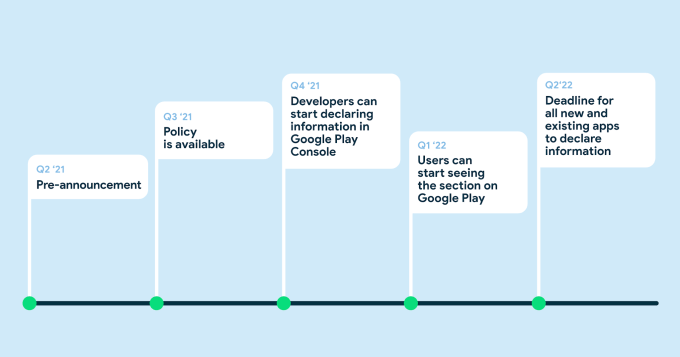
Image Credits: Google

There is, of course, a lot of irony to be found in an app privacy announcement from Google.

The company was one of the longest holdouts on issuing privacy labels for its own iOS apps, as it scrambled to review (and re-review, we understand) the labels’ content and disclosures. After initially claiming its labels would roll out “soon,” many of Google’s top apps then entered a lengthy period where they received no updates at all, as they were no longer compliant with App Store policies.

It took Google months after the deadline had passed to provide labels for its top apps. And when it did, it was mocked by critics — like privacy-focused search engine DuckDuckGo — for how much data apps like Chrome and the Google app collect.

Google’s plan to add a safety section of its own to Google Play gives it a chance to shift the narrative a bit.

It’s not a privacy push, necessarily. They’re not even called privacy labels! Instead, the changes seem designed to allow app developers to better explain if you can trust their app with your data, rather than setting the expectation that the app should not be collecting data in the first place.

How well this will resonate with consumers remains to be seen. Apple has made a solid case that it’s a company that compares about user privacy, and is adding features that put users in control of their data. It’s a hard argument to fight back against — especially in an era that’s seen too many data breaches to count, careless handling of private data by tech giants, widespread government spying, and a creepy adtech industry that grew to feel entitled to user data collection without disclosure.

Google says when the changes roll out, non-compliant apps will be required to fix their violations or become subject to policy enforcement. It hasn’t yet detailed how that process will be handled, or whether it will pause app updates for apps in violation.

The company noted its own apps would be required to share this same information and a privacy policy, too.


 

06 May 2021

Shauntel Garvey of Reach Capital will join us to judge this year’s Startup Battlefield

TechCrunch’s Startup Battlefield is one of the most popular parts of our annual TechCrunch Disrupt conference which is happening on September 21-23 this year. Now we’re very excited to reveal one of the fine people who will be judging Startup Battlefield at this year’s all-virtual event in September: Shauntel Garvey, a general partner at Reach Capital, a VC specializing in the world of education technology.

Startup Battlefield sees startups applying far and wide for a chance to pitch their ideas to a panel, and to all of us in the audience, giving the finalists a lot of exposure and a shot at winning the grand prize of $50,000. Startups: You can apply to be a part of the action here.

Edtech has seen a huge surge of interest in the last year of pandemic living, and that’s led to a pretty notable rise in education startups, more funding for education technology and a lot more attention paid to voices in edtech.

That’s because not only is edtech of huge importance to society and our economy, but those in the field have picked up a lot of learnings that apply well outside of edtech.

They know firsthand about engagement and how to get it; connecting with larger ecosystems of stakeholders; learning to work with public and private bodies; and the ins and outs of tapping into the latest innovations in areas like streaming, artificial intelligence and graphics to get the most out of a concept.

All of this makes Garvey a great person to have as a judge, someone with specific-area knowledge but very aware of how it relates to the wider challenges and opportunities in tech.

Garvey is a co-founder and general partner at Reach Capital, a Silicon Valley VC focused on the wider opportunity within the educational spectrum, backing the likes of ClassDojo, Springboard, Outschool, Handshake, Winnie and many more. Garvey herself currently sits on the boards of Riipen, FourthRev, Holberton School and Ellevation Education.

Her experience in edtech extends back years. Before Reach, she was a partner at the NewSchools Seed Fund and she has invested in more than 40 early-stage edtech companies, including Newsela, Nearpod and SchoolMint. She is also not all about edtech: Before turning to education and startups, Garvey trained and worked as a chemical engineer. We’re really looking forward to her input as a Startup Battlefield judge.

If you haven’t gotten your tickets yet, TechCrunch Disrupt is coming up around the corner, September 21-23. This will be our second year of having the conference in an all-virtual format, and we have a lot of great speakers, networking opportunities and other things planned — free of physical constraints, we can fly! — and we really hope you’ll join us.

06 May 2021

Google reveals a slate of Chromebook docks as it pushes to appeal to enterprise users

Chromebooks have been having banner quarter after banner quarter for the past year. While PC and tablet sales in general have been doing well as people shifted to remote working and learning, Google’s operating system has been leading the charge, in terms of the growth. That’s due in large part to the company’s wins in education.

With an extremely solid foothold in that category, Google is pushing to make a big play in enterprise — a category traditionally dominated by Microsoft (and, to a lesser degree, Apple). Today the company is announcing the launch of a new series of docks as part of the Works With Chromebook certification program it launched last year.

Launch partners including Targus, Belkin, Acer and Hyper. The hope is pretty clear: making the traditionally limited hardware more capable for a work setting. There are two different types of docks — one designed for remote working and the other for office/enterprise. Per Google:

Employees can benefit from two types of docks: larger docks capable of extending up to 3 external displays via HDMI, DP or USB-C, and smaller docks that extend to one external HDMI display for those in need of a more compact, travel-friendly docking solution.

More details are forthcoming from the third parties, which will be releasing the devices “in the coming months.” The Hyper system (pictured at top of the post), for instance, launches in August for $240, which put it around as much as some Chromebooks.

Among the upshots are the fact that these will also be compatible with PCs and Macs, to some degree — an upshot for enterprise buyers.


06 May 2021

AI is ready to take on a massive healthcare challenge

Which disease results in the highest total economic burden per annum? If you guessed diabetes, cancer, heart disease or even obesity, you guessed wrong. Reaching a mammoth financial burden of $966 billion in 2019, the cost of rare diseases far outpaced diabetes ($327 billion), cancer ($174 billion), heart disease ($214 billion) and other chronic diseases.

Cognitive intelligence, or cognitive computing solutions, blend artificial intelligence technologies like neural networks, machine learning, and natural language processing, and are able to mimic human intelligence.

It’s not surprising that rare diseases didn’t come to mind. By definition, a rare disease affects fewer than 200,000 people. However, collectively, there are thousands of rare diseases and those affect around 400 million people worldwide. About half of rare disease patients are children, and the typical patient, young or old, weather a diagnostic odyssey lasting five years or more during which they undergo countless tests and see numerous specialists before ultimately receiving a diagnosis.

No longer a moonshot challenge

Shortening that diagnostic odyssey and reducing the associated costs was, until recently, a moonshot challenge, but is now within reach. About 80% of rare diseases are genetic, and technology and AI advances are combining to make genetic testing widely accessible.

Whole-genome sequencing, an advanced genetic test that allows us to examine the entire human DNA, now costs under $1,000, and market leader Illumina is targeting a $100 genome in the near future.

The remaining challenge is interpreting that data in the context of human health, which is not a trivial challenge. The typical human contains 5 million unique genetic variants and of those we need to identify a single disease-causing variant. Recent advances in cognitive AI allow us to interrogate a person’s whole genome sequence and identify disease-causing mechanisms automatically, augmenting human capacity.

A shift from narrow to cognitive AI

The path to a broadly usable AI solution required a paradigm shift from narrow to broader machine learning models. Scientists interpreting genomic data review thousands of data points, collected from different sources, in different formats.

An analysis of a human genome can take as long as eight hours, and there are only a few thousand qualified scientists worldwide. When we reach the $100 genome, analysts are expecting 50 million-60 million people will have their DNA sequenced every year. How will we analyze the data generated in the context of their health? That’s where cognitive intelligence comes in.

06 May 2021

Less than 24 hours to save $100 to TC Sessions: Mobility 2021

Calling all frazzled procrastinators, feet-draggers, lollygaggers and last-minute decision makers. The best price on passes to TC Sessions: Mobility 2021, which takes place on June 9, disappears in mere hours.

It’s now o’clock, baby. Shift your EV into gear, hail a robotaxi or tell Mr. Scott to beam you up — whatever it takes to buy your pass before the early bird deadline expires tonight, May 6, at 11:59 pm (PT).

TC Sessions: Mobility 2021 gathers the very best people in the mobility startup ecosystem to discuss the rapidly evolving trends, opportunities and challenges that come from inventing new ways to move populations — and all their stuff — around the planet and beyond.

This one-day deep dive will help you drive your startup forward, understand emerging trends and gain insight on what investors want and where they’re placing bets. Engage in hyper-focused networking and discover opportunities anywhere in the world.

We have a great line up, and here are just a few examples of the interviews, inter-active panel discussions and breakout sessions waiting for you. Don’t forget to check out the event agenda here.

Mobility’s Robotic Future: Automotive manufacturers are looking to robotics as the future of mobility, from manufacturing to autonomy and beyond. We’ll be speaking with James Kuffner, CEO, Toyota Research Institute – Advanced Development, the head of robotics initiatives at one of the world’s largest automakers, to find out how the technology is set to transform the industry.

The Rise of Robotaxis in China: Silicon Valley has long been viewed as a hub for autonomous vehicle development. But another country is also leading the charge. Executives from three leading Chinese robotaxi companies (that also have operations in Europe or the U.S.) will join us to provide insight into the unique challenges of developing and deploying the technology in China and how it compares to other countries.

Will Venture Capital Drive the Future of Mobility? Clara Brenner (Urban Innovation Fund), Quin Garcia (Autotech Ventures) and Rachel Holt (Construct Capital) will discuss how the pandemic changed their investment strategies, the hottest sectors within the mobility industry, the rise of SPACs as a financial instrument and where they plan to put their capital in 2021 and beyond.

What are you waiting for? It’s now o’clock and time to save $100 — but only if you purchase your pass to Mobility 2021 before the price increase goes into effect tonight, May 6 at 11:59 pm (PT). Let the learning, networking and scaling begin!

Is your company interested in sponsoring or exhibiting at TC Sessions: Mobility 2021? Contact our sponsorship sales team by filling out this form.