Year: 2021

06 May 2021

BigBrain aims to bring live mobile trivia back to glory

If you ask Nik Bonaddio why he wanted to build a new mobile trivia app, his answer is simple.

“In my life, I’ve got very few true passions: I love trivia and I love sports,” Bonaddio told me. “I’ve already started a sports company, so I’ve got to start a trivia company.”

He isn’t kidding about either part of the equation. Bonaddio actually won $100,000 on “Who Wants To Be A Millionaire?”, which he used to start the sports analytics company numberFire (acquired by FanDuel in 2014).

And today, after a period of beta testing, Bonaddio is launching BigBrain. He’s also announcing that the startup has raised $4.5 million in seed funding from FirstRound Capital, Box Group, Ludlow Ventures, Golden Ventures and others.

Of course, you can’t mention mobile trivia without thinking of HQ Trivia, the trivia app that shut down last year after some high-profile drama and a spectacular final episode.

BigBrain

Image Credits: BigBrain

But Bonaddio said BigBrain is approaching things differently than HQ in a few key ways. For starters, although there will be a handful of free games, the majority will require users to pay to enter, with the cash rewards coming from the entry fees. (From a legal perspective, Bonaddio said this is distinct from gambling because trivia is recognized as a game of skill.)

“The free-to-play model doesn’t really work for trivia,” he argued.

In addition, there will be no live video with a live host — Bonaddio said this would “very, very difficult from a technical perspective and very cost ineffective.” Instead, he claimed the company has found a middle ground: “We have photos, we have different interactive elements, it’s not just a straight multiple choice quiz. We do try to keep it interactive.”

Plus, the simpler production means that where HQ was only hosting two quizzes a day, BigBrain will be hosting 20, with quizzes every 15 minutes at peak times.

Topics will range from old school hip hop to college football to ’90s movies, and Bonaddio said different quizzes will have different prize structures — some might be winner take all, while others might award prizes to the top 50% of participants. The average quiz will cost $2 to $3 to enter, but prices will range from free to “$20 or even $50.”

What kind of quiz might cost that much money to enter? As an example, Bonaddio said that in a survey of potential users, he found, “There are no casual ‘Rick and Morty’ fans … They’re almost completely price sensitive, and since they’ve seen every episode, they can’t fathom a world where someone knows more about ‘Rick and Morty’ than they do.”

06 May 2021

Freemium isn’t a trend — it’s the future of SaaS

As the COVID-19 lockdowns cascaded around the world last spring, companies large and small saw demand slow to a halt seemingly overnight. Enterprises weren’t comfortable making big, long-term commitments when they had no clue what the future would hold.

Innovative SaaS companies responded quickly by making their products available for free or at a steep discount to boost demand.

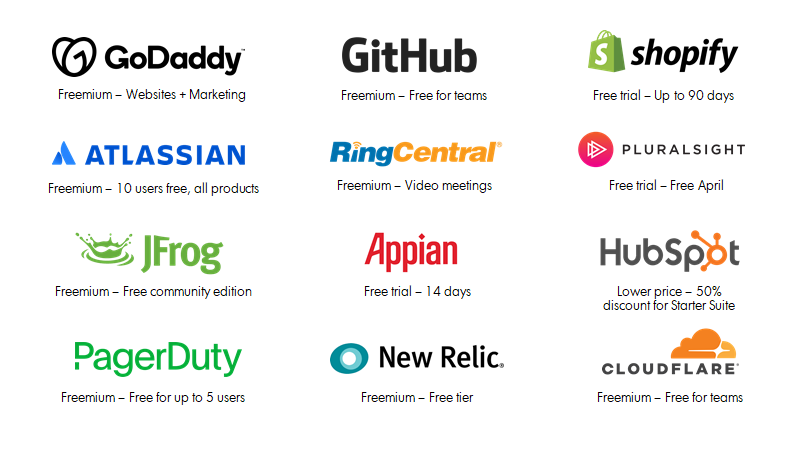
While Zoom gets all the attention, there were hundreds of free SaaS tools to help folks through the pandemic. Pluralsight ran a #FreeApril campaign, offering free access to its platform for all of April. Cloudflare made its Teams product free from March until September 1, 2020. GitHub went free for teams in April and slashed the price of its paid Team plan.

A selection of new free, free trial and low-priced offerings from leading SaaS companies. Image Credits: Kyle Poyar/OpenView.

The free products were aimed squarely at end users — whether it be a developer, individual marketer, sales rep or someone else at the edge of an organization. These end users were stuck at home during the pandemic, yet they desperately needed software to power their working lives.

End users prefer to do the vast majority of their research online before ever talking to a sales rep, making free products the ideal way to reach them.

End users prefer to do the vast majority of their research online before ever talking to a sales rep, making free products the ideal way to reach them. Many end users want to jump straight into a product, no hassle or credit card or budget approval required.

After they’ve set up an account and customized it for their workflow, end users have essentially already made a purchase decision with their time — all without ever feeling like they were in an active buying cycle.

An end user-focused free offering became an essential SaaS survival strategy in 2020.

But these free offerings didn’t go away as lockdowns loosened up. SaaS companies instead doubled down on freemium because they realized that doing so had a real and positive impact on their business. In doing so, they busted the outdated myths that have held 82% of SaaS companies back from offering their own free plan.

Myth: A free offering will cannibalize paying customers

GoDaddy is a digital behemoth, known for being a ’90s-era pioneer in web domains as well as for their controversial Super Bowl ads. The company has steadily diversified into business software, now generating roughly $700 million in ARR from its business applications segment and reaching millions of paying customers. There are very few businesses that would see greater potential revenue cannibalization from launching a free product than GoDaddy.

But GoDaddy didn’t let fear stop them from testing freemium when lockdowns set in. Freemium started out as a small-scale experiment in spring 2020 for the websites and marketing product. GoDaddy has since increased the experiment to 50% of U.S. website traffic, with plans to scale to 100% of U.S. traffic and open availability to other markets in 2021.

06 May 2021

Metafy adds $5.5M to its seed round as the market for games coaching grows

This morning Metafy, a distributed startup building a marketplace to match gamers with instructors, announced that it has closed an additional $5.5 million to its $3.15 million seed round. Call it a seed-2, seed-extension or merely a baby Series A; Forerunner Ventures, DCM and Seven Seven Six led the round as a trio.

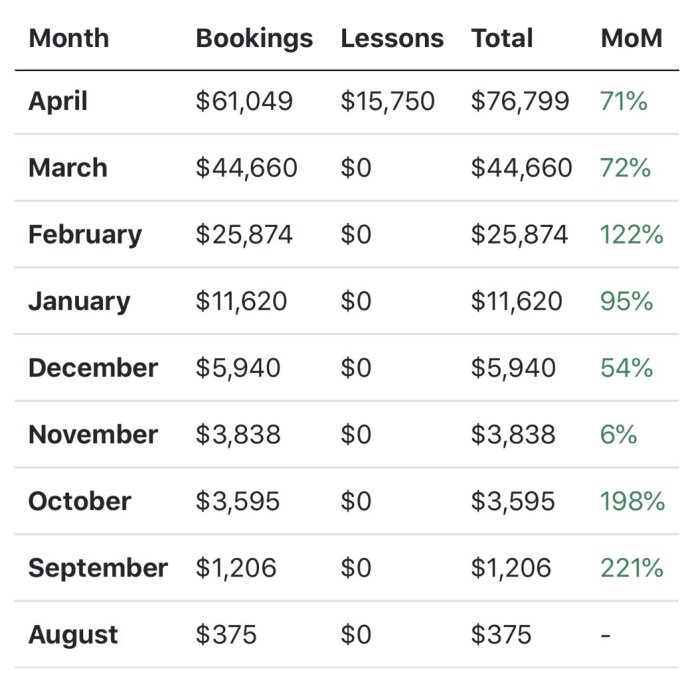
Metafy’s model is catching on with its market. According to its CEO Josh Fabian, the company has grown from incorporation to gross merchandise volume (GMV) of $76,000 in around nine months. That’s quick.

The startup is building in public, so we have its raw data to share. Via Fabian, here’s how Metafy has grown since its birth:

From the company. As a small tip, if you want the media to care about your startup’s growth rate, share like this!

When TechCrunch first caught wind of Metafy via prior seed investor M25, we presumed that it was a marketplace that was built to allow esports pros and other highly capable gamers teach esports-hopefuls get better at their chosen title. That’s not the case.

Don’t think of Metafy as a marketplace where you can hire a former professional League of Legends player to help improve your laning-phase AD carry mechanics. Though that might come in time. Today a full 0% of the company’s current GMV comes from esports titles. Instead, the company is pursuing games with strong niche followings, what Fabian described as “vibrant, loyal communities.” Like Super Smash Brothers, its leading game today in terms of GMV generated.

Why pursue those titles instead of the most competitive games? Metafy’s CEO explained that his startup has a particular take on its market — that it focuses on coaches as its core customer, over trainees. This allows the startup to focus on its mission of making coaching a full-time gig, or at least one that pays well enough to matter. By doing so, Metafy has cut its need for marketing spend, because the coaches that it onboards bring their own audience. This is where the company is targeting games with super-dedicated user bases, like Smash. They fit well into its build for coaches, onboard coaches, coaches bring their fans, GMV is generated model.

Metafy has big plans, which brings us back to its recent raise. Fabian told TechCrunch any game with a skill curve could wind up on Metafy. Think chess, poker or other games that can be played digitally. To build toward that future, Metafy decided to take on more capital so that it could grow its team.

So what does its $5.5 million unlock for the startup? Per its CEO, Metafy is currently a team of 18 with a monthly burn rate of around $80,000. He wants it to grow to 30 folks, with nearly all of its new hires going into its product org, broadly.

TechCrunch’s perspective is that gaming is not becoming mainstream, but that it has already done so. Building for the gaming world, then, makes good sense, as tools like Metafy won’t suffer from the same boom/bust cycles that can plague game developers. Especially as the startup becomes more diversified in its title base.

Normally we’d close by noting that we’ll get back in touch with the company in a few quarters to see how it’s getting on in growth terms. But because it’s sharing that data publicly, we’ll simply keep reading. More when we have a few months’ more data to chew on.

06 May 2021

TikTok’s new developer tools allow apps to offer ‘Login with TikTok,’ sound sharing, and more

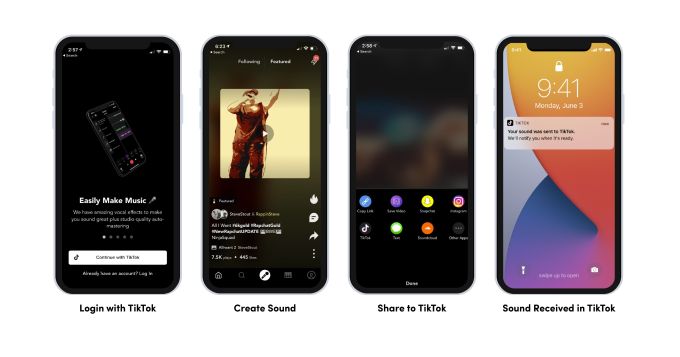
TikTok is expanding its integrations with third-party apps. The company today announced the launch of two new tool sets for app developers, the TikTok Login Kit and Sound Kit, that will allow apps on mobile, web and consoles to authenticate users via their TikTok credentials, build experiences that leverage users’ TikTok videos and share music and sounds back to TikTok from their own apps.

The company already offers tools that allow app developers to share content, including both pictures and videos, back to TikTok. But the new kits — or, SDKs (software development kits) — expand upon that functionality to make TikTok not just a destination for sharing, but a more deeply integrated part of the third-party app experience.

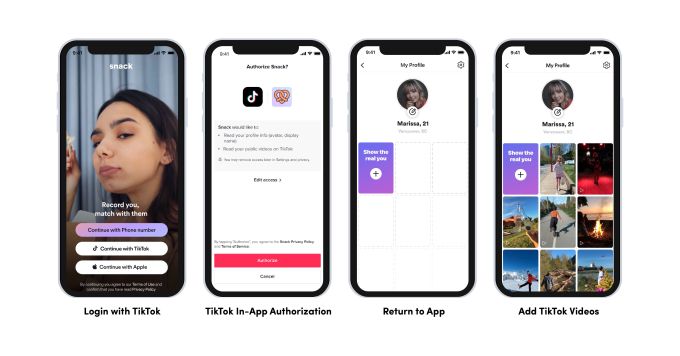
For starters, the new Login Kit allows an app’s users to sign in quickly using their TikTok log-in credentials, similar to other social log-ins offered by Facebook or Snap. Once signed in, users can then access their TikTok videos in the third-party app, potentially fueling entire new app ecosystems with TikTok content.

Image Credits: TikTok

For example, a video dating app called Snack is using the Login Kit to allow users to share their TikTok videos on their dating profiles to help them find new matches. The game recording app Medal will allow users to share their TikTok videos with their fellow gamers. And Singapore-based Burpple lets users share their food and dining reviews with a community.

Other early adopters of the Login Kit include gaming clips app Allstar, anti-anxiety app Breathwrk, social app IRL, as well as dating and friend-making apps Lolly, MeetMe, Monet, Swipehouse and EME Hive. Creator tool provider Streamlabs is also using Login Kit, as is video game PUBG, which is only using the login functionality. A forthcoming NFT platform Neon will use Login Kit, too.

When users log in to these apps via their TikTok credentials, they’ll then be presented with an additional permissions box that asks them if the app in question can read their profile information and access their public videos, which they then have to also agree to in order to take advantage of the additional video sharing options inside the app itself.

For the time being, these are the only permissions that Login Kit asks for — and it doesn’t give the app access to further information, like who the TikTok user’s friends are, for example. If TikTok expands beyond these permissions in the future, it says it will be transparent with users about any changes or new additions. For the time being, however, the focus is more on allowing apps to better integrate TikTok content into their own experiences.

Image Credits: TikTok/Rapchat

The other new SDK launching today is the Sound Kit, which allows artists and creators to bring their original sounds and music from a third-party app into TikTok. This kit, which also requires Login Kit to work, will help TikTok seed its sounds database with more original content it doesn’t have to license from major labels. Instead, whatever licensing rights to the music and other sounds that exist within the original app will still apply to whatever is shared out to TikTok. But by sharing the music more broadly, creators can gain interest from potential fans and even see their sounds used as the backing for new TikTok videos.

Early adopters on this front include mobile multi-track recording studio Audiobridge, music creation and collaboration suite LANDR, hip hop music creation app Rapchat and upcoming audio recording and remix app Yourdio.

TikTok says some of the apps selected as early partners for the SDKs were those that already adopted its Share to TikTok SDK, which launched in 2019. Others, however, were chosen based on a specific set of criteria, including the ability to move quickly to integrate the new features and the strength of their specific use cases. TikTok was looking for a diversity of use cases and those that were particularly novel — like building out a dating network based on videos, for instance.

More information on the new tools and developer documentation will be added to TikTok’s developer website, but TikTok says it will be vetting and reviewing developers who request access. And as most of the current developer partners are U.S.-based, with just a few exceptions, the company says it is looking to diversify the list of companies going forward, as this is a global initiative.

“As TikTok becomes increasingly ingrained in culture, more third-party apps across a variety of categories and use cases are looking to tap into our community on their own platforms,” said Isaac Bess, TikTok’s Global Head of Distribution Partnerships, in a statement about the launch. “Through the Sound Kit and Login Kit for TikTok, we’re providing seamless integration solutions that help developers expand their reach, increase exposure for creators, and empower our community to showcase their content on other platforms,” he added.

06 May 2021

Snap to launch a new Creator Marketplace this month, initially focused on Lens Creators

Snap on Wednesday announced its plan to soon launch a Creator Marketplace, which will make it easier for businesses to find and partner with Snapchat creators, including lens creators, AR creators and later, prominent Snapchat creators known as Snap Stars. At launch, the marketplace will focus on connecting brands and AR creators for AR ads. It will then expand to support all Snap Creators by 2022.

The company had previously helped connect its creator community with advertisers through its Snapchat Storytellers program, which first launched into pilot testing in 2018 — already a late arrival to the space. However, that program’s focus was similar to Facebook’s Brand Collabs Manager, as it focused on helping businesses find Snap creators who could produce video content.

Snap’s new marketplace, meanwhile, has a broader focus in terms of connecting all sorts of creators with the Snap advertising ecosystem. This includes Lens Creators, Developers and Partners, and then later, Snap’s popular creators with public profiles.

Snap says the Creator Marketplace will open to businesses later this month to help them partner with a select group of AR Creators in Snap’s Lens Network. These creators can help businesses build AR experiences without the need for extensive creative resources, which makes access to Snap’s AR ads more accessible to businesses, including smaller businesses without in-house developer talent.

Lens creators have already found opportunity working for businesses that want to grow their Snapchat presence — even allowing some creators to quit their day jobs and just build lens for a living. Snap has been further investing in this area of its business, having announced in December a $3.5 million fund directed towards AR Lens creation. The company said at the time there were tens of thousands of Lens creators who had collectively made over 1.5 million Lenses to date.

Using Lenses has grown more popular, too, the company had noted, saying that over 180 million people interact with a Snapchat Lens every day — up from 70 million daily active users of Lenses when the Lens Explorer section first launched in the app in 2018.

Now, Snap says that over 200 million Snapchat users interact with augmented reality on a daily basis, on average, out of its 280 million daily users. The majority (over 90%) of these users are 13-25 year olds. In total, users are posting over 5 billion Snaps per day.

Snap says the Creator Marketplace will remain focused on connecting businesses with AR Lens Creators throughout 2021.

The following year, it will expand to include the community of professional creators and storytellers who understand the current trends and interests of the Snap user base and can help businesses with their ad campaigns. The company will not take a cut of the deals facilitated through the Marketplace, it says.

This would include the creators making content for Snap’s new TikTok rival, Spotlight, which launched in November 2020. Snap encouraged adoption of the feature by shelling out $1 million per day to creators of top videos. In March 2021, over 125 million Snapchat users watched Spotlight, it says.

Image Credits: Snapchat

Spotlight isn’t the only way Snap is challenging TikTok.

The company also on Wednesday announced it’s snagging two of TikTok’s biggest stars for its upcoming Snap Originals lineup: Charli and Dixie D’Amelio. The siblings, who have gained over 20 million follows on Snapchat this past year, will star in the series “Charli vs. Dixie.” Other new Originals will feature names like artist Megan Thee Stallion, actor Ryan Reynolds, twins and influencers Niki and Gabi DeMartino, and YouTube beauty vlogger Manny Mua, among others.

Snap’s shows were watched by over 400 million people in 2020, including 93% of the Gen Z population in the U.S., it noted.


06 May 2021

Valence unveils training program to help build pipeline of Black execs

Diversity has been linked with equity and inclusion because diversity is just one part of the equation when it comes to hiring Black employees. How do the companies they work for make people feel welcome and included, rather than isolated? How do Black employees find their way into management, up the corporate ladder to the C Suite and into the boardroom?

Today Valence, a startup dedicated to empowering Black professionals, announced a new program called BONDS, which is designed to help companies train, retain and promote Black employees.

Valence CEO Guy Primus says that the organization has almost 16,000 community members and recognizing that getting hired was just the first step in a long journey, the company wanted to find a more concrete way to help its members. He says that companies tend to focus too much on the hiring pipeline and don’t give enough attention to what happens after Black employees get hired.

“People want the numbers to go up, and there’s [this notion of] recruit, retain, and promote. The problem is that everyone is focussed on the recruiting pipeline, but they’re not focused on retention and promotion, which ultimately affects recruiting. So it’s an ecosystem problem, not a pipeline issue,” Primus explained.

Primus knew that the company needed to do more, and he hired Tracy Williams as vice president of learning and development to build a curriculum specifically designed to help Black professionals thrive.

Williams points out that Black professionals often find themselves isolated at companies without a lot of peers whom they can talk to. She wanted to create a program that could give people that sense of community where they could commiserate over the issues they face with people who understood their experiences.

“Where an organization may not be able to provide that sense of community for their Black professionals, we’re able to do that for them and the benefit for those corporations and organizations is that they’re able to now invest in their Black employees’ development and opportunities, while connecting with their peers on a more personal level and still being trained and developed as potential senior level leaders,” Williams told me.

She says that this also gives the company a way to hold organizations accountable when it comes to promoting Black employees into management and executive positions.

“I think we have this opportunity not only to provide the community for emerging Black executives, but also on the other side of the marketplace, create a tool of accountability for these organizations who are investing in their employees and ensuring that they are acknowledging their employees’ readiness, and recognizing and promoting them based on their leadership readiness as well,” she said.

Among the organizations participating at the launch of this program are Accel, Electrolux, GGV Capital, Norwest Venture Partners, Providence Strategic Growth, Roblox, Silicon Valley Bank and Upfront Ventures.

The program itself includes a couple of key components including a curriculum designed around three modules: leading self, leading others and leading within your organization.

“Each of the curriculum components across those three modules truly provides content and development for our members that focus on how they are able to represent themselves and navigate the nuances of being an emerging Black executive in their organization, how they’re able to amplify their leadership readiness, how they’re able to communicate more effectively in their organizations and externally as well, and the steps that they need to take in order to fully own their career development,” Williams said.

But Williams wanted to do more than provide training materials for the members, she wanted to provide support for every member of the BONDS program. So the other component of this is a cohort with 10 peers in each one led by a facilitator and a coach who lead the members in deeper discussions about the training materials.

“It’s a safe space to practice what they’ve learned in the on demand curriculum, but also dive as deep as they need to in order to feel fully ready to promote themselves within their organization,” she said.

The program is trying to address a real problem related to Black employees getting the opportunity to grow into management and executive positions. The company pointed out that while Black professionals make up 12% of entry-level corporate jobs, just short of their 13.4% representation in the U.S. population, their numbers fall to 7% of management roles, according to research conducted by McKinsey & Co.

The hope is that by providing a more concrete framework like BONDS, it can lead to closing this gap and helping more Black professionals climb the professional ladder in their organizations.

06 May 2021

How much product room will fintech giants leave for startups?

I was going to wait until after Square reported its Q1 results today to dig into the world of fintech earnings and what they might mean for startups, but something got stuck in my craw that matters more than what Jack’s team may have up its sleeve: How much space is being left in fintech when the major players are growing rapidly in categories where startups are doing their best to make a dent?

This morning, we’ll examine the buy now, pay later (BNPL) market, mostly through the lens of PayPal’s first-quarter results.


The Exchange explores startups, markets and money.

Read it every morning on Extra Crunch or get The Exchange newsletter every Saturday.


PayPal’s BNPL results are impressive — and not just to your humble servant, but to other fintech watchers as well — which begs the question: Can the platform effect that the PayPals of the world bring to bear suffocate a growing slice of the startup market?

There are obvious issues with the thought. The first being that BNPL-focused Affirm recently went public. And Affirm was, until very recently, a startup and later a unicorn. And then there’s BNPL player AfterPay, which went public a few years back, not to mention Klarna, which could go public sometime soon.

But what we’re watching is PayPal chase a handful of unicorns-and-later BNPL companies. What about the actual startups in the market? Can they hack it? Let’s dig into PayPal’s results, take a peek at what AfterPay’s own can tell us, and then we’ll noodle on the startup question. We’ll come back to all of this after Affirm reports in a few day’s time.

Platforms versus startups

The “kill-zone” concept — that startups should not get too close to what big tech companies do — has never sat well with me. Mostly because it’s not true that small companies cannot take on big ones. And because big companies have a really great history of crappifying their products into vulnerability.

A great example of the first count is Zoom, which took on a host of enterprise-ready, platform-supported video chat services and crushed them by simply being not awful. This brings us to our second point: As big tech companies need to keep finding incremental revenue adds from their existing products, they make them worse to find a marginal top line. The biggest tech shops often trade near-term economic growth for long-term market ownership.

06 May 2021

Comms expert and VC Caryn Marooney will detail how to get attention at TC Early Stage

We’re thrilled to announce Caryn Marooney is speaking at our upcoming TechCrunch Early Stage virtual event in July. She spoke with us last year and we had to have her back.

Just look at her resume. She was the co-founder and CEO of The Outcast Agency, one of Silicon Valley’s best-regarded public relations firms. She left her company to serve as VP of Global Communication at Facebook, which she did for eight years, overseeing communication for Facebook, Instagram, WhatsApp and Oculus. In 2019 she joined Coatue Management as a general partner, where she went on to invest in Startburst, Supabase, Defined Networks and others.

Needless to say, Marooney is one of the Valley’s experts on getting people’s attention — a skill that’s critical when running a startup, nonprofit or school bake sale.

She said it best last year: “People just fundamentally aren’t walking around caring about this new startup — actually, nobody does.” So how do you get people to care? That’s the trick and why we’re having her back to speak on this evergreen topic.

Watch her presentation from 2020 here. It’s fantastic.

One of the great things about TC Early Stage is that the show is designed around breakout sessions, with each speaker leading a chat around a specific startup core competency (like fundraising, designing a brand, mastering the art of PR and more). Moreover, there is plenty of time for audience Q&A in each session.

Pick up your ticket for the event, which goes down July 8 and 9, right here. And if you do it today, you’ll save a cool $100 off of your registration.


06 May 2021

Personal skin problems leads founder to launch skincare startup Nøie, raises $12M Series A

Inspired by his own problems with skin ailments, tech founder Daniel Jensen decided there had to be a better way. So, using an in-house tech platform, his Copenhagen-based startup Nøie developed its own database of skin profiles, to better care for sensitive skin.

Nøie has now raised $12m in a Series A funding round led by Talis Capital, with participation from Inventure, as well as existing investors including Thomas Ryge Mikkelsen, former CMO of Pandora, and Kristian Schrøder Hart-Hansen, former CEO of LEO Pharma’s Innovation Lab.

Nøie’s customized skincare products target sensitive skin conditions including acne, psoriasis and eczema. Using its own R&D, Nøie says it screens thousands of skincare products on the market, selects what it thinks are the best, and uses an algorithm to assign customers to their ‘skin family’. Customers then get recommendations for customized products to suit their skin.

Skin+Me is probably the best-known perceived competitor, but this is a prescription provider. Noie is non-prescription.

Jensen said: “We firmly believe that the biggest competition is the broader skincare industry and the consumer behavior that comes with it. I truly believe that in 2030 we’ll be surprised that we ever went into a store and picked up a one-size-fits-all product to combat our skincare issues, based on what has the nicest packaging or the best marketing. In a sense, any new company that emerges in this space are peers to us: we’re all working together to intrinsically change how people choose skincare products. We’re all demonstrating to people that they can now receive highly-personalized products based on their own skin’s specific needs.”

Of his own problems to find the right skincare provider, he said: “It’s just extremely difficult to find something that works. When you look at technology, online, and all our apps and everything, we got so smart in so many areas, but not when it comes to consumer skin products. I believe that in five or 10 years down the line, you’ll be laughing that we really used to just go in and pick up products just off the shelf, without knowing what we’re supposed to be using. I think everything we will be using in the bathroom will be customized.”

Beatrice Aliprandi, principal at Talis Capital, said: “For too long have both the dermatology sector and the skincare industry relied on the outdated ‘one-size-fits-all’ approach to addressing chronic skin conditions. By instead taking a data-driven and community feedback approach, Nøie is building the next generation of skincare by providing complete personalization for its customers at a massive scale, pioneering the next revolution in skincare.”

06 May 2021

Lightmatter’s photonic AI ambitions light up an $80M B round

AI is fundamental to many products and services today, but its hunger for data and computing cycles is bottomless. Lightmatter plans to leapfrog Moore’s law with its ultra-fast photonic chips specialized for AI work, and with a new $80M round the company is poised to take its light-powered computing to market.

We first covered Lightmatter in 2018, when the founders were fresh out of MIT and had raised $11M to prove that their idea of photonic computing was as valuable as they claimed. They spent the next three years and change building and refining the tech — and running into all the hurdles that hardware startups and technical founders tend to find.

For a full breakdown of what the company’s tech does, read that feature — the essentials haven’t changed.

In a nutshell, Lightmatter’s chips perform certain complex calculations fundamental to machine learning in a flash — literally. Instead of using charge, logic gates, and transistors to record and manipulate data, the chips use photonic circuits that perform the calculations by manipulating the path of light. It’s been possible for years, but until recently getting it to work at scale, and for a practical, indeed a highly valuable purpose has not.

Prototype to product

It wasn’t entirely clear in 2018 when Lightmatter was getting off the ground whether this tech would be something they could sell to replace more traditional compute clusters like the thousands of custom units companies like Google and Amazon use to train their AIs.

“We knew in principle the tech should be great, but there were a lot of details we needed to figure out,” CEO and co-founder Nick Harris told TechCrunch in an interview. “Lots of hard theoretical computer science and chip design challenges we needed to overcome… and COVID was a beast.”

With suppliers out of commission and many in the industry pausing partnerships, delaying projects, and other things, the pandemic put Lightmatter months behind schedule, but they came out the other side stronger. Harris said that the challenges of building a chip company from the ground up were substantial, if not unexpected.

A rack of Lightmatter servers.

Image Credits: Lightmatter

“In general what we’re doing is pretty crazy,” he admitted. “We’re building computers from nothing. We design the chip, the chip package, the card the chip package sits on, the system the cards go in, and the software that runs on it…. we’ve had to build a company that straddles all this expertise.”

That company has grown from its handful of founders to more than 70 employees in Mountain View and Boston, and the growth will continue as it brings its new product to market.

Where a few years ago Lightmatter’s product was more of a well-informed twinkle in the eye, now it has taken a more solid form in the Envise, which they call a ‘general purpose photonic AI accelerator.” It’s a server unit designed to fit into normal datacenter racks but equipped with multiple photonic computing units, which can perform neural network inference processes at mind-boggling speeds. (It’s limited to certain types of calculations, namely linear algebra for now, and not complex logic, but this type of math happens to be a major component of machine learning processes.)

Harris was reticent to provide exact numbers on performance improvements, but more because those improvements are increasing than that they’re not impressive enough. The website suggests it’s 5x faster than an NVIDIA A100 unit on a large transformer model like BERT, while using about 15 percent of the energy. That makes the platform doubly attractive to deep-pocketed AI giants like Google and Amazon, which constantly require both more computing power and who pay through the nose for the energy required to use it. Either better performance or lower energy cost would be great — both together is irresistible.

It’s Lightmatter’s initial plan to test these units with its most likely customers by the end of 2021, refining it and bringing it up to production levels so it can be sold widely. But Harris emphasized this was essentially the Model T of their new approach.

“If we’re right, we just invented the next transistor,” he said, and for the purposes of large-scale computing, the claim is not without merit. You’re not going to have a miniature photonic computer in your hand any time soon, but in datacenters, where as much as 10 percent of the world’s power is predicted to go by 2030, “they really have unlimited appetite.”

The color of math
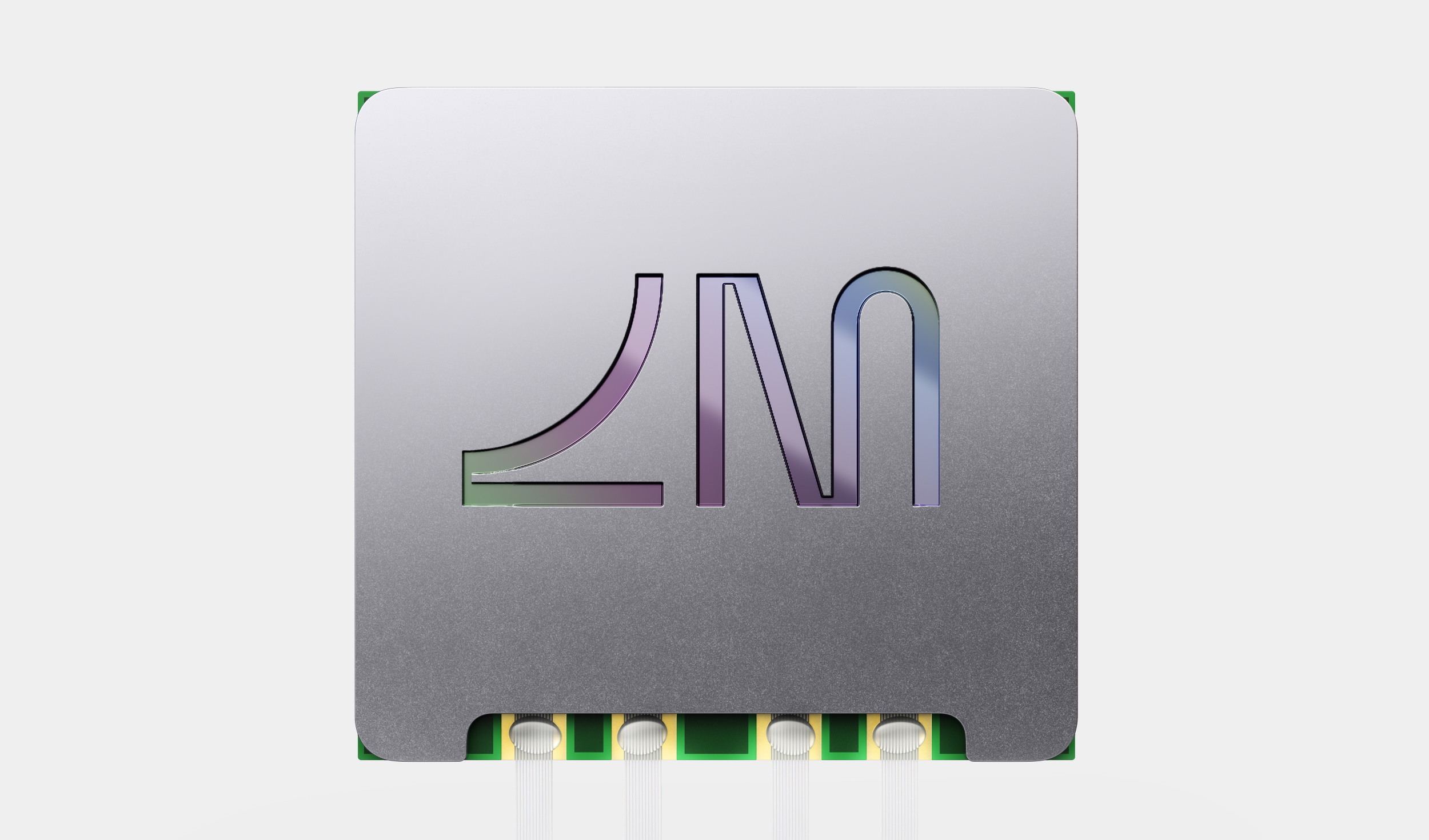
A Lightmatter chip with its logo on the side.

Image Credits: Lightmatter

There are two main ways by which Lightmatter plans to improve the capabilities of its photonic computers. The first, and most insane sounding, is processing in different colors.

It’s not so wild when you think about how these computers actually work. Transistors, which have been at the heart of computing for decades, use electricity to perform logic operations, opening and closing gates and so on. At a macro scale you can have different frequencies of electricity that can be manipulated like waveforms, but at this smaller scale it doesn’t work like that. You just have one form of currency, electrons, and gates are either open or closed.

In Lightmatter’s devices, however, light passes through waveguides that perform the calculations as it goes, simplifying (in some ways) and speeding up the process. And light, as we all learned in science class, comes in a variety of wavelengths — all of which can be used independently and simultaneously on the same hardware.

The same optical magic that lets a signal sent from a blue laser be processed at the speed of light works for a red or a green laser with minimal modification. And if the light waves don’t interfere with one another, they can travel through the same optical components at the same time without losing any coherence.

That means that if a Lightmatter chip can do, say, a million calculations a second using a red laser source, adding another color doubles that to two million, adding another makes three — with very little in the way of modification needed. The chief obstacle is getting lasers that are up to the task, Harris said. Being able to take roughly the same hardware and near-instantly double, triple, or 20x the performance makes for a nice roadmap.

It also leads to the second challenge the company is working on clearing away, namely interconnect. Any supercomputer is composed of many small individual computers, thousands and thousands of them, working in perfect synchrony. In order for them to do so, they need to communicate constantly to make sure each core knows what other cores are doing, and otherwise coordinate the immensely complex computing problems supercomputing is designed to take on. (Intel talks about this “concurrency” problem building an exa-scale supercomputer here.)

“One of the things we’ve learned along the way is, how do you get these chips to talk to each other when they get to the point where they’re so fast that they’re just sitting there waiting most of the time?” said Harris. The Lightmatter chips are doing work so quickly that they can’t rely on traditional computing cores to coordinate between them.

A photonic problem, it seems, requires a photonic solution: a wafer-scale interconnect board that uses waveguides instead of fiber optics to transfer data between the different cores. Fiber connections aren’t exactly slow, of course, but they aren’t infinitely fast, and the fibers themselves are actually fairly bulky at the scales chips are designed, limiting the number of channels you can have between cores.

“We built the optics, the waveguides, into the chip itself; we can fit 40 waveguides into the space of a single optical fiber,” said Harris. “That means you have way more lanes operating in parallel — it gets you to absurdly high interconnect speeds.” (Chip and server fiends can find that specs here.)

The optical interconnect board is called Passage, and will be part of a future generation of its Envise products — but as with the color calculation, it’s for a future generation. 5-10x performance at a fraction of the power will have to satisfy their potential customers for the present.

Putting that $80M to work

Those customers, initially the “hyper-scale” data handlers that already own datacenters and supercomputers that they’re maxing out, will be getting the first test chips later this year. That’s where the B round is primarily going, Harris said: “We’re funding our early access program.”

That means both building hardware to ship (very expensive per unit before economies of scale kick in, not to mention the present difficulties with suppliers) and building the go-to-market team. Servicing, support, and the immense amount of software that goes along with something like this — there’s a lot of hiring going on.

The round itself was led by Viking Global Investors, with participation from HP Enterprise, Lockheed Martin, SIP Global Partners, and previous investors GV, Matrix Partners and Spark Capital. It brings their total raised to about $113 million; There was the initial $11M A round, then GV hopping on with a $22M A-1, then this $80M.

Although there are other companies pursuing photonic computing and its potential applications in neural networks especially, Harris didn’t seem to feel that they were nipping at Lightmatter’s heels. Few if any seem close to shipping a product, and at any rate this is a market that is in the middle of its hockey stick moment. He pointed to an OpenAI study indicating that the demand for AI-related computing is increasing far faster than existing technology can provide it, except with ever larger datacenters.

The next decade will bring economic and political pressure to rein in that power consumption, just as we’ve seen with the cryptocurrency world, and Lightmatter is poised and ready to provide an efficient, powerful alternative to the usual GPU-based fare.

As Harris suggested hopefully earlier, what his company has made is potentially transformative in the industry and if so there’s no hurry — if there’s a gold rush, they’ve already staked their claim.