Year: 2021

06 May 2021

Look out PiedPiper – iSIZE reduces power for video streaming, raises $6.3M in round led by Octopus

It’s widely known that video streaming boomed during the pandemic, as millions of people were faced by boredom during lockdowns. But an unintended consequence of this was the growing environmental impact of millions of video streams which meant server farms needing to draw increasing amounts of power from the grid. Indeed, there were even calls for people to cycle down to Standard Definition, as HD streaming has a greater impact. But it turns out that if you optimize the video, you can reduce the bitrate required, reducing the data and energy needed.

Oddly enough this is also the pitch of the famed satirical show, Silicon Valley, where fictional startup PiedPiper invents a new creates an app that contains a revolutionary data compression algorithm for video.

But this scenario may about to become fact.

iSIZE, UK startup which applies deep learning to optimize video streaming and delivery, has $6.3 million in a funding round led by Octopus Ventures, with participation from existing investors including TD Veen and Patrick Pichette, Chairman of Twitter and ex-CFO of Google. The company has now raised a total of $8.2 million.

iSIZE’s BitSave technology optimizes video streaming quality while reducing bitrate requirements, “allowing for a significant reduction in data and energy consumption”.

This is trained to ‘see with the human eye’ in order to n=make the video still look high quality, but reduce the bitrate needed. It integrates with all video encoding standards (including AVC, HEVC, and AV1) without needing changes to the streaming process. In other words, the links of Netflix, etc would, says the company, be able to install the iSize solution relatively easily.

Founded by Sergio Grce and Dr. Yiannis Andreopoulos, the team combines R&D in machine learning, neural networks, and video signal processing, and is a graduate of the Creative Destruction Lab Oxford 2019-2020 program.

Sergio Grce, Founder and CEO of iSIZE, commented: “Today there are more people streaming more video than ever before. Our customers recognize both the commercial opportunity and their social responsibility to optimize their video delivery pipelines with our pioneering technology.”

On a call to me, he added: “The processing optimizes for human perception and tries to reverse engineer human perception of the receiver in a manner similar to psycho visual perception. So that saves bitrate and the content looks the same or better on the client device. We are doing something similar for video as what the MP3 did for music.”

Simon King, Partner and deep tech investor at Octopus Ventures, said: “The technology iSIZE has created is pioneering and is already being used by some of the world’s largest companies to reduce the costs and energy used in streaming. Consumer demand for high-quality video is only going to increase as our devices are upgraded, so it’s vital that we find new ways to reduce the environmental impact.”

iSIZE’s competitors include Wave 1 and Deep Render.

Meanwhile, let’s remind ourselves of how good PiedPiper was at video compression.

06 May 2021

Payments, lending and neobanks rule fintechs in emerging markets, report says

Tech investments in emerging markets have been in full swing over the past couple of years and their ecosystems have thrived as a result. Some of these markets like Africa, Latin America, and India, have comprehensive reports by publications and firms on trends and investments in their individual regions. But there’s hardly a report to compare and contrast trends and investments between these regions and rightfully so. Such a task is Herculean.

Well, a report released today by data research organization Briter Bridges and global inclusive tech accelerator Catalyst Fund is punching above its weight to offer a holistic representation to the darling sector of these three markets: fintech.

The report “State of Fintech in Emerging Markets Report” has three objectives — to evaluate the investment, product, and inclusivity trends across emerging markets.

The team surveyed over 177 startups and 33 investors across Africa, Latin America, and India. Though this sample size used is minuscule, the key findings are quite impressive.

Let’s dive in.

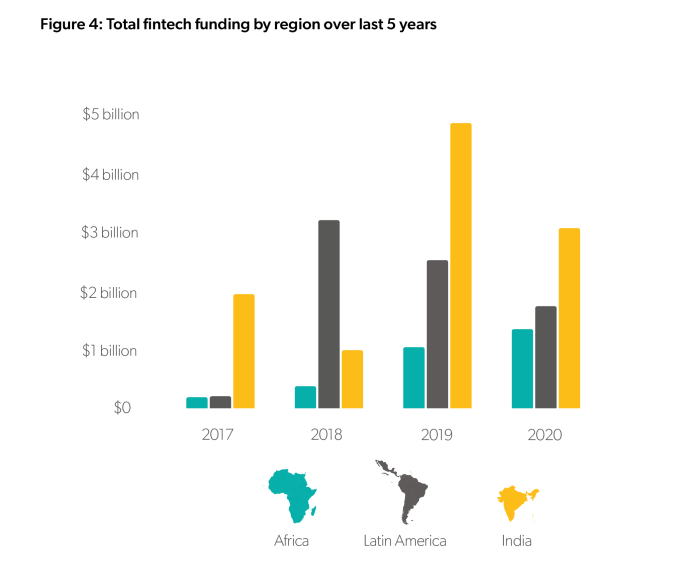
Fintechs have raised $23B across the regions since 2017

There’s no stopping emerging markets’ favorite. The sector has continued to receive the largest share of investments year-on-year for the past five years.

More than 300 million unbanked African adults account for 17% of the world’s unbanked population. So it’s not difficult to see why in 2019, the continent witnessed five mega deals in Branch, Tala, World Remit, Interswitch, and OPay that amounted to a total of over $775 million. While this dropped last year to $362 million, companies like Flutterwave, TymeBank, Kuda have raised sizeable rounds during this period.
fintech funding five years emerging markets

Image Credits: Briter Bridges & Catalyst Fund

Latin America is home to a growing base of digital users, enabling regulation and reforms, and vibrant small businesses. And just like Africa, the percentage of unbanked people is high, 70%. Fintechs in the region have taken the opportunity to cater to their needs and have been compensated with mega-rounds, including NuBank, Neon, Konfio, and Clip. Collectively, fintech startups have raised $10 billion in the past five years.

In 2019 alone, Indian fintech startups raised a record of $4.8 billion, per the report. Then last year, the sector brought in $3 billion. Over the past five years, they have totaled $11.6 billion with notable names like CRED, Razorpay, Groww, BharatPe, among others.

Africa’s average seed rounds stand at $1M, India and Latin America average $3M

Per the report, early-stage deals have been increasing over the past five years totaling over $1.6 billion. Their average size, especially for seed rounds, has grown from $750,000 in 2017 to $1 million in 2020. For  Latin America, the average seed deal in the last five years was around $5.7 million while India did approximately $4.6 million. The report says the data for the latter was skewed because of CRED’s $30 million seed round.
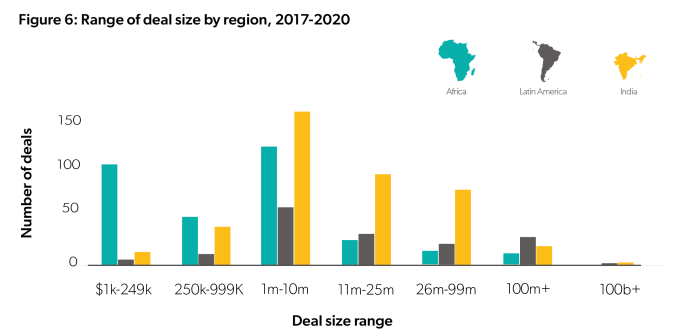
Image Credits: Briter Bridges & Catalyst Fund

Latin America is IPO-hungry, India breeds unicorns while Africa is just getting started with M&A

Last year, Stripe’s acquisition of Paystack was the highlight of Africa’s M&As because of its size and the homegrown status of the Nigerian fintech startup. Other larger rounds include the $500 million acquisition of Wave by WorldRemit (which happens to be the largest from the continent) and the DPO Group buyout by Network International for $288 million.

Unlike the African fintech market that has noticed mega acquisition deals and many undisclosed seven-figure deals, the Latin American fintech market is a sucker for IPOs. Per the report, fintechs in the region have several $100 million rounds (Nubank, PagSeguro,  Creditas, BancoInter and Neon) but have sparse M&A activity. Some of the startups to have gone public recently include Arco Educacao, Stone Pagamentos, Mosaico, and Pagseguro

On the other, India has more than 25 billion-dollar companies and keeps adding yearly. Just last month, the country recorded more than eight. These unicorns include established companies like PayTm and new ones like CRED.

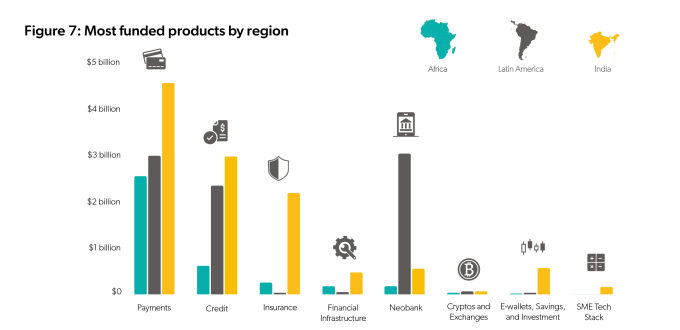
Payments, credit, and neobanks lead fintech activity

The report shows that payments companies are the crème de la crème for fintech investment across the three regions. Within that subset, B2B payments reign supreme. The next two funded fintech categories are credit and digital banking.

In Africa, payments startups have seen more investments than credit and neobanks. Flutterwave, Chipper Cash, Wave, Paystack, DPO come to mind.
most funded fintech categories emerging market

Image Credits: Briter Bridges & Catalyst Fund

Latin America most funded fintechs are neobanks. And it is the only region with all three product categories closely funded at $2-3 billion. Some of these companies include NuBank, Creditas, and dLocal.

India’s top-funded fintech startups are in payments. But it has notable representation in credit and neobanks, some of which have raised nine-figure rounds like Niyo, Lendingkart, and InCred.

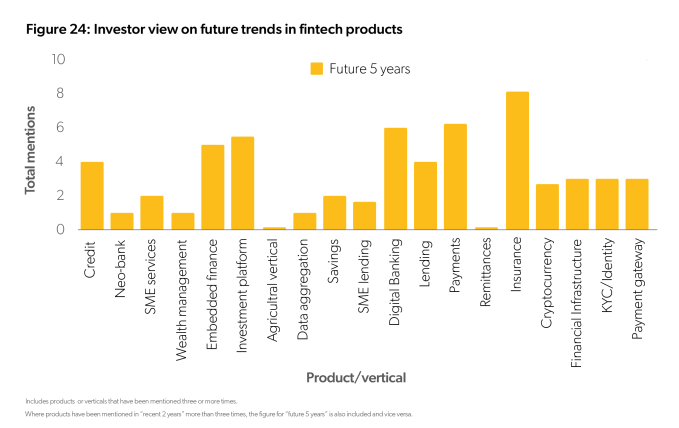
Investors are enthused about the future of insurance, payments, and digital banks

From the handful of investors surveyed in the report on their view on future trends in fintech products 5 years from now, most of them chose insurance, payments, and digital banking models.

Investment platforms and embedded models are also areas of interest. They were less keen on agriculture and remittances while wealth tech platforms and neobanks were also lower in priority. How is it that digital banking and neo-banking are at two ends of the spectrum of investor choice? I can’t say for sure.
investors appetite in the coming years emerging markets

Image Credits: Briter Bridges & Catalyst Fund

Parts of the report talk about underserved consumers in these regions and how fintech startups are serving them. It also discusses whether these fintech startups promote financial inclusion and what features and products would get them to that point.

In all of this, the glaring fact, which is no news, is that Africa is lagging years behind Latin America and India. Talking with Briter Bridges director Dario Giuliani, he pointed out that he’d lean on five years. He added that what makes India a better market at this stage is because it is a country rather than a continent.

“It is easier to manage one country than 54 countries in Africa and 20 in Latin America,” he said to TechCrunch. “In Africa, we use the label ‘Africa,’ but we’re very much talking about 4-6 countries. Latin America is basically Brazil, Mexico, Argentina and Colombia who are seeing massive companies rise. India is one.”

One key detail the report mentions is that most fintechs across emerging markets are crossing over to different sectors like crop insurance, credit lines for distributors and vendors, KYC, e-commerce payment gateways, medical finance, and insurance. Guiliani says he expects this to continue.


06 May 2021

ifeel, another well-being platform that blends self-care tools with 1-2-1 therapy, scores $6.6M

If the pandemic has been good for anything it’s been good for the therapy business and for startups targeting mental health, with VCs kept very busy signing checks. To wit, here’s another one: Madrid-based ifeel has bagged €5.5 million (~$6.6M) in Series A funding, led by Nauta Capital.

The startup was founded back in 2017 — initially as a consumer-focused therapy platform — but last year it pivoted to a hybrid business model, tapping into demand from businesses to offer staff emotional support during the public health crisis. So it’s available both to individuals via monthly subscription or as part of employer’s or insurance provider’s cover

It says that pandemic pivot has resulted in 1,000% growth in its b2b business.

Companies it’s signed up to offer its platform to their staff include AXA Partners, Glovo and Gympass.

“We have a total of 400K users on the platform (b2c and b2b),” says co-founder Amir Kaplan. “We have 100,000 eligible covered who have access to ifeel as a benefit (through our insurance and wellness partners or direct with ifeel).

“The 100K grew 10x from September 2020 and is the largest trend we are experiencing these days. Employees of 100 companies use ifeel on a weekly basis.”

ifeel’s platform delivers both live therapy sessions with licensed psychologists but also provides users with self-care tool such as daily mood trackers, recommended exercises and activities to expand the support available.

“By combining self-care and guided therapies, ifeel maximises engagement and retention of its users — with 90% reporting improved emotional and mental well-being after using ifeel,” it claims.

The startup is using AI technology in the self-care portion of its platform — to recommend “the most relevant” content or exercise to its users, per Kaplan. But he also says it’s looking at using the tech to assist the therapist practice by developing dedicated tools inside the platform.

ifeel has an international founding team, hailing from three countries (Israel, Italy and Mexico), and says its main markets so far are Spain, France, Brazil and Mexico. While its b2b and insurance network coverage extends to 20 countries and four languages (English, Spanish, French and Portuguese).

With so much competition in the mental health tools space — from mindfulness apps, to internet-delivered CBT programs, to therapy platforms — how does ifeel see itself standing out?

Kaplan suggests it has an advantage of being “global from day one”, and also flags a “strong technology integration focus” which he says has allowed it to plug into insurance companies and wellness players — to become a “main service provider”.

“Very early we partnered with global leading companies and we support them in many countries (compared to specific country players like in Germany and UK,” he tells TechCrunch. “The platform approach is different from ‘online therapy’ companies or ‘mindfulness apps’.

“We want our users to manage their emotional well being on our platform no matter the need. In this way we create millions of engagement events that are customized to the user’s needs and allow users over time to use different parts of our platform in different life situations.”

06 May 2021

TechCrunch Survey of Scottish Tech Hubs: Edinburgh, Glasgow, Dundee, Aberdeen

TechCrunch is embarking on a major new project to survey European founders and investors in cities outside the larger European capitals.

Over the next few weeks, we will ask entrepreneurs in these cities to talk about their ecosystems, in their own words.

This is your chance to put Edinburgh, Glasgow, Dundee, Aberdeen on the Techcrunch Map!.

If you are a tech startup founder or investor in one of these cities please fill out the survey form here.

We are particularly interested in hearing from women founders and investors.

This is the follow-up to the huge survey of investors (see also below) we’ve done over the last six or more months, largely in Europe’s biggest capital cities.

These formed part of a broader series of surveys we’re doing regularly for ExtraCrunch, our subscription service that unpacks key issues for startups and investors.

In the first wave of surveys, the cities we wrote about were largely capitals. You can see them listed here.

This time, we will be surveying founders and investors in Europe’s other cities to capture how European hubs are growing, from the perspective of the people on the ground.

We’d like to know how your city’s startup scene is evolving, how the tech sector is being impacted by COVID-19, and generally how your city will evolve.

We leave submissions mostly unedited and are generally looking for at least one or two paragraphs in answers to the questions.

So if you are a tech startup founder or investor in one of these cities please fill out our survey form here.

Thank you for participating. If you have questions you can email mike@techcrunch.com and/or DM on Twitter to @mikebutcher.

06 May 2021

Kahoot acquires Clever, the US-based edtech portal, for up to $500M

Kahoot, the popular Oslo-based edtech company that has built a big business out of gamifiying education and creating a platform for users to build their own learning games, is making an acquisition to double down on K-12 education and its opportunities to grow in the U.S. It is acquiring Clever, a startup that has built a single sign-on portal for educators, students and their families to build and engage in digital learning classrooms, currently used by about 65% of all U.S. K-12 schools. Kahoot said that the deal — coming in a combination of cash and shares — gives Clever an enterprise value of between $435 million and $500 million, dependent on meeting certain performance milestones.

The plan will be to continue growing Clever’s business in the U.S. — which currently employs 175 people — as well as give it a lever for expanding globally alongside Kahoot’s wider stable of edtech software and services.

“Clever and Kahoot! are two purpose-led organizations that are equally passionate about education and unleashing the potential within every learner,” said Eilert Hanoa, CEO at Kahoot, in a statement. “Through this acquisition we see considerable potential to collaborate on education innovation to better service all our users – schools, teachers, students, parents and lifelong learners – and leveraging our global scale to offer Clever’s unique platform worldwide. I’m excited to welcome Tyler and his team to the Kahoot family.”

The news came on the same day that Kahoot, which is traded in Oslo with a market cap of $4.3 billion, also announced strong Q1 results in which it also noted it has closed its acquisition of Whiteboard.fi, a provider of whiteboard tools for teachers, for an undisclosed sum.

The same tides that have been lifting Kahoot have also been playing out for Clever and other edtech companies.

The startup was originally incubated in Y Combinator and launched with a vision to be a “Twilio for education“, which in its vision was to create a unified way of being able to tap into the myriad of student sign-on systems and educational databases to make it easier for those building edtech services to scale their products, and bring on more customers (schools, teachers, students, families) to use them. As with payments, financial services in general, and telecommunications, it turns out that education is also a pretty fragmented market, and Clever wanted to figure out a way to fix the complexity and put it behind an API to make it easier for others to tap into it.

Over time it built that out also with a marketplace (application gallery in its terminology) of some 600 software providers and application developers that integrate with its SSO, which in turn becomes a way for a school or district to subsequently expand the number of edtech tools that it can use. This has been especially critical in the last year as schools have been forced to close in-person learning and go entirely virtual to help stave off the spread of the Covid-19 pandemic.

Clever has found a lot of traction for its approach both with schools, and investors. With the former, Clever says that it’s used by 89,000 schools and some 65% of K-12 school districts (13,000 overall) in the U.S., with that figure including 95 of the 100 largest school districts in the country. This works out to 20 million students logging in monthly and 5.6 billion learning sessions.

06 May 2021

Paystack expands to South Africa seven months after Stripe acquisition

Nigerian fintech startup Paystack has been relatively quiet since it was bought by fintech giant Stripe last October. The deal, worth more than $200 million, caused shockwaves to the African tech ecosystem and offered some form of validation to work done by founders, startups and investors alike.

Today, the payments company, which powers businesses with its payment API and is actively present in Nigeria and Ghana, is announcing its official launch in South Africa.

In 2018 when we reported Paystack’s $8 million Series A (which Stripe also led), it was powering 15% of all online payments in Nigeria. The company had more than 10,000 businesses on its platform and expansion to other African countries was one way it planned to use the money. Ghana was its next stop.

Since expanding to Ghana, Paystack has grown and claims to power 50% of all online payments in Nigeria with around 60,000 customers, including small businesses, larger corporates, fintechs, educational institutions and online betting companies. Some of its customers include MTN, SPAR and UPS, and they use the company’s software to collect payments globally.

The South African launch was preceded by a six-month pilot, which means the project kickstarted a month after Stripe acquired it. Stripe is gearing toward a hotly anticipated IPO and has been aggressively expanding to other markets. Before acquiring Paystack, the company added 17 countries to its platform in 18 months, but none from Africa. Paystack was its meal ticket to the African online commerce market, and CEO Patrick Collison didn’t mince words when talking about the acquisition in October.

“There is an enormous opportunity. In absolute numbers, Africa may be smaller right now than other regions, but online commerce will grow about 30% every year. And even with wider global declines, online shoppers are growing twice as fast. Stripe thinks on a longer time horizon than others because we are an infrastructure company. We are thinking of what the world will look like in 2040-2050,” he said. 

Although Stripe said the $600 million it raised in Series H this March would be used mainly for European expansion, its foray deeper into Africa has kicked off. And while Paystack claims to have had a clear expansion roadmap prior to the acquisition, its relationship with Stripe is accelerating the realization of that pan-African expansion goal.

Now, Africa accounts for three of the 42 countries where Stripe currently has customers today.

“South Africa is one of the continent’s most important markets, and our launch here is a significant milestone in our mission to accelerate commerce across Africa,” said Paystack CEO Shola Akinlade of the expansion. “We’re excited to continue building the financial infrastructure that empowers ambitious businesses in Africa, helps them scale and connects them to global markets.”

The six-month pilot saw Paystack work with different businesses and grow a local team to handle on-the-ground operations. However, unlike Nigeria and Ghana, where Paystack has managed to be a top player, what are the company’s prospects in the South African market where it will face stiff competition from the likes of Yoco and DPO?

“The opportunity for innovation in the South African payment space is far from saturated. Today, for instance, digital payments make up less than half of all transactions in the country,” Abdulrahman Jogbojogbo, product marketer at Paystack said. “So, the presence of competition is not only welcome; it’s encouraged. The more innovative plays there are, the faster it’ll be to realize our goal of having an integrated African market.”

Khadijah Abu, head of product expansion, added that “for many businesses in South Africa, we know that accepting payments online can be cumbersome. Our pilot in South Africa was hyper-focused on removing barriers to entry, eliminating tedious paperwork, providing world-class API documentation to developers, and making it a lot simpler for businesses to accept payments online.”

Many people compare Paystack to Africa’s newest fintech unicorn Flutterwave. Founded a year apart, both companies help businesses accept payments from thousands of businesses. When the latter raised its recent juggernaut $170 million round, it claimed to have 290,000 businesses on its platform. While Flutterwave has been high-flying with its pan-African expansion (it has a presence in 20 African countries), Paystack has adopted a rather scrupulous approach. The company said the reason behind this lies with the peculiarities each African country presents and because each country has different regulations, launching at scale takes time. 

“Our goal isn’t to have a presence in lots of countries, with little regard for service quality. We care deeply that we deliver a stellar end-to-end payment experience in the countries we operate in,” Jogbojogbo continued. “And this takes some time, careful planning and lots of behind-the-scenes, foundational work.”

But being backed by Stripe and armed with millions of dollars, Paystack might need to switch things up eventually. Even as it operates independently, its pan-African vision is equally important to Stripe, and speed will be crucial, even the five-year-old company acknowledges this and said, “its pace of expansion will quicken as it expands into more African countries.”

06 May 2021

Born in the pandemic, Moonfire’s first $60M Seed fund will combine remote investing with big data

During the pandemic, we’ve seen the rise of ‘Zoom investing’ – where VCs literally use remote video conference tools like Zoom and Google Meet to take pitches from entrepreneurs. Now a new European Seed fund plans to leverage that emerging behavior and bake it into their model.

Mattias Ljungman, the former co-founder of Atomico formed Moonfire when he left in December 2019, but few details were revealed about his new operation. Today Moonfire reveals it will be a $60 million seed-stage “data-driven” VC that will also leverage the new advantages of remote working which entrepreneurs themselves have had to adapt to.

Admittedly Ljungman didn’t have much choice. Starting in January 2020, he ended up having to found, raise and close the fund, as well as invest, almost all remotely. But, he says, that means it will continue to take advantage of this ‘new normal’. “We are doing zoom investing. It’s the death of geography, and people are now pretty comfortable with that way of living,” he told me, literally via Zoom.

Moonfire’s first fund has been raised from LPs spanning the usual swathe of institutional investors, entrepreneurs, and VCs. Cendana, the US-based seed fund investment firm, is the anchor investor. It is joined by Utah School & Institutional Trust Funds Office (SITFO) and Reference Capital, among others. Moonfire says the fund was significantly oversubscribed.

Moonfire will focus on a very broad range of areas which will include Health & Wellbeing, Work & Knowledge, Gaming, Community & Leisure and Capital & Finance. Its most recent investments across Europe include Humaans, Electric Noir Studios, Skunkworks, Pento, Awell Health, Mindstone, Business Score, Homerun, HiPeople, LoveShark, WillaPay, Oliva, Equify, and more.

Ljungman ‘knows his onions,’ as the phrase goes. As a co-founder of Atomico he spent 20 years investing tech startups-turned-unicorns including Klarna, Supercell, Viagogo and Climate Corp.

Mike Arpaia and Candice Lo. Arpaia will partner the firm with Ljungman. Former computer scientist Arpaia joins Moonfire with experience from Etsy, Facebook, Kolide, and Workday. Lo has been an entrepreneur but is an operator turned investor with experience at Uber in Europe and China, as well as an early-stage investor with the UK’s Blossom Capital.

Ljungman says data will form the cornerstone of the fund. He said: “Venture will always be a relationship business, but it should be powered by data, software, and machine learning to hone and optimize everything we do from discovery, screening, and evaluation to delivering better insights for our founders. We are able to enhance traditional thesis-driven investing and make decision-making quicker and more effective.”

Of course, just about every VC these days says it uses data to invest – Inreach Ventures in London, for instance, is just one of many that makes a great play of this idea.

Over a video call, Ljungman countered: “You’re looking at utilizing software, automation, and machine learning. If you look at any industry that is what happened – software is eating it up. It touches every component of your process from discovering companies to managing them, evaluating them, helping them with support. So we still have our thesis-driven approach, but what we’re doing is pairing it with software, like a bionic suit, so this is how to augment what we do and do it bigger and better.”

He added: “The European ecosystem is a lot bigger today, so relying on gut instinct, relationships, networking is not going to be efficient. Utilizing software is going to be critical for us. We have 1.4 million people already in our database. These entrepreneurs usually have a really nice history. The average entrepreneur is a lot older than it used to be, as well. If we’re looking at thousands of companies per year, there are real network effects. The more you build out your data the more you build out your portfolio, the more you make more investments, the better you are at helping and supporting your portfolio companies because you’ve institutionalized that knowledge.”

Graham Pingree, Partner at Cendana Capital, said in a statement: “We’ve been watching the European start-up ecosystem mature and grow in the past year and we’re excited to have the opportunity to partner with the team at Moonfire as they look to expand their portfolio. Moonfire, like Cendana, is passionate about supporting founders at the earliest stages of their journey and they have the skills and expertise needed to nurture a new generation of founders.”

06 May 2021

Could NFT auctions be moving away from Ethereum? One new group is betting they will

NFTs were arguably already taking off when Beeple sold his NFT artwork for $69m. But another crypto project attracted attention when it bought an original Banksy artwork for $95,000.

The group literally burnt the artwork and sold its NFT on the OpenSea platform for $400,000. Although the stunt was covered by CBS News, BBC News, The Guardian, and others, it did actually make a significant point.

By removing the physical piece, the group – calling itself “Burnt Banksy” – proved that the value of the piece wasn’t affected by being destroyed, given that the NFT went up so much in value.

Now that project is turning that stunt into an actual blockchain platform for art auctions.

Burnt Finance says it has raised $3 Million for a decentralized auction protocol built on the Solana blockchain.

The project is being incubated by Injective Protocol (which recently raised $10 from investors and Mark Cuban, as well as Multicoin, DeFiance, Alameda, Mechanism, Vessel Capital, Hashkey, Spartan, Do Kwon (CEO of Terra), Sandeep (COO of Polygon), and others.

The reason why it’s worth mentioning all this is that in trying to auction the painting, the Burnt Banksy group stumbled on an increasing problem in the world of NFTs: the rising congestion on the Ethereum network is leading to larger and larger gas fees. This is making both the creation and bidding on NFTs increasingly expensive, just from a baseline.

As a result, team decided to build the Burnt Finance NFT auction platform away from Etherum and hit upon the Solana blockchain, which has comparatively good speed, performance, and lower transaction costs. It will use ‘Solana Wormhole’ which connects ETH and ERC20 tokens to SPL Tokens.

A spokesperson for Burnt Finance, ‘Burnt Banksy’ told me: “Most auctions are Ethereum based, and currently the Ethereum gas fees are extremely high. It can cost you up to $70 to make an artwork, which doesn’t work if you’re selling an NFT for $50. We chose Solana mainly because of the ecosystem. It’s fast-growing, in addition to the technical aspect of it.”

There’s another reason why we may see other Crypto projects move away from Ethereum as ETH rises in price and as gas fees increase: the potential for bad faith actors in NFT auctions.

If a bad actor tries to leverage the congestion on Ethereum and manipulate the transaction fee, they might sway the results of an auction. This would be quite something, if the auction was for, say, $69 million…

06 May 2021

Autonomous trucking startup Einride raises $110M ahead of expansion into US

Einride, the Swedish startup known for its unusual-looking electric and autonomous pods that are designed to carry freight, has raised $110 million to help fund its expansion in Europe and into the United States.

The Series B round, which far exceeds its previous raises of $10 million in 2020 and $25 million in 2019, included new investors Temasek, Soros Fund Management LLC, Northzone and Maersk Growth. The company said Thursday that existing investors EQT Ventures, Plum Alley, Norrsken VC, Ericsson and NordicNinja VC also participated in the round.

Einride has raised a total of $150 million to date. The company didn’t share its post-money valuation.

The company, founded in 2016 by Robert Falck, Linnéa Kornehed, and Filip Lilja, has two kinds of vehicles: connected, electric heavy trucks driven by humans and its driverless Pods.

The electric trucks do much the freight-shuttling work today for customers like Swedish food producer Oatly, Coca-Cola, Lidl and Electrolux. The company’s pitch is that its electric trucks reduce emissions for its customers by 94% compared to driving with diesel. Einride has also developed a digital platform for carriers that handles planning, scheduling and routing as well as invoices and billing.

Einride electric truck

Image Credits: Screenshot/Einride

The company is perhaps best known for its Einride Pod — once called the T-Pod —  a self-driving truck that doesn’t have a cab and can be controlled remotely. The first-generation vehicle has been tested on public roads in Sweden and even carried freight in a pilot program for Oatly. In October, the unveiled a line of next-generation pod freight-carrying vehicles that depending on its level of autonomy will begin shipping to customers as early as this year.

Einride will be using this significant injection of capital to fulfill current customer contracts, double its 100-person workforce by the end of the year  and expand in Europe and into the United States, according to CEO Robert Falck.

Einride will have operations up and running in the U.S. before the end of the year and are looking to set up a headquarters in Austin, Texas, and additional offices in New York and Silicon Valley, Falck said in an email. Global agreements are in place with brands such as Oatly, which includes U.S. operations, with more to be announced soon, he added.

einride_next-gen pod

Image Credits: Einride

As Einride continues to scale its human-powered electric trucking operation, it is also working on the long-term goal of rolling out commercial driverless Pods. Einride has said its new Pods will be available with differing levels of autonomy and functionality based on its internal Autonomous Electric Transport (AET) classification system, which ranges from levels 1 to 5.

Its AET 1 Pod is for closed facilities with predetermined routes that are best suited for fully-autonomous operation. The constraints expand from there with Pods at AET 2 designed for closed facility operation with an added capability to traverse public roads over short distances between destinations. Einride has said that these first two level of Pods will begin shipping to customers starting in 2021.

Level 3 allows for operation on backroads and less busy main roads between facilities, at a maximum operating speed of 28 mph. At Level 4, under Einride’s system, the Pod will operate autonomously on freeways and other major roads at up to 52 mph. Einride has said that Levels 3 and 4 will ship to customers in 2022 and 2023.

06 May 2021

Shift Technology raises $220M at a $1B+ valuation to fight insurance fraud with AI

While insurance providers continue to get disrupted by startups like Lemonade, Alan, Clearcover, Pie and many others applying tech to rethink how to build a business around helping people and companies mitigate against risks with some financial security, one issue that has not disappeared is fraud. Today, a startup out of France is announcing some funding for AI technology that it has built for all insurance providers, old and new, to help them detect and prevent it.

Shift Technology, which provides a set of AI-based SaaS tools to insurance companies to scan and automatically flag fraud scenarios across a range of use cases — they include claims fraud, claims automation, underwriting, subrogation detection and financial crime detection — has raised $220 million, money that it will be using both to expand in the property and casualty insurance market, the area where it is already strong, as well as to expand into health, and to double down on growing its business in the U.S. It also provides fraud detection for the travel insurance sector.

This Series D is being led Advent International, via Advent Tech, with participation from Avenir and others. Accel, Bessemer Venture Partners, General Catalyst, and Iris Capital — who were all part of Shift’s Series C led by Bessemer in 2019 — also participated. With this round, Paris and Boston-based Shift Technology has now raised some $320 million and has confirmed that it is now valued at over $1 billion.

The company currently has around 100 customers across 25 different countries — with customers including Generali France and Mitsui Sumitomo — and says that it has already analyzed nearly two billion claims, data that’s feeding its machine learning algorithms to improve how they work.

The challenge (or I suppose, opportunity) that Shift is tackling, however, is much bigger. The Coalition Against Insurance Fraud, a non-profit in the U.S., estimates that at least $80 billion of fraudulent claims are made annually in the U.S. alone, but the figure is likely significantly higher. One problem has, ironically, been the move to more virtualized processes, which open the door to malicious actors exploiting loopholes in claims filing and fudging information.

Shift is also not alone in tackling this issue: the market for insurance fraud detection globally was estimated to be worth $2.5 billion in 2019 and projected to be worth as much as $8 billion by 2024.

In addition to others in claims management tech such as Brightcore and Guidewire, many of the wave of insuretech startups are building in their own in-house AI-based fraud protection, and it’s very likely that we’ll see a rise of other fraud protection services, built out of fintech to guard against financial crime, making their way to insurance, as the mechanics of how the two work and the compliance issues both face are very closely aligned.

“The entire Shift team has worked tirelessly to build this company and provide insurers with the technology solutions they need to empower employees to best be there for their policyholders. We are thrilled to partner with Advent International, given their considerable sector expertise and global reach and are taking another giant step forward with this latest investment,” stated Jeremy Jawish, CEO and co-founder, Shift Technology, in a statement. “We have only just scratched the surface of what is possible when AI-based decision automation and optimization is applied to the critical processes that drive the insurance policy lifecycle.”

For its backers, one key point with Shift is that it’s helping older providers bring on more tools and services that can help them improve their margins as well as better compete against the technology built by newer players.

“Since its founding in 2014, Shift has made a name for itself in the complex world of insurance,” said Thomas Weisman, an Advent director, in a statement. “Shift’s advanced suite of SaaS products is helping insurers to reshape manual and often time-consuming claims processes in a safer and more automated way. We are proud to be part of this exciting company’s next wave of growth.”