Year: 2021

05 May 2021

Twitter rolls out improved ‘reply prompts’ to cut down on harmful tweets

A year ago, Twitter began testing a feature that would prompt users to pause and reconsider before they replied to a tweet using “harmful” language — meaning language that was abusive, trolling, or otherwise offensive in nature. Today, the company says it’s rolling improved versions of these prompts to English-language users on iOS and soon, Android, after adjusting its systems that determine when to send the reminders to better understand when the language being used in the reply is actually harmful.

The idea behind these forced slow downs, or nudges, are about leveraging psychological tricks in order to help people make better decisions about what they post. Studies have indicated that introducing a nudge like this can lead people to edit and cancel posts they would have otherwise regretted.

Twitter’s own tests found that to be true, too. It said that 34% of people revised their initial reply after seeing the prompt, or chose not to send the reply at all. And, after being prompted once, people then composed 11% fewer offensive replies in the future, on average. That indicates that the prompt, for some small group at least, had a lasting impact on user behavior. (Twitter also found that users who were prompted were less likely to receive harmful replies back, but didn’t further quantify this metric.)
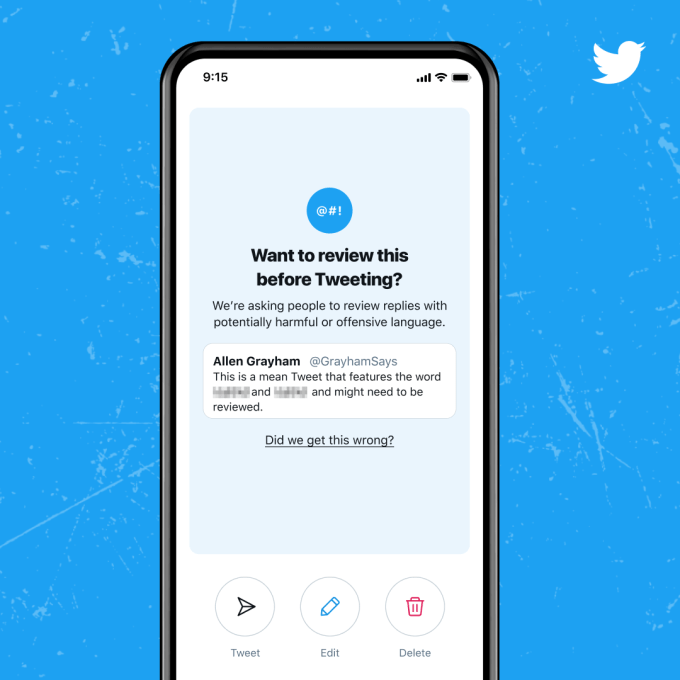
Image Credits: Twitter

However, Twitter’s early tests ran into some problems. it found its systems and algorithms sometimes struggled to understand the nuance that occurs in many conversations. For example, it couldn’t always differentiate between offensive replies and sarcasm or, sometimes, even friendly banter. It also struggled to account for those situations in which language is being reclaimed by underrepresented communities, and then used in non-harmful ways.

The improvements rolling out starting today aim to address these problems. Twitter says it’s made adjustments to the technology across these areas, and others. Now, it will take the relationship between the author and replier into consideration. That is, if both follow and reply to each other often, it’s more likely they have a better understanding of the preferred tone of communication than someone else who doesn’t.

Twitter says it has also improved the technology to more accurately detect strong language, including profanity.

And it’s made it easier for those who see the prompts to let Twitter know if the prompt was helpful or relevant — data that can help to improve the systems further.

How well this all works remains to be seen, of course.
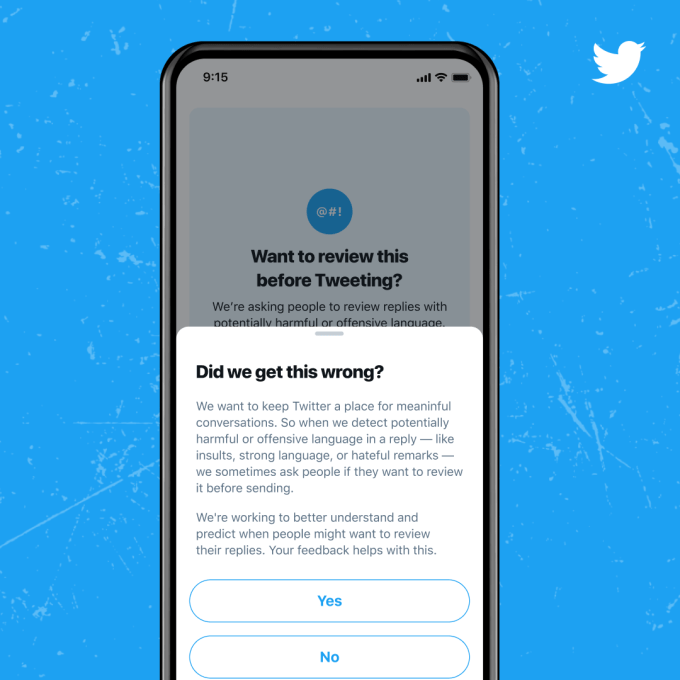
Image Credits: Twitter

While any feature that can help dial down some of the toxicity on Twitter may be useful, this only addresses one aspect of the larger problem — people who get into heated exchanges that they could later regret. There are other issues across Twitter regarding abusive and toxic content that this solution alone can’t address.

These “reply prompts” aren’t the only time Twitter has used the concept of nudges to impact user behavior. It also reminds users to read an article before you retweet and amplify it in an effort to promote more informed discussions on its platform.

Twitter says the improved prompts are rolling out to all English-language users on iOS starting today, and will reach Android over the next few days.

05 May 2021

Emerging open cloud security framework has backing of Microsoft, Google and IBM

Each of the big cloud platforms has its own methodology for passing on security information to logging and security platforms, leaving it to the vendors to find proprietary ways to translate that into a format that works for their tool. The Cloud Security Notification Framework (CSNF), a new working group that includes Microsoft, Google and IBM is trying to create a new open and standard way of delivering this information.

Nick Lippis, who is co-founder and co-chairman of ONUG, an open enterprise cloud community, which is the primary driver of CSNF says that what they’ve created is part standard and part open source. “What we’ve been really focusing on is how do we automate governance on the cloud. And so security was the place that was ripe for that where we can actually provide some value right away for the community,” he said.

While they’ve pulled in some of the big cloud vendors, they’ve also got large companies who consume cloud services like FedEx, Pfizer and Goldman Sachs. Conspicuously missing from the group is AWS, the biggest player in the cloud infrastructure market by far. But Lippis says that he hopes as the project matures, other companies including AWS will join.

“There’s lots of security programs and industry programs that get out there and that people are asking them to join, and so some companies want to wait to see how well this pans out [before making a commitment to it],” Lippis said. His hope is that over time, that Amazon will come around and join the group, but in the meantime they are working to get to the point everyone in the community will feel good about what they’re doing.

The idea is to start with security alerts and find a way to build a common format to give companies the same kind of system they have in the data center to track security alerts in the cloud. The way they hope to do that is with this open dialogue between the cloud vendors and the companies involved with the group.

“So the structure of that is that there’s a steering committee that is chaired by CISOs from these large cloud consumer brands, and also the cloud providers, and they provide voting and direction. And then there’s the working group where all the work is done. The beauty of what we do is that we have now consumers and also providers working together and collaborating,” he said.

Don Duet, a member of ONUG, who is CEO and co-founder of Concourse Labs, has been involved in the formation of the CSNF. He says to keep the project focused they are looking at this as a data management problem and they are establishing a common vocabulary for everyone to work within the group.

“How do you build a consensus on what are the types of terms that everybody can agree on and then you build the underlying basis so that the experts in your resource providers in this case, Cloud Service Providers, can bless how their data [connects] to those common standards,” Duet explained.

He says that particular problem is more of an organizational problem than a technical one, getting the various stakeholders together and just building consensus around this. At this point, they have that process in place and the next step is proving it by having the various companies involved in this test it out in the coming months.

After they get past the testing phase, in October they plan to actually demonstrate what this looks like in a before and after scenario, with the new framework and without it. As the group works toward these goals, the hope is that eventually the framework will become more established and other companies and vendors will come on board and make this a more standard way of sharing security alerts. If all goes well, they hope to build in other security information into this framework over time.

05 May 2021

Despite gains, gender diversity in VC funding struggled in 2020

People have been discussing the importance of expanding opportunities for women in venture capital and startup entrepreneurship for decades. And for some time it appeared that progress was being made in building a more diverse and equitable environment.

The prospect of more women writing checks was viewed as a positive for female founders, a cohort that has struggled to attract more than a fraction of the funds that their male peers manage. All-female teams have an especially tough time raising capital compared to all-male teams, underscoring the disparity.

Then COVID-19 arrived and scrambled the venture and startup scene, creating a risk-off environment during the end of Q1 and the start of Q2 2020. Following that, the venture world went into overdrive as software sales became a safe harbor in the business world during uncertain economic times. And when it became clear that the vaunted digital transformation of businesses large and small was accelerating, more capital appeared.

But data indicate that the torrent of new capital has not been distributed equally — indeed, some of the progress that female founders made in recent years may have eroded.


The Exchange explores startups, markets and money.

Read it every morning on Extra Crunch or get The Exchange newsletter every Saturday.


During a time of plenty, many female founders are still going without. The Exchange reached out to a number of American and European investors and founders to get their perspective on how today’s venture market treats female founders.

Recurring among the responses was a general view that more women venture capitalists would help lessen the gender gap in investments, and that VCs became more conservative due to COVID-19 and its constituent economic disruption, reverting to offering capital to repeat founders and their existing networks, both groups that are less diverse than the pool of new founders.

Our collection of founders and investors also said that women have been especially double-tasked during the pandemic to take on more domestic responsibilities in part due to sexist societal expectations, adding that that sexism more generally remains a problem that either isn’t improving or is improving too slowly.

But before we get into the core issues that prevent improvements in gender equity in venture funding, let’s check in on the data from last year and contrast it to its antecedents.

What the data show

While there have already been reports on gender disparities in funding, Nokia-backed VC firm NGP Capital made a great contribution to research on the topic with its 2021 dossier.

05 May 2021

Text Blaze raises $3.3M for its speed-writing automation service

Text Blaze, which was a part of the recent Winter 2021 Y Combinator accelerator batch, announced that it has closed a $3.3 million seed round. The company’s investment was led by Two Sigma Ventures’s Villi Iltchev and Susa Ventures’s Leo Polovets.

The company’s product hybridizes two trends that TechCrunch has been tracking in recent years, namely automation and the written word. On the automation front, we’ve seen Zapier grow into a behemoth, while no-code products and RPA have made the concept of letting software boost worker output increasingly mainstream. And on the writing-assistance side of things, from Grammarly to Copy.ai, it’s clear that people are willing to pay for tools to help them writer better and more quickly.

So what does Text Blaze do? Two main things. First, its Chrome extension allows users to save “snippets” of text that they can add to emails, and other notes in rapid-fire fashion. I might save “Hello and welcome back to Equity, TechCrunch’s venture capital-focused podcast, where we unpack the numbers behind the headlines” to “/intro in Text Blaze, saving myself lots of time whenever I kick off a new podcast script.

But saving snippets and quickly inserting them into various text boxes in a user’s browser are just part of what makes Text Blaze neat. The product can also save template snippets with various boxes left open for users to fill in. So, a user could have a user-feedback snippet saved, that reserved spots for them to add in names, and other unique information quickly, while reusing the bulk of the text itself.

Text Blaze also has integrations with external services to ensure that its service can save users time. For example, the service can pull in CRM data from Hubspot into a text snippet used in Gmail. The idea is to link different services and data sources automatically, helping users shave minutes from their days, and hours from their weeks.

So far Text Blaze has run lean, according to its co-founder Dan Barak, who told TechCrunch that its staff of four will grow to around 10 this year, thanks to its new capital. Like nearly every startup that we’ve spoken to in recent months, Barak said that Text Blaze is a remote-first startup with a wide hiring lens.

Text Blaze’s model is freemium, with a consumer paid offering that costs $2.99 monthly. The key limitation in its free product, Barak, is a hard cap of 20 snippets. Past that you’ll need to pay. TechCrunch was modestly confused at the low price point, and relatively robust free feature set that the startup is offering. The co-founder explained that the company’s long-term plan is to sell into enterprises, making the pro version of Text Blaze more of a tool to generate awareness in what its service can do more than its final monetization scheme.

Some 70% of the company’s users so far have signed up using their corporate email, which could provide a wide avenue into later enterprise sales. According to the Text Blaze website, business users will pay a little more than double what its prosumer users will.

The company’s strategy appears to be working. Not only is it attracting users — its Chrome extension notes more than 70,000 users — and early revenue, but it also managed to convert Iltchev and Polovets into believers in its product. “When I first saw Text Blaze, it reminded me of the early days of Zapier which helped professionals to automate repetitive tasks, except Text Blaze provides a more approachable and easier to adopt entry point though written communications,” the Two Sigma investor told TechCrunch.

Susa’s Polovets said that he “fell in love with the [startup’s] product,” adding that he “wanted to invest as soon as I tried the product.”

Text Blaze’s round closed a few weeks ago. Let’s see how quickly it can scale with the new funds under its belt.


05 May 2021

One CMO’s honest take on the modern chief marketing role

There’s no shortage of commentary around the chief marketing officer title these days, and certainly no lack of opinions about the role’s responsibilities and meaning within a company. There’s a reason for that. CMO is the shortest tenured C-suite role — the average tenure of a CMO is the lowest of all C-suite titles at 3.5 years.

CMOs either produce the numbers or we find another job.

That’s because the chief marketing officer’s role is increasingly complex. Qualifications require broad, strategic thinking while also maintaining tactical acumen across several functions. There’s a big disparity in what companies expect from CMOs. Some want a strategist with an eye for go-to-market planning, while others want a focus on close alignment with sales in addition to brand awareness, content strategy and lead generation.

Still other companies want their CMO to emphasize product marketing and management. Ask 10 CMOs how they define their role and you’ll get 10 different answers.

So, I’m sharing my honest, straight from the mouth of a tenured CMO take on what the role actually means, plus the key attributes of today’s modern CMO.

We must be the Master Builder

Hat tip to “The Lego Movie” for this analogy. Today’s marketing executives must bring functions and teams together. From sales and marketing alignment to product and everything in between, chief marketers are the connective tissue between every function. Driving alignment between these functions is table stakes.

Same goes for people teams and culture — I’ve experienced an increase in CMOs serving as the linchpin of a company’s culture. My CEO lives by the famous phrase “culture eats strategy for breakfast” and driving culture alignment now sits squarely on marketing’s shoulders.

Consistently drives new opportunities

Ah, demand generation. Driving new opportunity creation will continue to be a top priority for CMOs, of course. I’m not sharing anything new here, but the stakes are higher. CMOs either produce the numbers or we find another job. Doesn’t get any more straightforward than that. But, simply generating leads to check a box doesn’t cut it in board rooms anymore.

05 May 2021

One CMO’s honest take on the modern chief marketing role

There’s no shortage of commentary around the chief marketing officer title these days, and certainly no lack of opinions about the role’s responsibilities and meaning within a company. There’s a reason for that. CMO is the shortest tenured C-suite role — the average tenure of a CMO is the lowest of all C-suite titles at 3.5 years.

CMOs either produce the numbers or we find another job.

That’s because the chief marketing officer’s role is increasingly complex. Qualifications require broad, strategic thinking while also maintaining tactical acumen across several functions. There’s a big disparity in what companies expect from CMOs. Some want a strategist with an eye for go-to-market planning, while others want a focus on close alignment with sales in addition to brand awareness, content strategy and lead generation.

Still other companies want their CMO to emphasize product marketing and management. Ask 10 CMOs how they define their role and you’ll get 10 different answers.

So, I’m sharing my honest, straight from the mouth of a tenured CMO take on what the role actually means, plus the key attributes of today’s modern CMO.

We must be the Master Builder

Hat tip to “The Lego Movie” for this analogy. Today’s marketing executives must bring functions and teams together. From sales and marketing alignment to product and everything in between, chief marketers are the connective tissue between every function. Driving alignment between these functions is table stakes.

Same goes for people teams and culture — I’ve experienced an increase in CMOs serving as the linchpin of a company’s culture. My CEO lives by the famous phrase “culture eats strategy for breakfast” and driving culture alignment now sits squarely on marketing’s shoulders.

Consistently drives new opportunities

Ah, demand generation. Driving new opportunity creation will continue to be a top priority for CMOs, of course. I’m not sharing anything new here, but the stakes are higher. CMOs either produce the numbers or we find another job. Doesn’t get any more straightforward than that. But, simply generating leads to check a box doesn’t cut it in board rooms anymore.

05 May 2021

Tinder to roll out new 48-hour, in-app events called ‘Vibes’

On the heels of strong first quarter earnings, dating app giant Match announced its plan to introduce a new live event experience to its flagship app, Tinder. Dubbed “Vibes,” the new feature combines aspects from earlier Tinder events, Swipe Surge and Swipe Night, to create a new kind of in-app experience that’s both time sensitive and focused on finding new ways for users to break the ice.

Swipe Surge, for context, is longtime Tinder feature that lets users know when Tinder usage in the area is busier than usual. During a Surge, activity may be up to 15x higher, which increases users’ potential to get matched by 250%, the company has said. Users are alerted to “Surges” via push notifications or when they open the app.

Swipe Night, meanwhile, was an in-app interactive series which presented a narrative where users made choices, in a sort of “choose-your-own-adventure” format. Those choices were then displayed on user profiles for a time, which gave new matches something to talk about during those first and sometimes awkward conversations.

Vibes pulls in elements from both earlier events.

Image Credits: Tinder

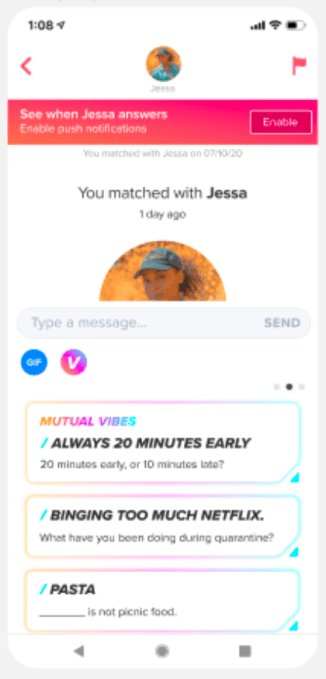
Like Swipe Surge, users will be alerted to the Vibes events via push notifications when it’s time to engage, or they’ll see it when they open the app if notifications are turned off. And like Swipe Night, the larger goal of Vibes is to help users begin a conversation with something other than just “hey.”

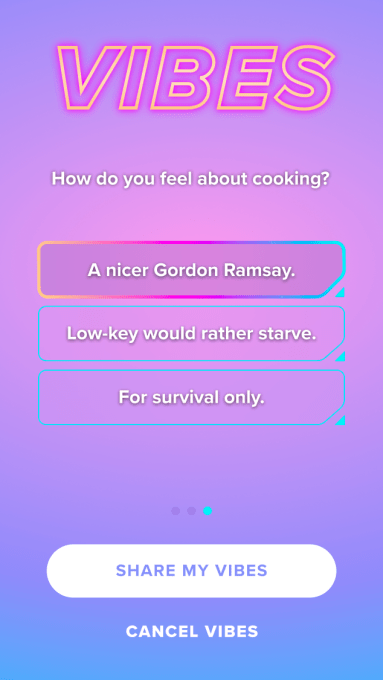
The experience of Vibes itself is not some produced video series, however. Instead, Vibers presents users with a series of questions ranging from personality traits to pop culture. Again like Swipe Night, their responses will be displayed on their profile — in this case, for 72 hours. And when matches who participated in Vibes begin to chat, they’ll be able to see one another’s responses directly within the chat window, Tinder says.

Image Credits: Tinder

Vibes will also help to push users into Tinder’s video chat, which began testing last year. The company says that Vives users will have the option to continue their conversations on video.

Each Vibes event will only last 48 hours, which will compress the potential user engagement into a predetermined time frame. Assuming Tinder users take to Vibes, the feature could give Tinder a dial it could turn any time it needed to drive more engagement for its app.

The announcement follows another big quarter for Match, which surprisingly weathered the pandemic despite stay-at-home measures that dampened the potential for in-person dating. Instead, Tinder continued to grow, as users stuck at home feeling socially isolated looked for ways to connect online. However, that growth slowed at times as Covid cases spikes and more lockdowns went into effect.

Image Credits: Tinder

In Q1 2021, Match reported $668 million in revenue, up 23% year-over-year. Non-Tinder brands grew direct revenue 30% while Tinder grew 18%, up from 13% in Q4 2020. The company reported it’s now seeing a new normalization level as the rollout of vaccines continues.

Tinder engagement was also above pre-COVID levels in the past quarter, the company noted, with daily swipe activity up 15%, messages up 19%, and conversations that are 32% longer compared with the baseline period before COVID.

The company says Vibes will roll out later in May,

05 May 2021

Tinder to roll out new 48-hour, in-app events called ‘Vibes’

On the heels of strong first quarter earnings, dating app giant Match announced its plan to introduce a new live event experience to its flagship app, Tinder. Dubbed “Vibes,” the new feature combines aspects from earlier Tinder events, Swipe Surge and Swipe Night, to create a new kind of in-app experience that’s both time sensitive and focused on finding new ways for users to break the ice.

Swipe Surge, for context, is longtime Tinder feature that lets users know when Tinder usage in the area is busier than usual. During a Surge, activity may be up to 15x higher, which increases users’ potential to get matched by 250%, the company has said. Users are alerted to “Surges” via push notifications or when they open the app.

Swipe Night, meanwhile, was an in-app interactive series which presented a narrative where users made choices, in a sort of “choose-your-own-adventure” format. Those choices were then displayed on user profiles for a time, which gave new matches something to talk about during those first and sometimes awkward conversations.

Vibes pulls in elements from both earlier events.

Image Credits: Tinder

Like Swipe Surge, users will be alerted to the Vibes events via push notifications when it’s time to engage, or they’ll see it when they open the app if notifications are turned off. And like Swipe Night, the larger goal of Vibes is to help users begin a conversation with something other than just “hey.”

The experience of Vibes itself is not some produced video series, however. Instead, Vibers presents users with a series of questions ranging from personality traits to pop culture. Again like Swipe Night, their responses will be displayed on their profile — in this case, for 72 hours. And when matches who participated in Vibes begin to chat, they’ll be able to see one another’s responses directly within the chat window, Tinder says.

Image Credits: Tinder

Vibes will also help to push users into Tinder’s video chat, which began testing last year. The company says that Vives users will have the option to continue their conversations on video.

Each Vibes event will only last 48 hours, which will compress the potential user engagement into a predetermined time frame. Assuming Tinder users take to Vibes, the feature could give Tinder a dial it could turn any time it needed to drive more engagement for its app.

The announcement follows another big quarter for Match, which surprisingly weathered the pandemic despite stay-at-home measures that dampened the potential for in-person dating. Instead, Tinder continued to grow, as users stuck at home feeling socially isolated looked for ways to connect online. However, that growth slowed at times as Covid cases spikes and more lockdowns went into effect.

Image Credits: Tinder

In Q1 2021, Match reported $668 million in revenue, up 23% year-over-year. Non-Tinder brands grew direct revenue 30% while Tinder grew 18%, up from 13% in Q4 2020. The company reported it’s now seeing a new normalization level as the rollout of vaccines continues.

Tinder engagement was also above pre-COVID levels in the past quarter, the company noted, with daily swipe activity up 15%, messages up 19%, and conversations that are 32% longer compared with the baseline period before COVID.

The company says Vibes will roll out later in May,

05 May 2021

Here’s all the biz dev support Startup Alley+ founders get at TC Disrupt 2021

We’re looking for motivated early-stage founders who want to take advantage of every possible opportunity to launch their startups to new levels of success. Historically, one of the most effective ways to do that is to exhibit in Startup Alley, at TechCrunch Disrupt.

This year at TechCrunch Disrupt 2021 (September 21-23) we’re shaking up history and adding a new layer of opportunity exclusively for founders who apply for a Startup Alley Pass. It’s called Startup Alley+, and here’s what you need to know.

Every exhibiting founder is eligible for Startup Alley+ — an experience designed to set you up with additional education, exposure and success before Disrupt even starts.

However, the TechCrunch team will select only 50 founders to form the cohort, and they’ll kick things off by attending TechCrunch Early Stage: Marketing and Fundraising in July — for free. That’s right. You won’t pay anything to participate in Startup Alley+ beyond the initial cost of your Startup Alley Pass.

Other perks include three months of free business development support. You’ll attend three masterclasses on topics that every early-stage founder needs to well, master.

Who wouldn’t want to perfect their pitch long before diving into Disrupt to impress investors? Startup Alley+ participants will do just that by pitching at one of our mini pitch-offs during our weekly Extra Crunch Live events. Check your calendar now and get ready to bring the heat.

  • Session 1- July 21
  • Session 2 – August 4
  • Session 3 – August 18
  • Session 4 – September 1
  • Session 5 – September 8

Keep your pitching arm warmed up and ready, because TechCrunch will introduce Startup Alley+ participants to top investors through our new VC match-making program. And don’t forget, there’s even more pitching in your future when you get to TC Disrupt. Every exhibitor in Startup Alley gets two minutes to pitch during a breakout feedback session.

We set a low hoop to jump through in order to be considered for Startup Alley+ — simply exhibit in Startup Alley. TechCrunch will choose the founders to participate in Startup Alley+ by the end of June.

Apply for your Startup Alley Pass now to make sure you have a shot. Even better — apply before the early-bird price expires next Friday, May 13 at 11:59 p.m. (PDT), and you’ll also save $50.

05 May 2021

You can bid for a seat on Blue Origin’s first human spaceflight on July 20

Jeff Bezos’ Blue Origin is offering up one seat on the inaugural flight of its sub-orbital rocket New Shepard, set to take place July 20 – but instead of a fixed price ticket sale, the seat will go to the highest bidder.

It’ll work like this: from May 5-19, bidders will be able to bid any amount on an auction website. From May 19, the bids will be made “unsealed,” or made visible, and bidders have continually exceed the highest bid to remain in the running for the seat. Bidding will conclude June 12 with a live online auction.

From Blue Origin’s website, it looks like the overall flight will be relatively quick, with the craft reaching apogee, or its highest point, four minutes after takeoff. The capsule containing the astronauts (and the lucky bidder) will land 10 minutes after takeoff near its launch site in West Texas.

Blue Origin said the winning bid will be donated to its charitable foundation, Club for the Future.

In recent weeks Blue Origin has conducted a dress rehearsal of astronaut loading and unloading. This is only the most recent move from the company, which has been testing and flight-certifying its spacecraft for the past few years. We will update the story as more information becomes available on the auction.