Year: 2021

28 Apr 2021

Greece’s Viva Wallet raises $80M for its neo-bank targeting small business merchants

Challenger banks continue to make significant waves in the world of finance, with smaller outfits luring customers away from incumbents by providing an easier way for them to not only engage with basic banking services, but to tap into a wave of technology that brings more personalization and often better deals into the equation. In the latest development, Viva Wallet, a Greek startup building banking services aimed at small and medium merchants, has picked up financing of $80 million, money that it will be using to expand its footprint and the services that it is offering to users, in particular expanding its Merchant Advance loans business.

The company is already live in 23 European markets and plans soon to expand that to Croatia, Hungary and Sweden.

The funding is notable in part because of who is doing the investing. Tencent — the Chinese technology giant behind Wechat that is also making major inroads into financial services — is in the round, alongside the European Bank for Reconstruction and Development (EBRD) and Breyer Capital.

Viva Wallet is not disclosing its valuation right now, but it means business. Yannis Larios, the company’s VP of strategy and business development, confirmed to us that it’s in the middle of closing a large Series D — last August sized at €500 million ($603 million) — that will value it at €1.5 billion ($1.8 billion). This is a big leap: he also noted that when Viva Wallet closed its Series C in the second half of 2019, it was valued at €305 million.

“We are excited to onboard Tencent, EBRD and Breyer Capital to Viva Wallet,” said Haris Karonis, Founder and CEO of Viva Wallet, in a statement. “We are confident that our investors’ extensive know-how and network of partnerships will accelerate Viva Wallet’s plan to unify the fragmented European payments market. The technology innovations that we are bringing forward to European merchants will help them provide a frictionless, localised payment experience to all their clients, and liberate them from the hassle of maintaining legacy card terminals.”

The round is notable for coming at a time when Europe is slowly, hopefully poking its head out from under the weight of the Covid-19 pandemic, which has shaken and knocked over many an economy already wobbling even before the public health crisis. Focused primarily on merchants, Viva Wallet is a prime example of the kind of tech business that might help some of these critical businesses recover.

If you think that the world of neo-banks is very crowded — and that specifically neo-banks focussed on the SMB opportunity is also getting crowded — one reason why Viva Wallet is getting some attention is because of its traction and track record so far.

Larios says that the startup has been profitable as of Q1 of this year, on the back of a business that has grown by more than 40% in the last year, with 60,000 merchants currently active on its books. It’s on track, he said, for that number to be 100,000 by the end of this year.

One reason for its success, he said, is that it’s taken a very localized approach to growth, setting up operations with physical branches in each of the countries where it is active — somewhat of a retro idea in today’s market where banks are regularly shutting down their brick-and-mortar locations and going virtual. “Viva Wallet is proving the resilience of its business model,” he said.

The funding will be used in part to build out its loans program but also to expand areas where Viva Wallet is already strong. One of these is its point of sale Tap-On-Phone solution, which turns any Android device (smartphone, tablet or enterprise device) into a card terminal, to accept both contactless and PIN payments without the need for separate hardware. (Most POS systems use small, separate terminals that will connect to a tablet or phone.)

He also said there will be some M&A in the future to expand to more markets more quickly.

One area where the company will not expand is into the consumer space. Other neo-banks like Revolut and Atom have leveraged their traction with younger consumers to move into providing services for the enterprises that they found, but Larios that that is not a strategy that Viva Wallet will take in the reverse, not least because the consumer market has so far proven to be a tough-margin (or even bad-margin) game.

“Viva Wallet focuses on businesses only and will continue to do so!” he said (exclamation his!). “The consumer segment is not providing any space for profitability and we are seeing that all competing neo-bank business models focusing on consumers are mostly burning money away.

“We are focusing on the SMEs of Europe, providing a pan-European payments solution which however is very much localized to address merchants’ true local needs in terms of local payments acceptance, local IBAN accounts, local BIN business debit cards etc.” But while Viva Wallet may have a lot of SMB customers — and the EBRD investment is definitely being made to endorse that — he points out that it also includes medium businesses and some enterprises — larger merchants like supermarket chains, for example — and that will be an area it will continue to expand in.

This gives Viva Wallet enough specialization and differentiation, alongside its profitability in targeting those areas so far, to bring in the big name investors keen to tap into economic recovery, both to help that along and to ride the wave of that as it pays dividends.

“We are very excited to help Viva Wallet unify the fragmented European payments ecosystem across 23 countries. Viva Wallet is at the forefront of a paradigm shift for fintech and together, we expect to transform the payments industry in Europe” said Jim Breyer of Breyer Capital, in a statement.

“Tencent shares Viva Wallet’s aspirations of creating value for users and partners through innovation. We look forward to supporting Viva Wallet in its expansion across Europe,” added Danying Ma, MD of Tencent Investment.
28 Apr 2021

Barkyn, a wellness startups for pets in Southern Europe, hits an $9.6M Series A round

Barkyn, a European subscription service for pets that combines food with tele-vet services, has raised a further €3 milion ($3.6M) from FoodTech investor Five Seasons Ventures, extending its previous Series A to €8M, and total funds raised to date to €10M. Five Seasons Ventures joins previous investors Indico Capital Partners, All Iron Ventures, Portugal Ventures and Shilling Capital. Barkyn is in the same space as Tails, acquired by Nestlé, and Butternut Box from the UK which has raised $28M.

Launched in 2017, the Portuguese startup currently serves customers in Portugal, Spain and Italy, and is aiming to be a key ‘pet wellness’ brand for Southern Europe.

Barkyn says its subscription service offers “healthy food using fresh meat” plus a dedicated remote online veterinarian. It says personalizing the food to match the dog’s nutritional needs is part of its attraction for customers. It has also created the ‘Barkyn Complex’, a trademarked anti-inflammatory supplement for pets, plus a pet insurance product to its customers in Portugal.

André Jordão, Barkyn’s CEO and Co-Founder said in a statement: “There is no one-size-fits-all when it comes to nutrition and what the body needs, and we solve this based on our knowledge, existing products and continued research and development.”

Barkyn is pushing at an open door. It’s widely acknowledged that during the pandemic, pet ownership has gone up across the world as people fought the lockdown blues.

In 2020 Barkyn says it experienced 40 percent growth each quarter across Southern Europe. 

Commenting on the investment in Barkyn, Five Seasons’ Founding Partner Niccolo Manzoni said: “Barkyn is a unique company within Southern Europe, where the region has higher levels of pet ownership but no inspiring digital pet wellness brands. Combining personalized food with tele-vet services and, in the case of Portugal, insurance, gives customers one destination for the well-being of their pets.”

Speaking to TechCrunch, Jordão said the startup had a shot at over-taking existing pet food brands because it’s “rethinking what the pet market should look like, through technology – building a pet care service and not only a pet food subscription. We’ve developed a 360 holistic experience: a subscription that aligns the best food you could ever give your dog with telemedicine. We’re able to secure a very close relationship while scaling the model.”

28 Apr 2021

Kenya’s Ajua acquires WayaWaya to consolidate consumer experience play in African SMEs

Kenyan consumer experience platform for businesses in Africa, Ajua today announced that it has acquired WayaWaya, a Kenya-based AI and ML messaging and payments company.

WayaWaya’s customers and partners include the likes of I&M Bank, Interswitch and MTN. The company offers a range of services, from digital banking and payment services to financial services APIs and payment bots.

According to Ajua, the acquisition is primarily focused on WayaWaya’s payments bots system known as Janja. The platform, which has customers like Airtel, Ezee Money, Housing Finance Company of Kenya (HF Group), enables borderless banking and payments across apps and social media platforms. Teddy Ogallo, the entrepreneur who founded WayaWaya, joins Ajua as VP of Product APIs and Integrations.

Per Crunchbase, WayaWaya has just raised $75,000. Although the two companies did not disclose the financial details of the acquisition, Ajua is expected to have paid 10 times more than WayaWaya’s total raise.

Ajua, formerly mSurvey, was founded in 2012 by Kenfield Griffith. The company is solving a consumer data problem for African businesses to understand their business better and drive growth.

“There’s a lot of commerce happening on the continent and Ajua wants companies to move from transaction numbers to the customers behind such transaction,” Griffith told TechCrunch. “Imagine if we knew what drove consumer habits for businesses. I mean, that’s a huge exponential curve for African businesses.”

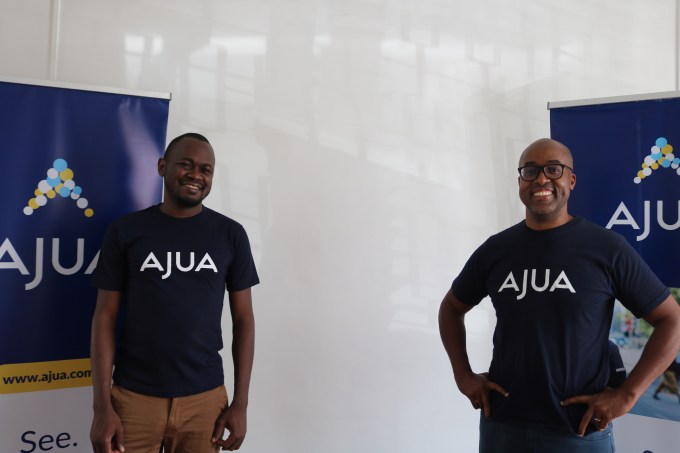
Teddy Ogallo (Founder, WayaWaya) & Kenfield Griffith (CEO, Ajua)

Teddy Ogallo (Founder, WayaWaya) & Kenfield Griffith (CEO, Ajua)

Nigeria’s SME market alone is valued at $220 billion annually. And while businesses, mostly big enterprises, can afford customer communication tools, a large segment of small businesses are being left out. Ajua’s play is to use data and analytics to connect companies with their customers in real time. “We’ve taken what makes enterprise customers successful, and we’re capturing it in a simple format so SMEs can have the same tools,” Griffith added

Since most consumer behavior for these SMEs happens offline, Ajua gives businesses unique USSD codes to receive payments, get feedback and offer discounts to their customers. It is one of the products Ajua has launched over the years for customer feedback at the point of service to businesses that cumulatively have over 45 million customers.

The company’s partners and clients also include Coca-Cola, FBNQuest, GoodLife Pharmacy, Java House, Safaricom, Standard Chartered and Total.

As an intelligent messaging bot, Janja is used by individuals and businesses across WhatsApp, Facebook Messenger and Telegram to automate customer support and make cross-border payments. So, Janja’s integration into Ajua’s product stack will close much of the acquirer’s customer experience loop by automating responses and giving customers what they want, when they want it.

This acquisition comes a month after Ajua announced that it partnered with telecom operator MTN Nigeria to launch a customer management product for Nigerian businesses. The product called MTN EnGauge carries the same features present in Ajua but, in this case, is tailored solely for businesses using the MTN network. The roll-out is expected to generate more data for Ajua’s thousands of users. It will also be upgraded to incorporate Janja and other services.

In hindsight, it appears Ajua could have created a product like Janja in-house due to its vast experience in the consumer experience space. However, the company chose an acquisition and Griffith gave two reasons why — building a similar product would have taken a long time and Ogallo seemed to know Janja’s business and operations so well, it just made sense to get him on board. 

“Teddy was going the same direction we’re going. We just thought to acquire WayaWaya instead and make a really good company out of both products attempting to solve the same problem. To me, it’s all about solving the problem together rather than going alone,” said the CEO. 

On why he accepted the acquisition, Ogallo, who now has a new role, noted that Ajua’s ability to scale customer service and experience and also help businesses was one reason and earned admiration from him. “Seeing how WayaWaya’s technology can complement Ajua’s innovative products and services, and help scale and monetize businesses, is an exciting opportunity for us, and we are happy that our teams will be collaborating to build something unique for the continent,” he added

This is a solid infrastructure play from Ajua coming from a founder who is a massive advocate of acquisition and consolidation. Griffith believes that the two are strategies for a speedier route to new markets and channels in Africa

I think there are lots of ways we can build the ecosystem. There are lots of young talent building stuff, and they don’t have access to capital to get to the next stage. The question is if they want to race to the finish line or take off time and get acquired. I think there’s a huge opportunity in Africa if you want to solve complex problems by acquisition.”

There has been an uptick in local acquisitions in Africa from startups within a single country and between two countries in the past three years. For the former, Nigerian recruitment platform Jobberman’s acquisition of NGCareers last year comes to mind. And there are pan-African instances like Lagos-based hub CcHub’s acquisition of iHub, its Nairobi counterpart; Ethiopian software provider Apposit sell-off to Nigerian fintech Paga; and Johannesburg-based fintech MFS Africa acquiring Uganda’s Beyonic.

The common theme among the acquisitions (and most African acquisitions) is their undisclosed sums. For Ajua, Griffith cited regulatory issues as one reason why the company is keeping the figure under wraps.

Since launching nine years ago, Ajua has raised a total of $3.5 million, according to Crunchbase. Given the nature of this acquisition and partnership with MTN, the company might set sights on another fundraise to scale aggressively into Nigeria (a market it entered in 2019) and other African countries.

28 Apr 2021

Arc opens its remote career platform to all software developers

The COVID-19 pandemic threw remote work into the spotlight, but tech companies have hired in other locations for years to deal with talent shortages. Arc announced today it is opening its remote hiring platform to all software developers. Previously, Arc was open only to developers who passed its verification process. Developers can still get verified to stand out from other applicants, but Arc’s job database and search engine is now available to everyone.

Arc was launched two years ago by the team behind Codementor, an online education platform for software developers. Since then, Arc has been used by companies like Spotify, Hims, Hubspot and FiveStars for hiring. Its investors include TechStars, 500 Startups, WI Harper and Y Combinator.

“As proud as we are of impact we have made for developers, we really want to scale that impact, and that’s why we decided to create a much more open product experience,” founder and chief executive officer Weiting Liu told TechCrunch.

The new version of Arc centers around two features: its smart remote job search engine and developer community. Arc crawls job boards and other sites for its database and has so far aggregated 54,000 developer openings from 13,000 companies. Then its search engine removes some of the challenges associated with searching for remote work.

“For example, one common complaint is that a lot of jobs are remote, but U.S. only. Or it’s only remote until the end of the pandemic,” Liu said. “Our algorithm will do its best based on your circumstances. For example, if you are a developer based in Asia or in Eastern Europe, there are certain job opportunities that are unfortunately not applicable to you based on the time zones. So we filter all of those things, and also based on your experience and tech stacks, to recommend the most relevant jobs.”

Arc Community is a resource for software developers who are new to remote work or want to learn about work practices in other countries. For example, “they might have questions like, should my resume be in this format for a U.S.-based employer, or what are the types of tools used and cultural norms?” Liu said. “If someone is looking for a position with an American company, we will talk about common interview practices or even basic work practices like how many companies use Slack. That’s where the community comes in and we want to enable developers who have already been working remotely to share their experiences.”

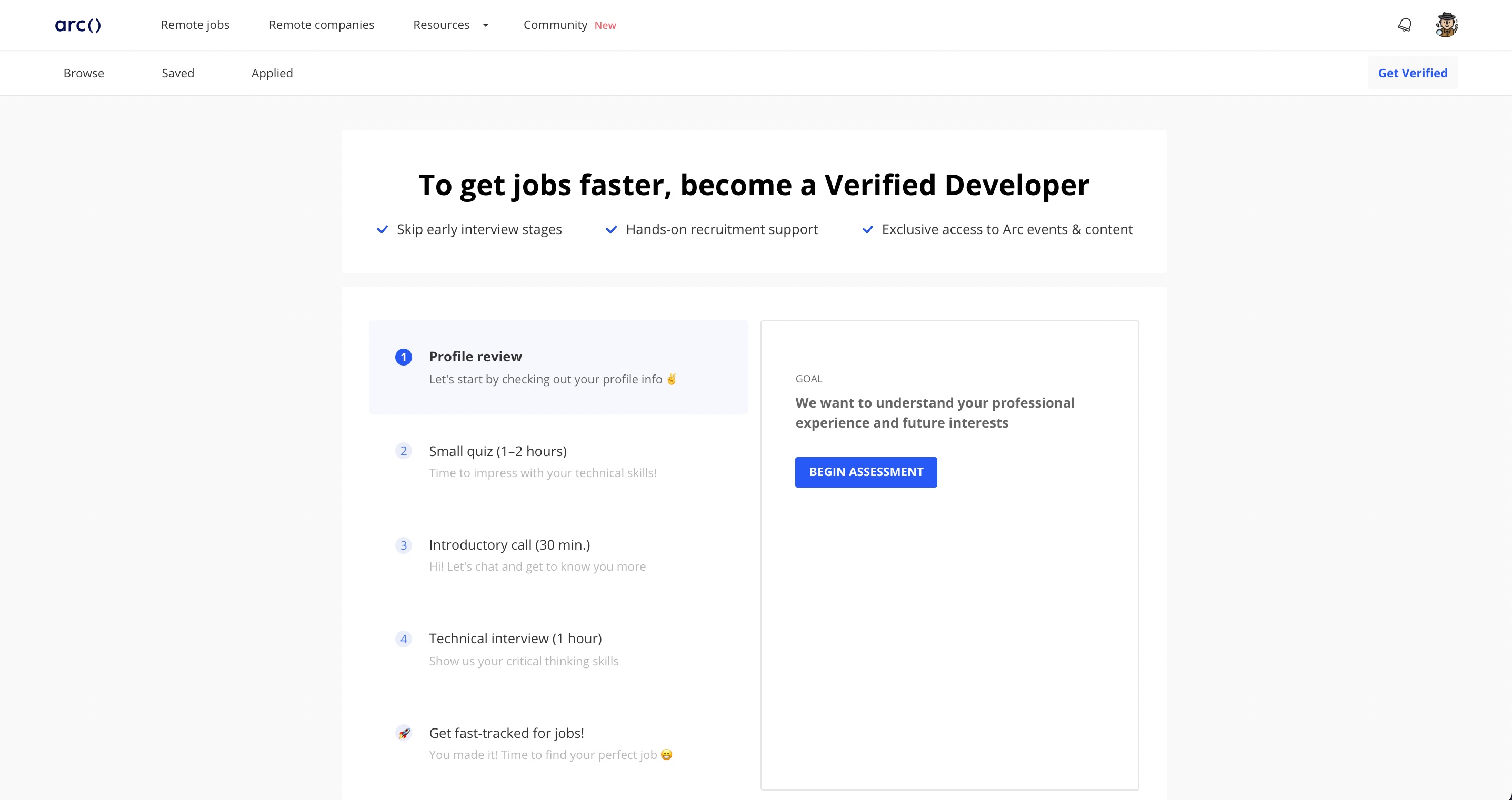
Even though it is now optional, Arc still recommends its verification process. It typically takes about a week, and includes a coding challenge and behavioral and technical interviews with an Arc team member. Even if someone doesn’t pass, they get feedback about where they can improve and can reapply in six months. Verification and job searches are free, and Arc monetizes by charging employers for hires through its platform.

A screenshot showing steps from Arc's developer verification process

Steps from Arc’s developer verification process

In addition to its community, Arc recently launched a program called Elevate. Inspired by Liu’s experiences in Y Combinator and TechStars, Elevate is meant to be a “short-term talent accelerator” for developers who want to transition into remote work. Its first program included 13 developers from Latin America and future cohorts will range in size from 10 to 20 people. The program includes career preparation workshops, interview practice and live mentorship sessions with developers who work at GitLab, Zapier and Dialpad.

Arc is currently running a crowdfunding campaign, started after the SEC implemented its new equity crowdfunding regulations, and has raised about $950,000 so far.

“This is aligned with our vision, which is about democratizing access, so if we can make Arc a partially community-owned remote job platform, it will be extremely interesting because we aspire to become the world’s largest remote job site and if we can turn our community members into investors-slash-owners of the platform, it can help us realize our mission faster,” said Liu.

28 Apr 2021

Look out Amazon Go — A Lisbon startup plans to offer autonomous stores to other retailers

Look out Amazon Go. A Lisbon startup plans to offer the same autonomous store technology to other retailers. Lisbon-based Sensei, a computer vision startup that allows convenience stores to offer check-out-free purchasing has secured a seed round of $6.5 million (€5.4M). The funding was led by Seaya Ventures and Iberis Capital, with participation from 200M Fund.

The startup will now scale its R&D and launch new stores. Its proprietary platform uses a blend of cameras, sensors, and AI to automate stores, both new and existing. The platform means retailers can manage inventory in real-time and also access insights into the way the stores are used.

Vasco Portugal, Sensei’s CEO and Co-founder said: “Sensei’s technology will help level the playing field for retailers to compete against digital giants such as Amazon. We aim to enhance the familiar and enjoyable customer shopping experience, making it seamless, convenient, and safe.”

Sensei is designed to work mainly with grab-and-go stores, forecourts, and similar retail formats. Competitors include Trigo which has raised $89 million.

The advantages of automated stores in a pandemic are obvious: customers no longer have to queue. Plus retailers can avoid stock-outs and staff turn into customer support.

“We are delighted to invest in a business that is part of the digitalization of commerce, a trend that is currently clearly being accelerated,” said Aris Xenofontos, Principal at Seaya Ventures.

Luis Quaresma, Partner at Iberis Capital, added: “Sensei brings tremendous efficiencies and cost-savings to the retail industry, while providing a much needed seamless checkout experience for consumers.”

Sensei was founded by Vasco Portugal (CEO, ex-MIT), Joana Rafael (COO),Nuno Moutinho (CTO) and Paulo Carreira (CSO).

28 Apr 2021

Fund managers can leverage ESG-related data to generate insights

Almost two centuries ago, gold prospectors in California set off one of the greatest rushes for wealth in history. Proponents of socially conscious investing claim fund managers will start a similar stampede when they discover that environmental, social and governance (ESG) insights can yield treasure in the form of alternative data that promise big payoffs — if only they knew how to mine it.

First, let’s be clear: ESG is not on the fringe.

There may be some truth to that line of thinking if you take some of the rhetoric and advertising out of the equation.

First, let’s be clear: ESG is not on the fringe. The European Union has implemented new financial regulations via the Sustainable Finance Disclosure Regulation (SFDR). These improve ESG disclosures and considerations and help to direct capital toward products and companies that benefit people and the planet. As we write, the U.S. Securities and Exchange Commission is also considering drafting and implementation of ESG-related regulations.

Whether enacted or currently under consideration, these rules encourage fund managers to integrate sustainability risks into their business processes, report on them publicly, stamp out greenwashing, and promote transparency and knowledge among investors. Accordingly, it will become easier to compare firms’ sustainability efforts, too, allowing stakeholders from all corners to make more informed decisions.

Incorporating ESG factors into investment strategies is not new, of course. The world’s largest asset managers have been practicing it for years. According to the Governance & Accountability Institute, 90% of companies listed on the S&P 500 now produce sustainability reports, an increase of 70 percentage points from more than a decade ago.

Yet some are still groaning about adopting an ESG investing mindset; they see ESG as a nuisance that detracts from their mission of earning high returns. But could this mindset mean they are missing important opportunities?

Don’t wait

Waiting for new mandatory ESG reporting and compliance framework standards in the U.S. puts Americas-focused managers at a significant disadvantage. Fund managers can start gaining insights today from alternative data originating in ESG-related data stemming from climate change, natural disasters, harassment and discrimination lawsuits, and other events and information that can be mined.

28 Apr 2021

Endeit Capital plans to boost European B-stage startups with its new €250M growth fund

Dutch-German growth capital firm Endeit Capital has raised a 250 million euro fund to invest in B+ stage European startups. This is its third and largest investment fund, Endeit Capital III. The firm says it plans to support European scale-up companies that “lead to an accelerated digital transformation of the European society and economy and indeed the digital maturity of Europe.”

Endeit was a relatively early European investor, kicking off in 2006, and investing in 35 companies. It’s previously raised and invested 250 million euro through its first two funds, in the Benelux, DACH and Nordic regions.

The firm previously invested in companies such as 3D Hubs, Roamler, Albelli, MetrixLab, Unamic and Eyeworks, Gastrofix, Comtravo, Contorion, Chronext, Tourradar, Smartclip, Nordics Blis, Unruly and Leadfeeder. Many of its portfolio companies have exited to firms such as Time Warner, Xerox, Newscorp, Protolabs, Lightspeed, Macromill, TMG and Cimpress. Endeit Capital’s portfolio company Bux, a Europen neo-broker, recently raised $80 million.

It joins a spate of recent new VC and growth funds in Europe such as new funds from Cusp Capital and Highland Europe.

The news is good for European later-stage companies. While European early-stage capital has been on a tear for a few years, late-stage capital in Europe is typically lacking.

Founder and managing partner Hubert Deitmers said: “This financing round of Fund III has been a huge success, where we could establish the fund within a short time frame in its ‘First & Final close’, despite corona. It’s rewarding to see that ten entrepreneurs that Endeit had previously invested in are now investors themselves in this third fund.”

He says Endeit is explicitly aimed at boosting European companies against the superpowers of the US and China: “We support those internet entrepreneurs who can drive the change to make Europe more competitive and who have the ambition to become global market leaders… The next generation of European internet companies will be accelerated by core technologies, like machine learning, AI, and quantum computing. We are deeply convinced that we need to develop this knowledge within Europe and want to help ensure that European companies developing these technologies find the right environment in their home markets, rather than outside of Europe.”

Endeit emerged out of Endemol, the breakout media giant of the last 25 years. Deitmers and Endeit co-founder Martijn Hamann built Endemol out of the Netherlands into a publicly listed, global firm, acquiring 80+ businesses along the way. Endemol was later sold for many billions.

Hamann added: “Every single aspect of Endeit Capital is focused on helping entrepreneurs who shape the internet future to move forward quickly. We are looking for entrepreneurs with a strong product and unwavering drive to build market-leading positions with us.

Speaking to me via zoom, Deitmers said: “We have been a long-time cross border investor. There’s strong cross fertilization between the Netherlands and Germany. It’s different than London or Paris, which are like centralized magnets. What you see in Germany is an ecosystem that is very decentralized, you have the Munich hub, you have the hub in Cologne, you have Berlin, Hamburg. Then there is Zurich, Vienna. So there are multiple hubs in the region. And that is good, and I think it also across Europe. And you have now multiple hubs as you have shown in your TechCrunch city survey. You see there are more and more cities popping up with their own specialties like Rotterdam, or Hamburg in logistics tech.”

Does he see any Brexit effects going on?: “I think on the FinTech side you do see some changes to Amsterdam, Frankfurt, Paris. I think specifically Amsterdam is benefiting a bit from a FinTech boost. We just closed a deal last week in a neobank there. The financial centers are shifting a little bit.”

28 Apr 2021

Indian food delivery startup Zomato files for an IPO

Indian food delivery startup Zomato on Wednesday filed for an initial public offering, becoming the first tech unicorn startup from the world’s second largest internet market to do so in recent years.

The 12-year-old Gurgaon-headquartered Indian startup, which counts Info Edge and Ant Group among its investors, has set $1.1 billion as its IPO size and will look to raise about $1 billion by issuing shares, it said in the filing.

Some key insights shared by Zomato in the filling:

  • Zomato has claimed market leading position in the food delivery market. The startup identified Prosus Ventures-backed Swiggy, as well as restraunts such as Domino’s, McDonalds and Pizza hut as its competitor. (But not Amazon, which entered the food delivery market last year.)
  • The startup clocked $183.6 million in revenue between April 1 and December 31. Its losses during this period were $91.8 million.
  • Info Edge, one of the biggest investor of Zomato, plans to sell stake worth $100 million, the investment firm said in a filing.

This is a developing story. More to follow…

27 Apr 2021

Founders Circle Capital has raised a new $355 million fund to buy secondary startup shares

Founders Circle Capital, a nine-year-old, San Francisco-based investment firm that strikes agreements with private, venture-backed companies to buy some of the vested stock options of their founders and employees — so they can buy a house or just breathe a bit more easily —  has closed its newest fund with $355 million in capital commitments, bringing the firm’s total assets under management to nearly $1 billion.

Not surprisingly, the outfit, which has more competition than ever — both by other secondary investment firms, aggressive outfits like Tiger Global that routinely acquire secondary stakes in companies,  as well as special purpose acquisition companies that are taking companies public a lot faster and alleviating the need of early shareholders to cash out via private sales — is also introducing a new twist to its business.

Specifically, according to both cofounder and CEO Ken Loveless and the outfit’s chief people officer, Mark Dempster, Founders Circle is now offering startups so-called flexible capital, too, including providing companies and executives with loans and other products in order to better compete in a fast-changing landscape. We talked with Loveless and Dempster via Zoom late last week about the new fund, the new products, and generally what they are seeing out there. Excerpts from that chat, edited for length and clarity, follow.

TC: This is your third fund. How does it compare with your earlier funds?

KL: We’ve raised three main funds. This is our third, but we’ve raised something like 17 entities [altogether], including some co-investment vehicles and special purpose vehicles to invest in some of our companies.

TC: And you’re now changing your approach a bit. How so?

MD: [We’re now offering] a mix of primary and secondary [investment dollars] and we can [offer these] are any time and in any combination. These [investments] don’t have to happen during a certain [distinct] round of financing; we might get involved in eight to 10 different investments [tied to the company].

TC: Do you have a debt partner so you have more capital at your disposal if you need it?

KL: We have a strategic partnership with Silicon Valley Bank, so they are typically the lender to these individuals as they solve their liquidity. In many cases, we provide an equity backstop to that.

TC: How has your world changed now that people perhaps see a light at the end of the tunnel, with companies becoming publicly traded entities in a variety of ways that we weren’t seeing in recent years? Are employees or founders any more or less reluctant to share their shares in secondary transactions?

KL: There hasn’t been any significant change. We had a portfolio company go public in UiPath that was 16 years old and if you think about how many things change in your life over that kind of time period, it would be quite a long list. We also had [stakes] in DoorDash and Poshmark, and if you look at the time between when they were founded and became publicly traded, it was close to a decade for both. So [while there is some market receptivity for companies] that really are two years old or three years old, the average [time from launch to publicly traded company] is still 10-plus years on average.

TC: A lot of outfits are competing for the same shares that you want to buy, including Tiger Global, which is paying very high prices in many cases. In addition to competing with these companies, I’m wondering if you ever sell your shares to them.

KL: We are typically a long-only investor. We have not sold any secondary shares. We typically hold through a public offering. We’re really trying to focus on those companies that can truly be in enduring, decades-old businesses. We obviously wouldn’t hold that long, but we’re holding into the public markets.

TC: How long do you hold your shares?

KL: We’re not bound [by anything] but what we tell our [investors] is that we typically hold for an average of one year post public offering [then distribute the shares to them].

TC: How, if at all, are you playing this SPAC phenomenon? Are you seeing opportunities to jump into these blank check companies before they merge with brands you’ve maybe been tracking?

KL: We have not directly participated in a SPAC, but we have had some of our portfolio companies merged with some SPACs to become what we hope will be enduring public businesses. So we’ve taken advantage of [those exits] as a financing tool.

TC: You’ve been at this for roughly a decade. How many companies have you backed and how many of these have exited?

MD: We’ve invested in 73 companies and 31 have exited.

TC: I know you tend to invest at a later stage — have there been any shutdowns owing to unforeseen circumstances?

MD: We’ve had zero company shutdowns.

TC: And what about what you’re having to pay? How has that changed over the last year or so?

KL: We just did an analysis of this and if you adjust for growth, we have not seen a substantial raise in valuations that we have paid compared to where prices were pre pandemic. We’re paying the same dollar for a point of growth as we were before [COVID-19 struck the U.S.].

TC: Why do you think that is?

KL: Companies that have solid unit economics have become better at both benchmarking their internal metrics, and investors have become better at understanding those and metrics. The consistency and underwriting by investors is becoming better and better.

27 Apr 2021

Porsche makes its case for an all-electric Taycan wagon

Porsche has always gone its own way when it comes to creating new vehicles. It is, after all, the company that continues to stick to the wacky idea that putting the weight of an engine in the rear of a sports car is a great idea. (It is!)

So, bucking the crossover trend to create an all-electric, soft-roading wagon with just 20 more millimeters of clearance than their popular electric Taycan sedan isn’t out of character for the brand. Instead, it’s another example of how Porsche approaches electrification.”You don’t make an electric car. You make a Porsche with an electric powertrain,” Calvin Kim, product spokesperson for the Taycan line, said in a recent interview.

The 2021 Taycan Cross Turismo fits that bill. Powerful, quick, comfortable, luxurious and tech-laden, the Porsche Taycan 4 Cross Turismo (one of four variants of the wagon) offers a blend of practicality with a whole lot of power and speed for under $100,000.

Why Build an Electric Porsche Wagon?

Porsche upended the sports car enthusiast club when it launched the Cayenne nearly 20 years ago and is doing the same with the Taycan and the Taycan Cross Turismo. While the SUV and crossover business is still a tremendous cash cow for the company, nearly 4,500 Taycans were sold in 2020, according to a recent release from Porsche. That’s more than either the 718 or the Panamera line.  Porsche also says that from cradle to manufacturing, the new Cross Turismo is carbon neutral — the first vehicle they’ve made that has achieved that status.

“Porsche wanted to create the most sporty capability we can make,” Kim said, “and a wagon version of the Taycan embodies that ethos.”

The 2021 Porsche Taycan Cross Turismo is on sale today. Porsche says that it expects deliveries to start this summer.

2021 Porsche Taycan 4 Cross Turismo

Image Credits: Abigail Bassett

Taycan vs. Taycan Cross Turismo

Beyond the obvious form factor, prospective buyers or EV enthusiasts might wonder why someone might opt for a Cross Turismo over the original Taycan?

There are a few important differences between the two vehicles that might push some customers over to the wagon. First up, the Cross Turismo offers more passenger and cargo space. Passengers get an additional 0.35 inches of headroom up front and 3.69 inches in the back. The wagon is also equipped with more cargo space — 15.7 cubic feet behind the rear seats or 42.8 cubic feet with them folded forward. Like the Taycan, the Cross Turismo has an additional 2.9 cubic feet of area in the frunk.

The Cross Turismo also has a skosh 20 millimeters (just short of 1 inch) more ground clearance than the Taycan sedan and an additional driving mode called Gravel. Gravel mode is activated by a soft key on the center console rather than by the mode wheel on the steering wheel. It raises the car’s height and makes changes to the stability control and torque management system for better grip on gravel, snow or ice. Unfortunately, on our short test drive, we didn’t get a chance to put Gravel mode to the test.

Porsche Taycan 4 Cross Turismo

Image Credits: Porsche

On top of these features, the Taycan Cross Turismo comes with all-wheel drive and standard air suspension (called Porsche Active Suspension Management or PASM), which, on the Taycan, is a $2,200 option. The Taycan Cross Turismo comes standard with the larger 93.4 kWh battery pack, which is a $5,780 option on the base Taycan sedan. The Cross Turismo is built on the same platform as the Taycan sedan, known as J1, internally.

There are four different variants of the Taycan Cross Turismo, including the one I drove. You can choose from the entry-level Taycan 4 Cross Turismo, the Taycan 4S Cross Turismo, the Taycan Turbo Cross Turismo, and the Taycan Turbo S Cross Turismo. At the highest trims, base prices start at $188,000. Pricing for the Taycan 4 Cross Turismo that I drove starts at $92,250 (including delivery).

Each flavor of Cross Turismo comes with an optional off-road package that adds lower body cladding to prevent rock chips on gravel roads and raises the vehicle by 10 millimeters. Porsche doesn’t state the ground clearance for the Taycan or the Taycan Cross Turismo, but approach and departure angles increase from 12.1 and 15.2 degrees to 12.2 and 16.2 degrees in the electric wagon.  In true Porsche fashion, the company says that there are more than 21,000 option combinations based solely on which Cross Turismo you choose, wheel choice, exterior color, and interior selection, not to mention details like badge deletion, stitching, technology options, and seat types.

Charging speeds are the same between the Cross Turismo and the Taycan. Porsche says that on DC fast chargers, the Taycan Cross Turismo can recharge from 5% to 80% in just 22.5-minutes.

First drive

The Taycan Cross Turismo 4, which I drove, represents the entry point to the new all-electric wagon. While neither Porsche nor the EPA has released range estimates, the European-spec, ruby red machine had just over 250 miles of range at 99% charge when I hopped into it for a Monday afternoon jaunt from Glendale, California to Big Bear and back. That nearly 200-mile trip left me with 68 miles of range in the proverbial tank. While it may seem like that math is off, it’s not, thanks to regenerative braking that helps generate electricity and push some of it back into the battery.

The drive consisted of about 140 miles along the highway and some 60 miles on mountain roads. Thanks to the dual-motor, all-wheel-drive setup that comes standard on all Cross Turismos, the electric wagon felt planted and secure on misty and slightly icy mountain roads and took corners without a modicum of body roll. With a 375 horsepower (469 with launch control)  and maximum available 368 lb-ft of torque, passing a sluggish motorist (or three at once) was handled with ease.

The Cross Turismo gets five different driving modes: Range, Normal, Sport, Sport Plus, and Individual. On the highway, I started in Normal mode and noticed how easy it was to push the vehicle beyond the stated speed limit. Using the toggle on the wheel, I switched to Range mode, which helps conserve battery by limiting speed to just 80 miles per hour. All of the modes except Range allow the driver to take the Cross Turismo to its full 136-mile-per-hour potential.

Porsche Taycan4_Cross_Turismo

Image Credits: Porsche

My test vehicle was a European model. This meant that certain tech features that come with the Cross Turismo, including Porsche’s advanced driving assistance system InnoDrive and the navigation features, couldn’t be activated since my test drive was in the United States. However, the regular adaptive cruise control did work and I used it extensively on the highway run from Glendale to the base of the mountain.

The Taycan Cross Turismo’s adaptive cruise adapted quickly to the numerous drivers who cut into my lane. The feature handled these tricky moments the same way I would have, only with a bit more finesse. When a car swerved unexpectedly into my lane, the Cross Turismo slowed without slamming the brakes or stuttering and simply drew the 5,029-pound vehicle down to a slower speed and a comfortable following distance that was neither too short nor too long. As traffic sped up, the system would maintain the following distance without jostling or awkward pauses.

When I reached the base of the mountain, I had around 200 miles of range left. I toggled the Cross Turismo into Sport Plus mode and began the climb. In Sport and Sport Plus, the “engine noise” (for lack of a better term) inside the cabin becomes more audible. Porsche says that to create the sound, they recorded the motors’ audio, adjusted it and then piped the sound into the cabin. Outside the cabin in both modes, the vehicle becomes a bit louder but not nearly as raucous as a combustion Porsche.

The roads leading to Big Bear are more winter worn than those in the Los Angeles Basin and have plenty of cracks and potholes after a wet season. On the day I drove the route, it was misty and around 40 degrees, with frost licking the tips of the pines at higher elevations giving them a silver hue. The road was wet and wound through dense patches of cloud and fog, causing a few small icy spots on the roadway. The Cross Turismo took all of those challenges in stride.

If you’ve ever hustled a heavy and relatively large vehicle up a technical and twisting road, you know the body roll battle all too well. It’s a non-issue in the Cross Turismo. Because the body weight (battery and motors) are set low into the floor, the Cross Turismo feels as planted, comfortable and capable as a 911. The steering is direct and communicative without being twitchy. On the climb, I managed to trim off roughly 10 minutes on my estimated arrival without breaking a sweat or really pushing the car anywhere near the limit. At the predetermined coffee stop, I’d worn the battery down to 118 miles–plenty to get me back to Glendale with room to spare.

I ran the mountain road in Sport and cruised back to the valley. At the bottom of the mountain road, I noted that the vehicle had gained a few miles back thanks to regenerative braking and had 124 miles remaining. Throwing range anxiety to the wind and vowing to keep my eyes up for potential speed traps, I kept the Taycan Cross Turismo in Sport mode and zipped my way through 3 pm traffic, arriving back at the studio with plenty of power to spare.