Year: 2021

27 Apr 2021

Daily Crunch: Spotify adds support for paid podcasts

Spotify launches paid podcast support, Amazon announces new tablets and we unveil the agenda for TC Sessions: Mobility. This is your Daily Crunch for April 27, 2021.

The big story: Spotify adds support for paid podcasts

As first announced in February, Spotify is now allowing podcasters to offer subscriber-only content, published through its Anchor podcasting software. Creators choose from three subscription tiers — $2.99, $4.99 or $7.99 per month.

This comes one week after Apple announced support for paid podcast subscriptions. But where Apple said it would take 30% of first-year subscriptions and 15% after that, Spotify says it will pass 100% of revenue on to podcasters for the first two years, only charging a 5% fee starting in 2023.

The tech giants

Amazon announces new Fire tablets and kids editions — The Fire HD 10 is thinner and lighter than its predecessor, with pricing starting at $150.

Tesla wants to make every home a distributed power plant — CEO Elon Musk said he wants to turn every home into a distributed power plant that would generate, store and even deliver energy back into the electricity grid, all using the company’s products.

Red Hat CEO looks to maintain double-digit growth in second year at helm — Red Hat CEO Paul Cormier runs the centerpiece of IBM’s transformation hopes.

Startups, funding and venture capital

Kids-focused fintech Greenlight raises $260M in a16z-led Series D, nearly doubles valuation to $2.3B — Since it launched its debit cards for kids in 2017, the company has set up accounts for more than 3 million parents and children.

Kry closes $312M Series D after use of its telehealth tools grows 100% yoy — During the pandemic, Kry quickly stepped in to offer a free service for doctors to conduct web-based consultations.

Banana Capital’s debut fund is for internet-first founders — You might know him for his viral tweets, but Turner Novak wasn’t always a master meme-maker.

Advice and analysis from Extra Crunch

Internal rates of return in emerging US tech hubs are starting to overtake Silicon Valley — AngelList analyzed IRR for almost 2,500 deals dating back to 2013.

Fifth Wall’s Brendan Wallace and Hippo’s Assaf Wand discuss proptech’s biggest opportunities — The pair joined us to discuss questions like: How should proptech founders think about competition, strategic investment versus top-tier VC firms and how to build their board?

SaaS subscriptions may be short-serving your customers — Adam Riggs argues that software as a service may have become a bit too interchangeable with subscription models.

(Extra Crunch is our membership program, which helps founders and startup teams get ahead. You can sign up here.)

Everything else

Announcing the Agenda for TC Sessions: Mobility 2021 — Our guests will include Scale AI founder Alexandr Wang, Zoox co-founder and CTO Jesse Levinson, Amy Jones Satrom of Nuro and famed investor Reid Hoffman.

Taking stock of the VC industry’s progress on diversity, equity and inclusion — A look at the VC Human Capital Survey from the National Venture Capital Association, Venture Forward and Deloitte.

The Daily Crunch is TechCrunch’s roundup of our biggest and most important stories. If you’d like to get this delivered to your inbox every day at around 3pm Pacific, you can subscribe here.

27 Apr 2021

At social media hearing, lawmakers circle algorithm-focused Section 230 reform

Rather than a CEO-slamming sound bite free-for-all, Tuesday’s big tech hearing on algorithms aimed for more of a listening session vibe — and in that sense it mostly succeeded.

The hearing centered on testimony from the policy leads at Facebook, YouTube and Twitter rather than the chief executives of those companies for a change. The resulting few hours didn’t offer any massive revelations but was still probably more productive than squeezing some of the world’s most powerful men for their commitments to “get back to you on that.”

In the hearing, lawmakers bemoaned social media echo chambers and the ways that the algorithms pumping content through platforms are capable of completely reshaping human behavior. .

“… This advanced technology is harnessed into algorithms designed to attract our time and attention on social media, and the results can be harmful to our kids’ attention spans, to the quality of our public discourse, to our public health, and even to our democracy itself,” said Chris Coons (D-DE), chair of the Senate Judiciary’s subcommittee on privacy and tech, which held the hearing.

Coons struck a cooperative note, observing that algorithms drive innovation but that their dark side comes with considerable costs

None of this is new, of course. But Congress is crawling closer to solutions, one repetitive tech hearing at a time. The Tuesday hearing highlighted some zones of bipartisan agreement that could determine the chances of a tech reform bill passing the Senate, which is narrowly controlled by Democrats. Coons expressed optimism that a “broadly bipartisan solution” could be reached.

What would that look like? Probably changes to Section 230 of the Communications Decency Act, which we’ve written about extensively over the years. That law protects social media companies from liability for user-created content and it’s been a major nexus of tech regulation talk, both in the newly Democratic Senate under Biden and the previous Republican-led Senate that took its cues from Trump.

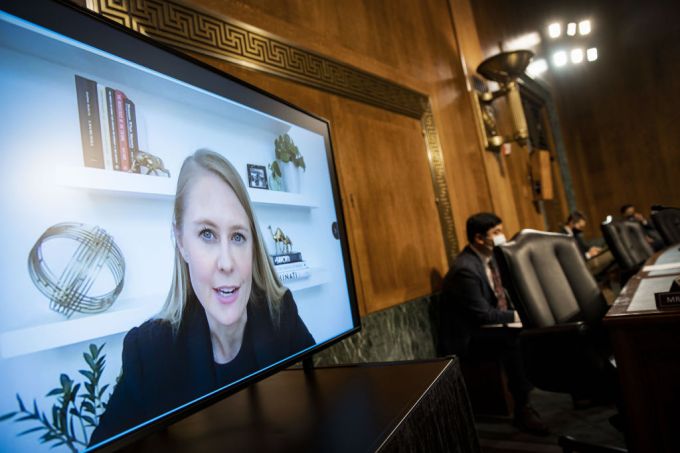
Lauren Culbertson, head of U.S. public policy at Twitter

Lauren Culbertson, head of U.S. public policy at Twitter Inc., speaks remotely during a Senate Judiciary Subcommittee hearing in Washington, D.C., U.S., on Tuesday, April 27, 2021. Photographer: Al Drago/Bloomberg via Getty Images

A broken business model

In the hearing, lawmakers pointed to flaws inherent to how major social media companies make money as the heart of the problem. Rather than criticizing companies for specific failings, they mostly focused on the core business model from which social media’s many ills spring forth.

“I think it’s very important for us to push back on the idea that really complicated, qualitative problems have easy quantitative solutions,” Sen. Ben Sasse (R-NE) said. He argued that because social media companies make money by keeping users hooked to their products, any real solution would have to upend that business model altogether.

“The business model of these companies is addiction,” Josh Hawley (R-MO) echoed, calling social media an “attention treadmill” by design.

Ex-Googler and frequent tech critic Tristan Harris didn’t mince words about how tech companies talk around that central design tenet in his own testimony. “It’s almost like listening to a hostage in a hostage video,” Harris said, likening the engagement-seeking business model to a gun just offstage.

Spotlight on Section 230

One big way lawmakers propose to disrupt those deeply entrenched incentives? Adding algorithm-focused exceptions to the Section 230 protections that social media companies enjoy. A few bills floating around take that approach.

One bill from Sen. John Kennedy (R-LA) and Reps. Paul Gosar (R-A) and Tulsi Gabbard (R-HI) would require platforms with 10 million or more users to obtain consent before serving users content based on their behavior or demographic data if they want to keep Section 230 protections. The idea is to revoke 230 immunity from platforms that boost engagement by “funneling information to users that polarizes their views” unless a user specifically opts in.

In another bill, the Protecting Americans from Dangerous Algorithms Act, Reps. Anna Eshoo (D-CA) and Tom Malinowski (D-NJ) propose suspending Section 230 protections and making companies liable “if their algorithms amplify misinformation that leads to offline violence.” That bill would amend Section 230 to reference existing civil rights laws.

Section 230’s defenders argue that any insufficiently targeted changes to the law could disrupt the modern internet as we know it, resulting in cascading negative impacts well beyond the intended scope of reform efforts. An outright repeal of the law is almost certainly off the table, but even small tweaks could completely realign internet businesses, for better or worse.

During the hearing, Hawley made a broader suggestion for companies that use algorithms to chase profits. “Why shouldn’t we just remove section 230 protection from any platform that engages in behavioral advertising or algorithmic amplification?” he asked, adding that he wasn’t opposed to an outright repeal of the law.

Sen. Klobuchar, who leads the Senate’s antitrust subcommittee, connected the algorithmic concerns to anti-competitive behavior in the tech industry. “If you have a company that buys out everyone from under them… we’re never going to know if they could have developed the bells and whistles to help us with misinformation because there is no competition,” Klobuchar said.

Subcommittee members Klobuchar and Sen. Mazie Hirono (D-HI) have their own major Section 230 reform bill, the Safe Tech Act, but that legislation is less concerned with algorithms than ads and paid content.

At least one more major bill looking at Section 230 through the lens of algorithms is still on the way. Prominent big tech critic House Rep. David Cicilline (D-RI) is due out soon with a Section 230 bill that could suspend liability protections for companies that rely on algorithms to boost engagement and line their pockets.

“That’s a very complicated algorithm that is designed to maximize engagement to drive up advertising prices to produce greater profits for the company,” Cicilline told Axios last month. “…That’s a set of business decisions for which, it might be quite easy to argue, that a company should be liable for.”

27 Apr 2021

Big tech earnings in less than 500 words

This afternoon Alphabet and Microsoft and Pinterest reported their quarterly earnings results for the first three months of 2021. Microsoft and Pinterest have rapidly lost value after reporting their results, while Alphabet appreciated after its own earnings download.

Sparing you a deluge of numbers, here’s what TechCrunch is pondering from each report in as few words as possible:

  • Alphabet’s earnings were strong across a number of fronts; investors cheered. YouTube revenue grew nearly 50% to $6.0 billion, search ads performed well, and even the infamously unprofitable “Other Bets” ground managed to post nearly $200 million in revenue. But the most notable result from the technology conglomerate was its cloud results. Google Cloud grew from $2.777 billion in revenue and an operating loss of $1.73 billion in the year-ago quarter to revenues of $4.047 billion and an operating loss of just $974 million. The Mountain View-based agglomeration of tech services is building not only a material revenue stream out of a non ad-based product, but one that could generate material operating income in time. If trends hold.
  • Microsoft’s earnings report was pretty good despite Wall Street disinterest. Microsoft grew 17% from its year-ago quarter while pushing its operating income up 31% to $17.0 billion; faster growing income compared to revenue is indicative of operating leverage. The company’s net income actually grew even more rapidly than its operating income, which is sharper than expected. Azure, the company’s Google Cloud and AWS competitor, grew 50% in the quarter which met expectations per CNBC. Microsoft remains incredibly rich, and its most future-looking products put up some pretty big numbers. Not bad!
  • Pinterest posted a monster quarter. Wall Street was not impressed. Pinterest’s Q1 2021 revenue of $485.230 million was up 78% compared to the year-ago quarter, the company cut its net loss from $141.196 million to $21.674 at the same time, and its non-GAAP net income rose from -$59.916 million to $78.527 during the first three months of the year. The result of this wildly impressive quarter? Its shares are off more than 8%. One reason Pinterest may have dropped is that the company missed on monthly active users (478 million reported, 480.5 million expected), and warned that it would see “sequential operating expense growth […] accelerate in Q2.” But with the company anticipating 105% revenue growth in the current quarter and mid-teens MAU growth in the same period, it’s hard to be that mad at the company. Unless we’re missing something major here, Pinterest is being punished by investors who simply expected even more?

And there you have it, a very quick catch up. I am not supposed to cover earnings much anymore, but while you can take the pig from the shit, it’s hard to get the pig to not blog about earnings!

27 Apr 2021

Exyn Technologies achieves highest level of aerial autonomy

Exyn Technologies announced Tuesday that it has achieved what it considers the highest level of aerial autonomy reached within the industry. The key to the achievement is that Exyn drones are immune to GPS signal loss, meaning all spatial and mapping computations are done onboard, the company said.

Under Exyn’s definitions of autonomy, which are based on a similar standard applied to automotive, the company’s drones have achieved Level 4A autonomy. This means the drones are able to explore a designated 3D area without a remote operator in the backseat, according to Exyn.

Exyn’s achievement is a major step up from the previous level 3 of autonomy, in which a human is required to be present to potentially take over, something that has prevented drones from entering spaces without ranging signals.

The Level 3 aerial autonomy landscape is also defined by point-to-point navigation, in which an operator lays out a sequence of locations for a robot to visit, and the robot does its best to get there. Autonomous aviation startup Xwing’s self-flying utility aircraft will operate on this level by following specific flight paths. However, in real-life use cases, an operator might not have intimate knowledge of the operating environment, and the robot might not be able to access existing maps to learn from and inform its movements.

“We developed an autonomous system that can take you into dark, dirty, dangerous environments,” Exyn’s CTO Jason Derenick told TechCrunch. “Place it at the edge of danger and send it off to collect the information that you need. Oftentimes the information you need is beyond the line of sight, both in terms of communications as well as visual.”

Exyn’s drones are given a capability the company calls “scoutaunomy,” which involves defining a “bounding box volume” around which the drone can fly. Using lidar sensors, the drone can identify volume between explored and unexplored spaces in order to self-navigate and create an accurate, high-resolution map of the space. The drones, which are hardware-agnostic, can also carry additional sensors that collect further information to be integrated onto the maps. 

“Think of building a three-dimensional map and then draping on top of it RGB information from the camera, so now you’ve got a photorealistic 3D representation of the space,” Nader Elm, CEO of Exyn Technologies, told TechCrunch. “If we’re carrying heat and humidity sensors, getting radiological reading, getting gas readings, checking the ventilation, et cetera. That’s going to be a very rich dataset that currently underground mining doesn’t have.”

Most of Exyn Technologies’ use cases are in the mining industry, with clients like Rupert Resources and Dundee Precious Metals, where the ability to chart the unknown can keep miners safe and inform better business decisions. The company recently announced a partnership with Swedish mining and construction giant Sandvik that will involve integrating Exyn’s mapping software with Sandvik’s mapping analytics capabilities. 

Exyn is also working with government customers for intelligence, surveillance and reconnaissance missions, as well as in nuclear energy, construction and logistics, according to the company. 

27 Apr 2021

Exyn Technologies achieves highest level of aerial autonomy

Exyn Technologies announced Tuesday that it has achieved what it considers the highest level of aerial autonomy reached within the industry. The key to the achievement is that Exyn drones are immune to GPS signal loss, meaning all spatial and mapping computations are done onboard, the company said.

Under Exyn’s definitions of autonomy, which are based on a similar standard applied to automotive, the company’s drones have achieved Level 4A autonomy. This means the drones are able to explore a designated 3D area without a remote operator in the backseat, according to Exyn.

Exyn’s achievement is a major step up from the previous level 3 of autonomy, in which a human is required to be present to potentially take over, something that has prevented drones from entering spaces without ranging signals.

The Level 3 aerial autonomy landscape is also defined by point-to-point navigation, in which an operator lays out a sequence of locations for a robot to visit, and the robot does its best to get there. Autonomous aviation startup Xwing’s self-flying utility aircraft will operate on this level by following specific flight paths. However, in real-life use cases, an operator might not have intimate knowledge of the operating environment, and the robot might not be able to access existing maps to learn from and inform its movements.

“We developed an autonomous system that can take you into dark, dirty, dangerous environments,” Exyn’s CTO Jason Derenick told TechCrunch. “Place it at the edge of danger and send it off to collect the information that you need. Oftentimes the information you need is beyond the line of sight, both in terms of communications as well as visual.”

Exyn’s drones are given a capability the company calls “scoutaunomy,” which involves defining a “bounding box volume” around which the drone can fly. Using lidar sensors, the drone can identify volume between explored and unexplored spaces in order to self-navigate and create an accurate, high-resolution map of the space. The drones, which are hardware-agnostic, can also carry additional sensors that collect further information to be integrated onto the maps. 

“Think of building a three-dimensional map and then draping on top of it RGB information from the camera, so now you’ve got a photorealistic 3D representation of the space,” Nader Elm, CEO of Exyn Technologies, told TechCrunch. “If we’re carrying heat and humidity sensors, getting radiological reading, getting gas readings, checking the ventilation, et cetera. That’s going to be a very rich dataset that currently underground mining doesn’t have.”

Most of Exyn Technologies’ use cases are in the mining industry, with clients like Rupert Resources and Dundee Precious Metals, where the ability to chart the unknown can keep miners safe and inform better business decisions. The company recently announced a partnership with Swedish mining and construction giant Sandvik that will involve integrating Exyn’s mapping software with Sandvik’s mapping analytics capabilities. 

Exyn is also working with government customers for intelligence, surveillance and reconnaissance missions, as well as in nuclear energy, construction and logistics, according to the company. 

27 Apr 2021

Taking stock of the VC industry’s progress on diversity, equity and inclusion

Let’s be clear: The venture capital industry has lacked diversity. The good news is the industry is working to improve itself.

To begin with, as an industry, venture capital can only improve what we measure. In 2016, we set out to develop a rigorous methodology for tracking progress on diversity, equity and inclusion (DEI) in venture capital, and to measure and benchmark those data through our biennial VC Human Capital Survey.

The goals of the survey — powered by the National Venture Capital Association, Venture Forward and Deloitte — are to collect demographic data on the VC workforce across all firm types, sizes, stages, sectors and geographies, as well as trends on firm talent management and recruitment practices. We’ve learned that progress can be slow and seem discouraging, but we’ve also captured evidence that diversity (and firm practices to advance diversity) is increasing in some areas, even as other areas have unfortunately not seen the same pace of change.

To begin with, as an industry, venture capital can only improve what we measure.

We fielded the survey in 2016, 2018 and 2020, and released the outcomes of the third edition last month, featuring data (as of June 30, 2020) collected from 378 firms, a marked increase from 203 participating firms in 2018. Furthermore, more than 145 firms signed the #VCHumanCapital pledge to publicly commit to submitting their DEI data.

At a high level, the data showed that improvements in diversity among investment partners have largely been driven by the hiring and advancement of female investors, while there has been little progress in the equitable representation of Black or Hispanic investment partners.

However, the demographic composition of junior investment professionals reflects greater diversity and wider adoption of diversity-focused talent management and recruitment practices suggest some cause for optimism. The industry still has a long way to go, but here are some of the key insights and changes we identified from the latest survey.

Intentionality associated with improved diversity

More firms are explicitly assigning responsibility for promoting diversity and inclusion internally — 50% of firms have a staff person or team tasked with this responsibility (compared with 34% in 2018 and 16% in 2016). Simultaneously, diversity and inclusion strategies have become more widespread; 43% of firms have implemented a diversity strategy (against 32% in 2018 and 24% in 2016), while 41% have an inclusion strategy (versus 31% in 2018 and 17% in 2016).

This intentionality translates to improved diversity outcomes. Firms with dedicated DEI staff, strategies and programs achieve greater gender and racial diversity on investment teams and among investment partners. The increased emphasis on DEI is also a broader ecosystem trend. More firms report that limited partners and portfolio companies have requested their DEI details over the past 12 months.

Encouraging signs in talent recruitment and development

Venture firms are relatively small and turnover is generally low, but 21% of firms in 2020 reported their number of senior-level investment positions had increased, while 43% said their number of junior-level positions had expanded. Meanwhile, the demographic composition of junior investment professionals reflects higher gender and racial diversity, a positive leading indicator for the diversity of future investment partners.

As overall DEI strategies have become increasingly widespread, more firms have also developed DEI-focused recruitment and hiring programs — 33% of firms have formal programs, while 74% have informal programs, both reflecting steady increases from 2016. Firms were also more likely to report that they typically seek external candidates for open positions than they did in 2018.

However, firms continue to largely rely on internal networks for recruitment, which often encourages homogeneous hiring outcomes. Between the 2018 and 2020 surveys, there was little change shown in the use of narrow recruitment methods to find external candidates; notifying peers in the VC industry (78%) and notifying the firm internally (59%) were the strategies cited most often. The exception was posting on third-party websites like LinkedIn or in newsletters, a strategy reported by 54% of firms in 2020 (a substantial increase from 37% in 2018), which presents one avenue to reach a broader audience of candidates outside of existing networks.

Assessing inclusion remains a challenge

Once talent has come on board, inclusive culture and retention become key metrics of DEI progress. More firms are implementing programs dedicated to leadership development, mentorship and retention, with about two-thirds reporting informal versions of such programs (20 percentage points higher than in 2016) and 20% of firms reporting formal programs.

Assessing inclusion through the VC Human Capital Survey is challenging because we survey one representative per firm, and one person cannot speak to the degree of inclusion felt by others. However, we added a new question to the 2020 survey to gauge how firms themselves are assessing inclusion. While 41% of firms reported having an inclusion strategy, only 26% said they conduct surveys of their employees to assess inclusion.

Subjective factors remain a key consideration in promotions

Well-structured, consistently applied policies for career advancement are critical to ensuring that diverse talent reaches the most senior decision-making levels of the industry. About 20% of firms reported having formal DEI programs focused on promotion (up from 5% in 2016), while 65% of firms have informal programs (compared with 39% in 2016).

Although DEI programs focused on the promotion of employees are more widespread, subjective factors remain a key consideration for promotion decisions, which can lead to unequal and biased outcomes.

Almost all firms reported that “contributions to the performance of the fund” (90%) and “deal origination” (82%) were very important or important factors in considering promotions. However, the factor most often rated highly was “soft skills,” with 94% of firms saying it was very important or important. These types of subjective factors present significant opportunity for unconscious bias to creep in and can detract from the weight given to objective measures more demonstrably relevant to performance.

Maintaining momentum

The results of the third edition of our survey are timely, coming on the heels of a year in which social justice and racial equity have been the subjects of sharp national focus, policymakers have sought to increase access to capital for underserved communities, and the VC industry has shown a renewed focus on DEI. The survey shows where the VC industry’s efforts should be focused and also serves as an important reminder of the intersectional needs of DEI-focused initiatives.

The data show that progress within one demographic element can be more nuanced when considering people who represent multiple marginalized communities (e.g., the percentage of investment partners who are women has steadily increased, but the percentage of investment partners who are women of color has not).

The pace of DEI progress has been slow and uneven in some areas, but there are reasons for optimism. On April 6, NVCA, Venture Forward and Deloitte hosted a discussion with industry leaders to further examine the latest survey results and to address DEI challenges, opportunities and strategies for the industry. More firms are prioritizing these constructive conversations, both within their firms and publicly with industry peers. More firms are acting in a collaborative spirit, adopting thoughtful and concrete DEI strategies and acting with intentionality and urgency.

If the industry can continue to build upon this momentum and commitment around DEI efforts, we can reach a tipping point that will translate to meaningful progress reflected in future editions of the survey.

27 Apr 2021

Red Hat CEO looks to maintain double-digit growth in second year at helm

Red Hat CEO Paul Cormier runs the centerpiece of IBM’s transformation hopes. When Big Blue paid $34 billion for his company in 2018, it was because it believed it could be the linchpin of the organization’s shift to a focus on hybrid computing.

In its most recent earnings report, IBM posted positive revenue growth for only the second time in 8 quarters, and it was Red Hat’s 15% growth that led the way. Cormier recognizes the role his company plays for IBM, and he doesn’t shy away from it.

As he told me in an interview this week ahead of the company’s Red Hat Summit, a lot, a lot of cloud technology is based on Linux, and as the company that originally made its name selling Red Hat Enterprise Linux (RHEL), he says that is a technology his organization is very comfortable working with. He sees the two companies working well together with Red Hat benefitting from having IBM sell his company’s software, while remaining neutral technologically, something that benefits customers and pushes the overall IBM vision.

Quite a first year

Even though Cormier has been with Red Hat for 20 years, he took over as its CEO after Arvind Krishna replaced Ginni Rometty as IBM’s chief executive, and long-time Red Hat CEO Jim Whitehurst moved over to a role at IBM last April. Cormier stepped in as leader just as the pandemic hit the U.S. with its full force.

“Going into my first year of a pandemic, no one knew what the business was going to look like, and not that we’re completely out of the woods yet, but we have weathered that pretty well,” he said.

Part of the reason for that is because like many software companies, he has seen his customers shifting to the cloud much faster than anyone thought previously. While the pandemic acted as a forcing event for digital transformation, it has left many companies to manage a hybrid on-prem and cloud environment, a place where Red Hat can help.

“Having a hybrid architecture brings a lot of value […], but it’s complex. It just doesn’t happen by magic, and I think we helped a lot of customers, and it accelerated a lot of things by years of what was going to happen anyways,” Cormier told me.

In terms of the workforce moving to work from home, Red Hat had 25% of its workforce doing that even before the pandemic, so the transition wasn’t as hard as you might think for a company of its size. “Most every meeting at Red Hat had someone on remotely [before the pandemic]. And so we just sort of flipped into that mode overnight. I think we had an easier time than others for that reason,” he said.

Acting as IBM’s growth engine

Red Hat’s 15% growth was a big reason for IBM showing modest revenue growth last quarter, something that has been hard to come by for the last seven years. At IBM’s earnings call with analysts, CEO Krishna and CFO Jim Kavanaugh both saw Red Hat maintaining that double digit growth as key to driving the company towards more stable positive revenue in the coming years.

Cormier says that he anticipates the same things that IBM expects — and that Red Hat is up to the task ahead of it. “We see that growth continuing to happen as it’s a huge market, and this is the way it’s really playing out. We share the optimism,” he explained.

While he understands that Red Hat must remain neutral and work with multiple cloud partners, IBM is free to push Red Hat, and having that kind of sales clout behind it is also helping drive Red Hat revenue. “What IBM does for us is they open the door for us in many more places. They are in many more countries than we were [prior to the acquisition], and they have a lot of high level relationships where they can open the door for us,” he said.

In fact, Cormier points out that IBM salespeople have quotas to push Red Hat in their biggest accounts. “IBM sales is very incentivized to bring Red Hat in to help solve customer problems with Red Hat products,” he said.

No pressure or anything

When you’re being billed as a savior of sorts for a company as storied as IBM, it wouldn’t be surprising for Cormier to feel the weight of those expectations. But if he is he doesn’t seem to show it. While he acknowledges that there is pressure, he argues that it’s no different from being a public company, only the stakeholders have changed.

“Sure it’s pressure, but prior to [being acquired] we were a public company. I look at Arvind as the chairman of the board and IBM as our shareholders. Our shareholders put a lot of pressure on us too [when we were public]. So I don’t feel any more pressure with IBM and with Arvind than we had with our shareholders,” he said.

Although they represent only 5% of IBM’s revenue at present, Cormier knows it isn’t really about that number, per se. It’s about what his team does and how that fits in with IBM’s transformation strategy overall.

Being under pressure to deliver quarter after quarter is the job of any CEO, especially one that’s in the position of running a company like Red Hat under a corporation like IBM, but Cormier as always appears to be comfortable in his own skin and confident in his company’s ability to continue chugging along as it has been with that double-digit growth. The market potential is definitely there. It’s up to Red and Hat and IBM to take advantage.

27 Apr 2021

Learn how to create an effective earned media strategy with Rebecca Reeve Henderson at TC Early Stage 2021

TechCrunch’s Early Stage 2021 is back for part two of our bootcamp-for-entrepreneurs event, with a focus on marketing and fundraising. Building on the first half of the event in April, this two-day virtual sprint will take place July 8 & 9, and we’re thrilled to welcome Rebecca Reeve Henderson as one of our all-star slate of experts. Rebecca will be joining us to share insight on how to build an effective earned media strategy for your startup, building on her deep expertise developing effective communications programs for some of the top business software companies in the world.

Earned media, aka the kind of exposure you get from a TechCrunch article, is a key element of any startup’s marketing strategy. It’s something that is best used as a complementary component to paid marketing and owned channel promotional efforts, but it’s also one of the trickiest things to get right, especially for first-time founders. Rebecca has worked with companies ranging from Slack, to Shopify, to Zapier, to Canva and many more, helping craft effective earned media strategies in one of the most difficult areas of all: B2B SaaS.

Image Credits: Rsquared Communications

Rebecca is also a founder herself, having built her communications company Rsquared from the ground up into an international business spanning the U.S. and Canada. Rsquared’s clients included startups at all stages of growth, from their very beginnings through to successful exits, including public market debuts, so she’s run effective communications campaigns at every point on the growth spectrum. Then in 2019, Rsquared had its own exit, with an acquisition by global communications firm Archetype.

We’ll hear tips from Rebecca on how earned media contributes to an effective overall communications strategy, and how you go about earning that media — including how to pitch media, and how to build successful long-term relationships with key reporters and publications in your industry.

Tickets for TC Early Stage: Marketing & Fundraising are available until this Friday at the early bird rate which gives you an instant $100 savings! Secure your seat before this weekend!

27 Apr 2021

Internal rates of return in emerging US tech hubs are starting to overtake Silicon Valley

Tech innovation is becoming more widely distributed across the United States.

Among the five startups launched in 2020 that raised the most financing, four were based outside the Bay Area. Prominent VCs like Keith Rabois of Founders Fund, David Blumberg of Blumberg Capital, and Joe Lonsdale of 8VC have moved out of the Bay Area to new emerging tech hubs, which AngelList defines as Austin, Texas; Seattle; Denver; Portland, Oregon; Brooklyn, New York; Nashville, Tennessee; Pittsburgh; and Miami.

The number of syndicated deals on AngelList in emerging markets has increased 144% over the last five years.

The number of startups in these emerging markets is growing fast, according to AngelList data, and increasingly getting a bigger piece of the VC pie.

AngelList compared the performance of startups based in emerging tech hubs to startups in Silicon Valley by internal rate of return (IRR), which measures the rate of growth these investments have generated. AngelList defines “Silicon Valley” as San Francisco, Palo Alto, Mountain View, Oakland, San Mateo, Berkeley, Redwood City, Menlo Park, San Jose, Santa Clara, Sunnyvale, Burlingame and San Carlos.

According to AngelList’s data, startups in emerging tech hubs have an aggregate IRR of 19.4% per year on syndicated deals on AngelList. Syndicated deals on AngelList in Silicon Valley have an aggregate IRR of 17.5% per year.

Total value to paid-in (TVPI), which is the return multiple net of fees, is also slightly higher for AngelList deals in emerging tech hubs (1.67x) than Silicon Valley (1.60x). This means for every $1 invested into startups based in emerging tech hubs, the investor’s portfolio is now valued at $1.67, compared to $1.60 for Silicon Valley startups.

This data is based on a sample of nearly 2,500 syndicated deals on AngelList dating back to 2013, with returns current as of January 1, 2021.

Investors we spoke with offered a variety of reasons for the rise of these emerging tech hubs, including cheaper taxes outside the Bay Area, lower cost of living and a wider distribution of talent brought on by the COVID-19 pandemic.

27 Apr 2021

Announcing the Agenda for TC Sessions: Mobility 2021

TC Sessions: Mobility is back and we’re excited to give you the first look at who is coming to the main stage and what we plan to talk about. The event will be virtual, but never fear, we will bring you the same informative panels and provocative one-on-one interviews and networking you’re used to.

The new format has provided one massive benefit: democratizing access. If you’re a startup or investor, you can listen in, network and connect with other participants here in Silicon Valley. Plus, you’ll be able to meet all of the attendees through our matchmaking platform, CrunchMatch.

You’ll need to make sure you have your ticket to join us at the event online. Our Early Bird savings end in just a couple of days, so make sure to book your $95 pass now, and save $100 before prices go up.

TechCrunch reporters and editors will interview some of the top leaders in transportation to tackle topics such as scaling up an electric vehicle company, the future of automated vehicle technology, building an AV startup and investing in the industry. Our guests include Scale AI founder Alexandr Wang, Zoox co-founder and CTO Jesse Levinson, Amy Jones Satrom of Nuro, famed investor Reid Hoffman, Joby Aviation founder JoeBen Bevirt, GM’s vice president of innovation Pamela Fletcher, Karl Iagnemma of Motional and Aurora co-founder and CEO Chris Urmson, to name a few.

Don’t forget, Early Bird Passes (including $100 savings) are currently available for a limited time; grab your tickets here before prices increase.

AGENDA

Self-Driving Deliveries with Ahti Heinla (Starship), Amy Jones Satrom (Nuro) and Apeksha Kumavat (Gatik)

Autonomous vehicles and robotics were well on their way transforming deliveries before the pandemic struck. In the past year, these technologies have moved from novel applications to essential innovations. We’re joined by a trio of companies — each with individual approaches that span the critical middle and last mile of delivery.

Supercharging Self-Driving Super Vision with Alexandr Wang (Scale AI)

Few startups were as prescient as Scale AI when it came to anticipating the need for massive sets of tagged data for use in AI. Co-founder and CEO Alex Wang also made a great bet on addressing the needs of lidar sensing companies early on, which has made the company instrumental in deploying AV networks. We’ll hear about what it takes to make sense of sensor data in driverless cars and look at where the industry is headed.

Will Venture Capital Drive the Future of Mobility? with Clara Brenner (Urban Innovation Fund), Quin Garcia (Autotech Ventures) and Rachel Holt (Construct Capital)

Clara Brenner, Quin Garcia and Rachel Holt will discuss how the pandemic changed their investment strategies, the hottest sectors within the mobility industry, the rise of SPACs as a financial instrument and where they plan to put their capital in 2021 and beyond.

From Concept to Commuter Car — and Beyond with Jesse Levinson (Zoox)

Zoox unveiled the design of its fit-for-purpose autonomous vehicle for the first time, after years of development and much anticipation. Meanwhile, the company was also acquired by Amazon in a high-profile deal that looks to give the company ample runway, while keeping its operations independent. We’ll hear from co-founder and CTO Jesse Levinson about what it’s like building an autonomous car company in the shadows of a commerce giant.

EV Founders in Focus with Ben Schippers (TezLab)

We sit down with the founders poised to take advantage of the rise in electric vehicle sales. We’ll chat with Ben Schippers, co-founder and CEO of TezLab, an app that operates like a Fitbit for Tesla vehicles (and soon other EVs) and allows drivers to go deep into their driving data. The app also breaks down the exact types and percentages of fossil fuels and renewable energy coming from charging locations.

The Future of Flight with JoeBen Bevirt (Joby Aviation) and Reid Hoffman (Reinvent Technology Partners)

Joby Aviation founder JoeBen Bevirt spent more than a decade quietly developing an all-electric, vertical take-off and landing passenger aircraft. Now he is preparing for a new phase of growth as Joby Aviation merges with the special purpose acquisition company formed by famed investor and Linked co-founder Reid Hoffman. Bevirt and Hoffman will come to our virtual stage to talk about the how build a startup (and keep it secret while raising funds), the future of flight and, of course, SPACs.

Equity, Accessibility and Cities with Tamika L. Butler (Tamika L. Butler Consulting), Tiffany Chu (Remix) and Frank Reig (Revel)

Can mobility be accessible, equitable and remain profitable? We have brought together community organizer, transportation consultant and lawyer Tamika L. Butler; Remix co-founder and CEO Tiffany Chu and Revel co-founder and CEO Frank Reig to discuss how (and if) shared mobility can provide equity in cities, while still remaining a viable and even profitable business. The trio will also dig into the challenges facing cities and how policy may affect startups.

The Rise of Robotaxis in China with Tony Han (WeRide), Jewel Li (AutoX) and Huan Sun (Momenta Europe)

Silicon Valley has long been viewed as a hub for autonomous vehicle development. But another country is also leading the charge. Executives from three leading Chinese robotaxi companies (that also have operations in Europe or the U.S.) will join us to provide insight into the unique challenges of developing and deploying the technology in China and how it compares to other countries.

Sponsored by Plus: Delivering Supervised Autonomous Trucks Globally with Shawn Kerrigan (Plus)

Plus is applying autonomous driving technology to launch supervised autonomous trucks today in order to dramatically improve safety, efficiency and driver comfort, while addressing critical challenges in long-haul trucking — driver shortage and high turnover, rising fuel costs, and reaching sustainability goals. Mass production of our supervised autonomous driving solution, PlusDrive, starts this summer. In the next few years, tens of thousands of heavy trucks powered by PlusDrive will be on the road. Plus’s COO and Co-Founder Shawn Kerrigan will introduce PlusDrive and our progress of deploying this driver-in solution globally. He will also share our learnings from working together with world-leading OEMs and fleet partners to develop and deploy autonomous trucks at scale.

Driving Innovation at General Motors with Pam Fletcher (GM)

GM is in the midst of sweeping changes that will eventually turn it into an EV-only producer of cars, trucks and SUVs. But the auto giant’s push to electrify passenger vehicles is just one of many efforts to be a leader in innovation and the future of transportation. We’ll talk with Pam Fletcher, vice president of innovation at GM, one of the key people behind the 113-year-old automaker’s push to become a nimble, tech-centric company.

AVs: Past, Present and Future with Karl Iagnemma (Motional) and Chris Urmson (Aurora)

TechCrunch Mobility will talk to two pioneers, and competitors, who are leading the charge to commercialize autonomous vehicles. Karl Iagnemma, president of the $4 billion Hyundai-Aptiv joint venture known as Motional, and Chris Urmson, the co-founder and CEO of Aurora, will discuss — and maybe even debate — the best approach to AV development and deployment, swap stories of the earliest days of the industry and provide a few forecasts of what’s to come.

EV Founders in Focus

We sit down with the founders poised to take advantage of the rise in electric vehicle sales. This time, we will chat with Kameale Terry, co-founder and CEO of ChargerHelp! a startup that enables on-demand repair of electric vehicle charging stations.

Sponsored by: Wejo: Making Mobility Data Accessible to Governmental Agencies to Meet New Transportation Demands with Bret Scott (Wejo)

Wejo provides accurate and unbiased unique journey data, curated from millions of connected cars, to help local, state, province and federal government agencies visualize traffic and congestion conditions. Unlock a deeper understanding of mobility trends, to make better decisions, support policy development and solve problems more effectively for your towns and cities.

Mobility’s Robotic Future with James Kuffner (Toyota Research Institute)

More than ever, automotive manufacturers are looking to robotics as the future of mobility, from manufacturing to autonomy and beyond. We’ll be speaking to the head of robotics initiatives at one of the world’s largest automakers  to find out how the technology is set to transform the industry.

TICKETS

As a special “Easter egg” thank you for making it to the end of the article, you can save an additional 15% on tickets with promo code “agenda2021“. Put it in the ticket widget below, and save! Early Bird pricing ends in a couple of days so be sure to book your passes today for maximum savings.