Year: 2021

19 Apr 2021

Less than 2 weeks left to save $100 on TC Early Stage 2021: Marketing & Fundraising

Regret — such an unfortunate and unnecessary emotion, is it not? If you missed out on our April TC Early Stage bootcamp, this is your chance to cast regret aside and secure your spot at TC Early Stage 2021: Marketing and Fundraising on July 8-9.

Jumping on the TC Early Stage bandwagon this well, early, offers a sweet benefit — you’ll save $100 bucks. But that early-bird savings disappears in less than two weeks. Don’t miss out. Buy your Early Stage 2021: Marketing and Fundraising ticket before April 30, at 11:59 p.m. (PT).

Let’s talk about the other benefits of attending TC Early Stage 2021: Marketing and Fundraising. This bootcamp is all about helping founders in their early innings learn, develop and improve on the essential skills required to build a successful startup.

You’ll hear from top-tier investors, seasoned founders and respected subject-matter experts across the startup ecosystem. Topics range from fundraising and marketplace positioning to growth marketing and content development.

But it’s more than just listening — all the presentations are highly interactive. It’s a rare opportunity to ask questions and get answers from the folks who’ve been there, done that and want to help you move forward.

We debuted TC Early Stage last year, and it was so well received that we doubled-down in 2021. Here’s what Ashley Barrington, the founder of MarketPearl, told us about her experience.

“Early Stage 2020 was a great opportunity to hear seasoned startup founders talking about their experiences and how they dealt with many of the same challenges I faced then and am going through now. It’s like a mini-MBA session on early-stage companies.”

Here are just two of the high-profile speakers lined up to share their knowledge in July at TC Early Stage 2021. We’re adding new speakers every week, so keep checking back.

  • Mike Duboe, general partner at Greylock will talk about the latest growth trends in consumer and B2B technology.
  • Sarah Kunst, founding partner at Cleo Capital, will share best practices and solid advice on a topic everyone wants to hear — how to get ready to fundraise.

That’s just the tip of the TC Early Stage experience. Day one will be packed with presentations and break-out sessions and day two…well that’s a whole new realm of opportunity. That’s the day-long TC Early Stage Pitch-off. TechCrunch will select 10 standout startups to pitch to a panel of VC judges for invaluable feedback and prizes, too.

Curious? You can read about the April TC Early Stage Pitch-off right here — spoiler alert: Nalagenetics took first place.

We’ll open the application process (you have to apply to be considered) in the coming weeks, so if you want in on the pitch-off action, be sure to check back.

TC Early Stage 2021: Marketing and Fundraising takes place on July 8-9. Kick regret to the curb, save $100 and learn the best ways to build a strong foundation for your startup. Remember: buy your pass before prices go up on April 30, at 11:59 p.m. (PT).

Is your company interested in sponsoring or exhibiting at Early Stage 2021 – Marketing & Fundraising? Contact our sponsorship sales team by filling out this form.

19 Apr 2021

Amazon taps ULA as first launch provider for Project Kuiper satellite constellation

Amazon’s Project Kuiper satellite constellation is one step closer to actually making it to space: The company announced it has secured an agreement with the United Launch Alliance (ULA) to fly its satellites on nine Atlas V rocket launches. Amazon intends to use multiple launch providers and spacecraft to ultimately get the full complement of 3,236 Kuiper satellites into low Earth orbit (LEO), but ULA is the first launch provider that Amazon has signed or announced.

ULA’s Atlas V is a proven workhorse in the space launch industry, having flown 85 prior missions with a perfect track record. The spacecraft was used to launch NASA’s Perseverance rover, for example, as well as Lockheed Martin’s OSIRIS-REx robotic asteroid exploration craft. While Amazon and ULA detailed to total number of launch vehicles that the contract covers, they didn’t share a timeline about when we can expect the launches to take place.

Late last year, I spoke to Amazon SVP of Devices & Services Dave Limp at our TC Sessions: Space events, and I asked him about timelines for launches. Limp said at the time that Amazon was about at the “middle of [its] design phase” for the Project Kuiper satellites, which indicates there’s still work to be done before they enter mass production, which would obviously precede launch.

Limp also pointed out that the clock is ticking for Amazon in terms of its FCC license to operate the constellation, so it essentially has to “have half [its] constellation up in about six years.” That will mean an aggressive launch schedule once the design phase is complete and its actually in the process of building its satellites.

Amazon has invested a lot of capital and time into Project Kuiper, with a commitment to back it with an initial $10 billion investment, and a dedicated staff on the project that now includes 500 people, as well as a dedicated office and research & development facility in Redmond near its global HQ.

19 Apr 2021

Apple confirms it will allow Parler to return to App Store

Apple will reinstate Parler on its App Store following its multi-month ban, according to a letter Apple has sent to Sen. Mike Lee and Rep. Ken Buck, which was made public today via a post this morning on Congressman Buck’s Twitter. TechCrunch also obtained the letter from Apple directly to confirm. The lawmakers had earlier written to Apple on March 31, 2021 to ask for additional information about why the app, which is heavily favored by conservatives, had been removed from the App Store. Apple’s response explains how Parler had violated its policies but said it has engaged in extensive conversions with Parler’s team since the app’s removal. It also says Parler’s proposed updates to the app, its content, and its moderation practices will allow it to be approved for reinstatement to the App Store immediately update its release.

Apple was one of several tech platforms that banned Parler following the Capitol riot, after it came to light how the app had been used by Trump supporters and other far-right users to call for violence and organize their plans to storm the Capitol. The insurrection left five people dead, over 140 police officers injured, and resulted hundreds of arrests.

Google and Amazon also quickly banned Parler from their respective platforms after the Capitol riot.

In Apple’s case, the company had first given Parler notice the app would be removed unless the company submitted a content moderation improvement plan. But Parler’s then-CEO John Matze posted to his own Parler account that he would not cave to Apple’s ultimatums and the app, having failed to meet Apple’s requirements, was banned. In the weeks that followed, Matze was fired by Parler’s board, controlled by Republican Party donor Rebekah Mercer.

Parler has been working to obtain re-entry to the App Store since its removal, but those efforts continued to fall short. Bloomberg reported last month, for example, that Parler had submitted new guidelines in February that were insufficient to comply with the App Store rules due to issues with violating content. That letter, addressed to Parler’s chief policy officer on Feb. 25, had stated: “There is no place for hateful, racist, discriminatory content on the App Store.”

According to Apple’s new letter, released today, things have changed. It says that Apple has now informed Parler as of April 14, 2021 that its proposed moderation practices will qualify it for reinstatement. The letter, signed by Timothy Powderly
Apple’s Senior Director of Government Affairs in the Americas, says:

In the period since Apple removed the Parler app from the App Store, Apple’s App Review Team has engaged in substantial conversations with Parler in an effort to bring the Parler app into compliance with the Guidelines and reinstate it in the App Store. As a result of those conversations, Parler has proposed updates to its app and the app’s content moderation practices, and the App Review Team has informed Parler as of April 14, 2021 that its proposed updated app will be approved for reinstatement to the App Store. Apple anticipates that the updated Parler app will become available immediately upon Parler releasing it.

The letter also notes that it did not consult with Google or Amazon in respect to its original decision to remove Parler — a response meant to put to rest the false claims of a coordinated effort between tech giants to silence conservatives.

Apple did not detail what specific changes Parler had agreed to, but earlier this year, the app was still non-compliant with Apple’s guidelines for allowing user profile pictures that featured swastikas and white nationalist imagery, and because it had permitted usernames and posts that were misogynistic, homophobic and racist, Bloomberg said at the time.

Apple’s letter, first reported this morning by CNN, indicates Parler will be approved immediately when submitted.

Apple also told TechCrunch the app’s relaunch time frame will be up to Parler to decide, but offered no additional comment.

Apple Response April 19, 2021 by TechCrunch on Scribd

19 Apr 2021

Alan raises $220 million for its health insurance and healthcare super app

French startup Alan has raised a $220 million funding round at a $1.67 billion valuation (€185 million and €1.4 billion respectively). Coatue is leading the round with Dragoneer, Exor, and existing investors Index Ventures, Ribbit Capital and Temasek also participating.

Alan has been building health insurance products from scratch. When I first covered the company back in 2016, the startup had just managed to get approval from regulators to become an official health insurance company.

Since then, it’s been a not-so-slow and steady growth story as the company now covers 160,000 people. Overall, Alan generates over €100 million in annualized revenue. While most of that revenue is spent back on claims, it’s an impressive revenue trajectory.

Like other insurance companies, Alan has some capital requirements to comply with health insurance regulation. Alan has to raise more if it wants to insure more people. But that’s just part of the story as the startup still had enough cash on its bank account for the next 12 to 18 months.

“The context is that we managed to end the year 2020 very strong, finally — and I say finally because it’s been stressful until the last minute,” co-founder and CEO Jean-Charles Samuelian-Werve told me.

Alan managed to meet its goals and international expansion finally started to take off. Many startups try to raise when they’re in a strong position. You shouldn’t wait until you have your back against the wall and that’s exactly what’s happening here.

“We thought it was the right time and we had multiple term sheets. Even though valuation is really good we first looked at a partner that has a really long-term vision,” Samuelian-Werve said.

With today’s funding round, the company can iterate on its core product — health insurance — and everything that makes Alan a super app — a single app that lets you access several services. In France, employees are covered by both the national healthcare system and private insurance companies. Alan sells its products to other companies so that their employees are automatically covered by Alan contracts. It’s a sort of B2B2C play.

9,400 companies have opted for Alan in France, Belgium and Spain — the company’s home market remains its main market. Clients include WeWork, Deliveroo, JustEat, Vitaliance and Big Mamma. By 2023, Alan wants to reach 1 million members.

In order to gain more customers, Alan is betting on three pillars — product innovation, customer satisfaction through additional services, and expansions to new verticals and markets.

When it comes to product innovation, Alan has designed a modular insurance builder. Small companies can subscribe to Alan in a few clicks. Big companies can tweak every single parameter to build the right insurance package for them.

After that, the company tries to make it easy to manage your health insurance. You’ll soon be able to automatically manage sick leaves, change the employee affiliation status, etc. As for employees, the company has always promoted a transparent offering. For instance, you should know how much you’re going to pay out of pocket when you see a doctor. You can see a map of doctors around you and how much they charge on average. This way, there’s no surprise.

Alan also tries to reimburse you as quickly as possible. If it’s a straightforward claim, the startup tries to analyze and categorize your claim as quickly as possible and then issue an instant SEPA transfer. 75% of claims are reimbursed and available on your bank account in less than an hour.

These core product features definitely contributes to customer satisfaction. But Alan is expanding beyond insurance products with several additional services that should increase retention. For instance, you can chat with a doctor, get medical advice for your baby’s health, get a free meditation app subscription, start a telehealth appointment via a partner, talk with someone about your mental health, etc.

Those services contribute to turning Alan into a super app for your health. Essentially, as soon as you’re insured by Alan, you become a member and can access all those services without additional charges.

Eventually, Alan plans to launch a personal care guidance service to help you contact the right healthcare professional based on your health issue. In Spain, Alan can already book appointments for you.

Finally, Alan plans to reach new customers through aggressive expansion goals. The company plans to hire 400 people within the next three years and expand to other industries with tailor-made insurance products, such as retail, wholesale and manufacturing.

While the company is still going to focus on France, Belgium and Spain in the near future, it is looking at opportunities across Europe. So let’s see where Alan is going to expand next.

19 Apr 2021

Knox Financial raises $10M to take the pain out of being a landlord

We’ve all heard the phrase “passive income” to describe how people can make money by owning rental properties. Many Americans would love to passively earn money, but the process of becoming a landlord can be intimidating and complicated. 

I mean, how many people have looked back and wished they hadn’t sold a property after seeing its value rise years after selling it?

And those who are already landlords can get overwhelmed by the complexities of managing properties.

One startup out of Boston, Knox Financial, aims to help people identify and manage residential rentals with its algorithm-based platform, and it’s raised a $10 million Series A to help it further that goal. Boston-based G20 Ventures led the round, which included participation from Greycroft, Pillar VC, 2LVC, and Gaingels.  

The investment brings Knox’s total raised since its inception in 2018 to $14.7 million. The company closed on a $3 million seed round in January 2020, led by Greycroft.

Knox co-founder and CEO David Friedman is no stranger to startups. He founded Boston Logic – an integrated marketing platform and online marketing services for real estate offices and agents – in 2004. He sold that company (now under the name Propertybase) to Providence Equity for an undisclosed amount in 2016.

Knox launched its platform in March of 2019, with the goal of offering homeowners who are ready to move “a completely hands-off way” of converting a home they’re moving out of into an investment property. It also claims to help landlords more easily and efficiently manage their rentals.

At the time of its seed round early last year, the company was only operating in the Boston market and had 50 units on its platform. It’s now operating in seven states, has “hundreds” of investment properties on its platform and is overseeing a portfolio of more than $100 million.

So how does it work? Once a property is enrolled on Knox’s “Frictionless Ownership Platform,” the company automates and oversees the property’s finances and taxes, insurance, leasing and legal, tenant and property care, banking and bill pay.

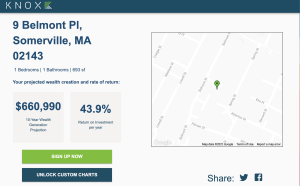
Knox also has developed a rental pricing and projection model for calculating the investment rate of return a property will produce over time.

Image Credits: Knox Financial

“We save investors a lot and almost always make their portfolios more profitable,” Friedman said. “If someone is moving or upsizing, we can turn properties into incredible ROI generators or cash flow.”

The company’s revenue model is simple.

When a dollar of rent moves through our system, we keep a dime,” Friedman told TechCrunch. “We align our interests with our customers. If there’s no rent coming in, we’re not making money. Or if a tenant doesn’t pay rent, we don’t make money.”

Knox plans to use its new capital to continue expanding geographically and getting the word out to more people.

“We want to become the de facto platform for real estate investment acquisition and ownership,” Friedman said. “And we have to be coast to coast to really do that for everybody. So, we’re still very early in our growth trajectory.”

Bob Hower, co-founder and partner of G20 Ventures, shared that weeks after his college graduation, he had bought a fixer upper with his mother’s help. A week after finishing renovations, he put the house on the market. Over the subsequent 5 months, he gradually reduced the price as the market softened, and eventually the property sold at a small profit.

“That house now is worth a multiple of what I paid for it,” Hower recalls. “In hindsight, the mistake I made was deciding to sell the house at all.”

That experience helped Hower appreciate what he describes as a “clarity of thinking” in Knox’s business model.

“Had Knox existed decades ago, I’d likely still have that fixer-upper I bought after college,” he said. “Investing platforms such as Betterment have collapsed multiple advising and optimization activities into a simple single-sign-on service, and Knox is the first company to apply this type model to residential real estate investing.”

19 Apr 2021

Tyltgo’s same-day delivery platform lets small businesses compete with Amazon

Tyltgo wants to make it easier for restaurants and small businesses to compete with same-day delivery services offered by the likes of Amazon and HelloFresh. The Canadian company, which recently raised CAD $2.3 million (USD $1.8 million) in a seed round, is akin to a white label Uber Eats, providing businesses an on-demand delivery platform under their own branding that connects them to gig economy couriers.

“I think about us as a post-purchase experience company,” co-founder and CEO Jaden Pereira told TechCrunch. “The recipient goes directly onto the merchant’s platform and places orders through them, so it feels like they’re interacting with the brand they purchased from throughout the entire experience. Our messages, notifications, tracking pages and delivery are all customized under the merchant’s brand name, but it’s powered by Tyltgo.”

The necessity of having products delivered during the pandemic’s shelter-in-place orders combined with the massive reach of e-commerce giants like Amazon has created a society that expects same-day deliveries. Tyltgo recognized the exclusionary nature of that reality on smaller businesses with less time and fewer resources, and contrived to remedy the situation with some innovative tech and gig economy couriers.

In July 2018, Pereira, 22, co-founded the company with fellow student and developer Aaron Paul while studying at the University of Waterloo. Pereira originally did deliveries himself as a side hustle, while building up a consumer-facing service on Shopify. In October 2019, Pereira and Paul shifted focus to B2B, identifying the real problem as merchants struggling to offer quality same-day delivery at an affordable price.

From December 2019 to December 2020, Tyltgo’s revenue grew 2000%, says Pereira. The company started 2020 with two staff members and ended with nine, including former head of Uber Eats Canada’s marketplace operations, Joe Rhew, and former director of engineering at Goldman Sachs-acquired fintech company Financeit, Adnan Ali.

Aided by funding from VC firm TI Platform Management, Y Combinator and angel investor Charles Songhurst, Tyltgo projects another 1500% revenue growth for 2021. The company’s goal is to expand its team, develop an API and app-based platform, and add 100 more merchants across Ontario.

Pereira said Tyltgo originally focused on florists, and occasionally pharmacies, but demand from the restaurant industry led to the company’s new target — meal kit deliveries.

Meal kit services that provide the culinarily challenged with perfectly portioned ingredients and cooking instructions were already gaining popularity in the before times. When the pandemic hit, services like HelloFresh and Blue Apron saw even more growth. As restaurants struggled to keep their businesses open, many started to get in on the action, delivering restaurant-quality meals with instructions for heating and serving.

The global meal kit delivery services market is expected to reach almost $20 billion by 2027, with heat-and-eat options taking a large share of that market. Tyltgo is counting on the success of this industry. It has already secured partnerships with restaurants like General Assembly Pizza and Crafty Ramen, as well as with more traditional meal kit delivery services from grocery stores and organic farms.

Pereira said working in the “quasi-perishable space” of flowers and meal kits is both a challenge and a differentiator for the company. Depending on the contents of the delivery, Tyltgo will determine its perishability window and make sure to match that window with a driver. It’s also got an advanced fleet management platform that assigns a number of deliveries to suit the size of a courier’s vehicle.

“In the earlier days, the hardest part was being able to match those perishability windows without causing damage to the products,” said Pereira. “We all know that in logistics, you have to account for traffic, weather conditions, all these other things, but you have an eight hour delivery window to get out 35 deliveries.”

Another challenge is ensuring the top quality service Tyltgo advertises while working in the gig economy. Selecting for reliable couriers has slowed the company down at points, but Tyltgo aims to grow capacity only if it can simultaneously maintain a low error threshold.

“We won’t bring on a merchant if we don’t think we have the capacity to handle their deliveries and meet those expectations,” said Pereira.

Whether or not Tyltgo’s meal kit focus will end up driving scalability in the long run, the platform itself has legs. Pereira’s goal is to see Tyltgo become a part of every post-purchase customer experience for all retail trade categories, and that includes expanding into customer service, branding and transactions on top of delivery.

“The main reason why we’re doing this is because a lot of these smaller, brick-and-mortar retailers don’t have the time and resources to be able to compete with the Amazons of the world,” said Pereira. “We want to be able to put that power in their hands.”

19 Apr 2021

The Klaviyo EC-1

E-commerce is booming as retailers race to transform their brick-and-mortar footprints into online storefronts. By some counts, the market grew an astonishing 42% in 2020 in the wake of the COVID-19 pandemic, and estimates show that online spending in the U.S. will surpass $1 trillion by 2022. It’s a bonanza, and everyone is figuring out this new terrain.

Consumers are likely familiar with the front-end brands for these storefronts — with companies like Amazon, Shopify, Square, and Stripe owning attention — but it’s the tooling behind the curtain that is increasingly determining the competitiveness of individual stores.

Klaviyo may not be a household name to consumers (at least, not yet), but in many ways, this startup has become the standard by which email marketers are judged today, triangulating against veterans Mailchimp and Constant Contact and riding the e-commerce wave to new heights.

Founded in 2012, this Boston-based company helps marketers personalize and automate their email messaging to customers. By now, most people are intimately familiar with these kinds of emails; if you’ve ever given your email address to an online store, the entreaties to come back to your abandoned cart or browse the latest sale are Klaviyo’s bread and butter.

It may seem obvious in retrospect that email would grow to become a premier platform for marketing, but this wasn’t the case even a few years ago when social ads and search engine marketing were the dominant paradigm. Today, owned marketing and customer experience management are white-hot trends, and Klaviyo has surged from a lifestyle business to a multi-billion dollar behemoth in just a few short years. Its story is at the heart of the internet economy today, and the future.

TechCrunch’s writer and analyst for this EC-1 is Chris Morrison. Morrison, who previously wrote our EC-1 on Roblox, has been a writer and independent game developer covering the video game industry and the marketing challenges that come with publishing. As an analyst and a potential user, he’s in a unique position to explain the Klaviyo story. The lead editor for this package was Danny Crichton, the assistant editor was Ram Iyer, the copy editor was Richard Dal Porto and illustrations were created by Nigel Sussman.

Klaviyo had no say in the content of this analysis and did not get advance access to it. Morrison has no financial ties to Klaviyo or other conflicts of interest to disclose.

The Klaviyo EC-1 comprises four main articles numbering 9,700 words and a reading time of 43 minutes. Let’s take a look:

  • Part 1: Origin storyHow Klaviyo transformed from a lifestyle business into a $4.15B email titan” (2,600 words/10 minutes) — Explores the rise of Klaviyo from a database for e-commerce data into a modern email powerhouse as it successively learned from customers and bootstrapped in the absence of funding from accelerators and early VCs.
  • Part 2: Business and growthHow Klaviyo used data and no-code to transform owned marketing” (3,000 words/12 minutes) — Analyzes Klaviyo’s recent growth and how marketers increasingly focus on owned marketing channels and customer experience management.
  • Part 3: Dynamics of e-commerce marketingMarketing in 2021 is emotional and not just transactional” (2,200 words/9 minutes) — To fully understand Klaviyo and this new world of martech, this article contextualizes how and why marketers are increasingly trying to personalize and build deeper emotional bonds with their customers outside of social media channels.
  • Part 4: Lessons on startup growthDrama and quirk aren’t necessary for startup success” (1,900 words/8 minutes) — Founders shouldn’t have to keep learning the same lessons over and over again. Klaviyo offers a number of tried-and-true tutorials to understand how to build a competitive startup and not get bogged down in finding product-market fit and scaling.

We’re always iterating on the EC-1 format. If you have questions, comments or ideas, please send an email to TechCrunch Managing Editor Danny Crichton at danny@techcrunch.com.

19 Apr 2021

How Klaviyo transformed from a lifestyle business into a $4.15B email titan

Startups are stories of feverish dreams and obsessive fears. Short of hearing it from the source, a glimpse into the inbox of a founder would be the best way to experience the travails they endure on the way to building a business. A customer finally makes a purchase, a VC invests or walks away, an employee signs their offer letter — all of the major and minor milestones of a startup are communicated via that now-ancient medium of email.

Current Klaviyo users may be surprised to hear that email was not a part of the initial product.

Email’s ubiquity is only part of the story, though. It’s also a symbol of freedom: The last social platform that remains relatively open and free from the clutches of a single monopoly owner. It’s a market rife with entrenched incumbents, but one that simultaneously continues to invite founders to find some new take on this venerable communications channel and make it better for everyone.

That was the mission that Andrew Bialecki and Ed Hallen undertook when they founded Klaviyo back in 2012. What they perhaps didn’t bank on was just how long of a route they were about to take — or how many rejections they might find in their own inboxes from accelerators and VCs who never thought a new generation of email service providers could make it.

So they bootstrapped, kept things lean. They debated canceling dinners to pay the bills when customers churned. And along the way, they built a special startup that is today valued at a whopping $4.15 billion. Klaviyo is the story of how two scrappy, inexperienced entrepreneurs set out to build a lifestyle business — and ended up creating an email titan.

Racing to the starting line

Klaviyo’s origin story sounds a bit like the generic advice given by every book on entrepreneurship. Andrew Bialecki — he goes by AB — had a need that no existing company filled. So, he started a company to address that need.

It began with what he calls a side hustle: a website devoted to cataloging the dates and locations of running races. Bialecki had the technical chops to build it, but the data wasn’t already available online and he needed race organizers to provide it. That, in turn, meant he needed to let them know his site existed and constantly follow up to make sure they were using it.

“I realized I’m on the phone with people and it’s never going to scale. After a while, I was working on that while I was at another startup, and I said I have two options here. Either I can go all-in on road races, or all-in on the problem: ‘How do we help these businesses connect with the people using their software or products?’” recalls Bialecki.

By then, he already had a co-founder in mind. Bialecki had been a student together with Ed Hallen at MIT, but the pair actually met while working at Applied Predictive Technologies (APT), a Washington, D.C. tech consultancy.

“I’d read all those books on, hey, when you’re looking for someone to start a business with, you want someone with similar values who’s also complementary,” says Bialecki. “I’d known he was kind of interested in starting a company, and we had really complementary skillsets. I loved the engineering and design and product, and he was a big product guy too, but was used to working with customers and clients.”

An email company that didn’t (initially) do email

Current Klaviyo users may be surprised to hear that email was not part of the product that emerged. Instead, Bialecki and Hallen built a database to collect all the e-commerce data that was falling through the cracks.

“Once we really talked to a lot of e-commerce people, it was clear there were long-standing problems,” says Hallen.

Bialecki adds, “There are facts you know, like their name, their email address, their favorite color or something they told you about their birthday. But some of the harder stuff was, jeez, how many times has this person visited my website, bought something from me, what products did they buy and how is that trending over time? Were they a really frequent customer that dropped off the face of the Earth?”

As they spoke to customers, the founders realized that handling customers’ data and making it useful to them was going to be critical to Klaviyo’s success. It just so happened that gathering data matched well with their experiences working at APT.

“We had a ton of experience stitching together data sources,” says Hallen. “We took that expertise and put it as our foundation. What’s the most broken, largest market, and let’s really tie data to it, not as an afterthought.”

Klaviyo’s two co-founders Andrew Bialecki and Ed Hallen in July 2012. Image Credits: Klaviyo

What that required, in practical terms, was spending the initial months building a custom database to store the disparate data types that come up during e-commerce transactions — events, documents and object data models. Conor O’Mahony, who joined the company in 2018 as chief product officer and departed this month to become an advisor, says that the company’s early time investment in its database laid the foundations for its later success in scaling up.

19 Apr 2021

How Klaviyo used data and no-code to transform owned marketing

Email is the communication medium that refuses to die.

“Eventually, every technology is trumped by something new and better. And I feel that email is ready to be trumped. But by what?” wrote the venture capitalist Fred Wilson in 2007. Three years later, he updated readers that other forms of messaging had outgrown email. “It looks like email’s reign as the king of communication is ending and social networking is now supreme,” he said. (To be fair to Wilson, his view was nuanced enough to continue investing in email tech.)

Despite the competition, Klaviyo didn’t just break into the market — it has also achieved an unusual level of excitement and loyalty among marketers despite its youthful history.

Investors weren’t alone — marketers have also spent years anticipating the next big thing.

“It was SMS, it was YouTube, it was Instagram. Before that it was Facebook, then it was Snapchat and TikTok. I kinda feel like individually all those things are fleeting. I think people found: You know what? Everyone still opens their emails every day,” says Darin Hager, a former sneaker entrepreneur who is now an email marketing manager at Adjust Media.

Email has an estimated four billion users today and continues to grow steadily even as mature social networks plateau. Estimates of the number of nonspam messages sent each day range from 25 billion to over 300 billion.

Unsurprisingly for a marketing channel with so much volume, there’s voluminous competition to send and program those emails. Yet, despite the competition, Klaviyo didn’t just break into the market — it has also achieved an unusual level of excitement and loyalty among marketers despite its youthful history.

“If you’re not using Klaviyo and you’re in e-commerce, then it’s not very professional. If you see ‘Sent by Constant Contact or Mailchimp’ at the bottom of an email by a brand, it makes it look like they’re not really there yet,” Hager said.

How did Klaviyo become the standard solution among email marketers?

In Klaviyo’s origin story, we delved into part of the answer: The company began life as an e-commerce analytics service. Once it matured to compete as an email service provider, Klaviyo benefited from the edge given by its deeper, more comprehensive focus on data.

However, that leaves several questions unanswered. Why is email so important to e-commerce? What are the substantive differences between Klaviyo’s feature set and those of its competitors? And why did several large, well-funded incumbents fail to capitalize on building an advantage in data first?

In this section, we’ll answer those questions — as well as laying out the significance of COVID-19 on the e-commerce market, and how newsletters and AI figure into the company’s future.

A positive Outlook on email’s longevity

Email is one of the oldest tech verticals: Constant Contact, one of the most venerable email service providers (ESPs), was founded in 1995, went public in 2007 and was taken private in 2015 for $1 billion. By the time Klaviyo started in 2012, the space was well served by numerous incumbents.

19 Apr 2021

Marketing in 2021 is emotional and not just transactional

Brands are emotions made physical. The clothes we wear, the media we consume, the devices we use — all signal not only to others what we value and see in ourselves, they also are a way to construct our very identities. Experimenting to deepen that bond has been at the core of the marketing profession for a century; its origins rooted in Freudian psychoanalysis.

There had always been one critical limitation, though: Marketers had to appeal to the masses. Radio, television and print media allowed brands to deliver only one message to everyone, no matter if their product conferred luxury or smart cost-consciousness.

On the internet, the masses have been shattered into ever smaller shards, shifting that marketing calculus toward targeted audiences and social network interest groups. Today, niche brands, large corporations and every business in between are reaching ever-narrower audiences.

Marketers who become expert at personalization, especially for existing customers through owned marketing platforms like email, will hold an edge over their competitors.

Yet, advertising and social networks are competitive marketplaces. Over time, prices to reach niche audiences rise, and strategies that once worked become unviable. In 2021, these perpetual challenges are joined by two new factors: a fresh influx of new e-commerce brands and changing privacy policies on third-party platforms.

Klaviyo benefits from these secular trends. While the cost or difficulty of acquiring new customers may increase, as we looked at in the second part of this EC-1, the cost of emailing an existing one remains much the same. Marketers who become expert at personalization, especially for existing customers through owned marketing platforms like email, will hold an edge over their competitors. It’s no longer about marketing to narrow slices of audiences — it’s about building an emotional bond with an audience of one.

To a booming economy, now ad inflation

While 2020 was a banner year for e-commerce in the wake of the COVID-19 pandemic, the early months of 2021 have brought about a new problem: Customer acquisition costs are rising, sometimes to a worrying degree. For instance, one company interviewed by TechCrunch that did not wish to be named said it has seen its return on investment for Facebook ads fall by nearly half in the first months of 2021. Such inflation has also been predicted by firms like ECI Media Management.

There are two possible reasons for this increase. First, an unprecedented number of companies are moving online, spurred by COVID-19 and worldwide lockdowns.