Year: 2021

19 Apr 2021

UiPath raises IPO range, still targets lower valuation than final private round

Robotic process automation unicorn UiPath is set to go public this week, concentrating our focus on its value.

The well-known company was last valued on the private markets at $35 billion in February when it closed a $750 million round. Living up to that price as a public company, however, at least when it comes to its formal IPO price, is proving to be challenging.

In a sense, that’s not too surprising given that the red-hot IPO market cooled as Q1 2021 came to a close. UiPath raised its last private round when the markets were most interested in public offerings, and is now going public in a slightly altered climate.

In numerical terms, UiPath raised its IPO range from $43 to $50 per share, to $52 to $54 per share. That’s a 21% jump in the value of the lower-end of its range, and an 8% gain to the value of the upper-end of its per-share IPO price interval.

UiPath is also selling more shares than before, which should make its total valuation slightly larger at the top-end than a mere 8% gain. So let’s go through the math one more time. Afterwards, we’ll stack its new simple, fully-diluted IPO valuations against its final private price, ask ourselves if our musings on the company’s recent profitability bore out, and close by asking where the company might finally price, and if we expect it to do so above its new price range.

UiPath at $54

19 Apr 2021

Fitbit’s latest is a $149 ‘luxury’ fitness tracker

It’s been a strange few years for Fitbit. After defining the fitness tracking space, the company was a bit late to the smartwatch trend, but was still able to ride that wave to a rebound. But while watches have received most of the press the now Google-owned company has garnered in recent years, bands still comprise a substantial part of its business.

Today Fitbit announced the arrival of the Luxe. It’s a weird product. There’s certainly a market for it, but it’s hard to say how much of a niche were talking about here. The company called its target demo, “a unique set of buyers whose needs weren’t being met.” Specifically, the product is a “fashioned-forward” tracker for people looking for something a bit nicer than a plastic band to wear out and about.

Frankly, it’s hard not to see some reflections of Misfit’s take on the category. Perhaps the Fossil-owned company was ahead of its time. At $149, the device is priced between the Charge and the Versa, but decidedly closer to the former. That is to say, it’s pricey in the grand scheme of fitness trackers, but more or less in line with other Fitbit products.

It is, indeed, a nice-looking tracker, as far of these things go, featuring a color touchscreen surrounded by a stainless steel case. That’s coupled with a broad range of accessories, ranging from leather to gold-colored stainless steel.

Here’s Fitbit co-founder and GM (under Google) James Park:

Over the past year, we’ve had to think differently about our health – from keeping an eye out for possible COVID-19 symptoms to managing the ongoing stress and anxiety of today’s world. Even though we are starting to see positive changes, it has never been more important to manage your holistic health. That’s why we’ve been resolute in introducing products to support you in staying mentally well and physically active. We’ve made major technological advancements with Luxe, creating a smaller, slimmer, beautifully designed tracker packed with advanced features – some that were previously only available with our smartwatches – making these tools accessible to even more people around the globe.

Certainly physical and mental health have been top of mind over the past year, even as step counts have dramatically plummeted. The device sports the usual array of Fitbit sensors, tracking activity, sleep and stress. It also works with a number of different mindfulness/meditation apps, including the company’s recently announced partnership with Deepak Chopra.

The band is up for preorder starting today and starts shipping in the spring.

19 Apr 2021

Facebook is expanding Spotify partnership with new ‘Boombox’ project

Facebook is deepening its relationship with music company Spotify and will allow users to listen to music hosted on Spotify while browsing through its apps as part of a new initiative called “Project Boombox,” Facebook CEO Mark Zuckerberg said Monday.

Facebook is building an in-line audio player that will allow users to listen to songs or playlists being shared on the platforms without being externally linked to Spotify’s app or website. Zuckerberg highlighted the feature as another product designed to improve the experience of creators on its platforms, specifically the ability of musicians to share their work, “basically making audio a first-class type of media,” he said.

We understand from sources familiar with the Spotify integration that this player will support both music and podcasts. It has already been tested in non-U.S. markets, including Mexico and Thailand, and that it’s expected to arrive in about a week.

The news was revealed in a wide-ranging interview with reporter Casey Newton on the company’s future pursuits in the audio world as Facebook aims to keep pace with upstart efforts like Clubhouse and increased activity in the podcasting world. The effort was not further detailed in a company blog post summarizing the audio announcements.

“We think that audio is going to be a first-class medium and that there are all these different products to be built across this whole spectrum,” said Zuckerberg. “Of course, it includes some areas that, that have been, you know, popular recently like like podcasting and and kind of live audio rooms like this, but I also think that there’s some interesting things that are that are under explored in the area overall.”

Spotify has already supported a fairly product relationship with the Facebook and Instagram platforms. In recent years the music and podcasts platform has been integrated more deeply into Instagram Stories where users can share content from the service, a feature that’s also been available in Facebook Stories.

19 Apr 2021

Facebook invests in audio with short-form Soundbites feature, podcast support, and a Clubhouse clone

Facebook today officially announced a suite of new audio products — an indication that it’s taking the threat from Clubhouse and other audio platforms more seriously. The company is doing more than just building its own take on Clubhouse, however, it’s also announcing tools that allow podcast creators to share long-form audio, a new Spotify integration for music, and a brand-new short-form experience called Sound Bites.

The Clubhouse clone was probably the most-discussed of the new products ahead of today’s announcement, given the increased interest in the audio networking market.

Like Clubhouse, the Facebook experience will also involve live audio rooms, where users can engage in topical discussions.

“I think the areas where is where I’m most excited about it on Facebook are basically in the large number of communities and groups that exist. I think that you already have these communities that are organized around interests, and allowing people to come together and have rooms where they can talk is — I think it’d be a very useful thing,” said Zuckerberg, in a friendly interview with Platformer, timed alongside the official announcement. “When we launched video rooms earlier last year, groups and communities were one of the bigger areas where that took off. So, I think around audio, just given how much more accessible it is, that’ll be a pretty exciting area as well.”
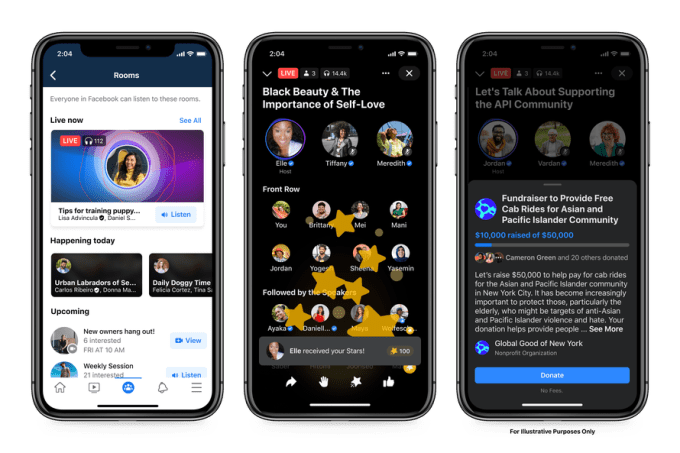
Image Credits: Facebook

The Live Audio Rooms will be available across both Facebook and Messenger, Facebook says in an official blog post.

The company will first test Live Audio Rooms in Groups, reaching Groups’ 1.8 billion monthly users. They’ll also be made available to public figures and experts. Early adopters of the feature will include American football quarterback Russell Wilson, Grammy-nominated electronic music artist TOKiMONSTA, artist and director Elle Moxley, and five-time Olympic medalist and entrepreneur Nastia Liukin, Facebook says.

Live Audio Rooms will be available to everyone on Facebook this summer. Also this summer, Live Audio Rooms will be made available on Messenger, for an experience that allows friends to hang out, too.

In addition to products that rehash audio functionality available in tech products from other companies, Zuckerberg also revealed that the company was working on an audio-only version of its TikTok competitor Instagram Reels that allows users to quickly move through algorithmically-sorted short audio clips, a project being called Soundbites. In its blog post, Facebook detailed that they will be testing Soundbites over the next few months with a small group of creators before making it widely available.
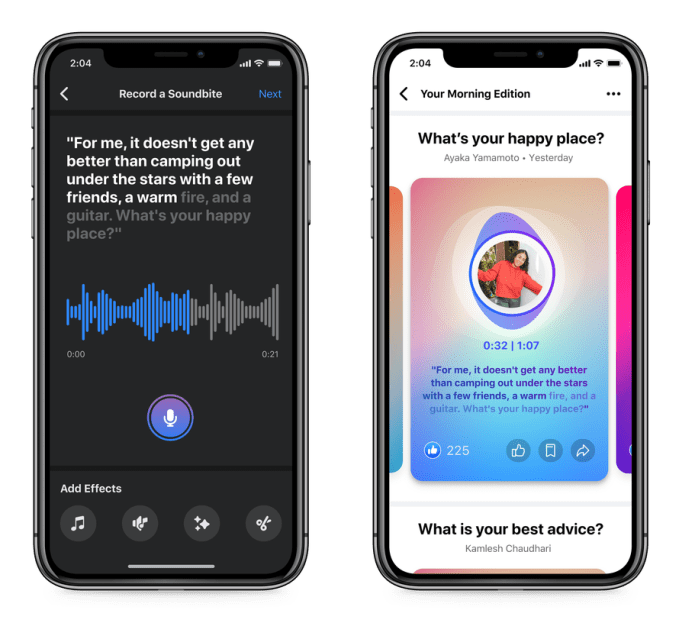
Image Credits: Facebook

“The idea here is it’s short form audio clips, whether it’s people sharing things that they find funny… or kind of pithy things that people want to share that cover a bunch of different genres and topics,” Zuckerberg said.

For podcast creators, Zuckerberg said the company will build out tools for those who follow podcasts and creators through Facebook Pages, but don’t currently have a way to access podcast content via the social network. He noted that there are now 170 million Facebook users who are connected to a Page for a podcast, which it why it wants to ensure they have a way to access this audio content more easily.

Image Credits: Facebook

For these users, they’ll be able to discover the audio and start playing it, even in the background. Or they could choose to launch a second app to continue play it. The feature will also help users with new podcast discovery based on your interests, and users will be able to comment on podcasts and recommend them to friends.

Related to these audio efforts, Zuckerberg referenced Facebook’s partnership with Spotify, which is now being expanded with something it has internally referred to as “Project Boombox” — is an integration that would allow people to share content from their favorite artists, playlists and other types of audio in their feed. That content would then appear in a little, in-line player for others to click and play.

Zuckerberg also referenced the need to serve the growing creator economy with its new products.

With Live Audio Rooms, fans will be able to support creators through Stars, Facebook existing in-app tipping feature, or donate to causes. Facebook says it will later offer other monetization tools like access to Live Audio Rooms on subscriptions. There’s also an Audio Creator Fund being made available to kick off the launch of Soundbites.

More to come…

19 Apr 2021

Geico admits fraudsters stole customer driver’s license numbers for months

Geico, the second-largest auto insurer in the U.S., has fixed a security bug that let fraudsters steal customer driver’s license numbers from its website.

In a data breach notice filed with the California attorney general’s office, Geico said information gathered from other sources was used to “obtain unauthorized access to your driver’s license number through the online sales system on our website.”

The insurance giant did not say how many customers were affected by the breach but said the fraudsters accessed customer driver’s license numbers between January 21 and March 1. Companies are required to alert the state’s attorney general’s office when more than 500 state residents are affected by a security incident.

Geico said it had “reason to believe that this information could be used to fraudulently apply for unemployment benefits in your name.”

Many financially-driven criminals target government agencies using stolen identities or data. But many U.S. states require a government ID — like a driver’s license — to file for unemployment benefits. To get a driver’s license number, fraudsters take public or previously breached data and exploit weaknesses in auto insurance websites to obtain a customer’s driver’s license number. That allows the fraudsters to obtain unemployment benefits in another person’s name.

Earlier this year, San Francisco-based insurance startup Metromile admitted a bug on its website was used to obtain driver’s license numbers for six months before the bug was fixed in January.

If you’ve received correspondence from your state government and haven’t filed for unemployment benefits, there’s a good chance your personal data may have been used fraudulently.

Geico spokesperson Christine Tasher did not return multiple requests for comment.

19 Apr 2021

These three investors think founders need some TLC (Collective funds)

Venture capital is a networks business — from networks of founders to the web of investors and angels and gossamer threads of potential customers, talent, and service providers. The density of those networks determines success: find just the right person to fit a role or a slot on a cap table, and a startup might just get a bit more lift.

It’s a topic that Casey Caruso has thought a lot about. In a research project at Stanford, she looked at a slightly different form of network density: using convolution neural network (CNN) models to evaluate investment decisions, working with a group of three other authors to analyze how to optimize VC using algorithms. It’s a cross-over point she’s familiar with, building upon a technical background and an engineering role at Google while also part-time investing with Bessemer.

While at a dinner at San Francisco’s northern Italian restaurant SPQR in Lower Pac Heights, she talked about investing with friends Lauren Stephanian, now a principal at blockchain-focused Pantera Capital, and Terri Burns, a partner at GV. They realized that much like how all roads lead to Rome, all three were on paths heading for the same direction: using technology to improve venture decision-making. “We are all computer scientists by training,” Caruso said. “Because of that fundamental training, we all approach problems pretty pragmatically.”

The three began collaborating outside of their day jobs on how to integrate AI better into the earliest stages of venture, identifying features from models while also being open to the qualitative nature of the business. Then, they decided to more formally build a compact around investing in 2019, creating TLC Collective (their combined initials) as a base to invest from.

Investing using their own combined capital, TLC writes angel and pre-seed checks into companies built by technical founders. So far, the group has invested in 11 companies, including data discovery platform Select Star (which I profiled a couple of weeks ago), audio breakout app Clubhouse, biology data platform Watershed, remote work manager Friday, cryptocurrency risk compliance platform TRM and a variety of others.

While their investments span sectors, the thread holding them all together is the technical chops of the founders. “We invest in very technical teams because we are very technical and that is our first qualifier,” Caruso said. Stephanian meanwhile emphasized that while technical talent is a key benchmark, the trio can diverge on areas of focus. “Despite having a similar background, we all have different interests and skillsets,” she said. They noted that Burns focuses on consumer, Stephanian on fintech, enterprise and crypto, and Caruso on frontier tech.

So far, the group remains a “side gig” for the three, and they are continuing to iterate on their underlying algorithm. “We go back and forth between using the actual algorithm versus just using it as a framework or reference,” Caruso explained. “We are finding a balance between the art and the science by applying our programming background.”

The collective’s pace has been roughly an investment per quarter, a bandwidth that the group said they are likely to continue for the time being. They continue to invest their own capital, and they don’t feel pressure to expand into new models like rolling funds or crowdfunding — at least, not yet. “We haven’t even considered doing a rolling fund,” Caruso said, although noted that the group is part of On Deck Angels. Stephanian said that the competition today in that space is keen. “I have gotten so many messages from people who are raising their own syndicates,” she said.

The firm’s checks range from the tens of thousands to the hundreds of thousands of dollars per investment.

Like the networks powering their AI models and the networks they are building among their founders, TLC Collective has built a triangle of connections amidst its investors. As those connections expand out, the hope for the group is that they are able to expand the data data to optimize their models while also investing in the best technical founders growing new businesses.

19 Apr 2021

Xbox Cloud Gaming beta starts rolling out on iOS and PC this week

The era of cloud gaming hasn’t arrived with the intensity that may have seemed imminent a couple years ago when major tech platforms announced their plays. In 2021, the market is still pretty much non-existent despite established presences from nearly all of tech’s biggest players.

Microsoft has been slow to roll out its Xbox Cloud Gaming beta to its users widely across platforms, but that’s likely because they know that, unlike other upstart platforms, there’s not a huge advantage to them rushing out the gate first. This week, the company will begin rolling out the service on iOS and PC to Game Pass Ultimate users, sending out invited to a limited number of users and scaling it up over time.

“The limited beta is our time to test and learn; we’ll send out more invites on a continuous basis to players in all 22 supported countries, evaluate feedback, continue to improve the experience, and add support for more devices,” wrote Xbox’s Catherine Gluckstein in a blog post. “Our plan is to iterate quickly and open up to all Xbox Game Pass Ultimate members in the coming months so more people have the opportunity to play Xbox in all-new ways.”

The service has been available in beta for Android users since last year but it’s been a slow expansion to other platforms outside that world.

A big part of that slowdown has been the result of Apple playing hardball with cloud gaming platform providers, whose business models represent a major threat to App Store gaming revenues. Apple announced a carve-out provision for cloud-gaming platforms that would maintain dependency on the App Store and in-app purchase frameworks but none of the providers seemed very happy with Apple’s solution. As a result, Xbox Cloud Gaming will operate entirely through the web on iOS inside mobile Safari.

19 Apr 2021

No one behind the wheel in deadly Tesla crash Saturday night, say authorities

The National Highway Transportation Safety Administration is opening an investigation into a crash involving a Tesla that authorities say was operating with no one behind the wheel, which left two men dead on late Saturday evening outside of Houston.

The 2019 Tesla Model S went off the road after it failed to negotiate a slight curve, local CBS-affiliate KHOU-TV reported. Harris County Precinct 4 Constable Mark Herman told local reporters that the accident was unprecedented.

“Our office has never experienced a crash scene like this,” he said. “Normally, when the fire dept arrives, they have a vehicle fire under control in minutes, but this went on for close to four hours.” The long burn time was reportedly due to the electric vehicle batteries repeatedly reigniting.

More than 30,000 gallons of water were used to put out the fire. One of the victims was in the front passenger seat and the other was in the backseat, “and at the time of the accident there was no one in the [driver’s] seat,” Herman said.

Earlier on the day of the crash, Tesla CEO Elon Musk retweeted news that the company released its first-quarter 2021 safety report. “Tesla with Autopilot engaged now approaching 10 times lower chance of accident than average vehicle,” he said. Tesla describes its Autopilot as a “suite of driver assistance features” and states that it requires “active driver supervision.”

“NHTSA is aware of the tragic crash involving a Tesla vehicle outside of Houston, Texas,” an spokesperson told TechCrunch. “NHTSA has immediately launched a Special Crash Investigation team to investigate the crash. We are actively engaged with local law enforcement and Tesla to learn more about the details of the crash and will take appropriate steps when we have more information.”

TechCrunch reached out to Tesla for comment and will update the story if the company responds.

19 Apr 2021

Reddit unveils its Clubhouse clone, Reddit Talk

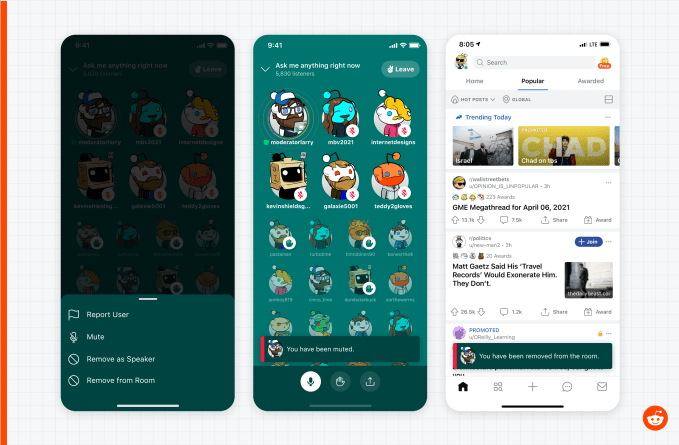
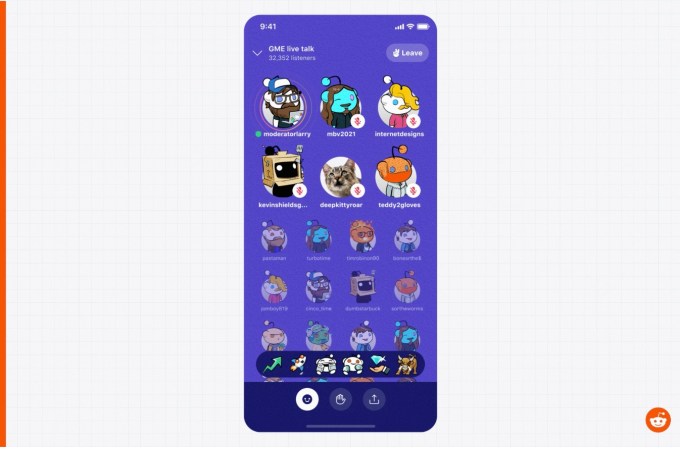
On the heels of Clubhouse’s latest fundraise, Reddit today officially unveiled its Clubhouse rival, Reddit Talk following a recent report from Mashable that revealed the company had been developing audio-based social networking features. Like many of the newly launched Clubhouse clones, Reddit’s voice chat experience hasn’t deviated much from Clubhouse’s overall design where speakers sit at the top of the screen in a stage area of sorts, and listeners appear below — all with rounded profile icons, plus tools to react or raise a hand to ask to speak.

In Reddit’s case, however, it’s repurposed this Clubhouse-style format for its own communities, known as subreddits. Initially, Reddit Talk will live within subreddits, which are individual forums focused on a given topic or theme. Those community’s moderators will be the only ones able to start a talk for the time being, as the audio feature is still being tested, Reddit says.

These moderators will be given tools that allow them invite users to join, mute participants, and remove speakers during the live sessions. They can also ban unwanted users from the talk entirely and stop them from being able to rejoin.

Although only the subreddit moderators can start talks, once they are underway, they can invite anyone they choose to join them to speak. The other users can listen the Reddit Talk sessions across both iOS and Android.

Image Credits: Reddit

While the overall style is very much Clubhouse-like, Reddit has added its own touches. For example, users can react to speakers using a different set of emojis than you might find on rival services. Reddit’s product images today showed reactions that included popular Reddit designs like a rocket ship, the Reddit alien, and the diamond emoji, among others. Reddit says it’s currently testing a way for moderators to customize the background colors and the emoji used in their own communities when they launch Reddit Talk. They’re also able to change their own avatar’s appearance to fit the talk, too.

Reddit suggests the new audio features will make sense for things like Q&As, AMAs (Ask Me Anything), lectures, sports radio-style discussions, community feedback sessions or even just hangouts.

The company is currently developing other features designed specifically to support AMAs and other types of conversations, it also noted.

In the comments of the Reddit Talk announcement, Reddit responded to questions from users about why it’s doing this, and acknowledged the Clubhouse similarities.

Image Credits: Reddit


“We believe that there is more to offer here by letting users have real-time live voice discussions with others in their communities — maybe talking about a sporting event while it’s on TV or listening to a casual chat or AMA with field experts,” Reddit’s Product Lead for creators wrote. “Yes, there are a few different platforms diving into live audio right now. Our hope is that by announcing this early with a community-first design, we will see engaging conversations hosted first by moderators, who we’ll be working with closely to ensure we’re creating a unique, supportive, and positive user experience,” the comment read.

There are more than a “few” other platforms now building out Clubhouse clones at this point, of course. Facebook has several tools on the way, Twitter has Spaces, and there are audio platforms in various stages of development from Discord, Telegram, Spotify and even LinkedIn, in the works.

Reddit Talk is not publicly available as it’s in a test period. But community moderators can join a waitlist to be alerted as to when they can try out the feature for themselves. After the test period, Reddit says it will work with moderators to allow other trusted users to host talks through the new feature, too.

19 Apr 2021

European VC soars in Q1

A stunning first quarter in venture capital funding was not restricted to the United States; Europe also had one hell of a start to the year.

According to data from Dealroom and Crunchbase News, an investor, and an analyst from PitchBook, European startups put together an impressive fundraising haul. The venture capital world kicked off its 2021 European investing cycle with enough activity to set the continent on the path that would crush yearly records.


The Exchange explores startups, markets and money. 

Read it every morning on Extra Crunch or get The Exchange newsletter every Saturday.


Inside the data, there’s lots to unpack, including which sectors of European startups stood out in terms of capital raised, rising seed and late-stage deals, and dollar volume. We’ll also need to discuss exits — the Deliveroo IPO and its various woes was not the only transaction from the period worth understanding.

As with our prior looks at AI startup fundraising and the United States’ own blistering start to the year, we’ll lean on multiple sources to ensure that we have a wide lens. And we’ll keep in mind that all venture capital data lags reality somewhat, as many deals from a particular period are not disclosed or discovered until long after they actually occurred.

In this case, it makes the numbers all the more impressive. Let’s get into the data.

The big numbers

Dealroom was first out of the gate, reporting that European startups had a record quarter in Q1 2021 back when April just got started. Its preliminary results for the first quarter indicated that startups on the continent raised €16.6 billion, or $19.9 billion at today’s exchange rates.

That total was not only a record, but what Dealroom described as double the results of Q1 2020. While we’ve become slightly inured in recent months to the venture capital market’s rapid pace and capital-rich environment, it’s worth considering for a moment, as the first quarter of last year ended, how few of us would have guessed that just a year later — as COVID-19 still harms public health and disrupts life and business — we’d see numbers like this.

The Dealroom data, however, was not all records. Round volume by the group’s estimates was down from the year-ago period, if slightly better than the last few quarters. The general move toward the later-stage and larger-round venture capital market is alive and well in Europe.