Year: 2021

17 Apr 2021

Outdoor startups see supercharged growth during COVID-19 era

After years of sustained growth, the pandemic supercharged the outdoor recreation industry. Startups that provide services like camper vans, private campsites and trail-finding apps became relevant to millions of new users when COVID-19 shut down indoor recreation, building on an existing boom in outdoor recreation.

Startups like Outdoorsy, AllTrails, Cabana, Hipcamp, Kibbo and Lowergear Outdoors have seen significant growth, but to keep it going, consumers who discovered a fondness for the great outdoors during the pandemic must turn it into a lifelong interest.

Outdoorsy, AllTrails, Cabana, Hipcamp, Kibbo and Lowergear Outdoors have seen significant growth, but to keep it going, consumers who discovered a fondness for the great outdoors during the pandemic must turn it into a lifelong interest.

Social media, increased environmentalism and high urbanization were already fueling a boom in popularity. There was a 72% increase in people who camp more than three times a year between 2014 and 2019, mostly spurred by young millennials, young families with kids and nonwhite participants.

But 2020 was a different animal: After months of shelter-in-place orders, widespread shutdowns and physical distancing, outdoors became the only location for safe socializing. In South Dakota, the Lewis and Clark Recreation Area saw a 59% increase in visitors from 2019 to 2020. In the pandemic year, consumers spent $887 billion on outdoor recreation according to the Outdoor Industry Association, more than pharmaceuticals and fuel combined.

And it’s going to continue to grow. Hiking equipment alone is supposed to reach a $7.4 billion market size by 2027, a 6.3% compound annual growth rate. Camping and caravanning is having an even more drastic moment. Without international travel, vacations shifted from flights to exotic resorts to domestic road trips, self-contained rentals and camping. In 2020, the market for camping and caravanning was almost $40 billion and is predicted to rise 13% to just over $45 billion this year.

After the initial and extreme drop-off in engagement early as national parks closed, private camping sites shut down and domestic travel ceased, many outdoor startups have had a breakout year. Outdoorsy, the peer-to-peer camper van rental marketplace, said it saw 44% of all bookings in the company’s history in 2020.

Campsite booking platform Hipcamp said it sent three times as much money to landowners in 2020 as compared to 2019. And it’s not just experienced outdoor veterans taking advantage of the work-from-home lifestyle: in 2020, Cabana, a camper van rental startup, said 70% of its customers had never rented a camper van or an RV before and another 26% had only done it once.

But a report commissioned by the Outdoor Industry Association showed that the most popular outdoor activities were ones that people could do close to home, not the traveling kind Hipcamp, Cabana and Outdoorsy traffic in. The three most popular outdoor activities for newbies: walking, running and bicycling.

But the pandemic did create a small boost for camping, climbing, backpacking and kayaking; fueled by an increase in women, younger, more ethnically diverse, urban and slightly less wealthy people pushing into the outdoors. This class of outdoor startups will need to engage the new demographic shift to capitalize on the pandemic’s outdoor boom because, according to the report, a quarter of those who started new outdoor activities during the pandemic don’t plan on continuing once it’s over.

Startups are increasing accessibility to the outdoors

But getting into the outdoors can be overwhelming: there’s gear to buy, skills to learn, exploring unfamiliar areas and the added stressor of safety. Outdoor startups are working to lower the barrier to entry to help grow their businesses.

“I think anytime you have like 2,000 articles with two dozen tips on how to use a product, that tells me that it is really, really too hard to use,” said Cabana founder Scott Kubly. “To me, that says there’s nothing but friction in this process. If you want to build something that’s mainstream, you need to make it super consistent and really easy to use.”

Kubly said only half a percent of the U.S. population takes a rental van or RV trip each year. Planning an outdoor adventure can be time-consuming — choosing a location, finding an open campsite, planning meals and water, and figuring out dump stations for trash or septic. That planning is multiplied tenfold if you are going for a road trip or backpacking and need to find new places every other night.

17 Apr 2021

This Week in Apps: A surprising report on App Tracking, Apple event predictions, Instagram for kids

Welcome back to This Week in Apps, the weekly TechCrunch series that recaps the latest in mobile OS news, mobile applications and the overall app economy.

The app industry is as hot as ever, with a record 218 billion downloads and $143 billion in global consumer spend in 2020.

Consumers last year also spent 3.5 trillion minutes using apps on Android devices alone. And in the U.S., app usage surged ahead of the time spent watching live TV. Currently, the average American watches 3.7 hours of live TV per day, but now spends four hours per day on their mobile devices.

Apps aren’t just a way to pass idle hours — they’re also a big business. In 2019, mobile-first companies had a combined  $544 billion valuation, 6.5x higher than those without a mobile focus. In 2020, investors poured $73 billion in capital into mobile companies — a figure that’s up 27% year-over-year.

This week, the news is heavily Apple-centric. The company is hosting an event next week, where we may get some new devices and form factors, as well as AirTags (maybe!). Plus, Apple’s App Tracking Transparency is still top of mind for many developers. So this week, we’re looking at some initial ATT data that has some surprises, among other things.

This Week in Apps will soon be a newsletter! Sign up here: techcrunch.com/newsletters

Top Stories

Apple’s Spring Loaded event arrives next week

Image Credits: Apple

Apple this week announced its plans to host a “Spring Loaded” event on April 20th, where it’s expected to make a handful of updates. While nothing is for certain — this is Apple, after all — rumors are pointing toward an updated iPad Pro lineup, perhaps with Apple’s Mini LED displays. A new iPad Mini could also be on the way, as it’s not been refreshed for two years.

Bloomberg had earlier reported new iPads were coming this spring, with a refreshed iPad Pro line sporting a faster processor and better cameras, in 11 and 12.9-inch sizes, as well as an iPad mini will a larger screen size.

But there are also hints that we might finally see Apple’s AirTags’ unveiling at long last. This not-so-secretive initiative was already found referenced in iOS code and in one of Apple’s own YouTube videos. And it’s been the subject of congressional hearings, as competitor Tile argued that Apple was leveraging the power of its ecosystem to give its own products an advantage. As a concession, Apple opened up access to the “Find My” app, which AirTags will also use, to third-party manufacturers. But Tile was not among the partners Apple introduced as the program and updated Find My app officially rolled out. We understand that’s because Tile wants to continue to own the relationship between its customers via its own iOS app, not have a third-party in between — and especially not Apple. There’s still a lot that’s not confirmed about Apple’s AirTags — like price point, or even what final design Apple may have settled on, so this could be a fun unveiling.

Apple may use the time to add on more surprises, too, like a third-generation version of AirPods or refreshed Apple TV. We expect Apple will also officially launch iOS 14.5, the big update with App Tracking Transparency, which has been a longer beta cycle.

A surprising report on ATT consent rates
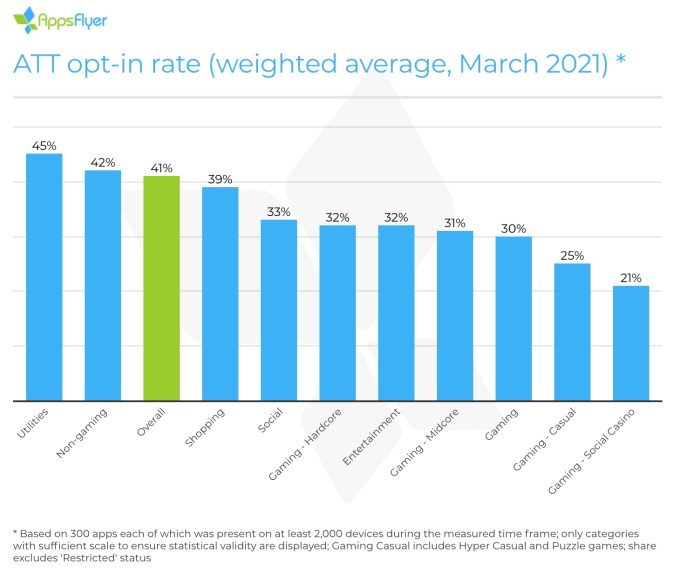
Image Credits: AppsFlyer

A new report on App Tracking Transparency (ATT) has yielded some interesting results. The new iOS 14 privacy feature will pop up a permissions request on users’ devices, asking them if they’d allow the app to track their activity. Most expected that users would almost universally say “No” to this request, which is why the mobile adtech industry is in chaos, with some companies even trying to figure out if they could work around the change that makes the existing ad identifier, the IDFA, obsolete.

But an AppsFlyer study found that opt-in rates for being tracked were much higher than anyone would have expected. The industry was forecasting opt-in rates anywhere from 2% to 20%, but were figuring things would more likely be in the single digits. So imagine everyone’s surprise when AppsFlyer found that opt-in rates were at a 28% average per app and a median of 32% (meaning about half the apps were exceeding 32%!).

The study was not a small sampling, either. The company counted 13,260,824 times when a prompt was shown to the end-user and found that 5,495,084 times (or 41%) the user tapped the “Allow” button. This took place in March 2021 across over 300 apps in multiple categories, including both apps and games.
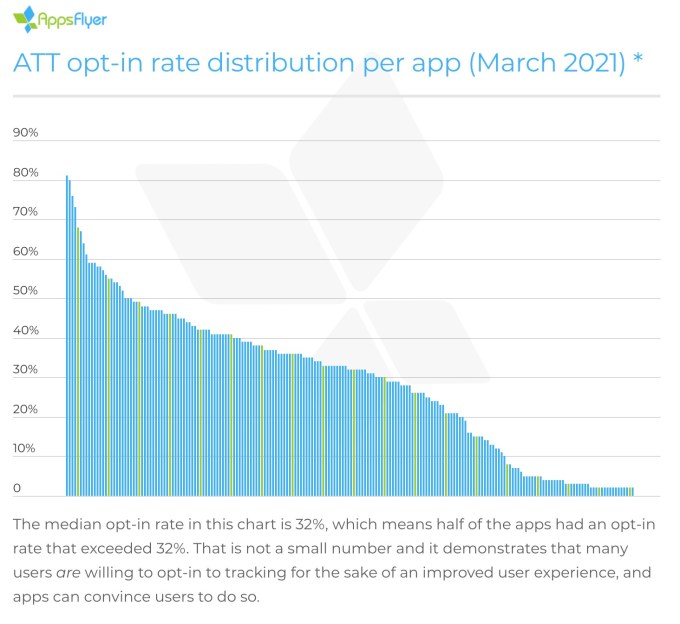
Image Credits: AppsFlyer

Of the 7,765,740 cases when tracking was denied, AppsFlyer said it was actually counting implicit “No’s” from users who previously enabled Limit Ad Tracking (LAT) on their devices in previous iOS versions. Since they had already said they wanted to limit ads, they don’t see the ATT prompt and are classified as denied.

The report found the opt-in rates were very different between apps and games, at 42% and 30%, respectively. This is due to lower brand affinity in gaming, it said. Larger apps also had higher opt-in rates. The top 10% (by device count) had a 50% higher rate than the bottom 10%.

Of course, we should caution that this initial data is preliminary and based off data collected from early adopters. This may not represent the industry at large. In other words, opt-in rates could certainly still change when Apple begins to officially enforce ATT with the release of iOS 14.5.

However, what could be working here is the use of something known as the pre-ATT prompt, which basically means gating Apple’s dialogue between the developer’s own prompt, that they can show at an appropriate time with their own messaging. By explaining to users that by opting in they may see more relevant content or help to keep the app free, users may be more likely to opt in, AppsFlyer suggested.
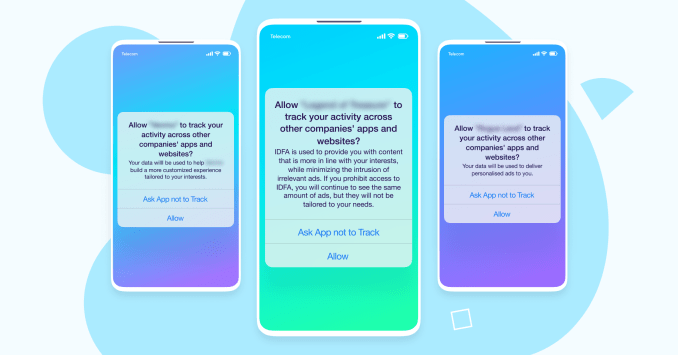
Image Credits: AppsFlyer

Weekly News

Apple

Apple device rumors! Analyst Ming-Chi Kuo says 2022 iPhones will feature a 48-megapixel camera, 8K video and come in only 6.1″ and 6.7″ sizes (no more 5.4″ Mini). Also predicted is an AR headset with 15 cameras.

Apple’s legal battle with Epic Games in Australian courts was temporarily put on pause while the U.S. case proceeds. Apple argued that the matter should be settled in the original jurisdiction in the U.S., while Epic says Apple’s anti-competitive behavior should be tried under Australian law as well. A judge ordered the case to be temporarily suspended for three months while the U.S. suit is underway.

Senate Judiciary Committee leaders Senators Amy Klobuchar (D-MN) and Mike Lee (R-UT) put pressure on Apple to provide a witness for an upcoming hearing on app store competition after it looked like Apple might bow out. But this week, the company committed to sending a representative to the Senate antitrust hearing, which Google will also attend. The hearing will focus on the tech giants’ control over “the cost, distribution, and availability of mobile applications on consumers, app developers, and competition.”

Apple filed an expert witness report for its U.S. legal battle with Epic Games where the witness stated that Apple would have to redesign its hardware and software in order to make the iPhone interoperable with alternative app stores outside of its own. Epic Games founder Tim Sweeney tweeted the statement was “baloney” and noted that Apple already has a program that allows users to install apps from the web, the Apple Enterprise Program. Only contractual obligations prevent such a mechanism from being used for consumer apps.

Google

Due to U.S. trade restrictions, China manufacturer Huawei isn’t able to use Google Mobile Services (GMS) on their smartphone, so the company came up with an alternative, Huawei Mobile Services (HMS). Now it’s launched an open-source Choice SDK that will allow app developers to turn their GMS apps into HMS apps more easily. The SDK currently supports features like location, sign-in, analytics, maps and messaging.

Google Assistant, which is integrated with Android devices and available as a standalone app, this week rolled out new features. The AI voice assistant is now able to locate and ring misplaced and silenced iPhones instead of just Android devices. To do so, the device places a regular call to your mobile numbers. It can also complete restaurant takeout orders and design Routines.

Android leaks! Reportedly, Android 12 may bring enhanced privacy controls, according to XDA Developers and a set of leaked Android 12 screenshots they published. Specifically, Google is copying the iOS feature that alerts you when an app you’re using is accessing the clipboard. It’s also working on enhanced notification permissions that let you choose what type of alerts you want to receive, like “real-time” or “conversations.”

E-commerce

TikTok plans to launch a range of new e-commerce-focused ad products, including Collection Ads, which will enable brands to combine their product catalog listings and branded videos; and Dynamic Product Ads, which will automatically retarget users with relevant products according to their actions on publishers’ apps and websites.

Amazon-owned Zappos teamed up with streaming startup BuyWith to add livestream shopping, led by influencers.

Google’s Shopping app for Android and iOS is shutting down, as Google has expanded shopping features in Search and on YouTube in the two years since the Express app was rebranded as Shopping.

Augmented Reality

Gucci Beauty launched a new Snapchat lens that lets users virtually try-on its Rouge De Beauté Brilliant hybrid lipstick and other makeup, including foundation and eyeshadows.

Snap also launched an interactive Lens in the main Snapchat Lens Carousel for all Snapchatters in the U.S. that highlights five AR monuments from the Monumental Perspectives project. The company had brought artists and Snap Lens Creators together to create the five AR monuments to celebrate diverse histories across Los Angeles, in an effort to offer more inclusive perspectives from communities across the region.

Fintech
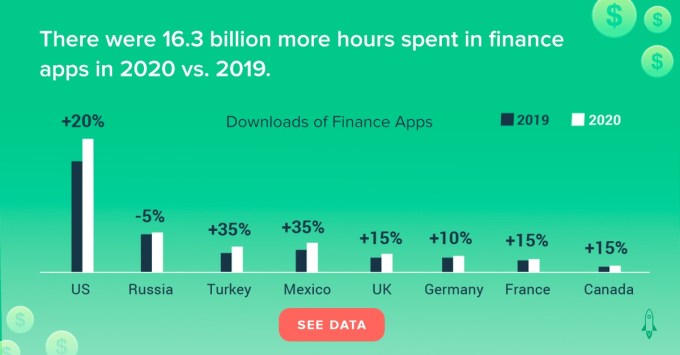
Image Credits: App Annie/Liftoff

A joint report by App Annie and marketing firm Liftoff found that downloads of finance apps grew 15% year-over-year in 2020 to 4.6 billion, and time spent in apps rose to 16.3 billion during the year, up 45% from 2019. In the popular category of investing apps, U.S. users spent 135% more time in the top five apps in this space, year-over-year.

A separate report by Sensor Tower found that finance app installs jumped 34% year-over-year in Q1 in the U.S. and Europe.

Social

Image Credits: TechCrunch

Instagram is launching a new test that will allow you to choose if you want to hide “Likes,” and a Facebook test will follow. In the test, users will get to decide what works best for them — either choosing to see the Like counts on others’ posts, or not. Users will also be able to turn off Like counts on their own posts, if they choose. Facebook additionally confirmed it will begin to test a similar experience on its own social network. The test aims to balance the feedback from those who rely on Likes as a metric that enables them to prove their value to advertisers, and those who are impacted by the anxiety of chasing Likes.

Discord announced a policy change that says all adult content should be kept behind an NSFW warning and that all NSFW communities and channels will be blocked on iOS devices.

Reddit is said to be exploring a Clubhouse-like voice chat feature, Mashable reported. The development is said to be in the early stages. Reddit didn’t reply to requests for comments, the report said.

Facebook says it will test new business discovery features in the U.S. News Feed. When live, users tap on topics they’re interested in underneath posts and ads in their News Feed in order to explore related content from businesses.
instagram app

Image credit: Jaap Arriens/NurPhoto via Getty Images

Thirty-five consumer advocacy groups and 64 child development experts co-signed a letter to Facebook asking the company to reconsider its plans to launch an Instagram version for children under the age of 13, arguing that social media has several risk factors for children and adolescents, related to both physical health and overall well-being.

They also launched a petition anyone can sign. Despite the concerns being raised, Instagram’s plans to compete for younger users will not likely be impacted by the outcry. Already, Instagram’s top competitor in social media today — TikTok — has developed an experience for kids under 13. In fact, it was forced to age-gate its app as a result of its settlement with the U.S. Federal Trade Commission, which had investigated Musical.ly (the app that became TikTok) for violations of the U.S. children’s privacy law COPPA.

Facebook, too, could be in a similar situation where it has to age-gate Instagram in order to properly direct its existing underage users to a COPPA-compliant experience. At the very least, Facebook has grounds to argue that it shouldn’t have to boot the under-13 crowd off its app, since TikTok did not. And the FTC’s fines, even when historic, barely make a dent in tech giants’ revenues.

Streaming & Entertainment

Clubhouse rolls out payments to over 60K creators following its initial test launched earlier this month. To send a payment, users can visit a creator’s profile, then tap on the button at the bottom that says “Send Money.” Clubhouse says 100% of the payments go directly to creators.

The TV version of the Google Play Movies & TV app will shut down on Roku, LG, Samsung and Vizio TVs in June, while users’ purchases will be migrated to YouTube.

Health & Fitness

Apple filed for dismissal of an $800 million lawsuit brought on by a developer who claimed the App Store rejected a coronavirus app for “no good reason.” The App Store policy says it’s only accepting coronavirus apps from “recognized institutions such as government, hospital, insurance company, NGO, or a university.” The developer argues they had a medical doctor (a former NASA cardiologist) on their team.

TikTok funded its first episodic public health series, “VIRAL,” from NowThis. The series will feature interviews with public health experts and a live Q&A session focused on answering questions about the pandemic. The partnership represents TikTok’s first-ever funding of an episodic series from a publisher, though TikTok has previously funded creator content.

Google’s Digital Wellbeing app added a new feature called “Heads Up” in its Settings which will remind Pixel device owners to look up when they’re using their phone while out walking. The app requires permission to users’ physical activity and location.

Facebook began sharing state vaccine info in the News Feed to let people know when they’re eligible to get a COVID-19 vaccine in their state, when the general public is eligible in their state and links to their state health department and Facebook’s Vaccine Finder.

Dating apps

Match-owned dating app Hinge launched “video prompts” in its virtual dating feature. The prompts help daters gauge compatibility with debate topics, which can help break the ice and make the virtual dating experience feel less awkward.

Leading dating app Tinder hires former Yum Brands (Pizza Hut and KFC) CMO George Felix as its new chief marketing officer. Tinder CEO Jim Lanzone says Felix “delivers iconic brand positioning and outstanding results” but does so “in new ways with very different brands.”

Security

Gay dating site and app Manhunt, which has 6 million members, confirmed a data breach in February where a hacker gained access to the company’s accounts database. The hacker was able to acquire usernames, emails and passwords for a subset (11%) of its users.

Researchers discovered a WhatsApp security risk that allows a remote hacker to deactivate WhatsApp on your phone and stop you from getting back in, even if you had two-factor enabled.

Clubhouse CEO Paul Davison said the recent report of a data breach was false and that user data was not leaked, calling the article that reported it “clickbait.”

Security researchers found that the popular APKPure app, which helps users install older or discontinued Android apps from outside the Play Store, contained malicious adware. The most recent app version was siphoning data from users’ devices and pushed ads to the lockscreen and in the background to generate fraudulent revenue for adware operators.

Joker malware impacted over 500,000 Huawei users’ devices after they downloaded infected apps from the company’s official Android app store. Researchers found 10 seemingly harmless apps in AppGallery — like virtual keyboards, a camera, a launcher, a messenger, a sticker collection and more — that were infected with the malicious code.

Customer data from the ParkMobile mobile parking app was discovered being sold online. The data included customer email addresses, dates of birth, phone numbers, license plate numbers, hashed passwords and mailing addresses for 21 million customers. ParkMobile attributed the breach to “a cybersecurity incident linked to a vulnerability in a third-party software that we use.”

Privacy

In legal settlements, Disney, Viacom and 10 adtech firms, including Twitter’s MoPub, agreed to remove certain advertising software from children’s apps due to privacy violations. The companies had placed tracking software in kids’ apps without parents’ knowledge or consent, the class-action cases had stated. SDK defendants also include AdColony, Chartboost, Flurry, InMob, ironSource, Tapjoy, Vungle, Unity Technologies, Comscore (Full Circle Studies), and Upsight.

Funding and M&A

? Messaging app Wire raised $21 million Series B led by UVC Partners for its end-to-end encrypted messaging app and service. The company redirected its focus from consumers to the enterprise market a couple of years ago and now has 1,800 customers, up 50% year-over-year.

? Ordering app and website Slice raised a $40 million Series D to power the marketing and ordering for independent pizzerias. The round, partially aimed at getting Twitter’s former CEO Dick Costolo and former COO Adam Bain on board, was led by Cross Creek and follows last year’s $43 million Series C.

? Triller acquired AI-based customer engagement platform, Amplify.AI, whose co-founder Mahi de Silva will now become TrillerNet’s CEO. Existing CEO Mike Lu will transition to president of TrillerNet and will focus on investor relations. The company separately announced the acquisition of FITE TV, a live event and pay-per-view combat sports streaming platform which will now become home to Triller Fight Club.

? Streaming media company Plex, which has apps for web, TV and mobile, raised a $50 million growth round to fuel its ad-supported streaming business and launch new services, including a TV and movie rentals (and maybe purchases) marketplace, and a subscription channels store.

? Epic Games, the company behind Fortnite, Houseparty and Unreal Engine, raised a massive $1 billion round, valuing the business at $28.7 billion. The round included a $200 million Sony Group Corporation investment. Other investors included Appaloosa, Baillie Gifford, Fidelity Management & Research Company LLC, GIC, T. Rowe Price Associates-managed accounts, Ontario Teachers’ Pension Plan Board, BlackRock managed accounts, Park West, KKR, AllianceBernstein, Altimeter, Franklin Templeton and Luxor Capital.

? French on-demand pediatrics app Biloba added support for prescriptions and raised a $1.7 million seed round for its app that lets parents reach a general practitioner and a nurse when they have medical questions about their child.

? U.K. climate-focused investing app Clim8 raised $8 million from 7pc Ventures. The app allows consumers to invest in companies and supply chains that focus on tackling climate change, and competes with startups including Tickr, Helios and Yova.

Downloads
Avatarify

Avatarify

Avatarify

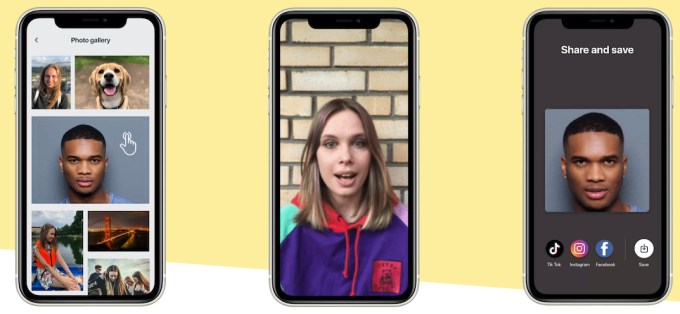
Avatarify, reviewed here by TechCrunch, is a new startup for making deepfake videos on your phone. The app processes user’s photos, then turns them into short videos by animating faces, using machine learning algorithms and adding sounds. The user can also select the effects and music they want to use, then tap to animate the photo. This resulting short video can then be shared to Instagram, Facebook or TikTok. The app has a freemium subscription model that costs $34.99/year or $2.49/week.

Feels

A screenshot of the app Feels

Image Credits: Feels

French startup Feels has launched a new dating app that wants to rethink the typical dating app profile, which today is more like browsing a catalog of people. In Feels, users can record videos, add text and stickers, answer questions, share photos and more. It also changes how users interact with profiles, ditching the binary thumbs up/down or swipe left/right for a feed of videos where you can react to users’ content or just swipe up to move on. There’s also no “Like” button here.

FCC Speed Test App
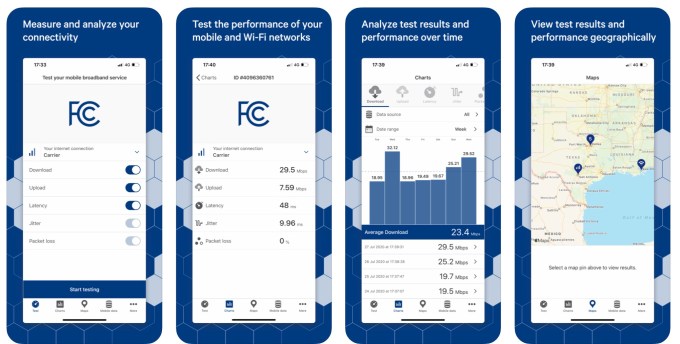
Image Credits: FCC

The U.S. Federal Communications Commission launched its own speed test app for both iOS and Android that aims to measure internet speeds across the country in order to better determine what areas need better access to broadband. The FCC’s current data on broadband speeds come from ISPs like Verizon and AT&T who will exaggerate their coverage, drawing criticism.

17 Apr 2021

This Week in Apps: A surprising report on App Tracking, Apple event predictions, Instagram for kids

Welcome back to This Week in Apps, the weekly TechCrunch series that recaps the latest in mobile OS news, mobile applications and the overall app economy.

The app industry is as hot as ever, with a record 218 billion downloads and $143 billion in global consumer spend in 2020.

Consumers last year also spent 3.5 trillion minutes using apps on Android devices alone. And in the U.S., app usage surged ahead of the time spent watching live TV. Currently, the average American watches 3.7 hours of live TV per day, but now spends four hours per day on their mobile devices.

Apps aren’t just a way to pass idle hours — they’re also a big business. In 2019, mobile-first companies had a combined  $544 billion valuation, 6.5x higher than those without a mobile focus. In 2020, investors poured $73 billion in capital into mobile companies — a figure that’s up 27% year-over-year.

This week, the news is heavily Apple-centric. The company is hosting an event next week, where we may get some new devices and form factors, as well as AirTags (maybe!). Plus, Apple’s App Tracking Transparency is still top of mind for many developers. So this week, we’re looking at some initial ATT data that has some surprises, among other things.

This Week in Apps will soon be a newsletter! Sign up here: techcrunch.com/newsletters

Top Stories

Apple’s Spring Loaded event arrives next week

Image Credits: Apple

Apple this week announced its plans to host a “Spring Loaded” event on April 20th, where it’s expected to make a handful of updates. While nothing is for certain — this is Apple, after all — rumors are pointing toward an updated iPad Pro lineup, perhaps with Apple’s Mini LED displays. A new iPad Mini could also be on the way, as it’s not been refreshed for two years.

Bloomberg had earlier reported new iPads were coming this spring, with a refreshed iPad Pro line sporting a faster processor and better cameras, in 11 and 12.9-inch sizes, as well as an iPad mini will a larger screen size.

But there are also hints that we might finally see Apple’s AirTags’ unveiling at long last. This not-so-secretive initiative was already found referenced in iOS code and in one of Apple’s own YouTube videos. And it’s been the subject of congressional hearings, as competitor Tile argued that Apple was leveraging the power of its ecosystem to give its own products an advantage. As a concession, Apple opened up access to the “Find My” app, which AirTags will also use, to third-party manufacturers. But Tile was not among the partners Apple introduced as the program and updated Find My app officially rolled out. We understand that’s because Tile wants to continue to own the relationship between its customers via its own iOS app, not have a third-party in between — and especially not Apple. There’s still a lot that’s not confirmed about Apple’s AirTags — like price point, or even what final design Apple may have settled on, so this could be a fun unveiling.

Apple may use the time to add on more surprises, too, like a third-generation version of AirPods or refreshed Apple TV. We expect Apple will also officially launch iOS 14.5, the big update with App Tracking Transparency, which has been a longer beta cycle.

A surprising report on ATT consent rates

Image Credits: AppsFlyer

A new report on App Tracking Transparency (ATT) has yielded some interesting results. The new iOS 14 privacy feature will pop up a permissions request on users’ devices, asking them if they’d allow the app to track their activity. Most expected that users would almost universally say “No” to this request, which is why the mobile adtech industry is in chaos, with some companies even trying to figure out if they could work around the change that makes the existing ad identifier, the IDFA, obsolete.

But an AppsFlyer study found that opt-in rates for being tracked were much higher than anyone would have expected. The industry was forecasting opt-in rates anywhere from 2% to 20%, but were figuring things would more likely be in the single digits. So imagine everyone’s surprise when AppsFlyer found that opt-in rates were at a 28% average per app and a median of 32% (meaning about half the apps were exceeding 32%!).

The study was not a small sampling, either. The company counted 13,260,824 times when a prompt was shown to the end-user and found that 5,495,084 times (or 41%) the user tapped the “Allow” button. This took place in March 2021 across over 300 apps in multiple categories, including both apps and games.

Image Credits: AppsFlyer

Of the 7,765,740 cases when tracking was denied, AppsFlyer said it was actually counting implicit “No’s” from users who previously enabled Limit Ad Tracking (LAT) on their devices in previous iOS versions. Since they had already said they wanted to limit ads, they don’t see the ATT prompt and are classified as denied.

The report found the opt-in rates were very different between apps and games, at 42% and 30%, respectively. This is due to lower brand affinity in gaming, it said. Larger apps also had higher opt-in rates. The top 10% (by device count) had a 50% higher rate than the bottom 10%.

Of course, we should caution that this initial data is preliminary and based off data collected from early adopters. This may not represent the industry at large. In other words, opt-in rates could certainly still change when Apple begins to officially enforce ATT with the release of iOS 14.5.

However, what could be working here is the use of something known as the pre-ATT prompt, which basically means gating Apple’s dialogue between the developer’s own prompt, that they can show at an appropriate time with their own messaging. By explaining to users that by opting in they may see more relevant content or help to keep the app free, users may be more likely to opt in, AppsFlyer suggested.

Image Credits: AppsFlyer

Weekly News

Apple

Apple device rumors! Analyst Ming-Chi Kuo says 2022 iPhones will feature a 48-megapixel camera, 8K video and come in only 6.1″ and 6.7″ sizes (no more 5.4″ Mini). Also predicted is an AR headset with 15 cameras.

Apple’s legal battle with Epic Games in Australian courts was temporarily put on pause while the U.S. case proceeds. Apple argued that the matter should be settled in the original jurisdiction in the U.S., while Epic says Apple’s anti-competitive behavior should be tried under Australian law as well. A judge ordered the case to be temporarily suspended for three months while the U.S. suit is underway.

Senate Judiciary Committee leaders Senators Amy Klobuchar (D-MN) and Mike Lee (R-UT) put pressure on Apple to provide a witness for an upcoming hearing on app store competition after it looked like Apple might bow out. But this week, the company committed to sending a representative to the Senate antitrust hearing, which Google will also attend. The hearing will focus on the tech giants’ control over “the cost, distribution, and availability of mobile applications on consumers, app developers, and competition.”

Apple filed an expert witness report for its U.S. legal battle with Epic Games where the witness stated that Apple would have to redesign its hardware and software in order to make the iPhone interoperable with alternative app stores outside of its own. Epic Games founder Tim Sweeney tweeted the statement was “baloney” and noted that Apple already has a program that allows users to install apps from the web, the Apple Enterprise Program. Only contractual obligations prevent such a mechanism from being used for consumer apps.

Google

Due to U.S. trade restrictions, China manufacturer Huawei isn’t able to use Google Mobile Services (GMS) on their smartphone, so the company came up with an alternative, Huawei Mobile Services (HMS). Now it’s launched an open-source Choice SDK that will allow app developers to turn their GMS apps into HMS apps more easily. The SDK currently supports features like location, sign-in, analytics, maps and messaging.

Google Assistant, which is integrated with Android devices and available as a standalone app, this week rolled out new features. The AI voice assistant is now able to locate and ring misplaced and silenced iPhones instead of just Android devices. To do so, the device places a regular call to your mobile numbers. It can also complete restaurant takeout orders and design Routines.

Android leaks! Reportedly, Android 12 may bring enhanced privacy controls, according to XDA Developers and a set of leaked Android 12 screenshots they published. Specifically, Google is copying the iOS feature that alerts you when an app you’re using is accessing the clipboard. It’s also working on enhanced notification permissions that let you choose what type of alerts you want to receive, like “real-time” or “conversations.”

E-commerce

TikTok plans to launch a range of new e-commerce-focused ad products, including Collection Ads, which will enable brands to combine their product catalog listings and branded videos; and Dynamic Product Ads, which will automatically retarget users with relevant products according to their actions on publishers’ apps and websites.

Amazon-owned Zappos teamed up with streaming startup BuyWith to add livestream shopping, led by influencers.

Google’s Shopping app for Android and iOS is shutting down, as Google has expanded shopping features in Search and on YouTube in the two years since the Express app was rebranded as Shopping.

Augmented Reality

Gucci Beauty launched a new Snapchat lens that lets users virtually try-on its Rouge De Beauté Brilliant hybrid lipstick and other makeup, including foundation and eyeshadows.

Snap also launched an interactive Lens in the main Snapchat Lens Carousel for all Snapchatters in the U.S. that highlights five AR monuments from the Monumental Perspectives project. The company had brought artists and Snap Lens Creators together to create the five AR monuments to celebrate diverse histories across Los Angeles, in an effort to offer more inclusive perspectives from communities across the region.

Fintech

Image Credits: App Annie/Liftoff

A joint report by App Annie and marketing firm Liftoff found that downloads of finance apps grew 15% year-over-year in 2020 to 4.6 billion, and time spent in apps rose to 16.3 billion during the year, up 45% from 2019. In the popular category of investing apps, U.S. users spent 135% more time in the top five apps in this space, year-over-year.

A separate report by Sensor Tower found that finance app installs jumped 34% year-over-year in Q1 in the U.S. and Europe.

Social

Image Credits: TechCrunch

Instagram is launching a new test that will allow you to choose if you want to hide “Likes,” and a Facebook test will follow. In the test, users will get to decide what works best for them — either choosing to see the Like counts on others’ posts, or not. Users will also be able to turn off Like counts on their own posts, if they choose. Facebook additionally confirmed it will begin to test a similar experience on its own social network. The test aims to balance the feedback from those who rely on Likes as a metric that enables them to prove their value to advertisers, and those who are impacted by the anxiety of chasing Likes.

Discord announced a policy change that says all adult content should be kept behind an NSFW warning and that all NSFW communities and channels will be blocked on iOS devices.

Reddit is said to be exploring a Clubhouse-like voice chat feature, Mashable reported. The development is said to be in the early stages. Reddit didn’t reply to requests for comments, the report said.

Facebook says it will test new business discovery features in the U.S. News Feed. When live, users tap on topics they’re interested in underneath posts and ads in their News Feed in order to explore related content from businesses.

instagram app

Image credit: Jaap Arriens/NurPhoto via Getty Images

Thirty-five consumer advocacy groups and 64 child development experts co-signed a letter to Facebook asking the company to reconsider its plans to launch an Instagram version for children under the age of 13, arguing that social media has several risk factors for children and adolescents, related to both physical health and overall well-being.

They also launched a petition anyone can sign. Despite the concerns being raised, Instagram’s plans to compete for younger users will not likely be impacted by the outcry. Already, Instagram’s top competitor in social media today — TikTok — has developed an experience for kids under 13. In fact, it was forced to age-gate its app as a result of its settlement with the U.S. Federal Trade Commission, which had investigated Musical.ly (the app that became TikTok) for violations of the U.S. children’s privacy law COPPA.

Facebook, too, could be in a similar situation where it has to age-gate Instagram in order to properly direct its existing underage users to a COPPA-compliant experience. At the very least, Facebook has grounds to argue that it shouldn’t have to boot the under-13 crowd off its app, since TikTok did not. And the FTC’s fines, even when historic, barely make a dent in tech giants’ revenues.

Streaming & Entertainment

Clubhouse rolls out payments to over 60K creators following its initial test launched earlier this month. To send a payment, users can visit a creator’s profile, then tap on the button at the bottom that says “Send Money.” Clubhouse says 100% of the payments go directly to creators.

The TV version of the Google Play Movies & TV app will shut down on Roku, LG, Samsung and Vizio TVs in June, while users’ purchases will be migrated to YouTube.

Health & Fitness

Apple filed for dismissal of an $800 million lawsuit brought on by a developer who claimed the App Store rejected a coronavirus app for “no good reason.” The App Store policy says it’s only accepting coronavirus apps from “recognized institutions such as government, hospital, insurance company, NGO, or a university.” The developer argues they had a medical doctor (a former NASA cardiologist) on their team.

TikTok funded its first episodic public health series, “VIRAL,” from NowThis. The series will feature interviews with public health experts and a live Q&A session focused on answering questions about the pandemic. The partnership represents TikTok’s first-ever funding of an episodic series from a publisher, though TikTok has previously funded creator content.

Google’s Digital Wellbeing app added a new feature called “Heads Up” in its Settings which will remind Pixel device owners to look up when they’re using their phone while out walking. The app requires permission to users’ physical activity and location.

Facebook began sharing state vaccine info in the News Feed to let people know when they’re eligible to get a COVID-19 vaccine in their state, when the general public is eligible in their state and links to their state health department and Facebook’s Vaccine Finder.

Dating apps

Match-owned dating app Hinge launched “video prompts” in its virtual dating feature. The prompts help daters gauge compatibility with debate topics, which can help break the ice and make the virtual dating experience feel less awkward.

Leading dating app Tinder hires former Yum Brands (Pizza Hut and KFC) CMO George Felix as its new chief marketing officer. Tinder CEO Jim Lanzone says Felix “delivers iconic brand positioning and outstanding results” but does so “in new ways with very different brands.”

Security

Gay dating site and app Manhunt, which has 6 million members, confirmed a data breach in February where a hacker gained access to the company’s accounts database. The hacker was able to acquire usernames, emails and passwords for a subset (11%) of its users.

Researchers discovered a WhatsApp security risk that allows a remote hacker to deactivate WhatsApp on your phone and stop you from getting back in, even if you had two-factor enabled.

Clubhouse CEO Paul Davison said the recent report of a data breach was false and that user data was not leaked, calling the article that reported it “clickbait.”

Security researchers found that the popular APKPure app, which helps users install older or discontinued Android apps from outside the Play Store, contained malicious adware. The most recent app version was siphoning data from users’ devices and pushed ads to the lockscreen and in the background to generate fraudulent revenue for adware operators.

Joker malware impacted over 500,000 Huawei users’ devices after they downloaded infected apps from the company’s official Android app store. Researchers found 10 seemingly harmless apps in AppGallery — like virtual keyboards, a camera, a launcher, a messenger, a sticker collection and more — that were infected with the malicious code.

Customer data from the ParkMobile mobile parking app was discovered being sold online. The data included customer email addresses, dates of birth, phone numbers, license plate numbers, hashed passwords and mailing addresses for 21 million customers. ParkMobile attributed the breach to “a cybersecurity incident linked to a vulnerability in a third-party software that we use.”

Privacy

In legal settlements, Disney, Viacom and 10 adtech firms, including Twitter’s MoPub, agreed to remove certain advertising software from children’s apps due to privacy violations. The companies had placed tracking software in kids’ apps without parents’ knowledge or consent, the class-action cases had stated. SDK defendants also include AdColony, Chartboost, Flurry, InMob, ironSource, Tapjoy, Vungle, Unity Technologies, Comscore (Full Circle Studies), and Upsight.

Funding and M&A

? Messaging app Wire raised $21 million Series B led by UVC Partners for its end-to-end encrypted messaging app and service. The company redirected its focus from consumers to the enterprise market a couple of years ago and now has 1,800 customers, up 50% year-over-year.

? Ordering app and website Slice raised a $40 million Series D to power the marketing and ordering for independent pizzerias. The round, partially aimed at getting Twitter’s former CEO Dick Costolo and former COO Adam Bain on board, was led by Cross Creek and follows last year’s $43 million Series C.

? Triller acquired AI-based customer engagement platform, Amplify.AI, whose co-founder Mahi de Silva will now become TrillerNet’s CEO. Existing CEO Mike Lu will transition to president of TrillerNet and will focus on investor relations. The company separately announced the acquisition of FITE TV, a live event and pay-per-view combat sports streaming platform which will now become home to Triller Fight Club.

? Streaming media company Plex, which has apps for web, TV and mobile, raised a $50 million growth round to fuel its ad-supported streaming business and launch new services, including a TV and movie rentals (and maybe purchases) marketplace, and a subscription channels store.

? Epic Games, the company behind Fortnite, Houseparty and Unreal Engine, raised a massive $1 billion round, valuing the business at $28.7 billion. The round included a $200 million Sony Group Corporation investment. Other investors included Appaloosa, Baillie Gifford, Fidelity Management & Research Company LLC, GIC, T. Rowe Price Associates-managed accounts, Ontario Teachers’ Pension Plan Board, BlackRock managed accounts, Park West, KKR, AllianceBernstein, Altimeter, Franklin Templeton and Luxor Capital.

? French on-demand pediatrics app Biloba added support for prescriptions and raised a $1.7 million seed round for its app that lets parents reach a general practitioner and a nurse when they have medical questions about their child.

? U.K. climate-focused investing app Clim8 raised $8 million from 7pc Ventures. The app allows consumers to invest in companies and supply chains that focus on tackling climate change, and competes with startups including Tickr, Helios and Yova.

Downloads

Avatarify

Avatarify

Avatarify

Avatarify, reviewed here by TechCrunch, is a new startup for making deepfake videos on your phone. The app processes user’s photos, then turns them into short videos by animating faces, using machine learning algorithms and adding sounds. The user can also select the effects and music they want to use, then tap to animate the photo. This resulting short video can then be shared to Instagram, Facebook or TikTok. The app has a freemium subscription model that costs $34.99/year or $2.49/week.

Feels

A screenshot of the app Feels

Image Credits: Feels

French startup Feels has launched a new dating app that wants to rethink the typical dating app profile, which today is more like browsing a catalog of people. In Feels, users can record videos, add text and stickers, answer questions, share photos and more. It also changes how users interact with profiles, ditching the binary thumbs up/down or swipe left/right for a feed of videos where you can react to users’ content or just swipe up to move on. There’s also no “Like” button here.

FCC Speed Test App

Image Credits: FCC

The U.S. Federal Communications Commission launched its own speed test app for both iOS and Android that aims to measure internet speeds across the country in order to better determine what areas need better access to broadband. The FCC’s current data on broadband speeds come from ISPs like Verizon and AT&T who will exaggerate their coverage, drawing criticism.

16 Apr 2021

Daily Crunch: Squarespace files to go public

Squarespace is going public, Apple shares some music payment details and Twitter bans the founder of the right-wing media organization Project Veritas. This is your Daily Crunch for April 16, 2021.

The big story: Squarespace files to go public

Squarespace has filed to go public via direct listing on the New York Stock Exchange, under the ticker symbol SQSP. The company behind the popular website builder has seen its revenue grow 28% year-over-year, from $484.8 million in 2019 to $621.1 in 2020. And it reported net income of $30.6 million last year.

Also worth noting: The majority of voting power still rests with founder and CEO Anthony Casalena.

The tech giants

Apple Music streaming revenue detailed in letter to artists — Things start at around a penny-per-stream, which is about double what Spotify pays out.

Google misled consumers over location data settings, Australia court finds — The case relates to personal location data collected by Google through Android mobile devices between January 2017 and December 2018.

Twitter bans James O’Keefe of Project Veritas over fake account policy — O’Keefe has already said that he will sue the company for defamation.

Startups, funding and venture capital

Level raises $27M from Khosla, Lightspeed ‘to rebuild insurance from the ground up’ — Level aims to give companies a more flexible way to offer benefits to employees.

Oxbotica raises $13.8M from Ocado to build autonomous vehicle tech for the online grocer’s logistics network — Ocado is treating this as a strategic investment to develop AI-powered, self-driving systems that will work across its operations.

Soona raises $10.2M to make remote photo and video shoots easy — Customers ship their products to Soona, then watch the shoot remotely and offer immediate feedback.

Advice and analysis from Extra Crunch

The IPO market is sending us mixed messages — Summing up the IPO news from UiPath, Coinbase, Grab, AppLovin and Zenvia.

Data scientists: Bring the narrative to the forefront — In our collective infatuation with data, what’s often overlooked is the role that storytelling plays in extracting real value from it.

Enterprise security attackers are one password away from your worst day — Exabeam’s Ralph Pisani argues that the world has changed, but cybersecurity hasn’t kept pace.

(Extra Crunch is our membership program, which helps founders and startup teams get ahead. You can sign up here.)

Everything else

Reform the US low-income broadband program by rebuilding Lifeline — America’s Lifeline program is a monthly subsidy designed to help low-income families afford critical communications services.

GM’s second $2.3B battery plant with LG Chem to open in late 2023 — The plant will supply the automaker with the cells needed for the 30 electric vehicle models it plans to launch by mid decade.

Pakistan temporarily blocks social media — The Pakistani government ordered the Pakistan Telecommunication Authority to block social media platforms including Twitter, Facebook, WhatsApp, YouTube and Telegram for several hours today.

The Daily Crunch is TechCrunch’s roundup of our biggest and most important stories. If you’d like to get this delivered to your inbox every day at around 3pm Pacific, you can subscribe here.

16 Apr 2021

Peloton responds to concerns over Apple GymKit integration

Third-party hardware integration can be a tricky thing. Peloton this week raised some eyebrows by dropping Apple GymKit compatibility for its Bike Bootcamp program. Users were, naturally, quick to react. The situation left some wondering whether the move was a direct response to Apple’s recent entry into the home exercise market with Fitness+.

A Peloton spokesperson offered the following statement to TechCrunch, “Apple GymKit is designed to work with equipment-based cardio workouts. However, Peloton recently implemented GymKit with Bike Bootcamp, a multi-disciplinary class type that combines strength and cardio, which the feature does not support. Members can still use GymKit to sync their cycling-only workouts to their Apple Watch from the Bike+.”

The comment appears to reflect one of the bigger issues with its initial GymKit implementation. Designed with the gym in mind, Apple’s program engages with specific exercise equipment. In other words, use the integration on the treadmill and the Watch specifically goes to work tracking run metrics. Use it with a bike and it tracks cycling.

A program like Bike Bootcamp complicates things, adding to the mix things like weightlifting. Likely that didn’t quite mesh with the third-party guidelines around GymKit implementation. The bigger issue for Peloton owners is that GymKit was a primary distinguisher between the standard Peloton bike and the Bike+ — two products with a $500 gulf between them.

Truth is, for now at least, working together is still a net positive for both parties. Apple may have its own fitness platform, but Peloton has a huge footprint — one that likely has significant overlap with Apple Watch users. GymKit may have been developed with gyms in mind, but people haven’t visited the gym much in the past year, and there’s a reasonable expectation that the industry might never entirely bounce back.

For Peloton’s part, it’s probably good to play nice with the company that utterly dominates the smartwatch category.


16 Apr 2021

Business continuity planning is a necessity for your fund and portfolio

Just shy of a year ago, I sent an email to our global fund manager partners and to our direct portfolio CEOs titled “Only the decisive survive.” At that time, not many outside of China were concerned about COVID-19. However, I was obsessed.

Hearing stories from fund manager friends with operations in China, I knew things were worse than what the Chinese press were telling the world. And I live only five miles south of the location of the first COVID death in the U.S. The pandemic was accelerating exponentially, and I wanted to get all of our partners to open their eyes to the risks and prepare as well as they could.

I’m not writing with that level of intensity or urgency this time, but I am concerned. We all need to be taking precautionary measures, not just in light of COVID, but to ensure our firms can continue to thrive when faced with unexpected tragedy.

We all need to be taking precautionary measures, not just in light of COVID, but to ensure our firms can continue to thrive when faced with unexpected tragedy.

My partner Susana invested in 90 funds over 20 years — she’s seen everything from motorcycle accidents to depression take out fund managers and CEOs. Life works that way sometimes, and it’s not always someone else. It’s the “What happens if I get hit by a bus scenario?” In this case, the bus happens to be a global pandemic.

One of our funds in Asia recently reported COVID cases in three CEOs among their 23 companies. While developed market infections and deaths are trending down, many countries are seeing serious new outbreaks, and some, like Brazil, are doing badly.

Pandemic forecasting site IHME predicts a growing caseload across sub-Saharan Africa and East Asia and Pacific regions. The LAC region is trending down overall, but some countries, including Colombia, are expected to experience a second (or third) wave of infections.

As the Economist said in mid-February, “Coronavirus is not done with humanity yet.”

Planning for your fund

A month or so ago, we were trying to move forward with an investment in a fund in Africa with whom we had been speaking and doing due diligence for a few months. They went radio silent for over two weeks. We didn’t know whether to be miffed, concerned for their health, or what.

16 Apr 2021

Katie Haun on saying yes to Coinbase and where a16z’s crypto fund is largely placing its bets now

Coinbase, the newly public cryptocurrency exchange, has had it share of ups and downs. Still, the nearly nine-year-old, San Francisco-based outfit got a lot right ahead of its highly successful direct listing this week, and among those things, seemingly, was inviting in former federal prosecutor Katie Haun to join its board in 2017.

At the time, Haun had already spent 11 years working for the Justice Department, handling cases relating to violent murders and organized crime and, later, the fast-growing world of cryptocurrencies. In fact, Haun had gotten to know Coinbase and other up-and-coming startups as part of her job to learn about and better understand digital currencies and decentralized systems. Because Haun, who won every case she argued, was ready a change, when Armstrong reached out about a formal role, she said yes. (A year later, Andreessen Horowitz, which wrote its first check to Coinbase in 2013, separately brought her aboard as the venture firm’s first woman general partner.)

The combination has proved powerful and lucrative. As an independent board member at the outset, Haun was given shares for her service that are reportedly now worth roughly $150 million. (a16z’s stake is valued at more than $11 billion.) Meanwhile, Haun — who recently renewed her board term — says the company’s most impactful days are still ahead.

We talked yesterday with Haun about Coinbase’s valuation, its evolution from here, and her work with a16z’s crypto fund, which she co-leads with longtime general partner and fellow Coinbase board member Chris Dixon and where the team has likely “seen and done more deals in the last couple months than in the last couple years,” she said. She also noted that a16z has been pouring the majority of its money into tokens. Our chat has been edited lightly for length and clarity.

TC: You were working on these intense cases, including murder trials and at some point, your superiors at the Justice Department offer you the chance to figure out what Bitcoin is all about. How did that lead you to Coinbase?

KH: I actually came to know Coinbase through some of the work I was doing on crypto cases in the government in the early days, I founded the U.S. government’s first cryptocurrency task force out of the Justice Department and part of our job was to go meet with companies or entrepreneurs in the space and get to know what they were up to and how we could work with them. Of course, as with any industry, the government’s objectives didn’t always align with the crypto industry’s. But sometimes there were synergies [and] sometimes they might need to reach someone in the government at one of these companies. Coinbase was not the only crypto company that I was interfacing with in those government days. There were many others. But that’s how I first came to know it.

TC: Because not everyone is going to know the specifics of your career, you played a role in prosecuting Silk Road founder Ross Ulbricht and also discovering two corrupt federal agents involved in that case. Is that right?

KH: I actually did not prosecute Ross Brecht, I did not prosecute the Silk Road case. What I did prosecute is what we’ll call the twist to the Silk Road case, and that was that a couple of the agents on one of the task forces that was investigating Ross Ulbricht and the Silk Road actually turned out to be double agents working both against the government while being federal agents. When I [first received] a tip that we had a rogue federal agent, I thought it was a conspiracy theory. So I thought I would go look into that, mostly to just clear this individual’s name.

TC: Was this a career federal employee?

KH: Yes, this was a federal agent for well over a decade, and it turned out there were two, and they weren’t working together–

TC: Which is even weirder!

KH: Right? The other one was also a career federal agent, which is extremely rare. It happens on TV, where you have corrupt police or law enforcement. But I can tell you that in reality, having been a federal prosecutor for over a decade, this was certainly a first for me. And so I looked into the high level, and what we found was that, let’s just say hundreds of thousands of dollars at the time — now it would be tens of millions or even hundreds of millions of dollars at today’s prices of cryptocurrency — moving around. When we looked into it initially, we thought it must just be some poorly backstopped undercover operation. But the more we looked at it, that transfer patterns were not making sense, and they turned out to be going to personal accounts, which then really piqued our interest.

[In fact] companies like Coinbase [and] other exchanges that kept compliant records were instrumental to our ability to solve that case because of the information that we were getting from those exchanges, but also, the blockchain itself. Without the blockchain, I can definitively say we never would have solved that case. Those agents would still be federal agents today. Had they just been using wires or fiat, we would never have been able to solve the case because they were going to financial institutions across the globe and flashing the badge and saying ‘delete these records.’ They could not do that on the blockchain.

TC: In terms of traceability, a16z has investments in some NFT companies, including Dapper Labs, a blockchain company working with the NBA and others to create NFTs, and, more recently, OpenSea, which is itself an NFT marketplace. Can I ask what you think of the potential for people to use NFTs to move money illegally from point A to B? It’s something I wrote about recently. 

KH: Money laundering is something I prosecuted at the Justice Department, I prosecuted one of the largest ever, if not the largest ever, online money laundering case: the case against BTC-E. We also led an investigation into the Mount Gox hack and we harnessed blockchain technology to help solve those cases, ironically.

I did read your article, Connie, and I found it really interesting, because at first I thought, ‘Oh, yeah, NFTs’ and ‘let’s see how could criminals exploit this,’ because the thing about criminal actors is they are often early adopters of new technologies. I’ve said before, they’re beta testers.

I think when you think about money laundering, the thing you have to step back and realize is that 99.9% of money laundering crimes with fiat today succeed, which is staggering. I think there’s this perception out there that ‘Oh, when wires or fiat money or physical goods are used, money launderers can’t do their thing,’ and that’s just completely contrary to reality.

What I would say is that crypto is a step-level function improvement. The reason I say that is because it leaves these what I call digital breadcrumbs in a way that the physical world or you cash, even wires, by the way, though wires are somewhat digital, cash, physical goods don’t quite leave. With NFT’s, I think that ultimately actually it makes it easier for investigators to trace because of those digital breadcrumbs.

TC: Speaking of NFTs and some of your firm’s deals, how would you describe your pacing right now?

KH: We’re deploying currently out of our second crypto fund. And I think it’s really exciting to start seeing a lot of these things work and capture mainstream attention. And just frankly, there’s been a lot of launches also in the last six months. So that’s also been really exciting. So although the pace is definitely frenetic, it’s an incredibly exciting time in the space. Obviously, yesterday was a milestone for Coinbase but also just for the entire crypto ecosystem.

In terms of pace and how many deals we’re seeing, I would say that we’ve seen and done more deals in the last couple months than in the last couple years, and stay tuned for some of our announcements there, because we’ve done a lot in this last quarter and they haven’t all yet been announced. There’s really an explosion of activity in the space.

We’re also doubling down on investments we’ve made years ago. You mentioned Dapper Labs. The Andreessen Horowitz Crypto Funds have invested in Dapper Labs several times over the years, including out of our first crypto fund, so it’s just really exciting to see now all of the progress that team has made.

TC: How does the process of evaluating these crypto deals differ in comparison with traditional startups?

KH: Some categories are the same and some are completely different. One thing we always look for is a founding team  that has a real vision and that can execute; Coinbase is a tremendous case study in that. We also consider the total addressable market. And we look at not just the product and tech but also its defensibility. Could others come along and quickly take over this idea? Those are some of the characteristics that are the same.

What’s different in crypto is first, regulatory and compliance. Have code audits been done, [have] vulnerabilities [been] found? What’s your plan for security, particularly if you’re talking about areas like decentralized finance.

We’re also [focused on] token economics. What we’re investing in at Andreessen Horowitz Crypto now largely is tokens. Because we’re a [registered investment advisor], we have that flexibility. We still think there are plenty of [opportunities] that merit equity investment; Coinbase is a prime example of an equity investment, not a token investment, but we’re increasingly doing a lot in the token space. I would say, the majority of our funds are deployed in tokens. And when you’re talking about tokens, you want to have really thought through token economics at the outset. Has the team set aside enough tokens for the community? Once the protocol is live, what does that look like? Are they going to Airdrop tokens? What’s their go-to-market strategy? Are they incentivizing early employees with tokens? So I would say the token economic model is something that we look at very heavily.

TC: Are you saying that the firm is looking at buying tokens, meaning buying slugs of currency, versus investing in foundational technology?

KH: We see tokens as foundational technology because we see these protocols, in many cases, as foundational technology.

I think what you might be asking me is, are we investing in the tokens versus the equity of a particular company, and the answer is very much yes. I could say the vast majority of our crypto funds are deployed into the tokens themselves, the assets themselves now [including] Bitcoin or Ethereum, for example. Then apart from that, we hold tokens in a number of different protocols that we acquired just through acquiring tokens — not because we owned equity in a company that distributed the tokens.

In some instances, we have owned equity, where a team has then created a token, and we get token rights as part of our original equity investment. But increasingly, what we’re seeing is the ability to just go buy tokens. We can buy them over the counter and we are definitely doing that.

TC: What percentage of the crypto fund’s assets are invested directly in Bitcoin and Ethereum? Is it a sizable percentage?

KH: We’ve never disclosed an actual percentage, but we definitely have a sizable position in both Bitcoin and Ethereum, which I can say because we’ve disclosed that before. So that’s really all I’m comfortable saying.

TC: That Bitcoin is now so valuable has been a boon for Coinbase, which makes most of its revenue off transaction volume. Can you help readers understand how this company is worth what it is today? Presumably it won’t be as reliant on those fees going forward (owing to pressure from rival companies).

Sure, it’s definitely true that the company has plans to diversify from just purely transactional revenue, although make no mistake, transactional revenue continues to be an important segment of the business now but also in the future.

However, I think we see diversification away from that in terms of recurring subscriptions or services. The best way to think about Coinbase is that it’s at the ground floor in some ways, because right now you have 56 million people on the Coinbase platform but well over 100 million people around the globe doing things right now with crypto: buying it, selling, even holding crypto assets. And we really see that as the ground floor because we’re seeing projects that are enabling entirely new industries.

Within crypto, we’ve talked about one already: NFTs. There’s [decentralized finance]. But there’s just so much more out there, like digital identity.

One of the things we’ve seen with crypto is that we can’t always predict where those new behaviors or products and services will lead. I mean, when the iPhone came out, did we think that would lead to behaviors like ride hailing, the gig economy, TikTok streaming? One of the things that we see for Coinbase is that it’s very well-positioned — because it’s a crypto first company — to capitalize on all kinds of different behaviors in the crypto economy that we don’t even yet know about.

TC: A lot of wealth was generated inside of Coinbase this week, with presumably a major divide between the haves and have nots. How does a company in this position deal with that issue?

KH: People who are attracted to Coinbase are attracted for a number of reasons. Economics is certainly one of them. But the candidates I see coming through Coinbase, there’s something about the vision that attracts them to the vision of the company and to crypto as a movement and as a technology.

I can also tell you that management team is very much here for the long haul and is very much invested in building the future. At 7:22 a.m. the morning after the offering, [Armstrong sent out an email] saying: “Okay, on to the next thing, let’s keep the focus.” And by the way, the same thing was true when the price of Bitcoin hit $10,000. I just happened to be in the Coinbase offices and the mood was, let’s keep building.

TC: Can you comment on whether Andreessen Horowitz sold part of its shares in this week’s offering and if so, what percentage? I’m assuming that the firm took some money off the table.

KH: Unfortunately, I can’t comment on any of that.

16 Apr 2021

SpaceX wins NASA contract to develop human landing system for returning to the Moon

The winner of NASA’s Human Landing System (HLS) contract award is SpaceX, which bid $2.9 billion for the privilege of developing the means by which NASA astronauts will return to the lunar surface for the first time since the Apollo program. SpaceX was in the running alongside Blue Origin and Dynetics, but reportedly undercut both those prospective suppliers considerably with its bid, according to The Washington Post.

SpaceX proposed using its Starship spacecraft, currently under development, as the landing vehicle for astronauts once they arrive at their lunar destination. The HLS is a key part of NASA’s Artemis program, which will begin with uncrewed flights, followed by a Moon fly-by with a human crew, and eventually a human lunar landing at the South Pole of the Moon, during a mission which had been targeting 2024 as its fly date.

NASA announced that SpaceX, Blue Origin and Dynetics made up the entirety of its field of approved vendors for bidding on the HLS contracts back in April last year. Since then, both Blue Origin (which bid alongside a “national team” that included Lockheed Martin, Northrop Grumman and Draper) and Dynetics have built full-scale models of their system and submitted proposals detailing their plans for the functional versions to NASA for consideration. Meanwhile, SpaceX has been actively testing functional prototypes of its Starship spacecraft in Texas, and is also in the process of developing the Super Heavy booster that will propel it to the Moon once it’s ready.

The plan here was for NASA to have chosen all three companies to build out initial versions in order to satisfy the early requirements of the contract, and then ultimately, it was generally thought that the agency would select a couple from the list of three to build human landers, in order to provide it with some flexibility when it comes to means of getting to the lunar surface. That’s essentially how NASA operated with its Commercial Crew program for the International Space Station, which saw awards for both SpaceX and Boeing to build astronaut transport spacecraft. SpaceX has already qualified and begun to operate its vehicle, and Boeing hopes to bring its option online either late this year or early next.

SpaceX has won a lot of trust at NASA by delivering on the Commercial Crew program with a reliable, reusable human-rated spacecraft in the Crew Dragon. The Post also says that in addition to its attractive pricing, NASA wasn’t drawn to Starship’s flexibility and cargo capacity, since it’s aiming to be able to fly not just humans, but also large quantities of supplies and materials to the Moon, and eventually, beyond.

Starship is a long way off from that goal at the moment, however; SpaceX has been quickly developing new iterations in a rapid prototyping approach to its test phase, but the most recent Starship high-altitude flight ended poorly with an explosion prior to landing. Other elements of the test program, however, including showing that Starship can successfully reorient itself in mid-air and slow its decent for landing, have been more successful on past tests. None of the tests so far have left Earth’s atmosphere, however, nor have they involved any human flight testing, both of which will require a lot more development before the spacecraft is deemed mission-ready.

SpaceX was also the launch provider chosen to deliver components of the Lunar Gateway satellite in 2024, working with Maxar, which will produce the actual Power and Propulsion Element and Habitation and Logistics Outpost. These, however, will be delivered via Falcon Heavy, which has already had multiple successful launches.

16 Apr 2021

Extra Crunch roundup: UiPath’s IPO filing, predicting revenue, how to pivot properly, much more

This is not a boast, but a warning: I could write a how-to article on almost any topic.

Give me enough time to do some research, and I can put together a reliable step-by-step for building a custom gaming PC, installing a hot water heater or interpreting public health data. But since I’ve never actually done those things, I would encourage you to ignore any advice I have to offer.

Trusted advice comes from experience. That’s why Ron Miller interviewed three entrepreneurs who have each built multiple companies to uncover some essential truths about achieving product-market fit:

  • Pouyan Salehi, CEO and co-founder, Scratchpad
  • Rami Essaid, CEO and founder,  Finmark
  • Melonee Wise, CEO and co-founder, Fetch Robotics

The basic tenets presented in Ron’s story will resonate with anyone who’s launched a startup.

Alex Wilhelm was particularly prolific this morning: For The Exchange, he studied UiPath’s 2020 quarterly results to get a clearer picture of its first S-1/A filing. Is the “somewhat slack news regarding UiPath’s potential IPO valuation” a harbinger of things to come?


Full Extra Crunch articles are only available to members.
Use discount code ECFriday to save 20% off a one- or two-year subscription.


In a follow-up, he recapped news from the public debuts of Coinbase, UiPath, Zenvia, AppLovin and Grab, all of which “adds up to a somewhat muddled picture of the current IPO market.” It feels like we’re in a turbulent window, but it’s also possible that we’re in the calm after the storm, he suggests.

Final note: I asked TechCrunch graphic designer/illustrator Bryce Durbin to create an image to accompany this primer on raising a Series A round. He didn’t just exceed my expectations — it’s my favorite TechCrunch illustration ever. Thanks, Bryce!

I hope you got something out of reading Extra Crunch this week. Have a great weekend.

Walter Thompson
Senior Editor, TechCrunch
@yourprotagonist


Building the right team for a billion-dollar startup

Image Credits: Bryce Durbin/TechCrunch

From building out Facebook’s first office in Austin to putting together most of Quora’s team, Bain Capital Ventures managing director Sarah Smith has done a bit of everything when it comes to hiring.

At TechCrunch Early Stage, she spoke about how to ensure the critical early hires are the right ones to grow a business. As an investor, Smith has a broad view into the problems companies face as they search for the right candidates to spur organizational success.

She touched on a number of issues, such as who to hire and when, when to fire, and how to ensure diversity from the earliest days.

So you want to raise a Series A

"So you want to raise a Series A" pamphlet in the style of "The Simpsons"

Image Credits: Bryce Durbin/TechCrunch

During a seed funding round, a founder needs to convince a venture capital investor on a vision. But during a Series A fundraise, napkin-stage ideas don’t make the cut — a founder needs product progress, numbers and revenue (or at least a plan to eventually generate some).

In many ways, the stakes are higher for a Series A — and Bucky Moore, a partner at Kleiner Perkins, joined TechCrunch Early Stage last week to give founders tactical advice on the process of raising one.

Moore spoke about storytelling over semantics, pricing, and where his firm sees itself “raising the bar” for startups.

With the right tools, predicting startup revenue is possible

For a long time, “revenue” seemed to be a taboo word in the startup world. Fortunately, things have changed with the rise of SaaS and alternative funding sources such as revenue-based investing VCs.

Still, revenue modeling remains a challenge for founders. How do you predict earnings when you’re still figuring it out?

How we dodged risks and raised millions for our open-source machine learning startup

Image Credits: erhui1979 / Getty Images

If you have a great idea within the open-core framework, expect your risks to be much lower than with a traditional business structure.

Clearly communicate this fact to venture capitalists for the best chance at securing the seed funding your organization needs.

But it takes more: Boasting a strong community around an emerging open-source product essentially serves as an “introduction letter” to venture capitalists. It highlights the founders’ ability to successfully execute their vision, as well as the mission to bring their product to a commercial reality.

Additionally, the iterative nature of open-source projects leads to fostering a sense of teamwork between the founders, their team, and investors and stakeholders.

Founder and investor Melissa Bradley outlines how to nail your virtual pitch meeting

Image Credits: Ureeka

Melissa Bradley is the co-founder of a startup called Ureeka, an investor at 1863 Ventures, and a professor at Georgetown’s business school. So it’s not an understatement to say that she understands the fundraising process from every angle.

She both invested and fundraised for her own startup during this last year, where the landscape has shifted drastically. At TechCrunch Early Stage, she led a session on how to nail your virtual pitch meeting.

Bradley covered how to allocate your time during the meeting, how to prepare, how to close out the meetings with a clear list of action items, and what to avoid.

Scale CEO Alex Wang and Accel’s Dan Levine explain why sometimes unconventional VC deals are best

Image Credits: Eric Millette / Scale AI

Scale CEO and co-founder Alex Wang credits their success since founding — which includes raising over $277 million and achieving breakeven status in terms of revenue — to early support from investors, including Accel’s Dan Levine.

Accel haș participated in four of Scale’s financing rounds, and Levine wrote one of the company’s very first checks. So on this past week’s episode of Extra Crunch Live, we spoke with Levine and Wang about how that first deal came together, and what their working relationship has been like in the years since.


Ride-hailing’s profitability promise is in its final countdown

Let’s parse Uber’s latest, vet its profit promise, consider its rivals and their performance, and then ask ourselves if the great ride-hailing and food-delivery booms will ever make back the money they cost to scale.


UiPath’s first IPO pricing could be a warning to late-stage investors

Co-founder and CEO of UiPath Daniel Dines

Image Credits: Noam Galai/Getty Images

For UiPath, its initial IPO price interval is a disappointment, though the company could see an upward revision in its valuation before it does sell shares and begin to trade.

But more to the point, the company’s private-market valuation bump followed by a quick public-market correction stands out as a counter-example to something that we’ve seen so frequently in recent months.

Is UiPath’s first IPO price interval another indicator that the IPO market is cooling?


How to choose and deploy industry-specific AI models

Image of flow chart on a blackboard.

Image Credits: alexsl / Getty Images

As artificial intelligence becomes more advanced, previously cutting-edge — but generic — AI models are becoming commonplace, such as Google Cloud’s Vision AI or Amazon Rekognition.

While effective in some use cases, these solutions do not suit industry-specific needs right out of the box. Organizations that seek the most accurate results from their AI projects will simply have to turn to industry-specific models.

Any team looking to expand its AI capabilities should first apply its data and use cases to a generic model and assess the results.

Let’s dive into each of these approaches and how businesses can decide which one works for their distinct circumstances.

Atomico’s talent partners share 6 tips for early-stage people ops success

Photo of Talent Partners Caro Chayot and Dan Hynes

Image Credits: Atomico

In the earliest stages of building a startup, it can be hard to justify focusing on anything other than creating a great product or service and meeting the needs of customers or users.

However, there are still a number of surefire measures that any early-stage company can and should put in place to achieve “people ops” success as they begin scaling, according to venture capital firm Atomico‘s talent partners, Caro Chayot and Dan Hynes.

Long story short: You need to recruit for what you need, but you also need to think about what is coming down the line.

5 questions about Grab’s epic SPAC investor deck

grab 1

Image Credits: Roslan Rahman/Getty Images

Southeast Asian superapp Grab is going public via a SPAC.

Grab, which provides ride-hailing, payments and food delivery, will trade under the ticker symbol “GRAB” on the Nasdaq exchange when the combination is complete.

Let’s walk through several key points from Grab’s SPAC investor deck, including growth, segment profitability, aggregate costs and COVID-19, among other factors.

Expect an even hotter AI venture capital market in the wake of the Microsoft-Nuance deal

Microsoft’s huge purchase of health tech AI company Nuance led the technology news cycle this week. The $19.7 billion transaction is Microsoft’s second-largest to date, only beaten by its purchase of LinkedIn some years ago.

For the AI space, the sale is a coup. Nuance was already a public company, but to see Microsoft offer a firm premium over its public-market value demonstrates the value that AI technology can have to wealthy companies. For startups working in the AI space, the Nuance deal is good news; the value of AI revenue was repriced by the acquisition’s announcement — and for the better.

In light of the megadeal, The Exchange dug into the AI venture capital market. What’s happening on the startup side of the coin in the artificial intelligence and machine learning (AI/ML) space?

What’s fueling hydrogen tech?

market-maps-hydrogen-fuel-cell

Image Credits: Bryce Durbin

When the word “hydrogen” is uttered today, the average non-insider’s mind likely gravitates toward transportation — cars, buses, maybe trains or 18-wheelers, all powered by the gas.

But hydrogen is, and does, a lot of things, and a better understanding of its other roles — and challenges within those roles — is necessary to its success in transportation.

Hydrogen is now capturing the attention of governments and private sector players, fueled by new tech, global green energy legislation and post-pandemic “green recovery” schemes.

5 product lessons to learn before you write a line of code

Rearview shot of a young businesswoman having a brainstorming session in a modern office

Image Credits: LaylaBird / Getty Images

Before a startup can achieve product-market fit, founders must first listen to their customers, build what they require and fashion a business plan that makes the whole enterprise worthwhile.

The numbers will tell the true story, but when it happens, you’ll feel it in your bones because sales will be good, customers will be happy and revenue will be growing.

Reaching that tipping point can be a slog, especially for first-time founders. To uncover some basic truths about building products, we spoke to three entrepreneurs who have each built more than one company.

Inside the US’ epic first-quarter venture capital results

In broad strokes, the United States had a crushing venture capital start to the new year, pandemic be damned.

That is especially true when we consider 2020’s full-year figures. Last year, venture capitalists deployed some $166 billion into U.S.-based startups across 12,546 rounds. In contrast, if the first quarter’s pace was maintained during the rest of 2021, the United States would see around 16,000 rounds worth around $280 billion.

Of course, we cannot see the future, so those projections are merely shared to underscore how active the first quarter proved to be.

Dear Sophie: How can I get an H-1B without the lottery?

lone figure at entrance to maze hedge that has an American flag at the center

Image Credits: Bryce Durbin/TechCrunch

Dear Sophie:

For the past few years, our company has put very promising candidates into the annual H-1B lottery. None of them have been selected — and none of them meet the requirements for other work visas like an O-1A.

We lost out again in this year’s H-1B lottery. Are there any other ways we can obtain H-1Bs for our team members?

— Soldiering On in Sunnyvale


Alexa von Tobel outlines how founders should manage personal finances

Alexa von Tobel

Image Credits: Alexa von Tobel

Few people are more knowledgeable on the topic of how founders should manage their finances than Alexa von Tobel.

She is a certified financial planner, started her own company in the midst of the recession (which happened to be a wildly successful personal finance startup that sold for hundreds of millions of dollars), and is now a VC who invests and advises founders.

At Early Stage 2021, she gave a presentation on how founders should think about managing their own wealth. Startup founders can often put all their money into their venture and end up paying more attention to the finances of their company than their own bank account.

Von Tobel outlined the various steps you can take to stay out of debt, build credit and accumulate wealth through investments to ensure you have financial peace of mind as you take on the most stressful venture of your life: Starting a company.

How to pivot your startup, save cash and maintain trust with investors and customers

Olive CEO Sean Lane

Image Credits: Olive

A few years ago, founder Sean Lane thought he’d achieved product-market fit.

Speaking to attendees at TechCrunch’s Early Stage virtual event, Lane said Queue, a secure digital check-in tablet for hospital waiting rooms that reduced wait times by uniting and correcting electronic medical records, was “selling like hotcakes.” But once Lane realized it would only ever address one piece of a much bigger market opportunity, he sold off the product, laid off two-thirds of the people affiliated with it and redirected the employees who were left.

Lane explained that what he really wanted to build is what his company — since renamed Olive — has now become, a robotic process automation (RPA) company that takes on hospital workers’ most tedious tasks so nurses and physicians can spend more time with patients.

Building customer-first relationships in a privacy-first world is critical

Concept of knowledge, data and protection. Paper human head with pad lock.

Image Credits: jayk7 (opens in a new window) / Getty Images

In business today, many believe that consumer privacy and business results are mutually exclusive — to excel in one area is to lack in the other. Consumer privacy is seen by many in the technology industry as an area to be managed.

But the truth is that the companies that champion privacy will be better-positioned to win in all areas. This is especially true as the digital industry continues to undergo tectonic shifts in privacy — both in government regulation and browser updates.

For startups choosing a platform, a decision looms: Build or buy?

Blank green arrow signs pointing in both directions on top of a metal post.

Image Credits: Chris Jongkind (opens in a new window)/ Getty Images

Founders shouldn’t be worried about starting companies that rely on other platforms.

Platforms exist to help startups get to users and customers faster and should be used as a means to an end, but everyone must get their piece.

Coinbase’s direct listing alters the landscape for fintech and crypto startups

Coinbase’s direct listing was a massive finance, startup and cryptocurrency event, and the transaction’s effects will be felt for some time in the public market, but also among the startups and capital that comprise the private market.

In the buildup to Coinbase’s flotation — and we’d argue especially after it released its blockbuster Q1 2021 results — there was a general expectation that the unicorn’s direct listing would provide a halo effect for other startups in the space.

The widely held perspective raised two questions: Will the success of Coinbase’s direct listing bolster private investment in crypto-focused startups, and will that success help other areas of financially focused startup work garner more investor attention?

Billion-dollar B2B: Cloud-first enterprise tech behemoths have massive potential

Abstract minimalist conceptual multiple coloured zig zag strip joined as one moving upwards on blue background.

Image Credits: twomeows (opens in a new window)/ Getty Images

The “billion-dollar B2B” paradigm refers to the forces shaping a new class of cloud-first, enterprise-tech behemoths with the potential to reach $1 billion in ARR — and achieve market capitalizations in excess of $50 billion or even $100 billion.

One of the biggest factors driving billion-dollar B2Bs is a simple but important shift in how organizations buy enterprise technology today.

How startups can ensure CCPA and GDPR compliance in 2021

Padlock in woman's hand. Data, information, property and security on the Internet concept. White background

Image Credits: tumsasedgars (opens in a new window) / Getty Images

Data is the most valuable asset for any business in 2021. If your business is online and collecting customer personal information, your business is dealing in data, which means data privacy compliance regulations will apply to everyone — no matter the company’s size.

Small startups might not think the world’s strictest data privacy laws — the California Consumer Privacy Act (CCPA) and Europe’s General Data Protection Regulation (GDPR) — apply to them, but it’s important to enact best data management practices before a legal situation arises.

Should Dell have pursued a more aggressive debt-reduction move with VMware?

Michael Dell, founder and chief executive officer of Dell Inc., speaks during the 2015 Dell World Conference in Austin, Texas, U.S., on Wednesday, Oct. 21, 2015. Dell said trimming debt for the massive deal to combine his namesake company with EMC Corp. should progress relatively quickly in the next couple of years. Photographer: Matthew Busch/Bloomberg via Getty Images

Image Credits: Bloomberg / Getty Images

When Dell announced it was spinning out VMware, the move itself wasn’t surprising; there had been public speculation for some time.

But Dell could have gone a number of ways in this deal, despite its choice to spin VMware out as a separate company with a constituent dividend instead of an outright sale.

It seems Dell hopes to have its cake and eat it too with this deal: It generates a large slug of cash to use for personal debt relief while securing a five-year commercial deal that should keep the two companies closely aligned.

What we all missed in UiPath’s latest IPO filing

Robotic process automation platform UiPath filed its first S-1/A this week, setting an initial price range for its shares. The numbers were impressive, if slightly disappointing because what UiPath indicated in terms of its potential IPO value was a lower valuation than it earned during its final private fundraising.

Here at The Exchange, we wondered if the somewhat slack news regarding UiPath’s potential IPO valuation was a warning to late-stage investors.

But in good news for UiPath shareholders, most everyone — ourselves included! — who discussed the company’s price range didn’t dig into the fact that the company first disclosed quarterly results to the same S-1/A filing that included its IPO valuation interval. And those numbers are very interesting, so much so that The Exchange is now generally expecting UiPath to target a higher price interval before it debuts.

But let’s dig into the company’s quarterly results to get a clearer picture of UiPath.

The IPO market is sending us mixed messages

If you only stayed up to date with the Coinbase direct listing this week, you’re forgiven. It was, after all, one heck of a flotation.

But underneath the cryptocurrency exchange’s public debut, other IPO news that matters did happen this week. And the news adds up to a somewhat muddled picture of the current IPO market.

To cap off the week, let’s run through IPO news from UiPath, Coinbase, Grab, AppLovin and Zenvia. The aggregate dataset should help you form your own perspective about where today’s IPO markets really are in terms of warmth for the often unprofitable unicorns of the world.

16 Apr 2021

AI-driven audio cloning startup gives voice to Einstein chatbot

You’ll need to prick up your ears up for this slice of deepfakery emerging from the wacky world of synthesized media: A digital version of Albert Einstein — with a synthesized voice that’s been (re)created using AI voice cloning technology drawing on audio recordings of the famous scientist’s actual voice.


The startup behind the ‘uncanny valley’ audio deepfake of Einstein is Aflorithmic (whose seed round we covered back in February).

While the video engine powering the 3D character rending components of this ‘digital human’ version of Einstein is the work of another synthesized media company — UneeQ — which is hosting the interactive chatbot version on its website.

Alforithmic says the ‘digital Einstein’ is intended as a showcase for what will soon be possible with conversational social commerce. Which is a fancy way of saying deepfakes that make like historical figures will probably be trying to sell you pizza soon enough, as industry watchers have presciently warned.

The startup also says it sees educational potential in bringing famous, long deceased figures to interactive ‘life’.

Or, well, an artificial approximation of it — the ‘life’ being purely virtual and Digital Einstein’s voice not being a pure tech-powered clone either; Alforithmic says it also worked with an actor to do voice modelling for the chatbot (because how else was it going to get Digital Einstein to be able to say words the real-deal would never even have dreamt of saying — like, er, ‘blockchain’?). So there’s a bit more than AI artifice going on here too.

“This is the next milestone in showcasing the technology to make conversational social commerce possible,” Alforithmic’s COO Matt Lehmann told us. “There are still more than one flaws to iron out as well as tech challenges to overcome but overall we think this is a good way to show where this is moving to.”

In a blog post discussing how it recreated Einstein’s voice the startup writes about progress it made on one challenging element associated with the chatbot version — saying it was able to shrink the response time between turning around input text from the computational knowledge engine to its API being able to render a voiced response, down from an initial 12 seconds to less than three (which it dubs “near-real-time”). But it’s still enough of a lag to ensure the bot can’t escape from being a bit tedious.

Laws that protect people’s data and/or image, meanwhile, present a legal and/or ethical challenge to creating such ‘digital clones’ of living humans — at least not without asking (and most likely paying) first.

Of course historical figures aren’t around to ask awkward questions about the ethics of their likeness being appropriated for selling stuff (if only the cloning technology itself, at this nascent stage). Though licensing rights may still apply — and do in fact in the case of Einstein.

“His rights lie with the Hebrew University of Jerusalem who is a partner in this project,” says Lehmann, before ‘fessing up to the artist licence element of the Einstein ‘voice cloning’ performance. “In fact, we actually didn’t clone Einstein’s voice as such but found inspiration in original recordings as well as in movies. The voice actor who helped us modelling his voice is a huge admirer himself and his performance captivated the character Einstein very well, we thought.”

Turns out the truth about high-tech ‘lies’ is itself a bit of a layer cake. But with deepfakes it’s not the sophistication of the technology that matters so much as the impact the content has — and that’s always going to depend upon context. And however well (or badly) the faking is done, how people respond to what they see and hear can shift the whole narrative — from a positive story (creative/educational synthesized media) to something deeply negative (alarming, misleading deepfakes).

Concern about the potential for deepfakes to become a tool for disinformation is rising, too, as the tech gets more sophisticated — helping to drive moves toward regulating AI in Europe, where the two main entities responsible for ‘Digital Einstein’ are based.

Earlier this week a leaked draft of an incoming legislative proposal on pan-EU rules for ‘high risk’ applications of artificial intelligence included some sections specifically targeted at deepfakes.

Under the plan, lawmakers look set to propose “harmonised transparency rules” for AI systems that are designed to interact with humans and those used to generate or manipulate image, audio or video content. So a future Digital Einstein chatbot (or sales pitch) is likely to need to unequivocally declare itself artificial before it starts faking it — to avoid the need for Internet users to have to apply a virtual Voight-Kampff test.

For now, though, the erudite-sounding interactive Digital Einstein chatbot still has enough of a lag to give the game away. Its makers are also clearly labelling their creation in the hopes of selling their vision of AI-driven social commerce to other businesses.