Year: 2021

16 Apr 2021

Data scientists: Bring the narrative to the forefront

By 2025, 463 exabytes of data will be created each day, according to some estimates. (For perspective, one exabyte of storage could hold 50,000 years of DVD-quality video.) It’s now easier than ever to translate physical and digital actions into data, and businesses of all types have raced to amass as much data as possible in order to gain a competitive edge.

However, in our collective infatuation with data (and obtaining more of it), what’s often overlooked is the role that storytelling plays in extracting real value from data.

The reality is that data by itself is insufficient to really influence human behavior. Whether the goal is to improve a business’ bottom line or convince people to stay home amid a pandemic, it’s the narrative that compels action, rather than the numbers alone. As more data is collected and analyzed, communication and storytelling will become even more integral in the data science discipline because of their role in separating the signal from the noise.

Yet this can be an area where data scientists struggle. In Anaconda’s 2020 State of Data Science survey of more than 2,300 data scientists, nearly a quarter of respondents said that their data science or machine learning (ML) teams lacked communication skills. This may be one reason why roughly 40% of respondents said they were able to effectively demonstrate business impact “only sometimes” or “almost never.”

The best data practitioners must be as skilled in storytelling as they are in coding and deploying models — and yes, this extends beyond creating visualizations to accompany reports. Here are some recommendations for how data scientists can situate their results within larger contextual narratives.

Make the abstract more tangible

Ever-growing datasets help machine learning models better understand the scope of a problem space, but more data does not necessarily help with human comprehension. Even for the most left-brain of thinkers, it’s not in our nature to understand large abstract numbers or things like marginal improvements in accuracy. This is why it’s important to include points of reference in your storytelling that make data tangible.

For example, throughout the pandemic, we’ve been bombarded with countless statistics around case counts, death rates, positivity rates, and more. While all of this data is important, tools like interactive maps and conversations around reproduction numbers are more effective than massive data dumps in terms of providing context, conveying risk, and, consequently, helping change behaviors as needed. In working with numbers, data practitioners have a responsibility to provide the necessary structure so that the data can be understood by the intended audience.
16 Apr 2021

Squarespace files for a direct listing on the NYSE

Today Squarespace, a well-known software-and-hosting provider for SMB websites, released its S-1 filing. The company is pursuing a direct listing on the New York Stock Exchange, or NYSE. It will trade under the ticker symbol “SQSP.”

The company’s financial results paint the picture of a rapidly-growing company that has a history of profitability. Squarespace also has listed financial results that are inclusive of some share conversions among other matters. Its pro forma results presume that “all shares of our convertible preferred stock had automatically converted” into different types of common stock. The pro forma results are also inclusive of a private placement, and its recent acquisition of Tock.

It will take some time to unspool that particular knot. For now we’ll stick to Squarespace’s historical results through 2020 without those accoutrements; if you intend to buy shares in the company, you’ll want to understand the more complicated math. For now let’s focus on Squarespace’s own metrics.

In 2019, Squarespace generated revenues of $484.8 million, leading to gross profit of $402.8 million, operating income of $61.3 million, and net income of $58.2 million. In 2020 those numbers changed to revenues of $621.1 million, gross profit of $522.8 million, operating income of $40.2 million, and net income of $30.6 million.

Squarespace’s revenue grew just over 28% in 2020, compared to 2019.

For reference, its pro forma results for 2020 include a modest revenue gain to $644.2 million, gross profit of $530.5 million, an operating loss of $246.4 million, and a net loss of $267.7 million.

Squarespace has a history of cash generation, including operating cash flow of $102.3 million in 2019 and $150.0 million in 2020. The company’s cash flow data explains why Squarespace is not pursuing a traditional IPO. As Squarespace can self-fund, it does not need to sell shares in its public debut.

Turning to Squarespace-specific metrics, the company’s “unique subscriptions” rose from 2.984 million in 2019 to 3.656 million in 2020. Its annual recurring revenue (ARR) rose from $549.2 million to $705.5 million in 2020.

Squarespace’s ARR grew around 28.5% in 2020, a faster pace of expansion than its GAAP revenues.

Per the company’s IPO filing, the company “completed its estimate of the fair value of its Class A common stock for financial reporting purposes as a weighted-average $63.70 per share for shares granted prior to March 11, 2021.” That should help form a reference price measuring stick for now.

Finally, who owns the company? Major shareholders include the company’s founder and CEO Anthony Casalena, who owns just around 76% of the company’s Class B shares, or 49,086,410 total units. Accel has 15,514,196 Class A shares. General Atlantic has 22,361,073 Class A shares and 4,958,345 Class B shares, while Index Ventures has 19,460,619 of the Class A equity.

The majority of voting power rests with the company’s CEO, with 68.2% control. Public market investors will have to vet how much they like having zero say in the company’s future direction.

Regardless, this is going to be a fascinating debut. More shortly.

16 Apr 2021

Tesla owners can now see how much solar or coal is powering their EVs

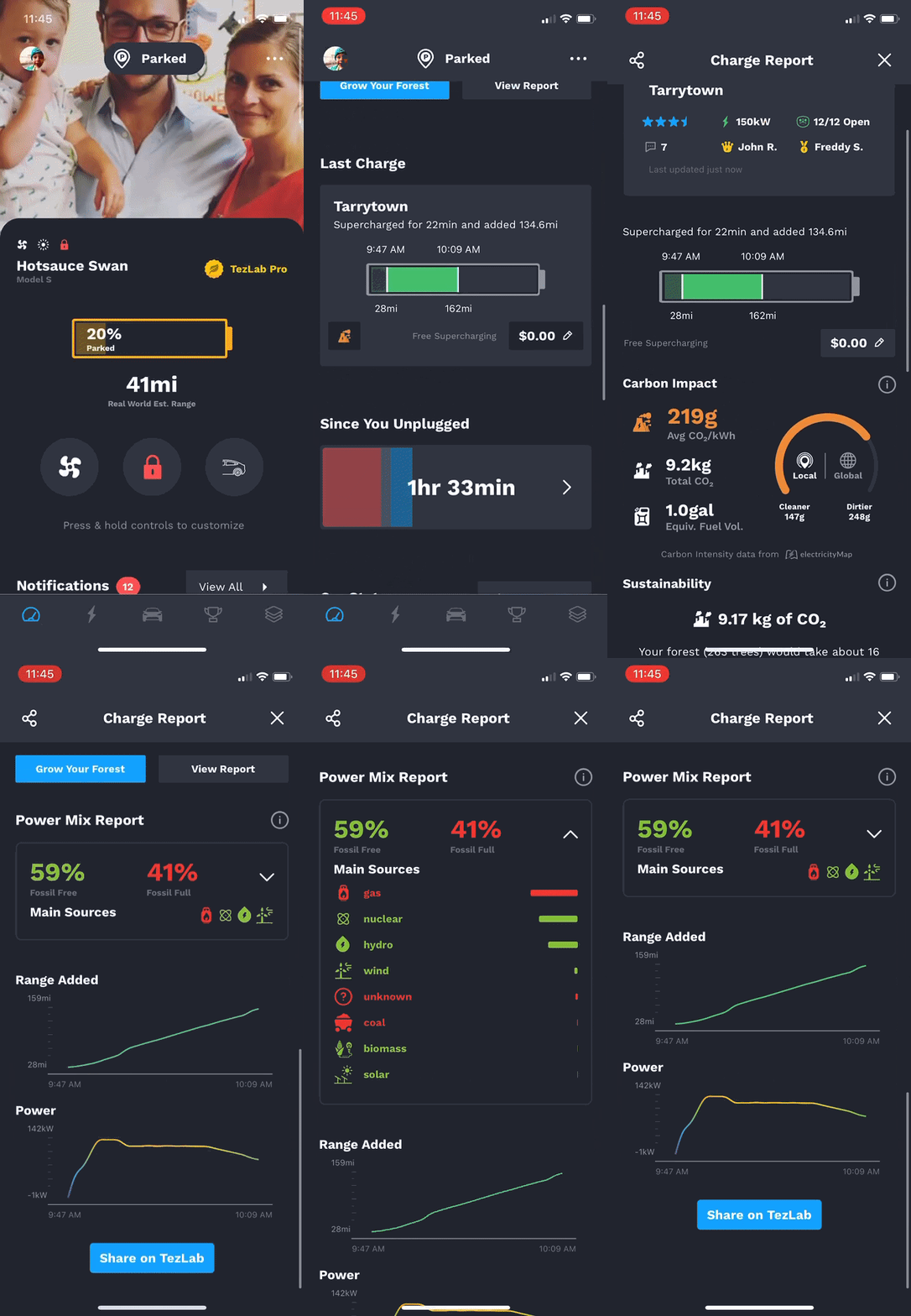
Tesla owners can now see exactly what kind of energy is powering their electric vehicles. TezLab, a free app that’s like a Fitbit for a Tesla vehicle, pushed out a new feature this week that shows the energy mix — breaking down the exact types and percentages of fossil fuels and renewable energy — coming from charging locations, including Superchargers and third-party networks throughout the United States.

“We’re tracking the origin of data as it relates to energy, so we know if you’re in Tucson or Brooklyn (or any location) where the energy is coming from and what the mix of that energy looks like,” Ben Schippers, the CEO and co-founder of TezLab explained in a recent interview. “As a result, we can see how much carbon is being pushed out into the atmosphere based on your charge, whether you’re charging at home, or whether you’re charging at a Supercharger.”

ElectricityMap, a project from Tomorrow, provided the energy data, which TezLab then folded into its consumer-facing app. Once downloaded, the app knows when and where a Tesla owner is plugging in. The energy mix feature builds off of an existing program on the app that gave owners more general information on how dirty or clean their charge is.

Image Credits: TezLab

Take Tesla’s Linq High Roller Supercharger in Las Vegas, a V3 Supercharger that is supposed to support a peak rate of up to 250 kilowatts and has been heralded for its use of Tesla solar panels and its Powerpack batteries to generate and store the power needed to operate the chargers.

According to TezLab’s data, 1.7% of the energy is from solar. The primary source of renewable energy is actually hydro at 65.6% — courtesy of the Hoover Dam. The remaining energy mix from the Supercharger is about 33% natural gas.

Tesla’s Supercharger in Hawthorne, California, which was one of the first to have solar panels, has an energy mix of 0.2% solar, 5.5% nuclear,13.3% natural gas, 27% coal and 49.9% wind.

The top 10 “cleanest” Superchargers — a list that includes Centralia, Leavenworth, Moses Lake and Seattle, Washington — achieved that goal thanks to hydroelectric power. Superchargers with the most solar energy are all located in the same power grid in California. Superchargers in Barstow, Oxnard, Cabazon, San Diego, Mojave, Inyokern, San Mateo, Seaside and Santa Ana, California all have 22.7% solar and 15% wind energy. The remaining mix at these locations is 0.2% battery storage, 2.9% biomass, 5.6% geothermal, 6.3% hydro, 6.6% nuclear and 40% natural gas.

TezLab was born out of HappyFunCorp, a software engineering shop that builds apps for mobile, web, wearables and Internet of Things devices for clients that include Amazon, Facebook and Twitter, as well as an array of startups. HFC’s engineers, including co-founders Schippers (who is now chairman of the company’s board) and William Schenk, were attracted to Tesla largely because of its software-driven approach. The group was particularly intrigued at the opportunity created by the openness of the Tesla API. The Tesla API is technically private. But the endpoints are accessible to outsiders. When reverse-engineered, it’s possible for a third-party app to communicate directly with the API.

TezLab launched in 2018 with some initial features that let owners track their efficiency, total trip miles and use it to control certain functions of the vehicle, such as locking and unlocking the doors and heating and air conditioning. More features have been added, mostly focused on building community, including one that allows Tesla owners to rate Supercharger stations.

All of that data is aggregated and anonymous. TezLab has said it won’t sell that data. It does post on its website insights gleaned from that data, such as a breakdown of model ownership, the average trip length and average time between plugging in.

As other electric vehicles come to market, TezLab is adding those to the app, including the Ford Mustang Mach-E.

16 Apr 2021

Apple Music streaming revenue detailed in letter to artists

Streaming revenue has been a longtime concern for musicians, especially those scraping by in the wake of an industry-wide implosion of record labels. Of course, a year that has made touring an impossibility has only brought those issues into starker relief as the primary revenue source for many has completely dried up.

Apple is hoping to clarify some of the major questions around streaming revenue in a letter it sent to artists. The note, reported by The Wall Street Journal, outlines a revenue that amounts to around double what Spotify pays out.

“As the discussion about streaming royalties continues, we believe it is important to share our values,” the company notes. “We believe in paying every creator the same rate, that a play has a value, and that creators should never have to pay for featuring music in prime display space on its service.”

The company’s comment is a clear shot at Spotify’s much more varied payment model. What that actually works out to at the end of the day, however, is a slightly more complicated question. Things start at around a penny-per-stream (though it can go down from there). That amount is paid out to rights holders — be they record labels or publishers. It’s another in a long line of issues that have led many musicians to question the efficacy of intermediaries in 2021.

Spotify CEO Daniel Ek fanned the flames in an interview last year, stating, “Some artists that used to do well in the past may not do well in this future landscape, where you can’t record music once every three to four years and think that’s going to be enough.”

At the end of the day, it’s a battle of pennies — or fractions thereof, for many artists. And it has become immensely difficult for mid-tier and truly independent artists to maintain a living as the world has shifted to a streaming model. Services like Bandcamp and Soundcloud have worked to make things more manageable for smaller artists, but the life of a modern musician remains a struggle — especially in the age of COVID-19.


16 Apr 2021

Enterprise security attackers are one password away from your worst day

If the definition of insanity is doing the same thing over and over and expecting a different outcome, then one might say the cybersecurity industry is insane.

Criminals continue to innovate with highly sophisticated attack methods, but many security organizations still use the same technological approaches they did 10 years ago. The world has changed, but cybersecurity hasn’t kept pace.

Distributed systems, with people and data everywhere, mean the perimeter has disappeared. And the hackers couldn’t be more excited. The same technology approaches, like correlation rules, manual processes, and reviewing alerts in isolation, do little more than remedy symptoms while hardly addressing the underlying problem.

Credentials are supposed to be the front gates of the castle, but as the SOC is failing to change, it is failing to detect. The cybersecurity industry must rethink its strategy to analyze how credentials are used and stop breaches before they become bigger problems.

It’s all about the credentials

Compromised credentials have long been a primary attack vector, but the problem has only grown worse in the mid-pandemic world. The acceleration of remote work has increased the attack footprint as organizations struggle to secure their network while employees work from unsecured connections. In April 2020, the FBI said that cybersecurity attacks reported to the organization grew by 400% compared to before the pandemic. Just imagine where that number is now in early 2021.

It only takes one compromised account for an attacker to enter the active directory and create their own credentials. In such an environment, all user accounts should be considered as potentially compromised.

Nearly all of the hundreds of breach reports I’ve read have involved compromised credentials. More than 80% of hacking breaches are now enabled by brute force or the use of lost or stolen credentials, according to the 2020 Data Breach Investigations Report. The most effective and commonly-used strategy is credential stuffing attacks, where digital adversaries break in, exploit the environment, then move laterally to gain higher-level access.

16 Apr 2021

BrandProject expands beyond the studio model with a new $43M fund

BrandProject —a firm that’s backed successful direct-to-consumer commerce startups like Freshly (acquired by Nestlé), Persona (also acquired by Nestlé) and Chef’s Plate (acquired by Hello Fresh) — is announcing that it has raised $43 million for what it says is its first traditional venture fund.

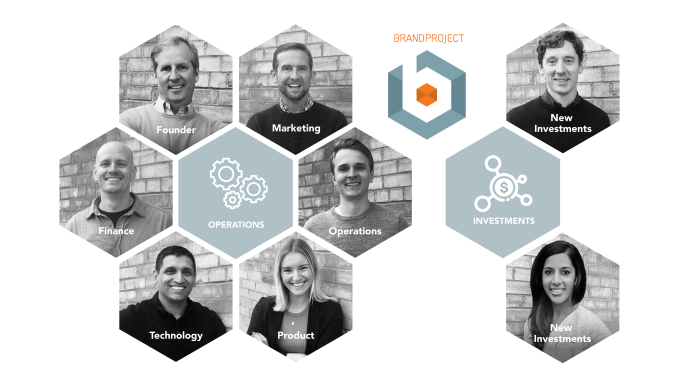
Founded Andrew Black, who previously co-founded Virgin Mobile Canada and served as president of LEGO Americas, BrandProject previously invested from a $12 million fund tied BrandProject Studio, where the money is just a small part of what’s being offered — apparently six of the firm’s eight team members are entirely focused on supporting startups, often serving as de facto CTOs, CFOs and CMOs.

With the new BrandProject Capital fund, the firm will be able to make larger investments in (somewhat) more mature companies. Black estimated that the new fund will be writing checks of between $1 million and $3 million; the goal is for half of the deals to be new investments, while the other half consists of follow-on investments in startups from BrandProject Studio.

“We’re going to be supporting the same type of businesses out of Studio or Capital, but with Studio, nothing’s too early for us — we’re all about team, team, team,” said Partner Hayden Williams. “But if it’s a Capital deal, we’re going to look for some evidence that something working, even if it’s a small scale.”

The focus will continue to be direct-to-consumer brands, and although the pandemic has led to tremendous e-commerce growth, Black said it hasn’t changed the BrandProject strategy.

BrandProject Team

Image Credits: BrandProject

“We haven’t adjusted our investment focus at all because of COVID,” he said. “We’ve always invested behind categories, brands and segments that we just think the world needs.”

One of the limited partners who invested in the new fund is probably BrandProject’s biggest success story — Freshly co-founder and CEO Michael Wystrach, who sold his healthy meal startup to Nestlé for $1.5 billion. Wystrach recalled reading about BrandProject in TechCrunch and, after looking the firm up, sending unsolicited meals to Partner Jay Bhatti in New York.

At that point, Freshly had only raised friends-and-family funding, and Wystrach admitted, “We would have taken a check from anyone.” But he said he was lucky that Bhatti liked the food and the firm decided to invest, with Black becoming an interim co-CEO, Bhatti serving as interim CTO and Partner Andrew Bridge serving as an interim CMO.

“What I loved about BrandProject is that they never came in and told us what kind of business we’re building,” he continued. “It was never a case where they said, ‘You need to do this.’ It was our business, and they were team members in helping us build the business.”

To illustrate the idea behind the new fund, Wystrach compared the investment ecosystem to the U.S. schools: “Where Andrew and the team come in, they’re K through 8 or maybe K through 6, they’re very hands on … With the new fund, maybe they’re moving to middle school.”

16 Apr 2021

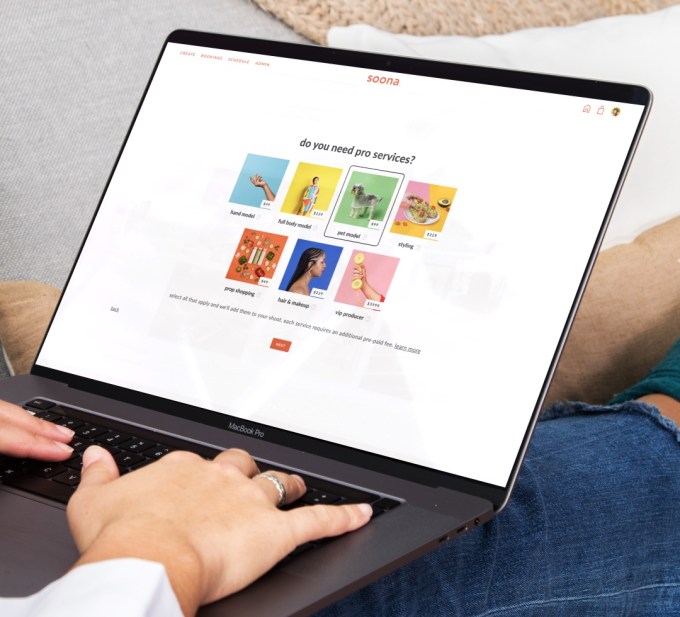
Soona raises $10.2M to make remote photo and video shoots easy

Soona, a startup aiming to satisfy the growing content needs of the e-commerce ecosystem, is announcing that it has raised $10.2 million in Series A funding led by Union Square Ventures.

When I wrote about Soona in 2019, the model focused on staging shoots that can deliver videos and photos in 24 hours or less. The startup still operates studios in Austin, Denver and Minneapolis, but co-founder and CEO Liz Georgi told me that during the pandemic, Soona shifted to a fully virtual/remote model — customers ship their products to Soona, then then watch the shoot remotely and offer immediate feedback, and only pay for the photos ($39 each) and video clips ($93 each) that they actually want.

In some cases, the studio isn’t even necessary — Georgi said that 30% of Soona’s photographers and crew members are working from home.

Soona has now worked with more than 4,000 customers, including Lola Tampons, The Sill, and Wild Earth, with revenue growing 400% last year. Georgi said that even as larger in-person shoots become possible again, this approach still makes sense for many clients.

“There’s nothing we sell online that does not require a visual, but not every single visual requires a massive full day shoot,” she said.

Soona

Image Credits: Soona

Georgi also suggested that Soona’s approach has unlocked a “new level of scalability,” adding, “Internally at Soona, we really believe in the remote shoot experience. It’s not only more efficient, it’s a lot more fun not having to fly a brand manager from Miami and have them spend a full day at a warehouse in New York. That’s not only cost-prohibitive, it’s also a time-consuming and exhausting process for everyone.”

The new funding follows a $1.2 million seed round. Georgi said the Series A will allow Soona to develop a subscription product with more collaboration tools and more data about what kinds of visual content is most effective.

“There’s an opportunity own the visual ecosystem of e-commerce from beginning to end,” she said.

Georgi also noted that Soona continues to employ its “candor clause” requiring investors to disclose whether they’ve ever faced complaints of sexual harassment or discrimination. In fact, the clause has been expanded to cover complaints around racism, ableism or anti-LGBTQ discrimination.

“In some ways it’s a gate that prevents bad actors from being involved […] but it really drives a deeper connection with the investor and the founder,” Georgi said. “We can have conversation about our values and how we see the world. We get to have a conversation about equality and justice at at time when we’re talking a lot about equity and the cap table.”

16 Apr 2021

Nelo raises $3M to grow ‘buy now, pay later’ in Mexico

Buy now, pay later is a way of paying for purchases via installment loans that generally have no interest. The concept has grown in popularity in recent years, especially in markets such as the United States, Europe and Australia. Numerous players abound, all fighting for market share — from Affirm to Klarna to Afterpay, among others.

But notably, none of these bigger players have yet to penetrate another very large market — Latin America. Enter Nelo, a startup founded by former Uber international growth team leads, which is building buy now, pay later in Mexico. The company is already live with more than 45 merchants and over 150,000 users.

San Francisco-based fintech-focused VC firm Homebrew led its recent seed round of $3 million, which also included participation from Susa Ventures, Crossbeam, Rogue Capital, Unpopular Ventures and others. With the latest capital infusion, Nelo has raised a total of $5.6 million since its 2019 inception.

Nelo is not the only player in the Mexican market. A number of others, including Alchemy and Addi, have recently outlined plans for buy now, pay later offerings in the region. But where Nelo has an advantage, believes CEO Kyle Miller, is its established relationships with about 45 merchants.

“What I’m excited about is the relationship with the merchants,” Miller told TechCrunch. “If we find a large global one and increase conversion for them, that is our defensibility [against competitors]. What’s important here is signing on merchants, since they usually only have one offering in their checkout.”

He and co-founder Stephen Hebson used to work for Uber’s international growth team, growing financial services products in India, Mexico, China and Brazil.

“We got to see a cross market where countries were accelerating and where others weren’t,” Miller recalls. “For example, China was a leader in mobile payments and digital finance in India was completely transformed.”

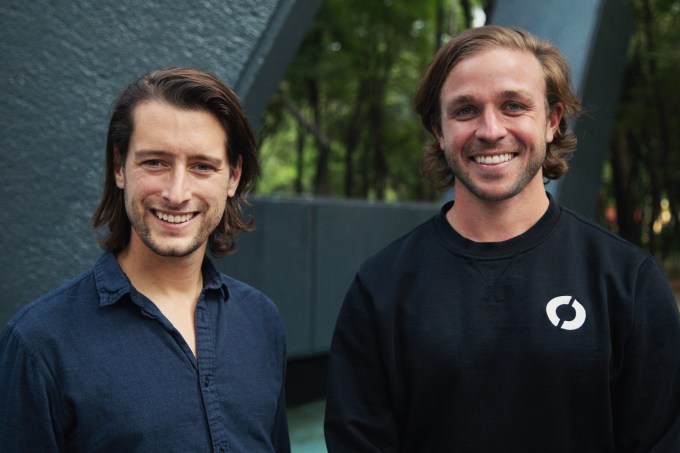
Nelo co-founders Stephen Hebson and Kyle Miller; Image courtesy of Nelo

But in markets like Mexico, the percentage of cash payments for trips was very high. And to Miller and Hebson, this spelled opportunity.

Nelo launched its first product in Mexico in January 2020, similar to a debit card offering from a neobank. In the middle of the year, the company launched credit installment loans.

“It became immediately clear that it was going to be our most popular feature,” Miller said. “By the end of the year, it was the vast majority of our business and something that our users were telling their friends about. We were solving a real pain point.”

Indeed, cash remains the dominant method of payment in Mexico, with an estimated 86% of all payments being in the form of cash. According to eMarketer, the region was the fastest-growing e-commerce market in the world in 2020, with 37% year over year growth.

“Access to credit is something we take for granted in the U.S.,” Miller said. “By the end of the year, we realized this was the future of business, and we decided to focus just on credit.”

In March, Nelo launched its first product via an Android app and will be launching a web app soon.

Customers can use its offering like a credit card, connecting directly with merchants such as Netflix and Spotify. Many users are paying for things like utility bills and cell phone bills, turning them from prepaid to postpay.

With its current product, the company has lent about $2 million, and is seeing growth of about 20% month over month.

“We’re seeing massive demand for this new product in the way of organic signups,” Miller said, “for all the reasons Buy Now, Pay Later has been successful in markets like the U.S., Europe and Australia.”

Paying for installments is already common in Latin America, particularly in Brazil, so the concept is not foreign to residents in the region.

“We expected this is soon going to be a competitive market, so we’re hiring data scientists and engineers to continue improving our product, and grow,” Miller said.

Nelo has about 14 employees with an engineering team in New York.

Homebrew Partner Satya Patel says he’s excited about Nelo because he believes the startup “solves a serious problem related to the lack of credit for Mexican consumers.”

“Credit card penetration is less than 10% in Mexico and other forms of credit are effectively non-existent,” he wrote via email. “Nelo makes it possible for Mexicans to easily and inexpensively increase their purchasing power at the point of sale. And importantly, Nelo is delivering this solution online, supporting growing interest in e-commerce, and also offline, where consumers regularly shop today.”

Patel adds that what Nelo is building is valuable because he is not aware of any reliable, comprehensive consumer credit rating data set in Mexico.

“They are building underwriting models based on proprietary data and growing the merchant network at an incredible rate,” he said. “This buy now, pay later opportunity is untapped in Mexico but requires a very different approach than what has been successful in other markets.”

The Nelo team, according to Patel, understands the nuances of the market and “is executing at an exceptional pace.”

16 Apr 2021

Reform the US low-income broadband program by rebuilding Lifeline

“If you build it, they will come” is a mantra that’s been repeated for more than three decades to embolden action. The line from “Field of Dreams” is a powerful saying, but I might add one word: “If you build it well, they will come.”

America’s Lifeline program, a monthly subsidy designed to help low-income families afford critical communications services, was created with the best intentions. The original goal was to achieve universal telephone service, but it has fallen far short of achieving its potential as the Federal Communications Commission has attempted to convert it to a broadband-centric program.

The FCC’s Universal Service Administrative Company estimates that only 26% of the families that are eligible for Lifeline currently participate in the program. That means that nearly three out of four low-income consumers are missing out on a benefit for which they qualify. But that doesn’t mean the program should be abandoned, as the Biden administration’s newly released infrastructure plan suggests.

Now is the right opportunity to complete the transformation of Lifeline to broadband and expand its utilization by increasing the benefit to a level commensurate with the broadband marketplace and making the benefit directly available to end users.

Rather, now is the right opportunity to complete the transformation of Lifeline to broadband and expand its utilization by increasing the benefit to a level commensurate with the broadband marketplace and making the benefit directly available to end users. Instead, the White House fact sheet on the plan recommends price controls for internet access services with a phaseout of subsidies for low-income subscribers. That is a flawed policy prescription.

If maintaining America’s global competitiveness, building broadband infrastructure in high-cost rural areas, and maintaining the nation’s rapid deployment of 5G wireless services are national goals, the government should not set prices for internet access.

Forcing artificially low prices in the quest for broadband affordability would leave internet service providers with insufficient revenues to continue to meet the nation’s communications infrastructure needs with robust innovation and investment.

Instead, targeted changes to the Lifeline program could dramatically increase its participation rate, helping to realize the goal of connecting Americans most in need with the phone and broadband services that in today’s world have become essential to employment, education, healthcare and access to government resources.

To start, Lifeline program participation should be made much easier. Today, individuals seeking the benefit must go through a process of self-enrollment. Implementing “coordinated enrollment” — through which individuals would automatically be enrolled in Lifeline when they qualify for certain other government assistance benefits, including SNAP (the Supplemental Nutrition Assistance Program, formerly known as food stamps) and Medicaid — would help to address the severe program underutilization.

Because multiple government programs serve the same constituency, a single qualification process for enrollment in all applicable programs would generate government efficiencies and reach Americans who are missing out.

Speaking before the American Enterprise Institute back in 2014, former FCC Commissioner Mignon Clyburn said, “In most states, to enroll in federal benefit programs administered by state agencies, consumers already must gather their income-related documentation, and for some programs, go through a face-to-face interview. Allowing customers to enroll in Lifeline at the same time as they apply for other government benefits would provide a better experience for consumers and streamline our efforts.”

Second, the use of the Lifeline benefit can be made far simpler for consumers if the subsidy is provided directly to them via an electronic Lifeline benefit card account — like the SNAP program’s electronic benefit transfer (EBT) card. Not only would a Lifeline benefit card make participation in the program more convenient, but low-income

Americans would then be able to shop among the various providers and select the carrier and the precise service(s) that best suits their needs. The flexibility of greater consumer choice would be an encouragement for more program sign-ups.

And, the current Lifeline subsidy amount — $9.25 per month — isn’t enough to pay for a broadband subscription. For the subsidy to be truly meaningful, an increase in the monthly benefit is needed. Last December, Congress passed the temporary Emergency Broadband Benefit to provide low-income Americans up to a $50 per month discount ($75 per month on tribal lands) to offset the cost of broadband connectivity during the pandemic. After the emergency benefit runs out, a monthly benefit adequate to defray the cost of a broadband subscription will be needed.

In order to support more than a $9.25 monthly benefit, the funding source for the Lifeline program must also be reimagined. Currently, the program relies on the FCC’s Universal Service Fund, which is financed through a “tax” on traditional long-distance and international telephone services.

As greater use is made of the web for voice communications, coupled with less use of traditional telephones, the tax rate has increased to compensate for the shrinking revenues associated with landline phone services. A decade ago, the tax, known as the “contribution factor,” was 15.5%, but it’s now more than double that at an unsustainable 33.4%. Without changes, the problem will only worsen.

It’s easy to see that the financing of a broadband benefit should no longer be tied to a dying technology. Instead, funding for the Lifeline program could come from a “tax” shared across the entire internet ecosystem, including the edge providers that depend on broadband to reach their customers, or from direct congressional appropriations for the Lifeline program.

These reforms are realistic and straightforward. Rather than burn the program down, it’s time to rebuild Lifeline to ensure that it fulfills its original intention and reaches America’s neediest.

16 Apr 2021

Facebook’s decision-review body to take “weeks” longer over Trump ban call

Facebook’s self-styled and handpicked ‘Oversight Board’ will make a decision on whether or not to overturn an indefinite suspension of the account of former president Donald Trump within “weeks”, it said in a brief update statement on the matter today.

The high profile case appears to have attracted major public interest, with the FOB tweeting that it’s received more than 9,000 responses so far to its earlier request for public feedback.

Also today it said it’s extended the deadline for comments on the case in line with its bylaws, saying its commitment to “carefully reviewing all comments” is responsible for the extension of the case timeline.

It’s not clear exactly how much more time people will have to submit views on whether or not Trump should get his social media megaphone back from Facebook. (We’ve asked.)

The Board’s statement merely notes that it will provide more information “soon”.

Trump’s indefinite suspension from Facebook and Instagram was announced by Facebook founder Mark Zuckerberg on January 7, after the then-president of the U.S. incited his followers to riot at the nation’s Capitol — an insurrection that led to chaotic and violent scenes and a number of deaths as his supporters clashed with police.

However Facebook quickly referred the decision to the FOB for review — opening up the possibility that the ban could be overturned in short order as Facebook has said it will be bound by the case review decisions issued by the Board.

After the FOB accepted the case for review it initially said it would issue a decision within 90 days of January 21 — a deadline that would have fallen next Wednesday.

However it now looks like the high profile, high stakes call on Trump’s social media fate could be pushed into next month.

It’s a familiar development in Facebook-land. Delay has been a long time feature of the tech giant’s crisis PR response in the face of a long history of scandals and bad publicity attached to how it operates its platform. So the tech giant is unlikely to be uncomfortable that the FOB is taking its time to make a call on Trump’s suspension.

After all, devising and configuring the bespoke case review body — as its proprietary parody of genuine civic oversight — is a process that has taken Facebook years already.

In related FOB news this week, Facebook announced that users can now request the board review its decisions not to remove content — expanding the Board’s potential cases to include reviews of ‘keep ups’ (not just content takedowns).