Year: 2021

08 Apr 2021

Nabla is building a healthcare super app for women

Meet Nabla, a French startup launching a new app today focused on women’s health. On Nabla, you’ll find several services that should all contribute to helping you stay on top of your health. In short, Nabla lets you chat with practitioners, offers community content, helps you centralize all your medical data and will soon offer telemedicine appointments.

Nabla’s key feature right now is the ability to start a conversation with health professionals. You can send a message to a general practitioner, a gynecologist, a midwife, a nurse, a nutritionist, or a physiotherapist.

While text discussions are not going to replace in-person appointments altogether, they can definitely be helpful. By increasing the number of interactions with health professionals, chances are you’ll be healthier and you may even end up booking more in-person appointments.

Other French startups have been providing text conversations with practitioners. For instance, health insurance company Alan lets you message a general practitioner — but you have to be insured by Alan. Biloba also lets you chat with a doctor — but the company has been focusing on pediatrics.

Nabla has a different positioning and offers this feature for free — there’s a limit as you can only send a handful of questions per month though. If it’s a common question, you may find the answer from the community. Nabla’s doctors will curate community content as well.

Using a free product to talk about your health feels suspicious. But that’s because the startup is well-funded and plans to launch premium features.

Image Credits: Nabla

The startup has raised $20.2 million (€17 million) and is already working with a team of doctors who are ready to answer questions from the company’s first users — or patients. Investors in the company include Xavier Niel, Artemis, Rachel Delacour, Julie Pellet, Marc Simoncini and Firstminute Capital.

One of the reasons why Nabla could raise so much money before releasing its app is that the three co-founders have a track record in the tech ecosystem.

Co-founder and CEO Alexandre Lebrun previously founded VirtuOz, which was acquired by Nuance, and Wit.ai, which was acquired by Facebook. More recently, he’s worked for Facebook’s AI research team (FAIR).

Co-founder and COO Delphine Groll has been heading business development and communications for two major media groups Aufeminin and My Little Paris. And Nabla’s co-founder and CTO Martin Raison has worked with Alexandre Lebrun at both Wit.ai and Facebook.

In addition to text conversations, Nabla shows all your past interactions in a personal log. You can connect that log with other apps and services, such as Apple’s Health app, Clue and Withings. This way, you can see all your data from the same app.

As you may have guessed, the startup truly believes that machine learning can help when it comes to preventive and holistic care. By default, nothing is shared with Nabla for machine learning purposes. But users can opt in and share data to improve processes, personalization and more.

Eventually, Nabla wants to optimize the interactions with doctors as much as possible. The startup says it doesn’t want to replace doctors altogether — it wants to enhance medical interactions so that doctors can focus on the human and empathetic part.

Nabla plans to launch a telemedicine service so that you can interact with doctors in real time as well as a premium offering with more features. That’s an ambitious roadmap, and it’s going to be interesting to track Nabla over the long run to see if they stick to their original vision and find a loyal user base.

08 Apr 2021

India’s Spinny raises $65 million to expand its online platform for selling used cars

Hundreds of thousands of used cars are sold in India each month. But buying one through the offline and traditional channel could prove to be a painstakingly long and high-risk process.

A Gurgaon-based startup that is attempting to improve this experience said on Thursday it has raised a new financing round.

Spinny has raised $65 million in its Series C financing round, the five-year-old Indian startup said. The new round was led by Silicon Valley-headquartered venture firm General Catalyst, while existing investors Fundamentum Partnership — backed by tech veterans Nandan Nilekani and Sanjeev Aggarwal — and Elevation Partners participated in it.

The round, which brings Spinny’s to-date raise to over $120 million, valued the startup at about $350 million, up from about $150 million a year ago, a person familiar with the matter told TechCrunch. The startup declined to comment on the valuation.

Spinny operates a platform to facilitate sale and purchase of used cars. One of the biggest challenges people face in buying a used car is the trust factor, and Niraj Singh, co-founder and chief executive of Spinny, says the startup’s thorough and transparent inspection of the car, buying it from the owner, and then selling it to customers is addressing those concerns.

The startup says it is removing the traditional middlemen from the equation, thereby making it more affordable and reliable for customers to buy a used car. If a customer is not satisfied with the car they have purchased from Spinny, they get their full-refund, he said.

Spinny began its journey as a marketplace for used cars, but Singh said the startup has expanded its offerings to become a full-stack platform.

Days after one of my previous conversations with Singh, New Delhi announced a months-long lockdown in the nation as it moved to contain the spread of the pandemic. Singh said the pandemic did hurt Spinny’s business for a few months, but the startup has long recovered its pre-pandemic growth figures.

This is a developing story. More to follow…

08 Apr 2021

Norway’s Kolonial rebrands as Oda, bags $265M on a $900M valuation to grow its online grocery delivery business in Europe

Food delivery startups, and specifically those focused on grocery delivery, continue to reap super-sized rounds of funding in Europe, buoyed by a year of pandemic living that has led many consumers to shift to shopping online. Today, the latest of these is coming out of Norway.

Kolonial, a startup based out of Oslo that offers same-day or next-day delivery of food, meal kits and home essentials — its aim is to provide “a weekly shop” for prices that compete against those of traditional supermarkets — has raised €223 million ($265 million) in an equity round of funding. Along with that, the company — profitable as of last year — is rebranding to Oda and plans to use the money (and new name) to expand to more markets, starting first with Finland and then Germany in 2022.

The market for online grocery ordering and delivery is gearing up to be a very crowded one, with hundreds of millions of dollars being poured by investors into the fuel tanks of a range of startups — each originating out of different geographies, each with a slightly different approach. Oda believes it has the right mix to end up at the front of the pack.

“We have found ourselves in a unique position,” CEO and co-founder Karl Munthe-Kaas said in an interview with TechCrunch. “We have built a service targeting the mass market with instant deliveries and low prices, because if you want to capture the full basket for the family, you can’t be a premium service. We’ve done that, and we’re profitable.”

And now, it will have the backing of two e-commerce heavyweights for its next steps. SoftBank’s Vision Fund 2 and Prosus (the tech holdings of South Africa’s Naspers), are co-leading the round, with past backers Kinnevik and a strategic investor, Norwegian “soft discount” chain REMA, also participating.

Munthe-Kaas confirmed to TechCrunch in an interview that Oda is valued at €750 million ($900 million) post-money.

The funding is a big leap for Oda (the name is not officially going to come into effect until the end of this month, although the company is already describing itself with the new brand, so we’ll follow that lead). PitchBook data notes that before this round, Oda had only raised about $96 million, and its last valuation was estimated to be just $178 million in 2017.

The company has certainly come a long way. Founded in 2013 by ten friends, Kolonial originally seemed to have a more modest vision when it first started out: Kolonial in Norwegian doesn’t mean “colonial” (a connotation Munthe-Kaas nevertheless said the startup wanted to avoid, one big reason for the change), but “cornershop.” These days, Oda is focused more on competing against large supermarkets — its average order size is $120 — yet with a significantly more efficient cost base behind the scenes.

It’s also been helped by the current climate. Online grocery shopping has been growing and maturing for a while now, but the last year been a veritable hothouse in that process: Covid-19, shelter in place orders and a general desire for people to keep their distance all compelled many more consumers to try out online grocery shopping for the first time, and many have stuck with it.

“We have seen a significant inflection point with grocery over the last year with the market transitioning online, accelerated by Covid,” said Larry Illg, CEO of Prosus Food, in a statement. “Oda’s leadership and impressive growth in Norway paired with its ground-breaking technology and ambition to scale across Europe and beyond makes them an ideal partner to tackle the grocery opportunity over the coming years.”

Oda has over the years grown to become the sector leader in a category it arguably helped define in its home country. It was profitable last year on revenues of €200 million, and it currently controls some 70% of Norway’s online grocery ordering and delivery market based on its own particular approach to the model.

That model involves Oda building and controlling its own supply chains from producers to consumers (no partnerships with third y partphysical retailers), producing several of the products itself (such as baked goods) to order, and using centralized fulfillment centers to manage orders for large geographies.

“Centralized warehouses means 50 supermarkets in one location,” Munthe-Kaas said, adding that this also makes the business significantly greener, too.

Those fulfillment centers, meanwhile, are operated at “extreme efficiency”, in his words. Oda’s grocery item picking averages out at 212 units per hour — that is, the amount of items “picked” for orders in a week divided by the number of hours in a week. The next closest UPH number in the industry, Munthe-Kaas said, was Ocado in the UK at 170 UPH, and the norm, he added, was more like 100 UPH, with physical store picking (where customers select items from shelves themselves) averaging out at 70 UPH.

All of this translates to much more cost-effective operations, including more efficient ordering and stock rotation, which helps Oda make better margins on its sales overall. Munthe-Kaas declined to go into the details of how Oda manages to get such high UPH numbers — that’s competitive knowledge, he said — noting only that a lot of automation and data analytics goes into the process.

That will be music to the ears of SoftBank, which has had a complicated run in e-commerce in the last several years, backing a number of interesting juggernauts that have nonetheless found themselves unable to improve on challenging unit economics.

“Oda’s leading position in Norway is testament to the merits of its bespoke and data-driven approach in offering a personalised, holistic and reliable online grocery experience,” said Munish Varma, managing partner for SoftBank Investment Advisers, in a statement. “We believe that Oda’s customer-centric focus, market-leading automation technology and fulfillment efficiency are a winning combination, and position Oda for success in scaling internationally for the benefit of customers and suppliers alike.”   

The big challenge for Oda going forward will be whether it can transplant its business model as it has been developed for Norway into further markets.

Oda will not only be looking for customer traction for its own business, but it will be doing so potentially against heavy competition from others also looking to expand outside their borders.

There are other online supermarket plays like Rohlik out of the Czech Republic (which in March bagged $230 million in funding); Everli out of Italy (formerly called Supermercato24, it also raised $100 million); Picnic out of the Netherlands (which has yet to announce any recent funding but it feels like it’s only a matter of time given it too has publicly laid out international ambitions); and Ocado in the UK (which also has raised huge amounts of money to pursue its own international ambitions).

And there is also the wave of companies that are building more fleet-of-foot approaches around smaller inventories and much faster turnaround times, the idea being that this can cater both to individuals and a different way of shopping — smaller and more often — even if you are a family.

Among these so-called “q-commerce” (quick commerce) players, covering just some of the most recent funding rounds, Glovo just last week raised $528 million; Gorillas in Berlin raised $290 million; Turkey’s Getir — also rapidly expanding across Europe — picked up $300 million on a $2.6 billion valuation as Sequoia took its first bite into the European food market; and reportedly Zapp in London has also closed $100 million in funding.

Deliveroo, which went public last week, is also now delivering groceries (in partnership with Sainsbury’s) alongside its restaurant delivery service.

These, ironically, are more cornershop replacements than Oda itself (formerly called Kolonia, or “cornershop” in Norwegian), and Munthe-Kaas said he sees them as “complementary” to what Oda does.

Indeed, Munthe-Kaas remains very committed to the basic rulebook that Oda has lived by for years.

“You need to beat the physical stores on quality, selection and price and get it home delivered,” he said. “This is a margin business and the only way to optimize is to be completely relentless.”

But he also understands that this might ultimately need to be modified depending on the market. For example, while the company has not worked with other retailers in Norway — even the investment by REMA is not for distribution but for better economies of scale in procuring products that REMA and Oda will sell independently from each other — this might be a route that Oda chooses to take in other markets.

“We’re in discussions with several other retailers, wholesalers and producers,” he said. “It’s important to get sourcing terms and have upstream logistics, but there are many ways of achieving that. We are super open to making partnerships on that front, but we still think the way to win is to run the value chain.”


08 Apr 2021

ShareChat valued at $2.1 billion in $502 million fundraise

ShareChat said on Thursday it has raised a new financing round that values it at over $2 billion, joining four other local startups in attaining the unicorn status this week.

The Indian social network said it has raised $502 million in a new financing round led by Tiger Global that valued ShareChat at $2.1 billion. Snap and Twitter also participated in the round, said ShareChat.

The startup began engaging with investors for the new financing round about 10 months ago, and explored a full buy out deal with Twitter, which didn’t materialize, TechCrunch reported earlier.

ShareChat, which claims to have over 160 million users, offers its social network app in 15 Indian languages and has a large following in small Indian cities and towns, or what venture capitalist Sajith Pai of Blume Ventures refer as “India 2.” Very few players in the Indian startup ecosystem have a reach to this segment of this population, which thanks to users from even smaller towns and villages — called “India 3” — getting online has expanded in recent years.

This is a developing story. More to follow…

08 Apr 2021

Beyond Meat opens its first production plant in China

About a year after Beyond Meat debuted in China on Starbucks’s menu, the Californian plant-based protein company opened a production facility near Shanghai to tap the country’s supply chain resources and potentially reduce the carbon footprint of its products.

Situated in Jiaxing, a city 85 km from Shanghai, the plant is Beyond Meat’s first end-to-end manufacturing facility outside the U.S., the Nasdaq-listed company said in an announcement on Wednesday.

Over the past year, competition became steep in China’s alternative protein space with the foray of foreign players like Beyond Meat and Eat Just, as well as a slew of capital injections for domestic startups including Hey Maet and Starfield.

Beyond Meat doesn’t flinch at the rivalry. When asked by TechCrunch to comment on a story about China’s alternative protein scene, a representative of the company said “there are none that Beyond Meat considers their competitors.”

China not only has an enormous, unsaturated market for meat replacements; it’s also a major supplier of plant-based protein. Chinese meat substitute startups enjoy a cost advantage from the outset and don’t lack interest from investors who race to back consumer products that are more reflective of the tastes of the rising middle class.

Having some kind of manufacturing capacity in China is thus almost a prerequisite for any serious foreign player. Tesla has done it before to build Gigafactory in Shanghai to deliver cheaper electric vehicles. Localized production also helps companies advance their sustainability goals as it shortens the supply chain.

In Beyond Meat’s own words, the Jiaxing facility is “expected to significantly increase the speed and scale in which the company can produce and distribute its products within the region while also improving Beyond Meat’s cost structure and sustainability of operations.”

The American food-tech giant works hard on localization, selling in China both its flagship burger patties and an imitation minced pork product made specifically for the world’s largest consumer of pork. The soy- and rice-based minced pork could be used in a wide range of Chinese cuisines and is the result of a collaboration between the firm’s Shanghai and Los Angeles teams.

Besides production, the Jiaxing plant will also take on R&D responsibilities to invent new products for the region. Beyond Meat will also be unveiling its first owned manufacturing facility in Europe this year.

“We are committed to investing in China as a region for long-term growth,” said Ethan Brown, CEO and founder of Beyond Meat. “We believe this new manufacturing facility will be instrumental in advancing our pricing and sustainability metrics as we seek to provide Chinese consumers with delicious plant-based proteins that are good for both people and planet.”

Beyond Meat products can now be found in Starbucks, KFC, Alibaba’s Hema supermarket and other retail channels across major Chinese cities.

07 Apr 2021

Spotify stays quiet about launch of its voice command ‘Hey Spotify’ on mobile

In 2019, Spotify began testing a hardware device for automobile owners it lovingly dubbed “Car Thing,” which allowed Spotify Premium users to play music and podcasts using voice commands that began with “Hey, Spotify.” Last year, Spotify began developing a similar voice integration into its mobile app. Now, access to the “Hey Spotify” voice feature is rolling out more broadly.

Spotify chose not to officially announce the new addition, despite numerous reports indicating the voice option was showing up for many people in their Spotify app, leading to some user confusion about availability.

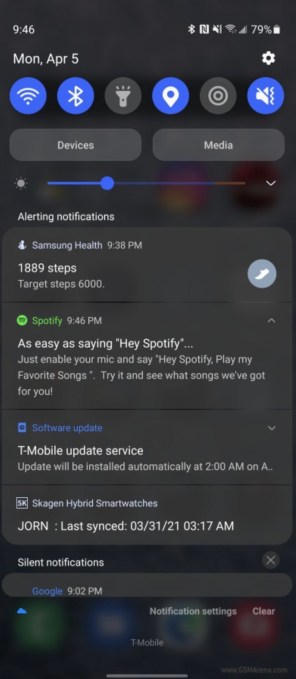
One early report by GSM Arena, for example, indicated Android users had been sent a push notification that alerted them to the feature. The notification advised users to “Just enable your mic and say ‘Hey Spotify, Play my Favorite Songs.” When tapped, the notification launched Spotify’s new voice interface where users are pushed to first give the app permission to use the microphone in order to be able to verbally request the music they want to hear.

Several outlets soon reported the feature had launched to Android users, which is only partially true.

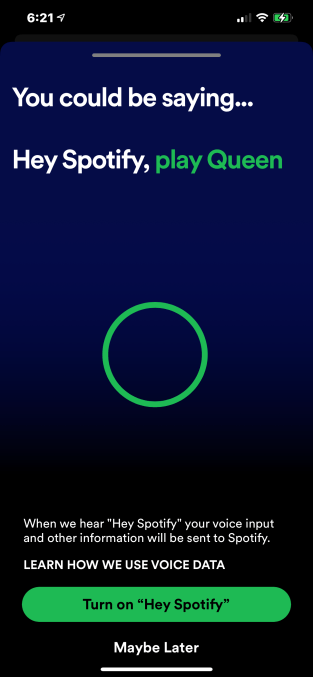
As it turns out, the feature is making its way to iOS devices, as well. When we launched the Spotify app here on an iPhone running iOS 14.5, for instance, we found the same feature had indeed gone live. You just tap on the microphone button by the search box to get to the voice experience. We asked around and found that other iPhone users on various versions of the iOS operating system also had the feature, including free users, Premium subscribers and Premium Family Plan subscribers.

The screen that appears suggests in big, bold text that you could be saying “Hey Spotify, play…” followed by a random artist’s name. It also presents a big green button at the bottom to turn on “Hey Spotify.”

Once enabled, you can ask for artists, albums, songs and playlists by name, as well as control playback with commands like stop, pause, skip this song, go back and others. Spotify confirms the command with a robotic-sounding male voice by default. (You can swap to a female voice in Settings, if you prefer.)

Image Credits: Spotify screenshot iOS

This screen also alerts users that when the app hears the “Hey Spotify” voice command, it sends the user’s voice data and other information to Spotify. There’s a link to Spotify policy regarding its use of voice data, which further explains that Spotify will collect recordings and transcripts of what you say along with information about the content it returned to you. The company says it may continue to use this data to improve the feature, develop new voice features and target users with relevant advertising. It may also share your information with service providers, like cloud storage providers.

The policy looks to be the same as the one that was used along with Spotify’s voice-enabled ads, launched last year, so it doesn’t seem to have been updated to fully reflect the changes enabled with the launch of “Hey Spotify.” However, it does indicate that, like other voice assistants, Spotify doesn’t just continuously record — it waits until users say the wake words.

Given the “Hey Spotify” voice command’s origins with “Car Thing,” there’s been speculation that the mobile rollout is a signal that the company is poised to launch its own hardware to the wider public in the near future. There’s already some indication that may be true — MacRumors recently reported finding references and photos to Car Thing and its various mounts inside the Spotify app’s code. This follows Car Thing’s reveal in FCC filings back in January of this year, which had also stoked rumors that the device was soon to launch.

Spotify was reached for comment this morning, but has yet been unable to provide any answers about the feature’s launch despite a day’s wait. Instead, we were told that they “unfortunately do not have any additional news to share at this time.” That further suggests some larger projects could be tied to this otherwise more minor feature’s launch.

Though today’s consumers are wary of tech companies’ data collection methods — and particularly their use of voice data after all three tech giants confessed to poor practices on this front — there’s still a use case for voice commands, particularly from an accessibility standpoint and, for drivers, from a safety standpoint.

And although you can direct your voice assistant on your phone (or via CarPlay or Android Auto, if available) to play content from Spotify, some may find it useful to be able to speak to Spotify directly — especially since Apple doesn’t allow Spotify to be set as a default music service. You can only train Siri to launch Spotify as your preferred service.

If, however, you have second thoughts about using the “Hey Spotify” feature after enabling it, you can turn it off under “Voice Interactions” in the app’s settings.

07 Apr 2021

Daily Crunch: Google I/O will return virtually next month

Google announces its I/O plans, Facebook tests an audio Q&A feature and Patreon triples its valuation. This is your Daily Crunch for April 7, 2021.

The big story: Google I/O will return virtually next month

Google canceled its giant developer conference last year during the pandemic. This year, the show will return in virtual form, from May 18 to May 20. It will be free and open to all.

Google is following the lead of companies like Apple (which is holding a virtual WWDC in June) and Microsoft (which will hold a virtual Build from May 25 to 27).

The tech giants

Facebook tests Hotline, a Q&A product that’s a mashup of Clubhouse and Instagram Live — Unlike Clubhouse, creators can opt to turn their cameras on for the event, instead of being audio-only.

Twitch expands its rules against hate and abuse to include behavior off the platform — The news comes as Twitch continues to grapple with reports of abusive behavior and sexual harassment, both on the platform and within the company itself.

E-bikes and earbuds among the first third-party hardware to support Apple’s Find My tracking — VanMoof’s S3 and X3 e-bikes will sport tracking functionality, along with a “Locate with Apple Find My” logo located on the bottom side of the crossbar.

Startups, funding and venture capital

Patreon triples valuation to $4 billion in new raise — This was in a $155 million funding round led by Tiger Global.

Plaid raises $425M Series D from Altimeter as it charts a post-Visa future — After its $5.3 billion sale to Visa fell through this January, it became clear that Plaid would chart its own future.

Authentic Artists is building virtual, AI-powered musicians — These musicians will perform their own concerts, initially in Twitch, and can respond to audience requests.

Advice and analysis from Extra Crunch

How to kick the 10 worst startup habits with Fuel Capital’s Leah Solivan — Solivan has ample experience on both sides of the fence, as she founded TaskRabbit and led it to exit through an acquisition by Ikea in 2017.

The do’s and don’ts of bug bounty programs with Katie Moussouris — In the rush to launch, cybersecurity doesn’t always get the attention it deserves, and yet it’s one of the first things that can go wrong for startups.

Building and leading an early-stage sales team with Zoom CRO Ryan Azus — Before his role at Zoom, Azus built RingCentral’s North American sales organization from the ground up.

(Extra Crunch is our membership program, which helps founders and startup teams get ahead. You can sign up here.)

Everything else

Saying hello to TechCrunch’s newest podcast: Found — The Equity team sits down with the hosts of TechCrunch’s new podcast Found.

The Daily Crunch is TechCrunch’s roundup of our biggest and most important stories. If you’d like to get this delivered to your inbox every day at around 3pm Pacific, you can subscribe here.

07 Apr 2021

Twitter said to have held acquisition talks with Clubhouse on potential $4B deal

Twitter held talks with Clubhouse around a potential acquisition of the live drop-in audio networking platform, with a deal value somewhere around $4 billion, according to a report from Bloomberg. TechCrunch has also confirmed the discussions took place from a source familiar with the conversations.

While the talks occurred over the past several months, they’re no longer taking place, though the reason they ended isn’t known according to the report. It’s also worth noting that just a few days ago, Bloomberg reported that Clubhouse was seeking to raise a new round of funding at a valuation of around $4 billion, but the report detailing the potential acquisition talks indicate that the discussions with Twitter collapsed first, leading to a change in strategy to pursue securing additional capital in exchange for equity investment.

Twitter has its own product very similar to Clubhouse — Spaces, a drop-in audio chatroom feature that it has been rolling out gradually to its user base over the past few months. Clubhouse, meanwhile, just launched the first of its monetization efforts, Clubhouse Payments, which lets users send direct payments to other creators on the platform, provided that person has enabled receipt of said payments.

Interestingly, the monetization effort from Clubhouse actually doesn’t provide them with any money; instead, it’s monetization for recipient users who get 100% of the funds directed their way, minus a small cut for processing that goes directly to Stripe, the payment provider Clubhouse is using to enable the virtual tips.

While we aren’t privy to the specifics of these talks between Twitter and Clubhouse, it does seem like an awfully high price tag for the social network to pay for the audio app, especially given its own progress with Spaces. Clubhouse’s early traction has been undeniable, but there are a lot of questions still remaining about its longevity, and it’s also being cloned left and right by other platforms, begging the age-old startup question of whether it’s a feature or a product on its own.

Whatever went down, the timing of this revelation seems likely to prime the pump for Clubhouse’s conversation with potential investors at its target valuation for the round it’s looking to raise. Regardless, it’s exciting to have this kind of activity, buzz and attention paid to a consumer software play after many years of what one could argue has been a relatively lacklustre period for the category.

07 Apr 2021

Uber entices drivers back post-pandemic with $250 million stimulus

Despite the classification of ride-hail drivers as “essential workers” during the early days of the pandemic, last April Uber’s business dropped by 80%. Drivers decided they’d rather not risk contracting or spreading COVID-19 for the measly revenue provided by the few rides per day they were getting, so when the federal CARES Act extended the Pandemic Unemployment Assistance to gig workers, many Uber drivers decided to hang up their keys. 

With more than a quarter of the U.S. population already vaccinated, Uber is now in a sticky situation wherein there are more riders requesting trips than there are drivers available. The ride-hailing giant not only wants drivers to know that there’s business to be had once again, but they also want to sweeten the deal with incentives. 

On Wednesday, the company announced the launch of a $250 million driver stimulus to welcome drivers back into the fold and recruit new ones as the pandemic begins to ease in the U.S. Both returning drivers and new drivers will be receiving bonuses over the coming months, according to an Uber spokesperson.  

“In 2020, many drivers stopped driving because they couldn’t count on getting enough trips to make it worth their time,” reads the blog post announcing the stimulus. “In 2021, there are more riders requesting trips than there are drivers available to give them—making it a great time to be a driver.”

Due to high rider demand and low supply of drivers, the current median hourly rate for cities like Philadelphia, Austin, Chicago, Miami and Phoenix is $26.66, which is 25% to 75% higher than they were in March of last year. Uber wants drivers to take advantage of the higher earnings now because “this is likely a temporary situation.” Meaning as the country recovers and more gig workers get back behind the wheel, earnings will likely decrease from their current levels. 

The stimulus money will go on top of those hourly rates, a spokesperson told TechCrunch. The incentive structure will be based on individual activity, as well as location. For example, in Austin, drivers are guaranteed $1,100 if they complete 115 trips. In Phoenix, drivers can earn an extra $1,775 for 200 trips. 

The money will also go towards guaranteed minimum pay and on-boarding for new Uber drivers, and the full $250 million pool is coming directly from Uber’s pockets. The company’s shares declined as much as 3.6% during trading on Wednesday. 

Uber is also aiming to help streamline the process of getting drivers vaccinated with an in-app booking portal as part of its partnership with Walgreens.

07 Apr 2021

Pinterest announces $500K Creator Fund, ‘Creator Code’ content policy, moderation tools and more

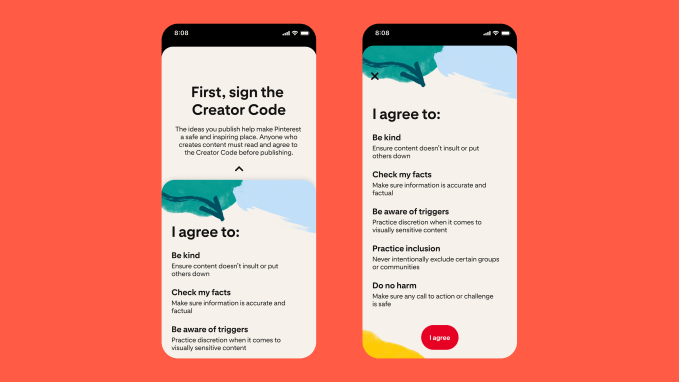
Pinterest today hosted an event focused on its creator community, where the company announced a series of updates including the launch of a $500,000 Creator Fund, a new content policy called the Creator Code, as well as new moderation tools, among other things. With the changes, the company says its goal is to ensure the platform continues to be a “inclusive, positive and inspiring place.” The new content guidelines put that into more specific terms as it requires Pinterest creators to fact-check content, practice inclusion, be kind, and ensure any call to action they make via the site doesn’t cause harm.

Creators will be required to agree and sign the code during the publishing process for Story Pins, where they tap a button that say “I agree” to statements that include “Be Kind,” “Check my facts,” “Be aware of triggers,” “Practice inclusion,” and “Do Not Harm.”

Image Credits: Pinterest

The code will be enforced the same way Pinterest today applies its rules for its other content policies: a combination of machine learning and human review, Pinterest tells us. However, the site’s algorithm will be designed to reward positive content and block harmful content, like anti-vaccination sentiments, for example. This could have a larger impact on what sort of content is shared on Pinterest, rather than a pop-up agreement with simple statements.

The Creator Code itself is not yet live, but will roll out to creators to sign and adopt in the weeks ahead, Pinterest says.

Image Credits: Pinterest

Pinterest today also introduced several new creator tools focused on the similar goal of making Pinterest a more positive, safe experience for all.

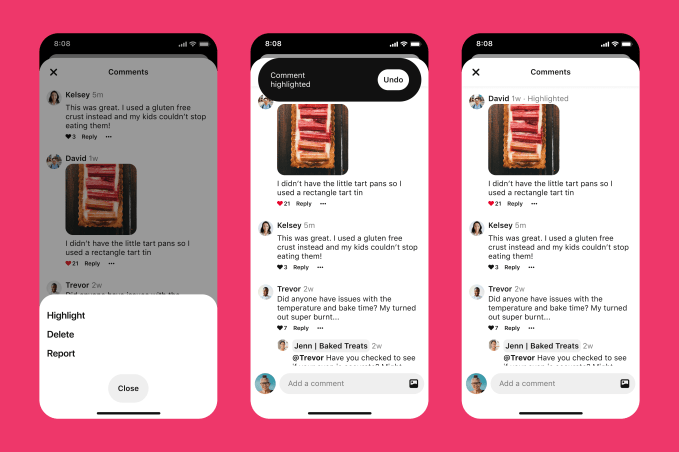
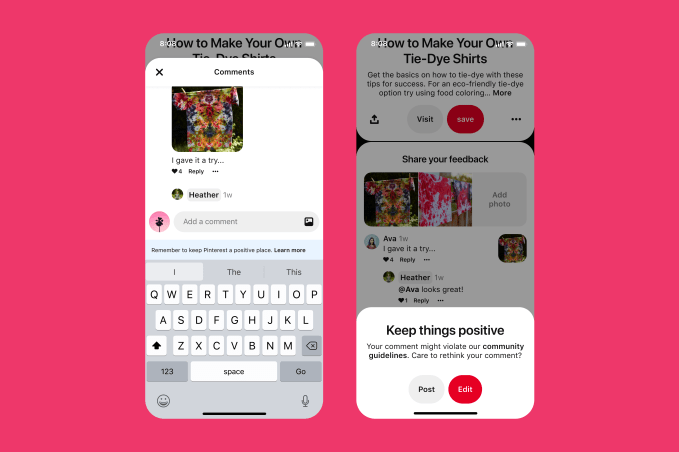
It’s launching comment moderation tools that will allow creators to remove and filter comments on their content, as well as tools that will allow them to feature up to three comments in the comment feed to highlight positive feedback. New spam prevention tools will help to clear out some of the unwanted comments, too, by leveraging machine learning technology to detect and remove bad comments.

Also new are “positivity reminders,” which will pop up asking Pinterest users to reconsider before posting potentially offensive comments. The notification will push users to go back and edit their comment, but doesn’t prevent them from posting.

Image Credits: Pinterest

Related to these efforts, Pinterest announced the launch of its first-ever Creator Fund at today’s event. The fund is specifically focused on elevating creators from underrepresented communities in the United States, and will offer a combination of creative strategy consulting, and compensating them with budget for content creation and ad credits. At least 50% of the fund’s recipients will be from underrepresented groups, Pinterest says.

The company tells us it’s initially committed to giving creators $500,000 in cash and media throughout 2021.

“For the first participants of the program, we worked with eight emerging creators across fashion, photography, food and travel, and will be identifying ten more creators in the next few months for the next cohort,” noted Creator Inclusion Lead Alexandra Nikolajev.

“We’re on a journey to build a globally inclusive platform where Pinners and Creators around the world can discover ideas that feel personalized, relevant and reflective of who they are,” Nikolajev said.

Pinterest has been working to rebuild its image in the wake of last year’s allegations of a host of internal issues, including unfair pay, racism, retaliation, and sexism, which conflicted with its outside image of being one of the “nicer” places to work in tech. Despite this fallout — which included a lawsuit, employee walkout, petitions, and more —  the issues that had been raised weren’t always reflected in Pinterest’s product.

The company had previously launched inclusive features like “skin tone ranges” to help those shopping for beauty products find matches for their skin tone. It also allowed retailers and brands to identify themselves as members of an underrepresented group, which gave their content the ability to appear in more places across Pinterest’s platform, like the Today tab, Shopping Spotlights and The Pinterest Shop, for instance.

Evan Sharp, Pinterest’s co-founder and Chief Design and Creative Officer, referenced the company’s image as “a positive place” at today’s event.

“We’ve been building Pinterest for 11 years, and ever since our users routinely tell us that Pinterest is the ‘last positive corner of the internet.’ In that time, we’ve also learned that you need to design positivity into online platforms as deliberately as much as you design negativity out,” Sharp said. “The Creator Code is a human-centric way for Creators to understand how to be successful on Pinterest while using their voice to keep Pinterest positive and inclusive,” he added.

Today, Pinterest serves over 450 million users worldwide, but is challenged by large platforms serving creators like Facebook, Instagram, YouTube, and others, including newcomers like TikTok and those that are inching into the creator community with funds of their own, like Snapchat, which is paying creators for Spotlight content, and Clubhouse, which is now funding creators’ shows. The increased competition for creator interest has left Pinterest needing an incentive program of its own.

To kick of its announcement, Pinterest’s Head of Content and Creator Partnerships, Aya Kanai, interviewed television personality Jonathan Van Ness (Queer Eye) at today’s virtual event, where they talked about the need for positivity and inclusivity on social media. Other event participants included creators Peter Som, Alison Cayne, Onyi Moss, Oyin Edogi and Jomely Breton — the latter two who spoke about putting the Creator Fund to use for themselves.