Year: 2021

07 Apr 2021

The do’s and don’ts of bug bounty programs with Katie Moussouris

In the rush to launch, cybersecurity doesn’t always get the attention it deserves, and yet it’s one of the first things that startups learn can — and will — go wrong.

Hacker and security researchers can be some of your biggest assets in helping your startup stay secure. Vulnerability disclosure and bug bounty programs are part of working with the hacker community to build a stronger, more resilient company. But these are not a replacement for security investments, which as a growing company you should not overlook.

Katie Moussouris has been in cybersecurity circles since some of the world’s biggest tech companies were startups, and helped to set up the first vulnerability disclosure and bug bounty programs. Moussouris, who runs consultancy firm Luta Security, now advises companies and governments on how to talk to hackers and what they need to do to build and improve their vulnerability disclosure programs.

At TC Early Stage, Moussouris explained what startups should (and shouldn’t) do, and what priorities should come first.


Knowing the basics

A bug bounty alone is not enough, and outsourcing the process to a platform isn’t going to save you time. Moussouris explained the basics and what differs between vulnerability disclosure, penetration testing and bug bounties.

Vulnerability disclosure is the process by which you hear about vulnerability from the outside. You digest that vulnerability somehow internally in your organization and figure out what to do with it — whether to create a patch, how to prioritize that patch, and then what to release to the public [ … ] What it comes down to is that organizations need guidelines on how to handle these issues appropriately.

Next we’ve got penetration testing: hiring professional hackers under contract [who have] a specific set of skills that match your problem set, and you pay them. They’re under a nondisclosure agreement (NDA) to keep your vulnerabilities secret for as long as you need them — perhaps forever — and you are at your leisure as to whether or not you fix those vulnerabilities.

Finally, bug bounties are simply adding a cash reward to the process of vulnerability disclosure programs. (Time stamp: 3:20)


ISO standards are your friend

07 Apr 2021

Walnut wants to crack open flexibility for healthcare bills

Healthcare insurance, if you’re lucky to have it, only covers a subset of conditions in the United States. As a result, patients can often get burdened with horror story charges, like huge deductibles, out-of-network costs and expensive co-pays. So for the uninsured and insured alike, innovative ways of managing big bills are in high demand — especially as uncertainty remains around how COVID-19 and long-haul symptoms will be handled by patients and payers.

Walnut, founded by Roshan Patel, is a point-of-sale lending company with a healthcare twist. Walnut uses a “buy now, pay later” model, popularized by Affirm and Klarna, to help patients pay for healthcare over a period of time, instead of in one $3,000 chunk. Walnut works with healthcare providers so that a patient’s bill can be paid back through $100-a-month increments for 30 months, instead of one aggressive credit card swipe.

A patient using Walnut to pay healthcare bills. Image Credits: Walnut

It’s a sweet deal, but Patel added one more detail that he thinks makes Walnut stand out: The startup doesn’t charge any interest or fees to consumers.

“Almost every ‘buy now, pay later’ company in e-commerce charges interest or fees, and every personal loan provider charges interest or fees, but we do not,” he said. “And that’s really important to me, not making healthcare any more expensive than it already is. It’s a very patient-friendly product.”

Companies that use the buy now, pay later model with zero interest or fees need to make revenue somehow, and in Walnut’s case it is by charging healthcare providers a percentage of each sale or transaction.

If a provider’s collection rate for an out-of-pocket is 50%, Walnut would go to them and say “give us a 40% discount, and we’ll guarantee the cash for you upfront.” The startup will take the risk, and then the provider is able to make 60% of the collection rate.

Now, ideally, a provider would want to get 100% of payments they are owed, but that is wishful thinking. Patel explained that a large number of bills go unpaid due to bankruptcies or a default on payments (the average collections rate for hospitals out of pocket is less than 20%). Because of this, a company like Walnut has room to offer at least some stable upfront cash to hospitals, even if it ends up being 60% of overall bills versus 100%.

The company uses “extensive underwriting models” to figure out if a patient should qualify for a loan. Patel says that the startup goes beyond using credit score, which he describes as an “outdated metric”, and instead looks at thousands of data points from different providers, from side hustle income to spending habits on things like groceries and bills.

Walnut’s biggest challenge, says Patel, is to underwrite the population and pay the healthcare provider upfront in cash. It then collects from the patient on the back end, which comes with its own amount of risk.

“To be able to take on that risk for patients that are less credit-worthy is a very challenging problem, and I don’t think it’s really solved yet in healthcare,” he said.

The startup is starting by working with small private practices of one to five physicians that focus on specialties like dentistry, dermatology and fertility.

A big part of Walnut’s success will be determined by if it can attract people that truly need flexible financing options. For example, the company doesn’t have any hospitals as a partner yet, which would tap a larger group of patients that likely need flexible financing options the most. Right now, “the people who get elective-care surgery are the ones that can afford it.”

But Patel doesn’t see this as a disconnect; instead, he sees it as an opportunity to widen access to elective medical care to more people.

“I talked to a person last week who has no teeth and wants dentures but it costs $6,000,” he said. “That person should be able to afford it, and we enabled them to pay $100 a month for it.”

Walnut’s two biggest customer groups are the uninsured (people who have lost their jobs from COVID-19), and consumers who have high deductible plans.

Walnut isn’t the first. PrimaHealth Credit, Walnut’s closest competitor, offers point-of-sale lending procedures for elective medical procedures. Think surgeries like cataract work or dental work. The company said the service is currently available in Arizona, California, Florida, Oklahoma and Texas, and will be expanded to all 50 states this year. Walnut, comparatively, is mostly focused on the East Coast and plans to expand nationwide by the end of this year.

PrimaHealth’s average loan size is $1,800, and Walnut’s average loan size is $5,000.

The company is currently piloting with a handful of healthcare providers in dermatology, dentistry and fertility. It has had more than 500 patient loan applications, totaling over $4.6 million in application volume year-to-date. Patel says that Walnut only accepted a fraction of these applications, but declined to share what percent of money it has lent so far. As Walnut refines its model, it might be able to cover other categories.

Up until this point, Walnut has been lending off of its own balance sheet. In order to truly scale, it will need to get a new source of capital — either a credit line, debt financing round or venture capital — to offer more loans. Patel says that the startup is in talks with banks, and turned down a debt offer due to size and rate.

Venture capital seems to be the solution for now: The startup announced that it has raised a $3.6 million seed round from investors including Gradient Ventures, Afore Capital, 2048 Ventures, Supernode Ventures, TA Ventures, Polymath Capital, Tack Ventures, Awesome People Ventures, Newark Ventures and NKM Capital. Angels include the CEOs of Giphy and PillPack, and the CTO of Rampm Financial as well as an NFL coach. The company is also a part of Plaid’s inaugural accelerator.

“I don’t want to be yet another startup trying to offer you an undifferentiated insurance plan,” Patel said.


07 Apr 2021

Walnut wants to crack open flexibility for healthcare bills

Healthcare insurance, if you’re lucky to have it, only covers a subset of conditions in the United States. As a result, patients can often get burdened with horror story charges, like huge deductibles, out-of-network costs and expensive co-pays. So for the uninsured and insured alike, innovative ways of managing big bills are in high demand — especially as uncertainty remains around how COVID-19 and long-haul symptoms will be handled by patients and payers.

Walnut, founded by Roshan Patel, is a point-of-sale lending company with a healthcare twist. Walnut uses a “buy now, pay later” model, popularized by Affirm and Klarna, to help patients pay for healthcare over a period of time, instead of in one $3,000 chunk. Walnut works with healthcare providers so that a patient’s bill can be paid back through $100-a-month increments for 30 months, instead of one aggressive credit card swipe.

A patient using Walnut to pay healthcare bills. Image Credits: Walnut

It’s a sweet deal, but Patel added one more detail that he thinks makes Walnut stand out: The startup doesn’t charge any interest or fees to consumers.

“Almost every ‘buy now, pay later’ company in e-commerce charges interest or fees, and every personal loan provider charges interest or fees, but we do not,” he said. “And that’s really important to me, not making healthcare any more expensive than it already is. It’s a very patient-friendly product.”

Companies that use the buy now, pay later model with zero interest or fees need to make revenue somehow, and in Walnut’s case it is by charging healthcare providers a percentage of each sale or transaction.

If a provider’s collection rate for an out-of-pocket is 50%, Walnut would go to them and say “give us a 40% discount, and we’ll guarantee the cash for you upfront.” The startup will take the risk, and then the provider is able to make 60% of the collection rate.

Now, ideally, a provider would want to get 100% of payments they are owed, but that is wishful thinking. Patel explained that a large number of bills go unpaid due to bankruptcies or a default on payments (the average collections rate for hospitals out of pocket is less than 20%). Because of this, a company like Walnut has room to offer at least some stable upfront cash to hospitals, even if it ends up being 60% of overall bills versus 100%.

The company uses “extensive underwriting models” to figure out if a patient should qualify for a loan. Patel says that the startup goes beyond using credit score, which he describes as an “outdated metric”, and instead looks at thousands of data points from different providers, from side hustle income to spending habits on things like groceries and bills.

Walnut’s biggest challenge, says Patel, is to underwrite the population and pay the healthcare provider upfront in cash. It then collects from the patient on the back end, which comes with its own amount of risk.

“To be able to take on that risk for patients that are less credit-worthy is a very challenging problem, and I don’t think it’s really solved yet in healthcare,” he said.

The startup is starting by working with small private practices of one to five physicians that focus on specialties like dentistry, dermatology and fertility.

A big part of Walnut’s success will be determined by if it can attract people that truly need flexible financing options. For example, the company doesn’t have any hospitals as a partner yet, which would tap a larger group of patients that likely need flexible financing options the most. Right now, “the people who get elective-care surgery are the ones that can afford it.”

But Patel doesn’t see this as a disconnect; instead, he sees it as an opportunity to widen access to elective medical care to more people.

“I talked to a person last week who has no teeth and wants dentures but it costs $6,000,” he said. “That person should be able to afford it, and we enabled them to pay $100 a month for it.”

Walnut’s two biggest customer groups are the uninsured (people who have lost their jobs from COVID-19), and consumers who have high deductible plans.

Walnut isn’t the first. PrimaHealth Credit, Walnut’s closest competitor, offers point-of-sale lending procedures for elective medical procedures. Think surgeries like cataract work or dental work. The company said the service is currently available in Arizona, California, Florida, Oklahoma and Texas, and will be expanded to all 50 states this year. Walnut, comparatively, is mostly focused on the East Coast and plans to expand nationwide by the end of this year.

PrimaHealth’s average loan size is $1,800, and Walnut’s average loan size is $5,000.

The company is currently piloting with a handful of healthcare providers in dermatology, dentistry and fertility. It has had more than 500 patient loan applications, totaling over $4.6 million in application volume year-to-date. Patel says that Walnut only accepted a fraction of these applications, but declined to share what percent of money it has lent so far. As Walnut refines its model, it might be able to cover other categories.

Up until this point, Walnut has been lending off of its own balance sheet. In order to truly scale, it will need to get a new source of capital — either a credit line, debt financing round or venture capital — to offer more loans. Patel says that the startup is in talks with banks, and turned down a debt offer due to size and rate.

Venture capital seems to be the solution for now: The startup announced that it has raised a $3.6 million seed round from investors including Gradient Ventures, Afore Capital, 2048 Ventures, Supernode Ventures, TA Ventures, Polymath Capital, Tack Ventures, Awesome People Ventures, Newark Ventures and NKM Capital. Angels include the CEOs of Giphy and PillPack, and the CTO of Rampm Financial as well as an NFL coach. The company is also a part of Plaid’s inaugural accelerator.

“I don’t want to be yet another startup trying to offer you an undifferentiated insurance plan,” Patel said.

07 Apr 2021

Twitch expands its rules against hate and abuse to include behavior off the platform

Twitch will start holding its streamers to a higher standard. The company just expanded its hate and harassment policy, specifying more kinds of bad behavior that break its rules and could result in a ban from the streaming service.

The news comes as Twitch continues to grapple with reports of abusive behavior and sexual harassment, both on the platform and within the company itself. In December, Twitch released an updated set of rules designed to take harassment and abuse more seriously, admitting that women, people of color the and LGBTQ community were impacted by a “disproportionate” amount of that toxic behavior on the platform.

Twitch’s policies now include serious offenses that could pose a safety threat, even when they happen entirely away from the streaming service. Those threats include violent extremism, terrorism, threats of mass violence, sexual assault and ties to known hate groups.

The company will also continue to evaluate off-platform behavior in cases that happen on Twitch, like an on-stream situation that leads to harassment on Twitter or Facebook.

“While this policy is new, we have taken action historically against serious, clear misconduct that took place off service, but until now, we didn’t have an approach that scaled,” the company wrote in a blog post, adding that investigating off-platform behavior requires additional resources to address the complexity inherent in those cases.

To handle reports for its broadened rules, Twitch created a dedicated email address (OSIT@twitch.tv) to handle reports about off-service behavior. The company says it has partnered with a third party investigative law firm to vet the reports it receives.

Twitch cites its actions against former President Donald Trump as the most high profile instance of off-platform behavior resulting in enforcement. The company disabled Trump’s account following the attack on the U.S. Capitol and later suspended him indefinitely, citing fears that he could use the service to incite violence.

It’s hard to have a higher profile than the president, but Trump isn’t the only big time banned Twitch user. Last June, Twitch kicked one of its biggest streamers off of the platform without providing an explanation for the decision.

Going on a year later, no one seems to know why Dr. Disrespect got the boot from Twitch, though the company’s insistence that it only acts in cases with a “preponderance of evidence” suggests his violations were serious and well-corroborated.


07 Apr 2021

Okta expands into privileged access management and identity governance reporting

Okta today announced it was expanding its platform into a couple of new areas. Up to this point, the company has been known for its identity access management product, giving companies the ability to sign onto multiple cloud products with a single sign on. Today, the company is moving into two new areas: privileged access and identity governance

Privileged access gives companies the ability to provide access on an as-needed basis to a limited number of people to key administrative services inside a company. This could be your database or your servers or any part of your technology stack that is highly sensitive and where you want to tightly control who can access these systems.

Okta CEO Todd McKinnon says that Okta has always been good at locking down the general user population access to cloud services like Salesforce, Office 365 and Gmail. What these cloud services have in common is you access them via a web interface.

Administrators access the speciality accounts using different protocols. “It’s something like secure shell, or you’re using a terminal on your computer to connect to a server in the cloud, or it’s a database connection where you’re actually logging in with a SQL connection, or you’re connecting to a container which is the Kubernetes protocol to actually manage the container,” McKinnon explained.

Privileged access offers a couple of key features including the ability to limit access to a given time window and to record a video of the session so there is an audit trail of exactly what happened while someone was accessing the system. McKinnon says that these features provide additional layers of protection for these sensitive accounts.

He says that it will be fairly trivial to carve out these accounts because Okta already has divided users into groups and can give these special privileges to only those people in the administrative access group. The challenge was figuring out how to get access to these other kinds of protocols.

The governance piece provides a way for security operations teams to run detailed reports and look for issues related to identity. “Governance provides exception reporting so you can give that to your auditors, and more importantly you can give that to your security team to make sure that you figure out what’s going on and why there is this deviation from your stated policy,” he said.

All of this when combined with the $6.5 billion acquisition of Auth0 last month is part of a larger plan by the company to be what McKinnon calls the identity cloud. He sees a market with several strategic clouds and he believes identity is going to be one of them.

“Because identity is so strategic for everything, it’s unlocking your customer, access, it’s unlocking your employee access, it’s keeping everything secure. And so this expansion, whether it’s customer identity with zero trust or whether it’s doing more on the workforce identity with not just access, but privileged access and identity governance. It’s about identity evolving in this primary cloud,” he said.

While both of these new products were announced today at the company’s virtual Oktane customer conference, they won’t be generally available until the first quarter of next year.

07 Apr 2021

Building and leading an early-stage sales team with Zoom CRO Ryan Azus

This year at Early Stage, TechCrunch spoke with Zoom Chief Revenue Officer (CRO) Ryan Azus about building an early-stage sales team. Azus is perhaps best known for leading the video-calling giant’s income arm during COVID-19, but his experience building RingCentral’s North American sales organization from the ground up made him the perfect guest to chat with about building an early-stage sales team.

We asked him about when founders should step aside from leading their startup’s sales org, how to build a working sales culture, hiring diversely, how to pick customer segments, and how to build a playbook.

Below, TechCrunch has compiled a number of key comments from Azus, and afterwards we’ve included the full video from the interview as well as a transcript. Let’s go!


When should founders let others run sales?

Nearly every startup leans on its CEO as its first salesperson. After all, who else knows the product and can talk it up like the startup’s leader? But having the CEO as point-person for sales scales poorly. So, when is the right time to have someone else step in?

Fairly early on. First off, CEOs need to solve customer needs. And so it’s important to be very hands-on for a while to really understand while you’re trying to figure out product-market fit. And then bringing in some of those sales people as you start seeing something [good].

Part of it is also knowing what type of salesperson you need. […] Who is your core audience? What persona are you going after? And trying to find people that know and understand selling something that’s primarily very transactional to small businesses, [or] e-commerce lead, or selling something that’s more enterprise — those are different animals, different segments that you’re going after. One mistake [startups make] is hiring the wrong type of salesperson. (Timestamp: 5:29)


How much product-market fit is enough?

07 Apr 2021

E-bikes and earbuds among the first third-party hardware to support Apple’s Find My tracking

Yesterday we noted that Apple launched a new Find My Certification Asst. app, designed to test support for third-party hardware. Find My, of course, has been a long-standing feature for Apple’s own hardware like iPhones, AirPods and Macs, but back at WWDC, the company announced plans to open it up to manufactures.

Today the company made official its Find My Network Accessory program, and unveiled a handful of hardware that will take advantage of the new Made for iPhone (MFi)-affiliated offering. Users will be able to locate missing devices via Apple’s Find My app.

Image Credits: Apple

At the top of the list are a pair of e-bikes, produced by VanMoof. The S3 and X3 will sport tracking functionality, along with a “Locate with Apple Find My” logo located on the bottom side of the crossbar. Belkin’s Soundform Freedom earbuds, meanwhile will join Apple’s iPods in sporting the feature, while the Chipolo ONE Spot will beat the long-rumored AirTags to the punch. According to Apple, the new products are set to hit the market next week.

There are a bunch of different privacy concerns laid out by Apple in the white papers, along with other specifications companies will have to adhere to. Draft specs for chip makers will also be released in the spring, so companies can utilize the Ultra Wideband tech on Apple devices sporting a U1 chip. Approved products will be able to display the aforementioned “Works with Apple Find My” badge.


07 Apr 2021

How founders can avoid blind spots and make better decisions with EchoVC’s Eghosa Omoigui

Building and maintaining a successful startup requires founders to see the entire playing field. Without that clear view, founders risk missteps when it comes to hiring, raising funds, launching a product or making an acquisition.

Essentially, any big decision can end in disaster if a founder loses perspective or lacks self- and situational awareness.

Eghosa Omoigui, the founder and managing general partner of EchoVC Partners, a seed and early-stage venture capital firm that serves underrepresented founders and underserved markets, has helped entrepreneurs navigate the first steps of starting a company and laying the right foundation early on.

Omoigui, who was previously director of consumer internet and semantic technologies at Intel Capital, advocates for founders to develop their own All-22 tape — a tool used by professional football coaches that allows the viewer to see all 22 players on the field at the same time. It improves a coach’s line of sight and, most importantly, helps avoid missing a critical motion or player.

The concept of this tool can — and should — be applied in the startup world as well, Omoigui said during the virtual TC Early Stage event.

Omoigui explained what it means to have an All-22 tape and the steps founders should take to develop a skill set that will allow them to see and understand the playbook from all sides.


The big picture

Before getting into the steps, it’s important to understand what the aim is. The upshot? For founders to have the best and most complete view of their company, team, investors, product and competitors.

For founders, that means being able to zoom out and see each of their employees’ points of view and being inclusive. Without an All-22 tape, founders can mistakenly spend too much on engineering while ignoring the product rollout strategy or forget to communicate with employees outside of their bubble of interest. A company can become fragmented as more blind spots emerge, which can ultimately lead to oversights that damage its reputation, operations or even its ability to raise money from investors.

For operators and investors, what we see is usually very driven by where we stand, or where we sit. And what you have to discover really is: How can I get much better views? And the best view is always the plan view, you’re looking from the top down, you’re watching the movement, and you have line of sight, you know, that’s essentially 360 degrees. (Timestamp: 3:40)


Situational and self-awareness

07 Apr 2021

Facebook tests Hotline, a Q&A product that’s a mashup of Clubhouse and Instagram Live

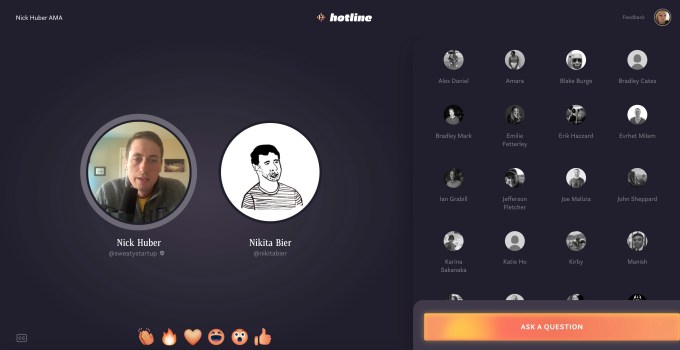
Facebook’s internal R&D group, NPE Team, has today launched its latest experiment, Hotline, into public beta testing. The web-based application could be described as a mashup of Instagram Live and Clubhouse, as it allows creators to speak to an audience who can then ask questions through either text or audio. However, unlike Clubhouse, creators can opt to turn their cameras on for the event, instead of being audio-only.

Real estate investor Nick Huber is the first to publicly try out the product with a livestream today that began at 10 AM PT (1 PM ET). Huber represents the sort of creator Facebook wants to work with for Hotline, Facebook told us, which is someone who helps people expand their professional skills or their finances. In Huber’s case, he’s talking about investing in industrial real estate as a second income stream.

At Facebook, Hotline is being led by Eric Hazzard, who joined Facebook when it acquired his app tbh, a positivity-focused Q&A app that grew to 2.5 million daily active users in nine weeks and saw over 1 billion poll answers before exiting. With Hotline, Hazzard is once again developing a product in the Q&A space.

But this time, the new app is taking inspiration from an up-and-coming social network, Clubhouse. In fact, Hotline’s user interface will look familiar to anyone who’s already used Clubhouse, Twitter Spaces or any of the other audio-only social networks, when it’s viewed on mobile. At the top on mobile (or to the left side on desktop), there’s a speaker section where the event host is featured in a round profile icon or live video stream. Below (or to the side on desktop) are the event’s listeners.

But there are also several differences between Hotline and existing apps, like Clubhouse.

Image Credits: Facebook

For starters, the app today has users sign in with Twitter then verify their identity via SMS.

The listeners’ section, for example, is divided up between those who are just watching the event, as represented by their profile icons, and those who are asking questions. At the top of this section, you’re presented with the lists of questions that users have asked, which others can upvote or downvote accordingly. The creator can then look to this section to find out which questions to answer next and can pull listeners onto the stage area with them for a conversation.

At present, users can type in their questions, then join the host “on stage,” when it’s their turn. Currently, guests are represented by their profile icon and are audio only when on stage. But in the settings, there’s an option for the listener to toggle on video that’s not yet functional for today’s test.

As the questions are asked, users can react with emoji including clapping hands, fire, heart, laughter, surprise and thumbs up.

Image Credits: Hotline

Hosts have full control over the experience, and can remove inappropriate questions from the queue or remove people from their Hotline session. For the initial tests, Facebook employees will moderate events and remove anyone that violates Facebook’s Community Standards, Terms of ServiceData Policy or the NPE Team’s Supplemental Terms.

Another notable difference between Hotline and Clubhouse is that Hotline events are recorded.

Today, Clubhouse favors more casual chats where people understand there’s no transcript or recording taking place (unless indicated by the host in the room’s title). This, Clubhouse believes, allows participants to speak more freely and with less fear. But Hotline automatically produces recordings. After the event, the host will receive two recordings of the session — one as an mp3 and another as an mp4. The creator can then upload these to other networks, like YouTube or Facebook, edit them into short-form content for apps like TikTok or turn the audio recording into a podcast, or anything else.

At launch, anyone can join a Hotline for free and there’s no limit on audience size, though this could change as the experiment progresses.

Despite the similarities with Clubhouse, Hotline has a different vibe because of its use of video, text-based questions, upvoting and because it’s recorded. This makes it feel less like a casual hangout and more like a professional event where an expert is leading a session and inviting an audience to ask questions.

Hotline is now one of several apps that Facebook’s NPE team has launched in the creator space to experiment with different ideas around audio and video. The group is continuing to test a creator app called Super, similar to Cameo, which is web-based and entirely video. It also previously tested an audio-only calling app, CatchUp, which shut down last year, as well as another Q&A product known as Venue, which is more of a Twitter-like companion for live events. More recently, it has launched TikTok-esque video apps Collab and BARS, which focused on collaborative music and raps, respectively.  

Over time, the goal of NPE projects isn’t necessarily to stand them up on their own as individual apps — though that could happen, if they gained enough traction. More broadly, the learnings from the tests and experiments can help inform future Facebook product development, as it builds out new features for existing products, like Messenger Rooms or Facebook Live, among other things.

Facebook didn’t make an official announcement about Hotline’s launch, but offered a statement about today’s test.

“With Hotline, we’re hoping to understand how interactive, live multimedia Q&As can help people learn from experts in areas like professional skills, just as it helps those experts build their businesses,” a spokesperson said. “New Product Experimentation has been testing multimedia products like CatchUp, Venue, Collab, and BARS, and we’re encouraged to see the formats continue to help people connect and build community,” they added.

Hotline isn’t Facebook’s only attempt to challenge Clubhouse. The company is also in the process of developing a Clubhouse rival within the Messenger Rooms product experience, Facebook recently confirmed.

07 Apr 2021

Mexican unicorn Kavak raises a $485M Series D at a $4B valuation.

Kavak, the Mexican startup that’s disrupted the used car market in Mexico and Argentina, today announced its Series D of $485 million, which now values the company at $4 billion. This round more than triples their previous valuation of $1.15 billion, which established them as a unicorn just a couple of months ago in October of 2020. Kavak is now one of the top five highest-valued startups in Latin America.

The round was led by D1 Capital Partners, Founders Fund, Ribbit, and BOND, and brings Kavak’s total capital raised to date to more than $900 million. Kavak recently soft-launched in Brazil, and this new round of funding will be used to build out the Brazilian market and beyond, said Carlos García Ottati, Kavak’s CEO and Co-Founder. The company plans to do a full launch in Brazil in the next 60 days, García said, and we can expect to see Kavak in markets outside Latin America in the next 24 months, he added.

“We were built to solve emerging market problems,” García said.

Kavak, which was founded in 2016, is an online marketplace that aims to bring transparency, security, and access to financing to the used car market. The company also offers its own financing through its fintech arm, Kavak Capital, and counts more than 2,500 employees and 20 logistics and reconditioning hubs in Mexico and Argentina.

“In Latin America, 90% of the [used car] transactions are informal, which leads to a 40% fraud rate,” said García, who experienced these challenges first-hand when he moved to Mexico from Colombia a couple of years ago and bought a used car. 

“My budget allowed me to buy a used car, but there was no infrastructure around it. It took me 6 months to buy the car, and then the car had legal and mechanical issues and I lost most of my money,” he said. Kavak buys cars from individuals, refurbishes them, and offers warranties to buyers.

“Instead of buying a new car, they can buy a better car that still has all the warranties. It’s a really aspirational process,” said García. The company, which really amounts to four companies in one given its areas of focus, was built to be comprehensive by design in order to meet the various gaps in the market, García said.

“When you’re building a business here [Latin America], you need to build several businesses because so many things are broken,” he said. That’s why the financing option, for example, has been a key to their success, according to García.

Financing has traditionally been hard to come by in Brazil, and as García said, the used car market lacks infrastructure there, too. That being said, Brazil is Latin America’s fintech hub, and the space has been made leaps and bounds over the last 7-10 years with companies such as Nubank, PagSeguro, Creditas, PicPay, and others leading the way. As a result, credit cards and loans are more widely available today in the region, offering competition for Kavak Capital. While Kavak has localized some of its product for the Brazilian market — namely building out a Portuguese language version of the app and website — García said the markets are very similar.

“In Brazil, you still have the same problems that you have in Mexico, but Brazil is a little more developed, especially in fintech, which is light years ahead of Mexico,” he said.

With the Brazilian product heading to the races, García said they already have plans for other regions, though he declined to name them.

“80% of people in emerging markets don’t have access to a car,” García said of the global market size. “We want to go into big markets where customers are facing similar problems and where Kavak can really change their lives,” he added.