Year: 2021

07 Apr 2021

Dear Sophie: Help! My H-1B wasn’t chosen!

Here’s another edition of “Dear Sophie,” the advice column that answers immigration-related questions about working at technology companies.

“Your questions are vital to the spread of knowledge that allows people all over the world to rise above borders and pursue their dreams,” says Sophie Alcorn, a Silicon Valley immigration attorney. “Whether you’re in people ops, a founder or seeking a job in Silicon Valley, I would love to answer your questions in my next column.”

Extra Crunch members receive access to weekly “Dear Sophie” columns; use promo code ALCORN to purchase a one- or two-year subscription for 50% off.


Dear Sophie:

My startup registered two H-1B candidates in this year’s lottery. Sadly, neither was selected.

One is my co-founder, the other is on OPT. Help! We can’t afford for them to have to leave the U.S. What are our options?

— Lost in Los Angeles

Dear Lost:

Take a deep breath; I’ve got your back. There are many creative immigration pathways for you, your co-founder and your F-1 OPT employee to explore. We’ll take a look at several options, and you can also check out my recent podcast in which my colleague Nadia Zaidi and I explain them in greater depth.

I hope the below ideas inspire you and fill you with a sense of hope and possibility. As always, I suggest consulting with an experienced immigration attorney who can help you identify the strongest path forward, as well as backup options for your co-founder and employee. The particular immigration strategy that’s best for you is always an individual determination. It’s best identified through a personal consultation with an attorney such as myself based on a variety of factors, including each person’s immigration history and your particular startup’s goals.

Co-founder immigration options

For a funded startup, there’s a great H-1B Plan B: the Cap-Exempt H-1B. Especially if your co-founder has a STEM background (and possibly even for some founders who don’t have this), there’s a wonderful new triple-win option that supports startups, international candidates and even diverse U.S. STEM college students seeking better project-based learning opportunities.

What is this magical rainbow-striped unicorn option, you ask? Well, here’s the legal background: Some employers qualify to petition for an H-1B visa at any time without going through the lottery. These employers — called cap-exempt employers because they are not subject to the annual H-1B cap of 85,000 visas available to for-profit employers — include:

  • Institutions of higher education.
  • Nonprofits tied to institutions of higher education.
  • Nonprofit research organizations.
  • Government research organizations.

If your co-founder can get a part-time H-1B visa through one of these cap-exempt employers, your startup can concurrently sponsor your co-founder for an H-1B regardless of the recent lottery results.

A composite image of immigration law attorney Sophie Alcorn in front of a background with a TechCrunch logo.

Image Credits: Joanna Buniak / Sophie Alcorn (opens in a new window)

To take advantage of this special law, I’m a huge fan of Open Avenues Foundation, which offers a Global Talent Fellowship. In this program, international talent can receive cap-exempt H-1B visas by leading university students for about five hours a week in real-world, project-based work within their field of expertise for the startup that nominated them for the fellowship. The candidate gets to stay in (or come to) the U.S., your startup gets a team of students working on a group project that benefits your company and increases diversity in your hiring pipeline, and U.S. students get the benefit of hands-on high quality STEM learning.

Once your candidate’s first cap-exempt H-1B is in place, your startup can petition for a second, concurrent Cap-Exempt H-1B for direct startup employment.

Interested in variations? If you’re not in STEM but have a university that would host you (free to the university), you can potentially partner with OAF. In addition, many universities in the U.S have global entrepreneur-in-residence programs that can help international co-founders qualify for concurrent Cap-Exempt H-1Bs. Your startup should also consider sponsoring your co-founder for an O-1A visa or change of status.

Another option to consider is for your co-founder to apply for International Entrepreneur Parole (IEP), a new 30-month immigration status in the U.S. The International Entrepreneur Rule (IER) was created by President Barack Obama and is the closest thing the U.S. has right now to a startup visa. The Trump administration tried to eliminate it, but the National Venture Capital Association, led by Jeff Farrah, successfully challenged the administration’s effort in federal court, so IEP remains on the books.

A lot of folks don’t believe it’s an option yet, so I’m currently looking for international startup founders with a strong case to file for IEP to test out this new program and demonstrate its existence to the world. We’re currently seeking global startup founders holding at least 15% equity in a U.S. startup that’s less than five years old and has raised at least $250,000 from U.S. investors. If you want to be on our free interest list, you can fill out this form. If we think you have a strong application, we’ll reach out.

If your co-founder wants to remain permanently in the U.S., consider starting a green card now such as the EB-1A green card for individuals of extraordinary ability or an EB-2 NIW (National Interest Waiver) green card for individuals of exceptional ability. Of these, the EB-1A is the quickest option, but its qualification requirements are tougher than for the EB-2 NIW.

F-1 OPT employee immigration options

If your F-1 OPT employee graduated with a qualified STEM degree, that employee can apply for a 24-month work extension, known as STEM OPT. That will allow the employee to remain in the U.S. to continue working for you. In the meantime, you can register them again next year for the H-1B lottery. If there’s no possibility for STEM, please check out the Cap-Exempt H-1B option explained above.

If your F-1 OPT employee only has a bachelor’s degree, they might want to consider pursuing an advanced degree. Individuals with a master’s or higher degree from a U.S. university have better odds of being selected in the annual H-1B lottery. That’s because 20,000 of the 85,000 H-1B visas available each year are earmarked for individuals with a master’s or higher degree from a U.S. university.

You should be aware, however, that next year’s H-1B lottery will likely shift from the current random selection process to one based on the highest wages. Unless the Biden administration changes the policy, which was devised by the previous administration, employers who pay their H-1B candidates a Level III wage or higher have the best chance of getting selected to file for an H-1B visa.

As you know, sponsoring employers must agree to pay an H-1B candidate the higher of either the actual wage paid for the job or the prevailing wage, which is broken down into four levels based on experience required for the position and location of the position. Level I wage is basically for an entry-level position, while a Level IV wage is for a position requiring the most experience. While this will add greater predictability to the annual H-1B “lottery,” early-stage startups and small businesses may have a difficult time competing against more established companies on salary, particularly because stock options and equity are not included in the salary calculation.

If you need to find alternative visa solutions, you can always consult with an attorney. I hope all of these options help you realize the control and agency you have in this situation. You have choices!

All my best,

Sophie


Have a question for Sophie? Ask it here. We reserve the right to edit your submission for clarity and/or space.

The information provided in “Dear Sophie” is general information and not legal advice. For more information on the limitations of “Dear Sophie,” please view our full disclaimer. You can contact Sophie directly at Alcorn Immigration Law.

Sophie’s podcast, Immigration Law for Tech Startups, is available on all major platforms. If you’d like to be a guest, she’s accepting applications!
07 Apr 2021

Google I/O will return as a virtual event May 18-20

When the pandemic arrived in the U.S. early last year, companies scrambled to figure out what to do with their long-standing, in-person developer events. For Apple and Microsoft, that meant going virtual – something companies have done with mixed results.

For Google, it meant calling off I/O all together. The company canceled the developer conference traditionally held each May at Mountain View, California’s Shoreline Amphitheater.

“Out of concern for the health and safety of our developers, employees, and local communities — and in line with recent ‘shelter in place’ orders by the local Bay Area counties — we sadly will not be holding I/O in any capacity this year,” the company wrote at the time.

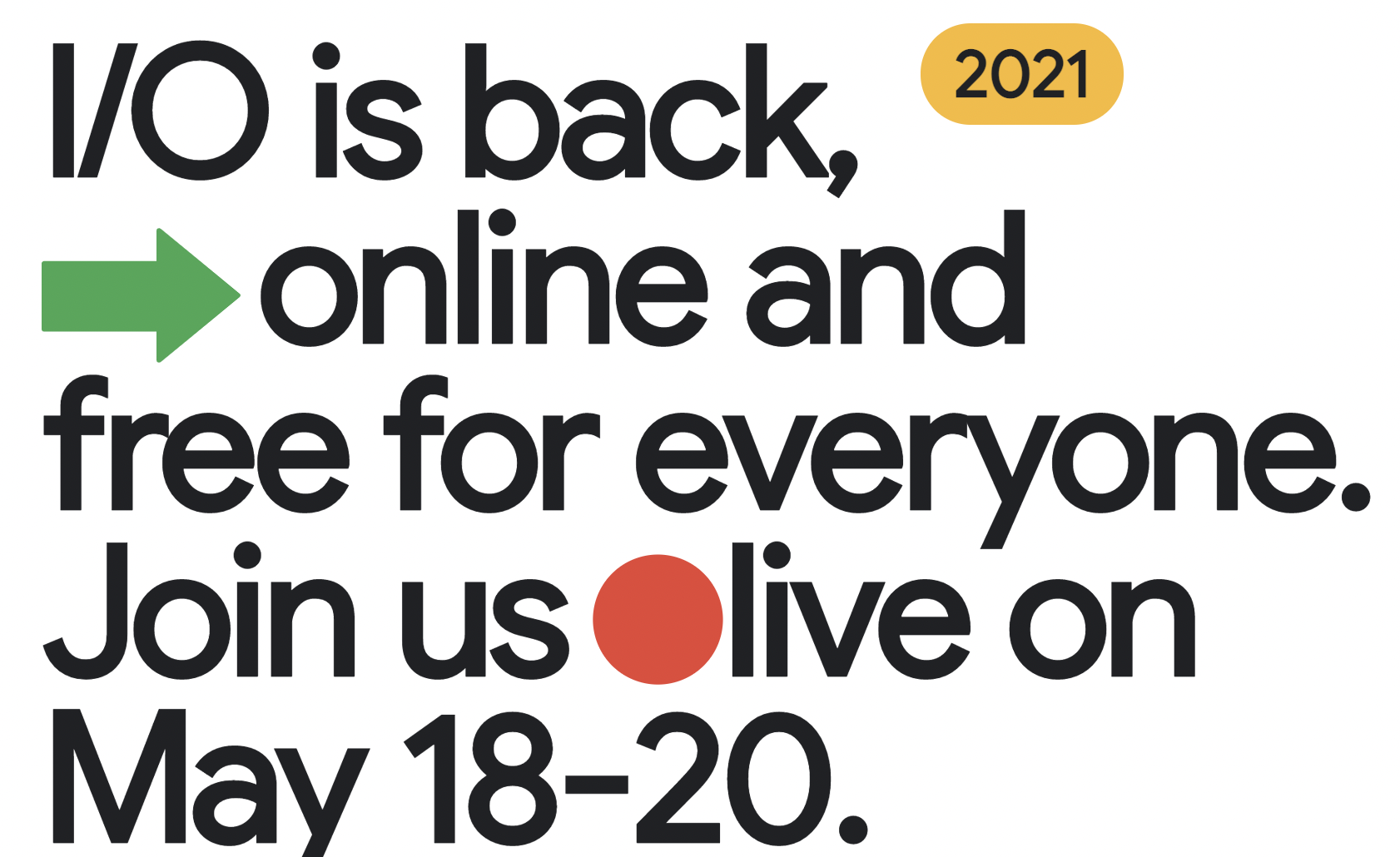
After a year off, the show is set to return in virtual form. Google sent out its customary puzzle invites today, noting that the event will be held May 18-20. (Props to 9 to 5 Google for solving.) Like other online-only events of a recent vintage, this version of the developer’s conference will be free to attend and open to all. (Live, we assume, and not “Olive,” but it’s hard to say for sure, based on the graphic below.)

Image Credits: Google

Google joins a number of companies continuing to hold virtual events in 2021. While an aggressive vaccine rollout has begun here in the States, there’s still plenty of questions and concerns surround the virus’s spread at large gatherings — even ones like I/O, which are traditionally held outdoors. Apple recently announced a second virtual version of WWDC, set for June, while Microsoft’s Build runs May 25-27.

07 Apr 2021

Facebook’s tardy disclosure of breach timing raises GDPR compliance questions

The question of whether Facebook will face any regulatory sanction over the latest massive historical platform privacy fail to come to light remains unclear. But the timeline of the incident looks increasingly awkward for the tech giant.

While it initially sought to play down the data breach revelations published by Business Insider at the weekend by suggesting that information like people’s birth dates and phone numbers was “old”, in a blog post late yesterday the tech giant finally revealed that the data in question had in fact been scraped from its platform by malicious actors “in 2019” and “prior to September 2019”.

That new detail about the timing of this incident raises the issue of compliance with Europe’s General Data Protection Regulation (GDPR) — which came into application in May 2018.

Under the EU regulation data controllers can face fines of up to 2% of their global annual turnover for failures to notify breaches, and up to 4% of annual turnover for more serious compliance violations.

The European framework looks important because Facebook indemnified itself against historical privacy issues in the US when it settled with the FTC for $5BN back in July 2019 — although that does still mean there’s a period of several months (June to September 2019) which could fall outside that settlement.

Yesterday, in its own statement responding to the breach revelations, Facebook’s lead data supervisor in the EU said the provenance of the newly published dataset wasn’t entirely clear, writing that it “seems to comprise the original 2018 (pre-GDPR) dataset” — referring to an earlier breach incident Facebook disclosed in 2018 which related to a vulnerability in its phone lookup functionality that it had said occurred between June 2017 and April 2018 — but also writing that the newly published dataset also looked to have been “combined with additional records, which may be from a later period”.

Facebook followed up the Irish Data Protection Commission (DPC)’s statement by confirming that suspicion — admitting that the data had been extracted from its platform in 2019, up until September of that year.

Another new detail that emerged in Facebook’s blog post yesterday was the fact users’ data was scraped not via the aforementioned phone lookup vulnerability — but via another method altogether: A contact importer tool vulnerability.

This route allowed an unknown number of “malicious actors” to use software to imitate Facebook’s app and upload large sets of phone numbers to see which ones matched Facebook users.

In this way a spammer (for example), could upload a database of potential phone numbers and link them to not only names but other data like birth date, email address, location — all the better to phish you with.

In its PR response to the breach, Facebook quickly claimed it had fixed this vulnerability in August 2019. But, again, that timing places the incident squarely in the period of GDPR being active.

As a reminder, Europe’s data protection framework bakes in a data breach notification regime that requires data controllers to notify a relevant supervisory authority if they believe a loss of personal data is likely to constitute a risk to users’ rights and freedoms — and to do so without undue delay (ideally within 72 hours of becoming aware of it).

Yet Facebook made no disclosure at all of this incident to the DPC. Indeed, the regulator made it clear yesterday that it had to proactively seek information from Facebook in the wake of BI’s report. That’s the opposite of how EU lawmakers intended the regulation to function.

Data breaches, meanwhile, are broadly defined under the GDPR. It could mean personal data being lost or stolen and/or accessed by unauthorized third parties. It can also relate to deliberate or accidental action or inaction by a data controller which exposes personal data.

Legal risk attached to the breach likely explains why Facebook has studiously avoided describing this latest data protection failure, in which the personal information of more than half a billion users was posted for free download on an online forum, as a ‘breach’.

And, indeed, why it’s sought to downplay the significance of the leaked information — dubbing people’s personal information “old data”. (Even as few people regularly change their mobile numbers, email address, full names and biographical information and so on, and no one (legally) gets a new birth date… )

Its blog post instead refers to data being scraped; and to scraping being “a common tactic that often relies on automated software to lift public information from the internet that can end up being distributed in online forums” — tacitly implying that the personal information leaked via its contact importer tool was somehow public.

The self-serving suggestion being peddled here by Facebook is that hundreds of millions of users had both published sensitive stuff like their mobile phone numbers on their Facebook profiles and left default settings on their accounts — thereby making this personal information ‘publicly available for scraping/no longer private/uncovered by data protection legislation’.

This is an argument as obviously absurd as it is viciously hostile to people’s rights and privacy. It’s also an argument that EU data protection regulators must quickly and definitively reject or be complicit in allowing Facebook (ab)use its market power to torch the very fundamental rights that regulators’ sole purpose is to defend and uphold.

Even if some Facebook users affected by this breach had their information exposed via the contact importer tool because they had not changed Facebook’s privacy-hostile defaults that still raises key questions of GPDR compliance — because the regulation also requires data controllers to adequately secure personal data and apply privacy by design and default.

Facebook allowing hundreds of millions of accounts to have their info freely pillaged by spammers (or whoever) doesn’t sound like good security or default privacy.

In short, it’s the Cambridge Analytica scandal all over again.

Facebook is trying to get away with continuing to be terrible at privacy and data protection because it’s been so terrible at it in the past — and likely feels confident in keeping on with this tactic because it’s faced relatively little regulatory sanction for an endless parade of data scandals. (A one-time $5BN FTC fine for a company than turns over $85BN+ in annual revenue is just another business expense.)

We asked Facebook why it failed to notify the DPC about this 2019 breach back in 2019, when it realized people’s information was once again being maliciously extracted from its platform — or, indeed, why it hasn’t bothered to tell affected Facebook users themselves — but the company declined to comment beyond what it said yesterday.

Then it told us it would not be commenting on its communications with regulators.

Under the GDPR, if a breach poses a high risk to users’ rights and freedoms a data controller is required to notify affected individuals — with the rational being that prompt notification of a threat can help people take steps to protect themselves from the risks of their data being breached, such as fraud and ID theft.

Yesterday Facebook also said it does not have plans to notify users either.

Perhaps the company’s trademark ‘thumbs up’ symbol would be more aptly expressed as a middle finger raised at everyone else.


07 Apr 2021

SpaceX launches 60 more Starlink satellites, now at 300 launched in just over one month

SpaceX has launched another batch of Starlink satellites, keeping up its rapid pace of launches for the broadband constellation it’s deploying in low Earth orbit. This now makes 300 Starlink satellites launched since March 4, with 60 on each of five flights between then and now.

The most recent launch before this one happened on March 24, with prior flights on March 14, March 11 and March 4 , respectively. That pace is intentionally fast, since SpaceX has said it aims to launch a total of 1,500 Starlink satellites over the course of this calendar year. Before that especially busy month, SpaceX also flew four other Starlink missions, including a shared ride on SpaceX’s first dedicated rideshare mission that also carried satellites for other customers.

In total, SpaceX has now launched 1,443 satellites for its Starlink constellation. That doesn’t reflect the total number of satellites on orbit, however, as a handful of those earlier satellites have been deorbited as planned. In total, the eventual planned sizer fo the constellation is expected to include up to 42,000 spacecraft based on current FCC frequency spectrum filings.

SpaceX recently signed a new agreement with NASA that outlines how the two organizations will avoid close approach or collision events between their respective spacecraft. NASA has measures it requires all launchers to follow in order to avoid these kinds of incidents, but the scale and frequency of SpaceX’s Starlink missions necessitated an additional, more extensive agreement.

This launch also included a landing of the Falcon 9 booster used, its seventh so far. The booster touched down as intended on SpaceX’s floating landing pad in the Atlantic Ocean, and will be refurbished for another potential reuse. SpaceX is also going to be looking to recover its fairing halves at sea, which are the two cargo covering shields that encase the satellites during take-off. The company actually just decommissioned two ships it had used to try to catch these out of mid-air as they fell slowed by parachutes, but it’s still looking to retrieve them from the ocean after splashdown for re-use.

Image Credits: SpaceX

07 Apr 2021

Nuvocargo raises $12M to digitize the freight logistics industry

Despite hundreds of billions of dollars’ worth of goods flowing across the U.S.-Mexican border each year, the freight industry has remained analog — each side of the border offering up its own maze of bureaucracy.

Nuvocargo, a digital logistics platform for cross-border trade, is trying to modernize the process. The company offers an all-in-one service that rolls freight forwarding, customs brokerage, cargo insurance and even trade financing into one UI-friendly software and app. Housing all of these services under one app makes it easier for companies to track their supply chain and gives customs and logistics teams access to more centralized information, according to Nuvocargo CEO Deepak Chhugani.

“And you just have one single audit trail in case something goes wrong,” Chhugani told TechCrunch, adding that the process helps reduce or eliminate the extra costs that come with a high administrative overhead. It also lets customers take a high-level look at their operations from within a single interface, he said.

Chhugani likened the experience to something like UberEats, which offers customers the ability to easily track food orders from restaurant to home.

“Just imagine, because you are dealing with so many different parties, you lose visibility on what’s going on. If you want a snapshot of – what did I spend end-to-end? – you actually have to go through all these email chains or faxes or texts with different providers,” Chhugani explained. “Some of them might be in another country. So [Nuvocargo] just creates more visibility throughout the process, from where the goods literally are to visibility around your finances.”

But Nuvocargo is thinking beyond the actual movement of goods. The company is also starting to offer customs brokerage, comprehensive cross-border cargo insurance, and factoring, or short-term account receivable finance. The last of these solves an especially difficult pain point for trucking companies, who sometimes must wait up to net-90 days to be paid.

The approach has caught investors’ eyes: nearly one year after announcing it had raised a $5.3 million seed round, the company has closed on a $12 million Series A funding led by QED Investors and with injections from David Velez, Michael Ronen, Raymond Tonsing, FJ Labs and Clocktower. Investors NFX and ALLVP, which participated in the previous round, also participated.

The “holy grail” of their new offerings, as Chhugani called it, is trade financing. Because Nuvocargo will already have a relationship with companies, including an understanding of credit and fraud risk, its hope is that it can offer financial products at a competitive rate.

This is what attracted QED Investors, a firm that typically focuses on financial technology rather than logistics and trucking.

“After speaking with [Deepak] and seeing the connection points and parallels between what we were looking at in e-commerce and the challenges of actually getting goods across border, the fintech spark went off in my own head,” Lauren Connolley Morton, a Partner at QED, said in an interview with TechCrunch. “The opportunities for factoring, for lending, for insuring goods are all very much right up our alley.”

Although Chhugani declined to disclose Nuvocargo’s valuation after this most recent round of funding, it’s clear there is plenty of room to grow into the logistics industry’s huge and seemingly disaggregated value chain.

07 Apr 2021

Black Innovation Alliance, Village Capital team up to support founders of color

Black Innovation Alliance and Village Capital today announced Resource, a national initiative aimed at boosting the efforts of entrepreneur support organizations (ESOs) led by, and focused on, founders of color.

The motivation behind the project is straightforward. ESOs “face record demand, declining resources and are chronically underestimated, underappreciated and underfunded,” the organizations say.

Resource aims to give local accelerators and incubators support in the form of training and community.

Resource’s “ESO Accelerator” will train startup ecosystem leaders on how to build a more financially sustainable organization, as well as help connect them to potential funders. It also will provide milestone-based financial support tied to organizational development.

Resource also plans to build a national community of practice among ESO leaders of color and their funders to share best practices and “develop stronger capital and mentorship pathways” for Black, Latinx and Indigenous founders across the U.S.

Village Capital, says CEO Allie Burns, supports and invest in entrepreneurs “who have been historically sitting in historical blind spots of investors, whether that’s by the problems they’re trying to solve, the geography they’re located in or demographic factors that we have seen lead to capital being concentrated in very few people, places and problems.” Village Capital has worked with more than 100 other ESOs to help grow companies with founders from all backgrounds over the past five years.

The goal with Resource is to help ensure that incubators and accelerators focused on supporting people of color have the resources they need to flourish, she added.

“We want to make sure that those accelerators and other ESOs have the financial, social and human capital to keep their doors open and grow,” Burns said.

Black Innovation Alliance Executive Director Kelly Burton points out that these Black-led organizations are often the first line of support for Black entrepreneurs yet reap few benefits from their success over time.

“They receive very little support and very little funding,” she said. “It’s almost like they do all the heavy lifting, they plant seeds and do all the cultivation but they don’t really get to benefit once that founder and that startup has really taken off. This is an opportunity for us to stabilize these organizations to help them build their own capacities and capabilities so that that organization can be sustainable.”

Resource is supported by a national coalition of funders committed to supporting entrepreneurs of color. The initial coalition includes Moody’s, The Sorenson Impact Foundation, Travelers and UBS.

In related news, on Tuesday we covered New Jersey Governor Phil Murphy’s proposal for a $10 million allocation in the state budget to create a seed fund for Black and Latinx startups.

In that piece, we noted that there are a number of organizations out there that are committed to funding diverse founders.

In February, several national and Chicago-based organizations banded together to support early-stage Black and Latinx tech entrepreneurs through a new program dubbed TechRise. The nonprofit P33 launched the program in partnership with Verizon and 1871, a private business incubator and technology hub, among others, with the goals “of narrowing the wealth gap in Chicago, generating thousands of tech-related jobs and giving $5 million in grant funding to Black and Latino entrepreneurs,” according to the Chicago Sun Times. (Disclosure: Verizon is TechCrunch’s parent company).

Also in Austin, DivInc is a nonprofit pre-accelerator that holds 12-week programs for underrepresented tech founders. Founded in 2016 by former Dell executive Preston James, the organization aims to “empower people of color and women entrepreneurs and help them build successful high-growth businesses by providing them with access to education, mentorship and vital networks.”

07 Apr 2021

How to kick the 10 worst startup habits with Fuel Capital’s Leah Solivan

Fuel Capital General Partner Leah Solivan joined us at TechCrunch Early Stage 2021 to talk about how to avoid early mistakes in building your startup. Solivan has ample experience on both sides of the fence, as she founded TaskRabbit and led it to exit through an acquisition by Ikea in 2017. She shared a list of 10 things to avoid in total, but here are some highlights of what to watch out for.


Share your ideas freely

Solivan urged founders to not be shy about sharing their ideas, as some people can tend to be secretive about their startup concept. The notion that giving up your idea somehow means you’ll end up with more competition is not a legitimate concern in the end, Solivan said. Instead, sharing that idea with as many people as you can is much more likely to generate positive results than negative.

I can’t tell you how many times I would be giving a presentation. And someone after the presentation would come up to me and say, oh my goodness, I had this same idea for TaskRabbit, like 10 years ago. And I’d be like, great! What did you do with that idea? And I think the point is, is that the idea itself isn’t the magic — the magic is in the execution of your idea and actually turning that idea into a business. (Timestamp: 01:42)


Take everyone’s advice, but make the call

07 Apr 2021

As competition heats up, TikTok announces six new interactive music effects for creators

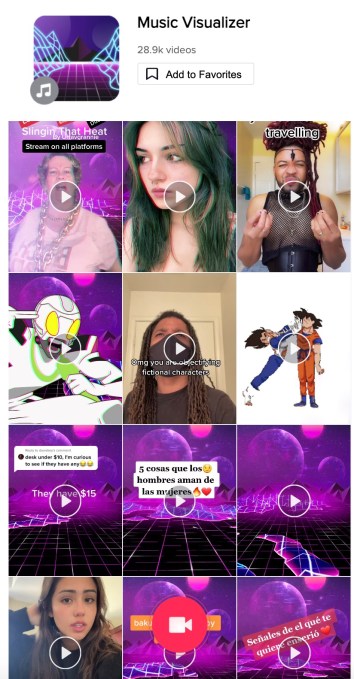
TikTok today is doubling down on its roots as a music-backed creation app with the launch of a half dozen new music effects for creators. The effects, which offer interactivity, visualizations, animations and more, will roll out over the next few weeks, starting with the launch of Music Visualizer. This effect is now available to TikTok’s global user base and runs real-time beat tracking to animate a retro greenscreen landscape, the company says.

The effect was added to TikTok’s Creative Effects tray yesterday and there are already over 28,000 videos created using the new feature. The effect results in videos featuring a purple sky with multiple moons (or planets?) in the background, where the grid on the ground pulses up and down with the music.

Music Visualizer works with any sounds in TikTok’s music library and has also been adopted by the electronic dance music duo AREA21 who used Music Visualizer to tease their new track “La La La.” Unfortunately, their use of the effect hides the animation behind one of their own. But several other creators showcase the effect better.

Other effects on the way include:

  • Music Machine, which offers an interactive set of tools that will allow users to control the real-time rendering of MIDI loops for different music layers. There will also be a BPM slider for real-time adjustments; five, one-shot sound effects; and dynamic visual responses for the video of your recorded music.
  • Delayed Beats, which recreates the freeze-frame effect that’s already popular on TikTok while aligning transitions to the beat of the music
  • Text Beats, which allows creators to add animated text overlays to their video that transition in sync with the beat of any sound from TikTok’s library.
  • Solid Beats, which add visual effects that sync to the beat of any song.
  • Mirror Beats, which align display transitions with the beat of any song from TikTok’s library.

The launch of the new features follow arrival of several new TikTok competitors from major social networks, including Instagram (Reels), Snapchat (Spotlight), and YouTube (Shorts). The additions of the features help to demonstrate how far behind these rivals are in terms of competing on on the product experience. While the newcomers to the short-form video space may have launched their own set of basic creation tools, they’re lacking the larger libraries of creative effects that make TikTok fun to use, as well as appealing to those who are more specifically interested in its music features.

All the new effects will be rolled out to the dedicated “Music” tab within TikTok’s Creative Effects tray, as they become globally available.

07 Apr 2021

Streamlit nabs $35M Series B to expand machine learning platform

As a company founded by data scientists, Streamlit may be in a unique position to develop tooling to help companies build machine learning applications. For starters, it developed an open source project, but today the startup announced an expanded beta of a new commercial offering and $35 million Series B funding.

Sequoia led the investment with help from previous investors Gradient Ventures and GGV Capital. Today’s round brings the total raised to $62 million, according to the company.

Data scientists can download the open source project and build a machine learning application, but it requires a certain level of technical aptitude to make all the parts work. Company co-founder and CEO Adrien Treuille  says that so far the company has 20,000 monthly active developers using the open source tooling to develop streaming apps, which have been viewed millions of times.

As they have gained that traction, they have customers who would prefer to use a commercial service. “It’s great to have something free and that you can use instantly, but not every company is capable of bridging that into a commercial offering,” Treuille explained.

Company COO and co-founder Amanda Kelly says that the commercial offering called Streamlit for Teams is designed to remove some of the complexity around using the open source application. “The whole [process of] how do I actually deploy an app, put it in a container, make sure it scales, has the resources and is securely connected to data sources […] — that’s a whole different skill set. That’s a DevOps and IT skill set,” she said.

What Streamlit for Teams does is take care of all that in the background for end users, so they can concentrate on the app building part of the equation without help from the technical side of the company to deploy it.

Sonya Huang, a partner at Sequoia, who is leading the firm’s investment in Streamlit, says that she was impressed with the company’s developer focus and sees the new commercial offering as a way to expand usage of the applications that data scientists have been building in the open source project.

“Streamlit has a chance to define a better interface between data teams and business users by ushering in a new paradigm for interactive, data-rich applications,” Huang said.

They have data scientists at big-name companies like Uber, Delta Dental and John Deere using the open source product already. They have kept the company fairly lean with 27 employees up until now, but the plan is to double that number in the coming year with the new funding, Kelly says.

She says that the founding team recognizes that it’s important to build a diverse company. She admits that it’s not always easy to do in practice when as a young startup, you are just fighting to stay alive, but she says that the funding gives them the luxury to step back and begin to hire more deliberately.

“Literally right before this call, I was on with a consultant who is going to come in and work with the executive team, so that we’re all super clear about what we mean [when it comes to] diversity for us and how is this actually a really core part of our company, so that we can flow that into recruiting and people and engineering practices and and make that a lived value within our company,” she said.

Streamlit for Teams is available in beta starting today. The company plans to make it generally available some time later this year.

07 Apr 2021

Snorkel AI scores $35M Series B to automate data labeling in machine learning

One of the more tedious aspects of machine learning is providing a set of labels to teach the machine learning model what it needs to know. Snorkel AI wants to make it easier for subject matter experts to apply those labels programmatically, and today the startup announced a $35 million Series B.

It also announced a new tool called Applications Studio that provides a way to build common machine learning applications using templates and predefined components.

Lightspeed Venture Partners led the round with participation from previous investors Greylock, GV, In-Q-Tel and Nepenthe Capital. New investors Walden and BlackRock also joined in. The startup reports that it has now raised $50 million.

Company co-founder and CEO Alex Ratner says that data labeling remains a huge challenge and roadblock to moving machine learning and artificial intelligence forward inside a lot of industries because it is costly, labor-intensive and hard for the subject experts to carve out the time to do it.

“The not so hidden secret about AI today is that in spite of all the technological and tooling advancements, roughly 80 to 90% of the cost and time for an average AI project goes into just manually labeling and collecting and relabeling this training data,” he said.

He says that his company has developed a solution to simplify this process to make it easier for subject experts to programmatically add the labels, a process he says decreases the time and effort required to apply labels in a pretty dramatic way from months to hours or days, depending on the complexity of the data.

As the company has developed this methodology, customers have been asking for help in the next step of the machine learning process, which is taking that training data and the model and building an application. That’s where the Application Studio comes in. It could be a contract classifier at a bank or a network anomaly detector at a telco and it helps companies take that next step after data labeling.

“It’s not just about how you programmatically label the data, it’s also about the models, the preprocessors, the post processors, and so we’ve made this now accessible in a kind of templated and visual no-code interface,” he said.

The company’s products are based on research that began at the Stanford AI Lab in 2015. The founders spent four years in the research phase before launching Snorkel in 2019. Today, the startup has 40 employees. Ratner recognizes the issues that the technology industry has had from a diversity perspective and says he has made a conscious effort to build a diverse and inclusive company.

“What I can say is that we tried to prioritize it at a company level, the full team level and at a board level from day one, and to also put action behind that. So we’ve been working with external firms for internal training and audits and strategy around DEI, and we’ve made pipeline diversity, a non-negotiable requirement of any of our contracts with recruiting firms,” he said.

Ratner also recognizes that automation can hard code bias into machine learning models, and he’s hopeful that by simplifying the labeling process, it can make it much easier to detect bias when it happens.

“If you start with a dozen or two dozen of what we call labeling functions in Snorkel, you still need to be vigilant and proactive about trying to detect bias, but it’s easier to audit what taught your model to change it by just going back and looking at a couple of hundred lines of code.”