Year: 2021

17 Sep 2021

Boston Dynamics owner Hyundai deploys Spot for factory safety monitoring

Back in June, Hyundai completed a deal for controlling interest in Boston Dynamics. The Korean automotive giant no doubt has some grand plans for integrating the Massachusetts-based firm’s technology into a lot of their forward-looking concept mobility vehicles – for now, however, it’s more about putting existing robots to work.

Hyundai today announced the arrival of the drably-named “Factory Safety Service Robot.” It immediately began referring to the unit as “the Robot” for reasons of brevity in the announcement release, and I’m inclined to do the same, because who has the time to type out “Factory Safety Service Robot” a dozen times?

The Robot (see?) is essentially a modded up version of Spot designed for safety inspections at factories. Naturally, Hyundai is starting close to home, rolling out its first pilot at a Seoul plant for subsidiary, Kia.

The Spot, er, Robot, comes equipped for LiDAR and a thermal camera, which scan the space for high-temperatures, fire hazards and open doors. If it senses something off, it will send an alert through a secure site. It shares images and data in real-time, and like Spot, can either operate autonomously or be controlled remotely.


We’re launching a robotics newsletter! Please sign up to get Actuator in your inbox as soon as the first issue hits! For free!


“The Factory Safety Service Robot is the first collaboration project with Boston Dynamics. The Robot will help detect risks and secure people’s safety in industrial sites,” said Hyundai’s Dong Jin Hyun said in a release. “We will also continue to create smart services that detect dangers at industrial sites and help support a safe work environment through continuous collaborations with Boston Dynamics.”

On the whole, if you know what Spot can do, you pretty much get the gist with Robot here, albeit with additional mounted sensors. Earlier this week, Boston Dynamics announced additional data collecting features for the robot.

17 Sep 2021

Former Instacart CFO Sagar Sanghvi joins Accel as its newest partner

Instacart‘s chief financial officer Sagar Sanghvi has departed from the on-demand grocery delivery company after nearly six years and is returning to his investing roots. Specifically, Sanghvi has joined Accel as a partner focused on global growth-stage consumer and enterprise investments.

Prior to becoming CFO of Instacart, Sanghvi served as the company’s vice president of finance and strategy. Interestingly, when he became CFO of Instacart in 2019, he was succeeding Ravi Gupta, who left the company to join Sequoia Capital as a partner on its growth team.

Sanghvi and Gupta worked together as investors at KKR (after Sanghvi had worked as an analyst for Goldman Sachs), so it is notable they are following similar career paths of first working in finance and then becoming operators before transitioning into VC roles. Both joined Instacart in 2015. And Gupta is the one who introduced Sanghvi to Accel’s Miles Clements years ago.

When Sanghvi joined Instacart, it had approximately 300 employees. By the time he’d left earlier this year, it had more than 1,500.

“I’ve been through quite the roller coaster of ups and downs along the way. It was the classic Silicon Valley journey. During my time there, a few crazy things happened,” he told TechCrunch. “ Amazon bought Whole Foods. We experienced the COVID pandemic and lockdowns, which led to an amazing wave of demand. It was an interesting time to be navigating the company.”

And while Sanghvi says he would definitely rather see a business be smaller “than have COVID happen to the world,” it was a time where he learned a lot in helping grow the company.

One of the things Sanghvi worked on during his time at Instacart was a $200 million venture round in October 2020 that valued the company at $17.7 billion. (Since then it raised another $265 million at a $39 billion valuation.) In fact, during his tenure, the company raised more than $2 billion.

But now, Sanghvi will be the one investing in other companies’ rounds — out of Accel’s Palo Alto office.

While his Instacart experience is clearly relevant to the consumer space, Sanghvi said he’ll be working with not just consumer-focused startups, but also a lot of enterprise solutions.

“One of the things that drew me to Miles and the team was the experience and success Accel as a firm has had investing in all different types of companies within the technology sector and so I’m hoping to diversify my experience,” he told TechCrunch.

Clements praised what he described as Sanghvi’s “humility and versatility.”

“He’s done everything from raising $2 billion of capital to being in the minutiae of evaluating back office automation software. He has led a company that is on its way to being an iconic consumer brand, but he’s also been a media investor at KKR,” Clements said. “He guided Instacart through some massive recent fundraises but only because he has also helped navigate through some previous existential challenges. So he brings a lot of natural empathy to founders and entrepreneurs.”

For his part, Sanghvi is eager to start investing as part of the Accel team.

When deciding to move to the venture world, he said, he was looking for a “very well-known brand” that invested across at all stages. He found that in Accel, he said.

“One of the things that was important to me was to find the type of people who really care about the success of companies, and in every person I met at Accel, I could see they took that responsibility very seriously,” Sanghvi told TechCrunch.

He officially started in his new role last week, so he’s actively scoping out investments as I type.

17 Sep 2021

Aurora Propulsion Technologies closes €1.7M seed for spacecraft maneuvering and deorbiting tech

More spacecraft will be sent to orbit this year than ever before in human history, and the number of satellite launches is only anticipated to increase through the rest of the decade. Under these crowded conditions, being able to maneuver satellites in space and deorbit them when they reach the end of their useful life will be key.

Enter Aurora Propulsion Technologies. It’s one of a handful of startups that has emerged in the past few years to help simplify the problem of spacecraft propulsion. Since its founding in 2018, the Finnish company has developed two products – a tiny thruster engine and a plasma braking system – and will be testing both in an in-orbit demonstration in the fourth quarter of this year. Aurora’s activities have caught the eye of investors: the company has just closed a €1.7 million ($2 million) seed round to bring its technology to market.

The round was led by Lithuanian VC firm Practica Capital, with additional participation from the state-owned private equity company TESI (Finnish Industry Investment Ltd.) and Kluz Ventures. Individual investors also participated.

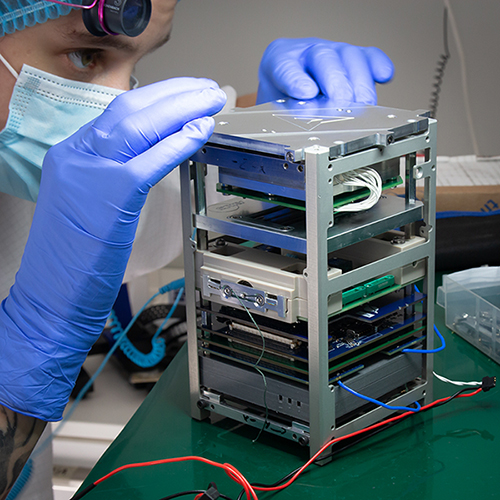
Aurora’s first in-orbit demonstration, Aurora Sat-1, will be heading to space on a Rocket Lab rideshare mission, the company announced last month. On that satellite will be two modules. The first module will contain six Aurora “resistojet” engines, designed to help small spacecraft adjust their attitude (the satellite’s orientation, not its mood) and de-tumble. Aurora will also test its Plasma Brake technology, which could be used to de-orbit satellites or even to conduct deep space missions.

Each resistojet thruster comes in at just around one centimeter long, and it moves the spacecraft using microliters of water and propellant. The six thrusters are distributed around the satellite in such a way to facilitate movement in virtually any direction, and the thruster can also modulate the temperature of the water and the strength of the puff of steam that’s discharged to generate movement.

Aurora CEO Roope Takala, who previously worked for Nokia, likened the innovations in weight and size in the space industry – which we see in the resistojet – to what happened to cell phones and computers twenty years ago. “The industry moves very slow,” he said in a recent interview with TechCrunch. “In the old space era, it took a quarter to develop a rocket engine – that would be a quarter of a century. Now, it takes two quarters of a year. That’s what we did.”

The Plasma Brake uses an electrically charged microtether to generate a lump of protons to generate drag. That’s ideal for de-orbiting a spacecraft, but interestingly (and counterintuitively), the Plasma Brake could also be used for traveling away from the planet, Takala said. That’s because when you go outside the Earth’s magnetosphere, the Plasma Brake becomes unstable and moves with solar wind (which is also plasma). “The same product can jump onto that flow of plasma from the sun and extract energy from that,” Takala explained. “In that context we can use it as an interplanetary traveling tool.”

Theoretically, if a spacecraft was equipped with multiple tethers extending different directions, it could be used to rotate and guide the spacecraft, like a sailboat, he added. This technology is only scalable to a certain degree, however, so don’t expect it to be sending a crewed spacecraft into deep space anytime soon. That’s mostly due to limitations in the material strength of the Plasma Brake tethers, but the tech can be used for satellites up to around 1,000 kilograms.

“That’s our future. That’s where we’re aiming,” Takala said. “We’re focused now for the short term on low Earth orbit with the Plasma Brake and the attitude control [resistojet], and later on when the moon businesses kick off as they are slowly starting to do, then we’ll probably be looking at that way.”

The Plasma Brake and resistojet thruster would need to be put on spacecraft before they launch to orbit, but Aurora is in conversation with other companies of the potential of in-orbit installation of Plasma Brakes for existing space junk. Looking to the short-term, the company is going to use the funding to productize the technology for low Earth orbit and to serialize its production, as well as to add features to the products to equip them for satellites larger than CubeSats.

In the longer term, Aurora has a vision of conducting missions in deep space. “We started off from the idea that we want to make a technology that fits into a really small spacecraft, [and] travels really fast so that we can catch up with the Voyager probes,” Takala said.

“First to the moon and then to Mars, Venus, and then one day we may be able to catch up with the Voyagers and take a big trip.”

17 Sep 2021

Extra Crunch roundup: Adtech investing, Intuit buys Mailchimp, ideal customer profiles

Major gains in online advertising have boosted valuations for adtech startups since the pandemic began, but one insider says investors are missing the party.

“Adtech is having a moment,” writes industry veteran Casey Saran.

“And while much of the oxygen has been soaked up by large legacy companies hitting the public market, there have been smaller deals that indicate a hunger for better creative adtech.”

Saran shares five reasons “why VCs should consider ratcheting up their investment into adtech startups building the next generation of creative tools.”


Full Extra Crunch articles are only available to members
Use discount code ECFriday to save 20% off a one- or two-year subscription


On Wednesday, September 22 at 9:05 a.m PT, I’m moderating “The Path for Underrepresented Entrepreneurs,” a panel discussion at Disrupt 2021.

Our conversation will examine some of the unique challenges facing founders from historically marginalized groups, the strategies they used along the way, and the disruptive changes we need to consider if we want to see fundamental change.

I’ll be speaking with:

  • Hana Mohan, founder & CEO, MagicBell
  • Leslie Feinzaig, founder & CEO, Female Founders Alliance
  • Stephen Bailey, co-founder & CEO, ExecOnline

I hope you’ll attend; we’ll take audience questions after our discussion concludes. Thanks very much for reading Extra Crunch this week, and have a great weekend.

Walter Thompson
Senior Editor, TechCrunch
@yourprotagonist

5 things you need to win your first customer

Putting the final building block onto the top of a rising pile signifying success and achievement

Image Credits: AndrewLilley (opens in a new window) / Getty Images

Congratulations on shipping your product, but how much do you know about your target customers?

Companies that haven’t created an ideal customer profile and performed a SWOT analysis are making big bets on guesswork and intuition. Sometimes that works out, but more frequently, it leads to tears.

In a guest post that walks readers through the fundamentals of creating customer personas that map to your company’s goals, Grammarly product marketing lead Bryan Dsouza shares five basic requirements for customer acquisition.

“Understanding and executing on these things can guarantee you that first customer win, provided you do them well and with sincerity,” he says.

“Your investors will also see the fruits of your labor and be comforted knowing their dollars are at good work.”

4 ways to leverage ROAS to triple lead generation

Someone pops the tab on a soda can, releasing a mist/spray

Image Credits: joshblake (opens in a new window) / Getty Images

In school, it’s highly unethical to copy someone else’s work and pass it off as your own. In business, however, it is expected.

Xiaoyun TU, global director of demand generation at Brightpearl, wrote a comprehensive guide for how to use the key metric of return on advertising spend (ROAS) to triple your company’s lead generation.

“A ‘good’ ROAS score is different for each company and campaign,” she says. “If your figure isn’t where you’d like it to be, you can leverage ROAS data to create targeted campaigns and personalized experiences.”

3 strategies to make adopting new HR tech easier for hiring managers

Steps with Check Mark on Chalkboard

Image Credits: porcorex (opens in a new window) / Getty Images

Most of us prefer to trust our instincts instead of letting automated tools help us make decisions, particularly when it comes to hiring. But that’s not smart.

If your startup relies on an ad hoc hiring process, you’re probably not tracking candidates properly, there’s likely little consistency regarding how they’re treated, and bias can play a major role in who gets hired.

It’s fine to be skeptical of automated hiring tools — but not ignorant.

What could stop the startup boom?

In yesterday’s edition of The Exchange, Anna Heim and Alex Wilhelm speculated about the conditions that could combine to cool off a hot startup market currently fueled by low interest rates and a sweeping digital transformation.

“From where we stand, the factors underpinning the startup fundraising boom appear solid and unlikely to unwind overnight. Still, no golden period shines forever, and even today’s luster will eventually tarnish.”

Intuit’s $12B Mailchimp acquisition is about expanding its small business focus

Signage for financial software company Intuit at the company's headquarters in the Silicon Valley town of Mountain View, California, August 24, 2016. (Photo by Smith Collection/Gado/Getty Images).

Image Credits: Smith Collection/Gado / Getty Images

Before news broke this week that Intuit was acquiring Mailchimp for $12 billion, the ’80s-born fintech giant’s biggest buy was spending $7.1 billion last year for Credit Karma.

In the last few years, Mailchimp “has been expanding upon its core email marketing functionality” with offerings like web design and CRM, writes enterprise reporter Ron Miller.

The industry watchers he interviewed said the move signals Intuit’s interest in acquiring and serving more SMB customers with a variety of tools:

  • Laurie McCabe, co-founder and partner, SMB Group
  • Brent Leary, founder and principal analyst, CRM Essentials
  • Holger Mueller, analyst, Constellation Research

Forge’s SPAC deal is a bet on unicorn illiquidity

“One of my favorite long-term issues with the late-stage startup market is that it is far better at creating value than it is at finding an exit point for that accreted value,” Alex Wilhelm writes for The Exchange. “More simply, the startup market is excellent at creating unicorns but somewhat poor at taking them public.”

That’s good news for Forge Global, a technology startup that operates a market for secondary transactions in private companies, with Alex dubbing its plans to go public via a SPAC combination “perfectly reasonable.”

Dear Sophie: Should I apply for citizenship if I have a conviction?

lone figure at entrance to maze hedge that has an American flag at the center

Image Credits: Bryce Durbin/TechCrunch

Dear Sophie,

At Burning Man a few years ago, I was arrested and charged with a misdemeanor for smoking marijuana in public (in my car) and driving under the influence.

I currently have a green card and want to apply for U.S. citizenship next year.

Can I? If so, how should I handle my criminal record?

— Remorseful About the Reefer

Atlanta’s sundry startups join in global VC funding boom

Alex Wilhelm and Anna Heim continued their tour of U.S. cities after hitting up Chicago and Boston in recent weeks.

This time, they dug into Atlanta’s booming startup scene, which is seeing record capital inflows.

“The picture that forms is one of a city enjoying a rising tide of venture activity, boosted by some local dynamics that may have helped some of its earlier-stage companies scale for cheaper than they might have in other markets,” they write.


17 Sep 2021

A knock against bootstrapping

Natasha and Mary Ann and Alex were all aboard this week under the guidance of Chris and Grace, which meant we had the full team. And speaking of teams, Mary Ann is joining the Friday show on a weekly basis now. She’s been a friend for years, and a colleague now twice-over for Natasha and Alex and we could not be more excited.

That personal news aside, here’s the rundown for today’s show!

Disrupt is next week, so expect some possible changes to the regular Equity show lineup if the news cycle gets dicey. Hugs!

Equity drops every Monday at 7:00 a.m. PDT, Wednesday, and Friday morning at 7:00 a.m. PDT, so subscribe to us on Apple PodcastsOvercastSpotify and all the casts.

17 Sep 2021

The value of software revenue may have finally stopped rising

Startups are raising record sums around the world, thanks to several contributing factors. As The Exchange explored yesterday, historically low interest rates have helped venture capitalists raise more capital than ever, to pick an example.

Low rates have helped startups in another manner: As yields fell for certain assets, investors chased returns by betting on growth. And in recent years, the investing classes turned their attention to public software companies, bidding up the value of their revenue to record highs.

This raised the worth of startups in general terms, and private tech companies’ comps enjoyed a steady, upward climb in the value of their revenues. If the value of a dollar of SaaS revenue was worth $1 one year and $2 the next, the repricing was good for private companies even if we were tracking the metrics from the perspective of public companies.

The free ride could be ending.


The Exchange explores startups, markets and money.

Read it every morning on Extra Crunch or get The Exchange newsletter every Saturday.


I’ve held back from covering the value of software (SaaS, largely) revenues for a few months after spending a bit too much time on it in preceding quarters — when VCs begin to point out that you could just swap out numbers quarter to quarter and write the same post, it’s time for a break. But the value of software revenues posted a simply incredible run, and I can’t say “no” to a chart.

The pace at which software revenues were repriced upwards in the last few years is simply astounding. Per the Bessemer Cloud Index, back in 2016, the median revenue multiple for public SaaS companies was around 5x. When 2018 began, median SaaS multiples had expanded to around 7x.

That’s a 40% climb in pricing, but it proved to be just a foretaste of the feast to come.

By the end of 2019, the median figure had appreciated to around the 9x mark. And today it has shot to just under 18x. That is why software companies have been able to raise so much money, earlier, and in larger chunks. Every dollar of recurring revenue they sold was worth $5 in market cap in mid-2016. At the end of 2019, that same dollar of revenue was worth $9. And today, for the median public software company, it’s valued at around $18.

There are nuances to the data, but we care less about exacting definitions than the directional change it describes: The median value of SaaS revenues more than tripled from 2016 to 2021. That’s an insane amount of growth.

17 Sep 2021

Google reportedly plans to add free channels to its smart TV platform

Chromecasts and other devices powered by Google TV might give users access to free television channels in the future. According to Protocol, Google has been in talks with free, ad-supported streaming television providers about the possibility of adding their channels to its smart TV platform. Those channels typically have a similar feel to traditional TV, and its shows will be interrupted by commercial breaks.

Protocol says Chromecast users might be able to browse live channels available to them through a dedicated menu similar to YouTube TV’s. Meanwhile, smart TVs powered by the platform might show the free channels alongside other over-the-air programming that can be accessed with an antenna. The publication says that’s similar to how companies like Samsung present free TV offerings on their own platforms. Samsung’s free TV service has become so popular, other companies (including Roku and Amazon) started giving their customers access to hundreds of free channels, as well.

The addition of linear programming to Google TV could help make Chromecasts and smart TVs powered by the operating system a more enticing option for cord-cutters. Google could officially launch free streaming channels as soon as this fall, though it could also wait to announce the feature until its smart TV partners are also ready to do so next year. Protocol also says that while it’s unclear what channels are making their way to the platform at this point, Google will likely strike deals that will give it access to “dozens of free channels” all at once.

Editor’s note: This article originally appeared on Engadget.

17 Sep 2021

Defy Partners leads $3M round into sales intelligence platform Aircover

Aircover raised $3 million in seed funding to continue developing its real-time sales intelligence platform.

Defy Partners led the round with participation from Firebolt Ventures, Flex Capital, Ridge Ventures and a group of angel investors.

The company, headquartered in the Bay Area, aims to give sales teams insights relevant to closing the sale as they are meeting with customers. Aircover’s conversational AI software integrates with Zoom and automates parts of the sales process to lead to more effective conversations.

Aircover’s founding team of Andrew Levy, Alex Young and Andrew’s brother David Levy worked together at Apteligent, a company co-founded and led by Andrew Levy, that was sold to VMware in 2017.

Chatting about pain points on the sales process over the years, Levy said it felt like the solution was always training the sales team more. However, by the time everyone was trained, that information would largely be out-of-date.

Instead, they created Aircover to be a software tool on top of video conferencing that performs real-time transcription of the conversation and then analysis to put the right content in front of the sales person at the right time based on customer issues and questions. This means that another sales expert doesn’t need to be pulled in or an additional call scheduled to provide answers to questions.

“We are anticipating that knowledge and parsing it out at key moments to provide more leverage to subject matter experts,” Andrew Levy told TechCrunch. “It’s like a sales assistant coming in to handle any issue.”

He considers Aircover in a similar realm with other sales team solutions, like Chorus.ai, which was recently scooped up by ZoomInfo, and Gong, but sees his company carving out space in real-time meeting experiences. Other tools also record the meetings, but to be reviewed after the call is completed.

“That can’t change the outcome of the sale, which is what we are trying to do,” Levy added.

The new funding will be used for product development. Levy intends to double his small engineering team by the end of the month.

He calls what Aircover is doing a “large interesting problem we are solving that requires some difficult technology because it is real time,” which is why the company was eager to partner with Bob Rosin, partner at Defy Partners, who joins Aircover’s board of directors as part of the investment.

Rosin joined Defy in 2020 after working on the leadership teams of Stripe, LinkedIn and Skype. He said sales and customer teams need tools in the moment, and while some are useful in retrospect, people want them to be live, in front of the customer.

“In the early days, tools helped before and after, but in the moment when they need the most help, we are not seeing many doing it,” Rosin added. “Aircover has come up with the complete solution.”


17 Sep 2021

Ketch raises another $20M as demand grows for its privacy data control platform

Six months after securing a $23 million Series A round, Ketch, a startup providing online privacy regulation and data compliance, brought in an additional $20 million in A1 funding, this time led by Acrew Capital.

Returning with Acrew for the second round are CRV, super{set} (the startup studio founded by Ketch’s co-founders CEO Tom Chavez and CTO Vivek Vaidya), Ridge Ventures and Silicon Valley Bank. The new investment gives Ketch a total of $43 million raised since the company came out of stealth earlier this year.

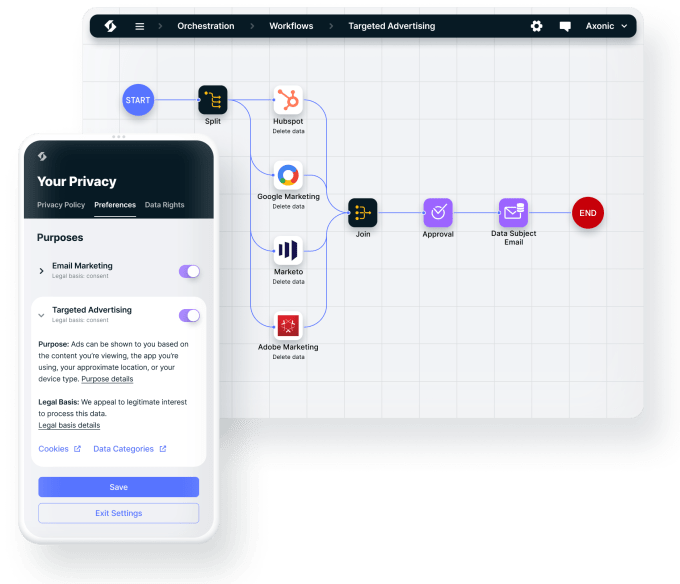
In 2020, Ketch introduced its data control platform for programmatic privacy, governance and security. The platform automates data control and consent management so that consumers’ privacy preferences are honored and implemented.

Enterprises are looking for a way to meet consumer needs and accommodate their rights and consents. At the same time, companies want data to fuel their growth and gain the trust of consumers, Chavez told TechCrunch.

There is also a matter of security, with much effort going into ransomware and malware, but Chavez feels a big opportunity is to bring security to the data wherever it lies. Once the infrastructure is in place for data control it needs to be at the level of individual cells and rows, he said.

“If someone wants to be deleted, there is a challenge in finding your specific row of data,” he added. “That is an exercise in data control.”

Ketch’s customer base grew by more than 300% since its March Series A announcement, and the new funding will go toward expanding its sales and go-to-market teams, Chavez said.

Ketch app. Image Credits: Ketch

This year, the company launched Ketch OTC, a free-to-use privacy tool that streamlines all aspects of privacy so that enterprise compliance programs build trust and reduce friction. Customer growth through OTC increased five times in six months. More recently, Qonsent, which developing a consent user experience, is using Ketch’s APIs and infrastructure, Chavez said.

When looking for strategic partners, Chavez and Vaidya wanted to have people around the table who have a deep context on what they were doing and could provide advice as they built out their products. They found that in Acrew founding partner Theresia Gouw, whom Chavez referred to as “the OG of privacy and security.”

Gouw has been investing in security and privacy for over 20 years and says Ketch is flipping the data privacy and security model on its head by putting it in the hands of developers. When she saw more people working from home and more data breaches, she saw an opportunity to increase and double down on Acrew’s initial investment.

She explained that Ketch is differentiating itself from competitors by taking data privacy and security and tying it to the data itself to empower software developers. With the OTC tool, similar to putting locks and cameras on a home, developers can download the API and attach rules to all of a user’s data.

“The magic of Ketch is that you can take the security and governance rules and embed them with the software and the piece of data,” Gouw added.

17 Sep 2021

Since I can’t build a wall around our talent, here’s how I’m reducing turnover

As the CEO of a tech company for 15 years, I have seen employees come and go for many reasons. But in the last four months, we have seen more turnover than in the previous two years combined. We’ve lost nearly 20% of our 50-person team. It’s putting a lot of pressure on our existing employees.

What’s driving this? During the current labor shortage, many talented workers now have unprecedented opportunities to increase their salary by making the leap to another company. Nationally, the labor force has been reduced by 3.5 million people — a level not seen since the 1970s — and employees have more negotiating power than almost any time in recent history.

In the last four months, we have seen more turnover than in the previous two years combined. We’ve lost nearly 20% of our 50-person team. It’s putting a lot of pressure on our existing employees.

With big employers looking for remote talent across the country, they can sometimes offer salaries 20% to 30% higher than what we’ve traditionally paid as a small company based in a smaller market.

To stave off the threat of talent poaching, which has long been a factor in the tech world, we’ve invested heavily in our culture and staff. Even before the pandemic, employees owned 40% of the company through an employee stock ownership plan established in 2016. But to make sure our compensation package stays relevant, we’ve tweaked it continually through the pandemic.

One of our biggest moves was to redirect some of the money we’ve traditionally set aside for employee development to help team members pay student debt, recognizing that many aren’t as inclined to take professional development courses as in recent years and there were lots of unused professional development dollars in the budget. After months of pandemic life, people didn’t have the time or desire to go to professional conferences, and many of those conferences weren’t happening anyway.

We were allowed to redirect the funds because of a little-known provision of the Coronavirus Aid, Relief and Economic Security (CARES) Act that we learned about when some of our team members saw a tweet about it. Employers are allowed to pay off up to $5,250 a year in student debt for employees without having to treat it as income from 2020 to 2025. This started a one-year program but was extended in December 2020.

To make sure the program was relevant to our company, we did a staff survey before rolling it out. We learned that out of our 40 to 45 employees, 20 said the reimbursement program would have a positive impact on them. That gave us the confidence to move ahead.

We started the program as a pilot, offering $1,200 in reimbursement to each employee per year. When that worked out well, we doubled it to $2,400 per year. It’s a way for us to stand out as an employer: Only 8% of employers had student loan repayment plans as of 2019, according to the Society for Human Resource Management.

There is a bit of setup involved in running a program like this. You need to run an educational assistance program (EAP) that complies with Section 127 of the Internal Revenue Code. And the program must benefit all employees equally — not just one group of employees. To makes sure those who didn’t have student debt could avail themselves of the funds, we continued our professional development program simultaneously. Any employee can submit for the reimbursement of professional development expenses from the same pool of money.

Fortunately, it did not take long to get set up. Once we did the research, it took us less than a month to draft our policy on the student loan reimbursements, publish it and let employees know about it.

To roll out the program, we announced it during a weekly video meeting with our staff. We made the application process very simple, asking employees to fill out a basic one-page form. To get reimbursed, employees have to submit a copy of a student loan bill from the past 12 months that showed how they made their loan payments. We cut them a check as reimbursement.

So far, the feedback on this program has been very positive. Many employees in our industry are on the younger side and struggling with mountains of student debt. Student debt forgiveness is something our employees need.

There is another benefit to the program: Tax savings. Employees can save on their federal tax and their share of payroll taxes. We, in turn, save on payroll taxes and also receive a compensation deduction equal to the amount of reimbursement we provide.

Although we’re bullish on student loan reimbursements, we recognize that this benefit, alone, isn’t enough to help us stay relevant and win the war for talent. The only way to know what matters to them is to listen to them, so we spend a lot of time doing that.

In response to concerns about the cost of living, we are now looking at programs like retention bonuses and 10-year bonuses. The challenge for a small company like ours is finding the money to support these bonuses. Most of our customers sign one- or two-year contracts, so we’d likely have to raise rates to add programs like this. And even if we do raise rates, it will take a while to see the effects in our budget.

Still, we’re willing to look for creative solutions. We want our employees to know we will take good care of them. It’s not only the right thing to do, but it ensures they can contribute their best to our company and aren’t distracted by concerns like whether they can afford to fill their gas tank to get to work.

My hope is that ultimately, once employees settle into working for us, we’ll be able to attract and hold onto the best talent by offering something that has nothing to do with money or benefit but has become more important to many people during the pandemic: A sense of belonging and purpose.

A job is more than just a job here. In a small company like ours, every person on our team counts. And in a small city like the one where we’re located, every employer matters to the community. By offering a workplace where smart people can come together to exchange ideas, enjoy each other’s company and make a difference outside of the pressure cooker of Silicon Valley, we hope we’ll keep attracting people who are looking for those things.

Will they get competitive benefits and compensation? Yes. But those things ultimately are part of a total experience that we will continue to put a lot of thought into, so we can keep our company thriving and growing.