Year: 2021

17 Sep 2021

Journey Clinical raises $3M to allow psychotherapists to prescribe psychedelics

Psychedelics companies are all the rage right now. Compass Pathways is working with the magic mushroom compound psilocybin to treat depression. It’s has raised $290 million in total. Atai Life Sciences — backed by PayPal co-founder Peter Thiel — brought in $258 million from its IPO. In the tech space, this has not gone unnoticed and the same business models that have been used in other platforms for health and wellness startups are coming to psychedelics.

The latest is Journey Clinical, based out of NYC, which has raised a $3 million seed round led by San Francisco VC firm Fifty Years. Also participating were Neo Kuma Ventures, Palo Santo, PsyMed Ventures, Lionheart Ventures, Christina Sass co-founder of Andela, ​​Edvard Engesæth, MD co-founder of Nurx and, Hans Gangeskar co-founder of Nurx.

Journey joins other startups in the space looking at psychedelic-assisted psychotherapy, where ketamine is used to treat depression, anxiety, PTSD, and trauma, known as ketamine-assisted psychotherapy (KAP). Miami-based startup NUE Life Health raised a $3.3 million seed round for the same purpose back in June. There is also Field Trip and Mindbloom playing in this space.

These startups are pushing at an open door on depression and anxiety. Pre-COVID-19, the National Center for Health Statistics estimated some 50 million Americans were fighting the afflictions. The pandemic has of course exacerbated this issue, with those figures doubling, by some estimates.

It’s still an early market. Journey says the market landscape for legal psychedelic therapies is very disparate, with over a million licensed mental health professionals lacking the infrastructure to offer these treatments as they lack access to prescribing clinicians. On the flip side, patients struggle to find psychotherapists who can prescribe psychedelics as treatment.

Journey says it has a “decentralized clinic model” that allows psychotherapists to offer legal psychedelic therapy treatments in their practice, starting with ketamine. The way it works is that Journey takes care of the pharmacology side, while psychotherapists that sign up to the platform take care of the psychotherapy of the patient. The treatment plans are then customized to meet the patient’s needs.

Jonathan Sabbagh, co-founder and CEO, was previously diagnosed with PTSD, but after discovering psychedelics, he went back to school to study clinical psychology, and went on to co-found Journey. He said: “We are on the verge of a paradigm shift in the field of mental health. Psychedelic-assisted psychotherapies are one of the most promising new means of treatment available; they will allow clinicians to tackle the growing global mental health crisis we are facing.”

Speaking to TechCrunch he added: “When we asked what was the main bottleneck for therapists to offer KAP to their patients, the #1 response was access to a prescribing doctor. Our alpha test group confirmed that guaranteeing access to a trained medical team and building a robust care management system would solve an essential bottleneck of mainstream adoption for KAP.”

Journey has two revenue streams. Psychotherapists pay them a $200 monthly membership fee which gives them access to a number of services including and access to the prescriber, an EHR (achieved through a white label), a KAP training (training materials created by a specialized training company), a profile on Journey’s directory, and a community of peers. Patients pay journey for medical services. They pay $250 for the intake consultation and $150 for follow-up consultations.

Ela Madej, Founding Partner at Fifty Years, said: “I dream of a world where those of us affected by trauma, anxiety, or depression don’t have to fall into learned helplessness. We’re lucky that powerful psychedelic treatments for the mind exist, but they need to be delivered responsibly, with proper screening, protocols, and follow-up. We’ve been incredibly impressed by Journey Clinical’s ambitious plan to empower psychotherapists to better treat their existing patients.”

The team also comprises Kyle Lapidus MD, Ph.D., who has over 20 years as a board-certified psychiatrist and has extensive experience working with ketamine; and Brigitte Gordon DNP a professor at Columbia University and also works for the Multidisciplinary Association for Psychedelic Studies (MAPS.)

17 Sep 2021

Apple and Google bow to pressure in Russia to remove Kremlin critic’s tactical voting app

Apple and Google have removed a tactical voting app created by the organization of jailed Kremlin critic, Alexei Navalny, from their respective mobile app stores in Russia.

Earlier this week Reuters reported that the Russian state had been amping up the pressure on foreign tech giants ahead of federal elections — appropriating the language of “election interference” to push US companies to censor the high profile political opponent to president Putin.

On Twitter today, a key Navalny ally, Ivan Zhdanov, tweeted that his organization is considering suing Apple and Google over removal of the apps — dubbing the act of censorship a “huge mistake”.

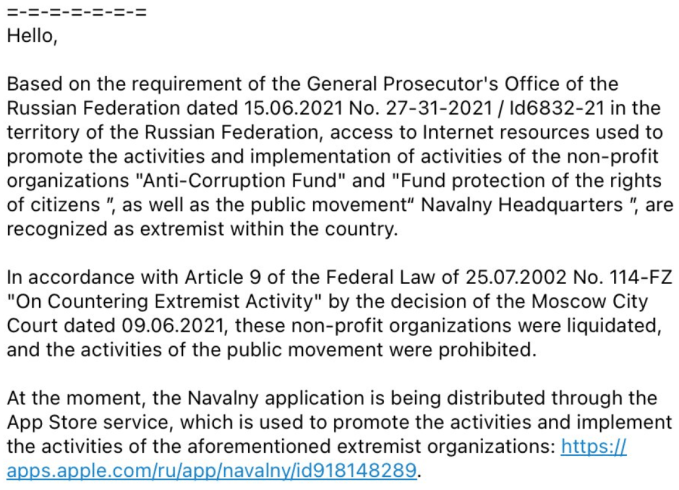
Zhdanov has also published what he says is Apple’s response to Team Navalny — in which the tech giant cites the Kremlin’s classification of a number of pro-Navalny organizations as “extremist” groups to justify its removal of the software.

(Image credit: Screengrab of detail from Apple’s notification to the developer, via Zhdanov’s tweet)

Apple and Google routinely say they comply with ‘all local laws’ in the countries where they operate.

However in Russia that stance means they have become complicit in acts of political censorship.

“We note that the Prosecutor’s Office of the Russian Federation and the Prosecutor’s Office of the City of Moscow have also determined that the app violates the legislation of the Russian Federation by enabling interference in elections,” Apple writes in the notification of takedown it sent to the developer of the tactical voting app.

“While your app has been removed from the Russia App Store, it is still available in the App Stores for the other territories you selected in App Store Connect,” Apple adds.

Apple and Google have been contacted for comment on the removal of Navalny’s app.


Also via Twitter, Zhdanov urged supporters to focus on the tactical voting mission — tweeting a link to a video hosted on Google-owned YouTube which contains recommendations to Russians on how to cast an anti-Putin vote in the parliamentary elections taking place today until Sunday.

Navalny’s supporters are hoping to mobilize voters across Russia to cast tactical ballots in a bid to unseat Putin by voting for whatever candidate has the best chance of defeating the ruling United Russia party.

Their tactical voting strategy has faced some criticism — given that many of the suggested alternatives are, at best, only very weakly opposed to Putin’s regime.

However Navalny’s supporters would surely point out they are having to operate within a flawed system.

After Apple and Google initially refused to remove Navalny’s ‘Smart Voting’ app, last month, the Russian state has been attempting to block access to his organization’s website.

It has even reportedly targeted Google docs — which supporters of Navalny have also been using to organize tactical voting efforts.

Screengrab of the Smart Voting app on the UK iOS app store (Image credits: Natasha Lomas/TechCrunch)

Earlier this month Reuters reported that Russia’s communications regulator, Roskomnadzor, had threatened Apple and Google with fines if they did not remove the Smart Voting app — warning that failure to comply could be interpreted as election meddling.

Russian press has also reported that Apple and Google were summoned to a meeting at the Federation Council on the eve of the election — as Putin’s regime sought to force them to do his anti-democratic bidding.

According to a report by Kommersant, the tech giants were warned the Russian Federation was preparing to tighten regulations on their businesses — and told to “come to their senses”, facing another warning that they were at a “red line”.

The last ditch effort to force the platforms to remove Navalny’s app did then pay off.

In recent weeks, Roskomnadzor has also been targeting VPN apps in the country for removal — making it hard for Russians to circumvent the local ban on Navalny’s app by accessing the software through the stores of other countries.

Local search giant, Yandex, has also reportedly been ordered not to display search results for the Smart Voting app.

Earlier this year, Putin’s regime also targeted Twitter — throttling the service for failing to remove content it wanted banned, although Roskomnadzor claimed the action was related to non-political content such as minors committing suicide, child sexual exploitation and drug use.

17 Sep 2021

Ryder to build logistics network with autonomous trucking company Embark

Supply chain and fleet management solutions company Ryder is partnering with yet another autonomous trucking company. On Thursday, Ryder announced its plans to help Embark launch a nationwide network of up to 100 transfer points that will be owned and operated by the autonomous trucking developer. 

This is Ryder’s third public partnership with autonomous trucking companies. It recently announced plans that are currently underway to help Waymo Via scale its autonomous trucking business by helping with standardized fleet maintenance and management. Ryder is also working with TuSimple to leverage its own facilities as terminals for the startup

“We’re on the cutting edge and really beginning to understand that AV could have a pretty significant role in the future of transportation logistics, so we want to get in as early as possible and start working with these companies that seem to be dominating the market with their technologies,” Karen Jones, Ryder’s EVP for new product innovation, told TechCrunch.

While Ryder has been in talks with other AV companies like Kodiak, Aurora and Plus, Jones said no other deals are in the pipeline. Jones says Ryder is hoping to learn and grow through the different use cases its existing partnerships provide, as well as come up with a replicable transfer hub model that will help the company go to market faster.

“I think as we move this technology forward there’s still a lot of unknowns about how to maintain, how to service and how to operate,” said Jones. “Ryder is a natural fit to partner with because we have huge facilities for maintenance, and then we also have our supply chain and logistics business. We are a real operator that knows how these facilities and the complexities of getting vehicles in and out for delivery to larger facilities work.”

As part of its partnership with Embark, Ryder will provide yard operations, maintenance and fleet management. It will also play an advisory role on Embark’s network of strategically located transfer points where freight is moved from driverless long-haul trucks to driver-controlled trucks for first- and last-mile delivery. 

Ryder is helping Embark to understand what’s required at the facilities and cooperating with Embark’s third-party partners who will either be constructing or locating sites for these facilities, says Jones. At the start, the companies will select sites in key freight markets in California, Arizona, Texas, Georgia, Tennessee and Florida through which Embark will be able to begin operations early next year in preparation for a larger commercial launch in 2024. 

Ryder to build logistics network with autonomous trucking company Embark

Image Credits: Embark

Autonomous companies often choose Sun Belt regions to begin operations because it’s rare to have to account for inclement weather patterns like snow and sleet, making the environment optimal for testing. But over the next five years, Embark and Ryder aim to work with a network of real estate operators to open 100 Embark transfer points across the country. 

Currently, Embark, which recently announced plans to go public via a SPAC deal, moves freight for companies like HP and Budweiser makers AB inBev, as well as Knight Swift Transportation, Werner Enterprises and other “top 25 U.S. truckload carriers,” according to CEO Alex Rodrigues. 

Rodrigues says Embark’s current freight partnerships are either pilots or smaller scale versions of what the company plans to launch in the future. The company has a fleet of 16 trucks today that operate exclusively on highways with a human safety operator in the front seat just in case, but usually, the driver does not have to take over, even if the AV encounters a new scenario. 

Operating only on highways means building out a network of off-highway transfer hubs, which is actually pretty essential, even though it will require a lot of capital and time to scale. TuSimple, by comparison, operates on both highways and surface streets, or streets that are not part of a freeway and have at-grade intersections with other surface streets. The startup’s AVs don’t go into residential areas, and thus don’t perform last-mile delivery, but they are able to access distribution centers and warehouse facilities more easily, according to TuSimple. This capability allows the startup to use existing Ryder locations and retrofit them to serve as TuSimple terminals, rather than building out new terminals, like what Embark is doing. 

Waymo Via is also building its own hubs, and Ryder’s fleet maintenance, inspections and roadside assistance will help the autonomous trucking arm of Waymo scale those sites as well as maximize vehicle uptime and reliability. 

As Ryder lends its varied capabilities to all of these different use cases, it is able to consider its own potential in the AV space, and not just in the logistics of it all. Jones said the company is open to operating an autonomous fleet one day if it makes sense to do so on behalf of a customer, and is also very entrenched in its first- and last-mile delivery services. 

“There’s a number of spaces for Ryder to play as the whole AV initiative evolves, but our first foray into this is really servicing and beginning to understand the technology, as well as the requirements for operating hubs,” said Jones. 

17 Sep 2021

In internal memo, Apple says it is monitoring legal challenges to Texas abortion law

In a message posted on an internal employee message board today, Apple said that it was monitoring the legal challenges to what it refers to as the “uniquely restrictive abortion law” that was recently passed in Texas. Apple confirmed the authenticity of the message to TechCrunch.

“We are actively monitoring the legal proceedings challenging the uniquely restrictive abortion law in Texas,” the unsigned memo reads. “In the meantime, we want to remind you that our benefits at Apple are comprehensive, and that they allow our employees to travel out-of-state for medical care if it is unavailable in their home state.”

The new law essentially bans the vast majority of abortions from occurring in the state and is currently being legally challenged In a variety of ways. A series of companies in and outside of tech have taken public stances against the law in recent days. Salesforce has offered to relocate any employees in Texas that are concerned about the ability to access reproductive care in the state post-enactment of the law. Offers to cover travel expenses for employees that needed care out of the state were set up by Match Group and Bumble, both Texas-based companies.

The message does not detail any further actions that Apple is taking to actively oppose the bill but says that Apple supports “our employees’ rights to make their own decisions regarding their reproductive health.”

Apple is a large employer in Texas where it has a campus of thousands in Austin, as well as a manufacturing plant and many Apple stores across the state.

The full text of the message is below:

A message about women’s reproductive health care

At Apple, we support our employees’ rights to make their own decisions regarding their reproductive health.

We are actively monitoring the legal proceedings challenging the uniquely restrictive abortion law in Texas. In the meantime, we want to remind you that our benefits at Apple are comprehensive, and that they allow our employees to travel out-of-state for medical care if it is unavailable in their home state. If you need help in navigating your care or that of your dependents, your health plan carrier can confidentially assist you.

Your health and well-being remain our highest priority, and we will continue to do all that we can to ensure that you and your families have access to the care that Apple provides.


16 Sep 2021

GM extends Chevy Bolt EV production shutdown through mid-October

General Motors is extending the shutdown of its Orion Assembly Plant until at least mid-October as a result of a battery pack shortage related to the recently announced Chevy Bolt EV and EUV safety recall. Bloomberg first reported that the company intends to idle its plant through the week of October 11.

“These most recent scheduling adjustments are being driven by the continued parts shortages caused by semiconductor supply constraints from international markets experiencing COVID-related restrictions,” the company said in a statement. “We remain confident in our team’s ability to continue finding creative solutions to minimize the impact on our highest-demand and capacity constrained vehicles. Although the situation remains complex and very fluid, GM continues to prioritize full-size truck production which remains in high demand.”

Last week, GM announced the shutdown of the Michigan assembly plant, which began on August 23, would extend to September 20, but it’s clear that the company has not yet found a solution to the causes of delay. In the meantime, GM said it would continue to work with its battery supplier, LG Chem, to update its manufacturing processes and production schedules.

In July, the company began recalls for its Chevy Bolts due to fire risks, and the National Highway Traffic and Safety Administration has recommended customers park their vehicles away from homes and other vehicles as a precaution.

Last week, GM said production on its full-size trucks and full-size SUVs would begin by this week, but chip shortages have also caused GM to announce slowing production at five other assembly plants in North America. Some, like the Fort Wayne Assembly and Silao Assembly plants, which produce the Chevrolet Silverado 1500 and GMC Sierra 1500 models, have already ramped up to full capacity as of September 13 after being briefly impacted by the global semiconductor shortage, GM said.

The Lansing Delta Township Assembly plant in Michigan, which builds the Chevrolet Traverse and the Buick Enclave, will add an additional week of downtime the week of September 27 and is expected to resume production the week of October 4. The plant has been shut down since July 19. Downtime for the Chevrolet Camaro and Cadillac Black Wing have also been extended through the week of the 27th, as well as previously announced downtime for Cadillac CT4 and CT5 production. Production on the Camaro has been down since September 13, and on the CT4 and CT5 since May 10.

Production of the Equinox, Blazer and GMC Terrain have been pushed out through the week of October 11, as well, which are produced at the CAMI Assembly plant in Canada and San Luis Potosi Assembly and Ramos Assembly in Mexico. Production of the Blazer and Equinox have been down since August 23 and August 16, respectively.

Cadillac XT4 production, which has been down since February 8, will resume at Fairfax Assembly in Kansas next week. GM said production of the Chevrolet Malibu, which is also at Fairfax and has been down since February 8, will remain down through the week of October 25.

16 Sep 2021

Facebook knows Instagram harms teens. Now, its plan to open the app to kids looks worse than ever

Facebook is in the hot seat again.

The Wall Street Journal published a powerful multi-part series on the company this week, drawing from internal documents on everything from the company’s secretive practice of whitelisting celebrities to its knowledge that Instagram is taking a serious toll on the mental health of teen girls.

The flurry of investigative pieces makes it clear that what Facebook says in public doesn’t always reflect the company’s knowledge on known issues behind the scenes. The revelations still managed to shock even though Facebook has been playing dumb about the various social ills it sows for years. (Remember when Mark Zuckerberg dismissed the notion that Facebook influenced the 2016 election as “crazy?”) Facebook’s longstanding PR playbook is to hide its dangers, denying knowledge of its darker impacts on society publicly, even as research spells them out internally.

That’s all well and good until someone gets ahold of the internal research.

One of the biggest revelations from the WSJ’s report: The company knows that Instagram poses serious dangers to mental health in teenage girls. An internal research slide from 2019 acknowledged that “We make body image issues worse for one in three teen girls” — a shocking admission for a company charging ahead with plans to expand to even younger and more vulnerable age groups.

As recently as May, Instagram’s Adam Mosseri dismissed concerns around the app’s negative impact on teens as “quite small.”

But internally, the picture told a different story. According to the WSJ, from 2019 to 2021, the company conducted a thorough deep dive into teen mental health including online surveys, diary studies, focus groups and large-scale questionnaires.

According to one internal slide, the findings showed that 32 percent of teenage girls reported that Instagram made them have a worse body image. Of research participants who experienced suicidal thoughts, 13 percent of British teens and 6 percent of American teens directly linked their interest in killing themselves to Instagram.

“Teens blame Instagram for increases in the rate of anxiety and depression,” another internal slide stated. “This reaction was unprompted and consistent across all groups.”

Following the WSJ report, Senators Marsha Blackburn (R-TN) and Richard Blumenthal (D-CT) announced a probe into Facebook’s lack of transparency around internal research showing that Instagram poses serious and even lethal danger to teens. The Senate Subcommittee on Consumer Protection, Product Safety, and Data Security will launch the investigation.

“We are in touch with a Facebook whistleblower and will use every resource at our disposal to investigate what Facebook knew and when they knew it – including seeking further documents and pursuing witness testimony,” Senators Blackburn and Blumenthal wrote. “The Wall Street Journal’s blockbuster reporting may only be the tip of the iceberg.”

Blackburn and Blumenthal weren’t the only U.S. lawmakers alarmed by the new report. Sen. Ed Markey (D-MA), Rep. Kathy Castor (D-FL), and Lori Trahan (D-MA) sent Facebook their own letter demanding that the company walk away from its plan to launch Instagram for kids. “Children and teens are uniquely vulnerable populations online, and these findings paint a clear and devastating picture of Instagram as an app that poses significant threats to young people’s wellbeing,” the lawmakers wrote.


In May, a group of 44 state attorneys general wrote to Instagram to encourage the company to abandon its plans to bring Instagram to kids under the age of 13. “It appears that Facebook is not responding to a need, but instead creating one, as this platform appeals primarily to children who otherwise do not or would not have an Instagram account,” the group of attorneys general wrote. They warned that an Instagram for kids would be “harmful for myriad reasons.”

In April, a collection of the same Democratic lawmakers expressed “serious concerns” about Instagram’s potential impact on the well-being of young users. That same month, a coalition of consumer advocacy organizations also demanded that the company reconsider launching a version of Instagram for kids.

According to the documents obtained by the WSJ, all of those concerns look extremely valid. In spite of extensive internal research and their deeply troubling findings, Facebook has downplayed its knowledge publicly, even as regulators regularly pressed the company for what it really knows.

Instagram’s Mosseri may have made matters worse Thursday when he made a less than flattering analogy between social media platforms and vehicles. “We know that more people die than would otherwise because of car accidents, but by and large, cars create way more value in the world than they destroy,” Mosseri told Peter Kafka on Recode’s media podcast. “And I think social media is similar.”

Mosseri dismissed any comparison between social media and drugs or cigarettes in spite of social media’s well-researched addictive effects, likening social platforms to the auto industry instead. Naturally, the company’s many critics jumped on the car comparison, pointing to their widespread lethality and the fact that the auto industry is heavily regulated — unlike social media.

16 Sep 2021

Rivian announces membership plan with complimentary charging and LTE connectivity

With R1T trucks rolling off the assembly line at its factory in Normal, Illinois, Rivian continues to prepare for the official debut of its first EVs later this month. On Thursday, the automaker introduced a membership program that will grant Rivian owners access to complimentary charging at its soon-to-be-built Adventure Network and Waypoints chargers. It also pledged to match every mile Rivian Membership customers drive with energy from renewable resources such as wind and solar, as well as offer unlimited access to 4G LTE connectivity.

Additionally, the service includes Rivian off-Roadside Assistance, additional coverage that will see the company send a recovery vehicle to you if you get stuck out on the trail or need an emergency battery recharge. The company also promised to add additional perks in the future, including new drive modes, community meetups and in-cabin content. Each new Rivian vehicle will come with 12 months of free access to the service. After that, you’ll need to pay to continue enjoying the perks of the membership. The company hasn’t said how much it plans to charge for the service, so we’ve reached out to it for more information.

Editor’s note: This story originally appeared on Engadget.


16 Sep 2021

Rivian announces membership plan with complimentary charging and LTE connectivity

With R1T trucks rolling off the assembly line at its factory in Normal, Illinois, Rivian continues to prepare for the official debut of its first EVs later this month. On Thursday, the automaker introduced a membership program that will grant Rivian owners access to complimentary charging at its soon-to-be-built Adventure Network and Waypoints chargers. It also pledged to match every mile Rivian Membership customers drive with energy from renewable resources such as wind and solar, as well as offer unlimited access to 4G LTE connectivity.

Additionally, the service includes Rivian off-Roadside Assistance, additional coverage that will see the company send a recovery vehicle to you if you get stuck out on the trail or need an emergency battery recharge. The company also promised to add additional perks in the future, including new drive modes, community meetups and in-cabin content. Each new Rivian vehicle will come with 12 months of free access to the service. After that, you’ll need to pay to continue enjoying the perks of the membership. The company hasn’t said how much it plans to charge for the service, so we’ve reached out to it for more information.

Editor’s note: This story originally appeared on Engadget.


16 Sep 2021

Reid Hoffman is returning to Disrupt

You’ve probably learned from Reid Hoffman before, either through his inventions, investments or inspirational words. The entrepreneur is the co-founder of LinkedIn, a partner at Greylock and the author of a new book based off of his hit podcast, Masters of Scale. 

His storied past makes him chock-full of interesting anecdotes and lessons, which is why we’re excited to have him back on the TechCrunch Disrupt stage happening next week from September 21-23. I’ll sit down with him to learn about his perspective on some of the biggest tensions that entrepreneurs face today. Hoffman’s advice is often fueled by his raw conversations with top tech CEOs and founders, so we’ll broaden access to his speed-dial list to understand how even his own perceptions on blitzscaling, growth and entrepreneurship are changing amid the pandemic. As I explained in my review of his new book, his words read like a well-networked mentor giving you a pep talk — so even if you’re not building a startup, there will be useful lessons to learn just by listening.

Here’s how it impacted my interview process, for example:

While press wasn’t a main character in the book, “Master of Scale” has already changed my perspective on how I interview founders. Lessons from Tristan Walker made me want to ask more questions about founders, and their most controversial beliefs, rather than how they plan to spend their new round of funding. A note from Andrés Ruzo made me realize that a startup that makes too much sense might be a comfortable read, but it might not be a moonshot that disrupts the world; in other words, pursue the startups that have too much seemingly foolish ambition — because they may be where the best strides, and stories, are made. Finally, it confirmed my belief that the best litmus test for a founder is if they are willing to talk about the hardships ahead of them in an honest, humble way.

OK, that’s all I’m hinting. Join me at Disrupt, where I’ll put Hoffman on the hot seat, balance out the cheerfulness with some cynical takes and push him to explain what his inevitable next book is about. Buy your tickets to TechCrunch Disrupt using this link, or use promo code “MASCARENHAS20” for a little discount from me.

16 Sep 2021

Daily Crunch: Lucid Air puts Tesla in rearview mirror by earning 520-mile EPA range rating

To get a roundup of TechCrunch’s biggest and most important stories delivered to your inbox every day at 3 p.m. PDT, subscribe here.

Hello and welcome to Daily Crunch for September 16, 2021. We are still on the countdown to Disrupt, so make sure you have a ticket, and get ready to drop your pitch deck into the hat. We’re going to space! — Alex

The TechCrunch Top 3

  • Tigers love robots: Sure we’re accustomed to seeing Tiger cut checks into every software company still alive, but did you know that the capital fund is also into physical goods? Our own Brian Heater has the news.
  • What could stop the startup boom? Today on the site TechCrunch dug back through its coverage of the Q2 venture capital cycle, asking what could stop the momentum that we’ve seen in recent quarters. The short answer? Not too much. The heady startup market is more stable than you’d think, but only partially on its own merit.
  • The American government gets serious about breaches: The U.S. Federal Trade Commission (FTC) is making sure that companies know that if their apps “collect personal health information [they] must notify consumers if their data is breached or shared with third parties without their permission.” Which is good. But how was that not always the rule?

Startups/VC

Apple held an event this week, so the technology market is still reverberating with takes about why it’s the iPhone 13 and not the iPhone 12S. Regardless of your take there, Apple’s long shadow is making itself known in other places. Like the market for helping folks find their gadgets. The Cupertino-based giant made waves the other month by introducing AirTags, in competition with Tile, a startup. Well, Tile is now back with $40 million in new capital. To war!

  • Fiberplane raises capital to build Google Docs for SREs: Building software tuned for a particular market is hot these days. The strategy is akin to building an anti-Word, if you will. In Fiberplane’s case — the company just raised $8.8 million — it’s building a Google-Docs-style product for site reliability engineers, or SREs. Is that niche too small? Probably not?
  • CodeSignal raises (again): Ah, credentialing. CodeSignal wants to make applying for developer gigs a bit more based on skill and a bit less based on where one went to school. Investors are lining up to fund its vision, dropping a fresh $50 million into the company’s coffers less than a year after it raised $25 million.
  • Self Financial proves that credit-building is still venture-backable: Altos Ventures led a $50 million Series E for the company, which wants to help “consumers build credit and savings at the same time.” It’s a good idea, given how broken the American credit system still is today.
  • Byju’s buys coding platform Tynker: The $200 million transaction will help Byju’s continue to expand in the United States. The Indian company’s bullishness on its own sector is perhaps balm to founders and investors worried about edtech in the wake of China’s decision to kneecap its domestic startup class chasing the market.
  • Open Mineral: What a great startup name. And it is more than apt, as the company wants to bring transparency to the global commodities markets. Which is good, as more transparency means better price discovery, and a more efficient market. Open Mineral just closed $33 million in a Series C.

3 strategies to make adopting new HR tech easier for hiring managers

Most of us prefer to trust our instincts instead of letting automated tools help us make decisions, particularly when it comes to hiring. But that’s not smart.

If your startup has an ad hoc hiring process, you’re not tracking candidates properly, there’s little consistency regarding how they’re treated and bias plays a major role in who gets hired.

It’s fine to be skeptical of automated hiring tools —- but not ignorant.

(Extra Crunch is our membership program, which helps founders and startup teams get ahead. You can sign up here.)

Big Tech Inc.

  • Twitter Super Follows may not be super lucrative: Data coming out from the Twitter Super Follows product indicates that its early performance is lackluster. So much so that it might go the way of Fleets. Do you Super Follow? If so let us know.
  • Ford spends to boost electric truck production: Worried that EVs might be a fad? Stop fretting. Traditional American car company Ford is doubling-down on its electric F-150 production, TechCrunch reports. And if Ford is doing well with EVs, they well and truly are mainstream.
  • Lucid Air snags the longest-range EV title, surpassing Tesla: Dodging the Elon fanboys for a minute, Lucid Motors is pushing the state of the EV art a bit forward with a car that sports a 520-mile range. That’s one hell of a hike. In general terms, the distance bump that Lucid — recall that the company is going public later this year — intends to offer could spark an arms race regarding EV range. Yes, please.

TechCrunch Experts: Growth Marketing

Illustration montage based on education and knowledge in blue

Image Credits: SEAN GLADWELL (opens in a new window) / Getty Images

TechCrunch wants you to recommend growth marketers who have expertise in SEO, social, content writing and more! If you’re a growth marketer, pass this survey along to your clients; we’d like to hear about why they loved working with you.

If you’re curious about how these surveys are shaping our coverage, check out this guest column by Bryan Dsouza on Extra Crunch, “5 things you need to win your first customer.”