Year: 2021

16 Sep 2021

4 ways to leverage ROAS to triple lead generation

Businesses that don’t invest in their future may not have a future to look forward to.

Whether you’re investing in your human resources or in critical tech, some outlay in the short term is always needed for long-term success. That’s true when it comes to marketing as well — you can’t market your product or service without investing in advertising. But if that investment isn’t turning into leads and conversions, you’re in trouble.

A “good” ROAS score is different for each company and campaign. If your figure isn’t where you’d like it to be, you can leverage ROAS data to create targeted campaigns and personalized experiences.

It’s vital to identify and apply the most suitable metrics based on business goals, and there’s no one best practice or one-size-fits-all method.

However, smart use of the return on advertising spend (ROAS) data can triple lead generation, as I discovered when I joined Brightpearl to restructure the marketing campaigns. Let’s take a look at some of the ways Brightpearl used ROAS to improve campaigns and increase lead generation. The key is to work out what represents a healthy ROAS for your business so that you can optimize accordingly.

Use the right return metric

It is paramount to choose the right return metric to calculate your ROAS. This will depend partly on your sales cycle.

Brightpearl has a lengthy sales cycle. On average it’s two to three months, and sometimes up to six months, meaning we don’t have tons of data on a monthly basis if we want to use new customer’s revenue data as the return metric. A company with a shorter sales cycle could use revenue, but that doesn’t help us to optimize our campaigns.

We chose to use the sales accepted opportunity (SAO) value instead. It usually takes us about a month to measure, so we can get more ROAS data at the same time. It’s the last sales stage before a win, and it’s more in line with our company goal (to grow our recurring annual revenue), but takes less time to gather the data.

By the SAO stage, we know which leads are good quality­ — they have the budget, are a good fit, and our software can meet their requirements. We can use them to measure our campaign performance.

When you choose a return metric, you need to make sure it matches your company goal without taking ages to get the data. It also has to be measurable at the campaign level, because the aim of using ROAS or other metrics is to optimize your campaigns.

Accept that less is more

I’ve noticed that many companies harbor a fear of missing out on opportunities, which leads them to advertise on all available channels instead of concentrating resources on the most profitable areas.

Prospects usually do their research on multiple channels, so you might try to cover all the possible touch points. In theory, this could generate more leads, but only if you had an unlimited marketing budget and human resources.

16 Sep 2021

Mirantis launches cloud-native data center-as-a-service software

Mirantis has been around the block, starting way back as an OpenStack startup, but a few years ago the company began to embrace cloud-native development technologies like containers, microservices and Kubernetes. Today, it announced Mirantis Flow, a fully managed open source set of services designed to help companies manage a cloud-native data center environment, whether your infrastructure lives on-prem or in a public cloud.

“We’re about delivering to customers an open source-based cloud-to-cloud experience in the data center, on the edge, and interoperable with public clouds,” Adrian Ionel, CEO and co-founder at Mirantis explained.

He points out that the biggest companies in the world, the hyperscalers like Facebook, Netflix and Apple, have all figured out how to manage in a hybrid cloud-native world, but most companies lack the resources of these large organizations. Mirantis Flow is aimed at putting these same types of capabilities that the big companies have inside these more modest organizations.

While the large infrastructure cloud vendors like Amazon, Microsoft and Google have been designed to help with this very problem, Ionel says that these tend to be less open and more proprietary. That can lead to lock-in, which today’s large organizations are looking desperately to avoid.

“[The large infrastructure vendors] will lock you into their stack and their APIs. They’re not based on open source standards or technology, so you are locked in your single source, and most large enterprises today are pursuing a multi-cloud strategy. They want infrastructure flexibility,” he said. He added, “The idea here is to provide a completely open and flexible zero lock-in alternative to the [big infrastructure providers, but with the] same cloud experience and same pace of innovation.”

They do this by putting together a stack of open source solutions in a single service. “We provide virtualization on top as part of the same fabric. We also provide software-defined networking, software-defined storage and CI/CD technology with DevOps as a service on top of it, which enables companies to automate the entire software development pipeline,” he said.

As the company describes the service in a blog post published today, it includes “Mirantis Container Cloud, Mirantis OpenStack and Mirantis Kubernetes Engine, all workloads are available for migration to cloud native infrastructure, whether they are traditional virtual machine workloads or containerized workloads.”

For companies worried about migrating their VMware virtual machines to this solution, Ionel says they have been able to move these VMs to the Mirantis solution in early customers. “This is a very, very simple conversion of the virtual machine from VMware standard to an open standard, and there is no reason why any application and any workload should not run on this infrastructure — and we’ve seen it over and over again in many many customers. So we don’t see any bottlenecks whatsoever for people to move right away,” he said.

It’s important to note that this solution does not include hardware. It’s about bringing your own hardware infrastructure, either physical or as a service, or using a Mirantis partner like Equinix. The service is available now for $15,000 per month or $180,000 annually, which includes: 1,000 core/vCPU licenses for access to all products in the Mirantis software suite plus support for 20 virtual machine (VM) migrations or application onboarding and unlimited 24×7 support. The company does not charge any additional fees for control plane and management software licenses.

16 Sep 2021

Twitter Super Follows has generated only around $6K+ in its first two weeks

Twitter’s creator platform Super Follows is off to an inauspicious start, having contributed to somewhere around $6,000 in U.S. iOS revenue in the first two weeks the feature has been live, according to app intelligence data provided by Sensor Tower. And it’s made only around $600 or so in Canada. A small portion of that revenue may be attributed to Ticketed Spaces, Twitter’s other in-app purchase offered in the U.S. — but there’s no way for this portion to be calculated by an outside firm.

Twitter first announced its plans to launch Super Follows during its Analyst Day event in February, where the company detailed many of its upcoming initiatives to generate new revenue streams.

Today, Twitter’s business is highly dependant on advertising, and Super Follows is one of the few ways it’s aiming to diversify. The company is also now offering a way for creators to charge for access to their live events with Ticketed Spaces and, outside the U.S., Twitter has begun testing a premium product for power users called Twitter Blue.
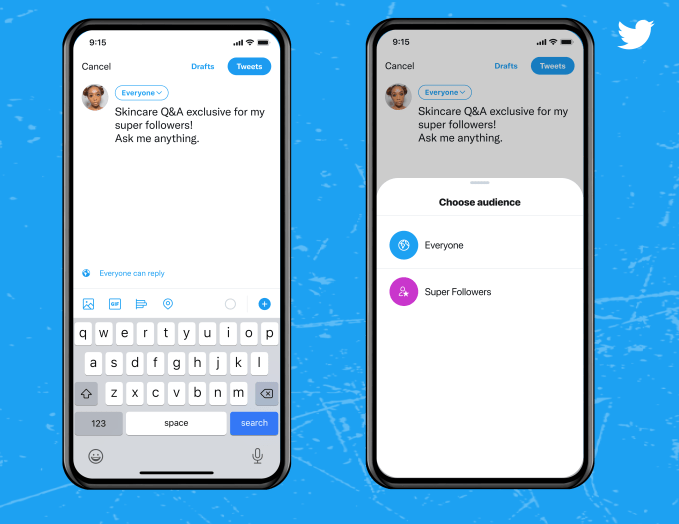
Image Credits: Twitter

But Super Follows, which targets creators, is the effort with the most potential appeal to mainstream users.

It’s also one that is working to capitalize on the growing creator economy, where content creators build a following, then generate revenue directly through subscriptions — decreasing their own dependence on ads or brand deals, as a result. The platforms they use for this business skim a little off the top to help them fund the development of the creator tools. (In Twitter’s case, it’s taking only a 3% cut.)

The feature would seem to make sense for Twitter, a platform that already allows high-profile figures and regular folks to hobnob in the same timeline and have conversations. Super Follows ups that access by letting fans get even closer to their favorite creators — whether those are musicians, artists, comedians, influencers, writers, gamers, or other experts, for example. These creators can set a monthly subscription price of $2.99, $4.99, or $9.99 to provide fans with access to bonus, “behind-the-scenes” content of their choosing. These generally come in the form of extra tweets, Q&As, other interactions with subscribers.
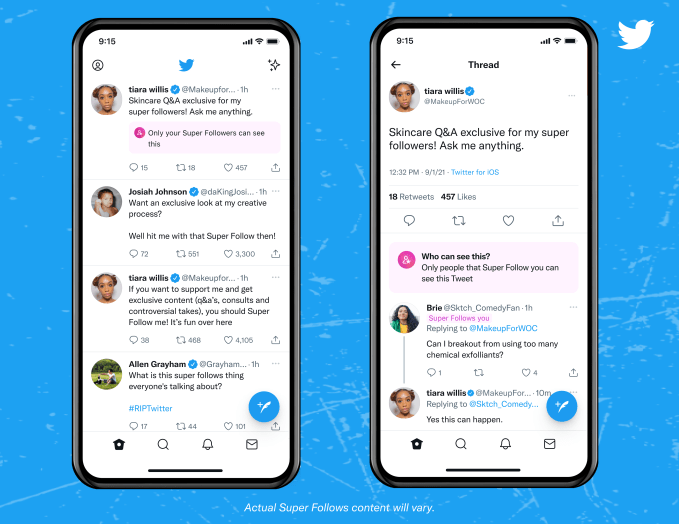
Image Credits: Twitter

At launch, Twitter opened up Super Follows to a handful of creators, including the beauty and skincare-focused account @MakeupforWOC; astrology account @TarotByBronx; sports-focused @KingJosiah54; writer @myeshachou; internet personality and podcaster @MichaelaOkla; spiritual healer @kemimarie; music charts tweeter @chartdata; Twitch streamers @FaZeMew, @VelvetIsCake, @MackWood1, @GabeJRuiz, and @Saulsrevenge; YouTubers @DoubleH_YT, @LxckTV, and @PowerGotNow; and crypto traders @itsALLrisky and @moon_shine15; among others. Twitter says there are fewer than 100 creators in total who have access to Super Follows.

While access on the creation side is limited, the ability to subscribe to creators is not. Any Twitter iOS user in the U.S. or Canada can “Super Follow” any number of the supported creator accounts. In the U.S., Twitter has 169 million average monetizable daily active users as of Q2 2021. Of course, only some subset of those will be iOS users.

Still, Twitter could easily count millions upon millions of “potential” customers for its Super Follow platform at launch. Its current revenue indicates that, possibly, only thousands of consumers have done so, given many of the top in-app purchases are for creators offering content at lower price points.
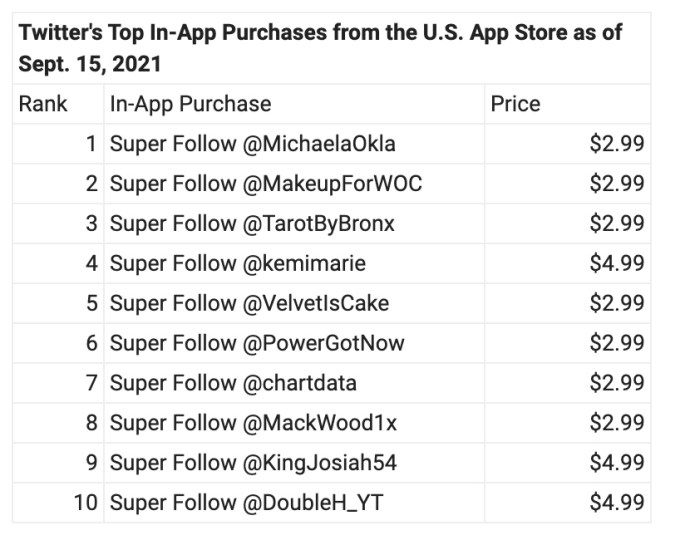
Image Credits: Sensor Tower

Sensor Tower notes the $6,000 in U.S. consumer spending on iOS was calculated during the first two weeks of September (Sept. 1-14). Before this period, U.S. iOS users spent only $100 from August 25 through 31 — a figure that would indicate user spending on Ticketed Spaces during that time. In other words, the contribution of Tickets Spaces revenue to this total of $6,000 in iOS consumer spending is likely quite small.

In Canada, the other market where Super Follow is now available to subscribers, Twitter’s iOS in-app purchase revenue from September 1 through September 14 was a negligible $600. (This would also include Twitter Blue subscription revenue, which is being tested in Canada and Australia.)

Worldwide, Twitter users on iOS spent $9,000 during that same time, which would include other Ticketed Spaces revenues and tests of its premium service, Twitter Blue. (Twitter’s Tip Jar, a way to pay creators directly, does not work through in-app purchases).

Unlike other Twitter products that developed by watching what users were already doing anyway — like using hashtags or retweeting content — many of Twitter’s newer features are attempts at redefining the use cases for its platform. In a massive rush of product pushes, Twitter has recently launched tools for not just for creators, but also for e-commerce, organizing reading materials, subscribing to newsletters, socializing in communities, chatting through audio, fact-checking content, keeping up with trends, conversing more privately, and more.

Twitter’s position on the slower start to Super Follows is that it’s still too early to make any determinations. While that’s fair, it’s also worth tracking adoption to see if the new product had seen any rapid, of-the-gate traction.

“This is just the start for Super Follows,” a  Twitter spokesperson said. “Our main goal is focused on ensuring creators are set up for success and so we’re working closely with a small group of creators in this first iteration to ensure they have the best experience using Super Follows before we roll out more widely.”

The spokesperson also noted Twitter Super Follows had been set up to help creators make more money as it scales.

“With Super Follows, people are eligible to earn up to 97% of revenue after in-app purchase fees until they make $50,000 in lifetime earnings. After $50,000 in lifetime earnings, they can earn up to 80% of revenue after in-app purchase fees,” they said.


16 Sep 2021

Microsoft Office 2021 will be available on October 5th

Microsoft will release Office 2021, the next consumer version of its productivity suite, on October 5th. That’s the same day the company will launch Windows 11. Much like Office 2019 before it, Office 2021 is a one-time purchase that will be available on both Windows and macOS. It’s for people who don’t want to subscribe to the company’s Microsoft 365 subscription.

Microsoft promised to share more details on Office 2021 soon, but we know from reporting by The Verge’s Tom Warren that the release will feature many of the same improvements found in Office LTSC, a variant of the software the company released today for enterprise customers who can’t access the Cloud. Among other improvements, it adds accessibility features and dark mode support. We also know from a previous announcement Microsoft plans to support the software for at least five years, and that the software will work with both 32- and 64-bit systems out of the box.

Editor’s note: This article originally appeared on Engadget.

16 Sep 2021

Rocket Lab’s Peter Beck will discuss taking a company interplanetary at Disrupt 2021

Building an orbital launch business from scratch is no simple matter, but what if that business is just a stepping stone to a vertically integrated, interplanetary space company? Rocket Lab founder Peter Beck will be joining us next week at TechCrunch Disrupt 2021 (Sept 21-23) to talk about the challenge and exhilaration of pursuing his passion for space, all the way to orbit, the moon and beyond.

Rocket Lab started over a decade ago as Beck tested increasingly large rockets, with the (supposedly) ultimate goal of building a small, reliable and relatively inexpensive launch vehicle that could deliver payloads to orbit at a weekly cadence — or even faster.

Since then the company and its Electron launch vehicle have become not just a sought-after ride to orbit, but it has begun expanding into spacecraft design and manufacturing with Photon, and announced a much larger vehicle called Neutron. Now they’ve even been tapped for an Artemis-related lunar mission and are planning a privately funded mission to Venus. (And of course they’ve raised a boatload of money and are going public.)

The always forthcoming, Beck will join us virtually from his home country HQ in New Zealand to discuss Rocket Lab’s success and future endeavors, and the challenge of adapting a company from underdog launch provider to sprawling space services company with competition nipping at its heels.

We hope you’ll join us next week at Disrupt. You can get your passes now for under $100 until Monday, September 20.

16 Sep 2021

For the love of the loot: Blockchain, the metaverse and gaming’s blind spot

The speed at which gaming has proliferated is matched only by the pace of new buzzwords inundating the ecosystem. Marketers and decision makers, already suffering from FOMO about opportunities within gaming, have latched onto buzzy trends like the applications of blockchain in gaming and the “metaverse” in an effort to get ahead of the trend rather than constantly play catch-up.

The allure is obvious, as the relationship between the blockchain, metaverse, and gaming makes sense. Gaming has always been on the forefront of digital ownership (one can credit gaming platform Steam for normalizing the concept for games, and arguably other media such as movies), and most agreed upon visions of the metaverse rely upon virtual environments common in games with decentralized digital ownership.

Whatever your opinion of either, I believe they both have an interrelated future in gaming. However, the success or relevance of either of these buzzy topics is dependent upon a crucial step that is being skipped at this point.

Let’s start with the example of blockchain and, more specifically, NFTs. Collecting items of varying rarities and often random distribution form some of the core “loops” in many games (i.e. kill monster, get better weapon, kill tougher monster, get even better weapon, etc.), and collecting “skins” (e.g. different outfits/permutation of game character) is one of the most embraced paradigms of micro-transactions in games.

The way NFTs are currently being discussed in relation to gaming are very much in danger of falling into this very trap: Killing the core gameplay loop via a financial fast track.

Now, NFTs are positioned to be a natural fit with various rare items having permanent, trackable, and open value. Recent releases such as “Loot (for Adventurers)” have introduced a novel approach wherein the NFTs are simply descriptions of fantasy-inspired gear and offered in a way that other creators can use them as tools to build worlds around. It’s not hard to imagine a game built around NFT items, à la Loot.

But that’s been done before… kind of. Developers of games with a “loot loop” like the one described above have long had a problem with “farmers”, who acquire game currencies and items to sell to players for real money, against the terms of service of the game. The solution was to implement in-game “auction houses” where players could instead use real money to purchase items from one another.

Unfortunately, this had an unwanted side-effect. As noted by renowned game psychologist Jamie Madigan, our brains are evolved to pay special attention to rewards that are both unexpected and beneficial. When much of the joy in some games comes from an unexpected or randomized reward, being able to easily acquire a known reward with real money robbed the game of what made it fun.

The way NFTs are currently being discussed in relation to gaming are very much in danger of falling into this very trap: Killing the core gameplay loop via a financial fast track. The most extreme examples of this phenomena commit the biggest cardinal sin in gaming — a game that is “pay to win,” where a player with a big bankroll can acquire a material advantage in a competitive game.

Blockchain games such as Axie Infinity have rapidly increased enthusiasm around the concept of “play to earn,” where players can potentially earn money by selling tokenized resources or characters earned within a blockchain game environment. If this sounds like a scenario that can come dangerously close to “pay to win,” that’s because it is.

What is less clear is whether it matters in this context. Does anyone care enough about the core game itself rather than the potential market value of NFTs or earning potential through playing? More fundamentally, if real-world earnings are the point, is it truly a game or just a gamified micro-economy, where “farming” as described above is not an illicit activity, but rather the core game mechanic?

The technology culture around blockchain has elevated solving for very hard problems that very few people care about. The solution (like many problems in tech) involves reevaluation from a more humanist approach. In the case of gaming, there are some fundamental gameplay and game psychology issues to be tackled before these technologies can gain mainstream traction.

We can turn to the metaverse for a related example. Even if you aren’t particularly interested in gaming, you’ve almost certainly heard of the concept after Mark Zuckerberg staked the future of Facebook upon it. For all the excitement, the fundamental issue is that it simply doesn’t exist, and the closest analogs are massive digital game spaces (such as Fortnite) or sandboxes (such as Roblox). Yet, many brands and marketers who haven’t really done the work to understand gaming are trying to fast-track to an opportunity that isn’t likely to materialize for a long time.

Gaming can be seen as the training wheels for the metaverse — the ways we communicate within, navigate, and think about virtual spaces are all based upon mechanics and systems with foundations in gaming. I’d go so far as to predict the first adopters of any “metaverse” will indeed be gamers who have honed these skills and find themselves comfortable within virtual environments.

By now, you might be seeing a pattern: We’re far more interested in the “future” applications of gaming without having much of a perspective on the “now” of gaming. Game scholarship has proliferated since the early aughts due to a recognition of how games were influencing thought in fields ranging from sociology to medicine, and yet the business world hasn’t paid it much attention until recently.

The result is that marketers and decision makers are doing what they do best (chasing the next big thing) without the usual history of why said thing should be big, or what to do with it when they get there. The growth of gaming has yielded an immense opportunity, but the sophistication of the conversations around these possibilities remains stunted, due in part to our misdirected attention.

There is no “pay to win” fast track out of this blind spot. We have to put in the work to win.

16 Sep 2021

Crypto’s networked collaboration will drive Web 3.0

Web 1.0 was the static web, and Web 2.0 is the social web, but Web 3.0 will be the decentralized web. It will move us from a world in which communities contribute but don’t own or profit, to one where they can through collaboration.

By breaking away from traditional business models centered around benefiting large corporations, Web3 brings the possibility of community-centered economies of scale. This collaborative spirit and its associated incentive mechanisms are attracting some of the most talented and ambitious developers today, unlocking projects that were previously not possible.

Web3 might not be the final answer, but it’s the current iteration, and innovation isn’t always obvious in the beginning.

Web3, as Ki Chong Tran once said, is “The next major iteration of the internet, which promises to wrest control from the centralized corporations that today dominate the web.” Web3-enabled collaboration is made possible by decentralized networks that no single entity controls.

In closed-source business models, users trust a business to manage funds and execute services. With open-source projects, users trust the technology to perform these tasks. In Web2, the bigger network wins. In Web3, whoever builds the biggest network together wins.

In a decentralized world, not only is participation open to all, the incentive structure is designed so that greater the number of participants, the more everybody succeeds.

Learning from Linux

Linux, which is behind a majority of Web2’s websites, changed the paradigm for how the internet was developed and provides a clear example of how collaborative processes can drive the future of technology. Linux wasn’t developed by an incumbent tech giant, but by a group of volunteer programmers who used networked collaboration, which is when people freely share information without central control.

In The Cathedral & The Bazaar, author Eric S. Raymond shares his observations of the Linux kernel development process and his experiences managing open source projects. Raymond depicts a time when the popular mindset was to develop complex operating systems carefully coordinated by a small, exclusionary group of people — “cathedrals,” which are corporations and financial institutions.

Linux evolved in a completely different way. Raymond explains, “Quality was maintained not by rigid standards or autocracy, but by the naively simple strategy of releasing every week and getting feedback from hundreds of users within days, creating a sort of Darwinian selection on the mutations introduced by developers. To the amazement of almost everyone, this worked quite well.” This Linux development model, or “bazaar” model as Raymond puts it, assumes that “bugs are generally shallow phenomena” when exposed to an army of hackers without significant coordination.

16 Sep 2021

Confluent CEO Jay Kreps is coming to TC Sessions: SaaS for a fireside chat

As companies process ever-increasing amounts of data, moving it in real time is a huge challenge for organizations. Confluent is a streaming data platform built on top of the open source Apache Kafka project that’s been designed to process massive numbers of events. To discuss this, and more, Confluent CEO and co-founder Jay Kreps will be joining us at TC Sessions: SaaS on Oct 27th for a fireside chat.

Data is a big part of the story we are telling at the SaaS event, as it has such a critical role in every business. Kreps has said in the past the data streams are at the core of every business, from sales to orders to customer experiences. As he wrote in a company blog post announcing the company’s $250 million Series E in April 2020, Confluent is working to process all of this data in real time — and that was a big reason why investors were willing to pour so much money into the company.

“The reason is simple: though new data technologies come and go, event streaming is emerging as a major new category that is on a path to be as important and foundational in the architecture of a modern digital company as databases have been,” Kreps wrote at the time.

The company’s streaming data platform takes a multi-faceted approach to streaming and builds on the open source Kafka project. While anyone can download and use Kafka, as with many open source projects, companies may lack the resources or expertise to deal with the raw open source code. Many a startup have been built on open source to help simplify whatever the project does, and Confluent and Kafka are no different.

Kreps told us in 2017 that companies using Kafka as a core technology include Netflix, Uber, Cisco and Goldman Sachs. But those companies have the resources to manage complex software like this. Mere mortal companies can pay Confluent to access a managed cloud version or they can manage it themselves and install it in the cloud infrastructure provider of choice.

The project was actually born at LinkedIn in 2011 when their engineers were tasked with building a tool to process the enormous number of events flowing through the platform. The company eventually open sourced the technology it had created and Apache Kafka was born.

Confluent launched in 2014 and raised over $450 million along the way. In its last private round in April 2020, the company scored a $4.5 billion valuation on a $250 million investment. As of today, it has a market cap of over $17 billion.

In addition to our discussion with Kreps, the conference will also include Google’s Javier Soltero, Amplitude’s Olivia Rose, as well as investors Kobie Fuller and Casey Aylward, among others. We hope you’ll join us. It’s going to be a thought-provoking lineup.

Buy your pass now to save up to $100 when you book by October 1. We can’t wait to see you in October!

16 Sep 2021

Whatnot raises another $150M for its livestream shopping platform, evolves into a unicorn

Whatnot, a live streaming shopping platform for collectors to buy and sell things like rare Pokémon cards and Funko Pops, has closed a $150M Series C — its third round of fundraising in 2021 alone. This round pins Whatnot’s valuation at $1.5B, earning it a spot on the ever-growing list of unicorns.

So what’s a Whatnot? The app captures a trend that had been growing popular on platforms like Instagram in the US (and was already hugely popular in China): live shopping. Verified sellers can go on the air at any time, hosting on-the-fly video auctions for their goods. Sometimes buyers know exactly what they’re getting. Other times it’s more of a mystery bag; with the popular “card break” concept, for example, users buy assigned portions of an unopened (and often itself rare) box of Pokémon or sports cards and watch its contents revealed live.

This round was funded by return investors A16Z and Y Combinator’s Continuity fund, along with one new firm joining them: CapitalG. They’ve also added a few well-known names to their list of angel investors, including Andre Iguodala of the Golden State Warriors, Zion Williamson of the New Orleans Pelicans, and Logan Paul of the YouTubes. Initial word of this round broke last week, via TheInformation.

Whatnot originally started out as a more standard (less live) resale platform, at first focused on authenticating just one kind of collectable: Funko Pops. As the pandemic took over and everyone was suddenly stuck at home, they leaned hard into live shopping — and grew rapidly as a result.

Meanwhile, the company has been quickly expanding its scope; it grew from just Funko Pops to all sorts of other collectables, including Pokémon cards, pins, vintage clothing, sneakers, and more. Whatnot co-founder Grant Lafontaine tells me that its biggest driver is sports cards, followed by Pokémon and Funko Pops. With each category it dives into, Whatnot focuses on onboarding sellers that are already known and trusted in their respective community; each streamer on the platform is currently vetted by the company before they can go live, helping them keep fraud to a minimum. Doing anything sketchy just means getting booted off the platform and burning your own reputation in the process.

A few other key bits from my conversation with Lafontaine:

  • He sees “thousands” of potential categories they can expand into. One they’re working on right now: NFTs. Streamers would be able to import their NFTs into Whatnot, displaying them on screen and bringing them in as (static or animated) overlays in the livestream. Users could tap an onscreen NFT to reveal its metadata and learn more about it.
  • He says there are “a couple thousand active livestream sellers” on the platform right now.
  • The company’s GMV (the total value of everything sold on the platform) is up 30x since its Series A back in the beginning of this year. Whatnot takes an 8% cut on each sale.
  • They’re in the middle of rolling out a “pre-bidding” feature, which will allow users to bid on items they know they want ahead of a livestream — if, for example, the user knows they want a certain thing and want a shot at it, but won’t be able to watch live. Others could still out bid them, of course.
  • The company is soon rolling out a complete rebuild of both its iOS and Android apps, with a new UI meant to make the entire process smoother and easier for both buyers and sellers. Lafontaine expects it to ship to everyone in “the next week or two.”

This round brings the company’s total funds raised to $225M — pretty much all of that in the last year. Meanwhile, competition in the space is heating up; Competitors like Popshop have been raising millions for their platforms, and Miami’s Loupe raised $12M back in June (and is opening a physical retail space soon) with its focus laser locked on sports cards live sales.The existing giants want in on it too: YouTube is playing with the live shopping concept, and Amazon has been bringing in influencers to host live sessions. In other words: watch this space. Maybe watch it via livestream.

16 Sep 2021

Facebook revamps its business tool lineup following threats to its ad targeting business

Facebook today is announcing the launch of new products and features for business owners, following the threat to its ad targeting business driven by Apple’s new privacy features, which now allow mobile users to opt out of being tracked across their iOS apps. The social networking giant has repeatedly argued that Apple’s changes would impact small businesses that relied on Facebook ads to reach their customers. But it was not successful in getting any of Apple’s changes halted. Instead, the market is shifting to a new era focused more on user privacy, where personalization and targeting are more of an opt-in experience. That’s required Facebook to address its business advertiser base in new ways.

As the ability to track consumers declines — very few consumers are opting into tracking, studies find — Facebook is rolling out new features that will allow businesses to better position themselves in front of relevant audiences. This includes updates that will let them reach customers, advertise to customers, chat with customers across Facebook apps, generate leads, acquire customers and more.

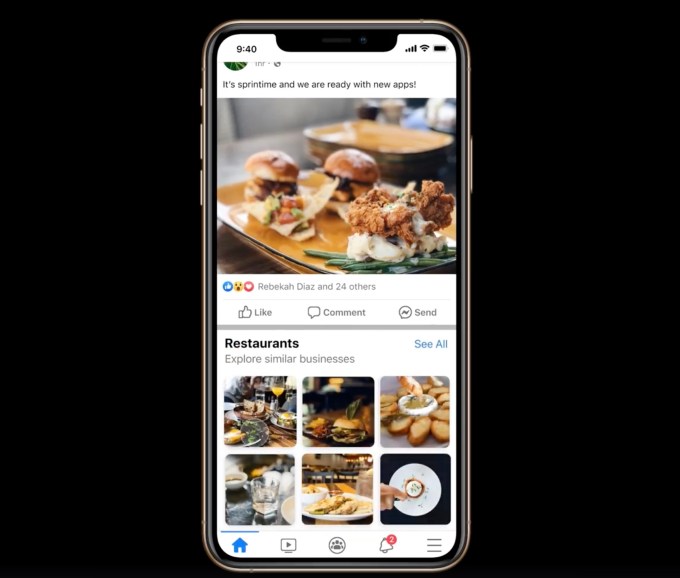
The company earlier this year began testing a way for customers to explore businesses from underneath News Feed posts by tapping on topics they were interested in — like beauty, fitness, and clothing, and explore content from other related businesses. The feature allows people to come across new businesses that may also like, and would allow Facebook to create its own data set of users who like certain types of content. Over time, it could possibly even turn the feature into an ad unit, where businesses could pay for higher placement.

But for the time being, Facebook will expand this feature to more users across the U.S., and launch it in Australia, Canada, Ireland, Malaysia, New Zealand, Philippines, Singapore, South Africa, and the U.K.

Image Credits: Facebook

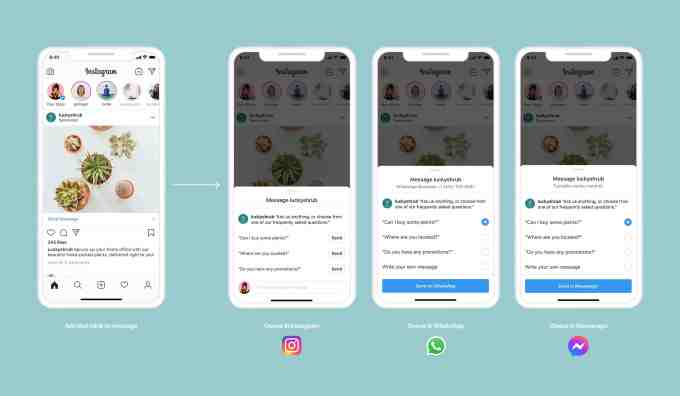
Facebook is also making it easier for businesses to chat with customers. They’re already able to buy ads that encourage people to message them on Facebook’s various chat platforms — Messenger, Instagram Direct, or WhatsApp. Now, they’ll be able to choose all the messaging platforms where they’re available, and Facebook will default the chat app showcased in the ad based on where the conversation is most likely to happen.

Image Credits: Facebook

The company will tie WhatsApp to Instagram, as well, as part of this effort. Facebook explains that many businesses market themselves or run shops across Instagram, but rely on WhatsApp to communicate with customers and answer questions. So, Facebook will now allow businesses to add a WhatsApp click-to-chat button to their Instagram profiles.

This change, in particular, represents another move that ties Facebook’s separate apps more closely together, at a time when regulators are considering breaking up Facebook over antitrust concerns. Already, Facebook interconnected Facebook’s Messenger and Instagram messaging services, which would make such a disassembly more complicated. And more recently, it’s begun integrating Messenger directly into Facebook’s platform itself.

Image Credits: Facebook

In a related change, soon businesses will be able to create ads that send users directly to WhatsApp from the Instagram app. (Facebook also already offers ads like this.)

Separately from this news, Facebook announced the launch of a new business directory on WhatsApp, allowing consumers to find shops and services on the chat platform, as well.

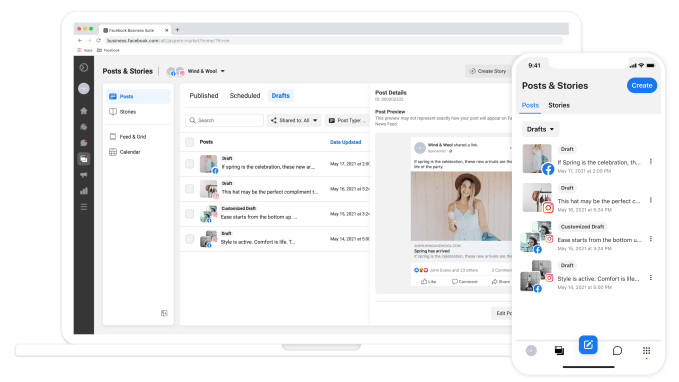
Another set of changes being introduced involve an update to Facebook Business Suite. Businesses will be able to manage emails through Inbox and sending remarketing emails; use a new File Manager for creating, managing, and posting content; and access a feature that will allow businesses to test different versions of a post to see which one is most effective.

Image Credits: Facebook

Other new products include tests of paid and organic lead generation tools on Instagram; quote requests on Messenger, where customers answer a few questions prior to their conversations; and a way for small businesses to access a bundle of tools to get started with Facebook ads, which includes a Facebook ad coupon along with free access to QuickBooks for 3 months or free access to Canva Pro for 3 months.

Image Credits: Facebook

Facebook will also begin testing something called “Work Accounts,” which will allow business owners to access their business products, like Business Manager, separately from their personal Facebook account. They’ll be able to manage these accounts on behalf of employees and use single-sign-on integrations.

Work Accounts will be tested through the remainder of the year with a small group of businesses, and Facebook says it expects to expand availability in 2022.

Other efforts it has in store include plans to incorporate more content from creators and local businesses and new features that let users control the content they see, but these changes were not detailed at this time.

Most of the products being announced are either rolling out today or will begin to show up soon.