Year: 2021

26 Feb 2021

MyHeritage now lets you animate old family photos using deepfakery

AI-enabled synthetic media is being used as a tool for manipulating real emotions and capturing user data by genealogy service, MyHeritage, which has just launched a new feature — called ‘deep nostalgia‘ — that lets users upload a photo of a person (or several people) to see individual faces animated by algorithm.

The Black Mirror-style pull of seeing long lost relatives — or famous people from another era — brought to a synthetic approximation of life, eyes swivelling, faces tilting as if they’re wondering why they’re stuck inside this useless digital photo frame, has led to an inexorable stream of social shares since it was unveiled yesterday at a family history conference… 

MyHeritage’s AI-powered viral marketing playbook with this deepfakery isn’t a complicated one: They’re going straight for tugging on your heart strings to grab data which can be used to drive sign ups for their other (paid) services. (Selling DNA tests is their main business.)

It’s free to animate a photo using the ‘deep nostalgia’ tech on MyHeritage’s site but you don’t get to see the result until you hand over at least an email (along with the photos you want animating, ofc) — and agree to its T&Cs and privacy policy. Both of which have attracted a number of concerns, over the years.

Last year, for example, the Norwegian Consumer Council reported MyHeritage to the national consumer protection and data authorities after a legal assessment of the T&Cs found the contract it asks customers to sign to be “incomprehensible”.

In 2018 MyHeritage also suffered a major data breach — and data from that breach was later found for sale on the dark web, among a wider cache of hacked account info pertaining to several other services.

The company — which, as we reported earlier this week, is being acquired by a US private equity firm for ~$600M — is doubtless relying on the deep pull of nostalgia to smooth over any individual misgivings about handing over data and agreeing to its terms.

The face animation technology itself is impressive enough — if you set aside the ethics of encouraging people to drag their long lost relatives into the uncanny valley to help MyHeritage cross-sell DNA testing (with all the massive privacy considerations around putting that kind of data in the hands of a commercial entity).

Looking at the inquisitive face of my great grandmother I do have to wonder what she would have made of all this?

The facial animation feature is powered by Israeli company D-ID, a TechCrunch Disrupt battlefield alum — which started out building tech to digital de-identify faces with an eye on protecting image and video from being identifiable by facial recognition algorithms.

It released a demo video of the photo-animating technology last year. The tech uses a driver video to animate the photo — mapping the facial features of the photo onto that base driver to create a ‘live portrait’, as D-ID calls it.

“The Live Portrait solution brings still photos to life. The photo is mapped and then animated by a driver video, causing the subject to move its head and facial features, mimicking the motions of the driver video,” D-ID said in a press release. “This technology can be implemented by historical organizations, museums, and educational programs to animate well-known figures.”

It’s offering live portraits as part of a wider ‘AI Face’ platform which will offer third parties access to other deep learning, computer vision and image processing technologies. D-ID bills the platform as a ‘one-stop shop’ for syntheized video creation.

Other tools include a ‘face anonymization’ feature which replaces one person’s face on video with another’s (such as for documentary film makers to protect a whistleblower’s identity); and a ‘talking heads’ feature that can be used for lip syncing or to replace the need to pay actors to appear in content such as marketing videos as it can turn an audio track into a video of a person appearing to speak those words.

The age of synthesized media is going to be a weird one, that’s for sure.

 

26 Feb 2021

How to land startup funding from Brookfield Asset Management, which manages $600 billion in assets

There are big investment firms, and then there are big investment firms. Brookfield Asset Management, the Toronto-based 122-year-old outfit whose current market cap is $63 billion and that oversees $600 billion in assets, clearly falls into the latter camp. Think real estate, infrastructure, renewable power, private equity, and credit. If it falls into a defined asset class, Brookfield probably has it in its portfolio.

That’s also true of venture capital, though venture is new enough to Brookfield that founders who might like its capital are still getting the memo. Indeed, it was a little less than four years ago that Brookfield Technology Partners began investing off the company’s balance sheet and soon after recruited Josh Raffaelli — a Stanford MBA who cut his teeth as a principal with Draper Fisher Jurvetson, then spent another five years with Silver Lake — to lead the practice.

Its existence came as a surprise to him, actually. “I’ve been a tech investor in Silicon Valley,” says Raffaelli. “My entire professional career has been in a 15-minute drive from the house I grew up in. And I had never heard about Brookfield before they started this practice because it’s in businesses. It’s in real estate. It has done things that are not generally tech-enabled.”

Not until fairly recently, that is. Raffaelli and his team of now 11 have not only made dozens of bets to date but they’re currently investing out of a pool of capital that features third party capital in addition to that of Brookfield — which is a first. As for what they are looking for, the idea is help Brookfield reimagine how its many office towers, malls and other real estate might be used or developed or leased or insured. It’s to make Brookfield smarter, better prepared, and more profitable. In return, the startups get industry expertise and a major customer in Brookfield.


To date, its bets have varied widely, as with Armis, an IoT startup focused on unmanaged device security; Loanpal, a point-of-sale payment platform for solar and other home efficiency products; and Carbon Health, a primary care company that blends real-world and virtual visits. “”We’re getting our themes effectively from the Brookfield ecosystem,” Raffaelli says.

Pulling back the curtain a bit more, Raffaelli says his team writes checks from $25 million to $50 million dollars and that they look for companies with $10 million in revenue that are seeing top-line year-over-year growth of more than 100%. In terms of pacing, they jump into roughly one new deal per quarter.

The fund is also independent and has its own custom committee, but that the committee is made up of the senior managing partners from each line of Brookfield’s businesses. (“These are the people that actually help us translate our investment themes that we’re generating here,” Raffaelli notes.)

To highlight how the operation works, Raffaelli points to Latch, a smart access software business that announced last month that it’s using a blank-check company backed by the real estate giant Tishman Speyer to become publicly traded. Brookfield owns roughly 70,000 multifamily units in North America, “so we have a lot of doors that need a lot of locks,” Raffaelli says. Latch, of course, is not the only smart access lock out there, so Brookfield ran “what was almost like a mini [proposal process], reaching out to all different companies in the market to understand how they compete,” he says.

It was a “six-month exercise,” but ultimately, his group led Latch’s Series B round in 2018 and since then, Brookfield was bought about 7,000 blocks from the business. It’s a meaningful difference, considering that when Brookfield first invested, the company had less than $20 million in bookings and those 7,000 locks have since brought in an additional $10 million to $15 million in revenue, Raffaelli says. “When we buy a lot of things at that stage of a company,” he adds, “we’re meaningfully enhancing their trajectory.”

It’s not a foolproof strategy, doubling down. If Latch’s locks turned out to be lemons (they haven’t), Brookfield would be out a big check along with that capital expenditure. It’s why Brookfield takes its time, says Raffaelli, adding that if he has done his job right, his team is involved with a company well before it is raising a round and shown already that it is a “strategic partner that has another lever.”

Either way, Raffaelli says that while the commercial real estate market has been hard hit by the pandemic, it has, counterintuitively, been a productive time for his group given the stronger incentive it has given the real estate world to adopt tech tools faster. Among the bets about which Raffaelli sounds most excited right now is VTS, for example, a leasing and asset management platform that can show properties remotely, and Deliverr, an e-commerce fulfillment startup that Raffaelli describes as “Amazon Prime for everybody else.”

In fact, Raffaelli convincingly argues that while the use case for a lot of real estate is changing,  the so-called built world remains Brookfield’s strongest competitive advantage given the size of its footprint.  The way he sees it, its options going forward are plentiful. “You’re looking at retail locations becoming ghost kitchens; you’re looking at retail locations turning into distribution and logistics facilities. We can turn physical locations into healthcare sites for [our portfolio company] Carbon Health, and our mall locations into locations for urgent care and primary care clinics for testing and vaccinations.”

It will never be a completely seamless transition. Brookfield has to be “thoughtful” given the pandemic and its devastating impacts, too. But Raffaelli comes across as excited in conversation nonetheless. The idea of turning physical real estate into a “mechanism for change within technology businesses,” adds Raffaelli, is a “very powerful place to be.”

26 Feb 2021

How to land startup funding from Brookfield Asset Management, which manages $600 billion in assets

There are big investment firms, and then there are big investment firms. Brookfield Asset Management, the Toronto-based 122-year-old outfit whose current market cap is $63 billion and that oversees $600 billion in assets, clearly falls into the latter camp. Think real estate, infrastructure, renewable power, private equity, and credit. If it falls into a defined asset class, Brookfield probably has it in its portfolio.

That’s also true of venture capital, though venture is new enough to Brookfield that founders who might like its capital are still getting the memo. Indeed, it was a little less than four years ago that Brookfield Technology Partners began investing off the company’s balance sheet and soon after recruited Josh Raffaelli — a Stanford MBA who cut his teeth as a principal with Draper Fisher Jurvetson, then spent another five years with Silver Lake — to lead the practice.

Its existence came as a surprise to him, actually. “I’ve been a tech investor in Silicon Valley,” says Raffaelli. “My entire professional career has been in a 15-minute drive from the house I grew up in. And I had never heard about Brookfield before they started this practice because it’s in businesses. It’s in real estate. It has done things that are not generally tech-enabled.”

Not until fairly recently, that is. Raffaelli and his team of now 11 have not only made dozens of bets to date but they’re currently investing out of a pool of capital that features third party capital in addition to that of Brookfield — which is a first. As for what they are looking for, the idea is help Brookfield reimagine how its many office towers, malls and other real estate might be used or developed or leased or insured. It’s to make Brookfield smarter, better prepared, and more profitable. In return, the startups get industry expertise and a major customer in Brookfield.


To date, its bets have varied widely, as with Armis, an IoT startup focused on unmanaged device security; Loanpal, a point-of-sale payment platform for solar and other home efficiency products; and Carbon Health, a primary care company that blends real-world and virtual visits. “”We’re getting our themes effectively from the Brookfield ecosystem,” Raffaelli says.

Pulling back the curtain a bit more, Raffaelli says his team writes checks from $25 million to $50 million dollars and that they look for companies with $10 million in revenue that are seeing top-line year-over-year growth of more than 100%. In terms of pacing, they jump into roughly one new deal per quarter.

The fund is also independent and has its own custom committee, but that the committee is made up of the senior managing partners from each line of Brookfield’s businesses. (“These are the people that actually help us translate our investment themes that we’re generating here,” Raffaelli notes.)

To highlight how the operation works, Raffaelli points to Latch, a smart access software business that announced last month that it’s using a blank-check company backed by the real estate giant Tishman Speyer to become publicly traded. Brookfield owns roughly 70,000 multifamily units in North America, “so we have a lot of doors that need a lot of locks,” Raffaelli says. Latch, of course, is not the only smart access lock out there, so Brookfield ran “what was almost like a mini [proposal process], reaching out to all different companies in the market to understand how they compete,” he says.

It was a “six-month exercise,” but ultimately, his group led Latch’s Series B round in 2018 and since then, Brookfield was bought about 7,000 blocks from the business. It’s a meaningful difference, considering that when Brookfield first invested, the company had less than $20 million in bookings and those 7,000 locks have since brought in an additional $10 million to $15 million in revenue, Raffaelli says. “When we buy a lot of things at that stage of a company,” he adds, “we’re meaningfully enhancing their trajectory.”

It’s not a foolproof strategy, doubling down. If Latch’s locks turned out to be lemons (they haven’t), Brookfield would be out a big check along with that capital expenditure. It’s why Brookfield takes its time, says Raffaelli, adding that if he has done his job right, his team is involved with a company well before it is raising a round and shown already that it is a “strategic partner that has another lever.”

Either way, Raffaelli says that while the commercial real estate market has been hard hit by the pandemic, it has, counterintuitively, been a productive time for his group given the stronger incentive it has given the real estate world to adopt tech tools faster. Among the bets about which Raffaelli sounds most excited right now is VTS, for example, a leasing and asset management platform that can show properties remotely, and Deliverr, an e-commerce fulfillment startup that Raffaelli describes as “Amazon Prime for everybody else.”

In fact, Raffaelli convincingly argues that while the use case for a lot of real estate is changing,  the so-called built world remains Brookfield’s strongest competitive advantage given the size of its footprint.  The way he sees it, its options going forward are plentiful. “You’re looking at retail locations becoming ghost kitchens; you’re looking at retail locations turning into distribution and logistics facilities. We can turn physical locations into healthcare sites for [our portfolio company] Carbon Health, and our mall locations into locations for urgent care and primary care clinics for testing and vaccinations.”

It will never be a completely seamless transition. Brookfield has to be “thoughtful” given the pandemic and its devastating impacts, too. But Raffaelli comes across as excited in conversation nonetheless. The idea of turning physical real estate into a “mechanism for change within technology businesses,” adds Raffaelli, is a “very powerful place to be.”

26 Feb 2021

Singapore-based Raena gets $9M Series A for its pivot to skincare and beauty-focused social commerce

A photo of social commerce startup Raena’s team. From left to right: chief operating officer Guo Xing Lim, chief executive officer Sreejita Deb and chief commercial officer Widelia Liu

Raena’s team, from left to right: chief operating officer Guo Xing Lim, chief executive officer Sreejita Deb and chief commercial officer Widelia Liu

Raena was founded in 2019 to create personal care brands with top social media influencers. After several launches, however, the Singapore-based startup quickly noticed an interesting trend: customers were ordering batches of products from Raena every week and reselling them on social media and e-commerce platforms like Shopee and Tokopedia. Last year, the company decided to focus on those sellers, and pivoted to social commerce.

Today Raena announced it has raised a Series A of $9 million, co-led by Alpha Wave Incubation and Alpha JWC Ventures, with participation from AC Ventures and returning investors Beenext, Beenos and Strive. Its last funding announcement was a $1.82 million seed round announced in July 2019.

After interviewing people who were setting up online stores with products from Raena, the company’s team realized that sellers’ earnings potential was capped because they were paying retail prices for their inventory.

They also saw that the even though new C2C retail models, like social commerce, are gaining popularity, the beauty industry’s supply chain hasn’t kept up. Sellers usually need to order minimum quantities, which makes it harder for people to start their own businesses, Raena co-founder Sreejita Deb told TechCrunch,

“Basically, you have to block your capital upfront. It’s difficult for individual sellers or micro-enterpreneurs to work with the old supply chain and categories like beauty,” she said.

Raena decided to pivot to serve those entrepreneurs. The company provides a catalog that includes mostly Japanese and Korean skincare and beauty brands. For those brands, Raena represents a way to enter new markets like Indonesia, which the startup estimates has $20 billion market opportunity.

Raena resellers, who are mostly women between 18 to 34-years-old in Indonesia and Malaysia, pick what items they want to feature on their social media accounts. Most use TikTok or Instagram for promotion, and set up online stores on Shopee or Tokopedia. But they don’t have to carry inventory. When somebody buys a product from a Raena reseller, the reseller orders it from Raena, which ships it directly to the customer.

This drop-shipping model means resellers make higher margins. Since they don’t have to carry inventory, it also dramatically lowers the barrier to launching a small business. Even though Raena’s pivot to social commerce coincided with the COVID-19 pandemic, Deb said it grew its revenue 50 times between January and December 2020. The platform now has more than 1,500 resellers, and claims a 60% seller retention rate after six months on the platform.

She attributes Raena’s growth to several factors, including the increase in online shopping during lockdowns and people looking for ways to earn additional income during the pandemic. While forced to stay at home, many people also began spending more time online, especially on the social media platforms that Raena resellers use.

Raena also benefited from its focus on skincare. Even though many retail categories, including color cosmetics, took a hit, skincare products proved resilient.

“We saw skincare had higher margins, and there are certain markets that are experts at formulating and producing skincare products, and demand for those products in other parts of the world,” she said, adding, “we’ve continued being a skincare company and because that is a category we had insight into, it was our first entry point into this social selling model as well. 90% of our sales are skincare. Our top-selling products are serums, toners, essences, which makes a lot of sense because people are in their homes and have more time to dedicate to their skincare routines.”

Social commerce, which allows people to earn a side income (or even a full-time income), by promoting products through social media, has taken off in several Asian markets. In China, for example, Pinduoduo has become a formidable rival to Alibaba through its group-selling model and focus on fresh produce. In India, Meesho resellers promote products through social media platforms like WhatsApp, Facebook and Instagram.

Social commerce is also gaining traction in Southeast Asia, with gross merchandise value growing threefold during the first half of 2020, according to iKala.

Deb said one of the ways Raena is different from other social commerce companies is that most of its resellers are selling to customers they don’t know, instead of focusing on family and friends. Many already had TikTok or Instagram profiles focused on beauty and skincare, and had developed reputations for being knowledgeable about products.

As Raena develops, it plans to hire a tech team to build tools that will simplify the process of managing orders and also strike deals directly with manufacturers to increase profit margins for resellers. The funding will be used to increase its team from 15 to over 100 over the next three months, and it plans to enter more Southeast Asian markets.

26 Feb 2021

Bessemer Venture Partners closes on $3.3 billion across two funds

Another major VC firm has closed two major rounds, underscoring the long-term confidence investors continue to have for backing privately-held companies in the tech sector.

Early-stage VC firm Bessemer Venture Partners announced Thursday the close of two new funds totaling $3.3 billion that it will be using both to back early-stage startups as well as growth rounds for more mature companies.

The Redwood City-based firm closed BVP XI with $2.475 billion and BVP Century II with $825 million in total commitments.

With BVP XI, it plans to focus on early-stage companies spanning across enterprise, consumer, healthcare, and frontier technologies. 

Its Century II fund is aimed at backing growth-stage companies that Bessemer believes “will define the next century,” and will include both follow-on rounds for existing portfolio companies or investments in new ones.

BVP XI marks Bessemer’s largest fund in its 110-year history. In October 2018, the firm brought in $1.85 billion for its tenth flagship VC fund. This latest fund is its fifth consecutive billion-dollar fund, based on PitchBook data. 

Despite being founded more than 100 years ago, Bessemer didn’t actually enter the venture business until 1965. It’s known for its investments in LinkedIn, Blue Apron and many others, with a current portfolio that includes PagerDuty, Shippo, Electric and DocuSign. Exits include Twitch and Shopify, among many others.

With more money than ever before available for backing startups, the challenge now for VCs is to see how and if they can find (and invest in) whatever will define the next generation of tech. 

“As venture capitalists, we pay too much attention to pattern recognition and matching when in reality, the biggest opportunities exist where those patterns break,” the firm wrote in a blog post today. “Our job is to make perceptive bets on the future, especially those that others will dismiss and ridicule. We are fundamental optimists and strong believers in the power of innovation; our life’s work is putting our reputation, time, and money to help entrepreneurs realize a different future. They’re the ones pioneering something entirely new and obscure – a technology, a business model, a category.

In addition to announcing the new funds, Bessemer also revealed today that it’s brought on five new partners including Jeff Blackburn, who joins after a 22-year career at Amazon, alongside the promotion of existing investors Mary D’Onofrio, Mike Droesch, Tess Hatch, and Andrew Hedin.

Most recently at Amazon, Blackburn served as senior vice president of worldwide business development where he oversaw dozens of Amazon’s minority investments and more than 100 acquisitions across all business lines – including retail, Kindle, Echo, Alexa, FireTV, advertising, music, streaming audio & video, and Amazon Web Services.  

“Having been part of Amazon for more than two decades, I’m excited to begin a new chapter helping customer-focused founders build breakthrough companies,” said Blackburn in a written statement.  “I’ve known the Bessemer team for many years and have long admired their strategic vision and success backing early-stage ventures.” 

With the latest changes, Bessemer now has 21 partners and over 45 investors, advisors, and platform “team members” located in Silicon Valley, San Francisco, Seattle, New York, Boston, London, Tel Aviv, Bangalore, and Beijing. 

“At Bessemer, there’s no corner office or consensus; every partner has the choice, independently, to pen a check. This kind of accountability and autonomy means a founder is teaming up with a partner and board director who thoroughly understands your business and can respond quickly and decisively,” the firm’s blog post read.

25 Feb 2021

Newsela, the replacement for textbooks, raises $100M and becomes a unicorn

Newsela, a SaaS platform for K-12 instructional material backed by the likes of TCV, Kleiner Perkins, Reach Capital, and Owl Ventures, announced today that it has raised $100 million in a Series D round. The financing was led by new investor Franklin Templeton, and brings Newsela’s valuation to $1 billion. The new round is larger than the aggregate of Newsela’s prior capital raised to-date.

“Hitting $1 billion [in valuation] doesn’t change a thing,” Newsela CEO Matthew Gross told TechCrunch. But the startup is joining Quizlet, Applyboard, and CourseHero as companies within the sector that have hit the unicorn mark as remote education continues to gain traction.

Newsela has created a platform that strings together a number of different third-party content, such as primary source documents or the latest National Geographic articles. Gross defines it as “material that isn’t purpose-built for education, [but] purpose-built for being interesting and informative.” If Newsela is doing its job right, the content can replace textbooks within a classroom altogether, while helping teachers give fresh, personalized material.

“Textbooks are dead in classrooms, but are well-and-live in district purchasing,” Gross said. The startup is on a mission to distribute its product better, and the money will be used to get it into more classrooms. Part of this, Gross explains, is telling teachers what else it can provide along with textbooks. Analytics has become a big part of Newsela’s business, as remote learning hurts student engagement.

The startup’s paid product is between $6 to $14 per student, which contrasts with textbooks that can cost a school $20 to $40 per student “even on an annualized basis.”

Like other edtech companies, Newsela offered its product for free in the beginning of the pandemic, which gave it a healthy bump of new users.

Newsela estimates that gross bookings have grown 115% over the pandemic, and that revenue grew 81%. It declined to share revenue numbers or if it has hit profitability. There will be over 11 million students using Newsela licensing by the end of 2021, Gross said.

Newsela estimates that two-thirds of public schools in the United States are using their platform, likely aided by school district flexibility that has grown amid the pandemic.

25 Feb 2021

Daily Crunch: Twitter announces ‘Super Follow’ subscriptions

Twitter reveals its move into paid subscriptions, Australia passes its media bargaining law and Coinbase files its S-1. This is your Daily Crunch for February 25, 2021.

The big story: Twitter announces ‘Super Follow’ subscriptions

Twitter announced its first paid product at an investor event today, showing off screenshots of a feature that will allow users to subscribe to their favorite creators in exchange for things like exclusive content, subscriber-only newsletters and a supporter badge.

The company also announced a feature called Communities, which could compete with Facebook Groups and enable Super Follow networks to interact, plus a Safety Mode for auto-blocking and muting abusive accounts. On top of all that, Twitter said it plans to double revenue by 2023.

Not announced: launch dates for any of these features.

The tech giants

After Facebook’s news flex, Australia passes bargaining code for platforms and publishers — This requires platform giants like Facebook and Google to negotiate to remunerate local news publishers for their content.

New Facebook ad campaign extols the benefits of personalized ads — The sentiments are similar to a campaign that Facebook launched last year in opposition to Apple’s upcoming App Tracking Transparency feature.

Startups, funding and venture capital

Sergey Brin’s airship aims to use world’s biggest mobile hydrogen fuel cell — The Google co-founder’s secretive airship company LTA Research and Exploration is planning to power a huge disaster relief airship with an equally record-breaking hydrogen fuel cell.

Coinbase files to go public in a key listing for the cryptocurrency category — Coinbase’s financials show a company that grew rapidly from 2019 to 2020 while also crossing the threshold into unadjusted profitability.

Boosted by the pandemic, meeting transcription service Otter.ai raises $50M — With convenient timing, Otter.ai added Zoom integration back in April 2020.

Advice and analysis from Extra Crunch

DigitalOcean’s IPO filing shows a two-class cloud market — The company intends to list on the New York Stock Exchange under the ticker symbol “DOCN.”

Pilot CEO Waseem Daher tears down his company’s $60M Series C pitch deck — For founders aiming to entice investors, the pitch deck remains the best way to communicate their startup’s progress and potential.

Five takeaways from Coinbase’s S-1 — We dig into Coinbase’s user numbers, its asset mix, its growing subscription incomes, its competitive landscape and who owns what in the company.

(Extra Crunch is our membership program, which helps founders and startup teams get ahead. You can sign up here.)

Everything else

Paramount+ will cost $4.99 per month with ads — The new streaming service launches on March 4.

Register for TC Sessions: Justice for a conversation on diversity, equity and inclusion in the startup world — This is just one week away!

The Daily Crunch is TechCrunch’s roundup of our biggest and most important stories. If you’d like to get this delivered to your inbox every day at around 3pm Pacific, you can subscribe here.

25 Feb 2021

AT&T is turning DirecTV into a standalone company

AT&T just announced an agreement with private equity firm TPG that will turn DirecTV into a standalone company, albeit one that’s still majority owned by the telecom giant.

Specifically, AT&T says it will own 70% of the new company, while TPG owns 30%. This transaction values DirecTV at $16.25 billion — a dramatic decline from the $48.5 billion that AT&T paid to acquire the pay TV provider in 2015, part of a wave of telecom-media acquisitions. (Verizon owns TechCrunch thanks to its acquisition of AOL.)

Even with new offerings like AT&T TV (which will be part of the standalone company, along with the DirecTV and U-Verse services) pay TV subscriptions have been declining, with AT&T reporting a net loss of 617,000 premium video subscribers in its most recent quarter. AT&T is trying to point out the positive trends in the numbers by noting that “it hit its peak level of subscriber losses in 2019” and that “premium video net losses had improved sequentially for five straight quarters.”

Meanwhile, AT&T made an even bigger acquisition with Time Warner (now known as WarnerMedia), and its TV ambitions seem to be focused on the streaming service HBO Max.

“As the pay-TV industry continues to evolve, forming a new entity with TPG to operate the U.S. video business separately provides the flexibility and dedicated management focus needed to continue meeting the needs of a high-quality customer base and managing the business for profitability,” said AT&T CEO John Stankey in a statement. “TPG is the right partner for this transaction and creating a new entity is the right way to structure and manage the video business for optimum value creation.”

The company said the transaction should close in the second half of 2021. The combined entity is expected to pay AT&T $7.8 billion, which the telecom company will use to reduce debt. AT&T also said that when the transaction closes, DirecTV’s CEO will be Bill Morrow, currently CEO of AT&T’s U.S. video unit.

The Wall Street Journal reported last year that AT&T was exploring a deal for DirecTV.

25 Feb 2021

Orca wants to give boating navigation its ‘iPhone moment’

Boating is a hobby steeped in history and tradition — and so is the industry and those that support it. With worldwide connectivity, electric boats, and other technological changes dragging the sector out of old habits, Orca aims to replace the outdated interfaces by which people navigate with a hardware-software combo as slick as any other modern consumer tech.

If you’re a boater, and I know at least some of you are, you’re probably familiar with two different ways of chart-plotting, or tracking your location and route: the one attached to your boat and the one in your pocket.

The one on your boat is clunky and old-fashioned, like the GPS interface on a years-old budget sedan. The one in your pocket is better and faster — but the phone isn’t exactly seaworthy and the app drains your battery with a quickness.

Orca is a Norwegian startup from veterans of the boating and chart-plotters that leapfrogs existing products with a built-from-scratch modern interface.

“The industry hasn’t changed in the last 20 years — you have three players who own 80 percent of the business,” said co-founder and CEO Jorge Sevillano. “For them, it’s very hard to think of how software creates value. All these devices are built on a user interface that’s 10-15 years old; think about a Tomtom, lots of menus, lots of clicks. This business hasn’t had its iPhone moment, where it had to rethink its entire design. So we thought: let’s start with a blank slate and build a new experience.”

CTO and co-founder Kristian Fallro started working on something like this years ago, and his company was acquired by Navico, one of the big players Sevillano refers to. But they didn’t seem to want to move forward with the ideas, and so he and the others formed Orca to pursue them. Their first complete product opened up for pre-orders this week.

“The challenge up until now has been that you need a combination of hardware and software, so the barrier to entry was very, very high,” Fallro explained. “It’s a very protected industry — and it’s too small for Apple and Google and the big boys.”

But now with a combination of the right hardware and a totally rebuilt software stack, they think they can steal a march on the dominant companies and be ready for the inevitable new generation of boaters who can’t stand to use the old tech any more. Shuttling an SD card to and from the in-boat system and your computer to update charts? Inputting destinations via directional pad? Using a separate mobile app to check weather and tides that might bear on your route? Not exactly cutting edge.

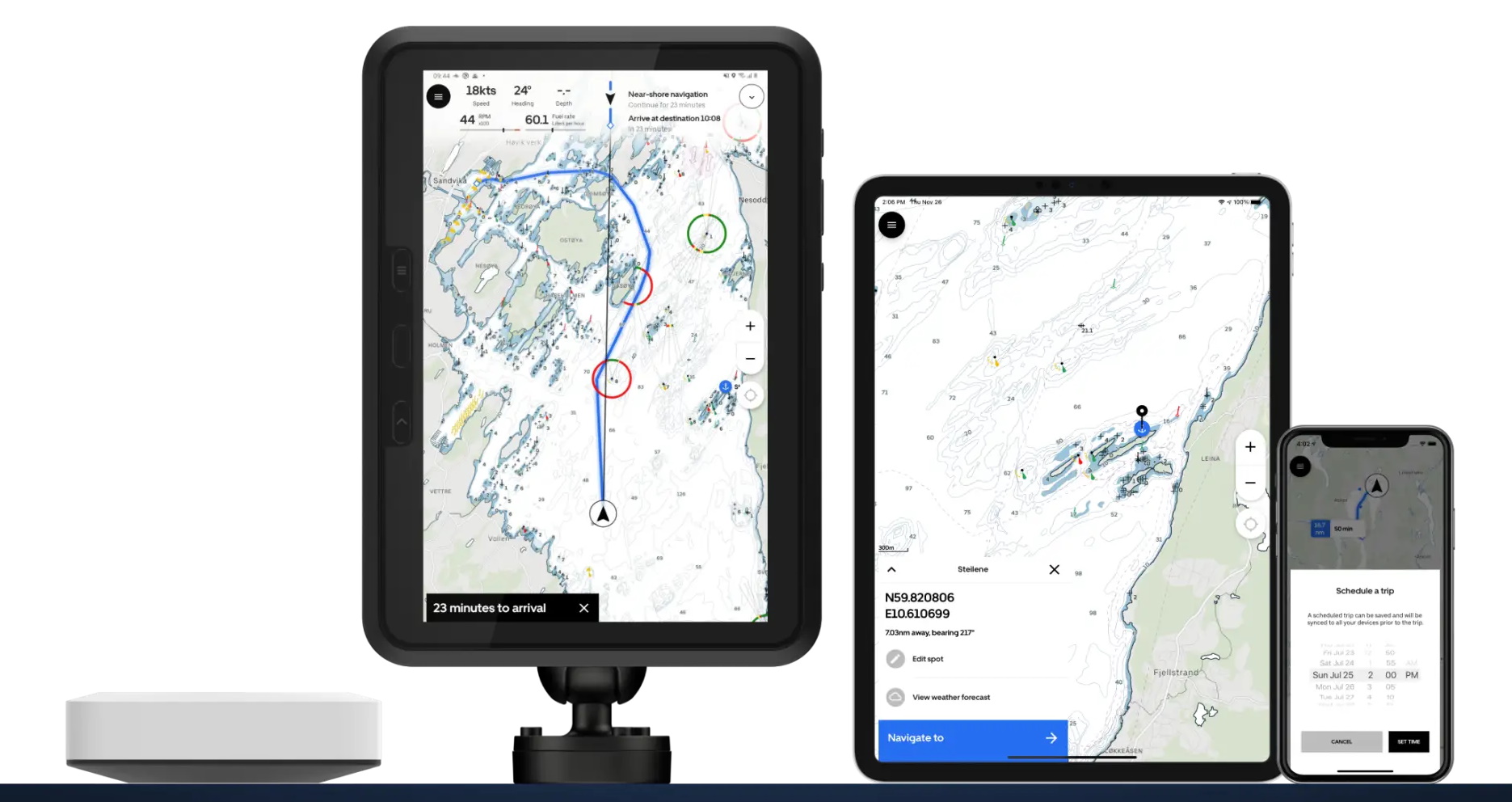
The Orca system comprises a ruggedized industrial tablet sourced from Samsung, an off the shelf marine quality mounting arm, a custom-designed interface for quick attachment and charging, and a computing base unit that connects to the boat’s own sensors like sonar and GPS over the NMEA 2000 protocol. It’s all made to be as good or better than anything you’d find on a boat today.

So far, so similar to many solutions out there. But Orca has rebuilt everything from the ground up as a modern mobile app with all the conveniences and connections you’d expect. Routing is instantaneous and accurate, on maps that are clear and readable as those on Google and Apple Maps but clearly still of the nautical variety. Weather and tide reports are integrated, as is marine traffic. It all runs on Android or iOS, so you can also use your phone, send routes or places of interest to the main unit, and vice versa.

Several devices showing the Orca chart-plotting interface.

Image Credits: Orca

“We can build new services that chart plotters can’t even dream of including,” said Sevillano. “With the latest tide report and wind, or if there’s a commercial ship going in your way, we can update your range and route. We do updates every week with new features and bug fixes. We can iterate and adapt to user feedback faster than anyone else.”

These improvements to the most central system of the boat mean the company has ambitions for coming years beyond simply replacing the ageing gadgets at the helm.

Information collected from the boat itself is also used to update the maps in near real time — depending on what your craft is monitoring, it could be used for alerting others or authorities, for example if you encounter major waves or dangerous levels of chemicals, or detect an obstacle where none is recorded. “The Waze of the seas,” they suggested. “Our goal is to become the marine data company. The opportunities for boaters, industries related to the sea, and society are immense.”

Being flexible about the placement and features means they hope to integrate directly with boats, becoming the built-in OS for new models. That’s especially important for the up-and-coming category of electric boats, which sort of by definition buck the old traditions and tend to attract tech-savvy early adopters.

“We’re seeing people take what works on land taking it to sea. They all have the same challenge though, the biggest problem is range anxiety — and it’s even worse on the water,” said Fallro. “We’ve been talking to a lot of these manufacturers and we’re finding that building a boat is hard but building that navigation experience is even harder.”

Whether that’s entirely true probably depends on your boat-building expertise, but it’s certainly the case that figuring out an electric boat’s effective range is a devilishly difficult problem. Even after building a new boat from starting principles and advanced physical simulations to be efficient and predictable, such as Zin Boats did, the laws of physics and how watercraft work mean even the best estimate has to be completely revised every few seconds.

“Figuring out range at sea is very hard, and we think we’re one of the best out there. So we want to provide boat manufacturers a software stack with integrated navigation that helps them solve the range anxiety problem their users have,” said Fallro.

Indeed, it seems likely that prospective purchasers of such a craft would be more tempted to close the deal if they knew there was a modern and responsive OS that not only accurately tracked range but provided easy, real-time access to potential charge points and other resources. Sure, you could use your phone — and many do these days because the old chart plotters attached to their boats are so limited. But the point is that with Orca you won’t be tempted to.

The full device combo of computing core, mount, and tablet costs €1,449, with the core alone selling for €449, with a considerable discount for early bird pre-orders. (For people buying new boats, these numbers may as well be rounding errors.)

Fallro said Orca is operating with funding (of an unspecified amount) from Atomico and Nordic VC firm Skyfall Ventures, as well as angel investors including Kahoot co-founder Johan Brand. The company has its work cut out for it simply in fulfilling the orders it has collected (they are doing a brisk trade, Fallro intimated) before moving on to adding features and updating regularly as promised.