Year: 2021

25 Feb 2021

DigitalOcean’s IPO filing shows a two-class cloud market

This morning DigitalOcean, a provider of cloud computing services to SMBs, filed to go public. The company intends to list on the New York Stock Exchange (NYSE) under the ticker symbol “DOCN.”

DigitalOcean’s offering comes amidst a hot-streak for tech IPOs, and valuations that are stretched by historical norms. The cloud hosting company was joined by Coinbase in filing its numbers publicly today.

DigitalOcean’s offering comes amidst a hot-streak for tech IPOs.

However, unlike the cryptocurrency exchange, DigitalOcean intends to raise capital through its offering. Its S-1 filing lists a $100 million placeholder number, a figure that will update when the company announces an IPO price range target.

This morning let’s explore the company’s financials briefly, and then ask ourselves what its results can tell us about the cloud market as a whole.

DigitalOcean’s financial results

TechCrunch has covered DigitalOcean with some frequency in recent years, including its early-2020 layoffs, its early-2020 $100 million debt raise and its $50 million investment from May of the same year that prior investors Access Industries and Andreessen Horowitz participated in.

From those pieces we knew that the company had reportedly reached $200 million in revenue during 2018, $250 million in 2019 and that DigitalOcean had expected to reach an annualized run rate of $300 million in 2020.

Those numbers held up well. Per its S-1 filing, DigitalOcean generated $203.1 million in 2018 revenue, $254.8 million in 2019 and $318.4 million in 2020. The company closed 2020 out with a self-calculated $357 million in annual run rate.

During its recent years of growth, DigitalOcean has managed to lose modestly increasing amounts of money, calculated using generally accepted accounting principles (GAAP), and non-GAAP profit (adjusted EBITDA) in rising quantities. Observe the rising disconnect:

25 Feb 2021

Crypto company Anchorage raises $80 million after getting federal banking charter

Anchorage has raised an $80 million Series C funding round led by GIC, also known as Singapore’s sovereign wealth fund. Andreessen Horowitz, Blockchain Capital, Lux and Indico are also participating in today’s funding round.

The thinking behind this funding round is quite simple. Some companies, such as Tesla or Square, have recently chosen to invest in cryptocurrencies. They’re converting a small portion of their cash balance into cryptocurrencies. And some investors choose to invest in companies that help you add cryptocurrencies to your cash balance — Anchorage is one of them.

The startup originally offered a custody solution. It lets you keep your cryptocurrencies safe for you so that you don’t have to take care of the wallets and their public and private keys. But more recently, Anchorage received a a federal banking charter, turning it into a digital asset bank.

Getting a thumbs-up sign from regulators should definitely help when it comes to confidence. Institutional investors are looking for trusty crypto partners to dip their toes into the crypto waters.

In addition to custody, Anchorage now offers several financial products, such as staking, crypto lending, etc. In other words, it wants to become a one-stop shop for institutional investors.

Interestingly, Anchorage also wants to become a crypto-banking-as-a-service startup. The startup thinks it could become the preferred crypto partner for both challenger banks and traditional banks.

25 Feb 2021

Twitter’s ‘Super Follow’ creator subscription takes shots at Substack and Patreon

It’s been an all-around more ambitious year for Twitter. Following activist shareholder action last year that aimed to oust CEO Jack Dorsey, the company has been making long overdue product moves, buying up companies and aiming to push the envelope on how it can tap its network and drive new revenue streams. Things seem to be paying off for the company, as their share price sits at an all-time-high double that of its 2020 high.

Today, the company shared early details on its first ever paid product, a feature called “Super Follow” which aims to combine the community trends of Discord, the newsletter insights of Substack, the audio chat rooms of Clubhouse and the creator support of Patreon into a creator subscription. The company announced the service during its Analyst Day event Thursday morning.

Plenty of details are still up in-the-air for the feature which notably does not have a launch timeline.

Screenshots shared by Twitter showcase a feature that allows Twitter users to subscribe to their favorite creators for a monthly price (one screenshot details a $4.99 per month cost) and earn certain subscriber-only perks, including things like “exclusive content,” “subscriber-only newsletters,” “community access,” “deals & discounts,” and a “supporter badge” for subscribers. Creators in the program will also be able to paywall certain media they share, including tweets, fleets and chats they organize in Twitter’s Clubhouse competitor Spaces.

The company’s other big announcement of the event was “Communities,” a product that seems designed to compete with Facebook Groups but also will likely provide “Super Follow” networks a place to interact with creators in close cahoots.

Introducing paywalls into the Twitter feed could dramatically shift the mechanics of the service. Twitter has been pretty conservative over the years in building features that are intended for singular classes of users. Creator-focused features built for a network which is already home to so many creators could be a major threat to services like Patreon which have largely popped up due to the lackluster monetization tools available from the big social platforms.

New revenue streams will undoubtedly be key to Twitter’s ambitious plan to double its revenues by 2023.


25 Feb 2021

Stoke Space wants to take reusable rockets to new heights with $9M seed

Many launch providers think reusability is the best way to lower the cost and delay involved in getting to space. SpaceX and Rocket Lab have shown reusable first stages, which take a payload to the edge of space — and now Stoke Space Technologies says it is making a reusable second stage, which will take that payload to orbit and beyond, and has raised a $9.1M seed round to realize it.

Designing a first stage that can return to Earth safely is no small task, but the fact that it only reaches a certain height and speed, and doesn’t actually climb into orbit at an even higher velocity, means that it is simpler to try. The second stage takes over when the first is spent, accelerating and guiding the payload to its destination orbit, which generally means it will have traveled a lot farther and will be going a lot faster when it tries to come back down.

Stoke thinks that it’s not just possible to create a second stage that’s reusable, but crucial to building the low-cost space economy that will enable decades of growth in the industry. The team previously worked on the New Glenn and New Shepard vehicles and engines at Blue Origin, the Merlin 1C for the Falcon 9 at SpaceX, and others.

“Our design philosophy is to design hardware that not only can be reused, but is operationally reusable. That means fast turnaround times with low refurbishment effort. Reusability of that type has to be designed in from the beginning,” said Andy Lapsa, co-founder and CEO of Stoke.


A rocket does a test fire in an industrial environment.

Image Credits: Stoke Space Technologies

Beyond the fact that the vehicle will employ a ballistic reentry and powered landing, Stoke did not comment on the engineering or method by which it would accomplish the Herculean feat of bring down a few tons of precision equipment safely from 400 kilometers up and traveling some 28,000 km/h. (Though Lapsa did mention to GeekWire that a “good, high-performing stable injector” is the core of their engine and therefore of the system around it.)

At speeds like that reentry can be deadly, so one hopes they save a little fuel not just for landing but for deceleration. That would increase the mass and complexity of the vehicle before payload, lowering its carrying capacity.

“It’s true that any reusable system will be inherently more complex than its expendable counterpart,” Lapsa said. “However, when one optimizes on mission cost and availability, that complexity is well worth it.”

As other launch companies have pointed out, you burn up a lot of money on reentry, but so far the safest move has been to keep the first stage alive. The second stage is by no means cheap, and any company would prefer to recycle it as well — and indeed it could lower the cost of launch enormously if they did so successfully.

The promise Stoke makes is not just to bring the upper stage home, but to bring it home and have it ready for reuse just a day later. “All launch hardware is reused time after time with aircraft-like regularity – zero refurbishment with 24-hour turnaround,” claims Lapsa.

Considering the amount of wear and tear a rocket goes through in ascent and landing, “zero refurbishment” may sound to many like an impossible dream. SpaceX’s reusable first stages can be turned around pretty quickly, but they can’t just fuel them up where they landed and press the button again.

Not only that, but Stoke aims to provide reusable-rocket service beyond low-Earth orbit, where the majority of small, lower-cost satellites go. Geosynchronous orbit and translunar or interplanetary trajectories are also planned.

“Missions to GTO, GEO direct, TLI, and earth escape will initially be done with partially reusable or expendable vehicles, depending on mission requirements, however those vehicles will be the same ones that may have been used on previous fully reusable missions to LEO. The design is extensible to full reuse for these missions (and/or extraplanetary landers) in future variants,” said Lapsa.

These are ambitious claims — even, given the state of rocketry right now, ones people may with good reason call unrealistic. But the industry has advanced more quickly than many would have predicted a decade ago and seemingly unrealistic ambition drove those changes as well.

The $9.1M seed round raised by Stoke will enable it to meet the next few milestones, but anyone who follows the industry will know that far more cash will be needed to cover the cost of development and testing in time.

The round was led by NFX and MaC Ventures, along with YC, Seven Seven Six (Alexis Ohanian), Liquid2 (Joe Montana), Trevor Blackwell, Kyle Vogt, and Charlie Songhurst, among others.

25 Feb 2021

Robotics roundup

Robotics took a small step into the wild world of SPACs this week, as Berkshire Grey announced its plan to go public by Q2. Setting aside some of the bigger issues with using the reverse merger route we’ve discussed plenty, BG is an ideal candidate for this next major step for a number of reasons.

First, the company’s got a track record and a ton of interest. I visited their HQ early last year, before the country shut down. Their plans were already fairly aggressive, with the wind of a recently raised $263 million Series B at their back. Retailers everywhere are already looking to automation as a way of staying competitive with the ominous monolith that is Amazon.

The mega-retailer has already acquired and deployed a ton of robots in fulfillment centers across the world. The latest number I’ve seen is 200,000. That comes from early 2020, so the number has no doubt increased since then. As Locus Robotics CEO Rick Faulk told me the other week, “There are investors that want to invest in helping everyone that’s not named ‘Amazon’ compete.” As with so many things these days, it’s Amazon versus the world.
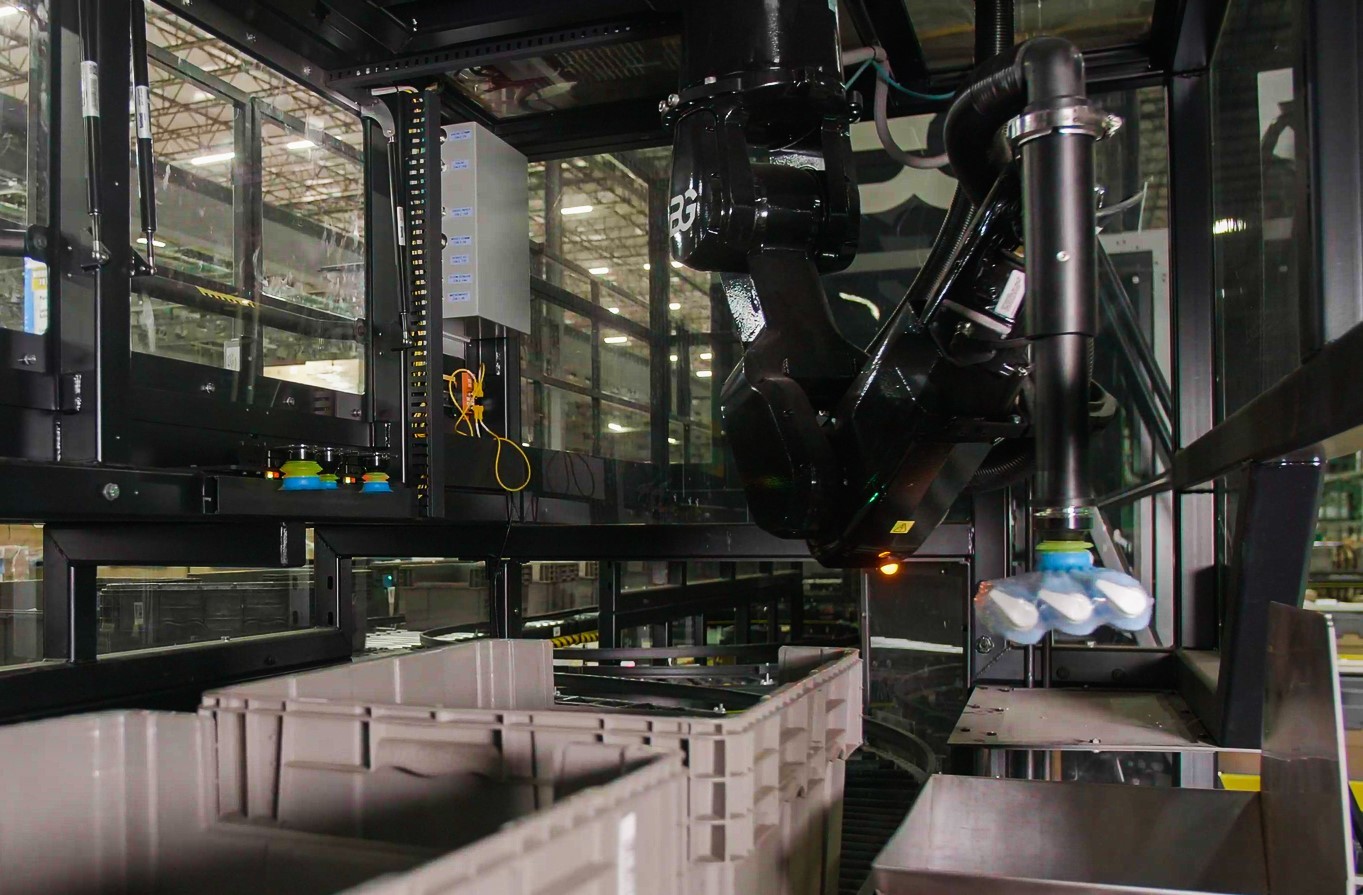
Image Credits: Berkshire Grey

Beyond its knack for raising money by the boatload, Berkshire Grey is the company you go to when you’re looking to automate a factory from the ground, up. The company says current warehouse automation is somewhere in the neighborhood of 5%. It’s a figure I’ve seen tossed around before, and certainly points to a ton of opportunity. BG’s offering isn’t lights-out automation, but it’s a pretty full-feature solution.

Locus, which just raised a healthy $150M Series E, represents a different end of the spectrum. Similar to offerings from companies like Fetch, it offers a more plug-and-play approach to automation. The lowered barrier of entry means a far less costly on-ramp. It also means you don’t have to shut down your warehouses for an extended period to implement the tech. It’s a more workable solution for situations with contract-based clients or temporary seasonal needs.

The company uses a RaaS (robot-as-a-service) model to deploy its technology. That’s something you’re going to be hearing more and more of around the industry. Like the HaaS (the “h” being hardware) model, the company essentially rents out these super-pricey machines, rather than selling them outright. It’s another way to lower the barrier of entry, and it gives the robotics companies the opportunity to offer continuous service upgrades.

Image Credits: Future Acres

It’s a model Future Acres, a Southern Californian agtech startup, is exploring as it comes out of stealth. Things are still early days for the company, which spun out of Wavemaker Partners (which also developed food service robotics company Miso). Among other things, the company is looking toward a crowdfunded raise by way of SeedInvest. I’ve not seen a lot of robotics companies take that route, so it will be interesting to see how that plays out.

Like logistics, agtech is shaping up to be a pretty massive category for robotics investments. FarmWise was ahead of that curve, announcing a $14.5 million round back in 2019 (bringing its total to north of $20 million). This week the Bay Area startup added crop dusting functionality to its weed-pulling robot.
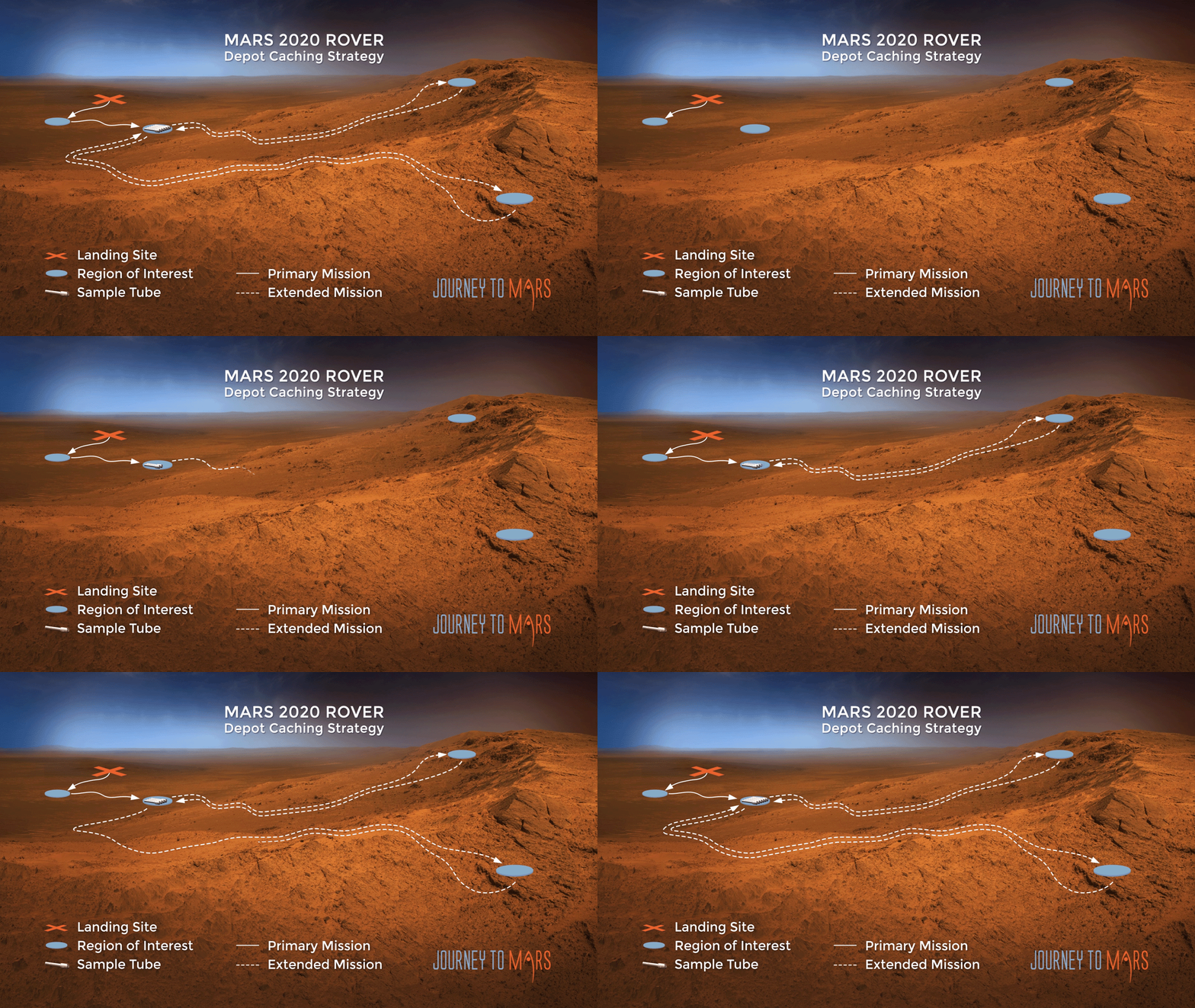
Animated image showing how Perseverance could travel and retravel certain routes to bring items to a central location.

Image Credits: NASA/JPL-Caltech

NASA’s Perseverance understandably grabbed the biggest robotics headlines of the week. Landing with a parachute sporting the JPL motto, “Dare mighty things,” the rover sent back some of the best and most stunning images of Mars to date.

MSCHF’s livestream, on the other hand, was a bit more spotty. But aside from a fair number of interruptions with the feed, I suspect the company’s 40th drop went about as well as it could have hoped. Prior to announcing that it would mount a remote-control paintball gun to the back of Spot, Boston Dynamics issued a statement condemning the move:

Our mission is to create and deliver surprisingly capable robots that inspire, delight & positively impact society. We take great care to make sure our customers intend to use our robots for legal uses. We cross-check every purchase request against the U.S. Government’s denied persons and entities lists, prior to authorizing a sale.

Image Credits: MSCHF

MSCHF seemed to bask in the attention, even before its name was revealed to the public. At the very least, the stunt was a success from the standpoint of having ignited a conversation about the future of robotics. Boston Dynamics intrinsically understands that its robots sometimes freak people out — it’s a big part of the reason we get viral videos from the company, like the recent one featuring various robots dancing to The Contours.

Among other things, the company is pushing back against the dystopian optics of shows like Black Mirror. Of course, a paintball gun isn’t a weapon, per say. But for the moment, optics are also important. A rep from the company told me, “I turned down a customer that wanted to use Spot for a haunted house. Even putting it in that context of using our technology to scare people was not within our terms of use and not how we imagined the product being beneficial for people, and so we declined that initial sale.”

The ACLU notably raised concern last year after footage from one of our events featuring Spot being used in the field by the Massachusetts police made the rounds. This week, the NYPD deployed a Spot robot yet again — this time at the scene of a home invasion in the Bronx (not to mention a new paint job and the name “Digidog” for some reason). Your own interpretation of those particular optics will likely depend on, among other things, your feelings about cops.

Certainly police departments have utilized robotics for decades for bomb disposal. It’s true that Boston Dynamics (along with much of the robotics industry) got early funding from DARPA. Spot in its current form isn’t much as far as war machines go, but I think these are important conversations to have at this stage in robotic evolution. Certainly there are military drones in the world, and have been for more than a decade.

That’s an important ethical conversation. As is the responsibility of robotics manufacturers once their machines are out in the world. Boston Dynamics does due diligence when selling its robots, but does it continue to be responsible for them once it no longer owns them? That’s certainly not a question we’re going to answer this week.


25 Feb 2021

Sergey Brin’s airship will use world’s biggest mobile hydrogen fuel cell

Sergey Brin’s secretive airship company LTA Research and Exploration is planning to power a huge disaster relief airship with an equally record-breaking hydrogen fuel cell.

A job listing from the company, which is based in Mountain View, California and Akron, Ohio, reveals that LTA wants to configure a 1.5-megawatt hydrogen propulsion system for an airship to deliver humanitarian aid and revolutionize transportation. While there are no specs tied to the job listing, such a system would likely be powerful enough to cross oceans. Although airships travel much slower than jet planes, they can potentially land or deliver goods almost anywhere.

Hydrogen fuel cells are an attractive solution for electric aviation because they are lighter and potentially cheaper than lithium-ion batteries. However, the largest hydrogen fuel cell to fly to date is a 0.25-megawatt system (250 kilowatts) in ZeroAvia’s small passenger plane last September. LTA’s first crewed prototype airship, called Pathfinder 1, will be powered by batteries when it takes to the air, possibly this year. FAA records show that the Pathfinder 1 has 12 electric motors and would be able to carry 14 people. 

That makes it about the same size as the only passenger airship operating today, the Zeppelin NT, which conducts sightseeing tours in Germany and Switzerland. The Pathfinder 1 also uses some Zeppelin components in its passenger gondola. 

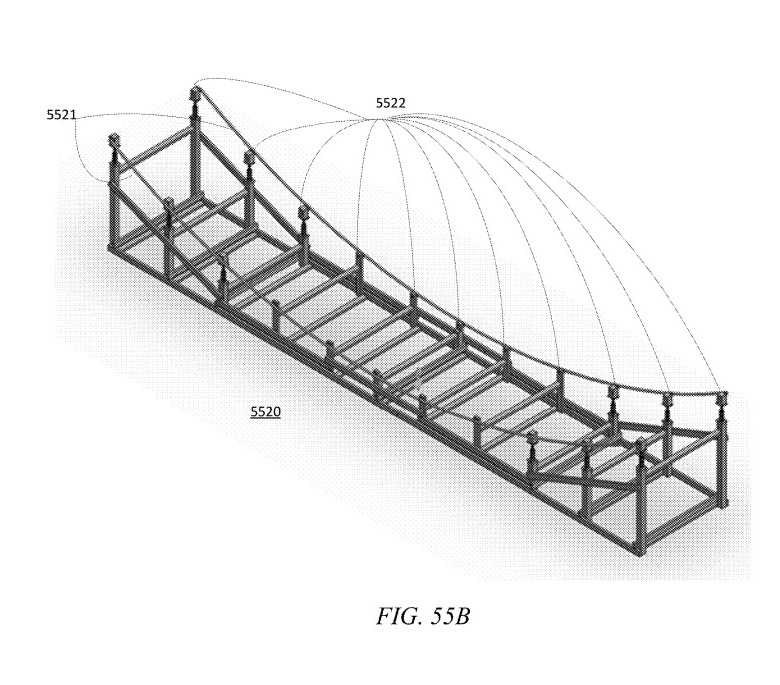
LTA Research and Exploration airship patent

Image Credits: LTA Patent US 2019/0112023 A1

Since the Hindenburg disaster in 1937, most airships, including LTA’s, have used non-flammable helium as a lifting gas. But using hydrogen for fuel still makes sense, according to Professor Dr. Josef Kallo of the German Aerospace Center, which is developing its own 1.5 MW fuel cell to power a 60-seater regional electric aircraft. 

“Where we could go something like 125 miles with batteries, we should be able to go nearly 1,000 miles using hydrogen,” Kallo said. “And airships are even more perfect for the efficiency of fuel cells.”

Fuel cells combine hydrogen and oxygen to produce water and electricity, but are traditionally heavy and complex. Putting one in an aircraft adds extra complications such as safely transporting the liquid hydrogen in fuel tanks, storing the water produced and dealing with a lot of waste heat.

LTA’s first fuel cell will be a 0.75 MW system, built by a third party and retrofitted into one of its existing prototypes, according to the job listing. That is unlikely to happen this year, however. A planned Pathfinder 3 airship, which will run on batteries, still has not been registered with the FAA.

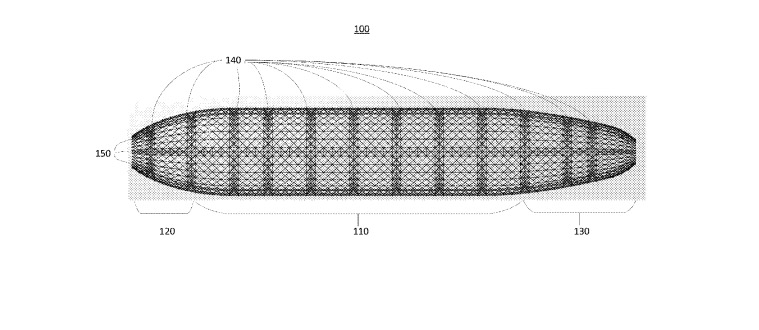
LTA Research and Exploration airship patent

Image Credits: LTA Research Patent US 2019/0112023 A1

“Functionality wise, there is no showstopper to using a hydrogen fuel cell,” Kallo said. “The challenge is to find someone who can afford not to look at the business case, because I don’t think it works out from an economic perspective. Maybe Sergey Brin can afford to do that.”

Brin is currently the ninth richest person in the world, with a net worth of over $86 billion. LTA’s website says the initial use case for its aircraft will be “humanitarian disaster response and relief efforts, especially in remote areas that cannot be easily accessed by plane and boat due to limited or destroyed infrastructure.” Ultimately, it intends to create a family of zero emissions aircraft for global cargo and passenger travel.

LTA has already started its charitable work, producing more than 3 million face masks for first responders during the COVID-19 pandemic, and donating nearly $3 million last year to the United Nations High Commissioner for Refugees.

LTA is likely to operate closely with Brin’s nonprofit disaster relief force, Global Support and Development (GSD), which is based just a few miles from LTA’s Mountain View hangars. GSD has deployed medics and ex-military personnel to numerous natural disasters over the past five years. It prides itself on its ability to arrive before traditional NGOs, on occasion even using Brin’s own superyacht. Tax records show that Brin is by far the largest funder of GSD, giving it at least $7.5 million in 2019. 

25 Feb 2021

Register for TC Sessions: Justice for a conversation on diversity, equity and inclusion in the startup world

Diversity, equity and inclusion. These essential elements remain woefully lacking across the tech industry despite recent strides. Join us on March 3 — just one week away — for TC Sessions: Justice 2021. Hear from and engage with the top experts and leading voices working to change the tech industry for the good of all humanity.

That may sound like a lofty goal, but we’re talking serious disrupters — founders, investors, engineers and visionaries with the drive and the tech chops to back up their ambitions. Folks like Naj Austin, Brian Brackeen, Arlan Hamilton, Wade Davis and plenty more incredible speakers.

Your ticket gives you access to an enormous amount of knowledge, inspiration, advice, connection and opportunity.

Here’s just a taste of the interactive presentations, breakout sessions and panel discussions waiting for you. Check the agenda for the full lineup and get your game plan on. Who knows? We may add a surprise or two.

Tech in the Era of Accountability: A hands-off approach to moderating online platforms invited hate to flourish in plain sight over the last four years. We’ll speak with Anti-Defamation League CEO Jonathan Greenblatt on proposed policy solutions, whether tech is on the cusp of a real era of accountability and what the organization’s mission looks like in 2021 and beyond.

State of the Union: Labor unions have been uncommon in tech. That’s finally starting to change in recent years, as workers have pushed to organize at some of the industry’s biggest companies, from Alphabet to Kickstarter. Parul Koul (Google), Grace Reckers (Office and Professional Employees International Union) and Clarissa Redwine (NYU) will join us to discuss the growing movement.

Finding the Next Unicorn: Arlan Hamilton, the founder and managing partner of Backstage Capital, has raised more than $12 million to back 150 companies led by underrepresented founders. In this session, Hamilton discusses how she vets the biggest opportunities in investment and how to disrupt in a positive way.

Plus, you’ll have the opportunity to meet some of the early-stage founders in the TC Include Program — and watch them take part in live pitch feedback sessions. These young startup entrepreneurs were nominated by our partner founder organizations, Black Female Founders, Latinx Startup Alliance, Startout and the Female Founders Alliance.

TC Sessions: Justice 2021 takes place in one week on March 3. Reserve your seat today, and add your voice to the chorus of leaders creating opportunities and meaningful — long overdue — change in tech.

25 Feb 2021

Docyt raises $1.5M for its ML-based accounting automation platform

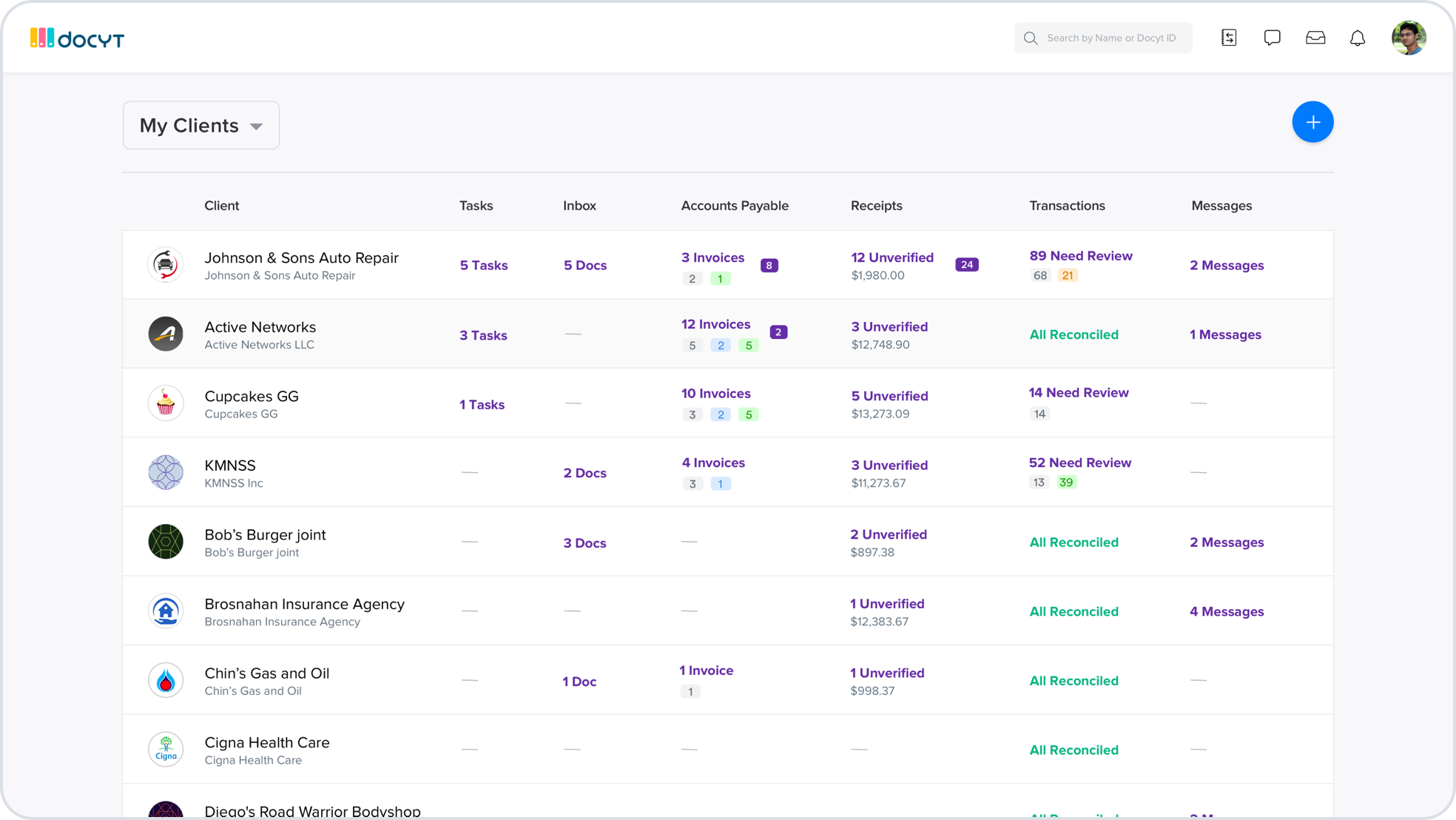
Accounting isn’t a topic that most people can get excited about — probably not even most accountants. But if you’re running any kind of business, there’s just no way around it. Santa Clara-based Docyt wants to make the life of small and medium business owners (and their accounting firms) a bit easier by using machine learning to handle a lot of the routine tasks around collecting financial data, digitizing receipts, categorization and — maybe most importantly — reconciliation.

The company today announced that it has raised a $1.5 million seed-extension round led by First Rays Venture Partners with participation from Morado Ventures and a group of angel investors. Docyt (pronounced ‘docket’) had previously raised a $2.2 million seed round from Morado Ventures, AME Cloud Ventures, Westwave Capital, Xplorer Capital, Tuesday and angel investors. The company plans to use the new investment to accelerate its customer growth.

At first glance, it may seem like Docyt competes with the likes of QuickBooks, which is pretty much the de facto standard for small business accounting. But Docyt co-founder and CTO Sugam Pandey tells me that he thinks of the service as a partner to the likes of QuickBooks.

Image Credits: Docyt

“Docyt is a product for the small business owners who finds accounting very complex, who are very experienced on howto run and grow their business, but not really an expert in accounting. At the same time, businesses who are graduating out of QuickBooks — small business owners sometimes become mid-sized enterprises as well — […] they start growing out of their accounting systems like QuickBooks and looking for more sophisticated systems like NetSuite and Sage. And Docyt fits in in that space as well, extending the life of QuickBooks for such business owners so they don’t have to change their systems.”

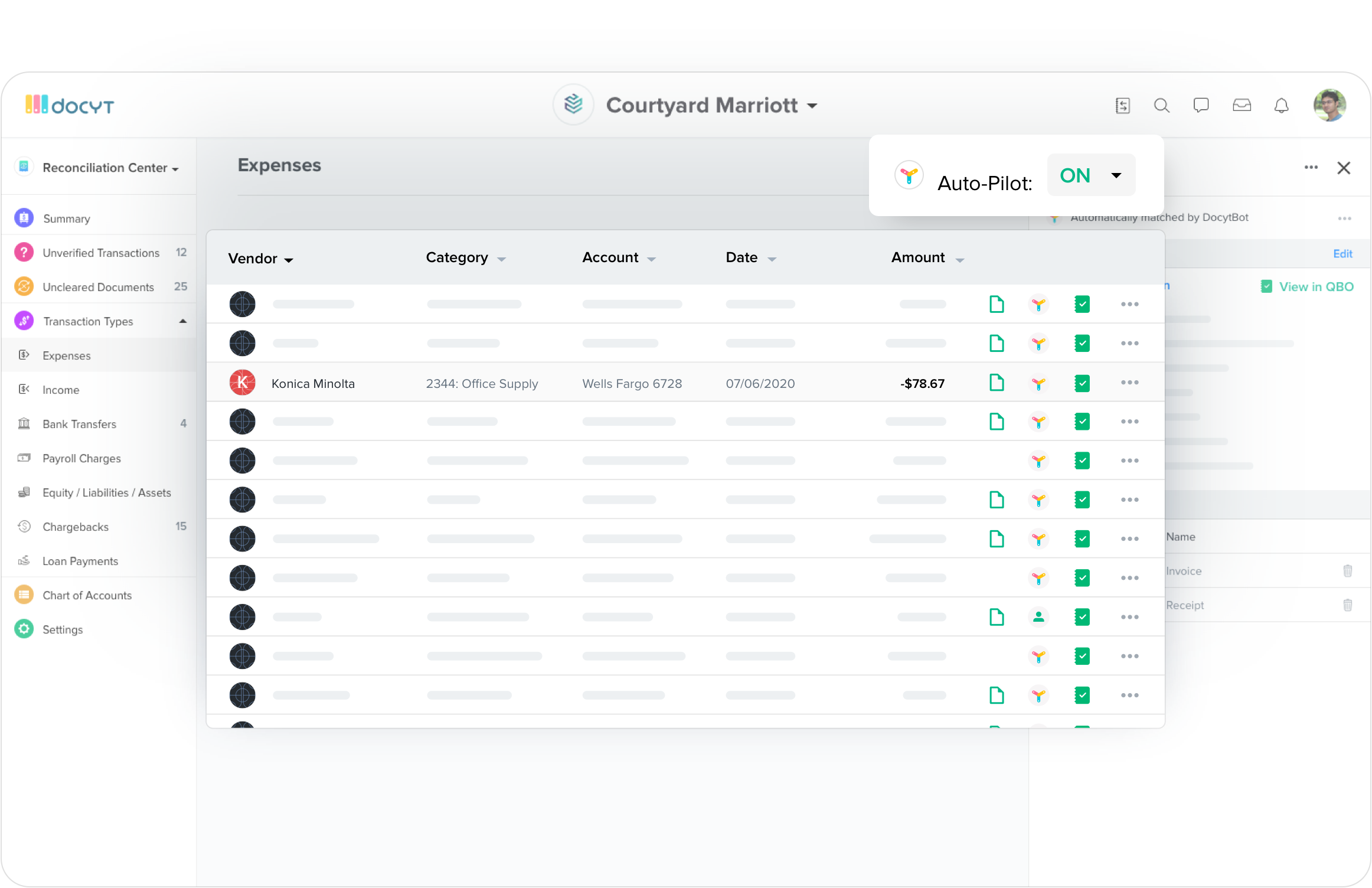
In its earliest days, Docyt was a secure document sharing platform with a focus on mobile. Some of this is still in the company’s DNA, with its focus on being able to pull in financial documents and then reconciling that with a business’ bank transactions. While other systems may put the emphasis on transaction data, Docyt’s emphasis is on documents. That means you can forward an emailed receipt to the service, for example, and it can automatically attach this to a financial transaction from your credit card or bank statement (the service uses Plaid to pull in this data).

Image Credits: Docyt

For new transactions, you sometimes have to train the system by entering some of this information by hand, but over time, Docyt should be able to do most of this automatically and then sync your data with QuickBooks.

“Docyt is the first company to apply AI across the entire accounting stack,” said Amit Sridharan, Founding General Partner at First Rays Venture Partners. “Docyt software’s AI-powered data extraction, auto categorization and auto reconciliation is unparalleled. It’s an enterprise-level, powerful solution that’s affordable and accessible to small and medium businesses.”

25 Feb 2021

Blue Origin pushes New Glenn orbital rocket’s first flight to Q4 2022

Jeff Bezos’ space company Blue Origin published an updated timeline for the first flight of New Glenn, the orbital rocket it’s building to complement its existing New Shepard suborbital space launch vehicle. The company is now targeting Q4 2022 – a slippage of roughly a year from the prior stated timeline of sometime towards the end of 2021. The main cause, per Blue Origin? Space Force passing on using New Glenn to launch national security payloads during a recent contract bid process.

Blue Origin said in a blog post that the “schedule has been refined to match the demand of Blue Origin’s commercial customers,” and specifically says it “follows the recent Space Force decision to not select New Glenn for the National Security Space Launch (NSSL) Phase 2 Launch Services Procurement (LSP).” Those awards were announced last August, and the two winners were the United Launch Alliance (ULA) and SpaceX, who prevailed over Blue Origin, and also Northrop Grumman. The launch service contracts that make up the awards begin in 2022, so it makes sense why Blue Origin had been pushing for a first launch of New Glenn by the end of this year in order to meet the needs of Space Force.

While it may not be under the same time pressure without access to those contracts, it’s still making “major progress” towards New Glenn and the facilities at Cape Canaveral in Florida from which it’ll launch, according to the company. Blue Origin shared tweets showing off some of its progress, including work on the New Glenn rocket factory, testing facility and Launch Complex 36. It also said it’s put more than $2.5 billion into the facilities and infrastructure that will support its eventual launches.

25 Feb 2021

Learn about creating equity in tech with Rep. Barbara Lee at TechCrunch Sessions: Justice

Rep. Barbara Lee, who has represented the East Bay of California since 1998, is one of Congress’s staunchest proponents of diversity in tech. Representing Oakland, Emeryville and other cities nestled around the hills of the East Bay, she knows all too well about the benefits reaped by those in Silicon Valley, San Francisco and beyond.

We are happy to announce that Rep. Lee will be joining us for a fireside chat at TechCrunch Sessions: Justice in just a few days.

By focusing on racial injustice, among the many other issues facing her constituency, Lee has highlighted the ways in which access to tech remains out of reach for people from underserved communities. And this doesn’t just refer to the so-called ‘pipeline problem,’ which is, arguably, a myth. It is also about the lack of tech education in early grades through high school, as well as a lack of access to computers and reliable broadband, which most of us take for granted.

We will speak with Lee about the opportunities that the tech industry has to create an equal playing field in tech so that underrepresented investors, founders, designers, coders and the like can take part in everything it has to offer. We will also discuss her membership in the Congressional Black Caucus, which is celebrating its 50th anniversary this year, as well as her role as co-chair of the Congressional Cannabis Caucus — the burgeoning cannabis industry will be a good place to start.

Head here to secure your seat to TechCrunch Sessions: Justice. In addition to Rep. Lee, you’ll hear from Backstage Capital’s Arlan Hamilton on finding the next big opportunities in tech, learn how to creatively navigate remote fundraising from top investors, examine the importance of accessible product design and learn how to battle algorithmic bias. Register now.