Year: 2021

25 Feb 2021

Foresite Capital raises $969 million fund to invest in healthcare startups across all stages of growth

Health and life science specialist investment firm Foresite Capital has raised a new fund, its fifth to date, totally $969 million in commitments from LPs. This is the firm’s largest fund to date, and was oversubscribed relative to its original target according to fund CEO and founder Dr. Jim Tananbaum, who told me that while the fundraising process started out slow in the early months of the pandemic, it gained steam quickly starting around last fall and ultimately exceeded expectations.

This latest fund actually makes up two separate investment vehicles, Foresite Capital Fund V, and Foresite Capital Opportunity Fund V, but Tananbaum says that the money will be used to fuel investments in line with its existing approach, which includes companies ranging from early- to late-stage, and everything in between. Foresite’s approach is designed to help it be uniquely positioned to shepherd companies from founding (they also have a company-building incubator) all the way to public market exit – and even beyond. Tananbaum said that they’re also very interested in coming in later to startups they have have missed out on at earlier stages of their growth, however.
Image Credits: Foresite Capital

“We can also come into a later situation that’s competitive with a number of hedge funds, and bring something unique to the table, because we have all these value added resources that we used to start companies,” Tananbaum said. “So we have a competitive advantage for later stage deals, and we have a competitive advantage for early stage deals, by virtue of being able to function at a high level in the capital markets.”

Foresite’s other advantage, according to Tananbaum, is that it has long focused on the intersection of traditional tech business mechanics and biotech. That approach has especially paid off in recent years, he says, since the gap between the two continues to narrow.

“We’ve just had this enormous believe that technology, and tools and data science, machine learning, biotechnology, biology, and genetics – they are going to come together,” he told me. “There hasn’t been an organization out there that really speaks both languages well for entrepreneurs, and knows how to bring that diverse set of people together. So that’s what we specialized i,n and we have a lot of resources and a lot of cross-lingual resources, so that techies that can talk to biotechies, and biotechies can talk to techies.”

Foresite extended this approach to company formation with the creation of Foresite Labs, an incubation platform that it spun up in October 2019 to leverage this experience at the earliest possible stage of startup founding. It’s run by Dr. Vik Bajaj, who was previously co-founder and Chief Science Officer of Alphabet’s Verily health sciences enterprise.

“What’s going on, or last couple decades, is that the innovation cycles are getting faster and faster,” Tananbaum said. “So and then at some point, the people that are having the really big wins on the public side are saying, ‘Well, these really big wins are being driven by innovation, and by quality science, so let’s go a little bit more upstream on the quality science.'”

That has combined with shorter and shorter healthcare product development cycles, he added, aided by general improvements in technology. Tananbaum pointed out that when he began Foresite in 2011, even, the time horizons for returns on healthcare investments were significantly longer, and at the outside edge of the tolerances of venture economics. Now, however, they’re much closer to those found in the general tech startup ecosystem, even in the case of fundamental scientific breakthroughs.

CAMBRIDGE – DECEMBER 1: Stephanie Chandler, Relay Therapeutics Office Manager, demonstrates how she and her fellow co-workers at the company administer their own COVID tests inside the COVID testing room at Relay Therapeutics in Cambridge, MA on Dec. 1, 2021. The cancer treatment development company converted its coat room into a room where employees get tested once a week. All 100+employees have been back in the office as a result of regular testing. Relay is a Foresite portfolio company. (Photo by Jessica Rinaldi/The Boston Globe via Getty Images)

“Basically, you’re seeing people now really look at biotech in general, in the same kind of way that you would look at a tech company,” he said. “There are these tech metrics that now also apply in biotech, about adoption velocity, other other things that may not exactly equate to immediate revenue, but give you all the core material that usually works over time.”

Overall, Foresite’s investment thesis focuses on funding companies in three areas – therapeutics at the clinical stage, infrastructure focused on automation and data generation, and what Tananbaum calls “individualized care.” All three are part of a continuum in the tech-enabled healthcare end state that he envisions, ultimately resulting “a world where we’re able to, at the individual level, help someone understand what their predispositions are to disease development.” That, Tananbaum suggests, will result in a transformation of this kind of targeted care into an everyday consumer experience – in the same way tech in general has taken previously specialist functions and abilities, and made them generally available to the public at large.
25 Feb 2021

Former top Paytm exec is building his own financial services startup

The executive who built the financial services boutique for Paytm, India’s most valuable startup, from the ground is ready to do something similar all over again.

Pravin Jadhav, the former chief executive of Paytm Money, revealed on Thursday his own startup, Raise Financial Services.

This time, Jadhav — under whose leadership, Paytm had amassed over 6 million Money customers — is focusing on serving a different set of the population.

Hundreds of millions of users in India today don’t have access to financial services. They don’t have a credit card, banks don’t lend to them, and they have never purchased an insurance cover or invested in mutual funds or stocks.

Scores of large firms and startups in India today are attempting to reach these users by building an underwriting technology that can use alternative data to determine an applicant’s credit worthiness. It’s a tough and capital intensive business, built on pillars of uncertainties, assumptions and hopes.

In an interview with TechCrunch, Jadhav said Raise Financial Services is aimed at customers living in metro, tier 1 and tier 2 cities (so very much in and around urban cities). “They want financial products, they are literate about these products, but they are not being served the way they should be,” he said.

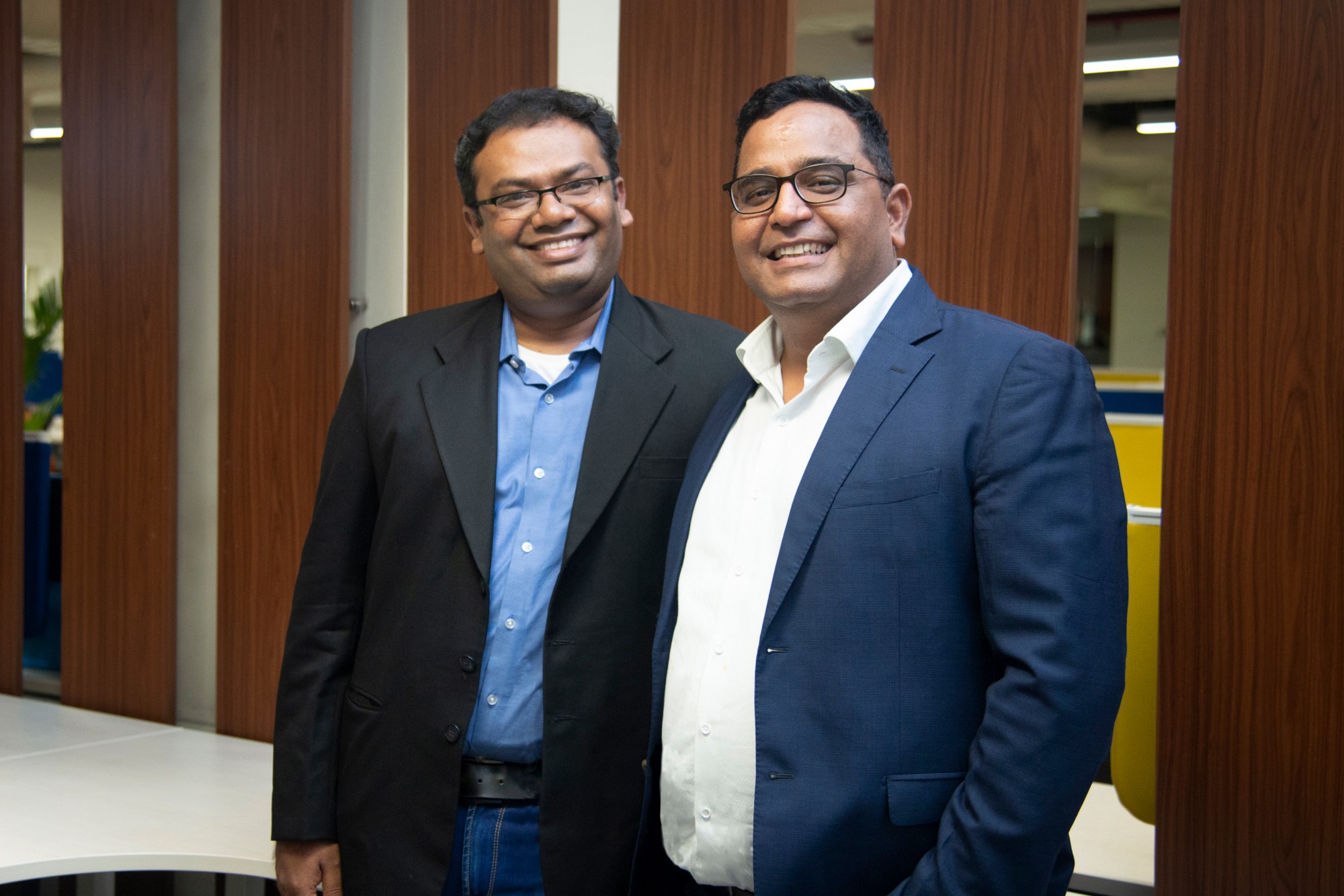
Pravin Jadhav, left, poses with Paytm founder and CEO Vijay Shekhar Sharma. Jadhav left Paytm last year.

He said his new startup will offer products across financial services including investing, financing, insurance, wealth, and payments. “Just not doing the banking part, as I believe that is more of an infrastructure play,” he said.

“The idea is to offer great exceptional products that are not being offered by anyone. Number 2: Focus a lot on tech-driven distribution. And third is that today the quality of customer service experience is bad across the market. So we are trying to solve that,” he said. “Over time, we will try to stitch all of this together.”

Jadhav also announced he has raised a Seed financing round. He did not disclose the amount, but revealed enough high-profile names, including: Kunal Shah (Cred), Kalyan Krishnamurthi (Flipkart), Amod Malviya and Sujeet Kumar (Udaan), Sameer Nigam and Rahul Chari (PhonePe), Amrish Rau (Pine Labs, Citrus Pay), Sandeep Tandon (Freecharge), Jitendra Gupta (Jupiter), Girish Mathrubootham (Freshworks), Nischal Shetty (WazirX), Kuldeep Dhankar (Clevertap), Sreevatsa Prabhakar (Servify), and Amit Bhor (Walnut).

Jadhav himself is also investing, and venture investor Mirae Asset Venture is leading the round, with participation from Multi-Act Private Equity, Blume Ventures (via its Founder’s Fund) and US based early-stage investor Social Leverage, for which it is the first investment in India.

Ashish Dave, CEO of Mirae Asset Venture’s India business, told TechCrunch that even though he had known Jadhav, it was listening to him at various Clubhouse sessions that prompted him to reach out to Jadhav.

Jadhav said users can expect the startup’s first product to be live by the end of the year. (TechCrunch understands it’s shipping much sooner. Raise Financial Services’ offerings will have some similarities with SoFi and Goldman Sachs’ Marcus.)

25 Feb 2021

Five takeaways from Coinbase’s S-1

The Coinbase S-1 is out! And hot damn, did the company have a good fourth quarter.

TechCrunch has a first look at the company’s headline numbers. But in case you’ve been busy, the key things to understand are that Coinbase was an impressive company in 2019 with more than a half-billion in revenue and a modest net loss. In 2020, the company grew sharply to more than $1.2 billion in revenue, providing it with lots of net income.


The Exchange explores startups, markets and money. Read it every morning on Extra Crunch, or get The Exchange newsletter every Saturday.


The company’s Q4 2020 was about as big as its entire 2019 in revenue terms, albeit much more profitable because the sum was concentrated in a single quarter instead of spread out over four.

However, beyond the top-level numbers are a host of details to explore. I want to dig more deeply into Coinbase’s user numbers, its asset mix, its growing subscription incomes, its competitive landscape and who owns what in the company. At the end, we’ll riff on a chart that discusses the correlation between crypto assets and the stock market, just for fun.

Sound good? You can read along in the S-1 here if you want, and I will provide page numbers as we go.

Inside Coinbase’s direct listing

To make things simpler, we’ll frame our digging in the form of questions, starting with: How many users did Coinbase need to generate its huge 2020 revenue gains?

The answer: not as many as I expected. In 2019, Coinbase generated $533.7 million from what it describes as 1 million “Monthly Transacting Users” (page 14). That works out to $533.7 million in revenue per MTU for the year.

In 2020, Coinbase generated $1.28 billion in revenue off of 2.8 million MTUs, which works out to around $457 apiece during the year. That’s a bit lower, but not terribly so. And given that the company’s transaction margins ranged in the mid-80s percent during much of 2020, each Coinbase active trader was still quite valuable, even at a lower revenue point.

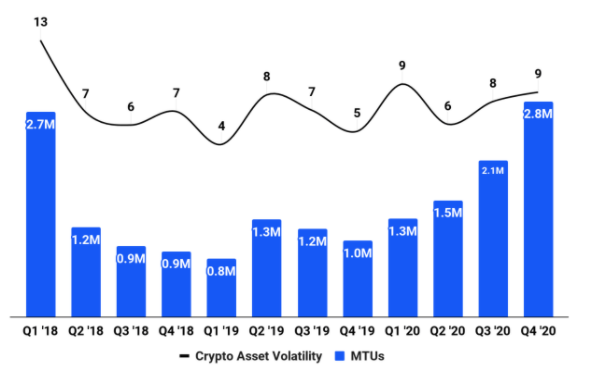
As we noted in our first look at the company’s economics, Coinbase’s metrics are highly variable. Its MTU figure is no exception. Observe the following chart from its S-1 filing (page 95):

Coinbase’s Q1 2018 was nearly as popular in MTU terms as its final quarter of 2020. And from that point in time, the company’s MTUs fell 70 percent to its Q1 2019 nadir. That’s a lot of variance.

The company itself notes in its filing that “MTUs have historically been correlated with both the price of Bitcoin and Crypto Asset Volatility,” though the company does point out that it expects such correlations to diminish over time.

The answer to our question is that it only takes a few million MTUs for Coinbase to be a huge business. But the other side of that point is that Coinbase has shown twice in two years (2018, 2019) that the number of traders on its platform can decline.

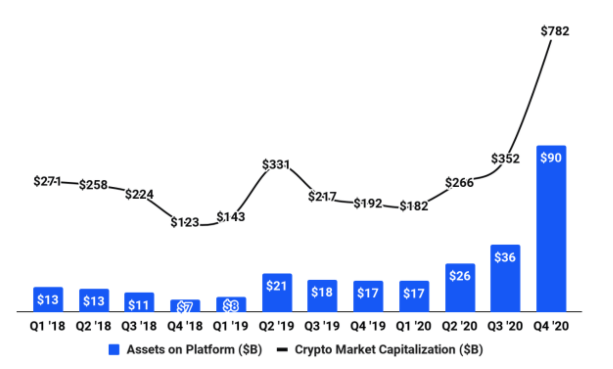
What assets do Coinbase users hold? This is a question that I am sure many of you crypto enthusiasts have. But first, what does the Coinbase user asset base look like? Like this, historically (page 96):

Holy shit, right? The chart shows two things. First, the rapid appreciation of cryptocurrencies overall, which you can spy in the upward kick of the black line. And then the blue bars show how the assets on Coinbase’s platform grew from $17 billion at the start of 2020 to $90 billion by year’s end.

25 Feb 2021

How top startup lawyer Dawn Belt thinks about company-building in the age of SPACs

Dawn Belt has been working with top tech companies for two decades, most recently helping commercial electric vehicle company Proterra go public as a SPAC in January.

Now she’ll be joining us at TC Early Stage in April to talk about building a company in 2021, from however you incorporate to however you decide to maybe go public one day.

As a partner at Fenwick & West, a top Silicon Valley law firm, Belt works with startups of all ages, sizes and industries (two of her past IPOs include Facebook and Bill.com). She has also written legal perspectives on a wide range of other topics that startups face, including implications of the CARES Act, board diversity legal requirements and how to manage acquired startups successfully. She also co-authored the firm’s Gender Diversity Survey, an in-depth report on women’s participation at senior levels of public tech companies.

She’ll be at Early Stage to share her experiences old and new, to help you make better decisions now for your company. The talk is part of the two days of events that explore seed and Series A fundraising, recruiting and more for early-stage startups at TC Early Stage – Operations and Fundraising on April 1 & 2. Grab your ticket now before prices increase tomorrow!


25 Feb 2021

Celebrity video platform Memmo raises $10M

Memmo.me, a startup allowing users to pay celebrities for personalized video messages, is announcing that it has raised $10 million in Series A funding.

“We’re really excited about our mission to break down these barriers [and help talent] connect one-to-one instead of one-to-thousands,” said co-founder and CEO Gustav Lundberg Toresson.

He added that celebrities are embracing this as a new source of income. It’s particularly appealing during the pandemic, but he predicted that celebrities will still be excited about “making this much money from their living rooms” after the pandemic ends.

The concept probably reminds you of Cameo (indeed, Carole Baskin of “Tiger King” fame has presence on both platforms), but while Cameo is U.S.-based, Memmo was founded in Stockholm, and Lundberg Toresson said its strategy is both global and localized — the company is currently operating localized marketplaces for Sweden, Germany, Finland, Norway, the United Kingdom, Spain, Italy and Canada, as well as a general global market.

“We want to be the place where you can find everyone from world famous talents like a soccer or basketball star, to the local musician down the road,” he said.” It’s all about using localization to help you find who’s most relevant for you, wherever you are.”

The startup says it has been used to send more than 100,000 messages globally, and that sales grew 50% every month between July of last year and January 2021.

The round was led by Left Lane Capital, with the firm’s founder and managing parter Harley Miller joining the Memmo board. Delivery Hero co-founder Lukasz Gadowski , FJ Labs, Depop CEO Maria Raga, Zillow co-founder Spencer Rascoff, former Groupon operations director Inbal Leshem, Voi Technology co-founder Fredrik Hjelm, former Udemy CEO Dennis Yang and Wolt co-founder Elias Aalto also participated.

“We’ve been impressed with the pace at which Memmo has expanded their offering across markets, where localization is critical to unlocking marketplace liquidity,” Miller said in a statement. “The ability to monetize the gap between wealth and fame for talent & celebrities, all the while allowing them to engage deeply with fans, is a trend that was only further underscored by the pandemic.”

Although Left Lane is based in New York, Lundberg Toresson said he was particularly excited about the firm’s marketplace expertise, and that its investment does not signal an imminent U.S. launch.

Memmo has now raised a total of $12 million. The new funding will allow the startup to add new features like live videos and to build out its business offerings, allowing companies to hire celebrities to create promotional videos for external marketing or internal employee motivation.

25 Feb 2021

The Landing is bringing shoppable social and collaboration to interior design

Monetizable mood boards might sound like the moonshot idea that no one asked for, but when you think about it, the vision is already informally happening in various corners of the internet. A young generation of users shops with community in mind, whether that’s buying merchandise from your favorite influencers or giving into those Instagram advertisements after spending way too much time on the grid.

As more users think of shopping as a social, digital-first activity, The Landing, a seed-stage startup coming out of stealth, is hoping to win over those who have an affinity for designing homes and spaces. On The Landing, users can create, and shop from, room designs to help furnish their homes.

Image Credits: The Landing

“There’s no contextually rich, visual shopping destination, where you could curate and discover and share and shop all in one place,” co-founder Miri Buckland said. The Landing hopes to be that destination.

Started by Buckland and Ellie Buckingham, The Landing is launching with $2.5 million in financing, in a round led by Aileen Lee at Cowboy Ventures. Lee will be taking a board seat. Other investors include Dara Treseder, the CMO of Peloton, Manish Chandra and Tracy Sun, the founders of Poshmark, Unshackled, Designer Fund, and Progression Fund.

The Landing began as a pandemic pivot. Buckland and Buckingham were always interested in solving the pain point of contextual furnishing for users, but began by physically moving people into apartments and helping them set up different furniture. Then, the pandemic hit and limited the ability to do high-touch services. Buckingham says that this was “potentially the best forcing function” to focus on what kind of business The Landing wanted to be.

“I don’t need to be the person moving into your apartment with a couch,” she said. “It was about the importance of empowering creativity and empowering individuals to create digital and physical spaces.” That’s when they dropped the moving service business, and instead used furnishing as a vector to solve the problem of contextual and social e-commerce.

It’s a smart idea that has not gone unnoticed. Houzz, a Sequoia-backed home improvement startup, connects users to products from third-party retailers as well as services from architects, designers, or contractors. There’s also Modsy, which has raised north of $70 million to date, which helps users virtually redesign their homes.

Buckingham worked for Modsy when she was at business school, where she first started noticing that she disagreed with the startups’ main thesis.

“Their motto was basically a digital rendition of an existing human service,” she said. “And I came away from the experience not super convinced that the service model was the scalable, future answer to consumerization of access to design.” She noticed that the younger generation was looking for a self-serve, customizable answer, instead.

Miri Buckland and Ellie Buckingham, the co-founders of The Landing.

The Landing is launching with creative tooling capabilities, which allow users to build and design spaces within its platform. In the coming months, the team is focused on adding a social layer atop the design tool, with features like profiles, discovery, fede, and commenting.

The Landing’s Slack channel is currently being used to discuss these features and what is most in-demand from early users.

The founders aren’t worried about a lack of demand, or only being a platform for the few times that people furnish their homes throughout their lifespan. As Buckland pointed out, people browse Zillow all the time, and have Reddit channels about dream homes, creating designs, and more. The startup is aiming to serve that population as well — the dreamers and not just the realists.

25 Feb 2021

USV has been aggressively selling off shares in Coinbase in run up to IPO

Coinbase’s S-1 publicly dropped this morning with much anticipation. My colleague Alex Wilhelm has the high-level details, but there was one major wrinkle for the crypto trading darling: two of its early investors seem to be cutting down their stakes pre-IPO.

The most notable case is Union Square Ventures, the prominent venture firm where Fred Wilson co-led the Series A round into the company back in 2013, which was the first investment made under the firm’s then newly christened blockchain thesis.

Over the past two years — which is the extent of disclosures that Coinbase includes in its S-1 filing — USV has been rapidly selling off its holdings in the company across multiple transactions, mostly selling to other venture firms around the cap table. Since late 2019, the firm has sold off approximately 28% of its holdings in Coinbase.

USV currently owns about 7.3% of Coinbase’s outstanding shares, or roughly 13.9 million of a total of 191.3 million based on Coinbase’s disclosed share count. As the following table indicates, USV has conducted four separately-dated transactions to sell nearly 5.5 million shares of its holdings in secondary transactions.

Fellow early-stage fintech investor Ribbit Capital, which joined USV in the Series A, also conducted a smaller secondary transaction in November 2019, selling a bit less than 5% of its outstanding shares (559,228 of 11,995,949 shares).

What’s interesting is not just that USV in particular is selling a large part of its holdings, but also the price they were willing to sell at. According to Coinbase’s filing, USV sold 3.35 million shares at $23 per share in late 2019, and later sold about 2 million shares at $28.83 per share in mid-2020.

Those prices are well-below Coinbase’s Series E price per share of $36.19, which it received in late 2019. It’s also below the price set by the secondary transactions of Coinbase CEO and co-founder Brian Armstrong and Paradigm founder and Coinbase co-founder Fred Ehrsam, who received $32.57 for their shares in late 2018.

Now, there are a couple of nuances to consider here. The secondary sale of preferred shares will typically convert to common (even if the sale is to another preferred shareholder), which means that the shares sold would hold fewer investor rights and provisions, and therefore, are intrinsically worth less to investors. This was the case with Coinbase as it disclosed in its filing, and that may explain at least some of the gap in the price.

The timing of USV’s investment is also perhaps notable. The bulk of USV’s investment in Coinbase comes from its 2012 vintage fund, which if it follows default industry practice, has a targeted 10-year shelf life. That means that the fund is designed to pay out its returns by 2022 — which was quickly coming up for the firm back in 2019 and 2020. There may have been some pressure to sell at least some of the firm’s stake early to make the firm’s LPs happier.

It’s also useful to note that USV and Ribbit mostly sold to other, existing investors like A16Z and Paradigm, which shows that other investors deeply burrowed on the cap table were quite excited to put more money to work in Coinbase, even at a fairly late stage.

Nonetheless, it’s rare for an ambitious fund like USV to sell arguably its single most important investment of all time just a year or two before what may well be one of the largest blockbuster IPOs of 2021. At a valuation of $100 billion let’s say (which is what Coinbase priced at a recent private market transaction), USV’s stake would be worth about $7.3 billion. Yet, the shares it sold over the past two years would have been worth several billion at exit, and it sold them for about $140 million in cash.

The mystery here is perhaps solved a bit. Fred Wilson, in a blog post from early 2018, talked about “taking money off the table” in earlier USV investments like Twitter, where the firm “sold about 30% of our position in those two secondary transactions for about $250mm and returned 2x the entire fund to our investors.” Then referring to crypto, he said:

If you are sitting on 20x, 50x, 100x your money on a crypto investment, it would not be a mistake to sell 10%, 20% or even 30% of your position. Selling 25% of your position on an investment that is up 50x is booking a 12.5x on the entire investment, while allowing you to keep 75% of it going. I know that many crypto holders think that selling anything is a mistake. And it might be. Or it might not be. You just don’t know.

Clearly, he took money off the table. It’s a financially-astute, risk-adjusted approach, even if it left billions of returns behind. A16Z and Paradigm are, I am sure, quite pleased to have made the purchase.

25 Feb 2021

Twitter plans to double revenue by 2023, reach 315M daily users

Just ahead of its 2021 virtual investor day on Thursday, Twitter this morning announced its three long-term goals focused on user base and revenue growth, and a faster pace of shipping new features across its platform. The company said it aims to “at least” double its total annual revenue from $3.7 billion in 2020 to $7.5 billion or more in 2023. It also expects to reach at least 315 million mDAUs — that’s Twitter’s self-invented metric for “monetizable” daily active users — by the fourth quarter of 2023.

That would represent a roughly 20% compound annual growth rate from Twitter’s base of 152 million mDAUs reported in the fourth quarter of 2019, the company noted in a new SEC filing.

Active user growth has been difficult for Twitter — the growth tends to be slow or even flat, at times. Per Twitter’s most recent earnings, mDAUs in the fourth quarter 2020 had reached 192 million instead of the 193.5 million expected, for instance. Investors are used to Twitter under-delivering on this metric — or even inventing its own user base metric to hide that its monthly user growth sometimes declines.

In any event, Twitter’s longer-term plans indicate it believes it will finally be able to deliver on user growth — perhaps aided by its investment in new features.

In its filing, Twitter said it would “double development velocity by the end of 2023,” which means doubling the number of features shipped per employee that “directly drive either mDAU or revenue,” it said.

On this front, Twitter has been fairly active in recent months. Late last year, it launched its “stories” feature called Fleets to its global audience. It’s also now testing new features including a Clubhouse rival, Twitter Spaces, and a community-led misinformation debunking effort known as Birdwatch. And it acquired newsletter platform Revue, which is already now integrated on the Twitter website. The company has made smaller acquisitions, as well, to build out product teams, including with social app Squad, stories template maker Chroma Labs, and podcasting app Breaker.

New features may help to attract increased Twitter usage, but revenue growth will also come from diversification beyond advertising. Twitter has spoken several times about its plans to build out a subscription product, which the company said would begin in 2021 but wouldn’t impact Twitter revenue in the near-term. The company has also said it may investigate other areas of monetization, like tipping and various paid consumer-facing features.

Today, Twitter said publicly it plans to reach the $7.5 billion or more target by “growing our audience and gaining advertising market share in both brand and direct response.” But the company did not speak to its plans for subscriptions.

Investors are already responding favorably to Twitter’s announcements this morning. Twitter stock is up by nearly 7% as of the time of writing.

25 Feb 2021

Why F5 spent $2.2B on 3 companies to focus on cloud native applications

It’s essential for older companies to recognize changes in the marketplace or face the brutal reality of being left in the dust. F5 is an old-school company that launched back in the 90s, yet has been able to transform a number of times in its history to avoid major disruption. Over the last two years, the company has continued that process of redefining itself, this time using a trio of acquisitions — NGINX, Shape Security and Volterra — totaling $2.2 billion to push in a new direction.

While F5 has been associated with applications management for some time, it recognized that the way companies developed and managed applications was changing in a big way with the shift to Kubernetes, microservices and containerization. At the same time, applications have been increasingly moving to the edge, closer to the user. The company understood that it needed to up its game in these areas if it was going to keep up with customers.

Taken separately, it would be easy to miss that there was a game plan behind the three acquisitions, but together they show a company with a clear opinion of where they want to go next. We spoke to F5 president and CEO François Locoh-Donou to learn why he bought these companies and to figure out the method in his company’s acquisition spree madness.

Looking back, looking forward

F5, which was founded in 1996, has found itself at a number of crossroads in its long history, times where it needed to reassess its position in the market. A few years ago it found itself at one such juncture. The company had successfully navigated the shift from physical appliance to virtual, and from data center to cloud. But it also saw the shift to cloud native on the horizon and it knew it had to be there to survive and thrive long term.

“We moved from just keeping applications performing to actually keeping them performing and secure. Over the years, we have become an application delivery and security company. And that’s really how F5 grew over the last 15 years,” said Locoh-Donou.

Today the company has over 18,000 customers centered in enterprise verticals like financial services, healthcare, government, technology and telecom. He says that the focus of the company has always been on applications and how to deliver and secure them, but as they looked ahead, they wanted to be able to do that in a modern context, and that’s where the acquisitions came into play.

As F5 saw it, applications were becoming central to their customers’ success and their IT departments were expending too many resources connecting applications to the cloud and keeping them secure. So part of the goal for these three acquisitions was to bring a level of automation to this whole process of managing modern applications.

“Our view is you fast forward five or 10 years, we are going to move to a world where applications will become adaptive, which essentially means that we are going to bring automation to the security and delivery and performance of applications, so that a lot of that stuff gets done in a more native and automated way,” Locoh-Donou said.

As part of this shift, the company saw customers increasingly using microservices architecture in their applications. This means instead of delivering a large monolithic application, developers were delivering them in smaller pieces inside containers, making it easier to manage, deploy and update.

At the same time, it saw companies needing a new way to secure these applications as they shifted from data center to cloud to the edge. And finally, that shift to the edge would require a new way to manage applications.

25 Feb 2021

Stori raises $32.5M in a Lightspeed-led Series B to build Mexico’s credit card for the masses

While credit cards are commonplace in the United States, they are far less ubiquitous in many other countries, particularly those in Latin America. In Mexico in particular, cash remains the dominant method of payment with an estimated 86% of all payments being in the form of cash.

But card usage is growing as more people are shopping online than ever before. According to one recent study, Mexico topped the list of the world’s fastest growing e-commerce markets. Meanwhile, only 37% of Mexicans over 15 years old have a bank account, according to recent World Bank stats.

All these factors clearly make the country ripe for fintech innovation. 

And for the founders of Mexico City-based startup Stori, they spell opportunity.

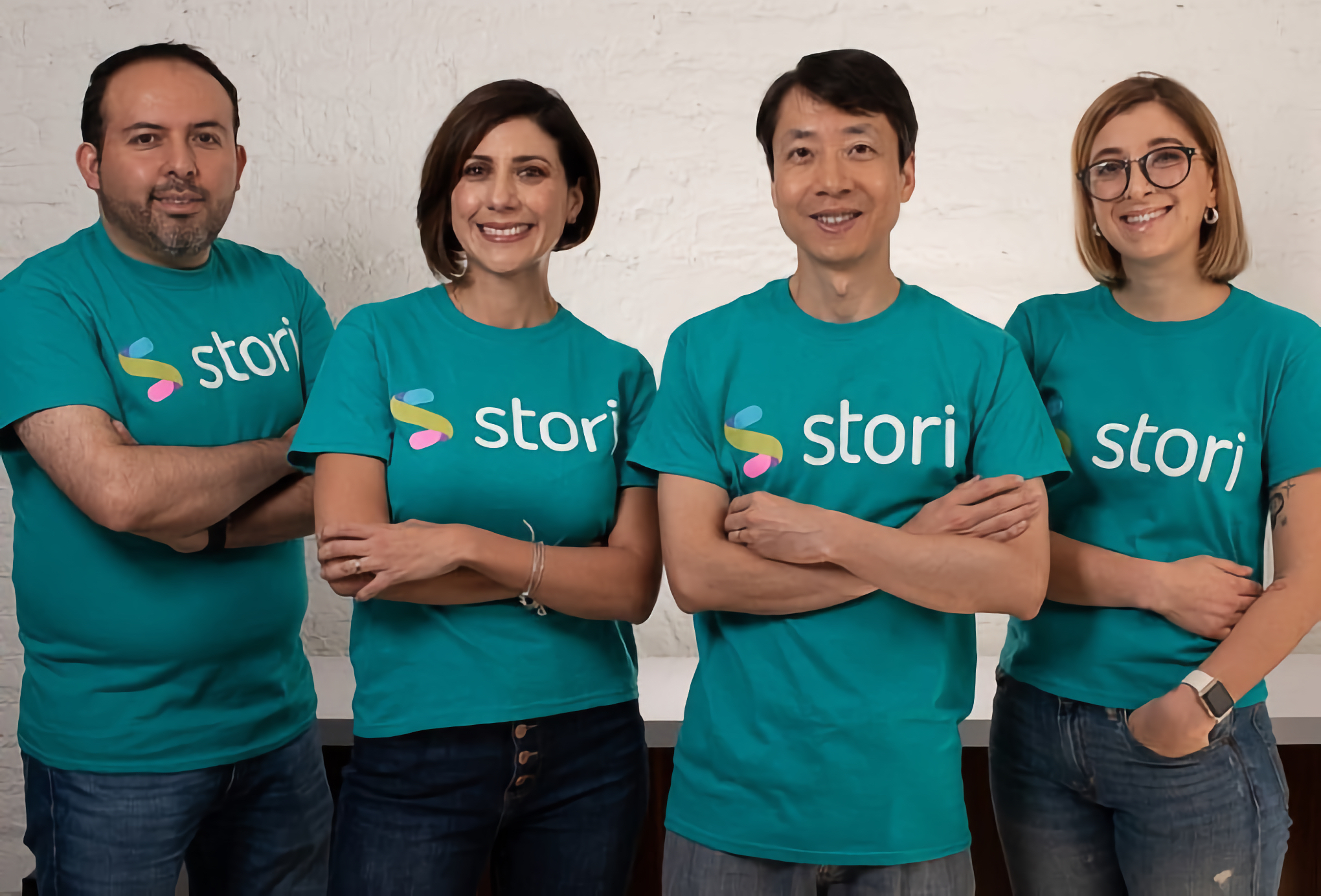
From left to right, Stori founding team Juan Villaseñor, Marlene Garayzar, Bin Chen, Camila Burne

Stori launched its credit card product in Mexico in January 2020 and has so far had more than 1 million customers apply for a card. 

Several members of the founding team spent years at Capital One honing their skills in underwriting underserved populations while others worked at the likes of Mastercard, Morgan Stanley, GE Money, HSBC and Intel in Mexico and the U.S.

Now the company has raised a $32.5 million Series B round with the goal of “becoming Mexico’s leading credit card issuer for the rising middle class.”

Lightspeed Venture Partners led the company’s financing, which brings Stori’s total raised since its early 2018 inception to $50 million. According to Lightspeed Partner Mercedes Bent, the investment marked her firm’s first large investment in the Latin American region “with more to come.”

Existing backers Vision Plus Capital, BAI Capital and Source Code Capital also participated in the round.

Stori provides credit cards with “a 100% mobile app-based experience” to the rising middle income population in Mexico. The team spent its first two years building out the startup’s infrastructure and platform. 

In January 2021, the fintech’s monthly new customer growth was 14 times than what it saw in January 2020 and 6 times the company’s monthly average for 2020, according to co-founder Bin Chen. He declined to reveal its current total of customers.

Because the Mexican market is so huge (the country has a population of nearly 130 million), Stori is currently only focused on serving the country.

Just as in other parts of the world, Stori saw tailwinds in the COVID-19 pandemic in that it fueled customer demand for a way to pay digitally. 

“Consumers in Mexico are increasingly using e-commerce and app-based services like ride hailing and delivery and credit cards are the preferred payment methods in those channels,” Chen said. “They’re experiencing more cash flow fluctuation and irregular expenses and need access to flexible credit that can meet short term needs.”

And of course, during pandemic-related lockdowns, more people are turning to digital financial offerings to avoid visiting bank branches in person.

One commonality among all of Stori’s co-founders, according to Chen, is that each “comes from a modest background.”

“We all experienced the feeling of being excluded from the traditional financial service world. As an international student pursuing my master’s degree in Illinois more than twenty years ago, I was relying solely on teaching assistantship to cover my study and living expenses,” Chen recalled. “I often ran out of money, and had a hard time to make ends meet – I received many rejections before I got my first credit card.”

Similar to TomoCredit’s mission in the U.S., Stori’s founders are working to give middle and low-income customers that are “new to the formal financial system” an opportunity to access credit.

The company plans to use its new capital to grow its customer base, boost headcount and invest in product design, technology infrastructure and underwriting, said Chen, who previously worked at Capital One and Mastercard in both U.S. and emerging markets. Today, Stori has 80 employees spread across offices in Mexico, U.S. and China, up from 40 a year ago.

“Our goal is to become a leading digital bank for the underserved population in the region,” he said.

For its part, Lightspeed first met the company’s founders over a year ago.

“We were struck by the depth of their experience. They navigated the pitfalls of Covid masterfully — without the benefit of a US style stimulus — and showed that their underwriting models were strong and improving,” Bent said. “That is a reflection of the quality of the team.”

Yiran Liu, a partner at China-based Vision Plus Capital, says the firm led Stori’s Series A round and “continues to be super pro rata in this round.”

“We have a structural thesis on digital fintech models and are investing in these models globally, particularly in emerging markets,” Liu said in a written statement. “We are impressed by the team’s execution and excited by the local market opportunity as evidenced by the rapid growth.”