Year: 2021

11 Feb 2021

South African VC firm Knife Capital gets first commitment for its $50M fund, to invest in 10-12 Series B rounds

Knife Capital, a South African venture capital firm, is raising a $50 million fund for startups looking to raise Series B financing. With Knife Fund III called the African Series B Expansion Fund, the firm seeks to directly invest in the aggressive expansion of South African breakout companies. It also plans to co-invest in companies across the rest of Africa.

The first fund, known as Knife Capital Fund I or HBD Venture Capital, was a closed private equity fund managed by Eben van Heerden and Keet van Zyl. The firm offered seed capital to startups. It also generated significant exits from its portfolio — VISA acquisition of fintech startup Fundamo, and orderTalk’s acquisition by UberEats come to mind.

In 2016, the VC firm launched its current 12J offering with Knife Capital Fund II. The fund (KNF Ventures) which invests primarily in Series A stage has eight startups in its portfolio. Last year the firm told TechCrunch of its intention to extend the Fund II and open to new investors. The plan was to give startups access to networks, money and expansion opportunities.

“We want to help South African and African companies internationalize,” said co-managing partner Andrea Bohmert at the time. A testament to its cause, one of its portfolio companies, DataProphet, raised $6 million Series A to expand into the U.S. and Europe.

Bohmert tells TechCrunch that the third fund aims to address the critical Series B funding gap that has characterised the venture capital asset class in South Africa, resulting in businesses not reaching full potential or exiting too early.

“Lately, we see an increase in companies able to raise $2 million to $5 million funding rounds. And while the companies are operating within their home country, in our case South Africa, such amounts take you far due to the local cost structure,” Bohmert says. “However, once these companies start gaining international traction and need to build an infrastructure outside of their home country, they need to raise significant amounts to afford so. There are currently hardly any South African VC funds, perhaps other than Naspers Foundry, that can write checks of $5 million or more and are willing to deploy them to finance the externalization of South African companies into larger markets.”

As a result, Bohmert argues that Africa has become an incubator for international VCs who can write these checks but cannot provide the local support most of these companies still need. Likewise, there are instances where international investors actively search for local co-investors in South Africa to invest in a round, and not finding one might blow the chances of them going further with the investment. This is the gap Knife Capital intends to fill by launching this fund, Bohmert says.

“We want to be the local lead investor of choice for South African technology companies looking to internationalise, co-investing with international investors who can lead the Series B discussion and further.”  

This week, Knife Capital secured $10 million out of the 50 from Mineworkers Investment Company (MIC), a South Africa-based investment firm. The commitment positions MIC as an anchor investor to the fund alongside other local and international investors.

Nchaupe Khaole, the CIO at MIC, explained that the move to change the way local institutional investors approach venture capital investment has been in MIC’s pipeline for a while. And by partnering with Knife Capital, this idea can begin to materialize.

“Our commitment brings to the table the investment, along with many of our strengths as an experienced player. One of which is our ability to influence the companies within our portfolio to partner with us and effect real, tangible change to the South African economy. We are delighted to be a key catalyst in the success of this funding round,” he said.

As per other details, Knife Capital aims for a first close by May and a final close by the end of the year. Most of its participation will be co-investing, and the idea is to that in 10 to 12 companies.


11 Feb 2021

Apple launches a new AR experience tied to ‘For All Mankind’

“For All Mankind: Time Capsule” is a new augmented reality app created by Apple to promote the upcoming second season of “For All Mankind,” which premieres on February 19 on Apple TV+.

Even for those of you who aren’t fans of the the show — which tells the story of an alternate history in which the Soviet Union beat the United States to the Moon, leading to an extended space race in the ’70s and beyond — the app is still noteworthy as another sign of Apple’s interest in AR, even beyond the reports that it’s working on AR glasses.

“Time Capsule” takes place during the decade-long gap between seasons one and two, tracing the relationship between Danny Stevens and his parents, the astronauts Gordo and Tracy Stevens. Users who download the free iOS app will be able to interact with a variety of objects — such as a mixtape and an Apple II computer — that illustrate the family relationship.

“Time Capsule” walks users through a linear experience with between 45 and 60 minutes of content, but it sounds like it’s also designed to support further exploration and additional visits. You’ll be able to check “D-mail” and play a text adventure game on the computer, and if you’ve got an Apple device with a LiDAR scanner (such as an iPhone 12 Pro, iPhone 12 Pro Max or iPad Pro) you can use a virtual slide projector to project Danny’s family photos onto your own walls.

“For All Mankind” producer Ben McGinnis said the app was created in parallel with the show’s second season, with the creative team working with Apple to figure out “which objects were best for getting the story across,” and offering feedback as the actual AR objects were developed.

Creator and executive producer Ron Moore added that he’s excited about the possibility of giving fans new ways to explore the show’s world and characters, especially since writers on the show often create far more material than what ends up on screen.

“Part of the promise of this technology is that a fan of any show, by definition, usually wants to know more about it, more about the characters,” Moore said.

In this case, “For All Mankind”‘s team had written things like love letters and newscasts that are only seen briefly on-screen. They could then be used in the app, along with additional material by Stephanie Shannon, a writer on the show. The key, Moore said, is to “play fair by the audience that just wants to show up.”

“You can certainly watch ‘For All Mankind’ on-air without the AR stuff,” he added. “But if you do the AR stuff first, it enriches your experience.”

11 Feb 2021

Robinhood’s pain is Public’s gain as VCs rush to give it more money

Public.com, a social-focused free stock trading service, is nearing the close of a Series D just two months after raising a $65 million Series C, sources familiar with the matter told TechCrunch.

The San Francisco-based fintech aims to give people the ability to invest in companies using any amount of money, with a focus on community activity over active trading. It competes with Robinhood, M1 Finance, and other American fintech companies that offer consumers a way to invest in equities with low or zero fees.

Public.com apparently got a flurry of investor interest over the past couple of weeks after Robinhood found itself in hot water and essentially raised $3.4 billion in a matter of days to help get itself out of a mess. 

That new capital came at a challenging time for the unicorn, which could pursue an IPO this year. And some investors reportedly want a piece of rival Public.com’s pie.

One source told TechCrunch that many of those offering term sheets believe there could be “a mass exodus from Robinhood” and want a way to capture that value.

Public recently shook up its business model, moving from generating revenue from order flow payments, a key way that Robinhood monetizes, to collecting tips from users in exchange for executing their orders. Payment for order flow, or PFOF, has become a touchstone in the debate surrounding low-cost trading platforms, and how users may pay for their transactions if not in direct fees.

Investors betting on Public, then, would be placing a wager on not merely future user growth, but the startup’s ability to monetize effectively in the future. 

The sources for this story were granted anonymity due to the sensitivity of the discussions.

Public grew quickly in 2020, expanding its user base by a multiple of 10 since the start of the year.

Co-founder Leif Abraham told TC’s Alex Wilhelm in December that the company’s growth has been consistent instead of lumpy, expanding at around 30% each month. The co-founder also stressed that most of Public’s users find its service organically, implying that the startup’s marketing costs have not been extreme, nor its growth artificially boosted.

We don’t know yet  how much Public is raising in its Series D, or who all is investing. Public has not responded to multiple requests for comment. VC firm Accel – which led its Series A, B and C rounds – also declined to comment. But we’ll definitely report details as we get them.

11 Feb 2021

A Dallas-based founder looks to tackle the student loan crisis with his startup, College Cash

Demetrius Curry has spent the last couple years chasing a dream.

His startup, College Cash, allows brands to petition users to create photo and video marketing content highlighting their product or service, with the wrinkle being that content creators are paid by the brands in the form of credits that go directly towards paying down their student loan debt. This model awards the brands involved a level of social good will and tax benefits.

The Dallas area founder was inspired to tackle student loan debt crisis after talking with his daughter about the prospect of eventually paying down her own loan debt. Curry has spent the past two years building out the nascent platform, tracking down brand partners, navigating accelerator programs, enticing users and pounding the pavement to find investors that are willing to bet on his vision.

College Cash has raised $105,000 to date, and is hoping to eventually wrap the funding into a $1 million seed round.

Filling out the round has been its own challenge for Curry who has struggled at times to find opportunity, even among historic levels of capital flowing into the startup ecosystem, a distinction that has been less noticeable for black founders that still make up just a small percentage of VC allocation. In the aftermath of last summer’s protests against police brutality, a number of venture capital firms issued statements decrying institutional racism and pledging to back more underserved founders, spinning up new programs for diverse founders.

Demetrius Curry, CEO of College Cash

While Curry says he appreciates the scope of the problem and the good intentions of those making the statements, he believes that venture capital networks still have a lot to learn about what being an “underserved” founder means and that plenty of the existing efforts feel like “lip service.” He says that even as Silicon Valley continues to idolize dropouts from prestigious universities, stakeholders have less interest in recognizing the accomplishments of founders who fought their way through poverty or found opportunity in geographies where opportunities are harder to come by.

“You can’t look for something different if you’re looking in the same places,” Curry tells TechCrunch. “When you look at the topic of ‘underserved founders,’ it’s not only a skin color thing, it’s also about where they came from and what they’ve been through.”

Curry says that it can be frustrating to compete for early stage opportunities when investors aren’t willing to meaningfully adjust their parameters. Of particular frustration to Curry has been navigating the world of “warm introductions” to even get a foot in the door for programs meant for diverse founders, or applying for early stage programs geared towards the “underserved” only to be told that they weren’t far enough along to qualify.

“Think about how much we had to go through to even get in the room with you,” Curry says. “I’ve sold plasma to pay a web hosting fee, nothing is going to stop me.”

College Cash’s mission of expanding opportunities for people struggling to manage their student loan debt is personal to Curry who saw his life turn around after going back to school.

Decades ago, fresh out of the military, Curry said he had a random conversation with a stranger while eating at a Hardee’s — the discussion about what more he wanted from life ended up pushing him to to go back and get his GED and later a business degree. What followed was a career in finance that eventually led towards his recent entrepreneurial pursuits with College Cash.

The platform is firmly an early-stage venture at the moment, but Curry has big ambitions he’s building toward. His next effort is building out a College Cash tipping integration with gig economy platforms, with the aim that users of those platforms could ultimately opt to tip a worker and route that money directly towards paying down that person’s student loan debt.

Curry says the team at College Cash has been working with a “national gig economy platform” to run a pilot of the integration and has run focus groups showing that users are more likely to tip when they know that money goes towards erasing loan debt.

11 Feb 2021

Frame.io streamlines film production with ‘camera to cloud’ video uploads

Video collaboration startup Frame.io unveiled a new technology today that it calls Frame.io Camera to Cloud.

Michael Cioni, the startup’s global senior vice president of innovation, explained that while consumers expect to instantly upload video footage to the cloud, professional film and TV productions still rely on hard drives.

There’s a good reason for that: Those productions use much higher-quality footage, which means that the files are enormous. But Frame.io gets around that by uploading “proxy” footage that’s not nearly so bandwidth intensive.

It can, in fact, be uploaded on an LTE connection, as the Frame.io team demonstrated for me by shooting brief footage that was accessible a few seconds later from a computer on the other side of the country.

Cioni said this means the editing process no longer has to wait on the movement of hard drives: “We take this linear process and make it parallel.”

Frame.io Camera to Cloud iPhone app

Image Credits: Frame.io

Footage uploaded through Camera to Cloud can then be edited in Frame.io, but the technology is also integrated with popular editing software like Final Cut Pro and Adobe Premiere. And because the proxy footage has the same timecodes and metadata as the original, any edits can be synchronized once you receive the drives.

In addition, Camera to Cloud allows production members on and off the set to view footage from their computer, iPhone or iPad, as soon as it’s shot.

“The moment that you hit stop [on the camera], wouldn’t it just be great to pull the footage up on your phone, because you want to see what you shot?” said Frame.io CEO Emery Wells. “You can’t do that right now on a professional set. There’s person whose job it is to do that, there are playback monitors all over the set and everybody watches playback at the same time.”

And while the company started to develop this technology before the pandemic, Wells said, “It turns out there’s even more of a need for this now, when fewer people can be on sets.”

In fact, the technology was already used during the production of the pandemic movie “Songbird,” The movie was filmed last summer, and by using Camera to Cloud, producers who were not allowed on the set (due to new safety protocols) could still keep up with the footage.

Camera to Cloud works on existing devices like the Teradek CUBE 655, Sound Devices 888 and Scorpio recorders, which can be attached to compatible cameras from Arri, RED and Sony. It’s available at no additional charge to paying Frame.io subscribers.

“It’s our prediction that by the end of the decade, everybody shooting audio, video and whatever, they’re going to shoot into the cloud,” Cioni said.

11 Feb 2021

European VC funds are building community around ESG initiatives

In general, ESG stands for “environment-social-governance” and comprises a set of principles that touches on issues from diversity and board structures to labor relations, supply chain, data ethics, environmental impact and legal requirements.

Unlike impact investing, which is squarely focused on the (external) effects of a business, ESG concerns mostly internal practices and processes that could support both a fund and its portfolio companies to make them more sustainable.

While other asset classes from buyout funds to public equities have seen a big push toward ESG ratings and initiatives, venture capital has been lagging behind. What has changed recently?

Over the last several months, quite a few mostly European funds have stepped forward with initiatives to tackle ESG. Balderton, for instance, announced its Sustainable Future Goals with a bang at the startup event Slush in early December 2020. Their efforts are focused both internally on the fund and externally on investment decisions and portfolio support. I asked Colin Hanna, one of the leaders of the development internally and a principal at the firm, how this initiative came about:

While our efforts on this front preceded COVID, this year we saw that a real impact was possible on climate-change-related goals […] we have become accustomed to doing virtual board meetings, cutting down on travel; the challenge will be to continue those efforts going forward and rolling them out to our portfolio companies even as the world returns to normal. Having a framework helps us do that.

This rationale also recently brought a group of about 25 VCs to form a community around ESG for VC for the first time. The initiative is led by GMG Ventures and Houghton Street Venture, a new firm affiliated with the London School of Economics that met for the first time in December with representatives from LocalGlobe and Latitude, Kindred Capital, Balderton, the Westly Group and Blisce. The group’s stated goal is to share expertise from the bottom up and fill the gap where existing frameworks don’t quite work.

This is direly needed right now, says Sophia Bendz, partner at Berlin-based firm Cherry Ventures:

Beginning with topics around DEI and climate issues, we are really keen on upping our ESG game. ESG involves such important issues and we have to dedicate the time to learn more to ultimately do more on these fronts now. Yet, I also believe that true impact doesn’t result from knowledge silos. It’s great that we are learning from and supporting each other to have more societal impacts in our day-to-day roles. I am really passionate about this.

What are the main drivers for this push? 

I asked Susan Winterberg, an ESG consultant who recently finished a two-year fellowship at Harvard producing a groundbreaking report on the subject of ESG for VCs specifically about the “why now”:

There are broadly two sets of reasons why investors and company leaders adopt ESG. The first set relates to increased awareness of how their activities impact external events happening in the world such as climate change and social justice. The second relates to increased awareness of how adopting ESG can advance specific business goals they have such as increasing sales, attracting top talent, and reducing operating risks.”

Obviously, 2020 was a watershed year to drive change based on both of these sets of rationales. Social justice issues — from Black Lives Matter and racial equity, COVID-19 and healthcare to freedom of expression and democracy — were prevalent across the spectrum. Startup leaders and investors were influenced by these societal movements as much as by new research helping them understand how ESG can help advance business objectives in venture capital. The two reports published by CDC/FMO and the Belfer Center are only two examples of this evidence.

What do VCs say, how has change happened for them? Hana told me that at Balderton a combination of factors mentioned by Winterberg above, worked together to start the process:

It was both a push and a pull within Balderton. Our investors and the leaders at the top of our firm were proponents of this change but the efforts were also driven by the younger generation within the firm; they felt it was important. Overall, we were silent about climate change and sustainability for a long time, which was not really an option anymore.

For Martin Weber, founding partner at HV Capital that’s working with the St. Gallen-based ESG initiative ROSE, the conversation really started with Leaders for Climate Action. Weber admits: “We didn’t think about ESG enough […] beyond our own horizon really […] sometimes you really need a kick in the butt, that’s what Leaders for Climate Action did for us; a small change started our awareness and commitment to ESG.”

ESG concerns mostly internal practices and processes that could support both a fund and its portfolio companies to make them more sustainable.

For HV Capital but also some funds in the U.S. such as the Westly Group a specific ESG vector started the journey — that could be the E as in environment but also DEI as part of the S and G of ESG.

I also spoke to several LPs recently among others moderating a panel at the U.K.-based Allocate conference; the atmosphere seems to be shifting more drastically toward “doing business better” among the asset owners, too. Particularly family offices managing their own money are outspoken already, but big asset owners are becoming aware (and active) as well.

Michael Cappucci, managing director of Compliance and Sustainable Investing at the Harvard Management Company — Harvard’s endowment — thinks that “we are long past the time to ‘wait and see’ if ESG integration is a worthwhile undertaking for investors” (see the UNPRI report for more context).

The movement here seems to be coming even stronger from Europe again, however. As a result, the same group around Houghton Street Ventures and GMG Ventures pushing ESG for VCs is also in the process to get more LPs on board with a special workshop in February, as I learned. The tempo on the LP front is increasing as we speak.

What is still missing?

While lots of progress has been made on the level of individual funds, individual LPs and in baby steps toward a more general industry-wide push, there are still some core elements that are not in place. I believe the five key gaps concern a clear differentiation of ESG from impact, finding the right language, establishing a common framework, agreeing on metrics and real LP commitment.

  1. Know what ESG is: Many investors (and LPs) I speak with still don’t really know the difference between impact and ESG. In very simple terms, ESG principles are about the (internal) processes (of a fund, portfolio company, etc.) while impact investing is about outcomes (sometimes operationalized through the Sustainable Development Goals (SDGs)). While impact will likely remain a niche asset class for the foreseeable future, ESG principles should inform the practices of all investors in one way or the other.
  2. Find the right language: On a related note, finding the right language to talk about what ESG (versus impact) is, might help us to differentiate better. As Sarah Drinkwater of Omidyar Network made very clear in her post from September last year, we simply don’t have a good word to describe (and own) what ESG expresses in the world of venture capital and technology — principled, progressive, equitable? Possibly, “setting a standard” can help with this issue, too.
  3. Somebody, set a standard: ESG (and impact) frameworks developed and deployed slowly in the venture industry are still all over the place; they are influenced by all kinds of other frameworks (from other asset classes and related activities, such as impact) and mostly made up by individual funds themselves. There is certainly a risk of green washing if it stays that way; (self-proclaimed and reported) marketing is one thing but if we really want to change the industry, an authoritative body will have to step forward. What the biggest European anchor investor — the European Investment Fund — has done on that front so far with a very high-level questionnaire is not enough. How about, for instance, the UNPRI descends from the plane of high level down to individual industry principles?
  4. What isn’t measured: One part of what could really lead to an industry standard is a set of widely accepted and benchmarkable metrics; what are the most important measurements across early-stage and late-stage VC portfolio companies? The group of funds in London has for good reason announced that this particularly question will be one of the focus points they are working on next. But how will this again be adopted and spread industrywide? Another set of players might get involved in that again: LPs. If they make their GPs report on ESG on an annual basis, this will surely shift the industry as a whole and make the next generation of startups more equitable, responsible and stakeholder-focused.
  5. LPs really need to bite: So far, we are still missing real LP commitments when it comes to ESG. On the one hand, many GPs I spoke with that have recently been fundraising reported that LPs in general still don’t ask about ESG. In fact, some LPs particularly in the U.S. believe ESG might be a distraction from generating returns. In any case, ESG still has not become a must-have but is merely regarded a nice-to-do. The ESG questionnaires that do exist — like the EIF framework — are so far really high level and unspecific. When big anchor LPs like the EIF and BBB in Europe or big foundations and university endowments ask about it in their due diligence meetings, GPs will have to comply — all of them. Their influence as agenda setters might in the medium term be the biggest driving factor toward making ESG for VC the normal way of doing business. Given that there is state-money, all of our money, involved here, it seems an absolute no-brainer to take that step.
11 Feb 2021

Racial disparity in Chicago cops’ use of force laid bare in new data

Analysis of a trove of data extracted from the Chicago Police Department has revealed major differences between how black and white officers, as well as male and female ones, actually enforce the law. This rare apples-to-apples comparison supports the idea that improving diversity in law enforcement may also improve the quality of policing.

Historically hard data from police departments has been extremely hard to come by, for a variety of reasons. As the authors put it in the paper:

Rigorous evaluation of the effects of police diversity has been stymied by a lack of sufficiently fine-grained data on officer deployment and behavior that makes it difficult or impossible to ensure that officers being compared are facing common circumstances while on duty.

…At present, a patchwork of nonstandard record-keeping and disclosure practices across roughly 18,000 U.S. police agencies has severely impeded broader policy evaluation.

This study by B.A. Ba et al., however, is based on highly detailed CPD records resulting from requests made to the department over a period of three years. It’s a collaboration between researchers from UC Irvine, the University of Pennsylvania, Princeton, and Columbia, and was published today in Science (access is free).

The records include millions of shifts and patrols from 2012 through 2015, which the team carefully sorted and pruned until it had a set that would allow the kind of analysis they hoped to do: comparing police work that is similar in all respects except the demographics of the officers doing it.

If on a Monday in March, in the same district at the same time of day, no serious differences could be found between Black officers and white officers, then race could be tentatively ruled out as a major contributor to how police do their work. On the other hand, if there were serious differences found, then that might indicate — as a topic for further study — the possibility of systemic bias of some kind.

As you might expect, the analysis found that there are indeed serious differences that, having isolated all the other variables, only correlate with the race of the officer. This may seem obvious to some and controversial to others, but the point of this work is not to assume or confirm assumptions, but to show plainly with data that there are disparities associated with race that need investigation and explanation.

Some of the specific findings can be summarized as follows:

  • Minority officers (black and Hispanic, self-identified) “receive vastly different patrol assignments,” something that had to be controlled for in order to provide effective comparisons for the other findings.
  • Black officers use force 35 percent less than white officers on average, with most of the difference coming from force used against black civilians.
  • Black officers perform far fewer “discretionary stops” for “suspicious behavior.”
  • Hispanic officers showed similar, but smaller reductions.
  • Female officers use force considerably less often than male ones, again especially when it comes to black civilians.
  • Much of the disparity in stops, arrests, and use of force results from differences in pursuing low-level offenses, especially in majority-black neighborhoods.

The data show (as a sort of inverse image of the above list) that white male officers stop, arrest, and use force more often, especially on people of color, and frequently as a result of minor crimes or “discretionary stops” with vague justifications.

This diagram shows a sampling of the collected data, indicating stops, arrests, and uses of force by officers on a map of the Wentworth District of Chicago.

The researchers are careful to point out that as conclusive as the patterns may appear to be, it’s important to understand that there is no causal mechanism studied or suggested. In fact they expressly point out that the data could be interpreted in two directions:

One explanation for these disparities centers on racial bias, i.e., white officers are more likely than Black officers to harass Black civilians. Technically, it is also possible that Black officers respond more leniently when observing crimes in progress.

More study is required, but they point out that one explanation — leniency by Black officers on minor offenses — has very little effect on public safety (violent crimes are addressed largely the same regardless of race and gender). The other — systemic racism — is significantly more harmful. Though they are “observationally equivalent” in the context of this data specifically, they are not equivalent in consequence. (Nor in likelihood — nor are they entirely incompatible with each other.)

In a valuable commentary on the paper and its implications, Yale’s Philip Atiba Goff notes that its findings are rich in implications that we ignore at our peril:

The magnitude of the differences provides strong evidence that — at least in some cities — the number of officers who identify with vulnerable groups can matter quite a bit in predicting police behavior. Although this does not settle the matter, the work stands alone in its ability to make apples-to-apples comparisons across officers – regardless of how many may be bad apples.

Given that Ba et al. find negligible demographic differences in officers’ responses to community violence, such a large difference in discretionary stops compels a reader to ask: Are any of those excess stops by white officers necessary? Should a department even be making them, given the demonstrated risk for abuse so evident in vulnerable communities?

Are any of those excess use of force incidents by white officers necessary? And if the excess force is not necessary for public safety, why does the department target Black communities for so much physical coercion? These questions are difficult to answer outside a broader engagement with the purpose of policing — and its limitations.

In other words, while it may require further study to get at the core of these issues, police departments may look at them and find that their resources are not necessarily being used to best effect. Indeed they may have to face the possibility — if only to refute it — that much of what officers do has little, no, or even negative value to the community. As Goff concludes:

With violence trending downward the past three decades, mostly troubling small geographic areas, and possibly occupying a small portion of police activity, what should the role of police be? Failing to take seriously the possibility that the answer should be “much less” may end up frustrating both researchers and a public that has been asking the question for far longer than most scientists.

This revealing study was only possible because the authors and legal authorities in Chicago compelled the police there to release this data. As noted above it can be difficult, if it is even possible, to collect large-scale data from any department, let alone from many departments for analysis at a national scale. The authors freely admit that their findings, in their specificity to Chicago, may not apply equally in other cities.

But that’s meant to be a call to action; if when finally given access to real data, researchers find problems of this magnitude, every department in the country should be weighing the benefits and risks of continued obfuscation with those of openness and collaboration.

11 Feb 2021

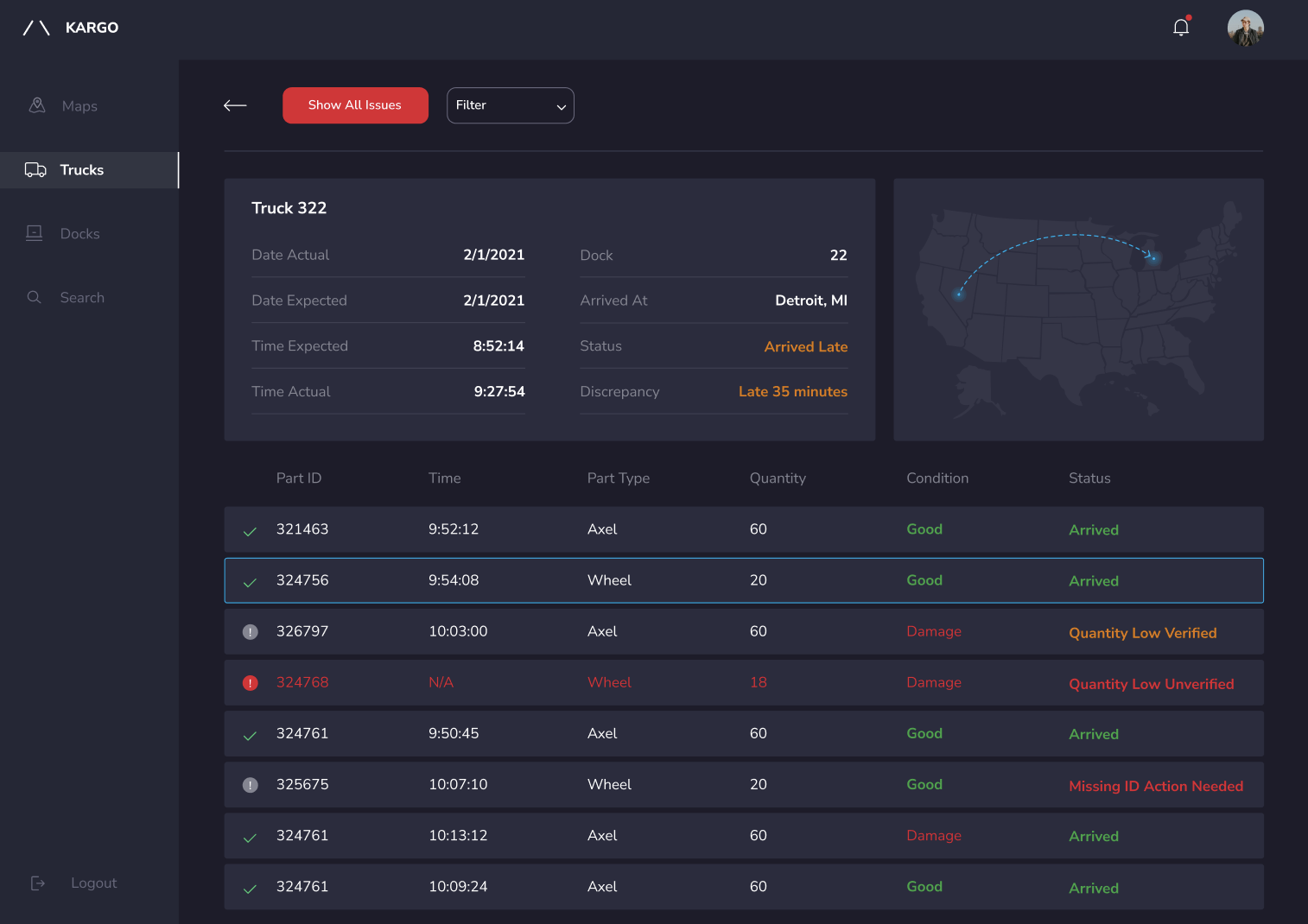
Kargo raises $6M to smarten up loading docks for the coming wave of autonomy

When Sam Lurye looks at a loading dock he sees both a bottleneck in the world’s supply chain and an opportunity. 

The opportunity — driven by a tension between the digital and physical infrastructure at warehouse distribution centers and factories today and the push toward autonomy — prompted Lurye to found Kargo, a smart loading dock platform startup that recently raised $6 million in seed money from Founders Fund, Accomplice, Sozo Ventures and other unnamed investors. 

In the first months of the company, which was founded in late 2019, Lurye spent months traveling throughout the United States, visiting warehouse distribution centers and factories and speaking with hundreds of truck drivers, plant workers and supply chain managers to understand where the change in the autonomous logistics was impacting them.

Their primary complaint: loading docks. 

“No matter whether you’re building cars or elevators or distributing things, everyone has loading docks,” Lurye said in a recent interview. “It’s kind of this universal API of the industrial world; a loading dock allows any industrial facility to connect with the outside world.”

Loading docks are ubiquitous, and so are their problems. Bottlenecks are common with the average truck waiting two and half hours to be loaded or unloaded at the dock. For every 15 minutes that the truck waits beyond that average dwell time, the chance of a crash later on in the route increased by 6.2%, according to a study by the U.S. Department of Transportation.

Lurye concluded that warehouses and factories weren’t ready for the coming wave of investment in autonomy, which tends to focus on autonomous trucks and warehouse robotics. 

Kargo’s platform is not just a digital enterprise. The company mounts physical sensor towers to a loading dock. The computer vision sensor is able to automatically identify and verify all incoming and outgoing freight in real time. The accompanying software platform takes in all of that data, which can then be used by customers to take a macro or micro view of its supply chain. 

kargo loading dock platform

Image Credits: Kargo

The company makes money by selling the sensor and then offering a software subscription that gives customers access to the data.  

Lurye said the platform has allowed its customers to reduce loading time by more than 40%. As more loading docks are connected to the platform, the predictive feature that Kargo built improves and will allow customers to make informed forecasts of whether a shipment will be late or missed. 

Lurye’s aim in 2021 is to use the new funds to double its 7-person workforce over the next several months and launch its first commercial launch of 50 loading docks with plans to triple that number before the end of the year. In 2022, Lurye wants to add more than 1,000 loading docks to the platform.  

Demand for Kargo’s platform and sensors could rise as e-commerce giants like Amazon as well as hundreds of other distributors add more automation inside their warehouses and factories.

11 Feb 2021

A webcam app left thousands of user accounts exposed online

A webcam app installed by thousands of users left an exposed database packed with user data on the internet without a password.

The Elasticsearch database belonged to Adorcam, an app for viewing and controlling several webcam models including Zeeporte and Umino cameras. Security researcher Justin Paine discovered the data exposure and contacted Adorcam, which secured the database.

Paine said in a blog post shared with TechCrunch that the database contained about 124 million rows of  data for the several thousand users, and included live details about the webcam — such as its location, whether the microphone was active, and name of the Wi-Fi network that the camera is connected to — and information about the webcam owner, such as email addresses.

Read more

Paine also found evidence of the camera uploading captured stills from the webcam to the app’s cloud, though he could not verify since the links had expired.

He also found hardcoded credentials in the database for the app’s MQTT server, a lightweight messaging protocol often used in internet-connected devices. Paine did not test the credentials (as doing so would be unlawful in the U.S.), but also alerted the app maker to the vulnerability, who then changed the password.

Paine verified that the database was updating live by signing up with a new account and searching for his information in the database. Although the data was limited in sensitivity, Paine warned that a malicious hacker could craft convincing phishing emails, or use the information for extortion.

Adorcam did not return our emails with questions — including if the company planned to inform users of the incident.

11 Feb 2021

Base Operations raises $2.2 million to modernize physical enterprise security

Typically when we talk about tech and security, the mind naturally jumps to cybersecurity. But equally important, especially for global companies with large, multinational organizations, is physical security – a key function at most medium-to-large enterprises, and yet one that to date, hasn’t really done much to take advantage of recent advances in technology. Enter Base Operations, a startup founded by risk management professional Cory Siskind in 2018. Base Operations just closed their $2.2 million seed funding round, and will use the money to capitalize on its recent launch of a street-level threat mapping platform for use in supporting enterprise security operations.

The funding, led by Good Growth Capital and including investors like Magma Partners, First In Capital, Gaingels and First Round Capital founder Howard Morgan, will be used primarily for hiring, as Base Operations looks to continue its team growth after doubling its employe base this past month. It’ll also be put to use extending and improving the company’s product, and growing the startup’s global footprint. I talked to Siskind about her company’s plans on the heels of this round, as well as the wider opportunity and how her company is serving the market in a novel way.

“What we do at Base Operations is help companies keep their people in operation secure with ‘Micro Intelligence,’ which is street-level threat assessments that facilitate a variety of routine security tasks in the travel security, real estate and supply chain security buckets,” Siskind explained. “Anything that the Chief Security Officer would be in charge of, but not cyber – so anything that intersects with the physical world.”

Siskind has first-hand experience about the complexity and challenges that enter into enterprise security, since she began her career working for global strategic risk consultancy firm Control Risks in Mexico City. Because of her time in the industry, she’s keenly aware of just how far physical and political security operations lag behind their cybersecurity counterparts. It’s an often-overlooked aspect of corporate risk management, particularly since in the past it’s been something that most employees at North American companies only ever encounter periodically, when their roles involve frequent travel. The events of the past couple of years have changed that, however.

“This was the last bastion of a company that hadn’t been optimized by a SaaS platform, basically, so there was some resistance and some allegiance to legacy players,” Siskind told me. “However, the events of 2020 sort of turned everything on its head, and companies realized that the security department ,and what happens in the physical world, is not just about compliance – it’s actually a strategic advantage to invest in those sort of services, because it helps you maintain business continuity.”

The COVID-19 pandemic, increased frequency and severity of natural disasters, and global political unrest all had significant impact on businesses worldwide in 2020, and Siskind says that this has proven a watershed moment in how enterprises consider physical security in their overall risk profile and strategic planning cycles.

“[Companies] have just realized that if you don’t invest and how to keep your operations running smoothly in the face of rising catastrophic events, you’re never going to achieve the the profits that you need, because it’s too choppy, and you have all sorts of problems,” she said.

Base Operations addresses this problem by taking available data from a range of sources and pulling it together to inform threat profiles. Their technology is all about making sense of the myriad stream of information we encounter daily – taking the wash of news that we sometimes associate with ‘doom-scrolling’ on social media, for instance, and combining it with other sources using machine learning to extrapolate actionable insights.

Those sources of information include “government statistics, social media, local news, data from partnerships, like NGOs and universities,” Siskind said. That data set powers their Micro Intelligence platform, and while the startup’s focus today is on helping enterprises keep people safe, while maintaining their operations, you can easily see how the same information could power everything from planning future geographical expansion, to tailoring product development to address specific markets.

Siskind saw there was a need for this kind of approach to an aspect of business that’s essential, but that has been relatively slow to adopt new technologies. From her vantage point two years ago, however, she couldn’t have anticipated just how urgent the need for better, more scalable enterprise security solutions would arise, and Base Operations now seems perfectly positioned to help with that need.