Year: 2021

11 Feb 2021

Immunai raises $60M as it expands from improving immune therapies to discovering new ones, too

Just three years after its founding, biotech startup Immunai has raised $60 million in Series A funding, bringing its total raised to over $80 million. Despite its youth, Immunai has already established the largest database in the world for single cell immunity characteristics, and it has already used its machine learning-powered immunity analysts platform to enhance the performance of existing immunotherapies, but aided by this new funding, it’s now ready to expand into the development of entirely new therapies based on the strength and breadth of its data and ML.

Immunai’s approach to developing new insights around the human immune system uses a ‘multi-omic’ approach – essentially layering analysis of different types of biological data, including a cell’s genome, microbiome, epigenome (a genome’s chemical instruction set) and more. The startup’s unique edge is in combining the largest and richest data set of its type available, formed in partnership with world-leading immunological research organizations, with its own machine learning technology to deliver analytics at unprecedented scale.

“I hope it doesn’t sound corny, but we don’t have the luxury to move more slowly,” explained Immunai co-founder and CEO Noam Solomon in an interview. “Because I think that we are in kind of a perfect storm, where a lot of advances in machine learning and compute computations have led us to the point where we can actually leverage those methods to mine important insights. You have a limit or ceiling to how fast you can go by the number of people that you have – so I think with the vision that we have, and thanks to our very think large network between MIT, and Cambridge to Stanford in the Bay Area, and Tel Aviv, we just moved very quickly to harness people to say, let’s solve this problem together.”

Solomon and his co-founder and CTO Luis Voloch both have extensive computer science and machine learning backgrounds, and they initially connected and identified a need for the application of this kind of technology in immunology. Scientific co-founder and SVP of Strategic Research Danny Wells then helped them refine their approach to focus on improving efficacy of immunotherapies designed to treat cancerous tumors.

Immunai has already demonstrated that its platform can help identify optimal targets for existing therapies, including in a partnership with the Baylor College of Medicine where it assisted with a cell therapy product for use in treating neuroblastoma (a type of cancer that develops from immune cells, often in the adrenal glands). The company is now also moving into new territory with therapies, using its machine learning platform and industry-leading cell database to new therapy discovery – not only identifying and validating targets for existing therapies, but helping to create entirely new ones.

“We’re moving from just observing cells, but actually to going and perturbing them, and seeing what the outcome is,” explained Voloch. This, from the computational side, later allows us to move from correlative assessments to actually causal assessments, which makes our models a lot more powerful. Both on the computational side and on the on the lab side, this is really bleeding edge technologies that I think we will be the first to really put together at any kind of real scale.”

“The next step is to say ‘Okay, now that we understand the human immune profile, can we develop new drugs?’,” said Solomon. “You can think about it like we’ve been building a Google Maps for the immune system of a few years – so we are mapping different roads and paths in the in the immune system. But at some point, we figured out that there are certain roads or bridges that haven’t been built yet. And we will be able to support building new roads and new and new bridges, and hopefully leading from current states of disease or cities of disease, to building cities of health.”

11 Feb 2021

Top 100 subscription apps grew 34% to $13B in 2020, share of total spend remained the same

Apps saw record downloads and consumer spending in 2020, globally reaching somewhere around $111 billion to $112 billion, according to various estimates. But a growing part of that spend was subscription payments, a new report from Sensor Tower indicates. Last year, global subscription app revenue from the top 100 subscription apps (excluding games), climbed 34% year-over-year to $13 billion, up from $9.7 billion in 2019.

The App Store, not surprisingly, accounted for a sizable chunk of this subscription revenue, given it has historically outpaced the Play Store on consumer spending. In 2020, the top 100 subscription apps worldwide generated $10.3 billion on the App Store, up 32% over 2019, compared with $2.7 billion on Google Play, which grew 42% from $1.9 billion in 2019.

Image Credits: Sensor Tower

There are some signs that subscription revenue growth may be hitting a peak. (Or it could be that subscriptions were a luxury some consumers cut in a down economy.)

Globally, subscription app revenue from the top 100 apps was around 11.7% of the total ~$111 billion consumers spent on in-app purchases in 2020 — which is roughly the same share it saw in 2019.

And in the fourth quarter of 2020, 86 of the top 100 earning apps worldwide offered subscriptions, which was down from the 89 that did so in the fourth quarter of 2019.

In addition, subscription app revenue growth in the U.S. is now trailing the global trends.

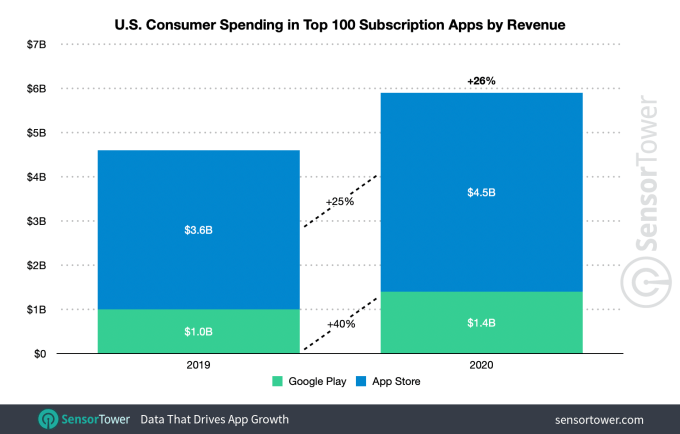
Although subscription app revenue was still up 26% on a year-over-year basis to reach nearly $5.9 billion in 2020, that was slower growth than the 34% seen worldwide.

Image Credits: Sensor Tower

What’s more, subscription app spending in the U.S. last year represented a smaller percentage of the total consumer spend than in 2019, the report found. In 2020, subscription payments from the top 100 subscription apps were 17.6% of the $33 billion U.S. consumers spent on in-app purchases, down from the 21% share they accounted for in 2019.

And out of the 100 top grossing apps in the U.S. in the fourth quarter 2020, 91 were subscription-based, down from 93 in the year ago quarter.

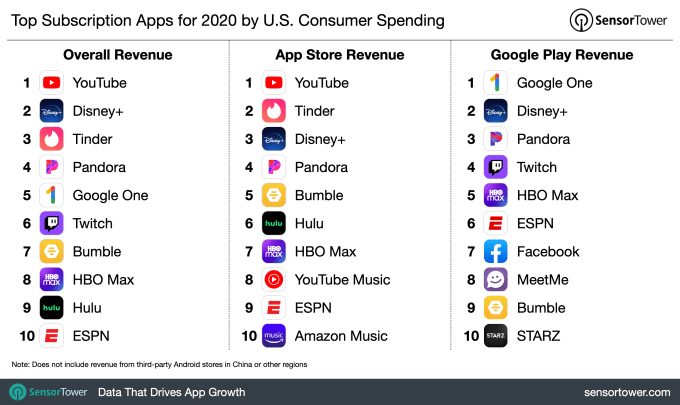
The top subscription apps in the U.S. looked different between the App Store and Google Play. On the former, YouTube was the top grosser in this category, while Google Pay users spent on Google One (Google’s cloud storage product). Tinder, meanwhile, was No. 2 on the App Store, while Disney+ took the second spot on Google Play.

Image Credits: Sensor Tower

Overall, the top 10 across both stores were YouTube, Disney+, Tinder, Pandora, Google One, Twitch, Bumble, HBO Max, Hulu, and ESPN. These top earners indicate that consumers are willing to pay for their entertainment — like streaming services — on subscription, but it’s more difficult for other categories to break into the top charts. Dating apps. however, remain an exception.

11 Feb 2021

As more insurtech offerings loom, CEO Dan Preston discusses MetroMile’s SPAC-led debut

MetroMile began trading as a public company yesterday. Its exit from the private market was accelerated by its decision to combine with a special purpose acquisition company, or SPAC.

Such transactions have exploded in popularity in recent years, bridging the gap between a host of richly-valued private companies and endless bored capital. SPACs raise cash, go public and then merge with a private entity. The SPAC then dissolves itself into the combined entity, a process that often includes an additional slug of money (PIPE) for good measure.


The Exchange explores startups, markets and money. Read it every morning on Extra Crunch, or get The Exchange newsletter every Saturday.


SPAC-led debuts can move faster than a traditional IPO, making them attractive to companies in a hurry. And with more visibility into how much capital might be raised than during a traditional public-offering pricing run, they can smooth worries amongst target-companies regarding how much cash they can attract by leaving the private-market fold.

MetroMile is hardly the final company we expect to debut this year via a SPAC. The list is long and may include fellow neoinsurance company Hippo. (Hippo declined to comment on the matter.)

But with many more SPACs coming our way, we took MetroMile’s debut as a learning moment. To that end, we got on the horn with CEO Dan Preston to chat about what the day meant for his company, and to elicit a note or two on the SPAC process for our own enjoyment.

MetroMile’s SPACtacular debut

TechCrunch asked Preston about the SPAC world and how his combination came about. He said his firm started by dipping its toe into the blank-check waters, kicking off with small set of conversations, chats that quickly gathered traction.

But don’t take that to mean that any company will elicit a similar market response. Preston said SPACs are designed for a specific class of company; namely those that want or need to share a bit more story when they go public. Younger companies, in other words, for whom a traditional S-1 filing might not be provide a sufficient summation of its potential.

11 Feb 2021

Planning 500,000 charging points for EVs by 2025, Shell becomes the latest company swept up in EV charging boom

Shell’s plan to roll out 500,000 electric charging station in just four years is the latest sign of an EV charging infrastructure boom that has prompted investors to pour cash into the industry and inspired a few companies to become public companies in search of the capital needed to meet demand.

Since the beginning of the year, three companies have been acquired by special purpose acquisition vehicles and are on a path to go public, while a third has raised tens of millions from some of the biggest names in private equity investing for its own path to commercial viability.

The SPAC attack began in September when an electric vehicle charging network ChargePoint struck a deal to merge with special-purpose acquisition company Switchback Energy Acquisition Corporation, with a market valuation of $2.4 billion. The company’s public listing will debut February 16 on the New York Stock Exchange.

In January, EVgo, an owner and operator of electric vehicle charging infrastructure, agreed to merge with the SPAC Climate Change Crisis Real Impact I Acquisition for a valuation of $2.6 billion— a huge win for the company’s privately held owner, the power development and investment company LS Power. LS Power and EVgo management, which today own 100% of the company will be rolling all of its equity into the transaction. Once the transaction closes in the second quarter, LS Power and EVgo will hold a 74% stake in the newly combined company.

One more deal soon followed. Volta Industries agreed to merge this month with Tortoise Acquisition II, a tie-up that would give the charging company named after battery inventor Alessandro Volta a $1.4 billion valuation. The deal sent shares of the SPAC company, trading under the ticker SNPR, rocketing up 31.9% in trading earlier this week to $17.01. The stock is currently trading around $15 per-share.


Not to be outdone, private equity firms are also getting into the game. Riverstone Holdings, one of the biggest names in private equity energy investment, placed its own bet on the charging space with an investment in FreeWire. That company raised $50 million in new round of funding earlier this year.

“The writing is on the wall and the investors have to take the time. There’s been a flight out of the traditional investment opportunities in markets,” said FreeWire chief executive, Arcady Sosinov, in an interview. “There’s been a flight out fo the oil and gas companies and out fo the traditional utilities. You have to look at other opportunities… This is going to be the largest growth opportunity of the next ten years.”

FreeWire deploys its infrastructure with BP currently, but the company’s charging technology can be rolled out to fast food companies, post offices, grocery stores, or anywhere where people go and spend somewhere between 20 minutes and an hour. With the Biden Administration’s plan to boost EV adoption in federal fleets, post offices actually represent another big opportunity for charging networks, Sosinov said.

“One of the reasons we find electrification of mobility so attractive is because it’s not if or how, it’s when,” said Robert Tichio, a partner at Riverstone in charge of the firm’s ESG efforts. “Penetration rates are incredibly low… compare that to Norway or Northern Europe. They have already achieved double digit percentages.”

A recent Super Bowl commercial from GM featuring Will Farrell showed just how far ahead Norway is when it comes to electric vehicle adoption. 

“The demands onc capital in the electrification of transport will begin to approach three quarters of a trillion annually,” Tichio said. “The short answer to your question is that the needs for capital now that we have collectively, politically, socially economically come to a consensus in terms of where we’re going and we couldn’t say that 18 months ago is going to be at a tipping point.”

Shell already has electric vehicle charging infrastructure that it has deployed in some markets. Back in 2019 the company acquired the Los Angeles-based company Greenlots, an EV charging developer. And earlier this year Shell made another move into electric vehicle charging with the acquisition of Ubitricity in the UK.

“As our customers’ needs evolve, we will increasingly offer a range of alternative energy sources, supported by digital technologies, to give people choice and the flexibility, wherever they need to go and whatever they drive,” said Mark Gainsborough, Executive Vice President, New Energies for Shell, in a statement at the time of the Greenlots acquisition. “This latest investment in meeting the low-carbon energy needs of US drivers today is part of our wider efforts to make a better tomorrow. It is a step towards making EV charging more accessible and more attractive to utilities, businesses and communities.”


11 Feb 2021

Maisonette is becoming a go-to brand for fashion-conscious families; here’s how

Maisonette, a four-year-old, New York-based company has aimed from the outset to become a one-stop curated shop for everything a family might need for their young children.

That plan appears to be working. Today, the company — which launched with preppy young children’s apparel and has steadily built out categories that include home decor, home furniture, toys, gear, and accessories — says it doubled its number of customers last year and tripled its revenue. Indeed, even as COVID could have crimped its style — sale of children’s dress-up clothes slowed for a time — its DIY and STEM toy sales shot up 1,400%.

Though the company keeps its sales numbers private, its growth is interesting, particularly given the unabated growth of Amazon, which became the nation’s leading apparel retailer somewhere around the end of 2018.

Seemingly, much of Maisonette’s traction owes to the trust it has built with customers, who see its offerings as high-end yet accessible relative to the many high-end fashion brands that are also increasingly focused on the children’s market, like Gucci and Burberry.

Specifically, the 75-person company has a merchandising team that prides itself on working with independent brands and surfacing items that are hard to find elsewhere.

Maisonette also launched its own apparel line roughly 30 months ago called Maison Me. Focused around “elevated basics” at a more reasonable price point, the line, made in China, is seeing brisk sales to families who buy items time and again as their kids outgrow or wear holes in them, says the company.

It helps that Maisonette’s founders have an eye for what’s chic. Cofounder Sylvana Ward Durrett and Luisana Mendoza Roccia met at Vogue magazine, where Durrett spent 15 years, joining the staff straight from Princeton and becoming its director of events (work that earned her a high profile in fashion circles). Roccia joined straight from Georgetown the same year, 2003, and left as the magazine’s accessories editor in 2008.

For those who might be curious, their former boss, Anna Wintour, is a champion of theirs. Yet they also have some other powerful advocates, including NEA investor Tony Florence, a kind of e-commerce whisperer who has also led previous investments on behalf of his firm in Jet, Goop, and Casper.

NEA is an investor in Maisonette, as is Thrive Capital and the growth-stage venture firm G Squared, which just today announced it led a $30 million round in the company that brings its total funding to $50 million.

Another ally is Marissa Mayer, who first met Durrett back in 2009 when Mayer was still known as Google’s first female engineer its most fashionable executive. Not only has their friendship endured — Mayer says she named one of her twin daughters Sylvana because she adored the name — but Mayer is on the board of Maisonette, where she has presumably helped refine its data strategy, including around an inherent advantage that the company enjoys: its very young customers.

“One of the things that’s really helpful when it comes to data and e-commerce is when you can capture people at a particular life stage,” Mayer explains. “It’s why people liked wedding registries. You get married, then you have children and [the retailer] can follow the children’s ages and start anticipating that customer’s needs and what they’re going to want two years from now.”

In terms of “predictable supply chain, for inventory selection, for just being able to meet that moment, having insight into those stages is really important and helpful,” she says. It can also be very lucrative for Maisonette as it continues to build out its business, notes Mayer,

Certainly, much is working in the company’s favor already. To Mayer’s point, Roccia says that more than half of Maisonette’s sales last year came from repeat customers. More, it already has an audience of more than 800,000 people who either receive emails from the company or follow its social media channels. (Maisonette also features a healthy dose of content at its site.)

Unlike some e-commerce businesses, Maisonette is asset-lite, too. Though it has opened a handful of pop-up stores previously and was contemplating a bigger move into retail (“that’s now on pause,” says Durrett), the company doesn’t have warehouses to manage. Instead, items are shipped directly to customers from the various retailers featured at its site.

Perhaps most meaningful of all, the company is competing in what is a massive and growing market. In the U.S. alone, the children’s apparel market is estimated to be $34 billion. Meanwhile, the children’s market is $630 billion globally. While Maisonette is selling to U.S. customers alone right now, it plans to use some of that new funding to move into international markets, says Roccia, who has been living in Milan with her own four children during the pandemic, while Durrett began working out Maisonette’s mostly empty Brooklyn headquarters in January to create a bit of space from her three.

Indeed, on a Zoom call from their far-flung locations, they talk at length about parents needing to create new space to work from home right now, as well as to update rooms for kids attending virtual school. While no one asked for a global shutdown, home decor is a “category that has picked up due to the Covid effect,” notes Roccia.

Asked what other trends the two are tracking — for example, Maisonette features the mommy-and-me clothing pairings that have become big business in recent years — Roccia says that even with the world shut down, it remains a “huge” trend. “It started with holiday pajamas — that was kind of the catalyst to this whole movement — and now swimwear and just casual dressing has become a pretty big piece of the business, too.”

As for what Durrett has noticed, she laughs. “Llamas are big. We sell a llama music player that we had to bring back on the site several times over the holidays.” Also “rainbows and unicorns. As cliche as it sounds, we literally can’t keep them in stock.”

Unicorns, she adds, “are a thing.”

11 Feb 2021

Reduct.Video raises $4M to simplify video editing

The team at Reduct.Video is hoping to dramatically increase the amount of videos created by businesses.

The startup’s technology is already used by customers including Intuit, Autodesk, Facebook, Dell, Spotify, Indeed, Superhuman and IDEO. And today, Reduct is announcing that it has raised a $4 million round led by Greylock and South Park Commons, with participation from Figma CEO Dylan Field, Hopin Chief Business Officer Armando Mann and former Twitter exec Elad Gil.

Reduct was founded by CEO Pabhas Pokharel and CTO Robert Ochshorn (both pictured above). Pokharel argued that despite the proliferation of streaming video platforms and social media apps on the consumer side, video remains “underutilized” in a business context, because it simply takes so much time to sort through video footage, much less edit it down into something watchable.

As Pokharel demonstrated for me, Reduct uses artificial intelligence, natural language processing and other technologies to simplify the process by automatically transcribing video footage (users can also pay for professional transcription), then tying that transcript to the video.

“The magic starts there: Once the transcription has been made, every single word is connected to the [corresponding] moment in the video,” he said.

Reduct.Video screenshot

Image Credits: Reduct.Video

That means editing a video is as simple as editing text. (I’ve taken advantage of a similar linkage between text and media in Otter, but Otter is focused on audio and I’ve treated it more as a transcription tool.) It also means you can search through hours of footage for every time a topic is mentioned, then organize, tag and share it.

Prabhas said that AI allows Reduct to simplify parts of the sorting and editing process, like understanding how different search terms might be related. But he doesn’t think the editing process will become fully automated — instead, he compared the product to an “Iron Man suit,” which makes a human editor more powerful.

He also suggested that this approach changes businesses’ perspective on video, and not just by making the editing process easier.

“Users on Reduct emphasize authenticity over polish, where it’s much more the content of the video that matters,” Prabhas said. He added that Reduct has been “learning from our customers” about what they can do with the product — user research teams can now easily organize and share hundreds of hours of user footage, while marketers can turn customer testimonials and webinars into short, shareable videos.

“Video has been so supply constrained, it’s crazy,” he continued. “There are all these use cases for asynchronous video that [companies] haven’t even bothered with.”

For example, he recalled one customer who said that she used to insist that team members attend a meeting even if there was only two minutes of it that they needed to hear. With Reduct, she can “give them that time back” and just share the parts they need.


11 Feb 2021

Treinta announces $500k+ in funding for its microbusiness financial app

Treinta, a startup that is part of the Winter 2021 Y Combinator cohort, announced this morning that it has raised north of half a million dollars for its bookkeeping and inventory management software aimed at Latin American small businesses.

The capital was raised between a small friends-and-family round, Y Combinator’s investment in Treinta, and another $220,000 that it closed in in early 2021.

The company, based in Bogotá, Colombia and currently sporting a team of 13, is working to bring digital transformation to the smallest of enterprises: namely single-operator small stores.

An accelerating digital transformation, the process by which companies transform aging workflows and processes into software-based rhythms, is not just for big companies. Though we often hear of large companies pursuing digital transformation efforts, Treinta is betting that tiny companies are similar to their larger siblings in needing to change how they do business.

Treinta’s concept of bringing the ability to record transactions, expenses, and track inventory to tiny companies in Latin America is proving to be a fast-growing idea. According to co-founder Lluís Cañadell, Treinta grew its monthly active users by 400% for a few months after launching on August 31, 2020. The company expected 300% growth in January and 30,000 monthly actives when we first spoke with them. The co-founder updated TechCrunch via email this week that his company actually reached the 35,000 user mark last month.

Cañadell also told TechCrunch that his company expects to keep expanding at a pace of around 100% month-over-month for a few more months. And Treinta surpassed $25 million in gross transaction volume — the value of transactions recorded in its app — a few weeks back. The startup is onto something.

How is it managing to grow so quickly? Lockdown in Colombia forced many small businesses online in a hurry. By offering what is, for many users, their first digital tool, Trenita is helping many small companies stay afloat.

Treinta plans on offering more services in time to its user base of SMB owners, including digital payments. Credit is another possibility that Cañadell mentioned to TechCrunch.

The startup has runway to get it through the end of Summer 2021, and big plans. Cañadell told TechCrunch that there are 50 million so-called microbusineses in Latin America — including Brazil, a market that Treinta has yet to expand to — of which 90% still use paper to record their business transactions. With smartphone penetration now greater than 80% in Colombia per the company, Treinta could have plenty of growth ahead of it.

I asked the company if it will participate in Y Combinator’s demo day. Cañadell said that he’s happy to talk to investors, but isn’t sure yet what his plans are. TechCrunch, of course, will be there.

11 Feb 2021

Tillit, a fintech offering buy now, pay later for B2B purchases, is closing in on investment from Sequoia

Tillit, a fintech startup that is building something akin to buy now, pay later for B2B purchases , looks set to become Sequoia’s next European investment, TechCrunch has learned.

According to multiple sources, the Silicon Valley VC — which recently expanded to Europe with an office in London — is backing a €2.5 million round in the Oslo, Norway-based company, alongside seed investors LocalGlobe and Visionaries Club. Sequoia and LocalGlobe declined to comment.

With the tagline, “Making b2b purchases a breeze” and yet to launch, Tillit appears to combine invoice financing with a buy now, pay later model, meaning that credit is offered at the point of checkout (or invoice), with a number of payment options, including instalments. In addition, Tillit offers expenses management, with a range features to make it easier for employees to make B2B purchases.

In other words, the premise is that sellers get better conversions through offering instant credit, and buyers can defer or spread out payments and have greater control and visibility over purchases.

Meanwhile, Tillit isn’t the first investment in Europe by Sequoia since it revealed that it was doubling down on Europe with a dedicated team on the ground. Most recently, the firm led a $20 million round in Xentral, a German startup that develops enterprise resource planning software covering a variety of back-office functions for online small businesses. That speaks to Sequioa’s remit to “invest throughout the journey,” from pre-seed/seed all the way to IPO and beyond.

11 Feb 2021

Intenseye raises $4M to boost workplace safety through computer vision

Workplace injuries and illnesses cost the U.S. upwards of $250 billion each year, according to the Economic Policy Institute. ERA-backed startup Intenseye, a machine learning platform, has raised a $4 million seed round to try to bring that number way down in an economic and efficient way.

The round was co-led by Point Nine and Air Street Capital, with participation by angel investors from Twitter, Cortex, Fastly, and Even Financial.

Intenseye integrates with existing network-connected cameras within facilities and then uses computer vision to monitor employee health and safety on the job. This means that Intenseye can identify health and safety violations, from not wearing a hard hat to ignoring social distancing protocols and everything in between, in real time.

The service’s dashboard incorporates federal and local workplace safety laws, as well as an individual organization’s rules to monitor worker safety in real time. All told, the Intenseye platform can identify 30 different unsafe behaviors which are common within workplaces. Managers can further customize these rules using a drag-and-drop interface.

When a violation occurs and is spotted, employee health and safety professionals receive an alert immediately, by text or email, to resolve the issue.

Intenseye also takes the aggregate of workplace safety compliance within a facility to generate a compliance score and diagnose problem areas.

The company charges a base deployment fee and then on an annual fee based on the number of cameras the facility wants to use as Intenseye monitoring points.

Cofounder Sercan Esen says that one of the greatest challenges of the business is a technical one: Intenseye monitors workplace safety through computer vision to send EHS (employee health and safety) violation alerts but it also never analyzes faces or identifies individuals, and all video is destroyed on the fly and never stored with Intenseye.

The Intenseye team is made up of 20 people.

“Today, our team at Intenseye is 20% female and 80% male and includes 4 nationalities,” said Esen. “We have teammates with MSs in computer science and teammates who have graduated from high school.”

Diversity and inclusion among the team is critical at every company, but is particularly important at a company that builds computer vision software.

The company has moved to remote work in the wake of the pandemic and is using VR to build a virtual office and connect workers in a way that’s more immersive than Zoom.

Intenseye is currently deployed across 30 cities and will use the funding to build out the team, particularly in the sales and marketing departments, and deploy go-to-market strategies.

11 Feb 2021

2up launches ahead of Valentines Day to help gamers find one another

People don’t often equate gaming with dating, but maybe they should. As gaming continues to grow in popularity, particularly in the wake of the pandemic, a new startup called 2up is launching to help gamers connect both on and off screen.

The app was founded by sibling duo Stephanie and Lincoln Smith, who have been gamers since they were young.

2up

Image Credits: 2up

2up isn’t specifically a dating app — users can specify if they’re looking for new friends, new teammates, or a romantic connection on the app. They can also share their preferred console or platform, favorite games, and whether they prefer to play games competitively or casually, filtering down their potential matches based on aligned interests.

Delightfully, 2up is designed with an old-school 8-bit aesthetic.

The startup plans on generating revenue through a premium subscription, not unlike other matching and dating apps. A premium subscription will provide unlimited swiping, as well as Charms. Charms are the equivalent of a Super Like, helping users get the attention of someone they’re interested in matching with.

At launch, one month of premium 2up will cost $19.99, six months costs $12.49 per month, and a yearly subscription costs $8.49 per month.

2up also has quests, which rewards people for using the app on a daily basis and completing monthly engagement goals. Those who complete quests will be entered into a raffle to win a real-world prize like a gaming headset, gaming chair or even a new console.

“2up is one network that unites gamers,” said Stephanie Lincoln. “There are so many different consoles, and there are all these different forums and communities. We wanted to unify everything and put everyone in one place. We knew that there was a need for something that was a more intimate. We wanted to deliver a way for that same community to connect one-on-one, on screen and off screen, to bring people together.”

2up has been bootstrapped since its inception.