Year: 2021

11 Feb 2021

401(k) provider Human Interest doubles valuation with $55M fundraise

Human Interest, a 401(k) provider for small and medium-sized businesses (SMBs), announced Thursday that it has tacked on another $55 million to its Series C.

The news is notable for a couple of reasons. For one, the San Francisco-based company had already raised $50 million across two tranches in 2020. Secondly, the majority of its existing backers (about 40 of 55) joined one new investor — NEA spinout NewView Capital (NVC) — in pumping more capital into Human Interest.

And last but definitely not least, the latest extension — which closed in December but is only now being publicly announced — effectively doubles Human Interest’s valuation from its financing a few months prior. 

CEO Jeff Schneble would not disclose the company’s current valuation, but he did say Human Interest “is now in the position of becoming a unicorn” the next time it raises, if that round “follows the same step-ups as the last couple” of financings.

With this latest extension, Human Interest has now raised a total of $136.7 million since its 2015 inception.

Human Interest’s growth has been impressive. It’s gone from adding about $100,000 a month in net new revenue in early 2019 to now adding more than $1 million a month in net new revenue, according to Schneble. The startup’s goal is to get to over $2 million a month by year’s end.

“We’ve grown about 10 times in the past 18 months or so, and we’re not going to stop here,” he told TechCrunch. “Our goal is to get to $100 million-plus ARR [annual recurring revenue] in the next three years so that we can go public in the next three to four years.”

Since its launch, Human Interest says it has helped nearly 3,000 businesses across America to offer retirement accounts to their more than 80,000 employees.

The COVID-19 pandemic was challenging, but led to an interesting shift in the company’s business. Pre-2020, about 85% of its customers were first-time 401(k) users. Last year, that number dropped to about 50%. This means that more companies moved from existing plans to Human Interest.

“Given there was a recession and a lot of uncertainty, it was a much easier pitch, considering we could offer a more affordable product,” Schneble said.

Human Interest says it works with “every kind of SMB” — from tech startups to law offices, from dentists to dog walkers, manufacturing firms and social justice nonprofits. Customers include a San Francisco Bay Area electrician company, a Denver-based  pizza chain and a Seattle-based chain of gas stations and convenience stores.

Despite being just a few years old, Schneble said the company doesn’t view itself as a startup.

“We want to build a really big company that will be around for decades, and can go public,” he said. “If we were trying to sell the company, we might be doing this differently.”

Currently, Human Interest has about 300 employees, up from a little over 100 a year ago. It plans to double the size of its engineering team this year.

Looking ahead, Schneble said the company is simply out “to do more of the same.”

“We don’t need new products,” he told TechCrunch. “There’s so much runway just doing what we’re doing, and that’s taking market share from others.”

It also plans to focus on improving the technology on its platform, which it moved from a third-party provider to in-house in 2020. The move led the company to double its margins over the past six months while eliminating transaction fees for plan administrators and participants, according to Schneble. 

“Often financial services products get worse as you go,” he said. “We want to be the opposite, and this year are focused on making our platform as awesome as it can be.”

Human Interest says it also launched new offerings, Complete and Concierge, last year in an effort to simplify retirement plan administration andmake retirement savings accessible to people in all lines of work.

“The big incumbents haven’t figured out how to make plans affordable and accessible for smaller companies,” Schneble said. “We knew that to make a permanent dent in this country’s retirement crisis, we had to do something different.” 

The 401(k) space is indeed a growing one. Last July San Mateo-based Guideline — which is also focused on SMBs — announced an $85 million Series D round co-led by Al Gore’s Generation Investment Management and Greyhound Capital. It was later revealed that American Express Ventures had joined the financing as an investor.

With more than $2 billion in assets under management, new investor NewView Capital (NVC) — which also backed Plaid — aims to match late-stage funding with “significant operational support.” 

NewView founder and Managing Partner Ravi Viswanathan said he was impressed by how the company simplifies the process and administration for SMBs to offer 401(k)s and “is able to do so at lower fees through software and automation.”   

The NewView team was also drawn to the company’s desire to make offering a 401(k) accessible for more employers. In a blog post, Ankit Sud and Christina Fa wrote:

“Traditional 401(k) providers like Vanguard and Fidelity designed and priced their plans for large businesses. The administrative burden and high fees make it unaffordable for small business owners. In fact, only 10% of small to mid-sized businesses (SMBs) offer 401(k) plans to their workforce, despite employing one-third of the working population…Human Interest brings simple, affordable 401(k) plans to the 90% of small businesses that do not offer retirement plans today. “

11 Feb 2021

401(k) provider Human Interest doubles valuation with $55M fundraise

Human Interest, a 401(k) provider for small and medium-sized businesses (SMBs), announced Thursday that it has tacked on another $55 million to its Series C.

The news is notable for a couple of reasons. For one, the San Francisco-based company had already raised $50 million across two tranches in 2020. Secondly, the majority of its existing backers (about 40 of 55) joined one new investor — NEA spinout NewView Capital (NVC) — in pumping more capital into Human Interest.

And last but definitely not least, the latest extension — which closed in December but is only now being publicly announced — effectively doubles Human Interest’s valuation from its financing a few months prior. 

CEO Jeff Schneble would not disclose the company’s current valuation, but he did say Human Interest “is now in the position of becoming a unicorn” the next time it raises, if that round “follows the same step-ups as the last couple” of financings.

With this latest extension, Human Interest has now raised a total of $136.7 million since its 2015 inception.

Human Interest’s growth has been impressive. It’s gone from adding about $100,000 a month in net new revenue in early 2019 to now adding more than $1 million a month in net new revenue, according to Schneble. The startup’s goal is to get to over $2 million a month by year’s end.

“We’ve grown about 10 times in the past 18 months or so, and we’re not going to stop here,” he told TechCrunch. “Our goal is to get to $100 million-plus ARR [annual recurring revenue] in the next three years so that we can go public in the next three to four years.”

Since its launch, Human Interest says it has helped nearly 3,000 businesses across America to offer retirement accounts to their more than 80,000 employees.

The COVID-19 pandemic was challenging, but led to an interesting shift in the company’s business. Pre-2020, about 85% of its customers were first-time 401(k) users. Last year, that number dropped to about 50%. This means that more companies moved from existing plans to Human Interest.

“Given there was a recession and a lot of uncertainty, it was a much easier pitch, considering we could offer a more affordable product,” Schneble said.

Human Interest says it works with “every kind of SMB” — from tech startups to law offices, from dentists to dog walkers, manufacturing firms and social justice nonprofits. Customers include a San Francisco Bay Area electrician company, a Denver-based  pizza chain and a Seattle-based chain of gas stations and convenience stores.

Despite being just a few years old, Schneble said the company doesn’t view itself as a startup.

“We want to build a really big company that will be around for decades, and can go public,” he said. “If we were trying to sell the company, we might be doing this differently.”

Currently, Human Interest has about 300 employees, up from a little over 100 a year ago. It plans to double the size of its engineering team this year.

Looking ahead, Schneble said the company is simply out “to do more of the same.”

“We don’t need new products,” he told TechCrunch. “There’s so much runway just doing what we’re doing, and that’s taking market share from others.”

It also plans to focus on improving the technology on its platform, which it moved from a third-party provider to in-house in 2020. The move led the company to double its margins over the past six months while eliminating transaction fees for plan administrators and participants, according to Schneble. 

“Often financial services products get worse as you go,” he said. “We want to be the opposite, and this year are focused on making our platform as awesome as it can be.”

Human Interest says it also launched new offerings, Complete and Concierge, last year in an effort to simplify retirement plan administration andmake retirement savings accessible to people in all lines of work.

“The big incumbents haven’t figured out how to make plans affordable and accessible for smaller companies,” Schneble said. “We knew that to make a permanent dent in this country’s retirement crisis, we had to do something different.” 

The 401(k) space is indeed a growing one. Last July San Mateo-based Guideline — which is also focused on SMBs — announced an $85 million Series D round co-led by Al Gore’s Generation Investment Management and Greyhound Capital. It was later revealed that American Express Ventures had joined the financing as an investor.

With more than $2 billion in assets under management, new investor NewView Capital (NVC) — which also backed Plaid — aims to match late-stage funding with “significant operational support.” 

NewView founder and Managing Partner Ravi Viswanathan said he was impressed by how the company simplifies the process and administration for SMBs to offer 401(k)s and “is able to do so at lower fees through software and automation.”   

The NewView team was also drawn to the company’s desire to make offering a 401(k) accessible for more employers. In a blog post, Ankit Sud and Christina Fa wrote:

“Traditional 401(k) providers like Vanguard and Fidelity designed and priced their plans for large businesses. The administrative burden and high fees make it unaffordable for small business owners. In fact, only 10% of small to mid-sized businesses (SMBs) offer 401(k) plans to their workforce, despite employing one-third of the working population…Human Interest brings simple, affordable 401(k) plans to the 90% of small businesses that do not offer retirement plans today. “

11 Feb 2021

TikTok emerges as a political battleground in Navalny-stirred Russia

TikTok has crafted a number of policies over the years to distance itself from the often-messy political fray, but its users continue to have other agendas in mind.

In Russia, a tug-of-war has emerged on the social network.

On one side are young people using the app to create videos in support of free speech, rallying the public against the government and its treatment of Alexander Navalny, the anti-Putin, anti-corruption politician and activist.

On the other is a government that has quickly versed itself in the art of video messaging — tapping and allegedly paying influencers to dissuade the masses from joining them.

Navalny’s long-term battle with Putin’s government has included political run-ins, imprisonments and a poisoning (with an evacuation to Germany to heal), followed by a return to Russia, subsequent arrest and conviction for violating a previous parole.

Through all of that, Navalny has taken on the mantle of anti-authoritarian hero. With many already unhappy about how the government is handling a weak economy and COVID-19 — a situation that has shaken (but, apparently, not completely toppled) government approval ratings — Navalny’s call for mass protests has been met with a strong response.

And as those protests unfold, TikTok is shaping up to be the scrappy social media analogue of that activity — not unlike the prominent role that Twitter took on during the Arab Spring.

“Political content is not typical for Russian TikTok,’’ said food blogger Egor Khodasevich, whose @kushat_hochu account has 1.2 million followers on the app. “Before Navalny’s return, Russian TikTok was all about dancing, pranks and post-Soviet trash aesthetics. All of a sudden, political videos have started to appear across all categories — humour, beauty, sport.’’

Now, in a significant turnaround, Russian content on the app is being flooded with catchy videos of teenagers cutting their passports in half and throwing them away, pupils taking down portraits of Putin and swapping them with those of Navalny, and others creating how-to’s for would-be protestors — advising them to wear warm clothes, to equip themselves with water and power banks and, if arrested, to pretend they are foreign.

@almorozova#навальный #свободунавальному быть против власти – не значит быть против Родины♬ оригинальный звук – новый год кончился…

These are pooling around hashtags like #23января (January 23, the date of one of the biggest protests so far) and #занавального (“For Navalny”).

The wave of videos even got shout-outs from Navalny himself — fittingly, not on TikTok, but Instagram, where he praised the TikTok activists for helping get the word and the crowds out.

“Respect to the schoolchildren who, according to my lawyer, caused a frenzy on TikTok,” he noted on one post. Later he poked fun at how the TikTok protest videos were described as “fakes” planted by dastardly Americans.

Russia as a country has a small but fast-growing and vocal group of TikTok users.

Figures provided to us from SensorTower estimate that of the more than 2.66 billion times to date globally that TikTok has been downloaded (a figure that includes its Chinese version Douyin), it has been installed about 93.6 million times in Russia (figures that don’t count third-party Android stores, direct downloads or sideloads).

A report in the Moscow Times from the end of December estimates that there are around 20 million active users in the country, more than double the 8 million it had at the end of 2019. TikTok itself does not disclose current MAUs in Russia or globally, but analysts have projected that the company is on track to pass 1 billion MAUs sometime in the early part of this year.

Even with those sub-100 million numbers, videos with the Navalny hashtag have passed 1 billion views on the platform (as of the time of publishing, the number of views has passed 1.6 billion).

The Empire Strikes Back…

But Russia is nothing if not persistent when it comes to being ahead of the game in tech, and it has been harnessing the media world in a couple of ways in aid of its own ends.

State television and other state media outlets strongly encouraged people to stay away from protests, citing issues like public safety, the spread of Covid-19, and the threat of arrest (one they followed through on: authorities have carried out controversial mass arrests of hundreds of people at these gatherings).

At the same time, attention turned to social media, and in particular TikTok.

Roskomnadzor first confirmed that it would fine all major social media platforms up to 4 million rubles ($54,000) over protest-related content, citing that “these Internet platforms failed to remove a total of 170 illegal appeals in a timely manner.”

It then followed that up with an order to the management teams of TikTok, Facebook, Telegram and Vkontakte to appear at the regulators’ offices to explain why they have not yet removed offending videos, reminding them that failure to comply will mean that fines will be increased to 10% of a company’s annual revenues, dangling the threat that non-compliance could mean services get blocked.

With TikTokers claiming they were being called in by the police after their videos were taken down, TikTok more directly started to get threatened with fines by the regulator in the wake of all this.

As with previous moves to censor online platforms, investigators explained their actions as a response to societal impact. In this case, regulators described protest videos as a coordinated criminal attempt to get minors to commit illegal acts that could endanger their safety.

In addition to all that, the state appeared to take on a guerilla approach, too.

Small accounts, newly created accounts and popular bloggers slowly all started posting videos persuading people away from the protests. These videos, in Russian, warn of the dangers of protesting.

It turns out that at least some of the people posting videos were quietly getting paid. Sums ranged from 2,000 rubles, or about $25, through to 5,000 rubles, according to one TikToker who declined the offer and posted the proposal on TikTok instead.

(Those figures may not sound very high, but they can still be welcome sums for young people in a country where the average salary as of 2019 is around $718 per month.)

It hasn’t taken long for the situation to get unmasked. Several videos criticizing protests have been removed in the last week. It’s unclear whether TikTok — which declined to comment for this article — or the original creators removed them.

But in one case, a TikToker who goes by the name @golyakov_ (741,000 followers) initially posted a stream of reasons why protesting was dangerous. He then later admitted to getting paid but claimed to believe in what he was saying (perhaps one reason why the video has stayed up?).

Startok, one of the agencies that represents social media influencers, confirmed to us that it has cut ties with two of the creators who had taken payments to make videos in support of the state.

TikTok’s immediate connection and current popularity with younger adults has made  it unique in the social media pantheon. However, it wasn’t the only social media platform seeing anti-Navalny activity — both in terms of messaging, and entities soliciting posts for payments.

A Navalny assistant posted this thread on Twitter of Stories from Instagram casting doubt on Navalny’s decision to return to Russia as a publicity stunt, knowing he would be arrested.

Meanwhile, Boris Kantorovich, a sales director of social media agency Avtorskiye Media who has used Twitter to post about people getting detained, noted that he also came across briefs on Telegram chat ADvizer.me, as well as in a Facebook group that required bloggers to create a video with one or two talking points. He said included “protesters provoked the police at the rally,” “we are tired of Navalny” and “we want peace and quiet.”

When Kantorovich posed as one of the TikTokers that he represents, he received a brief for a 15-second video. “After a quick negotiation I hiked the price up from 2,000 rubles to 3,500 rubles,” he said.

Further creative briefs came with the guidance that they needed to condemn protests on 31 January and 2 February, the second being the date of Navalny’s trial.

“Bloggers should say that ‘Navalny will go to jail 100%’, he is ‘funded from the West’ and ‘his recent imprisonment is legal,” Kantorovich said.

Kantorovich added that authorities didn’t reach out to his agency Avtorskiye Media to advertise with the bloggers it works with: “We clearly mark all ads but authorities don’t like it, because they are trying to create an illusion of a public opinion,” he said.

Similar information was shared by Anatoly Kapustin with the “Picture” advertising agency.

Kapustin, speaking in an interview on non-State-owned Russian TV station Rain, named the “public organization for youth affairs” as an advertiser.

“Talking points on offer were: ‘criminal charges could be brought against protesters,’ ‘you might end up in jail and then not find well-paid jobs,’ and ‘Navalny’s children are studying in America,’” he said in the interview.

In some cases, the virality tricks that TikTok is known for have been used by protestors to turn some of those pro-government campaigns around.

After a wave of people created videos based on the same clip of music that repeats in a deep voice that TikTok is not a place for politics, it’s a place for [fill in a fun and non-political activity/video here] — the audio and hashtag were hijacked by protestors seeking to encourage people to embrace free speech and not silence their voices.

TikTok declined to comment for this story, but in general the company has made it a policy not to wade into partisan politics, or to make a space for political advertising, turning its platform into a commercial opportunity to get political points across.

It declined to comment on whether it was taking down videos that might be reported as possible paid advertising by viewers, nor would it comment on whether it had responded to any government requests to remove videos. It periodically publishes transparency reports where some of that detail, and its subsequent actions, can be found, after the fact. (It judges each request individually.)

One thing that the Navalny situation has exposed is that there is a strong appetite among younger people to be more politically engaged, and for the moment, TikTok is emerging as their preferred place to do that.

Khodasevich, the food blogger, thinks TikTok can replace Twitter as a platform of choice for the opposition in Russia.

“Thanks to its clever algorithms, TikTok can show your video to a bigger audience than YouTube or Instagram, even if you don’t pay for promotion,” he said in an interview. “TikTok representatives told me political videos without direct calls for protests will not get banned.’’

It means that, with a bit of creativity — and a very heavy dose of opportunism and cynicism — both sides might still be able push forward with their political agenda. Boris Kantorovitch agrees.

“Authorities will change their strategy and become more subtle,” he said. “They acted in haste. Probably they thought of TikTok as a good breeding ground for loyalists. Now, the only way to stop people talking about politics on TikTok is by banning access to this platform.’’

Or, if you can’t beat them, join them? The last few days have seen government organizations the Ministry of Foreign Affairs and the Ministry of Emergency Situations joining the platform to give the public a glimpse into how they, too, can roll with it.

@mchs.russiaВы только посмотрите, что могут наши сотрудники! Отправляйте свою реакцию в комментариях!Спасибо за предоставленное видео @@anatoly.doletsky♬ оригинальный звук – МЧС России

Some of the content is not exactly subtle — the Foreign Affairs almost immediately used its new account to post a TikTok discrediting Navaly — but more generally, these are signs that the government is all too aware of the impact the platform is having to galvanize people against it, and it’s trying various things to fight that.

So did TikTok really manage to bring a considerable number of young people to rallies? Are we witnessing a birth of a new protest movement or yet another example of one click activism?

According to a poll conducted on 23 January by TV Rain in Moscow, 44% percent of protesters took to the streets for the first time ever. Only 10% of respondents were under the age of 18, with an average age of protesters hovering around 31 years old, showing an overlap with the audience using TikTok in the country.

Other major movements (such as last year’s run of BLM activism) point to 18-34 being the biggest age demographic among protestors (albeit, worth noting strong participation among other ages, too). With that in mind, it seems that both authorities and opposition in Russia will try to use the social media platforms most popular among that age group to recruit their new foot soldiers.

Of course, as with everything on social media, Khodasevich added, it’s sometimes hard to figure out everyone’s actual agenda. Some political posts are genuine, some could be attributed to “news jacking.” But ultimately, they are sparking a lot of attention that the government is now mobilizing to counteract.

And with another critical Navalny hearing coming up on February 15th, as well as the September 2021 state Duma elections being only months away, the stakes are high for whatever political battles come next.


11 Feb 2021

UpEquity raises $25 million in equity and debt for its cash-pay mortgage lending service

With a stated goal of aligning the mortgage industry with consumer interests, Austin-based UpEquity has raised $25 million in equity and debt funding to expand its business.

Chief executive Tim Herman started the mortgage lending company to take advantage of what he saw as inefficiencies in the $2 trillion U.S. housing market.

Existing financial services and property technology companies treat the symptom and not the cause of market inefficiencies, said Herman.

The company makes free cash offers but charges 2.5% on the loans it makes to homebuyers to give them the cash they need to make an offer before having to go through the traditional process of taking out a home loan through a bank. Then the homeowners can make payments directly to UpEquity to pay off the mortgage on the house.

“Our cash offer works like a guarantee that during the escrow period we will be able to get the mortgage in place,” Herman said.

A U.S. Naval Academy graduate and former fighter pilot, Herman saw real estate as the only avenue to true wealth creation open to him and his family given their years on the road and lack of available investment capital.

After the Navy, Herman went to Harvard Business School and met his co-founder Louis Wilson. It was in Boston while in B-School that the two men started UpEquity.

They since relocated to Austin because of its booming housing market and relatively more relaxed regulatory environment.

Ultimately, the pitch to customers is the ability to make an all-cash offer, which dramatically improves the likelihood of closing on a house. It’s a luxury that roughly 90 percent of Americans can’t afford, Herman said. There’s no downside for selling homeowners, if a purchaser doesn’t end up buying the home then UpEquity owns the house.

Of all of the 300 deals the company has done so far, only two have failed.

That’s why a company like UpEquity can raise $7.5 million in venture and $17.5 million in venture debt to start making loans.

The company’s A round was led by Next Coast Ventures and UpEquity said it would use the money to fund product development that can slash the time-to-close for the real estate agents that act as the company’s sales channel to ten days.

“Our goal is to finally align the mortgage industry with consumer interests,” said UpEquity Co-Founder and CEO Tim Herman. “This funding is validation that consumers, real estate agents and venture investors understand the power of removing friction from the homebuying process, not only for personal advancement, but to attain the American Dream.”

So far the company has expanded its operations from Texas into Colorado, Florida and California, where it has originated $100 million in mortgages in 2020.

“As real estate continues to evolve in the face of limited supply and tight competition, UpEquity is at the helm of PropTech’s growing capabilities,” said Thomas Ball, managing director at Next Coast Ventures. “Most innovation has focused on the front end, but until now, nobody has expedited what happens after the borrower submits an application. UpEquity has the team, talent and technology to not only succeed, but to disrupt and emerge as the leader in the mortgage lending marketplace.”


11 Feb 2021

EV charging stations, biofuels, the hydrogen transition and chemicals are pillars of Shell’s climate plan

Royal Dutch Shell Group, one of the largest publicly traded oil producers in the world, just laid out its plan for how the company will survive in a zero-emission, climate conscious world.

It’s a plan that rests on five main pillars that include the massive rollout of electric vehicle charging stations; a greater emphasis on lubricants, chemicals, and biofuels; the development of a significantly larger renewable energy generation portfolio and carbon offset plan; and the continued development of hydrogen and natural gas assets while slashing oil production by 1% to 2% per year and investing heavily in carbon capture and storage.

These four large categories cut across the company’s business operations and represent one of the most comprehensive (if high level) plans from a major oil company on how to keep their industry from becoming the next victim of the transition to low emission (and eventually) zero emission energy and power sources (I’m looking at you, coal industry).

“Our accelerated strategy will drive down carbon emissions and will deliver value for our shareholders, our customers and wider society,” said Royal Dutch Shell Chief Executive Officer, Ben van Beurden, in a statement.

To keep those shareholders from abandoning ship, the company also committed to slashing costs and boosting its dividend per share by around 4% per year. That means giving money back to investors that might have been spent on expensive oil and gas exploration operations. The company also committed too pay down its debt and make its payouts to shareholders 20% to 30% of its cash flow from operations. That’s… very generous.

gas vs electric vehicles

Image Credits: Bryce Durbin

The Plan

Shell is a massive business with more than 1 million commercial and industrial customers and about 30 million customers coming to its 46,000 retail service stations daily, according to the company’s own estimates. The company organized its thinking around what it sees as growth opportunities, energy transition opportunities, and then the gradual obsolescence of its upstream drilling and petroleum production operations.

In what it sees as areas for growth, Shell intends to invest around $5 billion to $6 billion to its initiatives including the development of 500,000 electric vehicle charging locations by 2025 (up from 60,000 today) and an attendant boost in retail and service locations to facilitate charging.

The company also said it would be investing heavily in the expansion of biofuels and renewable energy generation and carbon offsets. The company wants to generate 560 terawatt hours a year by 2030, which is double the amount of electricity it generates today. Expect to see Shell operate as an independent power producer that will provide renewable energy generation as a service to an expected 15 million retail and commercial customers.

Finally the company sees the hydrogen economy as another area where it can grow.

In places where Shell already has assets that can be transitioned to the low carbon economy, the company’s going to be doubling down on its bets. That means zero emission natural gas production and a trebling down on chemicals manufacturing (watch out Dow and BASF). That means more recycling as well, as the company intends to process 1 million tons of plastic waste to produce circular chemicals.

Upstream, which was the heart of the oil and gas business for years, the company said it would “focus on value over volume” in a statement. What that means in practice is looking for easier, low cost wells to drill (something that points to the continued importance of the Middle East in the oil economy for the foreseeable future). The company expects to reduce its oil production by around 1% to 2% per year. And the company’s going to be investing in carbon capture and storage to the tune of 25 million tons per year through projects like the Quest CCS development in Canada, Norway’s Northern Lights project, and the Porthos project n the Netherlands.

“We must give our customers the products and services they want and need – products that have the lowest environmental impact,” van Beurden said in a statement.”At the same time, we will use our established strengths to build on our competitive portfolio as we make the transition to be a net-zero emissions business in step with society.”

Money or finance green pattern with dollar banknotes. Banking, cashback, payment, e-commerce. Vector background.

Money talk

For the company to survive in a world where revenues from its main business are cut, it’s also going to be keeping operating expenses down and will be looking to sell off big chunks of the business that no longer make sense.

That means expenses of no more than $35 billion per year and sales of around $4 billion per year to keep those dividends and cash to investors flowing.

“Over time the balance of capital spending will shift towards the businesses in the Growth pillar, attracting around half of the additional capital spend,” the company said. “Cash flow will follow the same trend and in the long term will become less exposed to oil and gas prices, with a stronger link to broader economic growth.”

Shell set targets for reducing its carbon intensity as part of the pay that’s going to all of the company’s staff and those targets are… eye opening. It’s looking at reductions in carbon intensity of 6-8% by 2023, 20% by 2030, 45% by 2035 and 100% by 2050, using a baseline of 2016 as its benchmark.

The company said that its own carbon emissions peaked in 2018 at 1.7 giga-tons per year and its oil production peaked in 2019.

The context

Shell’s not taking these steps because it wants to, necessarily. The writing is on the wall that unless something dramatic is done to stop fossil fuel pollution and climate change, the world faces serious consequences.

A study released earlier this week indicated that air pollution from fossil fuels killed 18% of the world’s population. That means burning fossil fuels is almost as deadly as cancer, according to the study from researchers led by Harvard University.

Beyond the human toll directly tied to fossil fuels, there’s the huge cost of climate change, which the U.S. estimated could cost $500 billion per year by 2090 unless steps are taken to reverse course.

11 Feb 2021

Capitalize, a startup that wants to make it easy to roll over your 401(k), closes on $12.5M Series A

If you’ve ever left a job, chances are you left your 401(k) plan along with it.

And, if you’re like many Americans and change jobs every few years or so, you could have multiple 401(k) plans spread out at various companies, doing their own thing.

Many of us don’t deal with the hassle of trying to consolidate accounts, which can lead to lost money over many years.

Enter Capitalize. The New York-based startup aims to address this very problem with a platform that it claims makes it virtually painless to locate misplaced 401(k) accounts, select and open individual retirement accounts (IRAs) and consolidate retirement plans — for free. 

And it’s just raised $12.5 million in a Series A round to help grow that platform. Canapi Ventures led the round, with participation from existing backers including Bling Capital, Greycroft, RRE  Ventures and Walkabout Ventures. 

Australian-born Gaurav Sharma co-founded the company after years of working in traditional finance.

“While I enjoyed investing, I started peeling back the layers and saw a host of systemwide problems with the 401(k) market,” he recalls. “One of those being that our accounts are tied to our employers.”

Sharma said that about one-third of the people who change jobs end up cashing out their 401(k) plans, and paying the related penalties.

“Another several million leave it behind for an extended period of time, ultimately because it’s complicated to move the money,” he said.

Sharma teamed up with CTO Chris Phillips in late 2019 to form Capitalize, which went on to raise a $2 million seed round last March led by Bling Capital. Since its formal launch last September, the rollover platform has processed almost $10 million in volume.  

“There were a lot of layoffs during the summer last year as a result of the pandemic,” Sharma said. “So a lot of our early users while we were in beta were people who had been impacted by those layoffs.”

I was curious about how Capitalize’s offering differs from the services that financial advisors provide. According to Sharma, the difference lies in the process and eligibility requirements.

“If you have an advisor, they will help you do some of this but in a really manual way, whereas we have built an online platform to help consumers find and consolidate retirement accounts,” Sharma told TechCrunch. “And usually, you have to have a few hundred thousand in assets to even get an advisor.”

That was one of the things that motivated Sharma.

“Whether you have $500 or $500,000 in assets, we’ll help you,” he said.

As mentioned above, Capitalize’s service is free to consumers, who can go to the site and let the company manage the consolidation process for them. If they need to open an IRA, the platform can help them do that, too.

“We help them compare IRAs from leading fintech providers and established institutions,” Sharma explained. If Capitalize has forged a commercial relationship with one of those providers, it is compensated by them for the referral in a model that is similar to NerdWallet, PolicyGenius and Credit Karma.

And if they already have an IRA, Capitalize will still help with consolidation.

Capitalize also offers employers a free onboarding service to help departing employees “roll over quickly at the point of job change,” Sharma said. 

“This is also great for the employer, who can save money on administrative fees and reduce fiduciary risk,” he added.  

Canapi Venture partner Jeffrey Reitman said his fintech venture fund, which has about 43 banks as LPs, was attracted to a number of things about Capitalize’s team and platform. 

First off, he described Sharma as “one of the best early-stage CEOs” he’s seen when it comes to recruiting, company building and decision making.

Canapi also had one of its VPs and family members try out the product in its early beta format.

They said, according to Reitman, that the platform “worked like magic and removed so much friction in the process.”

“So when you have a team member that has such a strong reaction to it, that’s such a validator of what it can be at scale,” he told TechCrunch. “That made it a bit of a no-brainer for us.”

Besides also being drawn to the company’s “mission-driven” approach, Reitman noted that about 80% of its existing bank LP base has existing IRA and individual retirement account products.

“Many of them are digital in nature, we believe there should be a lot of synergies between what banks are trying to accomplish as they further digitize their product suite and what Capitalize is looking to accomplish in reducing friction for as many people as possible in that process.”

Looking ahead, Capitalize plans to use its new capital to refine and streamline its product, and continue to invest in technology.

11 Feb 2021

Goldman Sachs and Sesame Workshop pour money into this edtech firm’s newest fund

Shauntel Garvey and Jennifer Carolan liked edtech before the sector was cool, so the duo co-founded Reach Capital in 2015 with a $53 million debut fund. The San Francisco-based venture firm has since put checks into education startups including Newsela, Sketchy, ClassDojo and Outschool, landing six exits so far.

Now, after seeing its portfolio accelerate in the wake of the coronavirus, Reach is announcing its third fund aimed at backing edtech startups. Reach Capital III is a $165 million fund, the firm’s biggest to date. Reach’s team, which also includes Chian Gong, Wayee Chu and Esteban Sosnik, started raising the investment vehicle over the summer. New LPs in the fund include Sesame Workshop, National Geographic, Kaiser Foundation Hospitals and Goldman Sachs.

The Reach Capital team. Image Credits: Reach Capital

Reach plans to reserve half of its fund for follow-on investments for its startups, and the other half will go toward net-new investments. The firm intends to back 20 startups through Reach III, targeting about 15% ownership in each deal.

The edtech market raked in more than $10 billion in venture capital investment globally in 2020, but for students, parents and teachers, the past 12 months were defined more by its scramble than its surge. Reach as well as other firms have the opportunity to back startups that could change the broken bits, which is no easy feat.

Carolan, who taught in Chicago public schools for seven years before joining venture, said that the entire education system’s restructure has opened the door for more innovation and opportunities.

“What parents were experiencing with remote learning was the result of underinvestment in edtech for a long time,” she said. “The companies that were adopted to meet the ends were fragmented, many of the products were inoperable and many of them were built for the home school market and repurposed for schools.” Now, Carolan sees opportunity in the fact that more students have digital devices due to 1:1 technology infrastructure in schools.

“There has never been a more exciting time to be investing in education,” she said. Reach plans to back companies across edtech subsectors, from early childhood to K-12 to post-secondary learning. The firm is also joining a number of investors betting on lifelong learning, a term being used to describe education opportunities outside of a traditional classroom context.

Reach is one of the few venture capital firms that specifically back edtech companies. Others in the category include Owl Ventures, which closed $585 million in a pair of investment vehicles in September, and Learn Capital, which closed $132 million in December.

The pandemic has opened the software market in education and we’re just in the beginning of that opening,” Carolan said. “Education has gone from let’s hire 10 instructional coaches to let’s adopt some software to do that.”

11 Feb 2021

SuperAnnotate, a computer vision platform, partners with with open-source to spread visual ML

SuperAnnotate, a NoCode computer vision platform, is partnering with OpenCV, a non-profit organization that has built a large collection of open-source computer vision algorithms. The move means startups and entrepreneurs will be able to build their own AI models and allow cameras to detect objects using machine learning. SuperAnnotate has so far raised $3M to date from investors including Point Nine Capital, Fathom Capital and Berkeley SkyDeck Fund.

The AI-powered computer vision platform for data scientists and annotation teams will provide OpenCV AI Kit (OAK) users with access to its platform, as well as launching a computer vision course on building AI models. SuperAnnotate will also set up the AI Kit’s camera to detect objects using machine learning and OAK users will get $200 of credit to set up their systems on its platform. 

The OAK is a multi-camera device that can run computer vision and 3D perception tasks such as identifying objects, counting people and measuring distances. Since launching, around 11,000 of these cameras have been distributed.

The AI Kit has so far been used to build drone and security applications, agricultural vision sensors or even COVID-related detection devices (for example, to identify people whether someone is wearing a mask or not).

Tigran Petrosyan, co-founder and CEO at SuperAnnotate said in a statement that: “Computer vision and smart camera applications are gaining momentum, yet not many have the relevant AI expertise to implement those. With OAK Kit and SuperAnnotate, one can finally build their smart camera system, even without coding experience.”

Competitors to SuperAnnotate include Dataloop, Labelbox, Appen and Hive
.

11 Feb 2021

How African startups raised investments in 2020

The venture capital scene in Africa has consistently grown, with an influx of capital from local and international investors reaching unprecedented heights in recent years. To understand how much growth has occurred, African startups raised a meagre $400 million in 2015 compared to the $2 billion that came into the continent in 2019, according to Africa-focused fund Partech Africa.

However, that figure isn’t the only yardstick. With other outlets like media publications WeeTracker and Disrupt Africa disclosing different results for the African venture capital market, we compared and contrasted their results last year. The result of that investigation detailed differences in methodology, as well as similarities.

In comparison to Partech’s $2 billion figure for 2019, WeeTracker estimated that African startups raised $1.3 billion while Disrupt Africa, $496 million for the same year.

It was expected that these figures would increase in 2020. But with the pandemic bringing in utter confusion and panic, companies downsized as investors re-strategized, and due diligence slowed during the first few months of the year. Also, new predictions came into light in May with some pegging expected deals to close between $1.2 billion and $1.8 billion by the end of the year.

Investments did pick up, and from July, VC funding on the continent had a bullish run until December. Although 2020 didn’t witness the series of mammoth deals in 2019 and didn’t reach the $2 billion mark, it proved to be a good year for acquisitions. Sendwave’s $500 million purchase by WorldRemit; Network International buying DPO Group for $288 million; and Stripe’s larger than $200 million acquisition of Paystack were high-profile examples.

To better understand how VCs invested in Africa during 2020, we’ll look into data from Partech Africa, Briter Bridges and Disrupt Africa.

Behind the numbers

In 2019, Partech Africa reported that a total of $2 billion went into African startups. For 2020, the number dropped to $1.43 billion. Briter Bridges pegged total 2020 VC for African startups at $1.31 billion (for disclosed and undisclosed amounts), up from $1.27 billion in 2019.  Disrupt Africa noted an increase in its figures moving from $496 million in 2019 to $700 million in 2020. 

Just as last year, contrasting methodologies from the type of deals reviewed, to the definition of an African startup contributed to the numbers’ disparity. 

Cyril Collon, general partner at Partech says the firm’s numbers are based on equity deals greater than $200,000. Also, it defines African startups “as companies with their primary market, in terms of operations or revenues, in Africa not based on HQ or incorporation,” he said. “When these companies evolve to go global, we still count them as African companies.”

Briter Bridges has a similar methodology. According to Dario Giuliani, the firm’s director, the research organisation avoided using geography to define an African startup due to factors contributing to business identities like taxation, customers, IP, and management team.

For Disrupt Africa, the startups featured in its report are seven years or less in operation, still scaling, and a potential to achieve profitability. It excluded “companies that are spin-offs of corporates or any other large entity, or that have developed past the point of being a startup, by our definition of one.”

The continued dominance of fintech and the Big Four

Despite the drop in total funding, Partech says African startups closed more total deals in 2020 than previous years. According to the firm, 347 startups completed 359 deals compared in 2020 compared to 250 deals in 2019. This can be attributed to an increase in seed rounds (up 88% from 2019) and bridge rounds due to shortage of cash amidst a pandemic-induced lockdown.

A common theme in the three reports shows fintech, healthtech, and cleantech in the top five sectors. But, as expected, fintech retained the lion’s share of African VC funding.  

According to Partech, fintech represented 25% of total African funding raised last year, with agritech, logistics & mobility, off-grid tech, and healthtech sectors following behind.

Briter Bridges reported that fintech companies accounted for 31% of the total VC funding over the same time period. Cleantech came second; healthtech, third; agritech and data analytics, in fourth and fifth.

Fintech startups raised 24.9% of the total African VC funding counted by Disrupt Africa. E-commerce, healthtech, logistics, and energy startups followed respectively.

2020 also showed the Big Four countries’ preponderance in terms of investment destination, at least in two out of the three reports.

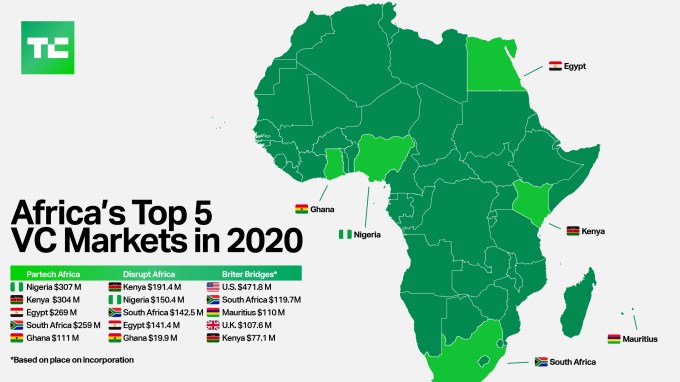
The countries remained unchanged on Partech’s top five as Nigeria remained the VC’s top destination with $307 million. At a close second was Kenya accounting for $304 million of the total investments in the continent. Egypt came third with its startups raising $269 million, while $259 million flowed into South African startups. Rounding up the top five was Ghana with $111 million, displacing Rwanda which was fifth in Partech’s 2019 list.

The sequence remained unchanged from Disrupt Africa’s 2019 list as well. Funding raised by Kenyan startups reached $191.4 million; Nigeria followed with $150.4 million; South Africa, third at $142.5 million; Egypt came a close fourth with $141.4 million; while Ghanaian startups raised $19.9 million.

Briter Bridges took a different approach. Whereas Partech and Disrupt Africa highlighted funding activities per country of origin and operations, Briter Bridges chose to attribute funding to the startups’ place of incorporation or headquarters. This premise slightly altered the Big Four’s positions. Startups headquartered in the US received $471.8 million of the total funding, according to Briter Bridges. Those in South Africa claimed $119.7 million. Mauritius-headquartered companies received $110 million while African startups headquartered in the U.K. and Kenya raised $107.6 million and $77.1 million respectively.

On why Briter Bridges went with this narrative, Giuliani said the company wants its data to be an impartial conversation starter which can be used to investigate more complex dynamics such as the need for better policies, regulation, or financial availability.

This speaks particularly to the absence of Nigeria as a primary location for incorporation. Due to unfriendly regulations, business and tax conditions, Nigerian startups are increasingly incorporating their startups abroad and other African countries like Seychelles and Mauritius. It’s a trend that may well continue as most foreign VCs prefer African startups to be incorporated in countries with business-friendly investment laws.

Regional and gender diversity check

With an increase in startup activity in Francophone Africa, one would’ve expected an uptick in VC funding in the region. Well, that’s not exactly the case. Senegal, the region’s top destination for VC funding dropped from $16 million in 2019 to $8.8 million in 2020 according to Partech. The country was 9th on the list while Ivory Coast, placed 10th, raised a meagre sum of $6.5 million.

However, the good news is that 22 other countries received investments outside this Big Four this year, according to Partech data. Will we see this continue? And if yes, which countries will likely join the nine-figure club?

Tidjane Deme, a general partner of Partech Africa, believes Ghana might be next. He references how it previously used to be a Big 3 of Kenya, Nigeria, and South Africa before Egypt became a dominant force, and says a similar event might happen with the West African country.

“We see a clear diversification happening as investors are going into more markets. Ghana, for instance, is already attracting above $100 million. Of course, we all wish it would happen faster, but we also recognize that this is a learning process for both investors entering new markets and for founders learning about this game.”

Ghana also emerged in Giuliani’s forecast. He adds the likes of Tunisia, Morocco, Rwanda as second-tier countries quickly entering global investors’ radar and building more sophisticated ecosystems.

Tom Jackson, co-founder of Disrupt Africa, doesn’t mention any names. But he thinks that while there are some positives from other markets, the Big Four dominance will continue.

“Funding will filter down to other markets more and more, and there are already positive signs in that regard. But the space is still relatively early-stage and those four big markets have a big head start and will remain far ahead for years to come,” he said.

Another diversity check that cannot be overlooked is that of gender. Despite all the talk of inclusion, Briter Bridges reported that 15% of the funded startups in 2020 had women as founders, co-founders, or C-level executives. Partech, on the other hand, places this number at 14%. There’s still a lot of work to be done to increase this figure, and we might see more early-stage firms looking to plug that gap.

11 Feb 2021

Crypto-currency pioneer Diana Biggs joins digital assets startup Valour as its new CEO

Crypto-currency pioneer and early Bitcoin thought-leader Diana Biggs has joined Swiss-based startup Valour, which lets investors easily buy digital assets through their bank or broker. The move is significant with the news that Tesla has bought $1.5 billion worth of Bitcoin, thus massively boosting the mainstream markets for crypto assets. Biggs explored the potential for blockchain technology to help solve humanitarian challenges through her venture, Proof of Purpose, in 2017, and her TEDx speech on Blockchain Technology that year is considered by many in the blockchain space to be one of the best in the genre.

Valour, a Zug, Switzerland-based issuer of investment products, brought in Biggs, the former Private Banking Global Head of Innovation for HSBC, as CEO after recently launching Bitcoin Zero, a fee-free, digital asset ETP product, which trades on the NGM stock exchange.

Biggs, who has been in the Bitcoin space since 2013 told TechCrunch: “I have never seen this much attention to Bitcoin and other crypto-assets… The time for decentralized technologies has arrived, and their potential is increasingly realized by institutional investors.”

Johan Wattenström, the founder of Valour, said: “Diana is the perfect candidate to lead the company through this next phase of growth and expansion. With a wealth of experience in traditional finance, as well as fintech, and her vision for bringing digital assets into the mainstream, we feel very lucky to have her on board.” Wattenström created and listed the digital asset ETP on Nasdaq Nordic, in 2015.

Biggs is an Associate Fellow at the University of Oxford’s Saïd Business School and served as Head Tutor for their Blockchain Strategy Programme from 2018 to 2020. She is on the Board of the World Economic Forum’s Digital Leaders of Europe community and is a member of the Milken Institute’s Young Leaders Circle. Prior to joining Valour, Biggs was Global Head of Innovation for HSBC Private Banking, where she led on fintech partnerships and driving open innovation.