Year: 2021

04 Feb 2021

Moka.care is a European mental healthcare solution for employees

Meet moka.care, a French startup that has built several services that should help you improve your psychological well-being. The company sells its solution to employers directly. They can then offer access to moka.care to their employees.

The startup raised a $3 million (€2.5 million) funding round from Singular, the VC firm founded by former Alven partners Jeremy Uzan and Raffi Kamber. A long list of business angels are also participating in today’s round, such as Nicolas Dessaigne (Algolia), Ning Li (Made.com, Typology), Florian Douetteau (Dataiku), Céline Lazorthes (Leetchi, MangoPay), Pierre Dubuc (OpenClassrooms), Marc-Antoine de Longevialle (LeCab), Adrien Ledoux (JobTeaser), Roxanne Varza (Station F), Thibault Lamarque (CASTALIE) and Côme Fouques (Indy).

Moka.care believes that companies aren’t doing enough when it comes to mental health. Many companies give you a phone number and tell you that you can call that number to get mental support. But few employees actually call those helplines.

That’s why the startup is taking a completely different approach. The most important principle is that people are looking for different things. And you don’t necessarily know what you’re looking for when you’re feeling down. When you first contact moka.care, the company spends roughly half an hour talking with you to understand what you’re looking for.

There are three main options after that. Moka.care could send you some recommendations for a practitioner — it can be a psychologist, a certified coach or a licensed therapist. Moka.care also organizes group sessions around a specific topic. It could be focused on remote work, work-life balance, self-confidence, etc. Finally, moka.care also provides content on some of those topics. You can access that content and learn more about yourself.

With this granular approach, the company hopes it can tackle mental health conditions before it’s too late — you don’t want to recommend a therapist when an employee is already suffering from excessive stress, fatigue or burnout.

Employees don’t pay for the first sessions as it’s part of moka.care’s plans. This way, the barrier to entry should be much lower for employees. Of course, if you want to book further appointments, you’ll have to pay at some point.

For employers, moka.care tries to lower the barrier to entry as well. Clients agree on a per-employee-per-month subscription plan based on some usage rate. If your employees end up using moka.care more than that, you don’t pay more. If your employees don’t use the service at all and you’re overpaying, the startup pays you back.

There are 30 companies currently using moka.care — it represents thousands of employees that could potentially create an account and access the service. The startup currently works with around 50 practitioners.

04 Feb 2021

Venmo to gain crypto, budgeting, savings and Honey integrations this year

The Venmo mobile payments app is going to look very different in 2021 as it inches closer to neobank territory with expansions into budgeting, saving and cryptocurrency, said Venmo parent company PayPal, during its fourth-quarter earnings on Wednesday. The company also plans to put its $4 billion Honey acquisition to work by integrating its suite of shopping tools into the Venmo app, including merchant offers, deals, price tracking and wish lists.

PayPal already signaled its intentions to bring cryptocurrencies to Venmo. The company entered the crypto market last November by adding support for buying, holding and selling cryptocurrencies in the U.S. through a partnership with the regulated crypto services provider, Paxos Trust Company. At the time, PayPal noted it would bring a similar feature set to its Venmo app during 2021.

That time frame is still on track, PayPal confirmed during its earnings call with investors.

The company said, in the next few months, Venmo users will gain the ability to buy, hold and sell crypto inside the Venmo mobile app, along with other “investment alternatives.” (This statement refers to PayPal’s work with central banks who are developing their own digital currencies on the blockchain.)

Other changes to Venmo make the app sound as if it’s becoming more of a neobank competitor.

For example, PayPal said it will work with its financial industry partners this year to introduce features like budgeting and saving tools as well as bill pay options inside PayPal — additions that are common to modern-day mobile banking apps.

On Venmo, the forthcoming savings feature will look similar to PayPal’s existing PayPal Cash Plus account, where it partners with financial institutions to provide FDIC pass-through insurance. Today, funds held in the Cash Plus account are eligible for this insurance only if customers also have a PayPal Cash Card debit card, have enrolled in Direct Deposit or have established Goals in their Cash Plus account. Venmo now has the pieces in place to offer the same.

Another change includes the Honey integration, which PayPal has been promising for some time. Now, the company is offering more details around what those integrations will look like. It said the plan is to integrate Honey’s features into both its PayPal and Venmo platforms in the first half of 2021 — including Honey’s wish list, price monitoring tools, deals, coupons and rewards.

This integration will allow merchants to target specific demographics of PayPal and Venmo customers with personalized offers and discounts, thanks to PayPal’s two-sided marketplace. In other words, the company will attempt to capture the consumer in the earlier stages of the shopping process, when they’re browsing for deals, looking up prices or searching for specific products. Honey’s shopping tools could point them to a matching deal, and then the customer could complete the checkout process using the Venmo app. 

These new tools will arrive at a time when the pandemic has forced more commerce to shift online, as retail stores and other in-person retail opportunities declined due to store closures and government lockdowns. Plus, some people today now just prefer to shop online because they no longer feel safe in physical retail stores where basic safety measures like mask-wearing and social distancing aren’t enforced.

This broader acceleration of e-commerce and “contactless” payments also helped PayPal to add 1.4 million new merchants in the quarter. It now has 29 million merchants across its platform, who interact with nearly 350 million consumers.

Meanwhile, Venmo’s total payment volume grew 60% year over year to $47 billion, and its customer base grew 32%, ending just shy of 70 million accounts. The company expects its revenues will approach $900 million in 2021.

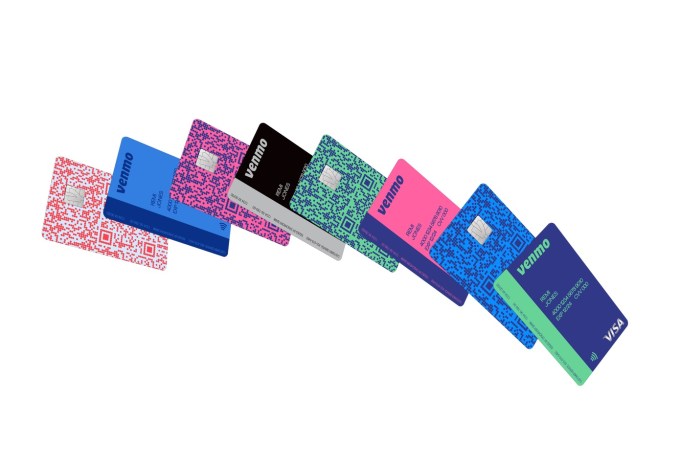
Venmo credit card

Image Credits: Venmo

Venmo has been rapidly expanding beyond being just a payments app. In recent months, it has launched its first credit card, which will be 100% rolled out by month-end, as well as QR codes for in-store shopping, business profiles and cash-checking features that arrived just in time to handle customers’ stimulus checks.

But Venmo doesn’t aim to be a full neobank — at least not yet. Instead, it imagines itself as more of a “digital wallet” of sorts.

“Today’s digital reality is rapidly accelerating the need for a digital wallet that encompasses payments, financial services and shopping,” explained PayPal CEO Dan Schulman, speaking to investors. “This year, our digital wallet will change more than it has ever changed before, significantly increasing its functionality within a single, integrated and beautifully designed app that should meaningfully increase consumer engagement,” he said.

As Venmo’s new features roll out, PayPal expects the app’s usage and payment volume to grow.

“I think we are going to see … a real bend in the historic rate of engagement. And it’s going to be all around that super app functionality in that digital wallet, moving well beyond just payments,” Schulman said.

Correction, 2/4/21, 1 p,m. EST —  Schulman’s note about bill pay was referencing a launch inside PayPal’s app in 2021. It was mentioned alongside other forthcoming Venmo features, which led to some confusion. We’ve now corrected this. 

04 Feb 2021

Barclays adds itemised digital receipts to its banking app in partnership with fintech Flux

Flux, the London fintech that has built a technology platform for banks and merchants to power itemised digital receipts and more, has seen its lengthy pilot with Barclays bear fruit.

Announced formally today — but actually quietly rolled out a few months ago — Flux-powered digital receipts are now available as an opt-in for all U.K. Barclays debit card holders within the bank’s main mobile banking app. Previously, the functionality was only available within the Barclays Launchpad app, which is available for customers that want to try out experimental or upcoming features.

Early last year, Barclays announced that it has invested in Flux, taking a minority stake, so the strengthening of its partnership isn’t too much of a surprise. Flux also went through the Techstars-powered Barclays accelerator in its very early days. However, not all corporate accelerators lead to great outcomes as corporates are notoriously risk-adverse. This one certainly wasn’t rushed but it’s meaningful regardless, giving Flux a major shot in the arm in reaching mainstream banking customers beyond the existing challenger bank partnerships it has forged.

“Customers who pay using their Barclays debit card for future in store purchases at H&M, shoe retailer schuh and food outlets, which include Just Eat and Papa Johns, will see their receipts sent automatically to their app after making a purchase. They can then easily and securely view their receipts whenever they need by tapping on the transaction,” says Barclays. Crucially, although opt-in, Barclays customers will receive a prompt to set up digital receipts when they purchase items from retailers currently on-boarded to Flux.

Founded in 2016 by former early employees at Revolut, Flux bridges the gap between the itemised receipt data captured by a merchant’s point-of-sale (POS) system and what little information typically shows up on your bank statement or mobile banking app. Off the back of this, it can also power loyalty schemes and card-linked offers, as well as give merchants much deeper POS analytics via aggregated and anonymised data on consumer behaviour, such as which products are selling best in unique baskets.

On the banking side, along with Barclays, Flux has partnered with challenger banks Starling and Monzo. Once banking customers link their account to the service, Flux delivers digital receipts (and where available rewards and loyalty) for transactions at Flux retailer partners.

Longer-term, Flux wants to become a standard for the interchange of item level digital receipt data — and the proprietary platform that powers that standard — but has always faced a chicken and egg problem: It needs bank integrations to sign up merchants and it needs merchant integrations to sign up banks. Barclays going live properly is another significant turn in the upstart’s flywheel.

04 Feb 2021

Barclays adds itemised digital receipts to its banking app in partnership with fintech Flux

Flux, the London fintech that has built a technology platform for banks and merchants to power itemised digital receipts and more, has seen its lengthy pilot with Barclays bear fruit.

Announced formally today — but actually quietly rolled out a few months ago — Flux-powered digital receipts are now available as an opt-in for all U.K. Barclays debit card holders within the bank’s main mobile banking app. Previously, the functionality was only available within the Barclays Launchpad app, which is available for customers that want to try out experimental or upcoming features.

Early last year, Barclays announced that it has invested in Flux, taking a minority stake, so the strengthening of its partnership isn’t too much of a surprise. Flux also went through the Techstars-powered Barclays accelerator in its very early days. However, not all corporate accelerators lead to great outcomes as corporates are notoriously risk-adverse. This one certainly wasn’t rushed but it’s meaningful regardless, giving Flux a major shot in the arm in reaching mainstream banking customers beyond the existing challenger bank partnerships it has forged.

“Customers who pay using their Barclays debit card for future in store purchases at H&M, shoe retailer schuh and food outlets, which include Just Eat and Papa Johns, will see their receipts sent automatically to their app after making a purchase. They can then easily and securely view their receipts whenever they need by tapping on the transaction,” says Barclays. Crucially, although opt-in, Barclays customers will receive a prompt to set up digital receipts when they purchase items from retailers currently on-boarded to Flux.

Founded in 2016 by former early employees at Revolut, Flux bridges the gap between the itemised receipt data captured by a merchant’s point-of-sale (POS) system and what little information typically shows up on your bank statement or mobile banking app. Off the back of this, it can also power loyalty schemes and card-linked offers, as well as give merchants much deeper POS analytics via aggregated and anonymised data on consumer behaviour, such as which products are selling best in unique baskets.

On the banking side, along with Barclays, Flux has partnered with challenger banks Starling and Monzo. Once banking customers link their account to the service, Flux delivers digital receipts (and where available rewards and loyalty) for transactions at Flux retailer partners.

Longer-term, Flux wants to become a standard for the interchange of item level digital receipt data — and the proprietary platform that powers that standard — but has always faced a chicken and egg problem: It needs bank integrations to sign up merchants and it needs merchant integrations to sign up banks. Barclays going live properly is another significant turn in the upstart’s flywheel.

04 Feb 2021

AI Dungeon-maker Latitude raises $3.3M to build games with ‘infinite’ story possibilities

Latitude, a startup building games with “infinite storylines” generated by artificial intelligence, is announcing that it has raised $3.3 million in seed funding.

The idea of an AI-generated story might make you think of hilariously nonsensical experiments like “Sunspring,” but Latitude’s first title, AI Dungeon, is an impressively open-ended (and coherent) text adventure game where you can choose from a wide variety of genres and characters.

And unlike a classic text adventure like Zork — where players quickly become familiar with “you can’t do that”-style messages when they type something the designers hadn’t planned for — AI Dungeon can respond to any command. For example, when my brave knight was charging into battle, I typed “get depressed” and he quickly sat on a rock with his head between his hands.

“How does the AI know what’s a good story?” said co-founder and CEO Nick Walton. “Because it’s read a lot of good stories and knows the patterns involved in that.”

AI Dungeon actually started out as one of Walton’s hackathon projects. And while the initial version didn’t win any prizes, he kept at it, assisted by improvements in OpenAI’s language generator, of which the most recent version is GPT-3.

AI Dungeon screenshot

AI Dungeon

“The very first version of AI Dungeon I built was coherent on a sentence level, but on a paragraph level it made no sense,” Walton said. “Once you get to GPT-2, it makes a lot more sense. Once you get to GPT-3, it’s a lot more coherent on a story level. And so I think to a degree, these issues with coherency, the story not making sense, get solved as the AI gets better.”

Latitude says AI Dungeon is attracting 1.5 million monthly active users. The startup plans to create more AI-powered games, and eventually to release a platform allowing other game designers to do the same.

Walton noted that without AI, video games are always constrained by imagination of its creators. Even when you get to games like The Elder Scrolls II: Daggerfall or No Man’s Sky, with randomly generated towns or planets, he argued that they’re really offering “the same spin on a similar concept.”

For example, he said that in Daggerfall, “When you go to all these towns, they’re all basically the same. That’s the problem with procedural generation: You’re not coming up with unique things.” AI, on the other hand, can come up with “something completely unique that’s so, so different every time.”

Latitude CEO Nick Walton

Latitude CEO Nick Walton

From a business perspective, he said that this could lower the cost of developing AAA games from more than $100 million to less than $100,000 — though Latitude has a ways to go before it reaches that level, since it hasn’t even released a game with graphics yet. Walton also said this could lead to new levels of immersion and interactivity.

“With this technology, you could have a world with tens of thousands of characters with their own hopes and wants and dreams,” he said. “You can have worlds that are dynamic, that are alive, rather than something like World of Warcraft, where you’ve got 10 million people who are doing the same quest.”

The startup’s funding was led by NFX, with participation from Album VC and Griffin Gaming Partners.

“Latitude is revolutionizing how games are made, creating a whole new genre of entertainment gaming fueled by AI,” said James Currier of NFX in a statement. “The best AI minds and engineers are gathering there to produce games that the world has never seen before. Latitude is already by far the leading AI games company.“

04 Feb 2021

Metalenz reimagines the camera in 2D and raises $10M to ship it

As impressive as the cameras in our smartphones are, they’re fundamentally limited by the physical necessities of lenses and sensors. Metalenz skips over that part with a camera made of a single “metasurface” that could save precious space and battery life in phones and other devices… and they’re about to ship it.

The concept is similar to, but not descended from, the “metamaterials” that gave rise to flat beam-forming radar and lidar of Lumotive and Echodyne. The idea is to take a complex 3D structure and accomplish what it does using a precisely engineered “2D” surface — not actually two-dimensional, of course, but usually a plane with features measured in microns.

In the case of a camera, the main components are of course a lens (these days it’s usually several stacked), which corrals the light, and an image sensor, which senses and measures that light. The problem faced by cameras now, particularly in smartphones, is that the lenses can’t be made much smaller without seriously affecting the clarity of the image. Likewise sensors are nearly at the limit of how much light they can work with. Consequently most of the photography advancements of the last few years have been done on the computational side.

Using an engineered surface that does away with the need for complex optics and other camera systems has been a goal for years. Back in 2016 I wrote about a NASA project that took inspiration from moth eyes to create a 2D camera of sorts. It’s harder than it sounds, though — usable imagery has been generated in labs, but it’s not the kind of thing that you take to Apple or Samsung.

Metalenz aims to change that. The company’s tech is built on the work of Harvard’s Frederico Capasso, who has been publishing on the science behind metasurfaces for years. He and Rob Devlin, who did his doctorate work in Capasso’s lab, co-founded the company to commercialize their efforts.

“Early demos were extremely inefficient,” said Devlin of the field’s first entrants. “You had light scattering all over the place, the materials and processes were non-standard, the designs weren’t able to handle the demands that a real world throws at you. Making one that works and publishing a paper on it is one thing, making 10 million and making sure they all do the same thing is another.”

Their breakthrough — if years of hard work and research can be called that — is the ability not just to make a metasurface camera that produces decent images, but to do it without exotic components or manufacturing processes.

“We’re really using all standard semiconductor processes and materials here, the exact same equipment — but with lenses instead of electronics,” said Devlin. “We can already make a million lenses a day with our foundry partners.”
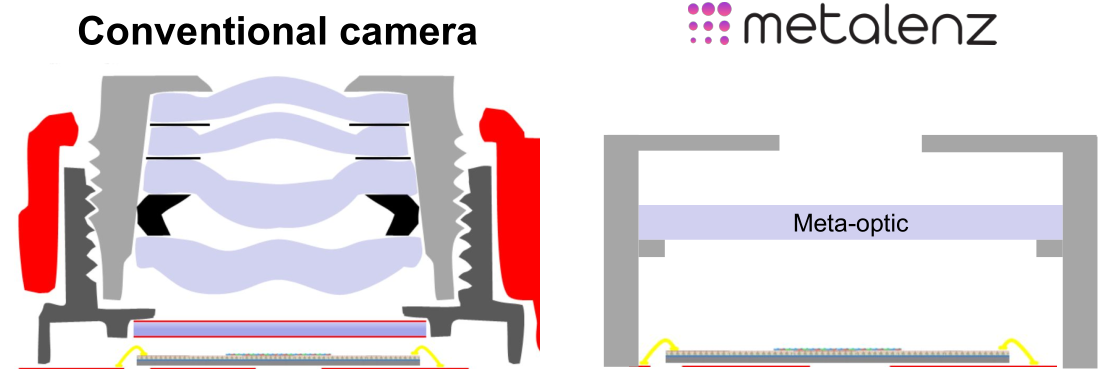
Diagram comparing the multi-lens barrel of a conventional phone camera, and their simpler "meta-optic"

The thing at the bottom is the chip where the image processor and logic would be, but the meta-optic could also integrate with that. the top is a pinhole.

The first challenge is more or less contained in the fact that incoming light, without lenses to bend and direct it, hits the metasurface in a much more chaotic way. Devlin’s own PhD work was concerned with taming this chaos.

“Light on a macro [i.e. conventional scale, not close-focusing] lens is controlled on the macro scale, you’re relying on the curvature to bend the light. There’s only so much you can do with it,” he explained. “But here you have features a thousand times smaller than a human hair, which gives us very fine control over the light that hits the lens.”

Those features, as you can see in this extreme close-up of the metasurface, are precisely tuned cylinders, “almost like little nano-scale Coke cans,” Devlin suggested. Like other metamaterials, these structures, far smaller than a visible or near-infrared light ray’s wavelength, manipulate the radiation by means that take a few years of study to understand.
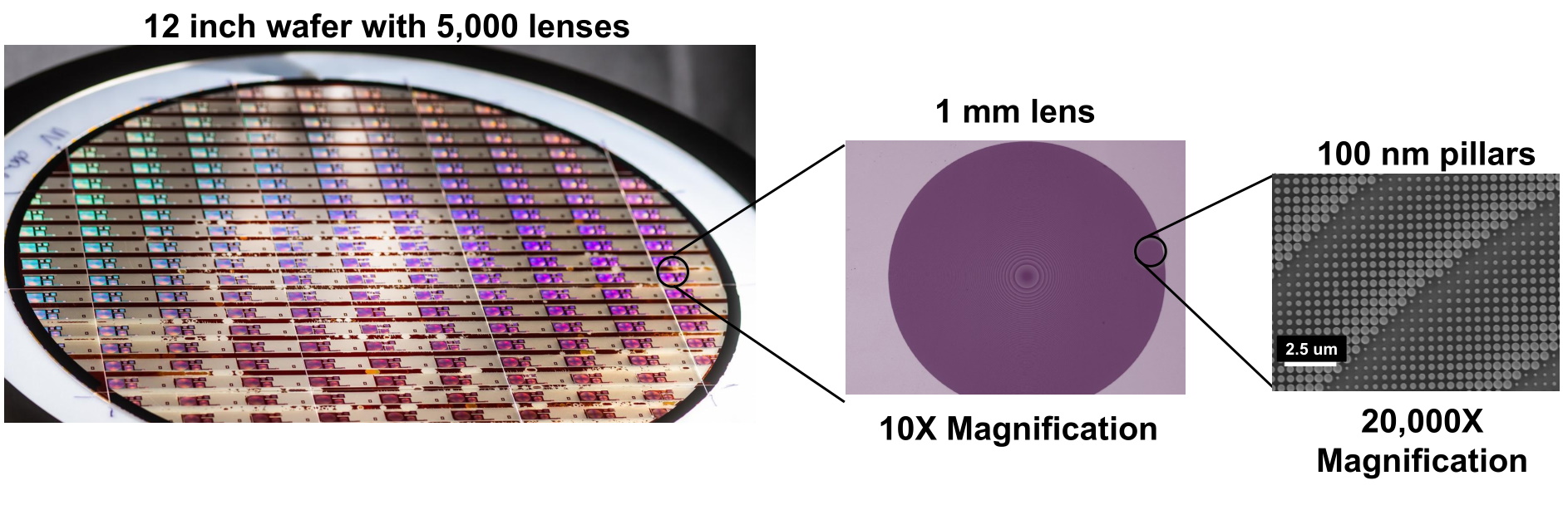
Diagram showing chips being manufactured, then an extreme close up showing nano-scale features.The result is a camera with extremely small proportions and vastly less complexity than the compact camera stacks found in consumer and industrial devices. To be clear, Metalenz isn’t looking to replace the main camera on your iPhone — for conventional photography purposes the conventional lens and sensor are still the way to go. But there are other applications that play to the chip-style lens’s strengths.

Something like the FaceID assembly, for instance, presents an opportunity. “That module is a very complex one for the cell phone world — it’s almost like a Rube Goldberg machine,” said Devlin. Likewise the miniature lidar sensor.

At this scale, the priorities are different, and by subtracting the lens from the equation the amount of light that reaches the sensor is significantly increased. That means it can potentially be smaller in every dimension while performing better and drawing less power.

Image (of a very small test board) from a traditional camera, left, and metasurface camera, right. Beyond the vignetting it’s not really easy to tell what’s different, which is kind of the point.

Lest you think this is still a lab-bound “wouldn’t it be nice if” type device, Metalenz is well on its way to commercial availability. The $10M round A they just raised was led by 3M Ventures, Applied Ventures LLC, Intel Capital, M Ventures and TDK Ventures, along with Tsingyuan Ventures and Braemar Energy Ventures — a lot of suppliers in there.

Unlike many other hardware startups, Metalenz isn’t starting with a short run of boutique demo devices but going big out of the gate.

“Because we’re using traditional fabrication techniques, it allows us to scale really quickly. We’re not building factories or foundries, we don’t have to raise hundreds of mils; we can use whats already there,” said Devlin. “But it means we have to look at applications that are high volume. We need the units to be in that tens of millions range for our foundry partners to see it making sense.”

Although Devlin declined to get specific, he did say that their first partner is “active in 3D sensing” and that a consumer device, though not a phone, would be shipping with Metalenz cameras in early 2022 — and later in 2022 will see a phone-based solution shipping as well.

In other words, while Metalenz is indeed a startup just coming out of stealth and raising its A round… it already has shipments planned on the order of tens of millions. The $10M isn’t a bridge to commercial viability but short term cash to hire and cover up-front costs associated with such a serious endeavor. It’s doubtful anyone on that list of investors harbors any serious doubts on ROI.

The 3D sensing thing is Metalenz’s first major application, but the company is already working on others. The potential to reduce complex lab equipment to handheld electronics that can be fielded easily is one, and improving the benchtop versions of tools with more light-gathering ability or quicker operation is another.

Though a device you use may in a few years have a Metalenz component in it, it’s likely you won’t know — the phone manufacturer will probably take all the credit for the improved performance or slimmer form factor. Nevertheless, it may show up in teardowns and bills of material, at which point you’ll know this particular university spin-out has made it to the big leagues.


04 Feb 2021

Andreessen Horowitz could make the carbon offset API Patch its latest climate bet

The early-stage carbon offset API developer, Patch, could be another one of Andreessen Horowitz’s early bets on climate tech.

According to several people with knowledge of the investment round, former OpenTable chief executive and current Andreessen Horowitz partner Jeff Jordan is looking at leading the young company’s latest financing.

Such an investment would be a win for Patch, which could benefit from Andreessen Horowitz’s marketing muscle in a space that’s becoming increasingly crowded. And, if the deal goes through, it could be an indicator of more to come from one of the venture industry’s most (socially) active investors.

Companies like Pachama, Cloverly, Carbon Interface, and Cooler.dev all have similar API offerings, but the market for these types of services will likely expand as more companies try to do the least amount of work possible to become carbon neutral through offsetting. A growing market could generate space for more than one venture-backed winner.

Neither Patch’s co-founders nor Andreessen Horowitz responded to a request for comment about the funding.

One concern with services like Patch is that its customers will look at offsetting as their final destination instead of a step on the road to removing carbon emissions from business operations. To fix our climate crisis will take more work.

Founded by Brennan Spellacy and Aaron Grunfeld, two former employees at the apartment rental service Sonder, Patch raised its initial financing from VersionOne Ventures back in September.

Around 15 to twenty companies that are using the service now, according to people familiar with the company’s operations.

The company has an API that can calculate a company’s emissions footprint based on an integration with their ERP system and then invests money into offset projects that are designed to remove an equivalent amount of carbon dioxide.

While services like Pachama privilege lower-cost sequestration solutions like reforestation and forest management, Patch offers an array of potential investment opportunities for offsets. And the company tries to nudge its customers to some of the more expensive, high technology options in an effort to bring down costs for emerging technologies, said one person familiar with the company’s plans.

Like other services automating offsetting, Patch evaluates projects based on their additionality (how much additional carbon they’re removing over an already established baseline), permanence (how long the carbon emissions will be sequestered) and verifiability.

And, as the company’s founders note in their own statement about the company’s service, it’s not intended to be the only solution that customers deploy.

“The majority of climate models indicate that we need to reduce our emissions globally, while also removing carbon dioxide from the atmosphere,” the founders wrote in a Medium post. “We take care of a company’s carbon removal goals, while they focus their efforts on reducing emissions, a more proprietary task that requires intimate operational knowledge. Patch complements this behavioral shift and gives us a real chance to mitigate climate change.”

VersionOne’s Angela Tran addressed any concerns about the defensibility of Patch’s technology in her own September announcement.

“We also believe that defensibility comes with the aggregation and “digitization” of quality supply. When we view Patch as a marketplace, we believe that businesses (demand) care about the type of projects (supply) they purchase to neutralize their emissions,” Tran wrote. “For example, a company might choose their sustainability legacy to be linked with forestry or mineralization projects. Patch is partnering with the best carbon removal developers and the latest negative emission technologies to build a network of low-cost, impactful projects.”

While Patch is explicitly focused on climate change, Andreessen has made a few early investments in a broad sustainability thesis. The firm led a $9 million investment into Silo last year and backed KoBold Metals back in 2019.

Silo has developed an enterprise resource planning tool for perishable food supply chains. Currently focused on wholesale produce, Silo said in a statement last year that it would be extending its services to meat, dairy and pantry items over the next year.

“The market potential for an innovator like Silo to reduce waste and improve margins is enormous and we’re excited to support its efforts as the system of record for food distribution in the United States,” said Anish Acharya, General Partner at Andreessen Horowitz, in a statement at the time. “Silo is well-positioned to scale beyond the west coast to help more customers modernize and transition their operations from pen and paper to software.”

Meanwhile, KoBold is a software developer that uses machine learning and big data processing technologies to find new prospects for the precious metals that companies need to make new batteries and renewable energy generation technologies.

“By building a digital prospecting engine — full stack, from scratch — using computer vision, machine learning, and sophisticated data analysis not currently available to the industry, KoBold’s software combines previously unavailable, dark data with conventional geochemical, geophysical, and geological data to identify prospects in models that can only get better over time, as with other data network effects,” wrote Connie Chan in a blog post at the time.

Taken together, these investments coalesce into a picture of how Andreessen Horowitz and its pool of $16.5 billion in assets under management may approach the renewables industry.

04 Feb 2021

Andreessen Horowitz could make the carbon offset API Patch its latest climate bet

The early-stage carbon offset API developer, Patch, could be another one of Andreessen Horowitz’s early bets on climate tech.

According to several people with knowledge of the investment round, former OpenTable chief executive and current Andreessen Horowitz partner Jeff Jordan is looking at leading the young company’s latest financing.

Such an investment would be a win for Patch, which could benefit from Andreessen Horowitz’s marketing muscle in a space that’s becoming increasingly crowded. And, if the deal goes through, it could be an indicator of more to come from one of the venture industry’s most (socially) active investors.

Companies like Pachama, Cloverly, Carbon Interface, and Cooler.dev all have similar API offerings, but the market for these types of services will likely expand as more companies try to do the least amount of work possible to become carbon neutral through offsetting. A growing market could generate space for more than one venture-backed winner.

Neither Patch’s co-founders nor Andreessen Horowitz responded to a request for comment about the funding.

One concern with services like Patch is that its customers will look at offsetting as their final destination instead of a step on the road to removing carbon emissions from business operations. To fix our climate crisis will take more work.

Founded by Brennan Spellacy and Aaron Grunfeld, two former employees at the apartment rental service Sonder, Patch raised its initial financing from VersionOne Ventures back in September.

Around 15 to twenty companies that are using the service now, according to people familiar with the company’s operations.

The company has an API that can calculate a company’s emissions footprint based on an integration with their ERP system and then invests money into offset projects that are designed to remove an equivalent amount of carbon dioxide.

While services like Pachama privilege lower-cost sequestration solutions like reforestation and forest management, Patch offers an array of potential investment opportunities for offsets. And the company tries to nudge its customers to some of the more expensive, high technology options in an effort to bring down costs for emerging technologies, said one person familiar with the company’s plans.

Like other services automating offsetting, Patch evaluates projects based on their additionality (how much additional carbon they’re removing over an already established baseline), permanence (how long the carbon emissions will be sequestered) and verifiability.

And, as the company’s founders note in their own statement about the company’s service, it’s not intended to be the only solution that customers deploy.

“The majority of climate models indicate that we need to reduce our emissions globally, while also removing carbon dioxide from the atmosphere,” the founders wrote in a Medium post. “We take care of a company’s carbon removal goals, while they focus their efforts on reducing emissions, a more proprietary task that requires intimate operational knowledge. Patch complements this behavioral shift and gives us a real chance to mitigate climate change.”

VersionOne’s Angela Tran addressed any concerns about the defensibility of Patch’s technology in her own September announcement.

“We also believe that defensibility comes with the aggregation and “digitization” of quality supply. When we view Patch as a marketplace, we believe that businesses (demand) care about the type of projects (supply) they purchase to neutralize their emissions,” Tran wrote. “For example, a company might choose their sustainability legacy to be linked with forestry or mineralization projects. Patch is partnering with the best carbon removal developers and the latest negative emission technologies to build a network of low-cost, impactful projects.”

While Patch is explicitly focused on climate change, Andreessen has made a few early investments in a broad sustainability thesis. The firm led a $9 million investment into Silo last year and backed KoBold Metals back in 2019.

Silo has developed an enterprise resource planning tool for perishable food supply chains. Currently focused on wholesale produce, Silo said in a statement last year that it would be extending its services to meat, dairy and pantry items over the next year.

“The market potential for an innovator like Silo to reduce waste and improve margins is enormous and we’re excited to support its efforts as the system of record for food distribution in the United States,” said Anish Acharya, General Partner at Andreessen Horowitz, in a statement at the time. “Silo is well-positioned to scale beyond the west coast to help more customers modernize and transition their operations from pen and paper to software.”

Meanwhile, KoBold is a software developer that uses machine learning and big data processing technologies to find new prospects for the precious metals that companies need to make new batteries and renewable energy generation technologies.

“By building a digital prospecting engine — full stack, from scratch — using computer vision, machine learning, and sophisticated data analysis not currently available to the industry, KoBold’s software combines previously unavailable, dark data with conventional geochemical, geophysical, and geological data to identify prospects in models that can only get better over time, as with other data network effects,” wrote Connie Chan in a blog post at the time.

Taken together, these investments coalesce into a picture of how Andreessen Horowitz and its pool of $16.5 billion in assets under management may approach the renewables industry.

04 Feb 2021

Google Cloud launches Apigee X, the next generation of its API management platform

Google today announced the launch of Apigee X, the next major release of the Apgiee API management platform it acquired back in 2016.

“If you look at what’s happening — especially after the pandemic started in March last year — the volume of digital activities has gone up in every kind of industry, all kinds of use cases are coming up. And one of the things we see is the need for a really high-performance, reliable, global digital transformation platform,” Amit Zavery, Google Cloud’s head of platform, told me.

He noted that the number of API calls has gone up 47 percent from last year and that the platform now handles about 2.2 trillion API calls per year.

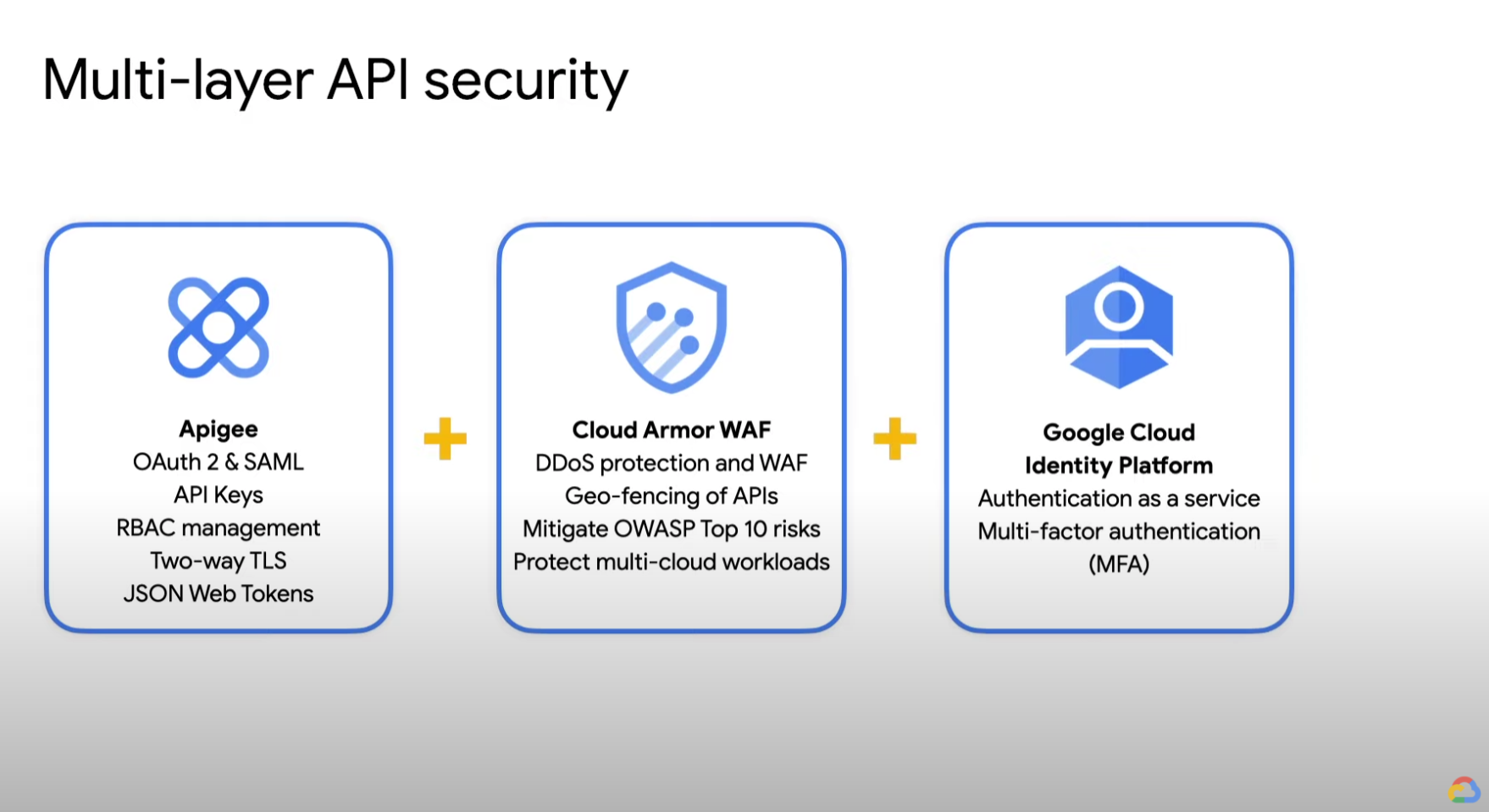
At the core of the updates are deeper integrations with Google Cloud’s AI, security and networking tools. In practice, this means Apigee users can now deploy their APIs across 24 Google Cloud regions, for example, and use Google’s caching services in more than 100 edge locations.

Image Credits: Google

In addition, Apigee X now integrates with Google’s Cloud Armor firewall and its Cloud Identity Access Management platform. This also means that Apigee users won’t have to use third-party tools for their firewall and identity management needs.

“We do a lot of AI/ML-based anomaly detection and operations management,” Zavery explained. “We can predict any kind of malicious intent or any other things which might happen to those API calls or your traffic by embedding a lot of those insights into our API platform. I think [that] is a big improvement, as well as new features, especially in operations management, security management, vulnerability management and making those a core capability so that as a business, you don’t have to worry about all these things. It comes with the core capabilities and that is really where the front doors of digital front-ends can shine and customers can focus on that.”

The platform now also makes better use of Google’s AI capabilities to help users identify anomalies or predict traffic for peak seasons. The idea here is to help customers automate a lot of the standards automation tasks and, of course, improve security at the same time.

As Zavery stressed, API management is now about more than just managing traffic between applications. But more than just helping customers manage their digital transformation projects, the Apigee team is now thinking about what it calls ‘digital excellence.’ “That’s how we’re thinking of the journey for customers moving from not just ‘hey, I can have a front end,’ but what about all the excellent things you want to do and how we can do that,” Zavery said.

“During these uncertain times, organizations worldwide are doubling-down on their API strategies to operate anywhere, automate processes, and deliver new digital experiences quickly and securely,” said James Fairweather, Chief Innovation Officer at Pitney Bowes. “By powering APIs with new capabilities like reCAPTCHA Enterprise, Cloud Armor (WAF), and Cloud CDN, Apigee X makes it easy for enterprises like us to scale digital initiatives, and deliver innovative experiences to our customers, employees and partners.”

04 Feb 2021

HubSpot acquires media startup The Hustle

Marketing software company HubSpot is acquiring The Hustle, the business and tech media startup behind the popular newsletter of the same name

Axios broke the news of the deal and reported that it values the startup at around $27 million. HubSpot declined to comment on the deal price, and while tweeting about the acquisition, The Hustle CEO Sam Parr wrote, “Early in my career I was transparent with money. But I didn’t like the result of sharing that stuff. So we’re not disclosing the price and HubSpot has agreed. I’m taking it to the grave!”

In its press release about the acquisition, HubSpot noted that customers are finding its products through content like its YouTube videos and HubSpot Academy.

“By acquiring The Hustle, we’ll be able to better meet the needs of these scaling companies by delivering educational, business, and tech trend content in their preferred formats,” said HubSpot’s senior vice president of marketing Kieran Flanagan in a statement. “Sam and his team have a proven ability to create content that entrepreneurs, startups, and scaling companies are deeply passionate about, and I’m excited to bring them on board to take that work to the next level.”

HubSpot says The Hustle’s flagship newsletter has 1.5 million subscribers. It also has a subscription offering called Trends and a podcast called My First Million.

“The goal is to build the largest business content network in the world,” Parr tweeted. “Soon, we’ll expand to a variety of mediums on a bunch of different topics and will have really innovative products coming out. We’re also going to hire the best content creators in the world.”