Year: 2021

04 Feb 2021

Accel backs Mexican startup Flink’s effort to bring consumer investing to Latin America

Here in the U.S., we take for granted the ability to invest and trade in the stock market. So while we can get in an uproar about the various ways Robinhood may or may not be acting responsibly, it can be easy to forget that not everyone in the world has the same access to potentially making — or losing — money via trading as we do.

For Mexico City-born Sergio Jiménez Amozurrutia, the fact that in his country of more than 120 million people, only a tiny fraction of the population have the ability to invest in the capital markets just didn’t seem right. To him, the lack of widespread participation in investing is an example of the rich getting richer as part of an infrastructure “that is built for the wealthy.” The result of the imbalance is that a lot of people are locked out of making potentially wealth-building investments.  

So after selling Easy Credit, a consumer lending platform he’d built with Rick Rafael Bueno (whom he met in 2015 at a hackathon at Tech de Monterrey), Amozurrutia set out to give Mexicans access to something he believed they’d never had access to: an app-based consumer trading platform.

That platform, called Flink, attracted the attention of Silicon Valley-based venture capital firm Accel, which just led a $12 million Series A for the company. Mexico’s ALLVP, Clocktower, Kevin Efrusy and Oskar Hjertonsson and existing backer Raptor Financial Group participated in the financing as well.

The demand for what Flink has to offer is clear. Since launching its first brokerage product in July of 2020, Flink has surpassed 1 million users and 800,000 active brokerage accounts. This makes Flink the largest retail brokerage service in Mexico, according to Amozurrutia. It averages 6,000 new customers a day, mostly due to word of mouth, the company said. And, the app was recently ranked in the top 10 of all apps downloaded in Mexico via Google Play, surpassing Spotify and Facebook app downloads, according to Amozurrutia.

“Most legacy Mexican banks cater to less than 1% of the population — meaning most Mexicans don’t have a bank account, let alone a brokerage account,” he said. “At Flink, we’re guided by the belief that Mexico’s financial system should work for everyone — not only a select few.”

The fact that Latin Americans are underbanked is not new news. In Mexico in particular, there are far fewer banks than the thousands the U.S. is home to. Those banks, Amozurrutia believes, make it challenging for most people to make investments by charging high fees, among other barriers to entry, such as large minimum deposits.

“Also, here in Mexico, the population is not that sophisticated like in the U.S. in terms of investing in the markets,” he told TechCrunch. “The banks and incumbents take advantage of that and make people feel like they’re not smart enough to manage their money. They say, ‘Give me your money and I’ll invest it and charge you fees.’ ”

Flink is out to not only give Mexicans a way to invest, but to help educate them as well. Ninety percent of its users are first-time investors, and many are millennials.

“When you compare this kind of product with Robinhood or Acorns for example, the difference with us is that we need to be even more responsible with the kind of information and access we are trying to provide,” Amozurrutia said. “We need to educate on a basic level.”

Image: Flink

Flink has also built a community around the product so that people can share ideas and try to help each other, including a Facebook group made up of more than 35,000 people.  

For Accel partner Andrew Braccia (who was also an early investor in Slack), the most interesting thing about Flink is that in many ways it is “creating a market,” rather than building an offering in an already large and sophisticated market.

“A high percentage of customers are a younger demographic that has never invested before, and never had the tools or opportunity to use a product like Flink,” Braccia said. “It’s a responsibility we take very seriously so we’re trying to make sure there’s a tremendous amount of education and transparency in the process.”

He also believes Flink’s story and the larger opportunity of what’s happening in Mexico “is one centered around accessibility and hope.”

Demand for Flink’s product is not only coming from Mexico, but from other Latin American countries such as Colombia, Chile, Peru and Argentina.

Flink can’t yet enter those markets due to regulatory constraints, but getting licenses to do business in Latin American countries is something the company plans to use some of its new capital to do.

“When you try to understand the deeper issues around financial services in Latin America,” Amozurrutia said, “you will see the status quo is really similar.”

Accel’s Braccia agrees.

Flink, he believes, has already created a level playing field for those who want to participate in investing in Mexico.

“The fact that the vast majority of their users are first-time participants in the stock market speaks to the significance of their vision of financial accessibility—a vision that we believe will continue to resonate with other markets throughout Latin America,” Braccia told TechCrunch.

Flink also plans to use its funding in part to continue improving the user experience and product offering, as well as to add to its current headcount of 60 to be able to meet rising demand.

“Our goal is to get to 4 million users by the end of 2021,” Amozurrutia said.

Meanwhile, backing Flink fits into Accel’s overall investment thesis. The firm has also put money in other fintechs globally, such as France’s Lydia, London-based Monzo and WorldRemit, Galileo and Braintree/Venmo, among others.

04 Feb 2021

Accel backs Mexican startup Flink’s effort to bring consumer investing to Latin America

Here in the U.S., we take for granted the ability to invest and trade in the stock market. So while we can get in an uproar about the various ways Robinhood may or may not be acting responsibly, it can be easy to forget that not everyone in the world has the same access to potentially making — or losing — money via trading as we do.

For Mexico City-born Sergio Jiménez Amozurrutia, the fact that in his country of more than 120 million people, only a tiny fraction of the population have the ability to invest in the capital markets just didn’t seem right. To him, the lack of widespread participation in investing is an example of the rich getting richer as part of an infrastructure “that is built for the wealthy.” The result of the imbalance is that a lot of people are locked out of making potentially wealth-building investments.  

So after selling Easy Credit, a consumer lending platform he’d built with Rick Rafael Bueno (whom he met in 2015 at a hackathon at Tech de Monterrey), Amozurrutia set out to give Mexicans access to something he believed they’d never had access to: an app-based consumer trading platform.

That platform, called Flink, attracted the attention of Silicon Valley-based venture capital firm Accel, which just led a $12 million Series A for the company. Mexico’s ALLVP, Clocktower, Kevin Efrusy and Oskar Hjertonsson and existing backer Raptor Financial Group participated in the financing as well.

The demand for what Flink has to offer is clear. Since launching its first brokerage product in July of 2020, Flink has surpassed 1 million users and 800,000 active brokerage accounts. This makes Flink the largest retail brokerage service in Mexico, according to Amozurrutia. It averages 6,000 new customers a day, mostly due to word of mouth, the company said. And, the app was recently ranked in the top 10 of all apps downloaded in Mexico via Google Play, surpassing Spotify and Facebook app downloads, according to Amozurrutia.

“Most legacy Mexican banks cater to less than 1% of the population — meaning most Mexicans don’t have a bank account, let alone a brokerage account,” he said. “At Flink, we’re guided by the belief that Mexico’s financial system should work for everyone — not only a select few.”

The fact that Latin Americans are underbanked is not new news. In Mexico in particular, there are far fewer banks than the thousands the U.S. is home to. Those banks, Amozurrutia believes, make it challenging for most people to make investments by charging high fees, among other barriers to entry, such as large minimum deposits.

“Also, here in Mexico, the population is not that sophisticated like in the U.S. in terms of investing in the markets,” he told TechCrunch. “The banks and incumbents take advantage of that and make people feel like they’re not smart enough to manage their money. They say, ‘Give me your money and I’ll invest it and charge you fees.’ ”

Flink is out to not only give Mexicans a way to invest, but to help educate them as well. Ninety percent of its users are first-time investors, and many are millennials.

“When you compare this kind of product with Robinhood or Acorns for example, the difference with us is that we need to be even more responsible with the kind of information and access we are trying to provide,” Amozurrutia said. “We need to educate on a basic level.”

Image: Flink

Flink has also built a community around the product so that people can share ideas and try to help each other, including a Facebook group made up of more than 35,000 people.  

For Accel partner Andrew Braccia (who was also an early investor in Slack), the most interesting thing about Flink is that in many ways it is “creating a market,” rather than building an offering in an already large and sophisticated market.

“A high percentage of customers are a younger demographic that has never invested before, and never had the tools or opportunity to use a product like Flink,” Braccia said. “It’s a responsibility we take very seriously so we’re trying to make sure there’s a tremendous amount of education and transparency in the process.”

He also believes Flink’s story and the larger opportunity of what’s happening in Mexico “is one centered around accessibility and hope.”

Demand for Flink’s product is not only coming from Mexico, but from other Latin American countries such as Colombia, Chile, Peru and Argentina.

Flink can’t yet enter those markets due to regulatory constraints, but getting licenses to do business in Latin American countries is something the company plans to use some of its new capital to do.

“When you try to understand the deeper issues around financial services in Latin America,” Amozurrutia said, “you will see the status quo is really similar.”

Accel’s Braccia agrees.

Flink, he believes, has already created a level playing field for those who want to participate in investing in Mexico.

“The fact that the vast majority of their users are first-time participants in the stock market speaks to the significance of their vision of financial accessibility—a vision that we believe will continue to resonate with other markets throughout Latin America,” Braccia told TechCrunch.

Flink also plans to use its funding in part to continue improving the user experience and product offering, as well as to add to its current headcount of 60 to be able to meet rising demand.

“Our goal is to get to 4 million users by the end of 2021,” Amozurrutia said.

Meanwhile, backing Flink fits into Accel’s overall investment thesis. The firm has also put money in other fintechs globally, such as France’s Lydia, London-based Monzo and WorldRemit, Galileo and Braintree/Venmo, among others.
04 Feb 2021

Google to offer heart and respiratory rate measurements using just your smartphone’s camera

Google is introducing features that will allow users to take vital health measurements using just the camera they already have on their smartphone, expanding health and fitness features typically only available on dedicated wearables to a whole new group of people. Beginning next month, and available initially on Google Pixel phones exclusively (but with plans to offer it for other Android devices in future), users will be able to measure both their heart rate and their respiratory rate using just their device’s camera.

Typically, taking these measurements has required specialized hardware, including red or green light-based heart rate monitors like those found on the Apple Watch or on fitness trackers like those made by Google-acquired Fitbit. Google’s hardware and software teams, including the Google Health unit led by Director of Health Technologies Shwetak Patel, have managed to develop computer vision-based methods for taking these measurements using only smartphone cameras, which it says can produce results that are comparable to clinical-grade measurement hardware (it has produced a study to validate these results, which it’s making available in pre-print format while it seeks peer review through an academic journal).

For respiratory rate, the technology relies on a technique known as ‘optical flow,’ which monitors movements in a person’s chest as they breathe and uses that to determine their breathing rate. In its clinical validation study, which covered both typical individuals in good health, and people with existing respiratory conditions, Google’s data indicates that it’s accurate to within 1 breath per minute across all participants.

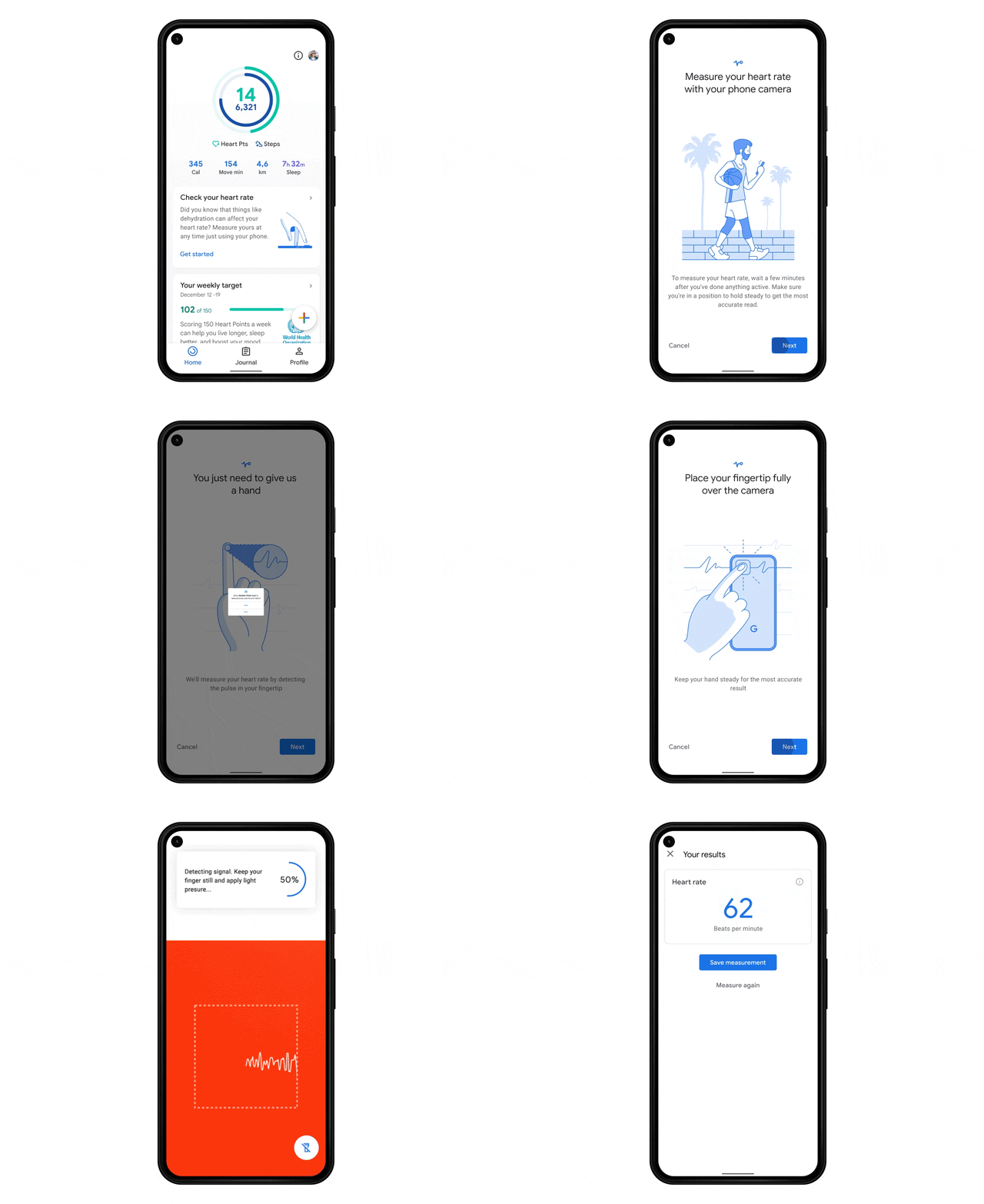
For heart rate, Google is initially using the camera to detect “subtle color changes” in a user’s finger tip, which provide an indicator about when oxygenated blood flows from your heart through to the rest of your body. The company’s validation data (again, still subject to external review) has shown accuracy within 2% margin of error, on average, across people with a range of different skin types. Google is also working on making this same technology work using color changes in a person’s face, it says, though that work is still in the exploratory phase.

Google is going to make these measurement features available to users within the next month, it says, via the Google Fit app, and initially on currently available Pixel devices made by the company itself. The plan is then to expand the features to different Android devices running Android 6 or later, sometime “in the coming months.”

Image Credits: Google

“My team has been working on ways that we can unlock the potential of everyday smart devices,” Patel said in a press briefing regarding the new features. This would include smart devices in the home, or a mobile phone, and how we leverage the sensors that are starting to become more and more ubiquitous within those devices, to support health and wellness.”

Patel, who is also a computer science professor at the University of Washington and who has been recognized with an ACM Prize in Computing Award for his work in digital health, said that the availability of powerful sensors in ubiquitous consumer devices, combined with advances in AI, have meant that daily health monitoring can be much more accessible than ever before.

“I really think that’s going to be a really important area moving forward given that if you think about health care, the journey just doesn’t end at the hospital, the four walls of the hospital,” he said. “It’s really this continuous journey, as you’re living your daily life, and being able to give you feedback and be able to measure your general wellness is an important thing.”

It’s worth noting that Google is explicit about these features being intended for use in a person’s own tracking of their general wellbeing – meaning it’s not meant as a diagnostic or medical tool. That’s pretty standard for these kinds of features, since few of these companies want to take of the task of getting full FDA medical-grade device certification for tools that are meant for general consumer use. To that end, Google Fit also doesn’t provide any guidance or advise based on the results of these measurements; instead, the app provides a general disclaimer that the results aren’t intended for medical use, and also offers up some very high-level description of why you’d even want to track these stats at all.

Many of the existing dedicated wellness and health tracking products on the market, like the Oura ring, for instance, provide more guidance and actionable insight based on the measurements it takes. Google seems intent on steering well clear of that line with these features, instead leaving the use of this information fully within the hands of users. That said, it could be a valuable resource to share with your physician, particularly if you’re concerned about potential health issues already, in place of other less convenient and available continuous health monitoring.

Patel said that Google is interested in potentially exploring how sensor fusion could further enhance tracking capabilities on existing devices, and in response to a question about potentially offering this on iPhones, he said that while the focus is currently on Android, they ultimate goal is indeed to get it “to as many people as possible.”

04 Feb 2021

Google to offer heart and respiratory rate measurements using just your smartphone’s camera

Google is introducing features that will allow users to take vital health measurements using just the camera they already have on their smartphone, expanding health and fitness features typically only available on dedicated wearables to a whole new group of people. Beginning next month, and available initially on Google Pixel phones exclusively (but with plans to offer it for other Android devices in future), users will be able to measure both their heart rate and their respiratory rate using just their device’s camera.

Typically, taking these measurements has required specialized hardware, including red or green light-based heart rate monitors like those found on the Apple Watch or on fitness trackers like those made by Google-acquired Fitbit. Google’s hardware and software teams, including the Google Health unit led by Director of Health Technologies Shwetak Patel, have managed to develop computer vision-based methods for taking these measurements using only smartphone cameras, which it says can produce results that are comparable to clinical-grade measurement hardware (it has produced a study to validate these results, which it’s making available in pre-print format while it seeks peer review through an academic journal).

For respiratory rate, the technology relies on a technique known as ‘optical flow,’ which monitors movements in a person’s chest as they breathe and uses that to determine their breathing rate. In its clinical validation study, which covered both typical individuals in good health, and people with existing respiratory conditions, Google’s data indicates that it’s accurate to within 1 breath per minute across all participants.

For heart rate, Google is initially using the camera to detect “subtle color changes” in a user’s finger tip, which provide an indicator about when oxygenated blood flows from your heart through to the rest of your body. The company’s validation data (again, still subject to external review) has shown accuracy within 2% margin of error, on average, across people with a range of different skin types. Google is also working on making this same technology work using color changes in a person’s face, it says, though that work is still in the exploratory phase.

Google is going to make these measurement features available to users within the next month, it says, via the Google Fit app, and initially on currently available Pixel devices made by the company itself. The plan is then to expand the features to different Android devices running Android 6 or later, sometime “in the coming months.”

Image Credits: Google

“My team has been working on ways that we can unlock the potential of everyday smart devices,” Patel said in a press briefing regarding the new features. This would include smart devices in the home, or a mobile phone, and how we leverage the sensors that are starting to become more and more ubiquitous within those devices, to support health and wellness.”

Patel, who is also a computer science professor at the University of Washington and who has been recognized with an ACM Prize in Computing Award for his work in digital health, said that the availability of powerful sensors in ubiquitous consumer devices, combined with advances in AI, have meant that daily health monitoring can be much more accessible than ever before.

“I really think that’s going to be a really important area moving forward given that if you think about health care, the journey just doesn’t end at the hospital, the four walls of the hospital,” he said. “It’s really this continuous journey, as you’re living your daily life, and being able to give you feedback and be able to measure your general wellness is an important thing.”

It’s worth noting that Google is explicit about these features being intended for use in a person’s own tracking of their general wellbeing – meaning it’s not meant as a diagnostic or medical tool. That’s pretty standard for these kinds of features, since few of these companies want to take of the task of getting full FDA medical-grade device certification for tools that are meant for general consumer use. To that end, Google Fit also doesn’t provide any guidance or advise based on the results of these measurements; instead, the app provides a general disclaimer that the results aren’t intended for medical use, and also offers up some very high-level description of why you’d even want to track these stats at all.

Many of the existing dedicated wellness and health tracking products on the market, like the Oura ring, for instance, provide more guidance and actionable insight based on the measurements it takes. Google seems intent on steering well clear of that line with these features, instead leaving the use of this information fully within the hands of users. That said, it could be a valuable resource to share with your physician, particularly if you’re concerned about potential health issues already, in place of other less convenient and available continuous health monitoring.

Patel said that Google is interested in potentially exploring how sensor fusion could further enhance tracking capabilities on existing devices, and in response to a question about potentially offering this on iPhones, he said that while the focus is currently on Android, they ultimate goal is indeed to get it “to as many people as possible.”

04 Feb 2021

Class adds $30 million to its balance sheet for a Zoom-friendly edtech solution

Class, launched less than a year ago by Blackboard co-founder Michael Chasen, integrates exclusively with Zoom to offer a more customized classroom for students and teachers alike. The inaugural product, Class for Zoom, uses both management and instruction tools to bolster the video conferencing call experience.

Formerly named ClassEDU, the startup announced today that it has added $30 million to its balance sheet, upping its total funding secured to $46 million. Raising that much pre-launch gives the startup key wiggle room, but it also gives validation: a number of Zoom’s earliest investors, including Emergence Capital and Bill Tai, who wrote the first check into Zoom, have put money into Class.

The money will be used to grow Class’ 60-person team to 100, as well as meet international demand for its product. More than 6,000 institutions from the United States, Dubai, Japan and Europe are on Class’ waitlist.

On the instruction side, Class for Zoom helps teachers launch live assignments, quizzes and tests, which can be completed by students in real time. On the management side, tools range from attendance trackers to features that allow a teacher to see how much time a student is participating in activities. Currently, ClassEDU is in a private, paid beta with more than 60 customers.

Image Credits: Class

Right now, Class software is only usable on Macs, but its beta will be available on iPhone, Windows and Android in the near future. The public launch is at the end of the quarter.

The startup is built entirely atop the Zoom platform, but functions as a standalone business versus a third-party integration, like what one would find on Zoom apps. Class is using the Zoom SDK, which is free, to use its back-end audio and video capabilities but build front-end interface and experience. Like any early-stage startup that relies on another business to work, the platform risk is notable.

At the same time, the risk comes with reward: Zoom is a household name, which helps Class reduce significant friction when selling to schools, says Chasen. Instead of a school having to replace the technology they have been using for the last year, Chasen says that Class can simply make it better.

“We’re going for the broader, larger deployments that just need to know that they have the stability and the scalability of Zoom, with just teaching learning tools built on top of that,” Chasen said. Over 125,000 schools use Zoom already, he said, which is enough to build a big business. The startup has no current plans to integrate with Teams or WebEx.

The startup sees the changing tide in edtech boiling down to a difference in sales, similar to Udemy’s new president’s sentiment with enterprise sales earlier this week.

“At Blackboard, we had a six to nine month sales cycle, we’d have to explain that e-learning is a thing,” Chasen said, who was at the LMS business for 15 years. “[With Class] we don’t even have to pitch. It wraps up in a month, and our sales cycle is just showing people the product.

The big hurdle for Class, and any startup selling e-learning solutions to institutions, is post-pandemic utility. While institutions have traditionally been slow to adopt software due to red tape, Chasen says that both of Class’ customers, higher ed and K-12, are actively allocating budget for these tools. The price for Class ranges between $10,000 to $65,000 annually depending on the number of students in the classes.

“We have not run into a budgeting problem in a single school,” he said. “Higher ed has already been taking this step towards online learning, and they’re now taking the next step, whereas K-12, this is the first step they’re taking.”

04 Feb 2021

Rad Power Bikes raises $150 million as electric bike sales boom

Electric bike sales boomed in 2020, a phenomenon driven by the COVID-19 pandemic and the disruption it delivered consumers’ daily lives.

Now, Rad Power Bikes is reaping those rewards and using them to double its workforce and scale globally.

The Seattle-based startup said Thursday it has raised $150 million from institutional investors including Morgan Stanley’s Counterpoint Global Fund, Fidelity Management & Research Company, TPG’s global impact investing platform The Rise Fund and funds and accounts advised by T. Rowe Price Associates. Existing investors Durable Capital Partners LP and Vulcan Capital also participated in the round.

The funding round — the largest of a U.S. electric bike startup — is a validation of Rad Power’s business model and its ability to expand beyond the $100 million in sales it generated in 2019. Rad Power Bikes declined to disclose its 2020 sales numbers.

Rad Power is a direct-to-consumer electric bike seller known for creating robust products that combine features like fat tires, big batteries and motors with touchscreens and even cargo carrying capacity — all at prices hundreds of dollars below its competitors.

The company, which was founded in 2007, initially was a low-volume custom bike builder. That changed in 2015, after Rad Power founder and CEO Mike Radenbaugh teamed up with friend Ty Collins and relaunched as a direct-to-consumer business. That year, they funded the RadRover Electric Fat Tire bike through an Indigogo campaign. The company has evolved into a large-volume seller and today has 11 different bikes in its portfolio, which are sold in 30 countries.

Rad Power has added more than just bikes. The company has built out its online sales platform, pre- and post-purchase customer support teams, retail showrooms, service van and a local service partner network. The company has always been profitable even as it has expanded, Radenbaugh said.

The company has largely been bootstrapped, although it did raise a private round of a few million dollars in 2009 and a $20 million injection of capital in 2020. To date, Rad Power has raised $175 million — the vast majority of which came in this new round.

“I felt this was a special opportunity because we’re able to accelerate investments into a bunch of areas of the business where we’ve already been experimenting for years and that we found work,” Radenbaugh said.

The funds will be used to scale in just about every sector of its business, Radenbaugh said. Rad Power employs 325 people today and Radenbaugh said they plan to double the team by the end of 2021. The company also plans to add more retail showrooms and service locations, continue to add more contract manufacturers in an aim to diversify its supply chain, and add more accessories so consumers and customize their bikes.

The team that will grow the fastest is Rad Power’s research and development department, which is currently at about 35 people, Radenbaugh added.

“The core strategy is to continue to develop new vehicle categories,” Radenbaugh  said. “So while we’ll still be an  ebike company — and we’re always going to have pedals and it’s always going to have that type of experience — we will continue to create stuff that really blurs the lines between ebikes and scooters and mopeds and even the automotive industry.”

04 Feb 2021

Rad Power Bikes raises $150 million as electric bike sales boom

Electric bike sales boomed in 2020, a phenomenon driven by the COVID-19 pandemic and the disruption it delivered consumers’ daily lives.

Now, Rad Power Bikes is reaping those rewards and using them to double its workforce and scale globally.

The Seattle-based startup said Thursday it has raised $150 million from institutional investors including Morgan Stanley’s Counterpoint Global Fund, Fidelity Management & Research Company, TPG’s global impact investing platform The Rise Fund and funds and accounts advised by T. Rowe Price Associates. Existing investors Durable Capital Partners LP and Vulcan Capital also participated in the round.

The funding round — the largest of a U.S. electric bike startup — is a validation of Rad Power’s business model and its ability to expand beyond the $100 million in sales it generated in 2019. Rad Power Bikes declined to disclose its 2020 sales numbers.

Rad Power is a direct-to-consumer electric bike seller known for creating robust products that combine features like fat tires, big batteries and motors with touchscreens and even cargo carrying capacity — all at prices hundreds of dollars below its competitors.

The company, which was founded in 2007, initially was a low-volume custom bike builder. That changed in 2015, after Rad Power founder and CEO Mike Radenbaugh teamed up with friend Ty Collins and relaunched as a direct-to-consumer business. That year, they funded the RadRover Electric Fat Tire bike through an Indigogo campaign. The company has evolved into a large-volume seller and today has 11 different bikes in its portfolio, which are sold in 30 countries.

Rad Power has added more than just bikes. The company has built out its online sales platform, pre- and post-purchase customer support teams, retail showrooms, service van and a local service partner network. The company has always been profitable even as it has expanded, Radenbaugh said.

The company has largely been bootstrapped, although it did raise a private round of a few million dollars in 2009 and a $20 million injection of capital in 2020. To date, Rad Power has raised $175 million — the vast majority of which came in this new round.

“I felt this was a special opportunity because we’re able to accelerate investments into a bunch of areas of the business where we’ve already been experimenting for years and that we found work,” Radenbaugh said.

The funds will be used to scale in just about every sector of its business, Radenbaugh said. Rad Power employs 325 people today and Radenbaugh said they plan to double the team by the end of 2021. The company also plans to add more retail showrooms and service locations, continue to add more contract manufacturers in an aim to diversify its supply chain, and add more accessories so consumers and customize their bikes.

The team that will grow the fastest is Rad Power’s research and development department, which is currently at about 35 people, Radenbaugh added.

“The core strategy is to continue to develop new vehicle categories,” Radenbaugh  said. “So while we’ll still be an  ebike company — and we’re always going to have pedals and it’s always going to have that type of experience — we will continue to create stuff that really blurs the lines between ebikes and scooters and mopeds and even the automotive industry.”

04 Feb 2021

Upstart gaming studio Mountaintop starts its climb with $5.5M seed from friends and family

Mountaintop, a sort of supergroup game development studio founded by veterans from a multitude of other major companies in the industry, has collected a $5.5 seed round from friends and family, and announced that their first title will be a PvP shooter.

The company emerged last summer, headed by Oculus co-founder Nate Mitchell and several others from larger gaming concerns that decided to strike off on their own. The idea would be to create an independent studio free from the pervasive culture of crunch and toxicity frequently found (or reported) at bigger publishers and developers.

Being independent also means no allowance from a big publisher, so they needed to get some capital to work with. That manifested from the enviably deep pockets of their families and friends, who I suppose felt more than justified in funding the activities of people whom they know to be successful entrepreneurs and industry movers and shakers.

The $5.5 million seed will go towards their first title, which will be a PvP shooter. Now, this may give some pause, as PvP shooters number among the last five years’ biggest successes (Overwatch, PUBG, Fortnite, Apex) and most notable failures (Crucible, Battleborn, Paragon, Gigantic) — the latter seemingly in fruitless attempts to emulate the former.

But the opportunistic corporate me-too attitude that sunk many a game is unlikely to exist at Mountaintop, a small team with no shareholders breathing down their neck — except their friends and family, who will be too polite to do so. If they think they can make an interesting and commercially viable PvP shooter, I say have at it, I’m tired of the other ones.

It’ll be nice to know that the product came from a crunch-free environment as well — as we’ve seen with Supergiant’s “Hades,” people working on their own schedules to make something they care about can have remarkable results.

As Mitchell put it:

We all know great games and products can be built without crunch. It’s about thoughtful scoping, planning, execution every step of the way. That’s not to say that avoiding crunch is easy — it’s incredibly challenging, especially with unexpected curve balls along the way.

In the end though, it always comes down to leadership and the decisions they make. At Mountaintop, we’re committed to doing right by the team, always.

The company has grown from the founding team of five now to 20. Although Mountaintop wasn’t intended from the start to be a pandemic-proof setup, its remote-first approach did mean that hiring during COVID didn’t mean changing how they planned for the company to work. Currently they have people from Epic, Blizzard, Naughty Dog, Respawn, Infinity Ward, Ubisoft, Raven, Turtle Rock, Double Fine, PopCap, and (obviously) Oculus.

But among the team’s other priorities were diversity and inclusion. With 19 of the 20 people on staff men, and 18 of the 20 white, that seems to be presenting more of a challenge to them.

“We’re just getting started, but we’re building a studio with diversity and inclusion at the core, where everyone feels like they belong. We have a long way to go, but we’re committed to seeing it through,” said Mitchell. With a target headcount of about 50, there’s a still a lot of room to grow into that promise.

No indication when we’ll learn more about the game, but at the current cadence we can probably expect another tidbit of info this summer.

04 Feb 2021

The cloud infrastructure market hit $129B in 2020

The cloud infrastructure market in 2020 reflected society itself, with the richest companies getting richer and the ones at the bottom of the market getting poorer. It grew to $129 billion for the year, according to data from Synergy Research Group. That’s up from around $97 billion in 2019.

Synergy also reported that the cloud infra market reached $37 billion in the fourth quarter, up from $33 billion in the third quarter, and 35% from a year ago.

I’ve heard from every founder under the sun for the last 9 months that the pandemic was accelerating digital transformation, and that a big part of that was an expedited shift to the cloud. These numbers would seem to bear that out.

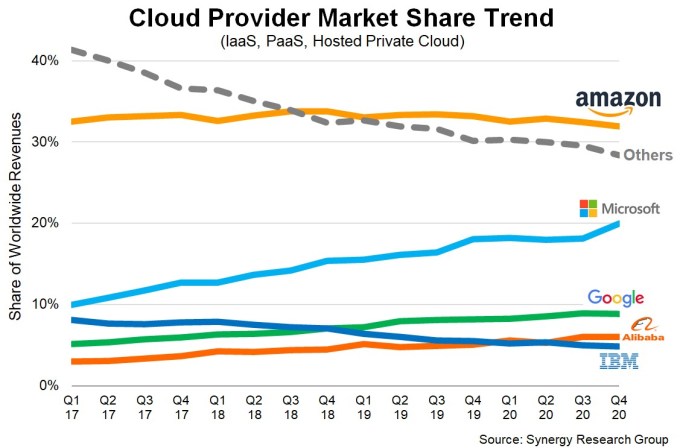
As usual the big three were Amazon, Microsoft and Google, with Alibaba now firmly entrenched in fourth place and IBM falling back to fifth. But Microsoft grew more quickly than rival Amazon, reaching 20% market share at the end of 2020 for the first time. Keep in mind that the Redmond-based software giant has now doubled its share since 2017. That’s remarkably rapid rapid growth. Meanwhile Google and Alibaba took home 9% and 6% respectively.

Here’s what that all looks like in chart form:

Cloud infrastructure marketshare for fourth quarter 2020 from Synergy Research.

Image Credits: Synergy Research

Amazon is an interesting case in that it has plateaued at around 33% for four straight years of Synergy data, but because it’s one-third share of an increasingly growing market, that means that it has kept growing its public cloud revenues as the category itself has expanded.

Amazon closed out the year with $12.74 billion in Q4 AWS revenue, putting it on a run rate of over just over $50 billion for the first time. That was up from $11.6 billion the prior quarter. While Microsoft’s numbers are always difficult to parse from its earning’s reports, doing the math of 20% of $37 billion, it came in with $7.4 billion up from $5.9 billion last quarter.

Google brought in $3.3 billion, up from $2.98 billion in Q3 2020, and Alibaba pulled in $2.22 billion, up from $1.65 billion over the same timeframe.

John Dinsdale, principal analyst at Synergy says the leaders are pretty firmly entrenched at this point with huge absolute market numbers and also huge gaps between the cloud providers. “AWS has been a great success story for over ten years now and it remains in an extremely strong market position despite increasing competition from a broad swathe of strong IT industry companies. That is a great testament both to Amazon and to the AWS leadership team and you’d have to suspect that will not change with the new regime,’ he told me.

He sees Microsoft as a worthy rival, but one that is bound to hit a growth wall at some point. “It is certainly feasible that Microsoft will continue to narrow the gap between itself and Amazon, but the bigger Microsoft Azure becomes the tougher it is to maintain really high growth rates. That is just the law of large numbers.”

Meanwhile, market share at the bottom of the cloud infrastructure space continued to decline even while the number of dollars at stake have continued to expand dramatically. “The market share losers have been the large group of smaller cloud providers, who collectively have lost 13 percentage points of market share over the last 16 quarters,” Synergy wrote in a statement.

Dinsdale says all is not lost for these players, however. “Regarding the smaller players (or the big companies that have only a small market share), they can either focus on specific market niches (can be based around geography, service type or customer vertical) or they can try to offer a broad range of cloud services to a broad range of customers. Companies doing the former can do quite well, while companies doing the latter will find it extremely tough,” Dinsdale told me.

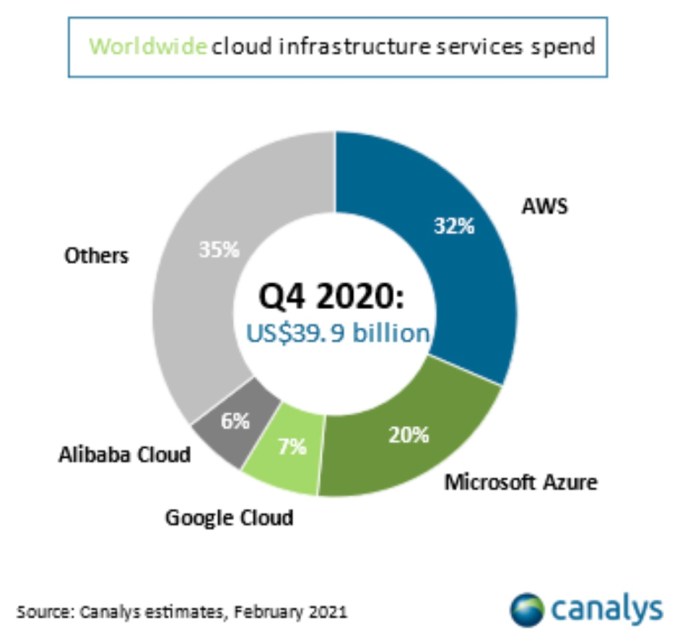
It’s worth noting that Canalys has slightly different numbers with a total market of around $142 billion and almost $40 billion for the quarter, but the percentages are in line with Synergy’s:

Canalys 4th quarter 2021 cloud infrastructure market share percentages

Image Credits: Canalys

At some point the numbers get so big they almost cease to have meaning, but as large as the public cloud revenue numbers become, they remain a relatively small percentage of overall worldwide IT spend. According to Gartner estimates, worldwide IT spend in 2020 was $3.6 trillion (with a T). That means that the cloud infrastructure market accounted for just 3.85% of total spend in 2020.

Think about that for a moment: less than 4% of IT spend currently is on cloud infrastructure, leaving so much room for growth and for those billions to grow ever bigger in the coming years.

It would certainly make it more interesting if someone could come in and disrupt the leaders, but for now at least they are going to be hard to push out of the way unless something unforeseen and dramatic happens to the way we think about computing.

04 Feb 2021

Iteratively raises $5.4M to help companies build data pipelines they can trust

As companies gather more data, ensuring that they can trust the quality of that data is becoming increasingly important. An analytics pipeline is only as good as the data it collects, after all, and messy data — or outright bugs — can easily lead to issues further down the line.

Seattle-based Iteratively wants to help businesses build data pipelines they can trust. The company today announced a $5.4 million seed funding round led by Google’s AI-centric Gradient Ventures fund. Fika Ventures and early Iteratively investor PSL Ventures also participated, with Gradient Ventures partner Zach Bratun-Glennon joining the company’s board.

Patrick Thompson, Iteratively’s Co-founder and CEO, started working on Iteratively about two years ago. Before that, he worked at Atlassian and at Syncplicity, where he met his co-founder Ondrej Hrebicek. After getting started, the team spent six months doing customer discovery and the theme they picked up on was that companies weren’t trusting the data they captured.

“We interviewed a ton of companies who built internal solutions, trying to solve this particular problem. We actually built one at Atlassian, as well, so I was very much intimately familiar with this pain. And so we decided to bring a product to market that really helps alleviate the pain,” he told me.

Image Credits: Iteratively

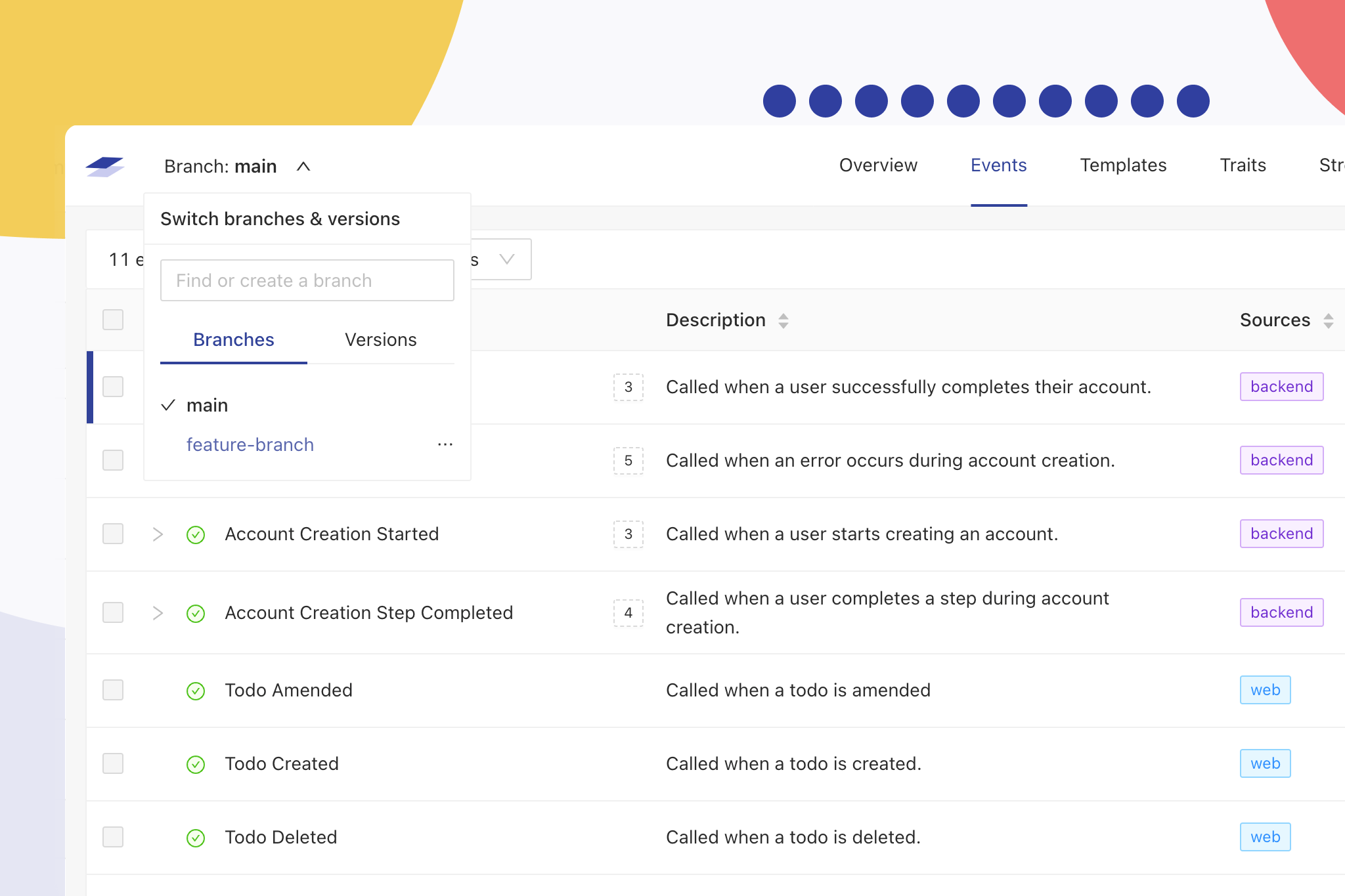
In a lot of companies, the data producers and data consumers don’t really talk to each other — and if they do, it’s often only through a spreadsheet or wiki. Iteratively aims to provide a collaborative environment to bring these different groups together and create a single source of truth for all stakeholders. “Typically, there’s a handoff process, either on a JIRA ticket or a Confluence page or spreadsheet, where they try to hand over these requirements — and generally, it’s never really implemented correctly, which then causes a lot of pain points down down the line,” Thompson explained.

Currently, Iteratively focuses on event streaming data for product and marketing analytics — the kind of data that typically flows into a Mixpanel, Amplitude or Segment. Iteratively itself sits at the origin of the data, say an app, and then validates the data and routes it to whatever third-party solution a company may use. That means the tool sits right where the data is generated, but this setup also means that none of the data ever flows through Iteratively’s own servers.

Image Credits: Iteratively

“We don’t actually see the data,” Thompson stressed. “We’re not a data set processor. We’re a wrapper over the top of your own analytics pipeline or your own third party SaaS tools, but we verify the payloads as they flow through our SDK on the client.”

Over time, though, that may change, he acknowledged and Iteratively may do some data processing as well, but likely with a focus on metadata and observability.

Since the company doesn’t actually process any of the data itself, it’s charging customers by seat and not based on how many events move through their pipelines, for example. That may obviously change over time as the company looks into doing some data processing on its side as well.

Currently, Iteratively has about 10 employees and plans to grow that to 20 by the end of the year. The company plans to hire across R&D, sales and marketing.

Iteratively‘s software has a unique approach to enabling company-wide collaboration and enforcing data quality,” said Gradient’s Bratun-Glennon. “Going forward, we believe that intelligent analytics and data-driven business decision making will differentiate successful companies and best-in-class products. Iteratively‘s mission, product and team are poised to give each of their customers these capabilities.”