
Year: 2021

04 Feb 2021

China’s national blockchain network embraces global developers

While China bans cryptocurrency exchanges and initial coin offerings, the government is set to leverage the underpinning technology — often without the decentralized part. Blockchain, for instance, could help track the shipment of luxury goods and authenticate court evidence. In the process of adopting blockchain applications in its own interest, China also wants to become a world leader of the new technology.

Last year, an ambitious, government-backed blockchain infrastructure network launched in China. The Blockchain-based Service Network, or BSN, acts as an operating system for blockchain programs so developers won’t have to design a framework from the ground up. Importantly, it’s part of the country’s goal to set industry standards and build the underlying infrastructure for blockchain applications worldwide.

The brains behind BNS are the State Information Center, an affiliate to China’s top economic and reform planner, the country’s credit card processing giant UnionPay, telecoms carrier China Mobile, and a little-known Beijing-based startup called Red Date which cut its teeth building smart city technology in China.

There are two main types of blockchains: permissionless, which is public, decentralized and transparent; and permissioned, which is operated by one or multiple stakeholders of a given industry, respectively called private and consortium blockchains.

BSN is designed as a global infrastructure to support both consortium and public blockchains, it says in a white paper published last March. “Just as with the internet, the BSN is also a cross-cloud, cross-portal, cross-framework global infrastructure network.”

An English version of the website is available for dApp developers, and major public chains like Ethereum, EOS, Tezos, NEO already have nodes on the network.

Now BNS is working on the more private part of its infrastructure. This week, it announced it will roll out a permissioned version of Cosmos. Introduced in 2019, Cosmos is a network comprised of many independent blockchains and calls itself the “internet of blockchains.”

The development work for the Cosmos-based chain is done by Bianjie, a Chinese blockchain startup, and the permissioned chain is named after the city Wenchang in China’s southernmost Hainan Province, home to China’s first blockchain pilot zone.

The intentions of the Wenchang Chain are to provide a “public infrastructure network that allows the low-cost development, deployment, operation, maintenance and regulation of consortium blockchain applications,” Bianjie said in an announcement.

Global developers can now deploy their dApps on the Wenchang Chain via BSN, which makes their dApps concurrently compliant with Chinese regulations, a Bianjie spokesperson explained via email.

“In this way, it’s possible for their dApps to gain a large number of Chinese users and enter the Chinese market.”

The Wenchang Chain is intended not just for enterprise services but also business-to-consumer and consumer-to-consumer programs. For example, Uptick, a consumer-facing e-ticketing dApp, will soon become the first dApp to launch on the permissioned chain, according to the Bianjie spokesperson.

04 Feb 2021

Headless CMS Storyblok raises $8.5M Series A funding round led by Mubadala Capital

Storyblok, a ‘headless’ CMS for developers and marketers to deliver content, has raised an $8.5 million Series A funding round led by Mubadala Capital, alongside existing Storyblok investors firstminute capital and 3VC. 

The Austria-founded company’s platform counts Pizza Hut, Adidas, UPC, Greggs, Decathlon and others among its roster of clients, alongside many thousands of solo developers that use its CMS. That means it’s currently powering more than 60,000 projects, it says.

Storyblok says its CMS provides ‘highly customizable content blocks and visual editing tools’ in n contrast to other headless CMS solutions which are flexible for developers but might be less so for actual editors to edit.

Dominik Angerer, Co-Founder and CEO of Storyblok, said in a statement: “The marketing world is in a state of transition. Fragmented channels and rapidly changing consumer behavior as a result of the Coronavirus pandemic have made it much more challenging to efficiently and quickly keep brand messaging consistent across multiple platforms. On paper, headless CMS technology solves a lot of these problems, but in practice, most platforms are only geared towards developers, which makes them incredibly difficult for non-technical people to use. Storyblok’s solution marries the needs of both editors and developers, which has given us a unique position in the market and resulted in rapid growth.”

Fatou Bintou Sagnang, director at Mubadala Capital said: “In a vast but relatively homogenous market, Storyblok has impressed us with a truly differentiated product that resonates with small and large enterprises. The organic traction is proof of the customer love from both developers and marketers.”

Competitors to Storyblok include ContentStack, Contentful, Sitecore, Adobe Experience Manager and Prismic.

Speaking to TechCrunch Angerer said: “A lot of headless CMS platforms are easily integrated into legacy systems but when it comes to actually using them on a daily basis marketers or other editors find them incredibly difficult to use. In practice, they end up having to go back to their IT or developer teams to sort out problems or make major changes which ends up wasting the time and money that headless CMS’s perport to save.”

04 Feb 2021

Indian gaming platform Mobile Premier League valued at $945M in $95M fundraise

Mobile Premier League (MPL) has raised $95 million in a new financing round, just five months after it secured $90 million as the two-and-a-half-year-old Bangalore-based esports and gaming platform looks to grow in international markets.

The new $95 million round, a Series D, was led by Composite Capital and Moore Strategic Ventures and gave the Indian startup a post-money valuation of $945 million, it said. Base Partners, RTP Global, SIG, Go-Ventures, Telstra Ventures, Founders Circle and Play Ventures also participated in the round, which brings its total to-date raise to $225.5 million.

MPL, which counts Times Internet among its backers, operates a pure-play gaming platform that hosts a range of tournaments. The app, which has amassed more than 60 million users in India and 3.5 million users in Indonesia, also serves as a publishing platform for other gaming firms. MPL, which does not develop games of its own, hosts about 70 games across multiple sports on the app today.

“As we grow our presence and expand, this fresh round of funds will help us focus on our core value propositions — a robust platform with the best features for gamers and onboarding the best eSports titles. The esports community in India is thriving, and we believe this is the perfect time to take Indian-made games to the world as well as help Indian gamers get recognized for their talent,” said Sai Srinivas, co-founder and chief executive of MPL, in a statement.

The Bangalore-based startup also offers fantasy sports, a segment that has taken off in many parts of India in recent years. Because fantasy sports is only one part of the business, the coronavirus outbreak that shut most real-world matches has not impeded the startup’s growth in recent quarters.

“We’re competing with battle-hardened, decade old companies with much, much deeper pockets but it’s incredible what the young team has achieved over the past couple of years. When we were on the Play Store, a couple of years back, MPL was the fastest app to reach a 1M DAU ever in India!” tweeted Abhishek Madhavan, SVP of Marketing at MPL, last year.

“We signed Virat Kohli (pictured above), when we were a 3-month old company! When we got out of the Play Store, we were told growth will be very very hard to come by, every single marketing metric would fall.”

This is a developing story. More to follow…

04 Feb 2021

GajiGesa, a fintech startup serving underbanked Indonesian workers, raises $2.5 million seed round

GajiGesa, a fintech company that offers Earned Wage Access (EWA) and other services for workers in Indonesia, has raised $2.5 million in seed funding. The round was co-led by Defy.vc and Quest Ventures. Other participants included GK Plug and Play, Next Billion Ventures, Alto Partners Multi-Family Office, Kanmo Group and strategic angel investors.

The company was founded last year by husband-and-wife team Vidit Agrawal and Martyna Malinowska. Agrawal was Uber’s first employee in Asia and has also served in leadership positions at Carro and Stripe. Malinowska led product development at Standard Chartered’s SC Ventures and alternative credit-scoring platform LenddoEFL.

About 66% of Indonesia’s 260 million population is “unbanked,” which means they don’t have a bank account and limited access to financial services like loans. Agrawal and Malinowska decided to launch GajiGesa in Indonesia because Malinowska worked with many unbanked workers while at LenddoEFL. While at Uber, Agrawal also worked with drivers across Southeast Asia whose average earnings were $250 USD a month (excluding Singapore), and he said the top issue they face was harassment by money lenders.

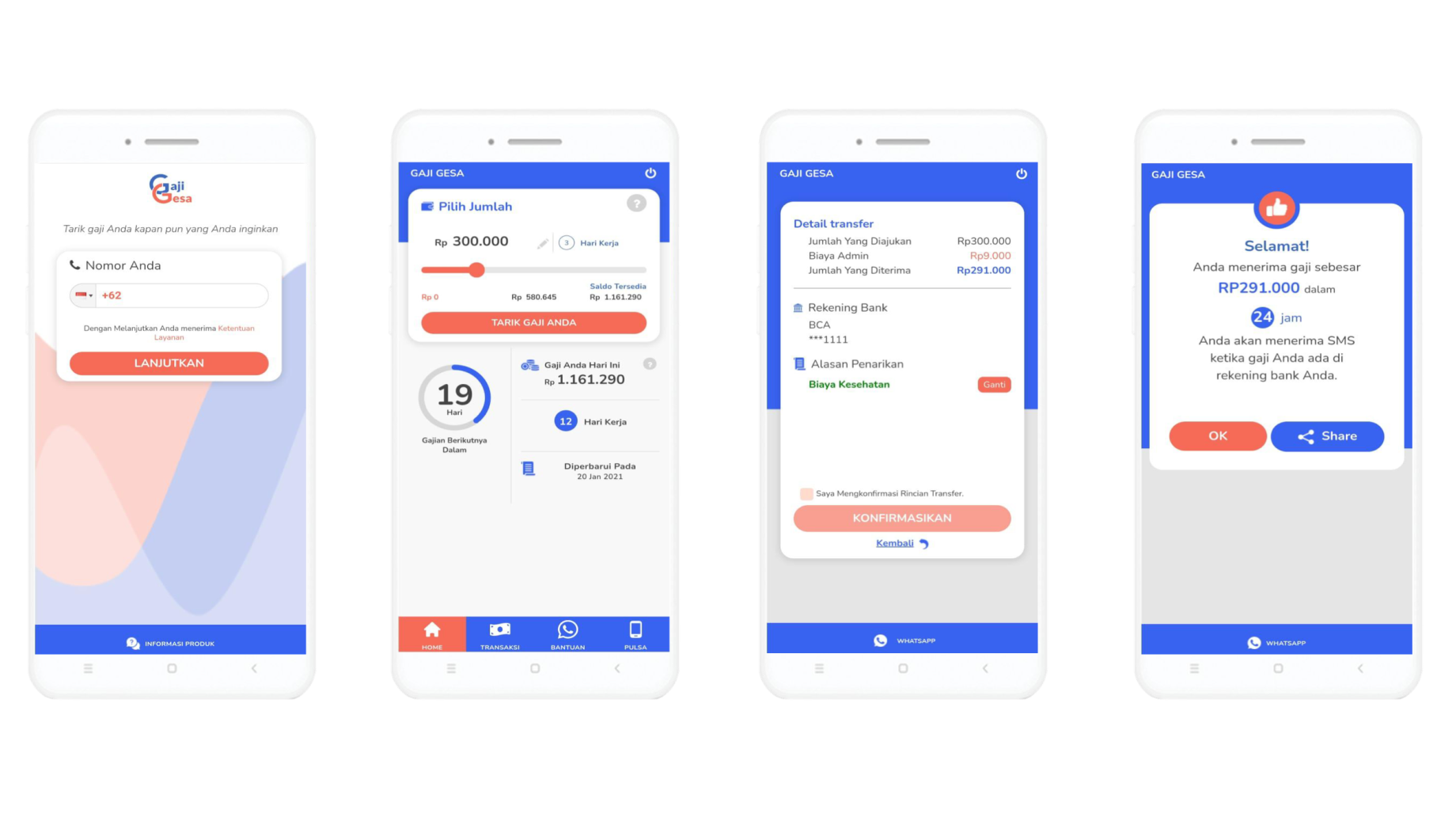
Screenshots showing how GajiGesa's app works. GajiGesa is a startup that offers earned wage access and other services to Indonesian workers.

GajiGesa’s app

“These hardworking Indonesians had no fair or formal sources for easy access to capital. Further, the most common reason for borrowing was short-term liquidity issues,” Agrawal told TechCrunch. “But workers were forced to borrow either long-term, high ticket size loans or short-term loans with exorbitantly high-interest rates.”

Having immediate access to earned wages, instead of waiting for a semi-monthly or monthly paycheck, can help alleviate financial stress and make it easier for workers to manage their income and handle emergencies. Companies that have started instant payment services for workers in other countries include Square, London-based startup Wagestream and Gusto.

Since launching in October 2020, GajiGesa has added over 30 employers on its platform, serving tens of thousand of workers in total. It integrates into a company’s existing human resources management and payroll systems. Workers can get earned wages immediately, track earnings, pay bills, buy prepaid cards and access financial education resources through an app.

GajiGesa does not charge interest rates or require collateral, since all its users are pre-approved by their employers. Companies decide to charge fees or offer GajiGesa as part of their benefits packages, and also get access to analytics that can help them create targeted incentives or new benefits for their workforce.

During COVID-19, Agrawal said the startup has “seen insatiable demand and support for GajiGesa’s EWA solution from employers. This is partly attributed to the various challenges employers are facing due to the effects of COVID-19, but our platform is designed to support employers and employees in the long-term. The value of EWA and the other services we offer is not limited to the pandemic.”

04 Feb 2021

Grab announces program to help increase COVID-19 vaccinations in Southeast Asia

Grab, the Southeast Asian ride-hailing and on-demand delivery giant, announced a program to increase access to COVID-19 vaccinations today. Its goal is to have all of its employees, as well as driver and delivery partners, vaccinated by 2022 (excluding people who are medically unable to receive shots). Grab also said it will work with governments to provide information about vaccines through its app, and is in discussions to provide last-mile vaccine distribution, and transportation to and from vaccination centers.

The company currently has operations in eight Southeast Asian countries: Singapore, Cambodia, Indonesia, Malaysia, Myanmar, the Philippines, Thailand and Vietnam. Grab joins a growing roster of private companies around the world that have offered to help governments with their vaccination programs. In the United States, these include tech companies like Microsoft, Oracle, Salesforce and Epic. Meanwhile, China’s largest ride-hailing company, Didi Chuxing, is pledging $10 million to support vaccination programs in 13 countries.

In a statement, Russell Cohen, Grab’s group managing director of operations, said, “The quicker we can achieve herd immunity, the sooner our communities and economies can start to rebuild. Public-private partnership has been critical in taking on some of the pandemic’s biggest battles, and this collaboration should continue.”

For drivers and delivery partners, Grab said it will subsidize COVID-19 vaccine costs not covered by national vaccination programs. The company will also extend its Group Prolonged Medical Leave insurance policy to cover income lost by drivers as a result of potential side effects from getting vaccinated. Employees and immediate family members will have any costs not covered by national programs paid for by Grab.

In terms of vaccine education, the Grab app will prominently display information from governments and health authorities, and run user surveys to help them understand public sentiment about COVID-19 vaccines. The company says its app has been downloaded more than 214 million times.

04 Feb 2021

SquadCast adds video podcast recording

Remote video podcasting is surprisingly still something of a Wild West these days. Given the massive sums of money currently being pumped into the category — not to mention the fact that pretty much all podcasting became remote podcasting in 2020 — you’d expect there to be a more unified solution. Many still continue to rely on catchall teleconferencing software to get the job done (full disclosure: I’ve been recording my podcasts on Zoom during the pandemic).

It’s not for lack of trying of course. A number of companies are vying to become the Zoom or Skype of remote podcasts, including, notably, Zencastr. SquadCast is another big name in the space. The company claims a pretty big footprint, though, again, its primary competitors are still non-specialized video calling apps.

While those platforms are generally reliable and ubiquitous, they do have their drawbacks: namely recording quality. SquadCast’s big selling point has been higher-quality recording than those services where sound is something of an afterthought. This week, the Oakland-based company is adding video recording to the mix.

“We were on an upward trajectory before COVID, but demand during the pandemic has resulted in over 280% growth in both revenue and customer acquisition,” CEO Zachariah Moreno said in a release. “Since Video recording is our most requested feature by current, past, and prospective customers, it was the natural next step to continue to move the needle in virtual recording for podcast professionals.”

The platform is adding the feature for existing customers starting this quarter. The latest beta version of the software records video locally as separate files at 720p. Once the recording is over, it will convert the files into MP4 or WebM.

SquadCast’s version 3.0 beta with Studio Quality Video Recording consumer plans start at $40/month up to $300/month. Zencastr began rolling out its own video recording feature in beta over the summer.

03 Feb 2021

Daily Crunch: TikTok will downrank ‘unsubstantiated’ claims

TikTok announces additional steps to fight misinformation, Myanmar’s military cracks down on Facebook and Google’s subsea cable goes online. This is your Daily Crunch for February 3, 2021.

The big story: TikTok will downrank ‘unsubstantiated’ claims

TikTok had already said it would try to reduce misinformation by removing videos flagged by fact checkers for including false information. Today it announced that it will go a step further by flagging videos where the fact checkers’ findings are inconclusive.

For example, the company said that there are cases where fact checkers cannot verify information in a video because events are still unfolding. Those “unsubstantiated” videos will then include a large banner, as well as an additional reminder prompt before users will be able to share them.

This feature is launching in the United States and Canada but will become available globally in “coming weeks.”

The tech giants

Myanmar military government orders telecom networks to temporarily block Facebook — The move comes after days of unrest in Myanmar, where earlier this week military took control of the country and declared a state of emergency for a year after detaining civilian leader Aung San Suu Kyi.

Google’s new subsea cable between the US and Europe is now online — The almost 4,000-mile cable has a total capacity of 250 terabits per second.

Instagram confirms it’s working on a ‘Vertical Stories’ feed — This could give the app a more TikTok-like feel.

Startups, funding and venture capital

Vivino raises $155M for wine recommendation and marketplace app — The app and the company behind it have been helping people enjoy better wine since 2010.

Good Eggs raises $100M and plans to launch in Southern California — Good Eggs says that in the past year, it has grown revenue to the nine figures (more than $100 million), hired more than 400 employees and nearly doubled its customer base.

Rocket.Chat raises $19M for its open-source approach to integrated enterprise messaging — The service is used by banks, the U.S. Navy, NGOs and other organizations to set up and run any variety of secure virtual communications services from one place.

Advice and analysis from Extra Crunch

Spotify Group Session UX teardown: The fails and their fixes — Essentially a “party mode,” the feature offers a way for participants to contribute to a collaborative playlist in real time and control what’s playing across everyone’s devices.

Edtech valuations aren’t skyrocketing, but investors see more exit opportunities — Thirteen VCs discuss how their deal-making has changed in the last year.

Deep Science: AIs with high class and higher altitudes — This roundup kicks off with a study looking at the relative positions of the U.S., EU and China in the AI “race.”

(Extra Crunch is our membership program, which helps founders and startup teams get ahead. You can sign up here.)

Everything else

Global smartphone shipments expected to rebound 11% this year — New numbers from Gartner point to a rebound to pre-2020 levels.

Todd Rundgren is about to launch a geofenced virtual tour — Rundgren is staging the tour with support from NoCap, the livestreaming concert startup founded by musicians Cisco Adler and Donavon Frankenreiter.

The Daily Crunch is TechCrunch’s roundup of our biggest and most important stories. If you’d like to get this delivered to your inbox every day at around 3pm Pacific, you can subscribe here.

03 Feb 2021

Spotify hints toward plans for podcast subscriptions, à la carte payments

Spotify again signaled its interest in developing new ways to monetize its investments in podcasts. In the company’s fourth-quarter earnings, chief executive Daniel Ek suggested the streaming media company foresees a future where there will be multiple business models for podcasts, including, potentially, both ad-supported subscriptions and à la carte options.

The company, which also revealed its podcast catalog has grown to now 2.2 million programs, said it’s seen increasing demand for the audio format in recent months.

For example, 25% of Spotify’s monthly active users now engage with podcasts, up from 22% just last quarter. Podcast consumption is also increasing, with listening hours having nearly doubled year-over-year in the fourth quarter.

Today, podcasts on Spotify’s platform are available to both free and paid users and are monetized with ads. This is still a key focus for the company — Spotify even recently acquired a podcast hosting and monetization platform, Megaphone, to help make streaming ad insertion technology available to its third-party publishers while also growing its targetable podcast inventory.

But Spotify recently put its feelers out about different means of monetizing podcasts, too.

Late last year, for instance, the company was spotted running a survey that asked its customers if they would be willing to pay for a standalone podcast subscription, and if so what would it look like and how much would it cost?

At the time, the survey offered a few different concepts.

At the low end, a subscription could offer ad-supported exclusive episodes and bonus content for $3 per month. This would be similar to Stitcher Premium, which today provides exclusives from top shows and other bonus episodes. But Spotify’s suggested version included ads, while Stitcher Premium is ad-free.

A middle option suggested a plan that would be even closer to Stitcher Premium, with exclusive shows and bonus material but no ads. This even matched Stitcher Premium’s price of $5 per month. And at the high-end, subscribers could get early access to ad-free interviews and episodes for $8 per month.

A survey, of course, is only meant to gauge consumer demand for such a subscription, and doesn’t indicate that Spotify has a new product in the works. (Spotify said the same when asked to comment on the news at the time.)

However, it’s clear that investors also want to know what Spotify is thinking when it comes to recouping its sizable investments in podcasts.

Asked if Spotify thought customers would be willing to pay for podcasts, Ek on the earnings call responded that he believed there were several new models that could be explored.

“I think we’re in the early days of seeing the long-term evolvement of how we can monetize audio on the internet. I’ve said this before, but I don’t believe that it’s a one-size-fits-all,” he said. “I believe, in fact, that we will have all business models, and that’s the future for all media companies — that you will have ad-supported subscriptions and à la carte sort of in the same space, of all media companies in the future.”

“And you should definitely expect Spotify to follow that strategy and that pattern,” Ek added, more definitively.

The answer seemed to indicate that Spotify is considering some of the ideas in that recent survey — of getting consumers to pay for some podcasts, instead of accessing them all for free or having them bundled into their music subscription.

Of course, that would change the meaning of the word “podcasts,” which today refers to freely distributed, serialized audio programs that get distributed via RSS feeds.

If Spotify chooses to paywall podcasts behind subscriptions or à la carte payments, then they’re no longer really podcasts — they’re a new sort of premium audio program.

This is an area where Spotify has plenty of room to grow, considering the significant investment it has made in podcasts over the years. To date, that’s included buying up content producers like Gimlet Media, The Ringer and Parcast, as well as signing top creators like Joe Rogan, Addison Rae, Kim Kardashian West, DC Comics, Michelle Obama and The Duke and Duchess of Sussex, among others. Spotify also bought podcast tools like Anchor and other ad technology and hosting services.

The advantage with podcasts is that Spotify has the ability to monetize them in multiple ways at once — with ads and subscriptions or direct payments, if it chose. And, of course, there are no licensing fees or royalties to contend with, as with streaming music.

Spotify could also adjust the podcast payments model as needed to fit its different geographies and the way customers around the world prefer to consume and pay for podcast content.

None of this thinking was about near-term launches, Ek also clarified.

“I think it’s early days, though, to specifically kind of look at how that could play out,” he said, talking about how the different models could take shape. “But, obviously, if that were to be the case, that revenue profile would be different than how we do music.”

03 Feb 2021

CA Supreme Court denies lawsuit challenging Prop 22’s constitutionality

The California Supreme Court today shot down the lawsuit filed by a group of rideshare drivers in California and the Service Employees International Union that alleged Proposition 22 violates the state’s constitution.

“We are disappointed in the Supreme Court’s decision not to hear our case, but make no mistake: we are not deterred in our fight to win a livable wage and basic rights,” Hector Castellanos, a plaintiff in the case, said in a statement. “We will consider every option available to protect California workers from attempts by companies like Uber and Lyft to subvert our democracy and attack our rights in order to improve their bottom lines.”

The suit argued Prop 22 makes it harder for the state’s legislature to create and enforce a workers’ compensation system for gig workers. It also argues Prop 22 violates the rule that limits ballot measures to a single issue, as well as unconstitutionally defines what would count as an amendment to the measure. As it stands today, Prop 22 requires a seven-eights legislative supermajority in order to amend the measure.

“We’re thankful, but not surprised, that the California Supreme Court has rejected this meritless lawsuit,” Jim Pyatt, a rideshare driver who advocated for Prop 22 and worked with the Yes on 22 campaign, said in a statement. “We’re hopeful this will send a strong signal to special interests to stop trying to undermine the will of voters who overwhelmingly stood with drivers to pass Proposition 22. The ballot measure was supported by nearly 60 percent of California voters across the political spectrum including hundreds of thousands of app-based drivers. It’s time to respect the vast majority of California voters as well as the drivers most impacted by Prop 22.”

How to contact TechCrunch

Got a tip? Contact us securely using SecureDrop. Find out more here. You can also reach this author via Signal at 415-516-5243

Meanwhile, Uber, Lyft and other companies have said they have their eyes on pursuing Prop 22-like legislation elsewhere. Given Uber and Lyft’s anti-gig-workers-as-employees stance, it came as no surprise when Uber and Lyft separately said they would pursue similar legislation in other parts of the country and the world.

Lyft, for example, has created external organizations that push for the independent contractor classification. Two of those organizations are Illinoisans for Independent Work and New Yorkers for Independent Work. Illinoisans for Independent Work was established in June and funded by Lyft with $1.2 million, according to committee filings. The stated purpose of the committee is “to support candidates who share the ideology of our organization and the value of independent work.”

But as we’ve previously discussed, the implementation of Prop 22 doesn’t mark the end of the battle for some gig workers to achieve employee status. There is a concerted effort to keep organizing this year, and getting ready to fight back wherever the next legislative battle emerges.

03 Feb 2021

Myanmar orders telecom networks to temporarily block Facebook

Myanmar has ordered local telecom firms to temporarily block Facebook in the Southeast Asian nation days after the military seized power in the country in a military coup.

Several users on Myanmar subreddit reported moments ago that Facebook was already inaccessible for them, suggesting that internet service providers have already started to comply with the order. In its order, Myanmar alleges that Facebook is contributing to instability in the country.

NetBlocks, which tracks global internet usage, reports that MPT, a state-owned telecom operator that commands the market, has blocked Facebook as well as Messenger, Instagram, and WhatsApp on its network.

Facebook did not immediately respond to a request for comment.

This is a developing story. More to follow…