Year: 2021

03 Feb 2021

Social platform veteran Sriram Krishnan is Andreessen Horowitz’s latest general partner

Today, Andreessen Horowitz founder Marc Andreessen announced that social media product veteran Sriram Krishnan will be joining the firm as their latest general partner.

Krishnan, whose previous roles include stints at Snap, Facebook and Twitter, has gained a higher profile in recent weeks from his recurring audio show “The Good Time Show” on Clubhouse. His recent talk with Tesla CEO Elon Musk was something of a watershed moment for the audio chat platform driving plenty of new attention to the budding app.

This announcement follows a report in The Information regarding the hire earlier this week.

Krishnan’s hire comes at an interesting point for Andreessen Horowitz, the firm is at the center of plenty of chatter among media circles regarding their “go direct” content strategy. At the same time, a16z and its leadership have played an increasingly hard-nosed role in driving a broader backlash against tech media in recent years among founders and tech enthusiasts in their orbit. Krishnan has spent much of the past couple years building out his flirtations with “tech optimism” content with his interview newsletter The Observer Effect, his Clubhouse show and his prolific Twitter usage.

Broader “tech pessimism” among media outlets has, I think, partially been owed to a swift and outspoken shift in thinking regarding the societal responsibilities of social media platforms to more aggressively moderate the content they are surfacing on a global scale. Some of the partners at a16z, a Facebook backer, have been among the more vocal in pushing back on these critiques even as the executives at their portfolio companies have seemed more amenable to shift their thinking.

In his blog post, Andreessen notes that Krishnan will be joining the firm’s consumer team to invest in areas that include social.

Krishnan, well-regarded in tech circles, may play an important role at the firm as they approach more social investments in a world where the effects of rapidly scaled consumer platforms have become more understood. The firm and its partners have been throwing their full support behind Clubhouse in an aggressive push to promote the platform, flexing the firm’s celebrity connections and influence along the way as the platform quickly picks up millions of new users. Krishnan’s direct operator roles engaging with the product struggles of building platforms that responsibly scale will likely be an asset as the firm faces increased competition across an increasingly frothy venture market.

03 Feb 2021

Todd Rundgren is about to launch a geofenced virtual tour

The idea of a virtual concert tour might seem tailor-made for the pandemic, but musician Todd Rundgren said he’s actually been thinking about something like this for years.

Rundgren told me that he’d become frustrated with our “collapsing” air travel system — exacerbated by hurricanes and climate change — that increasingly left him “sitting somewhere, unable to get to my next gig.” So he was already convinced that he need to “start imagining other ways” to reach audiences.

But it was in the context of COVID-19 that Rundgren finally decided to make it happen, with his Clearly Human Tour kicking off on February 14. He’d been planning for a traditional tour, but the dates kept getting pushed back due to the pandemic, until he finally told the organizers, “You have to let me do this. I can’t be committed to you and go two years without touring.”

Rundgren and his band will be performing entirely from Chicago, where they’ll play songs from across his career, as well as the entirety of his album “Nearly Human.” But the tour is taking place virtually across 25 U.S. cities, starting in Buffalo on February 14 and ending on March 22 in Seattle.

Rundgren said he found this more appealing than the idea of performing “one show and then blast it out to everybody.”

“People plan weeks or months in advance for this particular event, it attracts people from all over the metropolitan area or a particular region,” he said. “It’s a social event as much as anything else, and that’s what we are trying to do with the localization.”

That means performing live shows at 8pm, according to whatever the local time zone might be. Rundgren said the band will also try to “self-hypnotize” to get into the proper spirit: “We’ll dress all the walls with posters, sports team memorabilia … We’ll get food flown in from familiar local eateries.”

Other features include virtual meet and greets with local fans, as well as placing video screens around the concert venue to display virtual audience members. (There are a limited number of in-person tickets for sale as well, but obviously those attendees will need to be in Chicago.)

The concerts will be geofenced, although Rundgren said the approach has evolved — it’s less about limiting the Buffalo concert to Buffalo attendees, and more about enforcing geographic restrictions based on Rundgren’s contractual obligations. Or as he put it, “It’s less about enclosing an audience, and more about fencing them out.”

Clearly Human poster

Image Credits: Todd Rundgren

Rundgren is staging the tour with support from NoCap, the livestreaming concert startup founded by musicians Cisco Adler and Donavon Frankenreiter. NoCap has been around for less than a year, and Adler said that while it sold 700 tickets for its first show, it’s now selling “30, 40, 50 thousand tickets” per show. And he predicted that virtual concerts won’t be going away when the pandemic ends.

“There are all these underserved markets that you can visit once every five years, if that,” he said. “The future of this becomes a hybrid model.”

After all, he noted that televising sports has only made them “bigger and more global.” Similarly, when Adler was thinking about livestreaming concerts, he said, “I didn’t look at it as: How do we build a Band Aid and help everyone through this gap? It was more: How do we build a bridge to the other side of what music can be?”

03 Feb 2021

Announcing the TC Early Stage Pitch-Off

Founders — by now you must have heard about TechCrunch Early Stage events on April 1 and 2 and July 8 and 9. The two-day founder and entrepreneur bootcamp brings together top experts to teach you how to get ahead and build a successful company. This year on the second day of each event we’re adding a twist — the Early Stage Pitch-Off. TechCrunch is on the hunt to showcase 10 early-stage startups to our global audience of investors, press and tech industry leaders. Apply here for the April 2 Early Stage Pitch-Off by February 21.

It wouldn’t be a TC event without highlighting the best startups in the business. Here’s how it will work. Ten founders will pitch on stage for five minutes, followed by a five-minute Q&A with an esteemed panel of VC judges. The top three will then proceed to the finals, pitching again but this time with a more intensive Q&A and a new panel of judges. The winner will receive a feature article on TechCrunch.com, one-year free subscription to ExtraCrunch and a free Founder Pass to TechCrunch Disrupt this fall.

Nervous to pitch on-stage in front of thousands? Fear not. After completing the application, selected founders will receive several training sessions during a remote mini-bootcamp, communication training and personalized pitch-coaching by the Startup Battlefield team. Selected startups will also be announced on TechCrunch.com in advance of the show. 

What does it take to qualify? TechCrunch is looking for early-stage, pre-Series-A companies with limited press. The Early Stage Pitch-Off is open to companies from around the globe, consumer or enterprise and in any industry — biotech, space, mobility, impact, SaaS, hardware, sustainability and more.

Founders don’t miss your chance to pitch your company on the world’s best tech stage. Apply today!

03 Feb 2021

Deep Science: AIs with high class and higher altitudes

There’s more AI news out there than anyone can possibly keep up with. But you can stay tolerably up to date on the most interesting developments with this column, which collects AI and machine learning advancements from around the world and explains why they might be important to tech, startups or civilization.

Before we get to the research in this edition, however, here’s a study from the ITIF trade group evaluating the relative positions of the U.S., EU and China in the AI “race.” I put race in quotes because no one knows where we’re going or how long the track is — though it’s still worth checking who’s in front every once in a while.

The answer this year is the U.S., which is ahead largely due to private investment from large tech firms and venture capital. China is catching up in terms of money and published papers but still lags far behind and takes a hit for relying on U.S. silicon and infrastructure.

The EU is operating at a smaller scale, and making smaller gains, especially in the area of AI-based startup funding. Part of that is no doubt the inflated valuations of U.S. companies, but the trend is clear — and perhaps an opportunity for investors is as well, who might see this as an opportunity to get in on some high-quality startups without needing quite so much capital.

The full report (PDF) goes into much more detail, of course, if you’re interested in a more granular breakdown of these numbers.

If the authors had known about this new Amazon-funded AI research center at USC they probably would have pointed at it as a good example of the type of partnership that helps keep U.S. production of AI scholars up.

A touch of class

On the farthest possible end from monetization and practical application, we have two interesting uses of machine learning in fields where human expertise is valued in different ways.

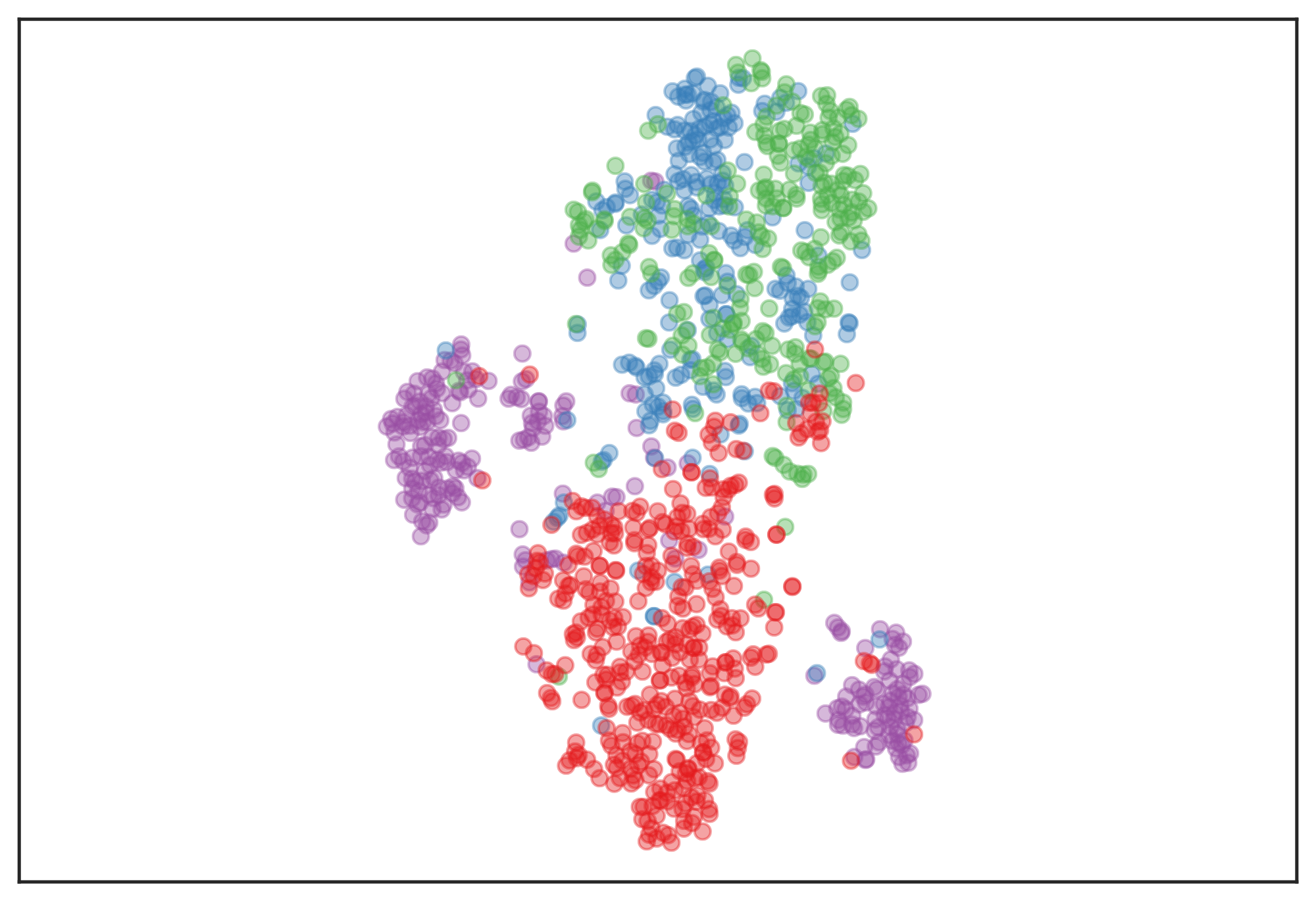
Diagram showing different modes of music as groups of dots in a 3D space.

Each color indicates a different mode style. Image Credits: EPFL

At Switzerland’s EPFL, some music-minded boffins at the Digital and Cognitive Musicology lab were investigating the shift in the use of modes in classical music over the ages — major, minor, other or none at all. In an effort to objectively categorize thousands of pieces from hundreds of years and composers, they created an unsupervised machine learning system to listen to and categorize the pieces according to mode. (Some of the data and methods are available on GitHub.)

“We already knew that in the Renaissance, for example, there were more than two modes. But for periods following the Classical era, the distinction between the modes blurs together. We wanted to see if we could nail down these differences more concretely,” he explained in a university news release.

03 Feb 2021

Rocket.Chat raises $19M for its open-source approach to integrated enterprise messaging

Chat platforms like Slack have been game-changes when it comes to what business users want and expect out of their work communications. Today, a company that’s aiming to move the goalpost again with an integrated, open-source alternative is announcing some funding to fuel its growth.

Rocket.Chat, a startup and open source-based platform of the same name used by banks, the U.S. Navy, NGOs, and other organizations big and small to set up and run any variety of secure virtual communications services from one place — they can include not just team chat, but also customer service, collaboration platforms covering your staff and outside partners, school classrooms, conferences and more — has raised $19 million.

The company plans to use the funding both to continue adding more customers, but also expanding the platform’s functionality, including more security features, a way to use the service over federated blockchain architecuture, apps for marketplaces, options for bots, and more social media and omnichannel customer service integrations, and potentially facilities for virtual events.

As more business interactions have gone virtual, it has essentially opened the door for companies like Rocket.Chat building virtual communications platforms to build in an increasing number of features into what it does.

The Series A round of funding has four lead investors — Valor Capital Group, Greycroft, Monashees, and NEA — with e.ventures, Graphene Ventures, ONEVC, and DGF also participating. The Porto Alegre, Brazil-based startup (which is incorporated in Delaware) has now raised $27 million to date.

Rocket.Chat is not disclosing its valuation with this round, but it comes on the back of some significant growth in the last year. The startup now has 16 million registered users across 150 countries, with 8 million of them monthly active users. Of that 16 million, 11.3 million users registered for the service in the past six months. It’s currently installed on some 845,000 servers, the company said, and has over 1,500 developers building on its platform.

Rocket.Chat’s funding and expanding business comes as part of a bigger focus overall for open source platforms.

The promise of open source in the world of enterprise IT has been that it provides a platform to customise a service to fit with how the organization in question wants to use it, while at the same time providing tools to make sure it is robust enough in terms of security, extensibility and more for use in a business environment.

Over the years, it has become a big business opportunity, in line with organizations getting more sophisticated in terms of what they expect and need out of their IT services, where off-the-shelf apps may not always fit the bill.

Rocket.Chat positions itself as something of an all-in-one superstore for any and all communications needs, with organizations putting their own services together in whatever way works for their purposes.

It can either be hosted and managed by customers themselves, or used as a cloud-based SaaS, with its pricing ranging between free (for minimal, self-hosted services) through to $4 per user per month, or higher, depending on which services customers want to have, whether its hosted or not, and how much the platform is being used each month.
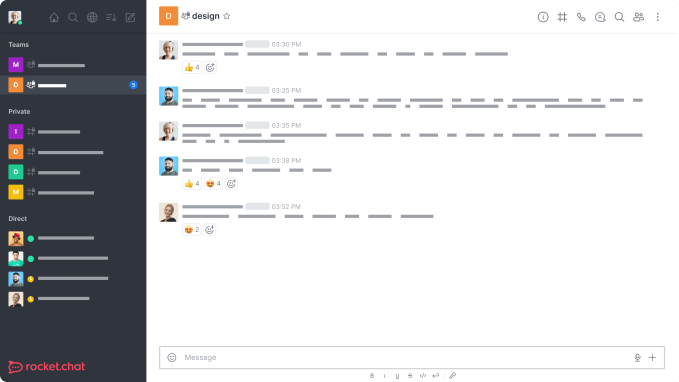
As you can see in the mock-up here, its basic platform looks a little like Slack. But if you are using it for omnichannel communications for customer service, for example, you can build a platform within Rocket.Chat where you incorporate communications from any other platforms that might use to communicate with customers.

Its work collaboration platform also starts with Rocket.Chat’s basic chat interface, but also allows you integrate alerts and links to other apps that you regularly use, as well a video calls and more. These and other functions built on Rocket.Chat can then be made to interact with each other — for example handing tickets off in customer service to internal tech support teams — or separately.

The idea is that by providing a version that can be hosted and managed by organizations themselves, it gives them more privacy and control over their electronic messaging.

Its thousands of customers reflect an interesting mix of the kinds of organizations that are looking for solutions that do just that.

Gabriel Engel, the CEO and founder, tells me the list includes several military and public sector organizations including the U.S. Navy, financial services companies like Credit Suisse and Citibank, as well as the likes of Cornell, Arizona State, UC Irvine, Bielefeld University and other educational institutions, and a number of other private companies. 

That flexibility does not always play to Rocket.Chat’s advantage, however. Controversially, it seems that the list also includes the other end of the spectrum of organizations that want to keep their messages limited to a very specific audience: Islamic State it turns out also hosts and runs a Rocket.Chat to disseminate messages.

Engel says that while this is not something that the company supports, and that it works with authorities to shut down users like these as much as it can, it’s a consequence of how the service was built:

“We are not able to track usage if they are running Rocket.Chat servers of their own,” he said. “There’s a reason why the U.S. Navy uses Rocket.Chat. And that’s because we cannot track and know what they’re doing. It’s isolated from any external influence, for better or worse.” He added that the company has policies so that if an illicit organization is using its SaaS version, these get taken down in cooperation with authorities. “But just as with Linux, if you download and run Rocket.Chat on your own computer, then obviously we it’s out of our reach.”

Hearing about how a platform built with privacy by design can be abused, with seemingly little to be done about it, does seem to offset some of the benefits. The ethics of that predicament, and whether technology can ever solve it, or whether it will be up to government authorities to address, will continue to be a question not just for Rocket.Chat but for all of us.

In the meantime, investors are interested because of the alternative it provides to those groups that need it.

“In today’s environment, organizations must have a secure communication platform to engage teams internally, communicate with customers and partners externally, and connect with safe interest-based communities,” said Dylan Pearce, Partner at Greycroft, in a statement. “Rocket.Chat’s world-class management team and open-source community lead the industry in innovation and provide a communications platform capable of serving every person on the planet.” 

03 Feb 2021

Polytomic announces $2.4M seed to move business data where it’s needed

There is so much data sitting inside companies these days, but getting data to the people who need it most remains a daunting challenge. Polytomic, a graduate of the Y Combinator Winter 2020 cohort set out to solve that problem, and today the startup announced a $2.4 million seed.

Caffeinated Capital led the round with help from Bow Capital and a number of individual investors including the founders of PlanGrid, Tracy Young and Ralph Gootee, the company where Polytomic founders CEO Ghalib Suleiman and CTO Nathan Yergler both previously worked.

“We synch internal data to business systems. You can imagine your sales team living in Salesforce and would like to see who’s using your product from your customer data that lives in other internal databases. We have a no-code web app that moves internal data to the business systems of the office,” Suleiman told me.

Data lives in silos across every company, and Polytomic lets you build the connectors by dragging and dropping components in the Polytomic interface. This new data then shows up as additional fields in the target application. So you might have a usage percentage field added to Salesforce automatically if you were connecting to customer usage data.

The company actually sells the product to business operations teams, who would be charged with setting up a catalogue or menu of data sources that live in Polytomic. This is usually handled by someone like a business analyst who can configure the different sources. Once that’s done, anyone can build connectors to these data sources by selecting them from the menu and then choosing where to deliver the data.

The founders came up with the idea for the company because when they were at PlanGrid, they faced a problem getting data to the people who needed it in the company. The problem became more pronounced as the company grew and they had ever more data and more employees who needed access to it.

They left PlanGrid in 2018 and launched Polytomic a year later to begin attacking the problem. The two founders joined YC as a way to learn to refine the product, and were still working on it on Demo Day, delivering their presentation off the record because they weren’t quite done with it yet.

They released the first iteration of the product last September and report some progress getting customers and gaining revenue. Early customers include Brex, ShipBob, Sourcegraph and Vanta.

The company has no additional employees beyond the two founders as of yet, but with the seed funding in the bank, they plan to begin hiring a few people this year.

03 Feb 2021

Gillmor Gang: In My Room

No sooner did we start developing a newsletter, the newsletter industry exploded. Twitter jumped in with a purchase of Revue, Facebook was rumored to be investigating the platform, and each new day brought further experiments. You could blame it on the post-Trump lifting of the fog of despair. The pandemic continued apace, with new variants spurring distribution of vaccines and a transparency in communications with the new President and his team.

After years of social mining of our behavior, interests, and transactions, inference has been replaced by direct evidence. The politics of data pressure mandate that we expect free software bundled with increasingly powerful hardware. The core utility of a phone culture shifted as people kept to their homes and mostly used the televisions for entertainment and news, and the phones as notifications consumers. The desktop remained the creation engine for business documents, analytics, and information triage.

One year after the pandemic took hold, the outlines of the recovery are becoming visible. Because so much of our transaction history is funneled through the phone, we have left less need or incentive for teasing out indirect data and making inferences on it. Netflix is a honeypot for direct recording of choices, tagged along each customer’s timeline with the minute-by-minute social characteristics of the groups they participate in.

The resulting data type is beyond the bifurcation of product in the Apple hardware sense and the user as product in the Google or Facebook sense, Netflix creates a kind of social signal out of the analytics that is recycled back into the service where it impacts on the user’s behavior organically. We tap into the recommendation flow not just at the Netflix level but also the notification and conversational flows.

Newsletters offer a similar organic resonance, as they combine the author’s analysis of the information flow (in the form of citations) with the actual orbiting references. As with Netflix, the user leaves a breadcrumb trail along with time data as they record their choices and unread items. The maturing newsletter model is one where the authorship more correctly anticipates what has been seen by the target audience, and saves time and insight for rapid return on the investment. Group metrics synthesize this benefit into value on Netflix, where the “ratings” are based on retention and time compression. This is the newsletter opportunity.

If you buy the idea of media consolidation under the newsletter umbrella, how will that manifest itself? Already we’re experiencing a battle similar to the age of blogs, where individual voices built a social engagement cloud that emulated the dynamics of a magazine. Just as Apple inserted itself into the music business with playlists and MTV with top forty radio, blogs leveraged Twitter and social to create bundles of news, features, and commentary. As with playlists, the users were in charge.

Mobile brought notifications to the party, blending blogs with media. Initially podcasts leveraged RSS’s attachment extension to download sound and video files to iPods. But when streaming arrived, the preferred way of consuming the content was by clicking on the notification. This in turn disrupted the cable networks just as the kids went mobile and abandoned TV. During the 2020 campaign, notifications were a great way of routing around insufferable analysis in favor of the actual events.
Meanwhile, Facebook Live, Periscope, and YouTube gave virtually everybody a seat at the table. Podcasts democratized media, and streaming democratized distribution. I know many think podcasting is experiencing a renaissance, but personally I think streaming is inventing a new paradigm of the economics of the industry.

Take Clubhouse, for example. It’s distinguished by what it doesn’t do rather than what it does: no recording, therefore no replays. No video, only audio. No lurking, at least surreptitious checking out the scene. If you click on a Clubhouse notification, your name pops up for all to see. And there’s no button to Leave Loudly, just Quietly. Significantly, however, you can operate in a private room, and then go public if you want to. It’s podcasting with an invisibility mode.

Private rooms are just the place to hash things out. Today I had several conversations skirting these issues. One was muted, tentative, doubt mixed with an arrogant optimism. The other was supple, teeming with validation and the presence of humor to leaven the serious nature of the fleeting time we may have. Not recorded, in one case just a regular cell call. But the mulch created informs this post, with its scaffolding of intersecting items lurking in calm support. Podcasting, no.
I
It reminds me of the Hayden Planetarium, where the planets orbit and the asteroids bisect the swirling cosmos. We’re suspended in the teeming reaches of the near universe, with its fractal efficiency in the representation of the whole. The enterprise moves glacially forward, a breast stroke pace with a small wake. Somehow big things are afoot. At a minimum, they could be.

from the Gillmor Gang Newsletter

__________________

The Gillmor Gang — Frank Radice, Michael Markman, Keith Teare, Denis Pombriant, Brent Leary and Steve Gillmor. Recorded live Friday, January 22, 2021.

Produced and directed by Tina Chase Gillmor @tinagillmor

@fradice, @mickeleh, @denispombriant, @kteare, @brentleary, @stevegillmor, @gillmorgang

Subscribe to the Gillmor Gang Newsletter and join the backchannel here on Telegram.

The Gillmor Gang on Facebook … and here’s our sister show G3 on Facebook.

03 Feb 2021

Spotify Group Session UX teardown: The fails and their fixes

In July last year, Spotify extended its shared-queue feature, Group Session, to support remote usage. Essentially a “party mode,” the feature offers a way for participants to contribute to a collaborative playlist in real-time and control what’s playing across everyone’s devices.

As TechCrunch’s Sarah Perez explained, Premium users are able to tune into the same playlist or podcast together at the same time, even if they’re not in the same place. Prompted by the coronavirus pandemic, Spotify, like a spew of other tech companies, is trying to create more shared online experiences that are lockdown-proof, and as people are being forced to spend more time indoors and online.

In our latest UX teardown, with the help of Built for Mars founder and UX expert Peter Ramsey, we highlight some of Spotify Group Sessions user experience failings and offer ways to fix them, as well as a number of UX features that are done right. Many of these lessons can be applied to other existing digital products or ones you are currently building, including the need to remember the difference between usernames and display names, when it makes sense to combine common actions into one, and how to use “react and explain” on-boarding.

Usernames and display names

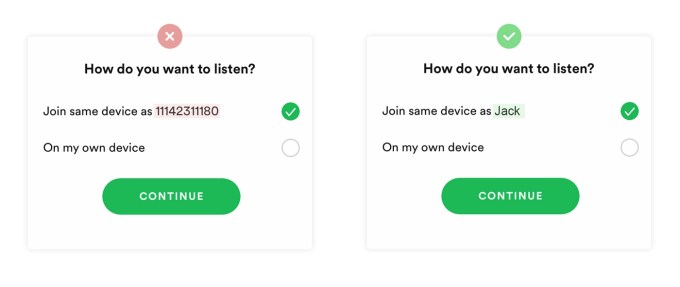
Always remember the difference between user names and displays.

Image Credits: Built For Mars

The fail: If you created a Spotify account using Facebook, then you’re arbitrarily assigned an 11-digit display name. This is then shown to everyone you invite and is totally meaningless.

The fix: Prompt the user to set a real display name when they create their first session. It avoids confusion and creates a more real experience.

Steve O’Hear: This looks really sloppy and unprofessional, as well as being useless from a usability point of view. However, I’m guessing this is technical debt of some kind; any idea what’s going on here?

Peter Ramsey: Yes, it happens when usernames go from being irrelevant (i.e., Spotify) to suddenly relevant (i.e. when they add social features). But by that point, the database/infrastructure is already in motion.

Can you think of an example where this has been done right?

Twitter is the perfect example of this done right. There can only be one @jack, but loads of people with the display name Jack. Otherwise basically every tweet would be by some obscure name and the world would feel like Reddit (i.e., anonymous).

Combining common actions into one

03 Feb 2021

TikTok will recheck the age of every user in Italy after DPA order

TikTok has agreed to re-verify the age of every user in Italy and block access to users who state they are under 13, the country’s data protection agency said today.

The video sharing social network confirmed that from February 9 every user in Italy will be required to go through its age gate process again — and only those users aged 13 and above will be allowed to continue using the app.

Accounts of those who say they are under 13 will be deleted.

The move to required all users in Italy to go through TikTok’s age-verification process again follows an emergency order by Italy’s GPDP on January 22 after the death of a 10-year-old girl from Palermo who died of asphyxiation after participating in a “blackout challenge” on the social network, according to reports in local media.

TikTok was given a deadline of January 29 to respond to the GPDP’s order, as we reported earlier. Today the agency confirmed the measures TikTok has agreed to take.

As well as asking all users in the country to re-enter their date of birth to continue using the app, the GPDP said TikTok will “consider deploying AI-based systems for age verification purposes”.

The Italian watchdog added that it will be monitoring the effectiveness of TikTok’s age verification process.

The basic age-check TikTok conducts when users sign-up — which it will be pushing out again to all users in Italian in a few days — simply requires users to enter a date of birth so is very easy to circumvent. But it’s also clear that age verification online remains a hard problem.

Robust identity checks to determine age beyond doubt threaten a ‘sledgehammer to crack a nut’ scenario — potentially limiting service access in a way that’s unfair and risking harm to online anonymity and privacy, with potential knock on impacts on other considerations like freedom of expression and data security.

On the flip side are growing public concerns that underage users are being exposed to inappropriate and even harmful content online.

While TikTok’s lead data supervisor in the European Union is Ireland’s Data Protection Commission (DPC), the EU’s General Data Protection Regulation (GDPR) includes a provision that allows national DPAs to take emergency interventions to protect users — which is the route the GPDP has used here.

“In order to identify users below 13 years with reasonable certainty following this initial check, the company undertook to further consider the deployment of AI-based systems,” the agency said today.

“Since the implementation of such systems requires balancing the need for accurate verification against the children’s right to data protection, the company committed to starting a dialogue with the Irish Data Protection Commission (DPC) on the use of AI for age verification purposes. Ireland is where TikTok set its main establishment in the EU,” it added.

Reached for comment, the Irish Data Protection Commission told TechCrunch: “The DPC is engaging with TikTok to review, in the context of the processing of personal data, the measures implemented by the company to ensure it has effective means of identifying child users on the platform and, more generally, the measures and protections to protect the most vulnerable of users in terms of risks arising from the processing of their personal data.” So it remains to be seen whether the regulator will push for more robust age checks.

In another change triggered by the GPDP’s intervention TikTok has implemented an in-app button to enable users to “quickly and easily” report other users that may seem to be below 13 years of age.

Per TikTok, these reports are reviewed by moderators and “removed as necessary”.

“All the above measures supplement those already in place,” the GPDP said, adding: “TikTok undertook to also double the number of Italian moderators of platform contents.”

Commenting in a statement, Alexandra Evans, TikTok’s head of child safety, added: “Keeping people on TikTok safe is our top priority. We’ve reached an agreement with the Garante and today, we’re taking additional steps to support our community in Italy. From February 9, we’ll be sending every user in Italy through our age gate process again and only users aged 13 and over will be able to continue using the app after going through this process. We’re also rolling out a new, dedicated in-app reporting button to allow users to flag an account they believe may be under the age of 13, which will then be reviewed by our team and removed as necessary.

“There is no finish line when it comes to protecting our users, especially our younger ones, and our work in this important area doesn’t stop. That’s why we’re continuing to invest in the people, processes and technologies that help to keep our community a safe space for positive, creative expression.”

TikTok’s reissued age check in Italy will also be accompanied by a local information campaign in which TikTok will aim to raise parents’ and children’s awareness of the age checks and other child-safety-related features — both via its app and in the media.

“An information campaign will be launched by TikTok starting on February 4 both via the app and through other channels. The company will send push alerts to users on the app before blocking their access and will inform them on the need to enter their age. Banners will also be published containing links to information on security tools and on how to change profile settings from ‘public’ to ‘private’. The information campaign both via the web and through the press will be addressed to parents and the age threshold for registration will be specifically highlighted, among other things,” the GPDP said.

The agency also noted that TikTok has agreed to improve the wording of the short privacy notice intended for users aged under 18 years — “to explain what data are collected and how those data are processed in an easily understandable and user-oriented manner”.

In addition to TikTok’s impending information campaign, the GPDP is launching a child safety awareness-raising campaign of its own on national TV channels, in cooperation with a child protection charity called Telefono Azzurro. It said this will be targeted at parents to encourage them to supervise their kids’ use of the app.

“The campaign is aimed at calling upon parents to actively supervise and pay special attention to the situations where their children are requested to enter their age in order to access TikTok,” it said.

03 Feb 2021

Clearview AI ruled ‘illegal’ by Canadian privacy authorities

Controversial facial recognition startup Clearview AI violated Canadian privacy laws when it collected photos of Canadians without their knowledge or permission, the country’s top privacy watchdog has ruled.

The New York-based company made its splashy newspaper debut a year ago by claiming it had collected over 3 billion photos of people’s faces and touting its connections to law enforcement and police departments. But the startup has faced a slew of criticism for scraping social media sites also without their permission, prompting Facebook, LinkedIn and Twitter to send cease and desist letters to demand it stops.

In a statement, Canada’s Office of the Privacy Commissioner said its investigation found Clearview had “collected highly sensitive biometric information without the knowledge or consent of individuals,” and that the startup “collected, used and disclosed Canadians’ personal information for inappropriate purposes, which cannot be rendered appropriate via consent.”

Clearview rebuffed the allegations, claiming Canada’s privacy laws do not apply because the company doesn’t have a “real and substantial connection” to the country, and that consent was not required because the images it scraped were publicly available.

That’s a challenge the company continues to face in court, as it faces a class action suit citing Illinois’ biometric protection laws that last year dinged Facebook to the tune of $550 million for violating the same law.

The Canadian privacy watchdog rejected Clearview’s arguments, and said it would “pursue other actions” if the company does not follow its recommendations, which included stopping the collection on Canadians and deleting all previously collected images. Clearview said in July that it stopped providing its technology to Canadian customers after the Royal Canadian Mounted Police and the Toronto Police Service were using the startup’s technology.

“What Clearview does is mass surveillance and it is illegal,” said Daniel Therrien, Canada’s privacy commissioner. “It is an affront to individuals’ privacy rights and inflicts broad-based harm on all members of society, who find themselves continually in a police lineup. This is completely unacceptable.”

A spokesperson for Clearview AI did not immediately return a request for comment.