Year: 2021

03 Feb 2021

Instagram confirms it’s working on a “Vertical Stories” feed

Instagram is developing a new feature that could give its app more of a TikTok-like feel: Vertical Instagram Stories. Today, users browse through Stories through taps and horizontal swipes — a feature Instagram adopted from Snapchat. But now, Stories are passé. Even Snapchat is borrowing ideas from TikTok. Its recent launch of Spotlight, for example, is its own TikTok clone.

In many ways, vertical swiping feels more natural than taps and horizontal flicks. It is, after all, how users navigate much of the mobile web, as well as other key features across a variety of social apps, like Facebook’s News Feed or YouTube’s home page.

That said, turning Instagram Stories into a vertical feed would be a notable change, and one that could potentially set the stage from a shift away from more static content — like the photos and reshared Feed posts that still often fill the Stories section today. In a “Vertical Stories” feed, on the other hand, Instagram would likely prioritize video posts over images to better compete with TikTok, just as it’s currently tweaking its algorithms and overall design to prioritize Reels. (A turn of the dials that has already been leveraged by indie creators to significantly grow their followings, in fact).

The “Vertical Stories” feature was spotted under development by Alessandro Paluzzi who shared the discovery on his Twitter account.

His screenshot shows a simple user interface with text that reads: “Now you can swipe up and down to browse stories” and then a big, blue button labeled “Vertical Stories.”

Paluzzi tells TechCrunch that the feature is not yet live. Instead, he dug it up from Instagram’s code.

Instagram confirmed to TechCrunch the feature is being built but is not out to the public at this time.

“This is an early prototype and is not currently testing on Instagram,” a company spokesperson told us.

A prototype may never actually make it to a public launch, of course, but its existence does say something about what sort of ideas Instagram is considering as a means of offering a better challenge to TikTok.

Today, the company’s TikTok rival, Reels, has been shoehorned into the platform via the Instagram Explore page, where Reels sits in the top position. When you click on the Reels video here, you’re taken to a new user interface where you then vertically swipe through videos, similar to TikTok.

This doesn’t feel right, and the launch of the new format has added to Instagram’s clutter. Today, the app has all sorts of places users can publish their videos, including in the Feed, as Stories, as longer-form IGTV content, and now Reels. It’s too much.

Instagram knows this arrangement isn’t quite working. As Instagram head Adam Mosseri recently told The Verge, most people probably don’t even understand the difference between IGTV content and videos posted to Instagram, for example. He said the company was looking at ways to simplify and consolidate its ideas, too.

While his comments were focused on the confusion between Instagram’s normal video posts and IGTV, there’s also significant overlap between Instagram’s Stories’ vertical video content and Reels. A “Vertical Stories” feed could allow for an eventual combination of those formats — Stories videos and Reels, perhaps.

It’s not clear that’s at all what Instagram has in mind, though. The social network could just be looking to transition another part of its app to the more modern vertical feed, as the demand for the traditional Stories format declines.


03 Feb 2021

Google’s new subsea cable between the U.S. and Europe is now online

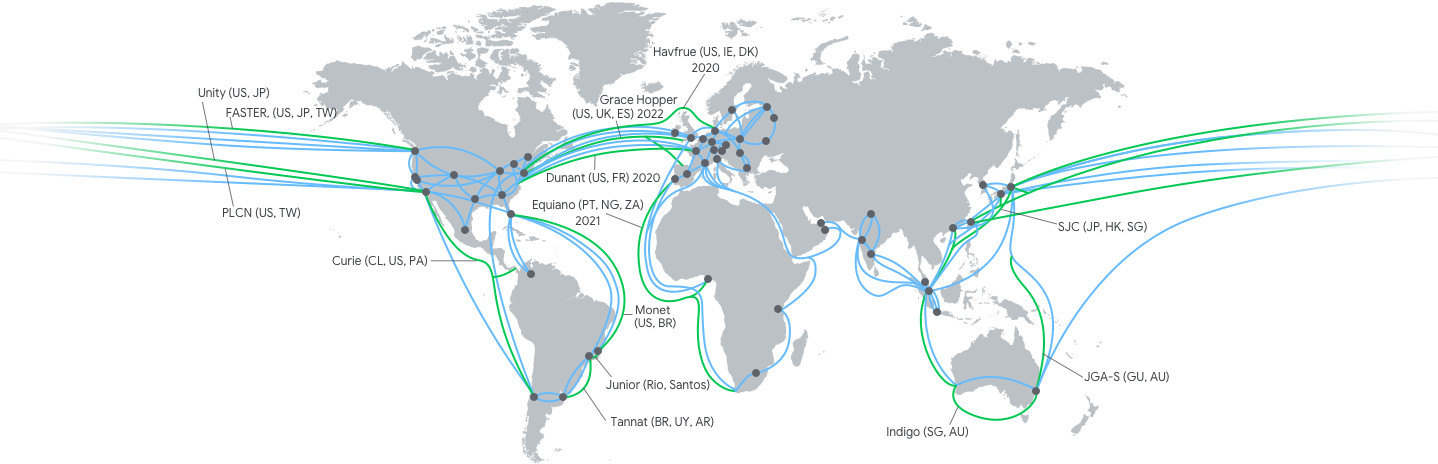
Google, together with its partner SubCom, today announced that the company’s privately owned Dunant subsea cable between Virginia Beach, Virginia and Saint-Hilaire-de-Riez on the French Atlantic coast is now operational.

Google first announced this project, which was named after the first Noble Peach Price winner and founder of the Red Cross, Henry Dunant, back in the middle of 2018. At the time it expected the project to go live in 2020, but besides dealing with the complications of spanning a long cable between continents, the project leaders probably didn’t budget for a global pandemic at the time.

The almost 4,000-mile cable has a total capacity of 250 terabits per second — or enough to transmit the “entire digitized Library of Congress three times every second” (though maybe using Library of Congress data size references is starting to feel a bit antiquated at this point?). Unlike some older cables, Dunant uses 12 fiber pairs, coupled with a number of technical innovations around maximizing its bandwidth, to achieve these numbers.

“Google is dedicated to meeting the exploding demand for cloud services and online content that continues unabated,” said Mark Sokol, senior director of Infrastructure, Google Cloud. “With record-breaking capacity and transmission speeds, Dunant will help users access content wherever they may be and supplement one of the busiest routes on the internet to support the growth of Google Cloud. Dunant is a remarkable achievement that would not have been possible without the dedication of both SubCom and Google’s employees, partners, and suppliers, who overcame multiple challenges this year to make this system a reality.”


Image Credits: Google

With Dunant now being operational, the next Google cable to go live will be the Grace Hopper cable between New York and Europe, with landing sites in Bilbao, Spain and Bude, UK. Google first announced this new cable, which it is also building in partnership with SubCom, last July. It’s expected to go online in 2022 and will feature a total of 16 fiber pairs.

In addition, Google is also building the Equiano cable from South Africa to Portugal. This cable is supposed to go online later this year.

In addition to its privately-owned cables, Google is also a partner in a number of consortiums that band together to build cable systems.

03 Feb 2021

Apple Music, Books, iTunes, App Store and more are experiencing outages

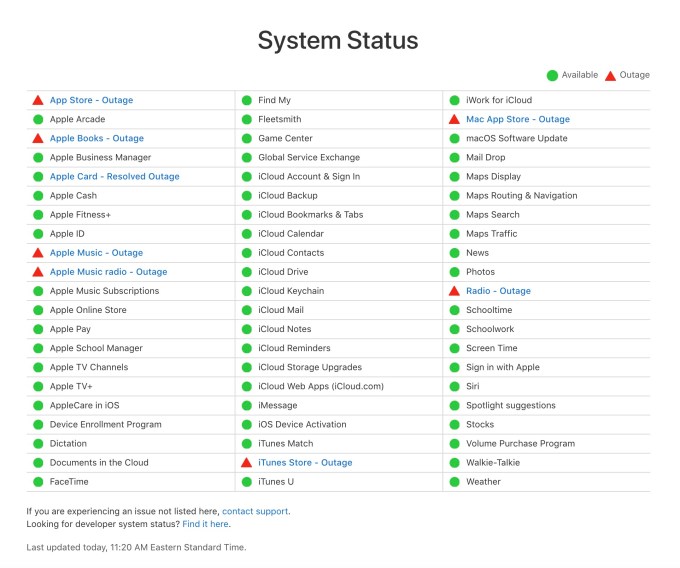
Several high-level Apple services are experiencing issues and outages on Wednesday morning, Apple has confirmed. These issues are impacting a number of consumer-facing services including Apple Music and Radio, Apple Books, and the App Store platforms across both iOS devices and Mac.

For some users, the services are down. For example, there were reports circulating this morning that users were having problems streaming music through Apple Music or using iTunes. Other have noticed strange problems cropping up on the App Store — like app search results that only returned a small handful of top apps related to the search term.

Even when the services are partially up, they’re sometimes much slower to load than usual — meaning users may see blank pages for several seconds before the page is populated with its usual content.

Image Credits: Apple

At the time of the initial reports, Apple’s Status page didn’t reflect these issues, as it showed all services as being available. That has since changed. Now, the page displays outages are occurring across the App Store, Apple Book, Apple Music, Apple Music Radio, iTunes Store, Mac App Store, and Radio.

The Apple Support Twitter account has also posted about the outage, but has yet to provide details about what has happened or when it might be resolved.

What’s concerning is that the account replied to a tweet with a complaint from a user who said they couldn’t reset their password — an indication that the outages could be impacting other types of backend services, as well.

Apple says it’s working to provide us with more information on this, and we’ll update when the company has more to share.

03 Feb 2021

Techstars Los Angeles names Matt Kozlov as its new managing director

Techstars Los Angeles, the local Los Angeles-focused branch of the global accelerator network, has named Matt Kozlov as its new managing director.

Kozlov, a longtime Techstars network fixture, has previously served as the head of the organization’s healthcare accelerator through a partnership with Cedars-Sinai and as the head of the Techstars Starburst Space Accelerator, which was focused on space and aerospace startups.

Now, Kozlov turns his attention to the Los Angeles ecosystem broadly.

“I’m humbled to have the opportunity each day to support incredible founders who are solving some of humanity’s greatest challenges,” said Kozlov, in a statement. “As I begin this new role, my goal is to continue to leverage my experience to help generate opportunities for future Techstars LA companies to make meaningful, long-term impact.”

Kozlov’s appointment comes as the Los Angeles tech ecosystem is having something of a moment. As the diaspora out of Silicon Valley continues, the Southern California tech world has proven to be a tempting landing pad during the COVID-19 pandemic. And remote work means that Los Angeles could be a fixture for more investors looking to escape the Bay.

Beyond Southern California’s coastal appeal is a vibrant technology ecosystem that encompasses enterprise software, financial services, healthcare, aerospace and defense, robotics, ecommerce and social media. It’s the home of social networking favorites Snap and TikTok’s U.S. base of operations and SpaceX’s significant presence has born a number of talented hardware and engineering startups.

LA is truly having a moment and Kozlov’s experience with some of the less-well-known corners of the city’s tech ecosystem could be a boon for the Techstars program.

“I’m thrilled by the selection of Matt as the new Managing Director for Techstars LA,” said Anna Barber, former Managing Director, Techstars LA, who stepped down from the role in November to join venture firm M13 as Partner, in a statement. “He is a talented investor and longstanding leader in LA’s Techstars community, and has been an essential and valued mentor for the program for the past four years. He embodies the Techstars values of #givefirst and I have every confidence that he is the right leader to continue building on what we’ve established in the LA community.”

Collectively, the 40 alumni companies who have participated in Techstars Los Angeles accelerator program have raised over $126 million and have a combined market cap of $328.6 million.

“Techstars LA plays a critical role in the Los Angeles tech ecosystem as the premier startup accelerator, providing valuable mentorship and funding for dozens of companies a year,” said Spencer Rascoff, Chair of dot.LA and Los Angeles angel investor. “I’m very excited that Matt will be the new Managing Director of Techstars LA. He brings extensive experience in healthcare and aerospace investing and has been an incredible mentor and leader to the companies of the Techstars Starburst Space Accelerator over the last several years.”


03 Feb 2021

Electric moped startup Revel launches an EV charging business

Revel, the shared electric moped startup, is building a DC fast-charging station for electric vehicles in New York City, the first in a new business venture that will eventually spread to other cities.

The company said Wednesday that this new “Superhub,” which is located at the former Pfizer building in Brooklyn, will contain 30 chargers and be open to the public 24 hours a day. This will be the first in a network of Superhubs opened by Revel across New York City, the company said.

Revel didn’t build the EV charging infrastructure in house. Instead, it is using Tritium’s new RTM75 model for the first 10 chargers at its Brooklyn site, which will go live this spring. These chargers are designed to delivery with 100 additional miles of charge to an electric vehicle in about 20 minutes, according to Revel.

The EV charging business has been couched by Revel as a mission to electrify cities. The move comes as a growing number of automakers, including legacy companies like GM, Ford and VW Group along with new entrant Rivian and EV leader Tesla add more electric vehicles to their portfolios.

Revel’s expansion into charging marks its first new product line since launching a shared fleet of electric mopeds in 2018. Revel, founded by Frank Reig and Paul Suhey, started with a pilot program in Brooklyn and later expanded to Queens, the Bronx and sections of Manhattan. It has been on a fast-paced growth track thanks to the $27.6 million in capital raised October 2019 in a Series A round led by Ibex Investors. The equity round included newcomer Toyota AI Ventures and further investments from Blue Collective, Launch Capital and Maniv Mobility.

Several thousands mopeds are available to rent in New York City today. Revel expanded its shared moped business to other cities such as Austin, Miami and Washington, D.C in its first 18 months of operation. Last year, the company launched in Oakland and received a permit in July 2020 to operate in San Francisco.

Shared mopeds haven’t been successful everywhere. Revel pulled out of Austin in December. Reig said at the time that the COVID-19 pandemic, which has caused ridership to fall across shared micromobility services, along with the city’s deep-rooted car culture was proven difficult to penetrate.

03 Feb 2021

Venture capital is going to get even bigger, faster, and more expensive this year

The venture capital market has skewed later and larger in recent quarters, something you might have felt in the rapid recent pace of new unicorn formation. December was a hot month for new unicorns, for example. So was January. February likely will be more of the same.

Powering those unicorns births are huge rounds led by large funds. In 2020, for example, there were at least 97 global fintech rounds worth $100 million or more. That number was up from 92 in 2019 and 66 in 2018. Each preceding year was a prior record.


The Exchange explores startups, markets and money. Read it every morning on Extra Crunch, or get The Exchange newsletter every Saturday.


It’s possible to see how venture is trending towards bigger, later-stage rounds in other pieces of private market data. Venture capital in Europe during Q4 2020 set a record for dollars invested, some $14.3 billion, for example. But that money was spread against the continent’s lowest deal count since Q4 2019.

The result of that divergence has been rising deal sizes in Europe. A median Series B on the continent saw its value double from $10 million in 2016 to $20 million in 2020, for example.

Adding to the pile of numbers, the US startup industry raised around 90 rounds worth $100 million or more in Q3 2020 alone.

The data goes on and on. If you read essentially any recent TechCrunch piece concerning the state of venture capital, private rounds are getting bigger as unicorns propagate, and the pace at which the market manages to find exits for the largest startups lags their aggregate value creation.

2021 could be more than just more of the same; this year could set fresh records for private investment results.

Parsing data from Silicon Valley Bank’s most recent markets’ report, I’ve pulled a few trends that help illustrate where the startup and private capital markets are heading this year. And, for flavor, I’ve also collected some data from an Insight Partners’ dive into the impact that middle-ages startups have on job creation. That final set of data will illustrate how quickly the startup market has bounced back from COVID-19 lows to near-record numbers and what that rebound could mean for 2021.

It’s going to be one hell of a year. Let’s talk about why.

2020’s venture capital market

03 Feb 2021

Global smartphone shipments expected to rebound 11% this year

Like countless other industries, mobile phone sales got hit hard in 2020. The industry hit a 10.5% decline for the year, as Covid-19 first decimated the supply and later consumer demand for devices. It was the latest in a rough couple of years for manufacturers, but 2020 hit significantly harder than most.

New numbers from Gartner point to a rebound to pre-2020 levels. The firm is forecasting 1.5 billion devices shipped globally for 2021, amounting to an 11.4% increase across the board. We certainly saw the beginnings of that rebound arrive in Q4 for last year, as declines continued to slow, thanks in no small part to a record quarter for iPhone sales.

That points to the beginnings of a so-called “supercycle” for Apple, which hits a sort of perfect storm. The last few years have seen consumers slow down upgrades, as device prices increased, features were generally less compelling and their existing devices were perfectly fine so as not to warrant a standard two to three year upgrade pattern.

Analysts pointed to 5G a clear conduit for righting slipping sales numbers early last year, but a global pandemic very much threw a wrench in all of that. If anything, however, the iPhone’s Covid-19 related delay actually contributed to a stellar quarter for the company, both in time for holiday sales and the arrival of multiple vaccines that pointed to some potential return to normalcy.

The long awaited 5G bump will continue in 2021, according to the new numbers, coupled with a quick push to offer next-gen wireless at an accessible price.

“The growing availability of 5G networks coupled with a higher variety of 5G smartphones starting at $200 will steer demand in mature markets and China,” the firm notes. “Demand in emerging countries will be driven by buyers looking for a smartphone with better specifications and a 5G connectivity as an optional feature. Gartner forecasts sales of 5G smartphones will total 539 million units worldwide in 2021, which will represent 35% of total smartphone sales in that year.”

03 Feb 2021

Box acquires eSignature startup SignRequest for new content workflows

Box announced this morning that it has agreed to acquire eSignature startup SignRequest for $55 million.The acquisition gives the company a native signature component it has been lacking and opens up new workflows for the company.

Box CEO Aaron Levie says the company has seen increased demand from customers to digitize more of their workflows, and this acquisition is about giving them a signature component right inside Box that will be known as Box Sign moving forward. “With Box Sign, customers can have a seamless esignature experience right where their content already lives,” Levie told me.

While Box has partnerships with other eSignature vendors, this gives it one to call its own, one that will be built into Box starting this summer. As we have learned during this pandemic, the more work we can do remotely, the safer it is. Even after the pandemic ends and we get back to more face-to-face interactions, being able to do things fully in the cloud and removing paper from the workflow will speed up everything.

“The massive push to remote work effectively instantly highlighted for every enterprise where their digital workflows were breaking down. And eSignature was a major part of that — too many industries still rely on paper based processes,” he said.

Levie says that the signature component has been a key missing piece from the platform. “As for our platform, when you look at Snowflake, they’re the data cloud. Salesforce is the sales cloud. Adobe is the marketing cloud. We want to build the content cloud. Imagine one platform that can power the entire lifecycle of content. eSignature has been a major missing link for critical workflows,” he said.

He believes this will open up the platform for a number of scenarios, that while possible before, could not flow as easily between Box components. “Having SignRequest gets us more natively into mission critical workflows like customer contracts, vendor onboarding, healthcare onboarding and supply chain collaboration,” Levie explained.

It’s worth noting that Dropbox acquired HelloSign for $230 million two years ago to provide it with a similar kind of functionality and workflow capability, but analyst Alan Pelz-Sharpe from Deep Analysis, a firm that follows the content management market, says this wasn’t really in reaction to that.

“I think what is interesting here is that Box is going to integrate SignRequest and bundle it as part of the standard service. That’s what really caught my eye as the challenge with eSig is that it’s typically a separate product and so gets limited use. They bought it partly in response to Dropbox, but it was a hole that needed fixing regardless so would have done so anyway,” Pelz-Sharpe explained.

As for SignRequest, the company was founded in the Netherlands in 2014. Neither Pitchbook nor Crunchbase has a record of it raising funds. The plan is for the company’s employees to join Box and help build the signature component that will become Box Sign. According to a message to customers on the company website, existing customers will have the opportunity over the next year to move to Box Sign, and get all of the other components of the Box platform.

Levie says the basic Box Sign function will be built into the platform at no additional charge, but there will be more advanced features coming that they could charge for. The deal is expected to close soon with the SignRequest team remaining in The Netherlands.

03 Feb 2021

Evinced raises $17M to speed up accessibility testing for the web

Making and keeping the web accessible is a full-time job, and like any other development role, accessibility tools need to evolve to keep up with the times. Evinced is a startup that promises both richer and faster checks of websites in production or in progress, and it just raised $17M to take its tools to the next level.

Because accessibility problems can happy in so many ways, it often takes a lot of manual code review to catch the errors. Even a team thinking about making their site fully accessible from the start — which should be everyone — can miss that this script doesn’t hook into that variable right if this menu is opened, and so on.

There’s automated code review, but it can be slow and bulky. Evinced is making a powerful, streamlined tool that checks a website in a fraction of a second while you’re using it, presenting the problems in a way that’s easy for devs to share and address. It also doesn’t trip up on the fancy, javascript-heavy web apps that millions use today.

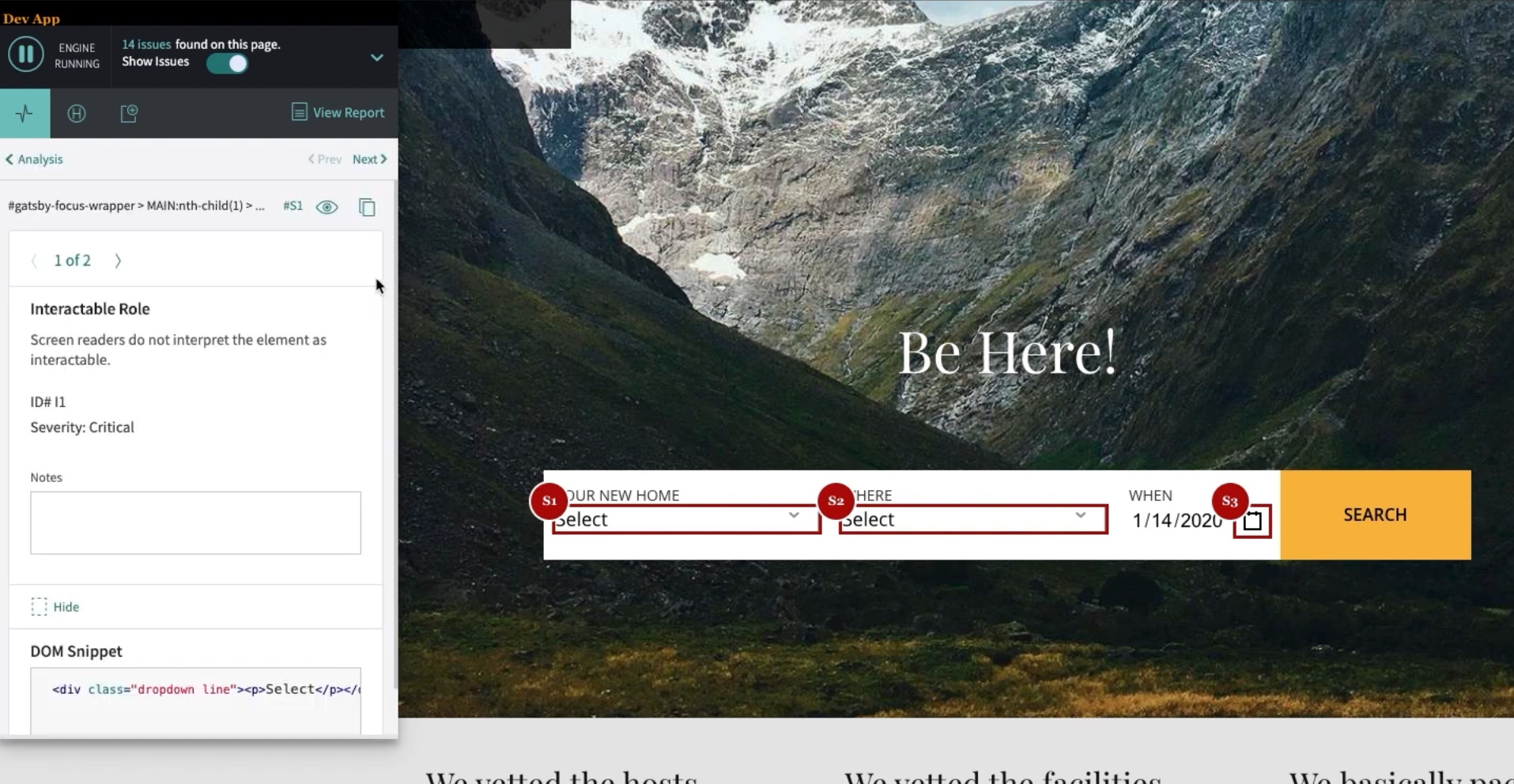
Here’s an example of a modern website that looks fine but is obviously (for demo purposes) riddled with accessibility issues. The video gives a good breakdown of what this part of the Evinced product does:

Honestly, that’s how it feels like it ought to look, but existing enterprise-level tools probably aren’t quite so efficient. And as you can see, the tool responds instantly while the user (that is to say, the developer) proceeds through the various actions the site enables. It could be, after all, that auditing the site before anyone fills in a form or pulls down any menus could give a misleading green light.

The inspector also brings in a bit of AI in the form of smart rules and computer vision, so if an element looks like a menu or button but isn’t labeled correctly, it isn’t fooled. Those elements do have distinct styles and roles: if something can be clicked and turns into a list that the user chooses from, well, it’s a pulldown menu whether it’s called that or not.

Image of Evinced's tool pointing out accessibility problems on a webpage.

Image Credits: Evinced

Naturally there are also quick fixes suggested and the ability to easily export the issues for formal inspection by the boss, as well as other expected features for a web development tool. It’s available as a Chrome extension, or as an API or automated part of other analysis or commit actions, throwing its list of errors in with the rest.

The company formed back in 2018, when they started development. The next year they hooked up with a few large enterprises to see about integrating and testing within their ecosystems. Capitol One became their biggest customer and is now an investor.

“We have since deployed our products in production at Capital One (means they are used every day – and power their end-to-end accessibility operations – see the Capital One blog) and others. These are paying customers that have an enterprise license,” said Founder and CEO, Navin Thandani.

Indeed, as Capitol One explains:

Capital One partnered with Evinced early, to guide their development with a particular focus on: helping developers release accessible code integrating multiple automated testing steps through the build and deployment lifecycle building products that can automatically scan for accessibility across a full web property (including through logins and internal repositories), and do this fast.

Capital One partnered with Evinced early, to guide their development with a particular focus on: helping developers release accessible code integrating multiple automated testing steps through the build and deployment lifecycle building products that can automatically scan for accessibility across a full web property (including through logins and internal repositories), and do this fast.

We’ve seen Evinced discover as much as 10x more critical accessibility issues than we were previously finding through automated testing alone. An even greater number of issues are discovered when a site is more interactive, including keyboard and screen reader usability issues.

Automated testing on a large enterprise scale can be an extremely complex and time consuming effort. Evinced is speedy and reliable, with 40x faster execution, enabling us to cut our processing time in some cases from 4-5 days down to less than 3 hours (and is being further optimized).

Glowing words, even if they are from an investor (technically Capital One Ventures, but still).

The company’s $17M series A was co-led by M12 BGV, and Capital One Ventures and included previous investors Engineering Capital.

As a sort of debut celebration present, Evinced is announcing its free tiers of service, including an iOS app accessibility debugger, which should be helpful to all the folks making apps who don’t know a thing about WCAG guidelines and ARIA roles. There’s also a free “community edition” site scanner that admins can sign up to be approved for, and a free trial for enterprises that want to give it a shot.

03 Feb 2021

Dear Sophie: What’s the recipe for an H-1B?

Here’s another edition of “Dear Sophie,” the advice column that answers immigration-related questions about working at technology companies.

“Your questions are vital to the spread of knowledge that allows people all over the world to rise above borders and pursue their dreams,” says Sophie Alcorn, a Silicon Valley immigration attorney. “Whether you’re in people ops, a founder or seeking a job in Silicon Valley, I would love to answer your questions in my next column.”

Extra Crunch members receive access to weekly “Dear Sophie” columns; use promo code ALCORN to purchase a one- or two-year subscription for 50% off.


Dear Sophie:

I want to sponsor a potential employee for an H-1B but the process for an H-1B petition seems pretty complex.

What goes into an H-1B petition? How has it changed in recent weeks? Is the lottery going to be wage-based or random?

— Hungry to Learn in Hillsborough

Dear Hungry:

This is a great time to get started on the H-1B lottery process — the time is fast approaching. In my most recent podcast episode about H-1Bs on Immigration Law for Tech Startups, we covered planning for the H-1B lottery.

For all those foodies out there, in this column, I include a recipe for making your very first H-1B, plus the latest on lottery timing, whether the lottery will be wage-based and pay-to-play, the end of Buy American, Hire American, and changes in how H-1B wage levels are calculated.

New to the H-1B?

To get started, if you’re a newbie looking to whet your appetite with what’s involved in the H-1B process, there’s no need for the H-1B lottery season to feel complex or daunting. In fact, I wrote out a recipe so you can easily understand how to cook up an H-1B petition. ;)

Alcorn H-1B Petition Recipe

Ingredients

  • 1 hungry employer seeking top global talent
  • > 1 motivated job seeker(s) from around the world
  • > 1 experienced business immigration attorney
  • > 1 compassionate business immigration paralegal
  • 1 package clear communication
  • 1 gallon legal strategy; add more to taste
  • 1 gallon hard work, divided
  • 4 cups enthusiasm and dedication
  • 2 questionnaires
  • 1 Labor Condition Application (LCA)
  • 4 forms for USCIS, 5 if you want to broil the case and eat sooner
  • 1 robust letter of support from the company
  • To taste: Job seekers’ supporting documents, as needed
  • For startup flavor: sprinkling of company formation documents

Directions

  1. It’s important to start off the H-1B with a solid legal strategy. Start by combining the employer and job seeker with at least one business immigration attorney and at least one business immigration paralegal. Add communication, half gallon of legal strategy and 1 cup of enthusiasm and dedication.
  2. After the legal strategy has been prepped, separate the rest of the ingredients into separate containers (there will be some overlap).
  3. Take the two questionnaires and distribute evenly between the employer and job seeker. Add to pan over medium-low heat or high heat depending on how soon everyone wants to eat.
  4. Once the questionnaires are evenly browned, remove from heat and examine to make sure everything is cooked properly.
  5. Once the questionnaires are reviewed, use some of the flavors to prepare the Labor Condition Application (LCA). Add in 1 cup of legal strategy and 1 quart of hard work. Let simmer for 7-10 days.
  6. While the LCA is simmering, prep your forms one at a time. Add ½ cup of legal strategy and 2 cups of hard work.
  7. After the forms are prepped, use the remaining legal strategy (more if necessary), 2 quarts of hard work, and 1 cup of enthusiasm and dedication to prepare the letter of support.
  8. Once that’s ready, and the LCA is fully cooked, use ½ quart of hard work to add the glazed forms, LCA and letter of support into a bowl (preferably Adobe Acrobat). After adding the letter of support, fold in the job seekers’ supporting documents. Add 1 cup of enthusiasm and dedication. Add startup sprinkles if desired.
  9. Finally, use the remaining 2 cups of enthusiasm and dedication to bake the case with USCIS!
  10. Allow to cool for 15 calendar days if famished, or 4-6 months if you’re not that hungry.
  11. Enjoy!

For those experts out there hungering for the latest H-1B updates, here’s a rundown of what we’ve been seeing over the last two weeks since the Biden Administration took office:

Lottery timing

We expect an imminent announcement regarding the details of the upcoming FY2022 H-1B lottery registration process for cap-subject nonimmigrant visa petitions. The electronic registration period lasts at least 14 days, and the latest possible start date will be March 18, 2021. We’re also awaiting details on when the initial registration period will begin; last year it lasted from March 1 to 20. Feel free to listen back to Get Ready for the H-1B FY2022 Lottery for more details on how this worked last year and please stay tuned if you’re planning on filing an H-1Bs this year: Following these dates is crucial.

Will the lottery be pay-to-play?

A final rule called “Modification of Registration Requirement for Petitioners Seeking To File Cap-Subject H–1B Petitions” issued under Trump is currently scheduled to take effect on March 9, 2021. It would change the lottery from being random to being allocated based on highest to lowest relative wage. On January 20 the Biden administration instructed all agencies to consider delaying the effective date of certain rules not yet in effect, such as this one.

We’re all waiting with bated breath to see if this new change will go through. So far USCIS has not published any rule in the Federal Register indicating that the wage-based H-1B lottery will be delayed until after the scheduled start date. Also, over the past few days, there are some preliminary indications that the system will go forward as Trump planned, even under the Biden administration. This includes changes to the H-1B registration online tool and the form.

Although a wage-based allocation might make H-1B salaries more expensive for some employers, it would also dramatically increase immigrant security and employer predictability. As we all wait to see what USCIS will decide to do here, you can also access our free H-1B guide for more information on H-1Bs.

The end of Buy American, Hire American

On January 25, President Biden issued Executive Order 14005, “Ensuring the Future Is Made in All of America by All of America’s Workers.” This ends Trump’s “Buy American and Hire American” Executive Order and ensures a broader focus of helping American businesses “compete in strategic industries” and helping “America’s workers thrive.” We anticipate that this change will probably lead to higher rates of U.S.-business-based visas and green cards being approved in the future.

Changes in wage-level calculations

There are changes to the way that prevailing wages are calculated for visas such as H-1Bs and the PERM portion of the green card process. White House Chief of Staff Ron Klain indicated that new rules may be withdrawn or delayed. We’ve already seen the Department of Labor withdraw the Office of Foreign Labor Certification H-1B Program Bulletin and a Wage and Hour Division Field Assistance Bulletin (FAB) on LCAs, so it is no longer in effect. Additionally, DOL announced this week that it will delay the rule regarding prevailing wage levels, to not take effect until May 14, 2021.

We’re tracking all the major H-1B changes here, so stay tuned to Dear Sophie for all the latest!

All my best,

Sophie


Have a question? Ask it here. We reserve the right to edit your submission for clarity and/or space. The information provided in “Dear Sophie” is general information and not legal advice. For more information on the limitations of “Dear Sophie,” please view our full disclaimer here. You can contact Sophie directly at Alcorn Immigration Law.

Sophie’s podcast, Immigration Law for Tech Startups, is available on all major podcast platforms. If you’d like to be a guest, she’s accepting applications!