Year: 2021

03 Feb 2021

TikTok to flag and downrank ‘unsubstantiated’ claims fact checkers can’t verify

TikTok this morning announced a new feature that aims to combat the spread of misinformation on its platform. In addition to removing videos that are identified to be spreading false information, as verified by fact checking partners, the company says it will now also flag videos where fact checks are inconclusive. These videos may also become ineligible for promotion into anyone’s For You page, TikTok notes.

The new feature will first launch in the U.S. and Canada, but will become globally available in the “coming weeks.”

The company explains that fact checkers aren’t always able to verify the information being reported in users’ videos. This could be because the fact check is inconclusive or can’t be immediately confirmed, such as in the case of “unfolding events.” (The recent storming of the U.S. Capitol comes to mind as an “unfolding event” that led to a surge of social media posts, only some of which were able to be quickly and accurately fact-checked.)

TikTok today works with partner fact checkers to help the company determine which videos are sharing misinformation. In the U.S., its partners include PolitiFact, Lead Stories, and SciVerify, who work to assess the accuracy of content in area related to civic processes, like elections, as well as health (e.g. COVID-19, vaccines), climate and more.

Internationally, TikTok works with Agence France-Presse (AFP), Animal Político, Estadão Verifica, Lead Stories, Logically, Newtral, Pagella Politica, Politifact, SciVerify, and Teyit.

Typically, TikTok’s internal investigation and moderation team works to first verify misinformation using readily available information, like existing public fact checks. If it can’t do so, it will sent the video to a fact-checking partner. If the fact check determines content is false, disinformation, manipulated media, or anything else that violates TikTok’s misinformation policy, it’s simply removed.

These fact checks can be returned in as fast as one our and most happen within less than one day, TikTok tells TechCrunch.

But going forward, if the fact checker can’t confirm the accuracy of the video’s content, it will be flagged as unsubstantiated content instead.

Image Credits: TikTok

A viewer who comes across one of these flagged videos will see a banner that says the content has been reviewed but can’t be conclusively validated. Unlike the COVID-19 banner, which appears at the bottom of the video, this new banner is more prominently overlaid across the video at the top of screen.

If the user then tries to share that flagged video, they’ll receive a prompt that reminds them the video has been flagged as unverified content. This additional step is meant to give the user a moment to pause and reconsider their actions. They’ll they need to choose whether to click the brightly-colored “cancel” button or the unhighlighted choice, “share anyway.”
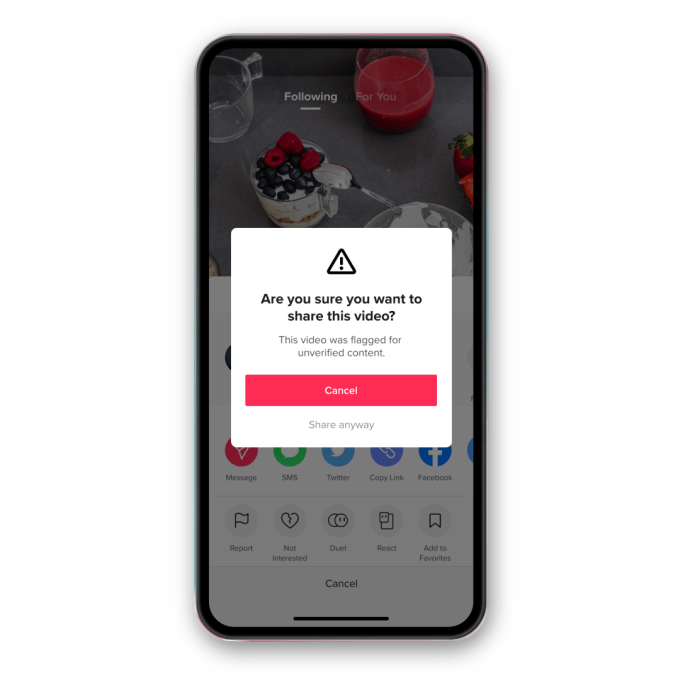
Image Credits: TikTok

The video’s original creator will also be alerted if their video is flagged as unverified content.

TikTok said it tested this labeling system in the U.S. late last year and found that viewers decreased the rate at which they shared videos by 24%. It also found that “likes” on unsubstantiated content decreased by 7%.

This system itself isn’t all that different from efforts made at other social networks to reduce the sharing of false content. For example, Facebook now labels misinformation after it’s reviewed by fact-checking partners and determined to be false. It also notifies people before they try to share the information and downranks the content so it appears lower in users’ News Feeds.

Twitter, too, uses a labeling system to identify misinformation and discourage sharing.

But on other platforms, only verifiably false information is labeled as such. TikTok’s new system moves to tackle the viral spread of unverified content, as well.

Image Credits: TikTok

That doesn’t mean users won’t see the videos. If someone follows the account, they could still see the flagged video in their Following feed or by visiting the account profile directly.

But TikTok believes the new system will encourage users to “be mindful about what they share.”

It could also potentially defer people from making vague but incendiary claims meant to draw viewers and attention. Knowing that these videos could be downranked to the point that they may not ever reach the “For You” page could have a dampening effect on a certain type of social media content — the kind that comes from creators who post first, then ask questions later. Or those who largely shrug their shoulders over the impact of their rumors.

The new feature was designed and tested with Irrational Labs, a behavioral science lab that uses the psychology of decision-making to develop solutions that aim to drive positive user behavior changes. TikTok also says the addition was a part of its ongoing work to advance media literacy, which had included the “Be Informed” educational videos it created in partnership with the National Association of Media Literacy Education.

The banner will begin appearing in the U.S. and Canada starting today.

03 Feb 2021

Vivino raises $155 million for wine recommendation and marketplace app

If you’re at all interested in wine, chances are you’ve turned to Vivino at least a few times for recommendations. The app and the company behind it have been helping people enjoy better wine since 2010, and now the startup has raised $155 million with its Series D round – a sum over twice as large as all of its previous funding to date. Spurred by rapid growth that has seen its user base grow from 29 million in 2018, to 50 million currently, Vivino wants to use the large cash injection to significantly boost its core tech and personalized recommendation engine, while also expanding its presence in key growth markets globally.

Vivino is an interesting company for many reasons, but chief among them might be just how similar its vision today is to the one it started out with. Founder and CEO Heini Zachariassen told me in an interview that the app has been remarkably immune to the pivot – something as natural as breathing in the fast-flowing startup world.

“I can look at my slide, from when I pitched this 10 years ago,” he told me. “It says, ‘Hey, you scan a bottle of wine, then you can buy it.’ That just makes a lot of sense to anybody, so it really hasn’t changed much.”

“It’s been very, very difficult to build much – much harder to build than building that slide,” he joked. But it’s always been the same – we always knew that was going to be the model.”

That core value proposition is what leads to a lot of Vivino’s initial downloads and subsequent usage. The scenario is likely familiar: You’re sitting in a restaurant and browsing the wine menu, or staring at a crowded shelf in a wine store. For myself, I think I likely searched for something like ‘wine recommendation app’ and found Vivino via the App Store, installed it and was snapping photos of labels or menus within minutes. The recommendations provided somewhere to start, and since then the app has grown more personalized as I’ve provided input about my tastes.

Image Credits: Vivino

Vivino’s marketplace component means you can often buy the wines you find and enjoy directly from the app, via partnerships the company fosters and maintains with merchants large and small around the world. Zachariassen explained that they strive to maintain high standards when it comes to these partners, since the experience a user has with them is largely a reflection on Vivino itself because the app provides the means for the purchase.

Building more relationships with more merchants in more geographies is one part of their expansion goal for addressing their primary growth markets, but the company is also going to put a lot more capital behind improving and extending its recommendation engine. A lot of the building blocks are in place to make big improvements there, not least of which is the wine database that Vivino spent a decade building essentially from zero.

“Stage one of the hurdles we faced, even before we got commercial, was really building the data,” Zachariassen told me. “There is no aggregated data anywhere. So we’ve basically built this data totally from scratch. So it means taking a picture of bottle of wine, then having people just entering info every single day to fill it. We have 1.5 billion pictures of wine labels right now, so building that mass of data in a good and structured way really is 10 years of work.”

He adds that wine is a particularly long-tail marketplace, with highly individual tastes and very little indication in the company’s history that that’s likely to change in any significant way. Vivino’s marketplace approach, which is highly local on both the supply and the demand side, is particularly well-suited to addressing the sector’s needs, and Zachariassen believes Vivino has only really begun to scratch the surface on that thus far. I asked him why now was the right time to take on this sizeable round, given they’ve been very modest with prior funding amounts.

Vivino wine app in San Francisco. Photo Copyright Nader Khouri 2018.

“I think we we’ve reached sort of a critical mass,” he said. “We saw last year massive growth, and actually reaching […] like a quarter of a billion dollars in sales, and we’ve really seen that the unit economics are healthy for us. At the same time, unlike other marketplaces – you know, the order of things when you have a marketplace might be if you’re like Uber, is that you go into market, you spend money, do marketing, a lot of money to build up the demand, and then you build the supply on top. We’re a little bit different in the way that demand is already there, because we have 50 million users around the world. So we just follow our demand.”

“But the hardest thing about that is that we’re now a 200 person company that sells wine in 17 countries,” he continued. “Which means we’re relatively thin in all these markets. So so one of the big things here, is actually to go much deeper in each market and say, okay, we now know it works here, let’s put more resources in every single market.”

Zachariassen also added that the company spends very little on marketing to date, so it’s going to begin spending more on that to extend its organic growth. Finally, it wants to really build out product engineering, since he says that while users love the existing app, they really “want to do so much more with it.”

Vivino has worked to modernize a product category that has long relied on local expertise and individual storehouses of highly-specific information, with an approach that provides all the benefits of a connected and global marketplace, while retaining regional and particular appeal at the granola level of the individual user. Now, the company is read to tap the rest of the massive submerged demand it has identified, and this fresh fundings would help it do just that.

The $155 million series D round was led by Sweden’s Kinnevik, and also includes participation by Sprints Capital, GP BullHound, and existing investor Creandum which led its Series A. This brings the company’s total funding to $221 million to date.

03 Feb 2021

Good Eggs raises $100M and plans to launch in Southern California

Grocery delivery startup Good Eggs is announcing that it has raised $100 million in new funding, and that it’s planning to launch in Southern California in either the summer or fall of this year.

Parts of this story might sound familiar to readers familiar with Good Eggs — when the startup raised its most recent, $50 million funding round in 2018, CEO Bentley Hall also mentioned plans for geographic expansion.

It seems, however, that the company has found plenty of opportunity for growth while remaining focused on the San Francisco Bay Area. Good Eggs says that in the past year, revenue has grown to the nine figures (more than $100 million), hired more than 400 employees and nearly doubled its customer base.

Hall also noted that the company opened a new, larger warehouse in Oakland just a few days before shelter-in-place orders took effect last March. So the team was busy enough trying to operate a new warehouse, meet increased demand for grocery delivery and keep workers safe in the process.

Good Eggs box

Image Credits: Good Eggs

And while the grocery delivery market has become increasingly competitive, Hall argued that Good Eggs stands out thanks to the quality and breadth of its products — 70% of its products are locally sourced, and it often delivers them within 48 hours of harvesting.

“There’s lots of people offering groceries, meal kits, prepared meals, alcohol — we do all of that, with a certain sourcing criteria,” Hall said. As a result, Good Eggs has become the “primary source” for many of its consumers, representing 65% to 85% of their home food purchases.

It’s also worth noting that this represents a bit of a turnaround for the company, after the it shut down operations in Los Angeles, New York City and New Orleans in 2015, with Hall coming on as CEO shortly afterwards. And it sounds like he isn’t in a rush to launch in a bunch of new markets.

“I think of [Southern California] not as one big region, but as several small sub-regions,” Hall said. “There’s the LA region, northern San Diego, Orange County — those areas collectively are the size of two or three Bay Areas. That’s a meaningful increase in our addressable market.”

Good Eggs CEO Bentley Hall

Good Eggs CEO Bentley Hall

The new funding was led by Glade Brook Capital Partners, with participation from GV, Tao Invest, Finistere Ventures and Rich’s, as well as previous investors Benchmark Partners, Index Ventures, S2G, DNS Capital and Obvious Ventures. Glade Brook’s J.P. Van Arsdale is joining the company’s board of directors.

“The grocery market is undergoing fundamental change and the shift to e-commerce and higher quality products and services is accelerating,” Van Arsdale said in a statement. “Good Eggs is experiencing rapid growth with strong unit economics and is well-positioned to become a category-defining leader. We are excited to partner with their team to help drive future growth and expansion.”

In addition to geographic expansion, Hall said the money will allow Good Eggs to continue adding new products and to find ways to improve the e-commerce experience.

In addition to the funding, Good Eggs is also announcing that it has hired Vineet Mehra as its chief growth and customer experience officer. Mehra was previously chief marketing officer and chief customer officer at Walgreens Boots Alliance, and before that as executive vice president and global chief marketing and revenue officer at Ancestry.

03 Feb 2021

WorkStep, a startup that helps large employers find and retain frontline workers, raises $10.5M Series A

Finding, and retaining, frontline workers has likely never been as critical as it is in these pandemic days.

Enter WorkStep, a four-year-old startup that was founded with the mission of helping large supply chain employers do just that. The fully distributed company announced this morning that it has closed on a $10.5 million Series A round, building on top of a previously unannounced $6.7 million seed funding that included equity and a convertible note.

FirstMark Capital led the Series A financing, which included participation from returning backer and strategic partner Prologist Ventures.

Dan Johnston, co-founder and CEO of WorkStep, said the Employee Lifecycle Management (ELM) software platform was designed to not only help large supply chain employers source new frontline employers, but to also onboard, train, and keep them happier with the goal of them staying on board longer. Johnston experienced some of the challenges firsthand  when he managed a warehouse in Portland, Oregon, more than a decade ago.

The COVID-19 pandemic has only highlighted the importance of the work frontline employees do – from serving food to delivering packages. But with the increasing dependence on supply chain labor came record turnover, points out Johnston – leaving many companies understaffed and remaining workers stretched thin.

WorkStep claims to provide human resources, recruiting and operations leaders “full transparency” across the employee lifecycle to help companies minimize that churn. The company had previously built out its cloud-based Hire™ offering and then last fall, launched its Retain™ product. 

 “The pandemic has forced companies of all sizes to prioritize the health, safety and satisfaction of frontline teams,” he said. 

Its customers include hundreds of industrial, logistics, transportation and warehousing employers across North America –– including regional 3PLs (third-party logistics companies) and distribution centers, as well as 16 of the Fortune 500. Customers include grocery chain Kroger, Alpine Food Distributing and TransPak, among others.

WorkStep says it has “reached” 500,000 supply chain workers over the years.

WorkStep claims that its Retain offering reduced turnover by up to 29 percent for a Fortune 100 food & beverage company with whom it conducted a case study. This saves companies money in replacement and retraining expenses, which can add up. 

As a result of launching Retain last fall, according to Johnston, WorkStep saw its business more than double in the second half of 2020. This led the company to end the year as “bottom line profitable,” meaning that its revenue exceeded expenses in the last two months of the year.

And while WorkStep did not necessarily need to take on new capital, the company saw an opportunity to double down so it could continue to scale, Johnston said.

“This was an opportunistic round,” he told TechCrunch. “The turnover in this segment has become a core focus.”

WorkStep plans to use its new funding to more than double the size of its existing team of 14 employees across engineering, product, sales and customer success departments this year and triple it by the end of fiscal year 2022.  

FirstMark Capital’s Adam Nelson was in the room with the company during its first whiteboard sessions and believes WorkStep is addressing a “massive” opportunity.

“We think the real differentiator between WorkStep and the existing solutions in the space is that WorkStep doesn’t see temporary staffing/gig liquidity as a solution,” Nelson told TechCrunch. “They see it as a symptom of a multi-hundred billion dollar deadweight loss that’s created when employers aren’t able to find, train and retain the right people.”

WorkStep, he added, is addressing the full employee lifecycle and leveraging the data  “to give a voice to frontline workers while also making employers smarter and more proactive.”

03 Feb 2021

India sends warning to Twitter over lifting block on accounts and noncompliance of order

India has issued a notice to Twitter, warning the American social firm to comply with New Delhi’s order to block accounts and content related to a protest by farmers and not “assume the role of a court and justify non-compliance.” Failure to comply may prompt penal action against Twitter, the notice warns.

The warning comes days after Twitter blocked dozens of high-profile accounts in India to comply with New Delhi’s request, but later lifted the restriction.

Twitter “cannot assume the role of a court and justify non-compliance. Twitter being an intermediary is obliged to obey the directions as per satisfaction of authorities as to which inflammatory content will arouse passion and impact public order. Twitter cannot sit as an appellate authority over the satisfaction of the authorities about its potential impact on derailing public order,” the notice said.

India’s IT ministry expressed concerns over what it deemed derogatory and factually incorrect tweets and hashtags that have been circulating in India this week that it said were designed to spread hate. “It is thus clear that, the offending tweets/ hashtag remained in public domain and must have been tweeted and re-tweeted several times at the risk and cost of public order and at the risk of incitement to the commission of offences,” the letter said.

Twitter did not immediately respond to request for comment.

This is a developing story. Check back for more information…

03 Feb 2021

Embedded finance startup Banxware raises €4M seed

Embedded finance — the idea of offering financial products where customers are already congregating via white label solutions and APIs – isn’t an entirely new concept. In fact, in one form or another, such as point of sale credit, the concept has existed for years and long before Silicon Valley venture capital firm and media company (ha!) Andreessen Horowitz made it a thing. However, fuelled by cloud technology and a plethora of new fintech and Banking-as-a-Service startups, there is no doubt the embedded finance trend is accelerating.

The latest company to declare its hand is Berlin-based Banxware, which offers embedded finance in the form of loans for SMEs, in partnership with marketplaces, payments providers, and others. It launched in December and today is disclosing that it has raised €4 million in seed funding.

Leading the round is Force over Mass, and VR Ventures. They are joined by HTGF, and private investors in banking, payment and e-commerce.

Banxware says it will use the investment to develop and grow its embedded white label financial services offering, and expand its team. In addition to lending, the startup will also soon offer card-based products and other financial services.

Banxware’s tech and infrastructure enables any company to offer loans and other banking services to SME customers. The idea is to act as the link between banks (lenders), digital platforms, and merchants. Banks get access to hard to reach SME customers. Platforms, such as online marketplaces, can up-sell financial products beyond their core offering. And merchants benefit from speedy access to working capital.

“SMEs have a hard time to access capital when needed, especially when they are less than three years old or do not have the most pristine credit history,” explains co-founder and CEO Jens Röhrborn. “On top of this, loan applications, i.e. loan decisions and loan payout, still take several weeks in most cases.

“More and more sellers and merchants are using digital platforms through which they sell their products or process their digital payments. By using the recent historic data on these merchants provided by the platforms, we can lend against their future revenues”.

This has seen Banxware build an instant lending tool that includes AML and KYC compliance, and a scoring engine that analyzes historic platform data and data from third party providers, such as account information providers and external scoring services. The promise is an instant loan decision and loan payout, “all in less than 15 minutes”.

“On the lending side, we work with both balance sheet lenders and lending vehicles with whom we pre-agree on lending terms and loan decision criteria and on whose behalf we execute the loan decision,” says Röhrborn. “Merchants repay their loan in such a way that platforms subtract a certain percentage of the future merchant payouts”.

Röhrborn says the company’s instant lending tool is “only the beginning” and that Banxware will develop additional embedded financial services and expand internationally.

Meanwhile, the German fintech currently generates revenue by charging a one time fee for each loan that is processed through its platform and via a one off customization fee.

03 Feb 2021

Alibaba Cloud turns profitable after 11 years

Alibaba Cloud, the cloud computing arm of Chinese e-commerce giant Alibaba, became profitable for the first time in the December quarter, the company announced in its earnings report.

The firm’s cloud unit achieved positive adjusted EBITA (earnings before interest, taxes, and amortization) during the quarter, after being in business since 2009. The milestone is in part a result of the “realization of economies of scale,” Alibaba said.

Alibaba Cloud, which incorporates everything from database, storage, big data analytics, security, machine learning to IoT services, has dominated China’s cloud infrastructure market for the past few years and its market share worldwide continues to grow. As of 2019, the cloud behemoth was the third-largest public cloud company (providing infrastructure-as-a-service) in the world with a 9% market, trailing behind Amazon and Microsoft, according to Gartner.

COVID-19 has been a boon to cloud and digital adoption around the world as the virus forces offline activities online. For instance, Alibaba notes in its earnings that demand for digitalization in the restaurant and service industry remains strong in the post-COVID period in China, a trend that benefits its food delivery and on-demand services app, Ele.me. The firm’s cloud revenue grew to $2.47 billion in the December quarter, primarily driven by “robust growth in revenue from customers in the internet and retail industries and the public sector.”

Commerce remained Alibaba’s largest revenue driver in the quarter accounting for nearly 70% of revenue, while cloud contributed 7%.

Tencent’s cloud segment is Alibaba Cloud’s closest rival. As of 2019, it had a 2.8% market globally, according to Gartner. The industry in China still has ample room for growth, as Alibaba executive vice-chairman Joe Tsai pointed out in an analyst call from last August.

“Based on the third-party studies that we’ve seen, the China cloud market is going to be somewhere in the $15 billion to $20 billion total size range, and the U.S. market is about eight times that. So the China market is still at a very early stage,” said Tsai.

“We feel very good, very comfortable to be in the China market and just being an environment of faster digitization and faster growth of usage of cloud from enterprises because we’re growing from such a smaller base, about one-eighth the base of that of the U.S. market.”

A key strategy to grow Alibaba Cloud is the integration of cloud into Alibaba’s enterprise chat app Dingtalk, which the company hopes can drive industries across the board onto cloud services. It’s a relationship that echoes that between Microsoft 365 and Azure, as president of Alibaba Cloud, Zhang Jianfeng, previously suggested in an interview.

“We don’t want to just provide cloud in terms of infrastructure services,” said Alibaba CEO Daniel Zhang in the August earnings call. “If we just do it as an infrastructure service, as SaaS services, then price competition is inevitable, and then all the cloud service is more like a commodity business. Today, Alibaba’s cloud is cloud plus intelligence services, and it’s about cloud plus the power of the data usage.”

03 Feb 2021

Could eyelash extensions become a huge market? This robotics startup thinks so

Eyelash extensions have taken off in recent years — particularly in Asia —  but the audience is only so broad. Getting extensions — semi-permanent fibers that are attached to one’s natural eyelashes — can require hundreds dollars and hours of in the seat of a lash stylist, which not everyone can afford. There’s always the risk, too, of irritation or worse. Little wonder that, even accounting for low-budget lashes that can be applied at home, the market stands at around $2 billion, which is too small a market to capture the attention of most venture capitalists.

Luum, a four-year-old, 15-person, Berkeley, Ca.-based robotics company, thinks it can change the math — and attract investment —  by expanding the market itself “exponentially,” says its CEO, Philippe Sanchez, who has overseen large chain businesses, including as a managing director for Starbucks in France.

The way forward, he says, is through robotics, artificial intelligence, and machine learning, which Luum says it’s using to ultimately create a robot that that can apply lashes in 20 minutes and, if all goes as planned, will be widely available in beauty shops. More, because even lash extensions eventually need to be replaced (every two to four weeks), customers will tend to come back again and again under the right circumstances.

Right now, there’s a bit of magical thinking involved, admits Sanchez. The tech currently relies on Epson industrial robots to which a variety of arms and sensors are attached (making it look a little like something you might see in the dentist’s office). The procedure of applying lashes has been tried out 100 times on 25 brave souls alone. The process currently takes as long as it would to apply lashes by hand, too, meaning a couple of hours. Still, Luum, which has raised $10 million to date from Foundation Capital and others and is about to begin talking with investors about a Series A round, is convinced that it has the right team to chase and grow what it sees as a big and underserved opportunity in the beauty space.

We talked with Sanchez yesterday afternoon about the company and its next steps. Our chat has been edited for length and clarity.

TC: So you are targeting this popular treatment in what seems like a very fragmented industry.

PS: It’s very popular and yet a little bit undiscovered and yes, it’s very fragmented. There are 34,000 lash extension services being offered right now in the U.S. alone, where you’ve got an artist coming over to you and selecting one lash extension at a time, dipping it in an adhesive, and gluing it to an existing lash, then waiting a few seconds to get the next one and the next one, and two hours later, you have amazing lashes that look extremely natural.

But these are individual lash artists. And we see this as a great opportunity to reinvent the category and take a service that’s already popular and make it even more popular with high-level execution and a new world-class brand.

TC: So the idea is that you create a brand and develop a chain of walk-in centers around the country and world where these eyelashes will be robotically attached?

PS: Correct. We want to leverage our technology to build our brand and launch a chain of studios, as well as to license the technology to people who already sell beauty services and products and and offer them a chance to either be much better at what they do if they are lash artists or, if you know, they have a hair salon or a large cosmetic retailer, they can [add lashes as an ancillary business]. They love the idea of returning customers having to come back every month for services, and lash extensions bring them back into their stores.

TC: This obviously requires the same or better precision than human fingers, along with high safety requirements given this hardware is so near to someone’s eyes. How does the robot work right now?

PS: The machine is pretty large and pretty soft and very advanced. There is a bed just like you would have in a first-class business flight. And the machine nearby that is about the size of a human, and so you lay in the bed and the machine work overs your face — you have a mask, just like if you were to do a manual extension — and it has a little robotic arm that does the job of a person but is much faster and more precise than any manual application. And it’s very safe. It’s got little prongs in the plastic at the end of these arms that are very light held by very light magnets because you need only a few grams of force to manipulate the lash.

TC: So if there was any type of external event — an earthquake or something . . .

PS:  . . . the arms literally fall because they’re held by these little very light magnets. If you you shake the machine or somebody sneezes, the arms will fall. It creates an environment that simply cannot hurt you, which is critical to the service itself.

TC: Are you licensing anyone else’s tech or building everything in-house eventually?

PS: It’s all built in house. We’re leveraging advanced robots from Epson that are very good at doing precise manipulation and that are fast. But [as for] IP in the beauty space, there was essentially no prior art, so we have secured a patent already in the U.S and Korea and Australia and [have] 25 patent cases around the world that are very broad and provide us with a moat and protection for the company at large.

TC: How much will these robots cost?

PS: They will cost about $125,000 or so, but this one-time capital expense can boost productivity of labor by four or six times, so you’ve essentially increased the throughput of one bed, one lash artist, by six. And the machine lasts four to five years.

TC: Plus other costs.

PS: You will have maintenance costs, but it’s essentially pure margin. For most of those consumer service business, most of the cost goes goes into the labor. That was for my experience at Starbucks.

TC: How far away are you from realizing this vision?

PS: COVID [slowed us down], though we can conduct consumer tests again right now [as California reopens slightly], so we’re testing the machine, which is already able to deliver a simple style at about the speed of a human. And as we continue to develop and work over the next few months and get closer to opening our first studio,  the performance of the machines will increase to twice the speed and three times the speed and four times the speed of a human application.

TC: You need more capital toward that end. How much are you looking to raise?

PS: A $15 million Series A. That will allow us to open our first studio and validate the unit economic model, as well as to build our third-generation machine. The capital will also be deployed to start to build the foundation of a world class beauty brand.

TC: Who should investors know is on your team?

PS: The company was founded by Nathan Harding, who also founded the [robotic exoskeleton pioneer] Ekso Bionics, and Kurt Amundson [who worked with Harding at Ekso Bionics for a decade]. They’ve got tremendous experience and expertise already in the world of advanced robotics, and also computer vision on the computer vision side.

TC: What’s to keep a company like Dyson from jumping into this market if you’re able to prove there is one?

PS: Some folks will realize that this is an attractive space and it’s worth looking at, but we’ve got a couple of years on them already.

03 Feb 2021

Bot MD, an AI-based chatbot for doctors, raises $5 million for expansion into more Asian markets

Time is critical for healthcare providers, especially in the middle of the pandemic. Singapore-based Bot MD helps save time with an AI-based chatbot that lets doctors look up important information from their smartphones, instead of needing to call a hospital operator or access its intranet. The startup announced today it has raised a $5 million Series A led by Monk’s Hill Venture.

Other backers include SeaX, XA Network and SG Innovate, and angel investors Yoh-Chie Lu, Jean-Luc Butel and Steve Blank. Bot MD was also part of Y Combinator’s summer 2018 batch.

The funding will be used to expand in the Asia-Pacific region, including Indonesia, the Philippines, Malaysia and Indonesia, and to add new features in response to demand from hospitals and healthcare organizations during COVID-19. Bot MD’s AI assistant currently supports English, with plans to release Bahasa Indonesian and Spanish later this year. It is currently used by about 13,000 doctors at organizations including Changi General Hospital,  National University Health System, National University Cancer Institute of Singapore, Tan Tock Seng Hospital, Singapore General Hospital, Parkway Radiology and the National Kidney Transplant Institute.

Co-founder and chief executive officer Dorothea Koh told TechCrunch that Bot MD integrates hospital information usually stored in multiple systems and makes it easier to access.

A smartphone with Bot MDs medical AI assistant for doctors displayed on it

Image Credits: Bot MD

Without Bot MD, doctors may need to dial a hospital operator to find which staffers are on call and get their contact information. If they want drug information, that means another call to the pharmacy. If they need to see updated guidelines and clinical protocols, that often entails finding a computer that is connected to the hospital’s intranet.

“A lot of what Bot MD does is to integrate the content that they need into a single interface that is searchable 24/7,” said Koh.

For example, during COVID-19, Bot MD introduced a new feature that takes healthcare providers to a form pre-filled with their information when they type “record temperature” into the chatbot. Many were accessing their organization’s intranet twice a day to log their temperature and Koh said being able to use the form through Bot MD has significantly improved compliance.

The time it takes to onboard Bot MD varies depending on the information systems and amount of content it needs to integrate, but Koh said its proprietary natural language processing chat engine makes training its AI relatively quick. For example, Changi General Hospital, a recent client, was onboarded in less than ten days.

Bot MD plans to add new clinical apps to its platform, including ones for electronic medical records (EMR), billing and scheduling integrations, clinical alerts and chronic disease monitoring.

03 Feb 2021

India’s Zetwerk raises $120 million to scale its B2B marketplace for manufacturing parts

When you want to buy a refrigerator or a television, you can walk to the nearby electronics store or visit an e-commerce website like Amazon. But where do you go when you’re looking for parts of a crane, a door or chassis of different machines?

For several businesses globally, the answer to that question is increasingly Zetwerk, a Bangalore-based startup.

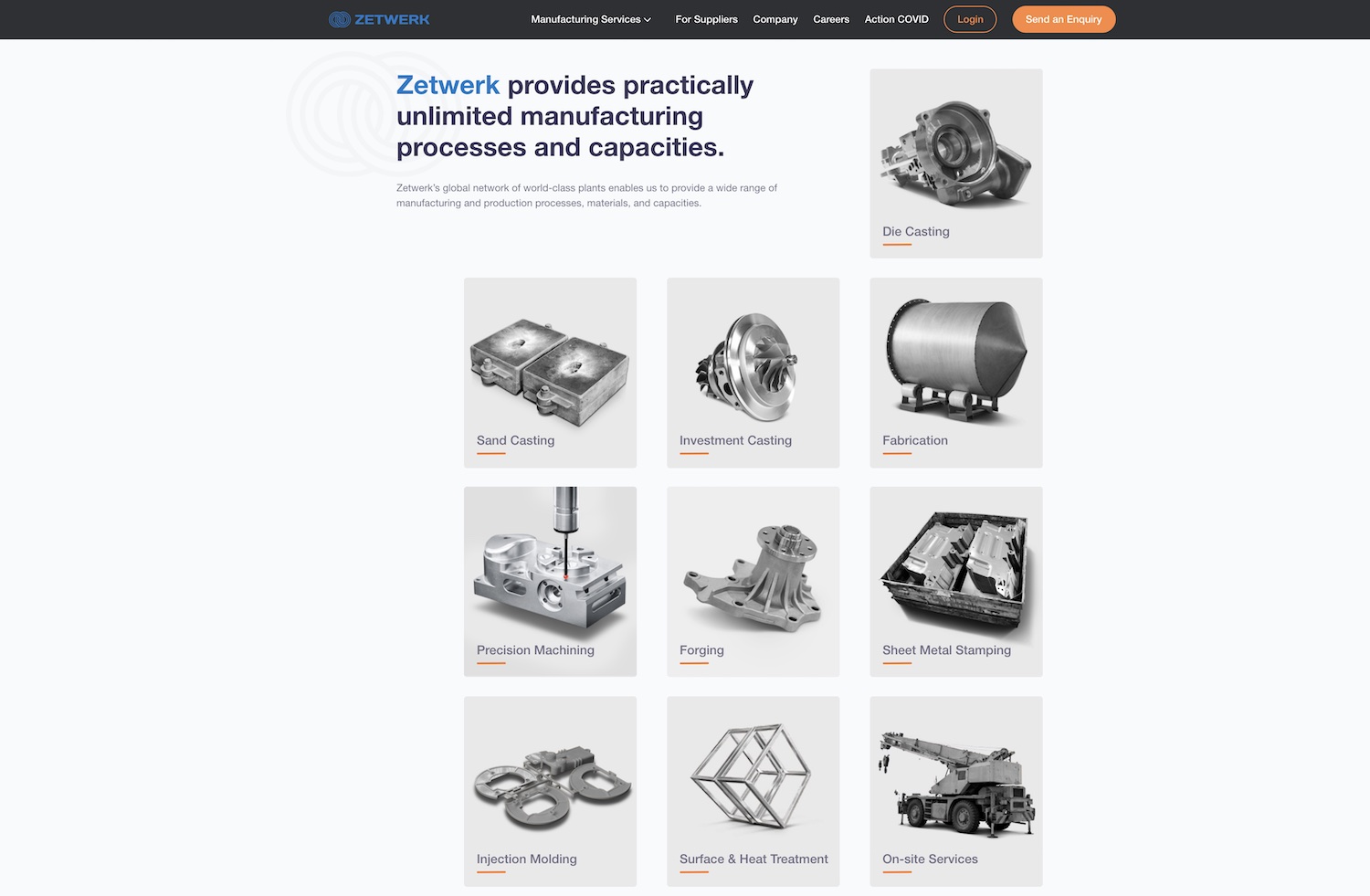
The three-year-old startup runs a business-to-business marketplace for manufacturing items that connects OEMs (original equipment manufacturers) and EPC (engineering procurement construction) customers with manufacturing small-businesses and enterprises.

All the products it sells today are custom-made. “Nobody has a stock of such inventories. You get the order, you find manufacturers and workshops that make them,” explained Amrit Acharya, co-founder and chief executive of Zetwerk, in an interview with TechCrunch.

Its customers — there are over 250 of them, up from 100 a year ago — operate across two-dozen industries (including process plants, oil & gas, steel, aerospace, medical devices, apparel and luxury goods) in the infrastructure space, and approach Zetwerk with digital designs they wish to be translated into physical products.

Customers aren’t alone in seeing value in Zetwerk. On Wednesday, the Indian startup said it has raised $120 million in a Series D financing round led by existing investors Greenoaks Capital and Lightspeed Venture Partners. Existing investors Sequoia Capital and Kae Capital also participated in the Series D round.

The new round, which brings Zetwerk’s to-date raise to $193 million, gives the firm a post-money valuation of somewhere between $600 million to $700 million, a person familiar with the matter told TechCrunch. (A quick side note: Zetwerk announced a $21 million Series C round last year, but ended up raising $31 million in that round.)

Zetwerk was co-founded by Acharya, Srinath Ramakkrushnan, Rahul Sharma and Vishal Chaudhary. Long before Acharya and Ramakkrushnan joined forces to tackle this space, they had been contemplating this idea.

Both of them studied at IIT Madras, went to the same exchange program in Singapore, and were colleagues at Kolkata-headquartered conglomerate ITC. While working there, they realized that part of a product manager’s job at the firm was dealing with gazillions of suppliers and the manufacturing items they offered.

The process was archaic: There were no databases, and people couldn’t track shipments.

The early version of Zetwerk, which was a database of suppliers, was a direct response to this. But after listening to requests from customers, the startup saw a bigger opportunity and transformed itself into a full-fledged marketplace with integrations with third-party vendors. Once a firm has placed an order, Zetwerk allows them to keep tabs on the progress of manufacturing and then the shipping. There are also quality checks in place.

Zetwerk website

Zetwerk operates in such a unique space today — Shailesh Lakhani, managing director at Sequoia India, says the startup has defined a new category of marketplace — that by and large it’s not competing with any other firm in India — or South Asia. (The startup competes with domain project consultants in the offline world.)

The opportunity in India itself is gigantic. According to industry reports, manufacturing today accounts for 14% of India’s GDP. Vaibhav Agarwal, a partner at Lightspeed, estimates that the market is as large as $40 billion to $60 billion in India and global trade-tailwinds that creates opportunity to serve international demand.

As more and more companies expand or shift their manufacturing to India — in part due to import duties imposed by India and geo-political tension with China, the global hub for manufacturing — this opportunity has only grown bigger in recent years.

“India has a lot of depth in manufacturing, but much of it has not been tapped well,” said Acharya.

Zetwerk — which grew 3X last year and reported revenue of $43.9 million in the financial year that ended in March, a 20X growth from the year prior — plans to deploy the new capital to expand to more areas of categories, and broaden its technology stack. Consumer goods (which covers items such as mixer grinders and TVs) is an area Zetwerk expanded to last year, and said it accounts for 15% of the revenue it generated in the last six months.

Currently 25 of its customers are in the U.S., Canada, Europe and other international markets. Acharya said the startup plans to open offices overseas this year as it scouts for more international customers. 

“We are excited to partner with Zetwerk on the next leg of their journey, as they expand their value proposition globally. Zetwerk’s operating system for manufacturing has digitized multiple supply chains end-to-end, ensuring on-time delivery and high quality standards. This has led to rapid growth in India and internationally, with the potential to quickly become one of the most important manufacturing platforms globally,” said Neil Shah, partner at Greenoaks Capital, in a statement.