Year: 2021

03 Feb 2021

BukuWarung, a startup digitizing Indonesia’s SMEs, raises new funding from Rocketship.vc

BukuWarung, an Indonesian startup focused on digitizing the country’s 60 million small businesses, announced today it has raised new funding from Rocketship.vc and an Indonesian retail conglomerate.

The amount was undisclosed, but sources say it brings BukuWarung’s total funding so far to $20 million. The company’s last round, announced in September 2020, was between $10 million to $15 million. Launched in 2019, BukuWarung was founded by Chinmay Chauhan and Abhinay Peddisetty and took part in Y Combinator last year.

Rocketship.vc is also an investor in Indian startup Khatabook, which reached a valuation between $275 million to $300 million in its last funding round. Like Khatabook, BukuWarung helps small businesses, like neigborhood stores called warung, that previously relied on paper ledgers transition to digital bookkeeping and online payments. BukuWarung recently launched Tokoko, a Shopify-like tool that lets merchants create online stores through an app, and says Tokoko has been used by 500,000 merchants so far.

Chuahan, BukuWarung’s president, said it has started making revenue through its payments solution. In total, BukuWarung now claims more than 3.5 million registered merchants in 750 Indonesian towns and cities, and says it is recording over $15 billion worth of transactions across its platform and processing over $500 million in terms of volume.

SMEs contribute about 60% to Indonesia’s gross domestic product and employ 97% of its domestic workforce, but many have difficulty accessing financial services that can help them grow. By digitizing their financial records, companies like BukuWarung can make it easier for them to access lines of credit, working capital loans and other services. Other companies serving SMEs in Indonesia, Southeast Asia’s largest economy, include BukuKas and CrediBook.

BukuWarung will use its new funding to grow its tech and product teams in Indonesia, India and Singapore. It plans to launch more monetization products, including credit, and grow its payments solution this year.

02 Feb 2021

Daily Crunch: Jeff Bezos will step down as Amazon CEO

The Bezos era is ending, Uber acquires Drizly and Tesla recalls 135,000 vehicles. This is your Daily Crunch for February 2, 2021.

The big story: Jeff Bezos will step down as Amazon CEO

Amazon announced today that founder Jeff Bezos will be transitioning from CEO to executive chair in the third quarter of this year. Andy Jassy, currently the CEO of Amazon Web Services, will be taking over as chief executive for the entire company.

In an email to employees, Bezos said that this will allow him to devote more time to “Day 1 Fund, the Bezos Earth Fund, Blue Origin, The Washington Post, and [his] other passions.” Jassy, meanwhile, had previously been identified as a likely successor.

The tech giants

Uber is buying alcohol delivery service Drizly for $1.1B — The plan is to build Drizly’s marketplace directly into the Uber Eats app, though Uber says it will maintain Drizly as a standalone app as well.

Tesla recalls 135,000 vehicles over touchscreen failures — According to the National Highway Traffic Safety Administration, the touchscreen in Model S and Model X vehicles can fail when a memory chip runs out of storage capacity.

Amazon to pay $61.7M to settle FTC complaint over stolen Amazon Flex driver tips — According to the complaint against Amazon and its subsidiary Amazon Logistics, the company had advertised that it paid 100% of tips to drivers, but in reality, Amazon used the customer tips to cover the difference after it lowered the hourly rate.

Startups, funding and venture capital

Divvy Homes secures $110M Series C to help renters become homeowners — Over the course of 2020, Divvy expanded operations from eight to 16 total markets and financed five times as many homes as it had in pre-pandemic times.

Kindred Ventures just closed its second fund with $100M in capital commitments — Kindred is a San Francisco-based pre-seed and seed-stage venture fund founded by Steve Jang and Kanyi Maqubela.

Omnispace raises $60M to fuse satellites and 5G into one ubiquitous network — Omnispace wants to offer ubiquitous 5G-compliant connectivity for enterprise users using a hybrid of wireless ground technology and satellites.

Advice and analysis from Extra Crunch

Udemy’s new president discusses the reskilling company’s future — “We blew through $100M ARR.”

The future of SaaS is on-demand: Use experts to drive growth and engagement — For SaaS companies, not having a gig economy strategy as we start 2021 is like missing the internet trend in 1990.

Save 25% with Extra Crunch Group Membership — This new feature allows you to easily manage seats and payments for your team through a self-service interface.

(Extra Crunch is our membership program, which helps founders and startup teams get ahead. You can sign up here.)

Everything else

Eight Miami-area investors assess America’s southernmost tech ecosystem — We’re seeing a “moment” in Miami, but many are hoping to turn it into a movement.

Welcome Tage Kene-Okafor, Mary Ann Azevedo, Sophie Burkholder and a guy named Drew — Hooray for new team members!

The Daily Crunch is TechCrunch’s roundup of our biggest and most important stories. If you’d like to get this delivered to your inbox every day at around 3pm Pacific, you can subscribe here.

02 Feb 2021

What Andy Jassy’s promotion to Amazon CEO could mean for AWS

Blockbuster news struck late this afternoon when Amazon announced that Jeff Bezos would be stepping back as CEO of Amazon, the company he built from a business in his garage to worldwide behemoth. As he takes on the role of executive chairman, his replacement will be none other than AWS CEO Andy Jassy.

With Jassy moving into his new role at the company, the immediate question is who replaces him to run AWS. Let the games begin. Among the names being tossed about in the rumor mill are Peter DeSantis, vice president of global infrastructure at AWS and Matt Garman, who is Vice President of sales and marketing. Both are members of Bezos’ elite executive team known as the S-team and either would make sense as Jassy’s successor. Nobody knows for sure though, and it could be any number of people inside the organization, or even someone from outside. (We have asked Amazon PR to provide clarity on the successor, but as of publication we had not heard from them.)

Holger Mueller, a senior analyst at Constellation Research, says that Jassy is being rewarded for doing a stellar job raising AWS from a tiny side business to one on a $50 billion run rate. “On the finance side it makes sense to appoint an executive who intimately knows Amazon’s most profitable business, that operates in more competitive markets. [Appointing Jassy] ensures that the new Amazon CEO does not break the ‘golden goose’,” Mueller told me.

Alex Smith, VP of channels, who covers the cloud infrastructure market at analyst firm Canalys, says the writing has been on the wall that a transition was in the works. “This move has been coming for some time. Jassy is the second most public-facing figure at Amazon and has lead one of its most successful business units. Bezos can go out on a high and focus on his many other ventures,” Smith said.

Smith adds that this move should enhance AWS’s place in the organization. “I think this is more of an AWS gain, in terms of its increasing strategic importance to Amazon going forwards, rather than loss in terms of losing Andy as direct lead. I expect he’ll remain close to that organization.”

Ed Anderson, a Gartner analyst also sees Jassy as the obvious choice to take over for Bezos. “Amazon is a company driven by technology innovation, something Andy has been doing at AWS for many years now. Also, it’s worth noting that Andy Jassy has an impressive track record of building and running a very large business. Under Andy’s leadership, AWS has grown to be one of the biggest technology companies in the world and one of the most impactful in defining what the future of computing will be,” Anderson said.

In the company earnings report released today, AWS came in at $12.74 billion for the quarter up 28% YoY from $9.60 billion a year ago. That puts the company on an elite $50 billion run rate. No other cloud infrastructure vendor, even the mighty Microsoft, is even close in this category. Microsoft stands at around 20% marketshare compared to AWS’s approximately 33% market share.

It’s unclear what impact the executive shuffle will have on the company at large or AWS in particular. In some ways it feels like when Larry Ellison stepped down as CEO of Oracle in 2014 to take on the exact same executive chairman role. While Safra Catz and Mark Hurd took over at co-CEOs in that situation, Ellison has remained intimately involved with the company he helped found. It’s reasonable to assume that Bezos will do the same.

With Jassy, the company is getting a man who has risen through the ranks since joining the company in 1997 after getting an undergraduate degree and an MBA from Harvard. In 2002 he became VP/ technical assistant, working directly under Bezos. It was in this role that he began to see the need for a set of common web services for Amazon developers to use. This idea grew into AWS and Jassy became a VP at the fledgling division working his way up until he was appointed CEO in 2016.

02 Feb 2021

Google Cloud lost $5.6B in 2020

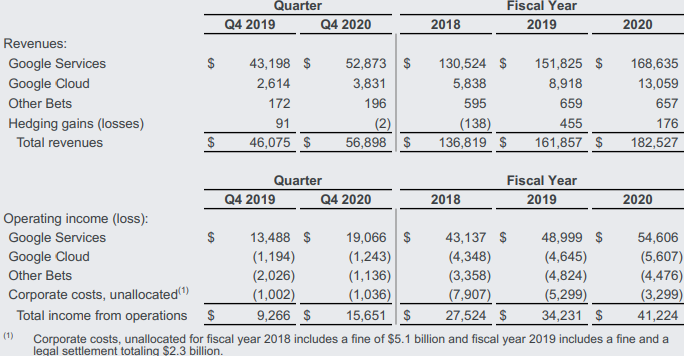
Google continues to bet heavily on Google Cloud and while it is seeing accelerated revenue growth, its losses are also increasing. For the first time today, Google disclosed operating income/loss for its Google Cloud business unit in its quarterly earnings today. Google Cloud lost $5.6 billion in Google’s fiscal year 2020, which ended December 31. That’s on $13 billion of revenue.

While this may look a bit dire at first glance (cloud computing should be pretty profitable, after all), there’s different ways of looking at this. On the one hand, losses are mounting, up from $4.3 billion in 2018 and $4.6 billion in 2019, but revenue is also seeing strong growth, up from $5.8 billion in 2018 and $8.9 billion in 2019. What we’re seeing here, more than anything else, is Google investing heavily in its cloud business.

Google’s Cloud unit, led by its CEO Thomas Kurian, includes all of its cloud infrastructure and platform services, as well as Google Workspace (which you probably still refer to as G Suite). And that’s exactly where Google is making a lot of investments right now. Data centers, after all, don’t come cheap and Google Cloud launched four new regions in 2020 and started work on others. That’s on top of its investment in its core services and a number of acquisitions.

Image Credits: Google

“Our strong fourth quarter performance, with revenues of $56.9 billion, was driven by Search and YouTube, as consumer and business activity recovered from earlier in the year,” Ruth Porat, CFO of Google and Alphabet, said. “Google Cloud revenues were $13.1 billion for 2020, with significant ongoing momentum, and we remain focused on delivering value across the growth opportunities we see.”

In today’s earnings call, Porat noted that Workspace is seeing strong growth among large enterprises, “which are signing meaningful, long-term commitment agreements.”

For now, though, Google’s core business, which saw a strong rebound in its advertising business in the last quarter, is subsidizing its cloud expansion.

Meanwhile, over in Seattle, AWS today reported revenue of $12.74 billion in the last quarter alone and operating income of $3.56 billion. For 2020, AWS’s operating income was $13.5 billion.

02 Feb 2021

Save 25% with Extra Crunch Group Membership

We’re excited to announce Group Membership for Extra Crunch. The feature allows you to easily manage seats and payments for your team through a self-service interface. If your team joins through Group Membership, you’ll also save 25% or more on annual pricing.

Extra Crunch Group Memberships can be found here.

Extra Crunch is a members-only community from TechCrunch. We help founders and startup teams get ahead. Membership grants you access to weekly startup investor surveys, private tech market analysis, how-tos on fundraising and growth, topical newsletters, and more. Membership also unlocks access to our weekly virtual event series, Extra Crunch Live.

Extra Crunch Group Memberships can be found here. For questions on Group Membership, please contact travis@techcrunch.com.


FAQ

How does Group Membership work?

One team leader will become the admin on the account, and he or she is responsible for payment and seat management. We recommend the admin be the first user on the team to sign up for Group Membership. 


How do I make seat assignments?

The seat assignments can be made in the original checkout flow or at a later date through the “My Account” section on TechCrunch. To assign seats through “My Account,” the admin should go to My Account / Subscription / Manage / Manage Shared Accounts. You’ll need email addresses of your team members to assign seats. Once seats are assigned, your team members will receive an email with an activation link.


How many users do we need to qualify for Group Membership?

You must have at least 5 team members in your group to qualify for Group Membership.


Is 25 the max size for Group Membership?

We have the ability to do groups larger than 25, but we’ll need to send you a special link. Please reach out to travis@techcrunch.com with your group size to obtain the link.


Do you offer invoicing instead of credit card?

All payments must be made over credit card. If your group is larger than 100 users, we’re open to discussing invoicing options. We do not offer invoicing for small groups. Reach out to travis@techcrunch.com for more information.

02 Feb 2021

Jeff Bezos will no longer be CEO of Amazon as of later this year

Amazon founder and current CEO Jeff Bezos will be transitioning to Executive Chair of the company sometime in Q3 of this year, with current AWS CEO Andy Jassy taking over the top executive role at the commerce company. Amazon announced the news alongside its earnings results on Tuesday.

Amazon initially rose after-hours as the market digested both the company’s earnings and its CEO news. The company beat on both earnings per share, and revenues. That makes it hard to untangle the market’s response to its busy set of announcements.

For reference, Amazon crushed earnings-per-share and revenue expectations in Q4 2020. So, any investor worried about the exit of Bezos from the CEO chair were given some measure of of performance-based amelioration. Amazon’s quarter was its first to break the $100 billion mark, bringing in $125.6 billion in revenue against an anticipated $119.7 billion. And, the company’s $14.09 per share in earnings was nearly double an expected $7.23.

Jassy has been identified previously as the likely successor to Bezos, after leading Amazon Web Services (AWS) to the success it currently enjoys as a leader in the cloud computing space.

Bezos sent an email to Amazon employees, which the company also released publicly on its blog on Tuesday following the announcement.

Developing …

02 Feb 2021

SpaceX’s Starship prototype once again flies to great heights, and again explodes on landing

SpaceX has once again flown its Starship spacecraft, a still-in-development space launch vehicle it’s building in south Florida. This test was a flight of SN9, the ninth in its current series of prototype rockets. The test involved flying SN9 to an altitude of around 10 km (just over 6 miles or nearly 33,000 feet). After reaching that apogee, the SN9 spacecraft altered its attitude to angle for re-entry (simulated, since it didn’t actually leave Earth”s atmosphere) and then descended for a controlled landing.

This is the second test along these lines, with the first happening in December using its SN8 prototype, the one before this in the current series. Today’s test saw SN9 reach its target altitude as intended, and saw a successful ‘belly flop’ maneuver, as well as the required propellant hand-off. This was also a successful test of the flaps on Starship, which control its angle as it moves through the air, and which alter their angle via on-board motors to do so. The landing portion didn’t go as smoothly – the spacecraft attempted to re-orient itself to go vertical for landing, but didn’t make it quite straight up-and-down, and also had too much speed going into the touchdown, so it exploded rather spectacularly when it hit ground.

Image Credits: SpaceX

SpaceX had a very similar test the first time around, with things going mostly smoothly up until the landing portion of the mission. During SN8’s flight, the Starship prototype appeared to be better-oriented for landing before touching down too hard, but it’s difficult to say too much about which was more or less successful without access to the data and the testing parameters.

Starship is designed to perform this crucial maneuver as part of its approach to reusability – the spacecraft is intended to be fully reusable, and will accomplish this with a powered-landing that includes, obviously, not the exploding component. As the company noted, however, the rest of this test looks pretty much like what they wanted to happen.

This kind of early testing isn’t expected to go exactly to plan, and the point is primarily to collect data that will help improve further attempts and spacecraft development. Of course, you’d hope to get things exactly right upon your first attempts, but it never actually works that way in rocketry. What is unusual is how public SpaceX is with its development program at this stage of testing.

The company will be back at it with another try soon. It already has its SN10 prototype set up on its launch site at its Texas facility, which is the other spaceship you see in the early part of the animation above.

02 Feb 2021

Cannabis marketing platform Springbig adds BudTender to its stash

Springbig today announced that it acquired Canada-based BudTender, a customer experience platform for cannabis retailers. The acquisition adds 200 clients to Springbig, which brings the total amount of retailers in its purview to 1,900.

This move comes as cannabis retailers are seeking novel approaches to expand their client base. In most regions, cannabis companies are unable to utilize modern advertising on social media. With BudTender, Springbig adds another tool to its marketing and loyalty platform. Springbig says that BudTender will soon be integrated into Springbig’s platform, allowing users to access BudTender’s reports and surveys.

“BudTender has been a dominant force in the Canadian canna-tech space; the company’s vision and platform effortlessly complements springbig’s ongoing commitment to enhancing the cannabis retail and loyalty experience,” said Jeffrey Harris, Founder and CEO of springbig in a released statement. “As the legal industry becomes increasingly sophisticated, brands and retailers will need to deploy more comprehensive customer retention and satisfaction solutions in order to stay competitive.”

Founded by Jake Crow in 2017, BudTender had a fantastic 2020. According to Springbig, BudTender saw 800% year-over-year growth and 1200% year-over-year revenue growth.

“This acquisition will not only be a boon to cannabis retailers across North America but also enrich millions of consumer experiences,” said Crow. “This will undoubtedly create a more modern cannabis industry, and we are thrilled to officially join forces with springbig.”

The terms of the deal are undisclosed.

02 Feb 2021

VC meets the land of opportunity

The wave of venture capital interest in geographies other than Silicon Valley has been building momentum over the past 5+ years. If you measure capital flow by Twitter chatter alone, you may assume the tidal wave is about to break and checks are being doled out via T-shirt launchers repurposed from hockey games.

Meanwhile, VCs will approach founders saying, “We are now looking into markets beyond Silicon Valley.”

When Mucker launched back in 2011, our founding partners, who had left Silicon Valley for LA, set out to prove that high-growth companies can be built anywhere. Our portfolio from this past decade is a testament to this very narrative. With offices in LA, Austin and Nashville — and investments all over North America, we are seeing a marked increase in receptivity to an idea we had over a decade ago to invest across the U.S. and into Canada.

As of late, I’m receiving more and more outreach from VCs based in San Francisco, New York and beyond interested in deal flow here in Nashville and the Southeast.

When we think about the opportunity beyond Silicon Valley, we are really speaking of America.

In reality, there will be some lag time before the checks being written by these same VCs are consistent with both the outward hype and existing market opportunity. The broadened geographic focus of VCs for marketing purposes and FOMO is not adequately capturing the real narrative.

In short: When we think about the opportunity beyond Silicon Valley, we are really speaking of America.

America is the opportunity and we are worthy of investment, aren’t we?

“We” is a loaded declaration. I write this as a venture capitalist and also as the biracial daughter of a first-generation immigrant, with both of my parents growing up poor by most people’s standards. One branch of my family immigrated to the U.S. from Mexico during the Mexican Revolution, the other harkens back to rural Oklahoma. The founders I meet day in and day out in the Southeast oftentimes tell a similar story.

My story is that of the average American, and yet feels light years apart from what people perceive as the “innovation economy.” Many of the people I’ve met in venture capital this past decade come from prestigious lineages with parents and grandparents who may have never associated with mine. And yet, here we are. This is America.

While Silicon Valley’s origins and climb to international stardom center around a collection of innovators, attracting more innovators and capital as the decades passed, one critical element arguably fell by the wayside — America as an expansive and diverse collection of states and people. Annual reporting on where venture capital dollars flow supports this discrepancy, with the majority of funds being funneled into companies based in and around Silicon Valley.
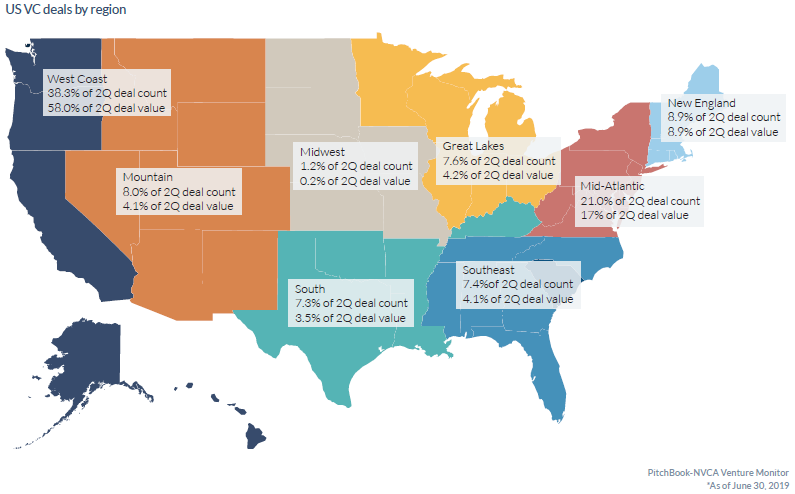
US VC deals by region as of June 2019

U.S. VC deals by region, as of June 2019. Image Credits: PitchBook/NVCA Venture Monitor

We find ourselves at the threshold of a decade where America will be rightfully recast as the land of opportunity for VC dollars to flow into the products and services fueling America’s future. And, at the helm of such innovations needs to be the people closest to these market opportunities, in full alignment with their customers and the nuances to best serve them.

In a post-COVID world, customers have never demanded more transparency into supply chains, workplace culture and equity ownership. Customers are more informed than ever before, with a 24/7 info line on brands and a growing scrutiny on where to place their hard-earned dollars. In short, they demand to be seen, and the founders who recognize this are the ones thriving in this new climate.

Follow the money

Where do the customers live? I’ll give you a hint: They are largely not in Silicon Valley.

U.S. population around Nashville, TN. Image Credits: Nashville 2018 Regional Economic Development Guide

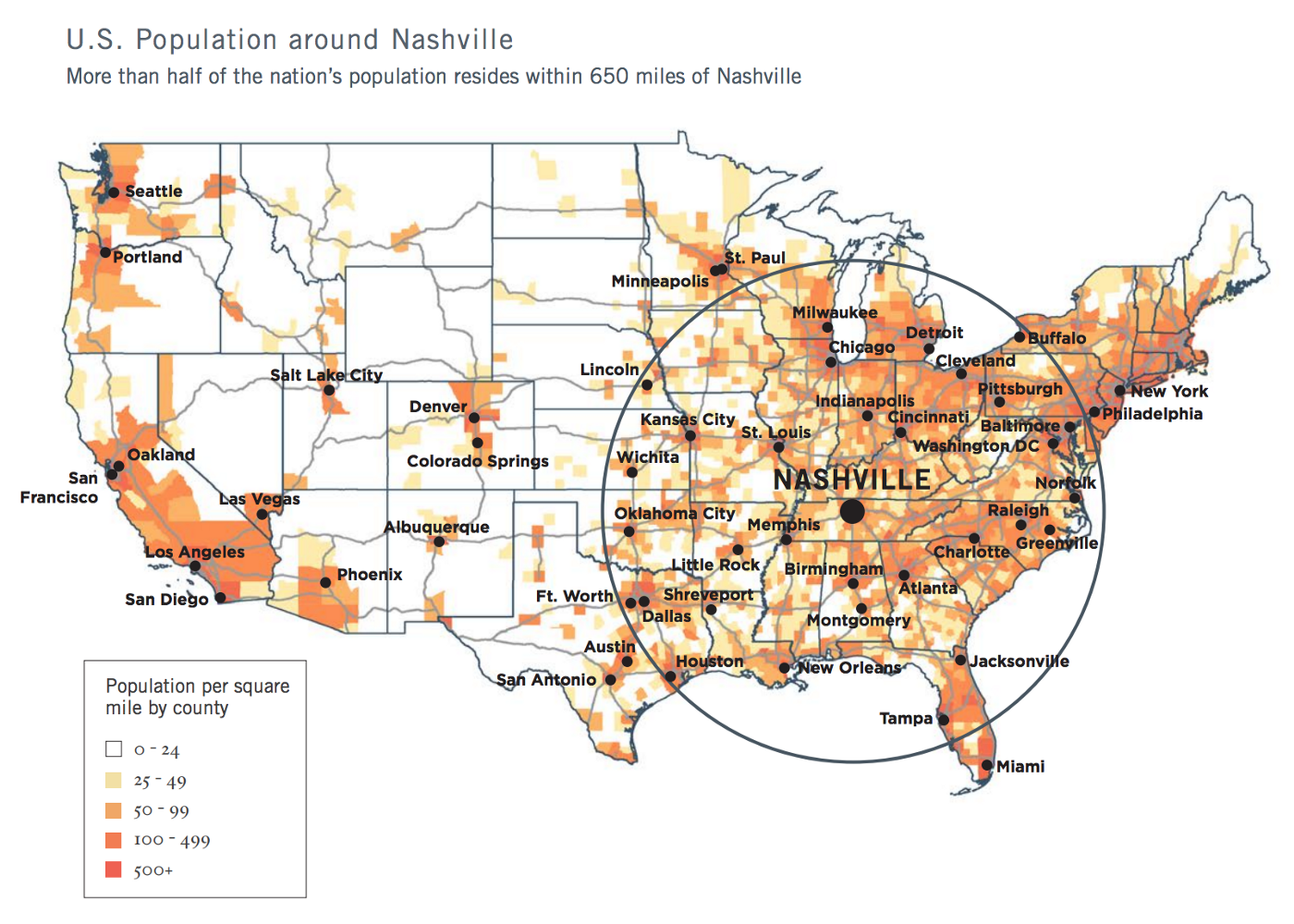
I wrote about the unfair advantage of Nashville back in 2018 when I announced the launch of Build In SE, a community I co-founded to support founders choosing to build their companies in the Southeast. Nashville is at the center of over half of the United States population within a radius of 650 miles, and within a two-hour flight of 75% of the U.S. market.

Customers come in all shapes and sizes, and founders with boots on the ground in these markets, wearing the same brand of proverbial boots as these customers, carry an unfair advantage. These same founders historically bootstrapped their companies out of need, as access to early-stage, high-risk capital can be scarce and vary widely city by city, state by state, industry by industry.

These same founders still built household name companies in the tech and innovation economy, including the likes of Mailchimp, Calendly, Lynda.com, and GoFundMe (their Series A valued them at $600 million pre-money). All of these companies have another thing in common — they were founded “beyond Silicon Valley.”

Talent as the stronger magnet

Another macrotrend at play is that of the increasing distribution of talent beyond traditional metropolitan strongholds like San Francisco and New York. Entrepreneurs, technologists and operational talent are lifestyle-seeking at a time in history when life feels all the more precious. Moving to cities like Nashville, Austin, Atlanta, Denver, Durham, Miami, et. al. means proximity to aging family members, affordable childcare and outdoor activities.

These simple pleasures were the tradeoffs people made when “pursuing their dreams” in coastal cities, picking up to move in pursuit of money (sometimes better weather). Seemingly overnight, capital abounds in the private markets just as talent becomes increasingly scarce and therefore valuable. The pendulum swung, and capital became the weaker of the two magnets; Wall Street began moving up Manhattan island toward coffee shops and dog parks when talent began to pose the question, “How long do I want my commute to be?” and “How much time do I want to reclaim for my family, and myself?”

2020 was the match to ignite this dry hillside. People trapped inside of cramped quarters with resources left to invest in a new life (or in other cases, left with nothing to lose) packed their bags for a new, up-and-coming metro.

For some, this comes with a newfound sense of community and belonging, as I experienced in 2017 when I moved from my lifelong home of Los Angeles to Nashville. In LA, my local neighborhood hardly knew one another due to the transient nature of the town. In Nashville, I became part of something greater than myself.

Opportunities abound everywhere

One of the big frustrations expressed by founders I know in markets like Nashville, Atlanta, the Research Triangle, Cincinnati and Toronto, is, “I keep hearing there is more capital available, but I’m not seeing it.” They will meet with investors, then be told they are too early, raising too little money, or too much, or not going after a “big enough market.”

Sometimes, one or more of these may be true. However, there are instances where these investor responses may be thinly veiled criticism of the perceived ability of the founders who might not sound, look or behave like Silicon Valley entrepreneurs.

Closing this gap of understanding between pattern-matching VCs of varying skill and startup CEOs across the country will require hard work in the coming decade. A big piece of this will require breaking bread as neighbors, with kids in the same schools, a shared affinity for the local greasy spoon and a mutual trust. This will be step one. Though really, it will require much more alignment and rigor around the very definition of America.

It is up to investors to capture this opportunity in the next decade. In fact, it is our job.

02 Feb 2021

Facebook Messenger lands on Oculus Quest

Facebook spent more time than usual talking about their success with VR in their quarterly earnings call, taking time to note developer success and their own wins peddling their latest Quest 2 VR headset.

One of the VR platform’s remaining quirks is a general lack of third-party support for apps that go beyond gaming. The headset is a powerful piece of hardware with few VR ports of mobile apps available, even available streaming apps from Hulu and Netflix have seen scant updates due to the relatively small number of headsets out there.

Facebook, a major app maker itself, has seemed to be playing a fairly delicate balancing act in bringing some of the mothership’s utility to the headset without alienating consumers who might be less interested in a clearly Facebook-branded piece of hardware. After mandating Facebook-login last fall it seems like most bets should be off there. Today, the company announced that Quest and Quest 2 users will now gain access to Messenger chats inside the app, enabling users to fire off a quick canned message to friends, use the in-VR keyboard to pound out a quick message, or use the headset’s voice-to-text feature.

For those upset about Facebook’s increasingly heavy-handed software presence on their VR platform, this will likely be another reason to avoid the Quest 2, but for those eager to make their VR gameplay a more social experience or avoid the total isolation that comes from strapping a headset on and ignoring your phone, it will be much more welcome.

Alongside, the Messenger update, Facebook also shared that with the new update, they will be rolling out what they call App Lab, essentially a TestFlight-like feature to allow Quest users to download content outside of the curated Oculus Store. It’s a feature meant to address develop complaints that Facebook has boxed fledgling game designers out from bringing content to the Quest. Users can search for the title by name in App Lab or click a link to be directed to the title. The new feature competed directly with SideQuest, a startup that has been building a hub for more experimental Quest content.

Facebook says that the new update is rolling out “gradually” to users so not all users may see the update immediately.