
Year: 2021

28 Jan 2021

Scalapay raises $48M to scale its buy now, pay later service in Europe

Buy now, pay later services — which let consumers finance the purchase of goods online by paying back the total in installments over time — have been growing in ubiquity this past year. Today, Scalapay, one of the companies that’s building a platform to enable buy now, pay later (BNPL) and related features, has raised a round to boost its position in the race for customers against competitors like Klarna, Afterpay and Affirm.

The Milan, Italy-based startup has picked up $48 million in funding, money that it will use to continue building the tech in its platform, scaling its service in Europe, and to begin working on efforts to break into the U.S.

The round was led by Fasanara Capital and also included Baleen Capital and Italian family office Ithaca Investments. This is the startup’s first significant funding since launching in 2019.

Scalapay’s service is based around a basic model involving a quick sign-up, and then an agreement to repay the full amount in three equal installments, debited from your bank account or a credit card.

Like others such as Affirm, Scalapay does not charge consumers interest or other fees: its business model is based around taking a commission from the merchants on each transaction, the argument being that offering an easy and quick BNPL service will increase conversions and shopping cart size.

The startup currently has around 1,000 merchants in Europe using its service in France, Italy and Germany, including well-known, mulitnational European retailers like Decathlon, Calzedonia, Bata, Aosom and Bricobravo. It claims to be the biggest provider of BNPL services in its home country.

It also inked a recent partnership with banking “marketplace” Raisin Bank, and through that, Scalapay will soon be able to offer its merchant customers the ability to offer BNPL services in any European country.

The plan will be to add on more originating countries, said CEO and co-founder Simone Mancini, as well as related payment features in areas like customer acquisition, conversion, retention and the back office tasks associated with taking and fulfilling and order.

For a start, on its own site, Scalapay lists merchants that offer its BNPL service, and the startup has found that these links are on average generating 1 million referrals each month. Mancini said the company is working on a way of building a product around this concept as part of its expansion.

There was a time when it was not that common to find installment-based payment options on sites, with BNPL a carryover from the world of brick and mortar where people might have in the past paid for items using layaway or other in-store finance options, in particular for more expensive items like televisions.

But the traction of older online services like privately-held Klarna (valued now at over $10 billion), as well as Affirm in the U.S. and Afterpay in Australia (both of which are publicly traded), have paved the way for more recent entrants like Scalapay (which was founded in 2019) and other newer players like Alma.

All of them have in part been lifted by the conditions that we are living under at the moment.

E-commerce usage has seen a huge surge of activity due to people staying away from physical stores (when those stores are even open) to help with social distancing. But at the same time, many consumers are in less financial stable situations as a result of the pandemic, so options to help them stretch out payments and remain more flexible with their money have grown in appeal.

This has also meant that the average price of the kinds of items that people are buying on installments is also changing. Mancini said the average sum people are paying on Scalapay currently is around €100. That underscores the value that people are not willing to pay up front, so from a microeconomics perspective it will be interesting to see how that figure rises or falls in the future.

The fact that the sums are not particularly high right now, meanwhile, might be one reason why Scalapay has seen some strong numbers in terms of defaults and approvals. Mancini said that “first purchase approval rates” are about 93% right now, higher or lower depending on the category. And its default rate is below 1.5%.

These are not bad, but also not markedly different from its competitors.

Going forward, the big challenges for a company like Scalapay, therefore, will not just the usual ones of building solid algorithms to ensure that they are not financing people who are likely to default on payments, making sure its system stays fraud-free, and so on. They will also include finding a way to distinguish itself from the rest of the pack of companies providing the same kinds of basic services.

Perhaps a small detail, but it’s notable to me that Scalapay’s site doesn’t look unlike Klarna’s. Both even lean heavily on pink as a color theme.

It’s also worth mentioning that Mancini moved to Italy from Australia (where his co-founder Johnny Mitrevski still lives and runs R&D) to start Scalapay because Australia, he said, was going to be too hard to break into because of the dominance of Afterpay.

“Australia is one of the most competitive markets, versus Italy being one of the most underdeveloped markets,” he said. “It was an easy pick, with heaps of opportunity here for BNPL.” The company’s focus on building more beyond basic BNPL should also help with building a profile and diversifying the business.

“I was impressed with the fast growth of the company and the underlying model,” said Francesco Filia, CEO of Fasanara Capital, in a statement. “They have shown resilience during a difficult period and I’m excited by where the company is headed.”

“Scalapay’s platform delights customers while driving dramatic results for merchants,” added Fang Li, Managing Partner of Baleen Capital, in a statement. “As a long-time investor in the BNPL industry, I have been beyond impressed by Scalapay’s team, execution, and product vision. I believe the company is on the way to building a valued and leading partner for European retailers.”
28 Jan 2021

Scalapay raises $48M to scale its buy now, pay later service in Europe

Buy now, pay later services — which let consumers finance the purchase of goods online by paying back the total in installments over time — have been growing in ubiquity this past year. Today, Scalapay, one of the companies that’s building a platform to enable buy now, pay later (BNPL) and related features, has raised a round to boost its position in the race for customers against competitors like Klarna, Afterpay and Affirm.

The Milan, Italy-based startup has picked up $48 million in funding, money that it will use to continue building the tech in its platform, scaling its service in Europe, and to begin working on efforts to break into the U.S.

The round was led by Fasanara Capital and also included Baleen Capital and Italian family office Ithaca Investments. This is the startup’s first significant funding since launching in 2019.

Scalapay’s service is based around a basic model involving a quick sign-up, and then an agreement to repay the full amount in three equal installments, debited from your bank account or a credit card.

Like others such as Affirm, Scalapay does not charge consumers interest or other fees: its business model is based around taking a commission from the merchants on each transaction, the argument being that offering an easy and quick BNPL service will increase conversions and shopping cart size.

The startup currently has around 1,000 merchants in Europe using its service in France, Italy and Germany, including well-known, mulitnational European retailers like Decathlon, Calzedonia, Bata, Aosom and Bricobravo. It claims to be the biggest provider of BNPL services in its home country.

It also inked a recent partnership with banking “marketplace” Raisin Bank, and through that, Scalapay will soon be able to offer its merchant customers the ability to offer BNPL services in any European country.

The plan will be to add on more originating countries, said CEO and co-founder Simone Mancini, as well as related payment features in areas like customer acquisition, conversion, retention and the back office tasks associated with taking and fulfilling and order.

For a start, on its own site, Scalapay lists merchants that offer its BNPL service, and the startup has found that these links are on average generating 1 million referrals each month. Mancini said the company is working on a way of building a product around this concept as part of its expansion.

There was a time when it was not that common to find installment-based payment options on sites, with BNPL a carryover from the world of brick and mortar where people might have in the past paid for items using layaway or other in-store finance options, in particular for more expensive items like televisions.

But the traction of older online services like privately-held Klarna (valued now at over $10 billion), as well as Affirm in the U.S. and Afterpay in Australia (both of which are publicly traded), have paved the way for more recent entrants like Scalapay (which was founded in 2019) and other newer players like Alma.

All of them have in part been lifted by the conditions that we are living under at the moment.

E-commerce usage has seen a huge surge of activity due to people staying away from physical stores (when those stores are even open) to help with social distancing. But at the same time, many consumers are in less financial stable situations as a result of the pandemic, so options to help them stretch out payments and remain more flexible with their money have grown in appeal.

This has also meant that the average price of the kinds of items that people are buying on installments is also changing. Mancini said the average sum people are paying on Scalapay currently is around €100. That underscores the value that people are not willing to pay up front, so from a microeconomics perspective it will be interesting to see how that figure rises or falls in the future.

The fact that the sums are not particularly high right now, meanwhile, might be one reason why Scalapay has seen some strong numbers in terms of defaults and approvals. Mancini said that “first purchase approval rates” are about 93% right now, higher or lower depending on the category. And its default rate is below 1.5%.

These are not bad, but also not markedly different from its competitors.

Going forward, the big challenges for a company like Scalapay, therefore, will not just the usual ones of building solid algorithms to ensure that they are not financing people who are likely to default on payments, making sure its system stays fraud-free, and so on. They will also include finding a way to distinguish itself from the rest of the pack of companies providing the same kinds of basic services.

Perhaps a small detail, but it’s notable to me that Scalapay’s site doesn’t look unlike Klarna’s. Both even lean heavily on pink as a color theme.

It’s also worth mentioning that Mancini moved to Italy from Australia (where his co-founder Johnny Mitrevski still lives and runs R&D) to start Scalapay because Australia, he said, was going to be too hard to break into because of the dominance of Afterpay.

“Australia is one of the most competitive markets, versus Italy being one of the most underdeveloped markets,” he said. “It was an easy pick, with heaps of opportunity here for BNPL.” The company’s focus on building more beyond basic BNPL should also help with building a profile and diversifying the business.

“I was impressed with the fast growth of the company and the underlying model,” said Francesco Filia, CEO of Fasanara Capital, in a statement. “They have shown resilience during a difficult period and I’m excited by where the company is headed.”

“Scalapay’s platform delights customers while driving dramatic results for merchants,” added Fang Li, Managing Partner of Baleen Capital, in a statement. “As a long-time investor in the BNPL industry, I have been beyond impressed by Scalapay’s team, execution, and product vision. I believe the company is on the way to building a valued and leading partner for European retailers.”

28 Jan 2021

Robinhood restricts trading in GameStop after retail brouhaha shakes markets

Update: Robinhood has made public note of the changes, stating that “in light of recent volatility” it is “restricting transactions for certain securities to position closing only, including $AMC, $BB, $BBBY, $EXPR, $GME, $KOSS, $NAKD and $NOK.” The company added that it has “raised margin requirements for certain securities.”

Robinhood, the popular consumer trading application, has restricted its users from making some popular investments and wagers, public reports indicate. Social media is awash with notes from individual Robinhood users indicating that some popular securities are now untradable, and the company reportedly sent out a note yesterday saying that it is “implementing certain restrictions for for GME [GameStop] and AMC [the theater chain] options trading.”

TechCrunch has multiple emails in to the company asking for clarification regarding what trades, and securities are banned in aggregate, and the reasoning behind the move, but we’ve yet to hear back at time of publication. User commentary thus far concerning Robinhood’s choice has been swift, and negative, however.

Robinhood’s decision comes after zero-cost trading platforms found themselves at the center of one of the public market’s more bizarre sagas, in which a horde of retail investors bid shares of heavily-shorted securities higher in an attempt to break the trades of professional investors; precisely who is making the bets, and what portion of the new wagers are from individual investors and not larger pools of capital following the trade is not clear.

Yesterday, after noting that some traditional online brokers had restricted some user access to certain securities, citing their volatility, TechCrunch asked Robinhood and a number of its peers if they were taking similar precautions.

One of the group added some protection, but most cited their focus on long-term shareholding over day trading; a fair position but one at odds with the fact that most free-trading apps generate revenue from consumer trade volume. And options and other more exotic trades generate more revenue for neo-brokers than trades executed in well-known stocks.

Robinhood’s latest move, then, will ding its revenues as it is no longer allowing for trading in some very popular securities and other market-based wagers.

This is not the first time that neo-brokers have come up against tension between their business model and user access to exotic investments. After a Robinhood user committed suicide after trading options and not understanding one of their trades, a tragedy, Robinhood worked to make options trading harder to get into. That was definitely the right call, but likely not great for its revenue in the short-term, we imagine, given how lucrative those trades have historically proven for the company.

Options volume is setting records. Trading volume is at historical highs. And at the time of writing, shares of GameStop are set to rally at the open yet again today. Let’s see what happens.

28 Jan 2021

Qualtrics prices IPO at $30 per share, above its upgraded target range

Last night, Qualtrics priced its IPO at $30 per share, selling 50.4 million shares in the process.

Notably, the company’s IPO price was harder to chase down than usual, with a formal press release in scarce supply. SEC filings indicate that the company “anticipate[s]” a price of $30 per share, and reports from media and IPO-watching entities cite the $30 figure as well.

TechCrunch has an email into the Qualtrics team asking to confirm the reports, which are sufficiently widespread and confident that we’re similarly comfortable with its final price.

At $30 per share, Qualtrics priced its IPO at $1 per share above its raised IPO range of $27 to $29 a share. TechCrunch anticipated that the company’s first IPO price interval was low; and this publication noted that we would not “fall over in shock if Qualtrics priced a dollar or two above [its] raised range.”

Quelle surprise.

At $30 per share, and with 511,138,997 shares outstanding after its debut per its most recent S-1/A, inclusive of its underwriters’ option, Qualtrics would be worth $15.3 billion. That’s just under double the $8 billion that the company was worth when it sold to SAP a few years ago. Of course, let’s wait until we get a formal, final share count before we lock in the company’s pre-trading value.

For SAP, then, the deal is a win. But it’s not alone in enjoying quick returns on Qualtrics. Silver Lake agreed to buy “15,018,484 shares at $21.64 per share” and “225 million of shares at the initial public offering price” back in December. So that means that the company has a paper gain of more than $125 million on the shares it bought for just under $22 apiece.

Not a bad trade. If Qualtrics’ gains in early trading, Silver Lake will do even better.

TechCrunch is talking to the company later today, and will have more notes on its performance and valuation when it begins to trade.

28 Jan 2021

UCLA is building a digital archive of mass incarceration with a new $3.6M grant

UCLA researchers have been awarded a $3.65 million grant to collect, contextualize, and digitally preserve a huge archive of materials relating to policing and mass incarceration. It should help historians and anthropologists, but more fundamentally it will thoroughly document a period that many would rather forget.

The “Archiving the Age of Mass incarceration” effort is being led by Kelly Lytle Hernandez, director of the university’s Bunche Center for African American Studies and creator of Million Dollar Hoods, another project documenting the human cost of incarceration in Los Angeles. The grant is provided by the Andrew W. Mellon Foundation.

“We may be at a turning point in American history — may be building something new,” Lytle Hernandez told me, citing a tumultuous but potentially transformative 2020. “If that’s the case we want to make sure we are preserving the record of what happened. What we want to do is retain the records, the memory, the experiences of people affected by mass incarceration, and where possible the records of the state, which would otherwise be destroyed.”

The core of this collection will be a cache of documents released to Lytle Hernandez by the LAPD as part of this 2019 settlement (shortly after she won a MacArthur fellowship) regarding public disclosures and communication. She described it as around 177 boxes of paper records from the 1980s to the early 2000s detailing the “war on drugs,” policing immigrants, and many other topics, with more to be provided later under an agreement with the department.

The idea would be to “counterbalance” these official documents, as she put it, with documentation and testimony from the other side of the equation.

“People who are disproportionately incarcerated or arrested — we often lose our records because we get evicted; because where we stored our records, we can’t make the payments and they’re seized; they’re seized when we’re arrested, etc.,” she explained. “If we need to undo generations of harm, we need to know, where did that harm happen? Who did it happen to? I see this archival project as part of that dismantlement effort.”

Over the next few years Lytle Hernandez will lead the effort to assemble the archive, which will involve such traditional work as scanning and indexing paper documents, but also visiting communities and collecting “carceral ephemera” such as receipts for bail bonds (which may be the only surviving record of a person’s brush with the justice system) and personal stories and media.

Getting records from police and state agencies is a difficult and sometimes legally or politically fraught process. It’s important to get as much information as possible, from as many sources as possible, as quickly as possible, she said. Other major turning points in the history of racial justice have been inadequately documented, for reasons both negligent and deliberate.

“What if the nation had sent out squads of oral historians and students to capture and preserve the record? Imagine what we could know about enslavement and its toll on all of us, what it meant to the making of this country, if we had talked to the people who had experienced it — what kind of archive that would have left us, to grapple with and to help us move away from its legacies,” said Lytle Hernandez. “But we’ve been able to forget the power and legacy of slavery because we didn’t do a good enough job. Same with native removal, internment, immigration.”

Now there is an opportunity — around the country, she was careful to point out, not just in LA — to do just that with the era of mass incarceration. Not only that but they can bring modern techniques to bear in ways that weren’t possible during, say, the Civil Rights movement.

Her experience with Million Dollar Hood has shown her that there is serious interest in turning the tables among communities that have historically been disenfranchised or targeted by racist and classist policies propped up by bogus data.

“When we have a meeting we have black and brown students crammed into the room and out into the hall to learn data analysis and data science,” she said. “Part of the project is opening up that door. When you bring the people into the room who are the most impacted, they see that data differently — they see different stories.”

The archive will be completely public, though the exact scope of what documents will be included and how they will be sorted, described, and so on is still being worked out. Regardless of the exact details, the archive should prove invaluable to students, researchers, and a curious public over the coming decades as the changes Lytle Hernandez hopes for begin to get underway.

28 Jan 2021

UCLA is building a digital archive of mass incarceration with a new $3.6M grant

UCLA researchers have been awarded a $3.65 million grant to collect, contextualize, and digitally preserve a huge archive of materials relating to policing and mass incarceration. It should help historians and anthropologists, but more fundamentally it will thoroughly document a period that many would rather forget.

The “Archiving the Age of Mass incarceration” effort is being led by Kelly Lytle Hernandez, director of the university’s Bunche Center for African American Studies and creator of Million Dollar Hoods, another project documenting the human cost of incarceration in Los Angeles. The grant is provided by the Andrew W. Mellon Foundation.

“We may be at a turning point in American history — may be building something new,” Lytle Hernandez told me, citing a tumultuous but potentially transformative 2020. “If that’s the case we want to make sure we are preserving the record of what happened. What we want to do is retain the records, the memory, the experiences of people affected by mass incarceration, and where possible the records of the state, which would otherwise be destroyed.”

The core of this collection will be a cache of documents released to Lytle Hernandez by the LAPD as part of this 2019 settlement (shortly after she won a MacArthur fellowship) regarding public disclosures and communication. She described it as around 177 boxes of paper records from the 1980s to the early 2000s detailing the “war on drugs,” policing immigrants, and many other topics, with more to be provided later under an agreement with the department.

The idea would be to “counterbalance” these official documents, as she put it, with documentation and testimony from the other side of the equation.

“People who are disproportionately incarcerated or arrested — we often lose our records because we get evicted; because where we stored our records, we can’t make the payments and they’re seized; they’re seized when we’re arrested, etc.,” she explained. “If we need to undo generations of harm, we need to know, where did that harm happen? Who did it happen to? I see this archival project as part of that dismantlement effort.”

Over the next few years Lytle Hernandez will lead the effort to assemble the archive, which will involve such traditional work as scanning and indexing paper documents, but also visiting communities and collecting “carceral ephemera” such as receipts for bail bonds (which may be the only surviving record of a person’s brush with the justice system) and personal stories and media.

Getting records from police and state agencies is a difficult and sometimes legally or politically fraught process. It’s important to get as much information as possible, from as many sources as possible, as quickly as possible, she said. Other major turning points in the history of racial justice have been inadequately documented, for reasons both negligent and deliberate.

“What if the nation had sent out squads of oral historians and students to capture and preserve the record? Imagine what we could know about enslavement and its toll on all of us, what it meant to the making of this country, if we had talked to the people who had experienced it — what kind of archive that would have left us, to grapple with and to help us move away from its legacies,” said Lytle Hernandez. “But we’ve been able to forget the power and legacy of slavery because we didn’t do a good enough job. Same with native removal, internment, immigration.”

Now there is an opportunity — around the country, she was careful to point out, not just in LA — to do just that with the era of mass incarceration. Not only that but they can bring modern techniques to bear in ways that weren’t possible during, say, the Civil Rights movement.

Her experience with Million Dollar Hood has shown her that there is serious interest in turning the tables among communities that have historically been disenfranchised or targeted by racist and classist policies propped up by bogus data.

“When we have a meeting we have black and brown students crammed into the room and out into the hall to learn data analysis and data science,” she said. “Part of the project is opening up that door. When you bring the people into the room who are the most impacted, they see that data differently — they see different stories.”

The archive will be completely public, though the exact scope of what documents will be included and how they will be sorted, described, and so on is still being worked out. Regardless of the exact details, the archive should prove invaluable to students, researchers, and a curious public over the coming decades as the changes Lytle Hernandez hopes for begin to get underway.

28 Jan 2021

Fetch’s latest warehouse robot is designed to replace forklifts

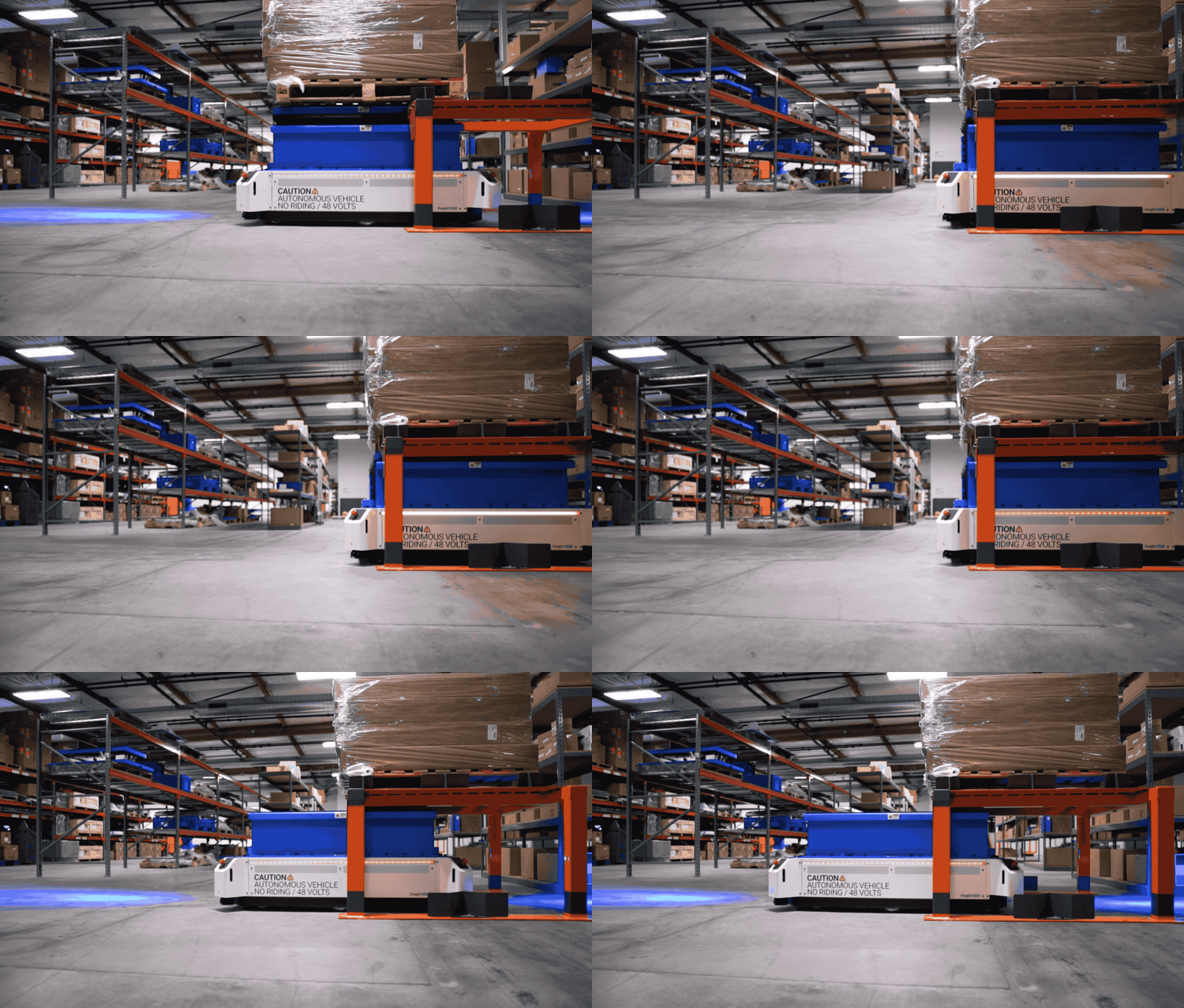
San Jose-based robotics company Fetch unveiled its latest robot this morning. The PalletTransport1500 is an autonomous bot designed specifically to replace forklift uses in warehouses. The systems, which are designed to pick up and delivery pallets, are capable of sporting payloads of up to 2,504 pounds.

The device joins a number of different robotic forklift solutions from various companies, including Toyota. Though Amazon’s own Kiva Systems-produced robots are likely still the best-known pallet moving robotics in the game.

The system was developed with Honeywell’s Intelligrated’s Momentum warehouse software. Fetch, of course, already offers a number of different warehouse robotic solutions, building out a kind of autonomous ecosystem. The company’s systems are notable for their relative flexibility over other full-scale solutions.

Per a press release, the new robot is designed to remove humans from the pallet-moving equation. Actions include,

  • Cross-docking: the AMR can transport pallets directly from inbound to outbound shipment areas. After pallets are unloaded from the truck, the AMR carries pallets routed from the inbound trailers/containers directly to the respective outbound shipping area location.

  • Returns: once inbound items are sorted based on product type or vendor, the AMR transports pallets to their appropriate return station (inventory, recycle, charity, etc.)

  • Warehouse transport: after received products are unloaded and palletized, the AMR moves inventory to storage locations based on business needs

This product category was no doubt one of its most highly demanded, given the fairly common occurance of forklift-related accidents. Per numbers from OSHA, “forklifts cause about 85 fatal accidents per year; 34,900 accidents result in serious injury; and 61,800 are classified as non-serious.” That’s a pretty big source of workplace accidents. The agency adds if you assign one accident per machine, that means somewhere in the neighborhood or 11% of U.S. forklifts are involved in an accident.

In addition to these concerns, COVID-19 related shutdowns have no doubt made the move toward automated fulfillment systems all the more compelling over the past year.

28 Jan 2021

Fetch’s latest warehouse robot is designed to replace forklifts

San Jose-based robotics company Fetch unveiled its latest robot this morning. The PalletTransport1500 is an autonomous bot designed specifically to replace forklift uses in warehouses. The systems, which are designed to pick up and delivery pallets, are capable of sporting payloads of up to 2,504 pounds.

The device joins a number of different robotic forklift solutions from various companies, including Toyota. Though Amazon’s own Kiva Systems-produced robots are likely still the best-known pallet moving robotics in the game.

The system was developed with Honeywell’s Intelligrated’s Momentum warehouse software. Fetch, of course, already offers a number of different warehouse robotic solutions, building out a kind of autonomous ecosystem. The company’s systems are notable for their relative flexibility over other full-scale solutions.

Per a press release, the new robot is designed to remove humans from the pallet-moving equation. Actions include,

  • Cross-docking: the AMR can transport pallets directly from inbound to outbound shipment areas. After pallets are unloaded from the truck, the AMR carries pallets routed from the inbound trailers/containers directly to the respective outbound shipping area location.

  • Returns: once inbound items are sorted based on product type or vendor, the AMR transports pallets to their appropriate return station (inventory, recycle, charity, etc.)

  • Warehouse transport: after received products are unloaded and palletized, the AMR moves inventory to storage locations based on business needs

This product category was no doubt one of its most highly demanded, given the fairly common occurance of forklift-related accidents. Per numbers from OSHA, “forklifts cause about 85 fatal accidents per year; 34,900 accidents result in serious injury; and 61,800 are classified as non-serious.” That’s a pretty big source of workplace accidents. The agency adds if you assign one accident per machine, that means somewhere in the neighborhood or 11% of U.S. forklifts are involved in an accident.

In addition to these concerns, COVID-19 related shutdowns have no doubt made the move toward automated fulfillment systems all the more compelling over the past year.

28 Jan 2021

Location broker X-Mode continues to track users despite app store bans

Hundreds of Android apps, far more than previously disclosed, have sent granular user location data to X-Mode, a data broker known to sell location data to U.S. military contractors.

The apps include messaging apps, a free video and file converter, several dating sites, and religion and prayer apps — each accounting for tens of millions of downloads to date, according to new research.

Sean O’Brien, principal researcher at ExpressVPN Digital Security Lab, and Esther Onfroy, co-founder of the Defensive Lab Agency, found close to 200 Android apps that at some point over the past year contained X-Mode tracking code.

Some of the apps were still sending location data to X-Mode as recently as December when Apple and Google told developers to remove X-Mode from their apps or face a ban from the app stores.

But weeks after the ban took effect, one popular U.S. transit map app that had been installed hundreds of thousands of times was still downloadable from Google Play even though it was still sending location data to X-Mode.

The new research, now published, is believed to be the broadest review to date of apps that collaborate with X-Mode, one of dozens of companies in a multibillion-dollar industry that buys and sells access to the location data collected from ordinary phone apps, often for the purposes of serving targeted advertising.

But X-Mode has faced greater scrutiny for its connections to government work, amid fresh reports that U.S. intelligence bought access to commercial location data to search for Americans’ past movements without first obtaining a warrant.

X-Mode pays app developers to include its tracking code, known as a software development kit, or SDK, in exchange for collecting and handing over the user’s location data. Users opt-in to this tracking by accepting the app’s terms of use and privacy policies. But not all apps that use X-Mode disclose to their users that their location data may end up with the data broker or is sold to military contractors.

X-Mode’s ties to military contractors (and by extension the U.S. military) was first disclosed by Motherboard, which first reported that a popular prayer app with more than 98 million downloads worldwide sent granular movement data to X-Mode.

In November, Motherboard found that another previously unreported Muslim prayer app called Qibla Compass sent data to X-Mode. O’Brien’s findings corroborate that and also point to several more Muslim-focused apps as containing X-Mode. By conducting network traffic analysis, Motherboard verified that at least three of those apps did at some point send location data to X-Mode, although none of the versions currently on Google Play do so. You can read Motherboard’s full story here.

X-Mode’s chief executive Josh Anton told CNN last year that the data broker tracks 25 million devices in the U.S., and told Motherboard its SDK had been used in about 400 apps.

In a statement to TechCrunch, Anton said:

“The ban on X-Mode’s SDK has broader ecosystem implications considering X-Mode collected similar mobile app data as most advertising SDKs. Apple and Google have set the precedent that they can determine private enterprises’ ability to collect and use mobile app data even when a majority of our publishers had secondary consent for the collection and use of location data.

We’ve recently sent a letter to Apple and Google to understand how we can best resolve this issue together so that we can both continue to use location data to save lives and continue to power the tech communities’ ability to build location-based products. We believe it’s important to ensure that Apple and Google hold X-Mode to the same standard they hold upon themselves when it comes to the collection and use of location data.”

The researchers also published new endpoints that apps using X-Mode’s SDK are known to communicate with, which O’Brien said he hoped would help others discover which apps are sending — or have historically sent — users’ location data to X-Mode.

“We hope consumers can identify if they’re the target of one of these location trackers and, more importantly, demand that this spying end. We want researchers to build off of our findings in the public interest, helping to shine light on these threats to privacy, security, and rights,” said O’Brien.

TechCrunch analyzed the network traffic on about two-dozen of the most downloaded Android apps in the researchers’ findings to look for apps that were communicating with any of the known X-Mode endpoints, and confirmed that several of the apps were at some point sending location data to X-Mode.

We also used the endpoints identified by the researchers to look for other popular apps that may have communicated with X-Mode.

At least one app identified by TechCrunch slipped through Google’s app store ban.

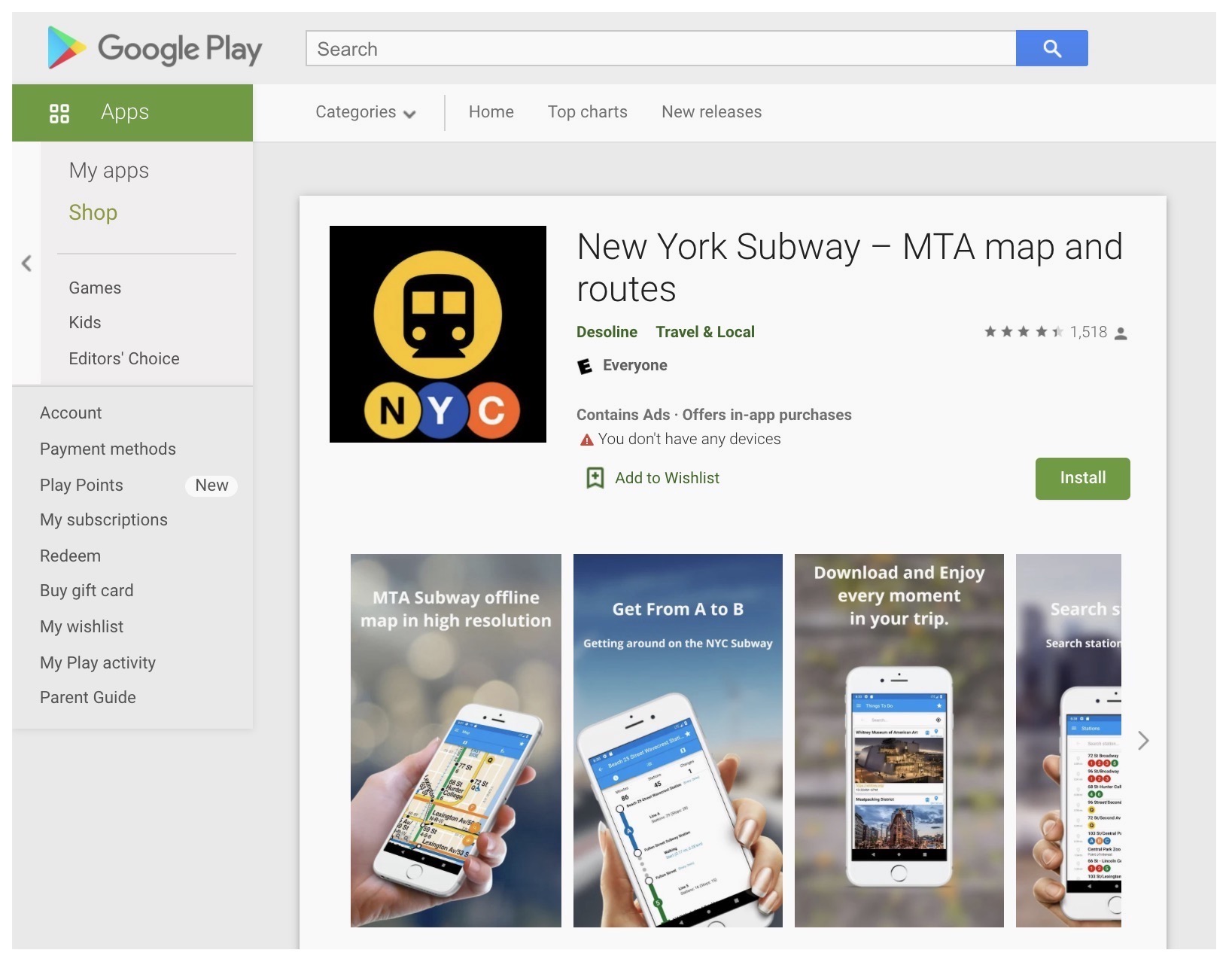
New York Subway in Google Play., until it was removed by Google. (Image: TechCrunch)

New York Subway, a popular app for navigating the New York City subway system that has been downloaded 250,000 times, according to data provided by Sensor Tower, was still listed in Google Play as of this week. But the app, which had not been updated since the app store bans were implemented, was still sending location data to X-Mode.

As soon as the app loads, a splash screen immediately asks for the user’s consent to send data to X-Mode for ads, analytics and market research, but the app did not mention X-Mode’s government work.

Desoline, the Israel-based app maker, did not respond to multiple requests for comment, but removed references to X-Mode from its privacy policy a short while after we reached out. At the time of writing, the app has not returned to Google Play.

A Google spokesperson confirmed the company removed the app from Google Play.

Using the researchers’ list of apps, TechCrunch also found that previous versions of two highly popular apps, Moco and Video MP3 Converter, which account for more than 115 million downloads to date, are still sending user location data to X-Mode. That poses a privacy risk to users who install Android apps from outside Google Play, and those who are running older apps that are still sending data to X-Mode.

Neither app maker responded to a request for comment. Google would not say if it had removed any other apps for similar violations or what measures it would take, if any, to protect users running older app versions that are still sending location data to X-Mode.

None of the corresponding and namesake apps for Apple’s iOS that we tested appeared to communicate with X-Mode’s endpoints. When reached, Apple declined to say if it had blocked any apps after its ban went into effect.

Read more on TechCrunch

“The sensors in smartphones provide rich data that can be exploited to limit our movements, our free expression, and our autonomy,” said O’Brien. “Location spying poses a serious threat to human rights because it peers into the most sensitive aspects of our lives and who we associate with.”

The newly published research is likely to bring fresh scrutiny to how ordinary smartphone apps are harvesting and selling vast amounts of personal data on millions of Americans, often without the user’s explicit consent.

Several federal agencies, including the Internal Revenue Service and Homeland Security, are under investigation by government watchdogs for buying and using location data from various data brokers without first obtaining a warrant. Last week it emerged that intelligence analysts at the Defense Intelligence Agency buy access to commercial databases of Americans’ location data.

Critics say the government is exploiting a loophole in a 2018 Supreme Court ruling, which stopped law enforcement from obtaining cell phone location data directly from the cell carriers without a warrant.

Now the government says it doesn’t believe it needs a warrant for what it can buy directly from brokers.

Sen. Ron Wyden, a vocal privacy critic whose office has been investigating the data broker industry, previously drafted legislation that would grant the Federal Trade Commission new powers to regulate and fine data brokers.

“Americans are sick of learning that their location data is being sold by data brokers to anyone with a credit card. Industry self-regulation clearly isn’t working — Congress needs to pass tough legislation, like my Mind Your Own Business Act, to give consumers effective tools to prevent their data being sold and to give the FTC the power to hold companies accountable when they violate Americans’ privacy,” said Wyden.


Send tips securely over Signal and WhatsApp to +1 646-755-8849. You can also send files or documents with SecureDrop.

28 Jan 2021

Online wholesale retailer Boxed taps Aeon for Asia expansion

Boxed, the New York-based online retailer that sells and delivers bulk-sized groceries, makes its foray into Asia by partnering with Aeon, one of Asia’s largest brick-and-mortar retail operators.

Unlike its consumer-focused business in the U.S., which has been described as “Costco for millennials,” Boxed is exporting its nascent software-as-a-service solution to Aeon in Malaysia. As part of the tie-up, the American startup will create an end-to-end e-commerce solution to aid Aeon’s digital transformation, which includes a storefront platform and inventory-picking software. Boxed declined to disclose the value of the deal but said it’s in the “several tens of millions of dollars.”

Malaysia, which is home to more than 30 million people, is Boxed’s first stop in Asia and Aeon’s biggest market outside its home base of Japan. Aeon employs some 10,000 staff in Malaysia, where it has pledged to spur local employment amid the pandemic through its virtual mall.

With Boxed’s technology, Aeon customers will have the flexibility to pick their chosen number of items and have them shipped in a box to their doorstep. Boxed doesn’t intend to provide last-mile delivery in Asia but will instead tap local courier services. Grab, for instance, is a potential partner, Boxed co-founder and CEO Chieh Huang told TechCrunch in an interview.

Foray into Asia

Through a mutual friend, Huang got in touch with Aeon, which was established 263 years ago in Japan and today operates 21,000 locations, from clothing chains, convenience stores to general merchandise stores, across 14 countries.

Working with Aeon was challenging at first, Huang said, as there were differences not only in time zones but also in cultural norms due to Aeon’s colossal size. It took numerous in-person meetings and international calls to eventually bridge the gap.

The partners are also exploring opportunities to work together in other Southeast Asian markets. Boxed will keep its enterprise-facing angle by licensing software to local retailers rather than expanding its consumer business to the region, which is already crowded with established e-commerce players like Shopee, Lazada and Tokopedia.

Digitizing traditional retailers

An Aeon mall / Source: Aeon

Prior to the SaaS deal, Aeon was already an investor in Boxed. In 2018, it led the e-commerce startup’s $111 billion Series D funding round so it could tap Boxed’s intel in retail digitization. Huang believed his company was chosen because it was one of the few e-commerce operators alongside JD.com and Amazon that have full control over the supply chain and users’ purchasing experience.

Boxed builds its own warehouse robots as well because “we are able to do it much cheaper ourselves than buying the robots,” argued Huang. “Most of the robots are very advanced because they are not able to control the environment. We own the fulfillment center so we can delete a lot of the things that are expensive, such as Lidar.”

Furthermore, the startup’s “box” model helps flat out the costs of shipping with each incremental item delivered, giving the platform a price advantage, the founder said.

Future of Boxed

Founded in 2013, Boxed has accumulated over seven million registered users. With a staff of 500 employees across the U.S., it’s now generating hundreds of millions of dollars in annual revenue.

In all, Boxed has raised over $270 million. Since its last financing round in 2018, the company has had little publicity. During that time Boxed was focused on fine-tuning its retail software solution, which has become its second and more profitable line of business. The firm’s margin is improving every year and getting close to profitability in 2021, said Huang. And like other e-commerce companies, Boxed saw growth in user demand through the pandemic.

Going public is “always on our mind,” said Huang. “I think it will surprise a lot of people how close we are to profitability.”

Reuters reported in September that Boxed was weighing up “a sale or going public through a merger with a blank-check acquisition company that could value it at around $1 billion.” To that, the startup gave a somewhat indefinite response:

“As a result of the shift to online, we’ve also seen increased demand from many parties looking to partner with us to accelerate growth both in our marketplace and new SaaS business. We are thoughtfully considering these options when it comes to the long-term success of Boxed.”