Year: 2021

27 Jan 2021

ByteDance to cut jobs in India amid TikTok ban

Chinese internet giant ByteDance has told employees in India that it will be reducing the size of its team in the country after New Delhi retained ban on TikTok and other Chinese apps last week, a source familiar with the matter told TechCrunch.

The company shared the news with employees in the country at 10am local time and said only critical jobs will be retained in the country. ByteDance said it was left with no choice because the Indian government, which banned the app late June, has offered no clear direction on when TikTok could make return in the nation, the source said on the condition of anonymity.

ByteDance did not immediately respond to a request for comment.

This is breaking news. Check back for more information.

27 Jan 2021

Will this time be any different?

As Twitter seems to buy its way into competing with Clubhouse and Substack, one wonders whether the beleaguered social media company is finally ready to move past its truly awful track record of seizing opportunities.

Twitter’s pace of product ambition has certainly seemed to speed in the past several months, conveniently following shareholder action to oust CEO Jack Dorsey last year. They’ve finally rolled out their Stories product Fleets, they’ve embraced audio both in the traditional feed and with their beta Spaces feature, and they’ve taken some much-publicized steps to reign in disinformation and content moderation woes (though there’s still plenty to be done there).

In the past few weeks, Twitter has also made some particularly interesting acquisitions. Today, it was announced that they were buying Revue, a newsletter management startup. Earlier this month, they bought Breaker, a podcasting service. Last month, they bought Squad, a social screen-sharing app.

It’s an aggressive turn that follows Twitter’s announcement that it will be shutting down Periscope, a live video app that was purchased and long-neglected by Twitter despite the fact that the company’s current product chief was its founder.

TikTok’s wild 2020 success in fully realizing the broader vision for Vine, which Twitter shut down in 2017, seems to be a particularly embarrassing stain on the company’s history; it’s also the most crystallized example of Twitter shooting itself in the foot as a result of not embracing risk. And while Twitter was ahead of that curve and simply didn’t make it happen, Substack and Clubhouse are two prime examples of competitors which Twitter could have prevented from reaching their current stature if it had just been more aggressive in recognizing adjacent social market opportunities and sprung into action.

It’s particularly hard to reckon in the shadow of Facebook’s ever-swelling isolation. Once the eager enemy of any social upstart, Facebook finds itself desperately complicated by global politics and antitrust woes in a way that may never strike it down, but have seemed to slow its maneuverability. A startup like Clubhouse may once seemed like a prime acquisition target, but it’s too complicated of a purchase for Facebook to even attempt in 2021, leaving Twitter a potential competitor that could scale to full size on its own.

Twitter is a much smaller company than Facebook is, though it’s still plenty big. As the company aims to move beyond the 2020 US election that ate up so much of its attention and expand its ambitions, one of its most pertinent challenges will be reinvigorating a product culture to recognize opportunities and take on rising competitors — though another challenge might be getting its competition to take it seriously in the first place.

26 Jan 2021

Sila Nanotechnologies raises $590M to fund battery materials factory

Sila Nanotechnologies, a Silicon Valley battery materials company, has spent years developing technology designed to pack more energy into a cell at a lower cost — an end game that has helped it lock in partnerships with Amperex Technology Limited as well as automakers BMW and Daimler.

Now, Sila Nano, flush with a fresh injection of capital that has pushed its valuation to $3.3 billion, is ready to bring its technology to the masses.

The company, which was founded nearly a decade ago, said Tuesday it has raised $590 million in a Series F funding round led by Coatue with significant participation by funds and accounts advised by T. Rowe Price Associates, Inc. Existing investors 8VC, Bessemer Venture Partners, Canada Pension Plan Investment Board, and Sutter Hill Ventures also participated in the round.

Sila Nano plans to use the funds to hire another 100 people this year and begin to buildout a factory in North America capable of producing 100 gigawatt-hours of silicon-based anode material, which is used in batteries for the smartphone and automotive industries. While the company hasn’t revealed the location of the factory, it does have a timeline. Sila Nano said it plans to start production at the factory in 2024. Materials produced at the plant will be in electric vehicles by 2025, the company said.

“It took eight years and 35,000 iterations to create a new battery chemistry, but that was just step one,” Sila Nano CEO and co-founder Gene Berdichevsky said in a statement. “For any new technology to make an impact in the real-world, it has to scale, which will cost billions of dollars. We know from our experience building our production lines in Alameda that investing in our next plant today will keep us on track to be powering cars and hundreds of millions of consumer devices by 2025.”

The tech

A lithium-ion battery contains two electrodes. There’s an anode (negative) on one side and a cathode (positive) on the other. Typically, an electrolyte sits in the middle and acts as the courier, moving ions between the electrodes when charging and discharging. Graphite is commonly used as the anode in commercial lithium-ion batteries.

Sila Nano has developed a silicon-based anode that replaces graphite in lithium-ion batteries. The critical detail is that the material was designed to take the place of graphite in without needing to change the battery manufacturing process or equipment.

Sila Nano has been focused on silicon anode because the material can store a lot more lithium ions. Using a material that lets you pack in more lithium ions would theoretically allow you to increase the energy density — or the amount of energy that can be stored in a battery per its volume — of the cell. The upshot would be a cheaper battery that contains more energy in the same space.

The opportunity

It’s a compelling product for automakers attempting to bring more electric vehicles to market. Nearly every global automaker has announced plans or is already producing a new batch of all-electric and plug-in electric vehicles, including Ford, GM, Daimler, BMW, Hyundai and Kia. Tesla continues to ramp up production of its Model 3 and Model Y vehicles as a string of newcomers like Rivian prepare to bring their own EVs to market.

In short: the demand of batteries is climbing; and automakers are looking for the next-generation tech that will give them a competitive edge.

Battery production sat at about 20 GWh per year in 2010. Sila Nano expects it to jump to 2,000 GWh per year by 2030 and 30,000 GWh per year by 2050.

Sila Nano started building the first production lines for its battery materials in 2018. That first line is capable of producing the material to supply the equivalent of 50 megawatts of lithium-ion batteries.

26 Jan 2021

Daily Crunch: Calendly valued at $3B

A popular scheduling startup raises a big funding round, Twitter makes a newsletter acquisition and Beyond Meat teams up with PepsiCo. This is your Daily Crunch for January 26, 2021.

The big story: Calendly valued at $3B

Calendly, which helps users schedule and confirm meeting times, has raised $350 million from OpenView Venture Partners and Iconiq.

Until now, the Atlanta-based startup had only raised $550K, but the company says it has 10 million monthly users, with $70 million in subscription revenue last year.

“Calendly has a vision increasingly to be a central part of the meeting life cycle,” said OpenView’s Blake Bartlett.

The tech giants

Twitter acquires newsletter platform Revue — Twitter is getting into the newsletter business.

TikTok is being used by vape sellers marketing to teens — Sellers are offering flavored disposable vapes, parent-proof “discreet” packaging and no ID checks.

PepsiCo and Beyond Meat launch poorly named joint venture for new plant-based food and drinks — The name? The PLANeT Partnership.

Startups, funding and venture capital

Fast raises $102M as the online checkout wars continue to attract huge investment — The new funding was led by Stripe.

SetSail nabs $26M Series A to rethink sales compensation — SetSail says salespeople should be paid them throughout the sales cycle.

Mealco raises $7M to launch new delivery-centric restaurants — By launching a restaurant with Mealco, chefs don’t sign a lease or pay any other upfront costs.

Advice and analysis from Extra Crunch

Ten VCs say interactivity, regulation and independent creators will reshape digital media in 2021 — We asked about the likelihood of further industry consolidation, whether we’ll see more digital media companies take the SPAC route and, of course, what they’re looking for in their next investment.

The five biggest mistakes I made as a first-time startup founder — Finmark CEO Rami Essaid has some regrets.

Does a $27B or $29B valuation make sense for Databricks? — A look at Databricks’ growth history, economics and scale.

(Extra Crunch is our membership program, which helps founders and startup teams get ahead. You can sign up here.)

Everything else

President Joe Biden commits to replacing entire federal fleet with electric vehicles — His commitment is tied to a broader campaign promise to create 1 million new jobs in the American auto industry and supply chains.

Meet the early-stage founder community at TC Early Stage 2021 — Early Stage part one focuses on operations and fundraising and takes place on April 1-2, while Early Stage part two focusing on marketing, PR and fundraising and runs July 8-9.

The Daily Crunch is TechCrunch’s roundup of our biggest and most important stories. If you’d like to get this delivered to your inbox every day at around 3pm Pacific, you can subscribe here.

26 Jan 2021

Apple just had its best quarter in India

When Apple reports its earnings on Wednesday, you can expect mentions of India on the call.

Apple shipped more than 1.5 million iPhone units in India in the quarter that ended in December, up 100% year-on-year, making this its best quarter in the world’s largest smartphone market to date, according to research firms Counterpoint and CyberMedia.

Thanks to the improved sales of older generation iPhone 11, iPhone XR, iPhone 12 and the newer iPhone SE, Apple doubled its market share in India to 4% in the quarter, the research firms said.

Overall, Apple shipped more than 3.2 million iPhone units in India in 2020, up 60% year-on-year, Counterpoint said.

The improvement in shipment comes months after Apple launched its online store in the country and offered customers a wide-range of financing options, AppleCare+, and lucrative perks such as a free set of AirPods with the purchase of iPhone 11. The company plans to open its first physical retail store in the country later this year.

For more than a decade, Apple has struggled to sell its handsets in India because of the expensive price tags they carry. Most smartphones that ship in India are priced between $100 to $200. Samsung, and a group of Chinese smartphone vendors including Xiaomi, Oppo, and Vivo flooded the market in the past decade with their affordable smartphones.

None the less, Apple has visibly grown more interested in the country, which is also one of the world’s fastest growing smartphones markets. The company’s contract manufacturers today locally assemble the recent generation of iPhone models and some accessories — an effort the company kickstarted more than two years ago. (A recent violent event at an Indian facility of Wistron, one of Apple’s contract manufacturer, however, underscored some of the challenges Apple will confront as it scales its local production efforts in the country.)

That move has allowed Apple to lower prices of some iPhone models in India, where for years the company has passed custom duty charges to customers. The starting price of the iPhone 12 Pro Max is $1,781 in India, compared to $1,099 in the U.S. (It has yet to start locally assemble the iPhone 12 units.) The AirPods Pro, which sells at $249 in the U.S., was made available in India at $341 at the time of launch. AirPods Max, similarly, is priced at $815 in India, compared to $549 in the U.S. (It doesn’t help that an average Indian makes $2,000 a year.)

Unlike most foreign firms that offer their products and services for free in India or at some of the world’s cheapest prices, Apple has focused entirely on a small fraction of the population that can afford to pay big bucks, Jayanth Kolla, chief analyst at Convergence Catalyst, told TechCrunch.

That’s not to say that Apple has not made some changes to its price strategy for India. The monthly cost of Apple Music is $1.35 in India, compared to $9.99 in the U.S. Its Apple One bundle, which includes Apple Music, TV+, Arcade and iCloud, costs $2.65 a month in India.

26 Jan 2021

ClassDojo’s second act comes with first profits

ClassDojo’s first eight years as an edtech consumer startup could look like failure: zero revenue; no paid users; and a team that hasn’t aggressively grown in years. But the company, which helps parents and teachers communicate about students, has raised tens of millions in venture capital from elite Silicon Valley investors including Y Combinator, GSV, SignalFire and General Catalyst over its life.

If you ask co-founder Sam Chaudhary to explain how the startup survived so long without bringing in money, he responds simply: “When you have something that you think will be for the long term you can put [in] a lot of energy. So, we always kind of maintained the belief that like bringing people together and helping them be connected, especially last year when they needed to be apart, physically apart, was going to be really important.”

In layman’s terms: ClassDojo has been playing the long-game in edtech since 2011, quietly aggregating free users-turned-fans across the world’s public schools, which are notoriously hard to sell due to tight budgets. Every engineer on the team serves a population that is the size of the city of San Francisco. The company has been intentionally frugal throughout the process. Its core service, which is an interface that allows parents and teachers to communicate updates and stay involved in the classroom, is free for anyone to download.

“Our view from the start was actually that the idea of districts isn’t the customer of education, [that’s] kind of backwards,” he said. “It’s like Airbnb saying we’re going to transform travel by selling to hotels.” The route has helped ClassDojo gain traction with 51 million users across 180 countries.

Two years ago, ClassDojo tested this customer love. It launched its first monetization attempt in 2019: Beyond School, a service that complements in-school learning with at-home tutorials. Within four months of launching the paid service, ClassDojo hit profitability. In 2020, the added dimension of COVID-19 helped ClassDojo triple its revenue and grow to have hundreds of thousands of paying subscribers.

It’s a lesson in how a venture-backed startup can successfully live for years without any plans to monetize, grow a super-fan user base, and eventually turn those users into paying customers if the fit is right.

The acceleration of ClassDojo’s business got noticed by Josh Buckley, the new CEO of Product Hunt and a solo capitalist.

“For years, they’ve quietly been building the most adored brand in the industry; kids, teachers and families they serve love it. Their business model follows that vision; they’re focused on serving the consumers, not the ‘system’” Buckley said.

Buckley led a new $30 million financing round for ClassDojo, he tells TechCrunch. The round also includes Superhuman CEO Rahul Vohra, Coda CEO and former Youtube head of product and engineering Shishir Mehrotra, former product lead of growth for Airbnb Lenny Rachitsky, and others.

The financing comes nearly two years after ClassDojo raised a $35 million Series C round led by GSV. When new capital is less than the preceding round it usually signals a downround, but Chaudhary says that ClassDojo had a “significant markup on valuation” with the extension round. The trend of opportunistic extension rounds has grown for edtech startups recently as the pandemic underscores the need for remote learning innovation.

ClassDojo’s next act

With new financing and massive scale, ClassDojo is now trying to evolve from a communication app into a platform that can help students get better learning experiences beyond the one they get from schools.

Chaudhary says that they plan to double ClassDojo’s 55-person team, invest in product, and enter new markets.

“For me, I’d always thought ClassDojo could enable a better future, specifically one where kids’ outcomes aren’t entirely determined by what their ZIP code can offer them,” Chaudhary said. “That’s the kind of future we’ve been building toward.” He likened ClassDojo’s goal as similar to Netflix: provide a broad scope of material for a broad scope of people, not just on-demand political dramas.

ClassDojo is already creating content around topics not discussed in school such as how to fail and how to become an empathetic person, as part of its Big Idea series. The Beyond School offering helps students set goals and track activities, as well as find activities such as dinner table discussion starters or bedtime meditations.
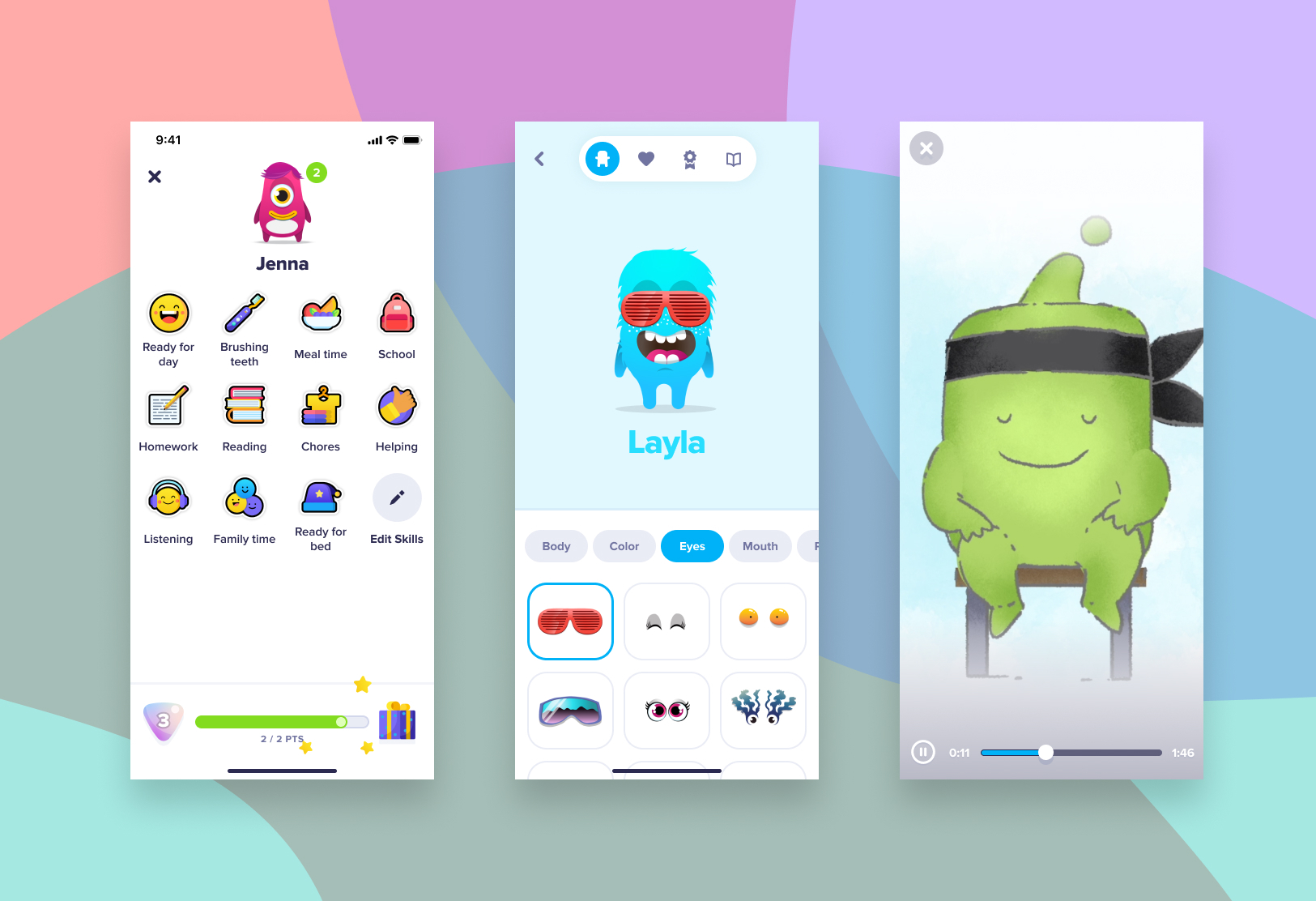
Image Credits: ClassDojo

ClassDojo charges $7.99 a month, or $59.99 annually, for its premium content. The platform is finding small ways to add personalization and spice to its content, such as customized avatars, but further innovation will be key in making its next phase work.

While ClassDojo certainly has a strong user engine to monetize off of, the content game is difficult to win at. Content, to an extent, is commoditized. If you can find a free tutorial on YouTube or Khan Academy, why buy a subscription to an edtech platform that offers the same solution? The commodification of education is good for end-users and is often why startups have a freemium model as a customer acquisition strategy. To convert free users into paying subscribers, edtech startups need to offer differentiated and targeted content.

The United States continues to be a dominant market for ClassDojo, which also has users in the United Kingdom, Ireland, United Arab Emirates and more. While some in edtech express concern that United States consistently lags in consumer spending in education, Chaudhary thinks it’s an unfair assessment.

“To believe that, you have to believe that families don’t care all that much about their kids. And I just don’t think that’s true,” he said. “All the ways that American people express their care for children, there’s such a range, from extracurricular to sports camp to moving to the right zip code.”

And with that mindset, ClassDojo thinks that it can become the brand that families turn to when they think about a child’s education.

“I think there’s just like a missing brand in the world right now,” Chaudhary said. “There’s a blank, a lot of fear, uncertainty, and doubt.”


 

26 Jan 2021

The 5 biggest mistakes I made as a first-time startup founder

June 4, 2019 should have been one of the happiest days of my life.

At 11:30 a.m., a press release hit the wire announcing that the cybersecurity company I had spent more than eight years building was being acquired by a larger cybersecurity player.

What’s not to love about a successful exit? I’d be set financially, the investors who had given us $70 million would make money, and the technology we created would get new legs in an organization with broader reach and resources.

Still, I had regrets. For one thing, I initially hadn’t wanted to sell. (More on that later.) For another, I was nagged by the feeling that our company had fallen short of its true potential, and that the reason was me — specifically, several rookie mistakes I made as a first-time entrepreneur.

I don’t stew about those errors any longer. In fact, I believe my miscues at my first startup will help define my career from here on out. That’s why, as I grow my next company, I’m thinking about not only the things I want to do but those I’d never do again.

Here are five of them.

Trying to do too much myself

In management theory terms, I was a “pacesetter.” I’d be the first to jump into any project or task, I’d execute it as quickly as possible and I expected everyone else to keep up. I thought that was how a startup leader acted — super helpful and scrappy.

But it came at a big price: disempowerment of the team. I was hoarding not only control — nobody felt like they personally owned anything — but also the institutional knowledge that needs to be spread around as a company grows. I became a human GPS: People could follow my directions, but they struggled to find the way themselves. Independent thinking suffered.

I became a human GPS: People could follow my directions, but they struggled to find the way themselves. Independent thinking suffered.

After a few years, I had a frustrating sense that I had all the answers and no one else did. Well, no wonder.

I’m now leaving the pacesetting to NASCAR and marathons.

Thinking people can read my mind

I believed all I had to do was say something once and everyone would get it. I became irritated when that didn’t happen. “We talked about this three months ago,” I’d bark. Intimidated team members would say to themselves, “Yeah, but we really only got 50% of it.”

26 Jan 2021

‘Anti-superficial’ dating app S’More raises $2.1M

S’More, a dating app that’s focused on helping users find more meaningful relationships, announced today that it has raised $2.1 million in seed funding.

S’More (short for “something more”) ensures that users can’t focus on physical appearance, because photos are  initally blurred — they gradually un-blur as you interact with someone. The startup has introduced new features like video chat (also blurred initially), and it launched a redesigned app of the beginning of this month — CEO Adam Cohen-Aslatei said it’s a “completely rebuilt product” with new features like real-time conversation prompts and the ability to pay to promote your profile.

Cohen-Aslatei also said that S’More’s focus on “anti-superficial relationships” is attracting a real audience, with 160,000 downloads in its first year and “thousands” of paying users, including a 50% increase in subscriptions after launching the new app in January.

Looking at how dating will evolve after the pandemic, Cohen-Aslatei suggested, “I don’t think we’re going back to the way things were.” He pointed to a recent survey of S’More users in which 80% of respondents said they hadn’t gone on a single live, in-person date in 2020.

“Do you want to meet for casual encounter on Tinder, or do you have to want to have a conversation get to know a real person on S’More?” he said. Assuming that many people will choose the latter, the next question is: “How do you make discovery fun? There’s got to be multimedia, video, audio, games, all of those features are part of our product roadmap … S’More will feel like Hinge meets Nextdoor.” (Apparently, there’s “a huge cohort” of users on Nextdoor who are single and looking for relationships.)

S'More

Image Credits: S’More

The new funding comes from a long list of investors: Benson Oak Ventures, Mark Pincus’ Workplay Ventures, Gaingels VC, Loud Capital/Pride Fund
SideCar Angels, AppLovin Chairman Rafael Vivas, Joshua Black of Apollo Management, Plus Grade CEO Ken Harris, Harvard geneticist George Church, former Meet Group CEO John Abbott, former IMAX CEO Brad Weschler, Aaron and Sharon Stern, Justen Stepka/Enterprise Fund, Boston Harbor Angels, Grit Daily CEO Jordan French, Kind.Fund founder Marty Isaac, Craig Mullett and Dating Group.

Cohen-Asletai told me the funding has already allowed him to hire what he’s calling a “founding team,” including chief architect Long Nguyen, head of operations Sneha Ramanchandran, head of product and design Regina Guinto and senior developer David Lichy.

S’More is also announcing that it has signed a production deal with producers Elvia Van Es Oliva and Jack Tarantino, who have worked on shows like “90 Day Fiancé.” Cohen-Asletai said the startup will work with them to create “anti-superficial” dating content for digital platforms and TV networks.

This deal builds on the success of S’More Live, the startup’s celebrity dating show on Instagram Live, which has aired 60 episodes so far.

“We’re using that show to build our brand, to gain awareness and then …
we’re actually able to leverage all of the viewers and retarget them with content from S’More, which has made our cost to acquire a user [very affordable],” Cohen-Asletai said.

26 Jan 2021

Apple says iOS 14.4 fixes three security bugs ‘actively exploited’ by hackers

Apple has released iOS 14.4 with security fixes for three vulnerabilities, said to be under active attack by hackers.

The technology giant said in its security update pages for iOS and iPadOS 14.4 that the three bugs affecting iPhones and iPads “may have been actively exploited.” Details of the vulnerabilities are scarce, and an Apple spokesperson declined to comment beyond what’s in the advisory.

It’s not known who is actively exploiting the vulnerabilities, or who might have fallen victim. Apple did not say if the attack was targeted against a small subset of users or if it was a wider attack. Apple granted anonymity to the individual who submitted the bug, the advisory said.

Two of the bugs were found in WebKit, the browser engine that powers the Safari browser, and the Kernel, the core of the operating system. Some successful exploits use sets of vulnerabilities chained together, rather than a single flaw. It’s not uncommon for attackers to first target vulnerabilities in a device’s browsers as a way to get access to the underlying operating system.

Apple said additional details would be available soon, but did not say when.

It’s a rare admission by Apple, which prides itself on its security image, that its customers might be under active attack by hackers.

In 2019, Google security researchers found a number of malicious websites laced with code that quietly hacked into victims’ iPhones. TechCrunch revealed that the attack was part of an operation, likely by the Chinese government, to spy on Uyghur Muslims. In response, Apple disputed some of Google’s findings in an equally rare public statement, for which Apple faced more criticism for underplaying the severity of the attack.

Last month, internet watchdog Citizen Lab found dozens of journalists had their iPhones hacked with a previously unknown vulnerability to install spyware developed by Israel-based NSO Group.

In the absence of details, iPhone and iPad users should update to iOS 14.4 as soon as possible.

26 Jan 2021

Tweetbot 6 released with new subscription pricing

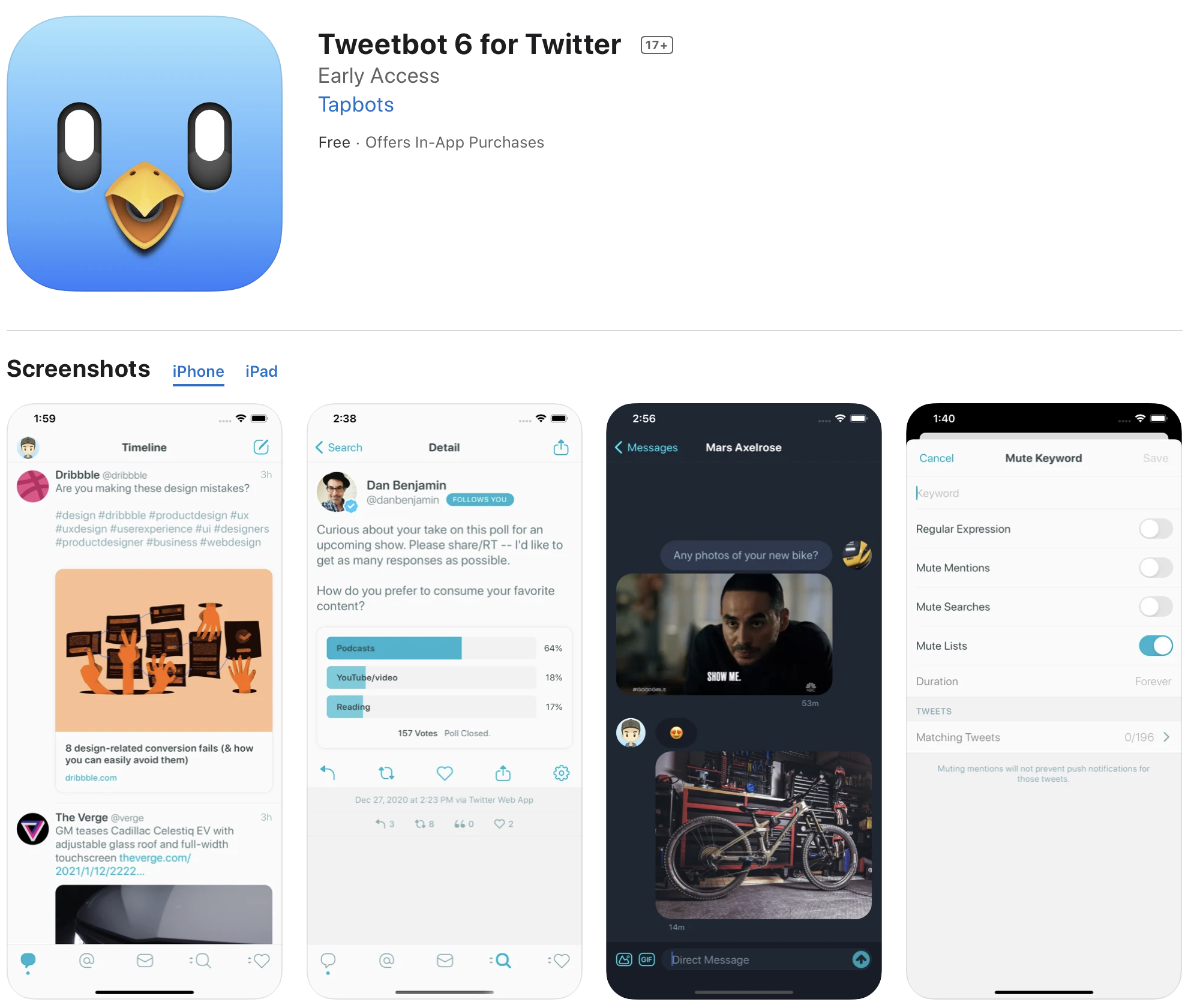
Tapbots, the company behind Tweetbot, has released a major update for the iPhone and iPad. Tweetbot 6 is now available in the App store. While there aren’t a lot of visual changes, there are a couple of important things happening under the hood.

First, Tweetbot 6 is using Twitter’s API v2. An API is an interface that lets two applications or services interact with each other. In today’s case, Tweetbot uses Twitter’s API to interact with the service.

And third-party developers can only do what Twitter lets them do. For many years, Twitter’s API has been somewhat limited, especially if you’ve been trying to build a full-fledged Twitter client. But API v2 surfaces some missing features.

For instance, Tweetbot 6 can now display polls. Before that, polls simply didn’t appear in the timeline. Similarly, Tweetbot 6 displays preview cards, which let you preview linked content without having to click on them. Some features are still missing, such as stories.

There are some minor changes with Tweetbot 6, such as new interface themes, a new feature that lets you select Chrome or Firefox as browser options for links and some tweaks in the app design.

The business model is changing as well. Instead of paying to download the app, you can now download a free app with many restrictions — for instance, you can’t tweet. When you’re ready, you can subscribe to unlock all features for $0.99 per month or $5.99 per year.

This change should ensure the future of the app. Tapbots says Tweetbot 6 is currently in early access. The company plans to add more features down the road.

And if you’re using Tweetbot 5 right now, the app is still working fine. You can re-download the app from the ‘Purchased’ section in the App Store.