Year: 2021

13 Sep 2021

The past, present and future of IoT in physical security

When Axis Communications released the first internet protocol (IP) camera after the 1996 Olympic games in Atlanta, there was some initial confusion. Connected cameras weren’t something the market had been clamoring for, and many experts questioned whether they were even necessary.

Today, of course, traditional analog cameras have been almost completely phased out as organizations have recognized the tremendous advantage that IoT devices can offer, but that technology felt like a tremendous risk during those early days.

To say that things have changed since then would be a dramatic understatement. The growth of the Internet of Things (IoT) represents one of the ways physical security has evolved. Connected devices have become the norm, opening up exciting new possibilities that go far beyond recorded video. Further developments, such as the improvement and widespread acceptance of the IP camera, have helped power additional breakthroughs including improved analytics, increased processing power, and the growth of open-architecture technology. On the 25th anniversary of the initial launch of the IP camera, it is worth reflecting on how far the industry has come — and where it is likely to go from here.

Tech improvements herald the rise of IP cameras

Comparing today’s IP cameras to those available in 1996 is almost laughable. While they were certainly groundbreaking at the time, those early cameras could record just one frame every 17 seconds — quite a change from what cameras can do today.

But despite this drawback, those on the cutting edge of physical security understood what a monumental breakthrough the IP camera could represent. After all, creating a network of cameras would enable more effective remote monitoring, which — if the technology could scale — would enable them to deploy much larger systems, tying together disparate groups of cameras. Early applications might include watching oil fields, airport landing strips or remote cell phone towers. Better still, the technology had the potential to usher in an entirely new world of analytics capabilities.

Of course, better chipsets were needed to make that endless potential a reality. Groundbreaking or not, the limited frame rate of the early cameras was never going to be effective enough to drive widespread adoption of traditional surveillance applications. Solving this problem required a significant investment of resources, but before long these improved chipsets brought IP cameras from one frame every 17 seconds to 30 frames per second. Poor frame rate could no longer be listed as a justification for shunning IP cameras in favor of their analog cousins, and developers could begin to explore the devices’ analytics potential.

Perhaps the most important technological leap was the introduction of embedded Linux, which made IP cameras more practical from a developer point of view. During the 1990s, most devices used proprietary operating systems, which made them difficult to develop for.

Even within the companies themselves, proprietary systems meant that developers had to be trained on a specific technology, costing companies both time and money. There were a few attempts at standardization within the industry, such as the Wind River operating system, but these ultimately failed. They were too small, with limited resources behind them — and besides, a better solution already existed: Linux.

Linux offered a wide range of benefits, not the least of which was the ability to collaborate with other developers in the open source community. This was a road that ran two ways. Because most IP cameras lacked the hard disk necessary to run Linux, hardware known as JFFS was developed that would allow a device to use a Flash memory chip as a hard disk. That technology was contributed to the open source community, and while it is currently on its third iteration, it remains in widespread use today.

Compression technology represented a similar challenge, with the more prominent data compression models in the late ’90s and early 2000s poorly suited for video. At the time, video storage involved individual frames being stored one-by-one — a data storage nightmare. Fortunately, the H.264 compression format, which was designed with video in mind, became much more commonplace in 2009.

By the end of that year, more than 90% of IP cameras and most video management systems used the H.264 compression format. It is important to note that improvements in compression capabilities have also enabled manufacturers to improve their video resolution as well. Before the new compression format, video resolution had not changed since the ’60s with NTSC/PAL. Today, most cameras are capable of recording in high definition (HD).

1996: First IP camera is released.
2001: Edge-based analytics with video motion detection arrive.
2006: First downloadable, edge-based analytics become available.
2009: Full HD becomes the standard video resolution; H.264 compression goes mainstream.
2015: Smart compression revolutionizes video storage.

The growth of analytics

Analytics is not exactly a “new” technology — customers requested various analytics capabilities even in the early days of the IP camera — but it is one that has seen dramatic improvement. Although it might seem quaint by today’s high standards, video motion detection was one of the earliest analytics loaded onto IP cameras.

Customers needed a way to detect movement within certain parameters to avoid having a tree swaying in the wind, or a squirrel running by, trigger a false alarm. Further refinement of this type of detection and recognition technology has helped automate many aspects of physical security, triggering alerts when potentially suspicious activity is detected and ensuring that it is brought to human attention. By taking human fallibility out of the equation, analytics has turned video surveillance from a reactive tool to a proactive one.

Reliable motion detection remains one of the most widely used analytics, and while false alarms can never be entirely eliminated, modern improvements have made it a reliable way to detect potential intruders. Object detection is also growing in popularity and is increasingly capable of classifying cars, people, animals and other objects.

License plate recognition is popular in many countries (though less so in the United States), not just for identifying vehicles involved in criminal activity, but for uses as simple as parking recognition. Details like car model, shirt color or license plate number are easy for the human eye to miss or fail to notice — but thanks to modern analytics, that data is cataloged and stored for easy reference. The advent of technology like deep learning, which features better pattern recognition and object classification through improved labeling and categorization, will drive further advancements in this area of analytics.

The rise of analytics also helps highlight why the security industry has embraced open-architecture technology. Simply put, it is impossible for a single manufacturer to keep up with every application that its customers might need. By using open-architecture technology, they can empower those customers to seek out the solutions that are right for them, without the need to specifically tailor the device for certain use cases. Hospitals might look to add audio analytics to detect signs of patient distress; retail stores might focus on people counting or theft detection; law enforcement might focus on gunshot detection — with all of these applications housed within the same device model.

It is also important to note that the COVID-19 pandemic drove interesting new uses for both physical security devices and analytics — though some applications, such as using thermal cameras for fever measurement, proved difficult to implement with a high degree of accuracy. Within the healthcare industry, camera usage increased significantly — something that is unlikely to change. Hospitals have seen the benefit of cameras within patient rooms, with video and intercom technology enabling healthcare professionals to monitor and communicate with patients while maintaining a secure environment.

Even simple analytics like cross-line detection can generate an alert if a patient who is a fall risk attempts to leave a designated area, potentially reducing accidents and overall liability. The fact that analytics like this bear only a passing mention today highlights how far physical security has come since the early days of the IP camera.

Looking to the future of security

That said, an examination of today’s trends can provide a glimpse into what the future might hold for the security industry. For instance, video resolution will certainly continue to improve.

Ten years ago, the standard resolution for video surveillance was 720p (1 megapixel), and 10 years before that it was the analog NTSC/PAL resolution of 572×488, or 0.3 megapixels. Today, the standard resolution is 1080p (2 megapixels), and a healthy application of Moore’s law indicates that 10 years from now it will be 4K (8 megapixels).

As ever, the amount of storage that higher-resolution video generates is the limiting factor, and the development of smart storage technologies such as Zipstream has helped tremendously in recent years. We will likely see further improvements in smart storage and video compression that will help make higher-resolution video possible.

Cybersecurity will also be a growing concern for both manufacturers and end users.

Recently, one of Sweden’s largest retailers was shut down for a week because of a hack, and others will meet the same fate if they continue to use poorly secured devices. Any piece of software can contain a bug, but only developers and manufacturers committed to identifying and fixing these potential vulnerabilities can be considered reliable partners. Governments across the globe will likely pass new regulations mandating cybersecurity improvements, with California’s recent IoT protection law serving as an early indicator of what the industry can expect.

Finally, ethical behavior will continue to become more important. A growing number of companies have begun foregrounding their ethics policies, issuing guidelines for how they expect technology like facial recognition to be used — not abused.

While new regulations are coming, it’s important to remember that regulation always lags behind, and companies that wish to have a positive reputation will need to adhere to their own ethical guidelines. More and more consumers now list ethical considerations among their major concerns—especially in the wake of the COVID-19 pandemic—and today’s businesses will need to strongly consider how to broadcast and enforce responsible product use.

Change is always around the corner

Physical security has come a long way since the IP camera was introduced, but it is important to remember that these changes, while significant, took place over more than two decades. Changes take time — often more time than you might think. Still, it is impossible to compare where the industry stands today to where it stood 25 years ago without being impressed. The technology has evolved, end users’ needs have shifted, and even the major players in the industry have come and gone according to their ability to keep up with the times.

Change is inevitable, but careful observation of today’s trends and how they fit into today’s evolving security needs can help today’s developers and device manufacturers understand how to position themselves for the future. The pandemic highlighted the fact that today’s security devices can provide added value in ways that no one would have predicted just a few short years ago, further underscoring the importance of open communication, reliable customer support and ethical behavior.

As we move into the future, organizations that continue to prioritize these core values will be among the most successful.

13 Sep 2021

Epic Games appeals last week’s ruling in antitrust battle with Apple

Fortnite maker Epic Games is appealing last week’s ruling in its court battle with Apple, where a federal judge said Apple would no longer be allowed to block developers from adding links to alternative payment mechanisms, but stopped short of dubbing Apple a monopolist. The latter would have allowed Epic Games to argue for alternative means of serving its iOS user base, including perhaps, through third-party app stores or even sideloading capabilities built into Apple’s mobile operating system, similar to those on Google’s Android OS.

Apple immediately declared the court battle a victory, as the judge had agreed with its position that the company was “not in violation of antitrust law” and had also deemed Apple’s success in the app and gaming ecosystem as “not illegal.” Epic Games founder and CEO Tim Sweeney, meanwhile, said the ruling was not a win for either developers or consumers. On Twitter, he hinted that the company may appeal the decision when he said, “We will fight on.”

In a court filing published on Sunday (see below), Epic Games officially stated its attention to appeal U.S. District Judge Yvonne Gonzalez Rogers’ final judgment and “all orders leading to or producing that judgment.”

As part of the judge’s decision, Epic Games had been ordered to pay Apple the 30% of the $12 million it earned when it introduced its alternative payment system in Fortnite on iOS, which was then in breach of its legal contract with Apple.

The appellate court will revisit how Judge Gonzalez Rogers defined the market where Epic Games had argued Apple was acting as a monopolist. Contrary to both parties’ wishes, Gonzalez Rogers defined it as the market for “digital mobile gaming transactions” specifically. Though an appeal may or may not see the court shifting its opinion in Epic Games’ favor, a new ruling could potentially help to clarify the vague language used in the injunction to describe how Apple must now accommodate developers who want to point their customers to other payment mechanisms.

So far, the expectation floating around the developer community is that Apple will simply extend the “reader app” category exception to all non-reader apps (apps that provide access to purchased content). Apple recently settled with a Japanese regulator by agreeing to allow reader apps to point users to their own website where users could sign up and manage their accounts, which could include customers paying for subscriptions — like Netflix or Spotify subscriptions, for instance. Apple said this change would be global.

In briefings with reporters, Apple said the details of the injunction issued with the Epic Games ruling, however, would still need to be worked out. Given the recency of the decision, the company has not yet communicated with developers on how this change will impact them directly nor has it updated its App Store guidelines with new language.

Reached for comment, Epic Games said it does not have any further statements on its decision to appeal at this time.

13 Sep 2021

BitSight raises $250M from Moody’s and acquires cyber risk startup VisibleRisk

BitSight, a startup that assesses the likelihood that an organization will be breached, has received a $250 million investment from credit rating giant Moody’s, and acquired Israeli cyber risk assessment startup VisibleRisk for an undisclosed sum.

Boston-based BitSight says the investment from Moody’s, which has long warned that cyber risk can impact credit ratings, will enable it to create a cybersecurity risk platform, while the credit ratings giant said it plans to make use of BitSight’s cyber risk data and research across its integrated risk assessment product offerings.

The investment values BitSight at $2.4 billion and makes Moody’s the largest shareholder in the company.

“Creating transparency and enabling trust is at the core of Moody’s mission,” Moody’s president and CEO Rob Fauber said in a statement. “BitSight is the leader in the cybersecurity ratings space, and together we will help market participants across disciplines better understand, measure, and manage their cyber risks and translate that to the risk of cyber loss.”

Meanwhile, BitSight’s purchase of VisibleRisk, a cyber risk ratings joint venture created by Moody’s and Team8, brings in-depth cyber risk assessment capabilities to BitSight’s platform, enabling the startup to better analyze and calculate an organization’s financial exposure to cyber risk. VisibleRisk, which has raised $25 million to date, says its so-called “cyber ratings” are based on cyber risk quantification, which allows companies to benchmark their cyber risk against those of their peers, and to better understand and manage the impact of cyber threats to their businesses.

Following the acquisition, BitSight will also create a risk solutions division focused on delivering a suite of critical solutions and analytics serving stakeholders including chief risk officers, C-suite executives, and boards of directors. This division will be led by VisibleRisk co-founder and CEO Derek Vadala, who previously headed up Moody’s cyber risk group.

Steve Harvey, president and CEO of BitSight, said the company’s partnership with Moody’s and its acquisition of VisibleRisk will expand its reach to “help customers manage cyber risk in an increasingly digital world.”

BitSight was founded in 2011 and has raised a total of $155 million in outside funding, most recently closing a $60 million Series D round led by Warburg Pincus. The startup has just shy of 500 employees and more than 2,300 global customers, including government agencies, insurers and asset managers. 

13 Sep 2021

What to make of Freshworks’ first IPO price range

Two major private tech companies announced IPO price ranges this morning, with Toast targeting a market value of nearly $18 billion at the top end of its range and Freshworks looking to price its equity between $28 and $32 per share. TechCrunch calculates that the company would be worth around $8.9 billion at $32 per share, not employing a fully diluted share count.

Inclusive of shares represented by fully vested options and the like, Freshworks’ valuation could reach $9.6 billion, Renaissance Capital reports.

Unlike Toast, with a revenue mix including four distinct products, Freshworks is a more straightforward software company. That means we can do much more interesting work to understand its valuation. So, this morning, let’s unpack how Freshworks is considering valuing itself in its IPO at its present range, look at some market comps, and come to a conclusion regarding whether or not we expect the unicorn to raise its valuation before it floats.

Lies, damned lies and revenue multiples

As a refresher, in the first half of 2021 (Q1 and Q2), Freshworks posted revenues of $168.9 million. That annualizes to $337.9 million, thanks to numerical rounding.

At a valuation of $9.6 billion — recall that simple IPO valuations for the company and lower share-price points from its IPO range generate lower valuations and therefore more conservative multiples than what we’ll be discussing here — Freshworks would be worth 28.4x its current revenue run rate, set during H1 2021.

13 Sep 2021

SpotOn raises $300M at a $3.15B valuation and acquires Appetize

Last year at this time, SpotOn was on the brink of announcing a $60 million Series C funding round at a $625 million valuation.

Fast forward to almost exactly one year later, and a lot has changed for the payments and software startup.

Today, SpotOn said it has closed on $300 million in Series E financing that values the company at $3.15 billion — more than 5x of its valuation at the time of its Series C round, and significantly higher than its $1.875 billion valuation in May (yes, just three and a half months ago) when it raised $125 million in a Series D funding event.

Andreessen Horowitz (a16z) led both the Series D and E rounds for the company, which says it has seen 100% growth year over year and a tripling in revenue over the past 18 months. Existing investors DST Global, 01 Advisors, Dragoneer Investment Group, Franklin Templeton and Mubadala Investment Company too doubled down on their investments in SpotOn, joining new backers Wellington Management and Coatue Management. Advisors Douglas Merritt, CEO of Splunk, and Mike Scarpelli, CFO of Snowflake, also made individual investments as angels. With the new capital, SpotOn has raised $628 million since its inception.

The latest investment is being used to finance the acquisition of another company in the space — Appetize, a digital and mobile commerce payments platform for enterprises such as sports and entertainment venues, theme parks and zoos. SpotOn is paying $415 million in cash and stock for the Los Angeles-based company.

Since its 2017 inception, SpotOn has been focused on providing software and payments technology to SMBs with an emphasis on restaurants and retail businesses. The acquisition of Appetize extends SpotOn’s reach to the enterprise space in a major way. Appetize will go to market as SpotOn and will work to grow its client base, which already includes an impressive list of companies and organizations including Live Nation, LSU, Dodger Stadium and Urban Air. 

In fact, Appetize currently covers 65% of all major league sports stadiums, specializing in contactless payments, mobile ordering and menu management. So for example, when you’re ordering food at a game or concert, Appetize’s technology makes it easier to pay in a variety of contactless ways through point of sale (POS) devices, self-service kiosks, handheld devices, online ordering, mobile web and API integrations.

Image Credits: SpotOn

SpotOn is taking on the likes of Square in the payments space. But the company says its offering extends beyond traditional payment processing and point-of-sale software. Its platform aims to give SMBs the ability to run their businesses “from building a brand to taking payments and everything in between.” SpotOn’s goal is to be a “one-stop shop” by incorporating tools that include things such as custom website development, scheduling software, marketing, appointment scheduling, review management, analytics and digital loyalty.

The combined company will have 1,600 employees — 1,300 from SpotOn and 300 from Appetize. SpotOn will now have over 500 employees on its product and technology team, according to co-founder and co-CEO Zach Hyman. It will also have clients in the tens of thousands, a number that SpotOn says is growing by “thousands more every month.”

The acquisition is not the first for SpotOn, which also acquired SeatNinja earlier this year.

But in Appetize it saw a company that was complementary both in its go-to-market and tech stacks, and a “natural fit.”

SMEs are going to benefit from the scalable tech that can go with them, including things like kiosks and offline modes, and for the enterprise clients of Appetize, they’re going to be able to leverage products like sophisticated loyalty programs and extended marketing capabilities,” Hyman told TechCrunch. 

SpotOn was not necessarily planning to raise another round so soon, Hyman added, but the opportunity came up to acquire Appetize.

“We spent a lot of time together, and it was too compelling to pass up,” he told TechCrunch.

For its part, Appetize — which has raised over $77 million over its lifetime, according to Crunchbase — too saw the combination as a logical one.

“It was important to us to retain a stake in the business. We were not looking to cash out,” said Appetize CEO Max Roper. “We are deeply invested in growing the business together. It’s a big win for our team and our clients over the long term. This is a rocketship that we are excited to be on.” 

No doubt that the COVID-19 pandemic only emphasized the need for more digital offerings from small businesses to enterprises alike.

“There has been a high demand for our services and now as businesses are faced with a Covid resurgence, no one is closing down,” Hyman said. “So they see a responsibility to install the necessary technology to properly run their business.”

One of the moves SpotOn has made, for example, is launching a vaccination alert system in its reservation management software platform to make it easier for consumers to confirm they are vaccinated for cities and states that have those requirements.

Clearly, a16z General Partner David George too was bullish on the idea of a combined company.

He told TechCrunch that the two companies fit together “extremely nicely.”

“It felt like a no-brainer for us to want to lead the round, and continue to support them,” George said.

Since first investing in SpotOn in May, the startup’s growth has “exceeded” a16z’s expectations, he added.

“When companies are growing as fast as it is organically, they don’t need to rely on acquisitions to fuel growth,” he said. “But the strategic rationale here is so strong, that the acquisition will only turbocharge what is already high growth.”

While the Series E capital is primarily funding the acquisition, SpotOn continues to double down on its product and technology.

“This is our time to shine and invest in the future with forward thinking technology,” Hyman told TechCrunch. “We’re thinking about things like how are consumers going to be ordering their beer at a Dodgers game in three years? Are they going to be standing in line for 25 minutes or are they going to be interacting and buying merchandise in other unique ways? Those are the things we’re looking to solve for.”

13 Sep 2021

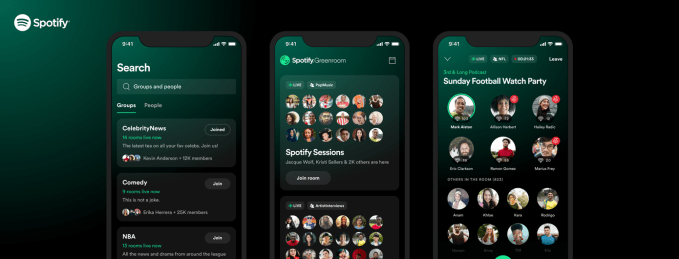
Spotify’s Clubhouse clone adds six new weekly shows, some that tie to Spotify playlists

This summer, Spotify launched its live audio app and Clubhouse rival, Spotify Greenroom, with the promises of more programming to come in the months ahead to augment its then primarily user-generated live content. Today, the company is making good on that earlier commitment, with the launch of six new shows on Spotify Greenroom focused on pop culture and music, in addition to what Spotify calls “playlist-inspired shows” — meaning those that are inspired by Spotify’s own playlists.

This includes a new show based on the popular playlist Lorem, which launched in 2019, showcasing an eclectic mix of music that has included indie pop, R&B, garage rock, hip-hop, and more, focused on a younger, Gen Z audience. That playlist today has over 884,000 “likes” on Spotify and has risen to become one of the places new artists are able to break through on the platform. Now, Lorem listeners will be connected to “Lorem Life,” a Spotify Greenroom show that will feature a mix of culture and discussions about music, the environment, sustainability, fashion, and space, Spotify says. The show is hosted by Gen Z influencers and TikTok stars, Dev Lemons and Max Motley, who will engage with other artists and influencers. It begins airing on Wednesday, September 15, at 9 PM ET.

Another new “playlist-inspired” show is “The Get Up LIVE.” If the name sounds familiar, it’s because “The Get Up” was introduced last fall as Spotify’s own take on a daily morning show by mixing music with talk radio-style content led by hosts who discuss the news, pop culture, entertainment, and other topics. To date, that content has not been provided as a live program, however. Instead, the show has been pre-recorded then made available as a playlist that gives listeners the feel of a daily FM radio show. Now, “The Get Up’s” co-hosts Kat Lazo and Xavier “X” Jernigan will record their show live on Greenroom, starting on Wednesday, Sept. 15 at 11 AM ET.

This odd time seems to contradict Spotify’s original intention of providing a show for those who commute to the office. But with the rise of remote work in the face of the unending pandemic, addressing the commuter audience may be of less interest, with the new program. However, Spotify tells us “The Get up LIVE” will be complementary to the daily show, which will still run as normal — that’s why it has a later airing.

Other new Greenroom shows include “A Gay in the Life,” hosted by the married couple, actor Garrett Clayton and writer and educator Blake Knight, who will discuss LGBTQIA+ news and issues (weekly, 8 PM ET, starting today); “Take a Seat,” hosted by Ben Mandelker and Ronnie Karam of the “Watch What Crappens” podcast, who will recap reality shows and dive into other pop culture fascinations (weekly, 10 PM ET, starting today); “The Movie Buff,” hosted by film buff and comedian Jon Gabrus, who will review and break down the latest hot movies (weekly, 11 PM ET, starting today); and “The Most Necessary: Live,” a complement to Spotify’s “Most Necessary” playlist, where host B.Dot will discuss up-and-comers in hip-hop (weekly, 9 PM ET, starting Tuesday).

In addition to the new programs, Deuxmoi’s show “Deux Me After Dark” will also air this evening (Sept. 13) at 9 PM ET to recap the red carpet looks and gossip from this year’s Met Gala alongside guest Hillary Kerr, co-founder of Who What Wear.

Image Credits: Spotify

Greenrom is now available to listeners in over 135 global markets and has been quietly expanding with live audio from sports site and podcast network “The Ringer” as well as from artists like Pop Smoke, the company says. Other programs added include Men In BlazersDeaux Me After DarkTrue Crime Rewind and Ask The Tarot. Many of the shows are also being published on-demand after the live show ends.

The app had gotten off to a slower start this year, given its roots had been in sports talk live programming, which didn’t necessarily connect with Spotify’s music fans. Plus, it has faced growing competition from not only Clubhouse, which inspired its creation, but also other top social networks like Facebook, Twitter, Reddit, Discord, and more. Without dedicated programs to garner user interest in yet another live audio app, the company had only seen 141,000 new downloads for Greenroom on iOS a little over a month after its launch, and fewer on Google Play. But Spotify’s long-term vision for the service was to more closely tie Greenroom to the music, artists, programs, and podcasts that were already available on its flagship music streaming app — and these new shows are an example of that plan in action.

13 Sep 2021

Toast looks toward $18B valuation in upcoming IPO

As if the Boston startup market needed additional momentum, it appears restaurant software startup Toast will dramatically bolster its valuation in its upcoming IPO.

For a city perhaps best known internationally for its hard tech and biotech efforts, to see Toast not only rebound from its early-pandemic layoffs to a public debut, but to target a valuation closer to $20 billion than $10 billion, is a coup.


The Exchange explores startups, markets and money.

Read it every morning on Extra Crunch or get The Exchange newsletter every Saturday.


In a new S-1/A filing this morning, Toast indicated an early IPO range of between $30 and $33 per share, leading to a maximum fundraise of $825 million in its IPO. The company was last valued at $4.9 billion in early 2020, when Toast raised $400 million. The company is set to dramatically supersede that valuation mark thanks to expanding revenues and an especially strong second quarter.

Let’s dig into the company’s new IPO price range, calculate simple and fully diluted results, and see what we can learn from where Toast may price. Recall that the company has a mix of recurring software (SaaS) incomes as well as fintech revenue (payments, mostly). Its revenue mix is interesting, and how Toast prices could help us better understand how to value vertical SaaS startups that are pursuing a payments-and-SaaS business approach.

Into the filing!

Toast’s IPO valuation

Toast is selling 21,739,131 Class A shares in its IPO. They get one vote. Class B shares get 10. If you were considering buying into Toast’s IPO in hopes of having a say in its future, don’t. You won’t. The company’s IPO is really a method by which public-market investors can endorse the company’s current management group — or decline to buy any ownership at all.

Regardless of how we feel about corporate governance structures designed to eliminate the influence of common shareholders, Toast will have 499,332,681 shares outstanding after its IPO, or 502,593,550 if its underwriters choose to purchase their allotted greenshoe option.

At the company’s expected IPO price range of $30 to $33 per share, Toast is worth $14.98 billion at the low end, and $16.48 billion at the top. Inclusive of shares from its underwriters’ option, Toast’s simple IPO valuation range expands from $15.08 billion at the bottom to $16.59 billion at the top.

13 Sep 2021

GrubMarket gobbles up $120M at a $1B+ pre-money valuation to take on the grocery supply chain

When people talk about “online food delivery” services, chances are that they’ll think of the Uber Eats, Instacarts and Getirs of this world. But today a startup that’s tackling a different aspect of the market — addressing the supply chain that subsequently turns the wheels of the bigger food distribution machine — is announcing a big round of funding as it continues to grow.

GrubMarket, which provides software and services that help link up and manage relationships between food suppliers and their customers — which can include wholesalers and other distributors, markets and supermarkets, delivery startups, restaurants, and consumers — has picked up $120 million in a Series E round of funding.

The funding is coming from a wide mix of investors. Liberty Street Funds, Walleye Capital, Japan Post Capital, Joseph Stone Capital, Pegasus Tech Ventures, Tech Pioneers Fund are among the new backers, who are being joined by existing investors Celtic House Asia Partners, INP Capital, Reimagined Ventures, Moringa Capital Management, and others, along with other unnamed participants

Mike Xu, GrubMarket’s founder and CEO (pictured, above), tells me that the company is currently profitable in a big way. It’s now at a $1 billion annualized run-rate, having grown revenues 300% over last year, with some markets like New York growing even more (it went from less than $10 million ARR to $100 million+).

With operations currently in Arizona, California, Connecticut, Georgia, Michigan, New York, New Jersey, Missouri, Massachusetts, Oregon, Pennsylvania, Texas, and Washington, and some 40 warehouses nationwide. GrubMarket had a pre-money valuation of over $1 billion, and now it will be looking to grow even more, both in terms of territory and in terms of tech, moving ahead in a market that is largely absent from competitors.

“We are still the first mover in this space,” Xu said when I asked him in an interview about rivals. “No one else is doing consolidation on the supply chain side as we are. We are trying to consolidate the American food supply chain through software technologies, while also trying to find the best solutions in this space.”

(And for some context, the $1 billion+ valuation is more than double GrubMarket’s valuation in October 2020, when it raised $60 million at a $500 million post-money valuation.)

Longer term, the plan will be to look at an IPO provisionally filing the paperwork by summer 2022, Xu added.

GrubMarket got its start several years ago as one of many companies looking to provide a more efficient farm-to-table service. Tapping into a growing consumer interest in higher quality, and more traceable food, it saw an opportunity to build a platform to link up producers to the consumers, restaurants and grocery stores that were buying their products. (Grocery stores, incidentally, might be independent operations, or something much bigger: one of GrubMarket’s biggest customers is Whole Foods, which uses GrubMarket for produce supply in certain regions of the U.S. It is currently is the company’s biggest customer.)

As we wrote last year, GrubMarket — like many other grocery delivery services — found that the pandemic initially provided a big fillip, and a big rush of demand, from that consumer side of the business, as more people turned to internet-based ordering and delivery services to offset the fact that many stores were closed, or they simply wanted to curtail the amount of shopping they were doing in-person to slow the spread of Covid-19.

But fast forward to today, while the startup still serves consumers, this is currently not the primary part of its business. Instead, it’s B2B2C, serving companies that in turn serve consumers. Xu says that overall, demand from consumers has dropped off considerably compared to a year ago.

“We think that restaurant re-openings have meant more people are dining out again and spending less time at home,” Xu said, ” and also they can go back to physical grocery stores, so they are not as interested as they were before in buying raw ingredients online. I don’t want to offend other food tech companies, but I think many of them will be seeing the same. I think B2C is really going to slow down going forward.”

The opening for GrubMarket has been not just positioning itself as a middleman between producers and buyers, but to do so by way of technology and consolidating what has been a very regionalized and fragmented market up to now.

GrubMarket has snapped up no less than 40 companies in the last three years. While some of these have been to help it expand geographically (it made 10 acquisitions in the Los Angeles area alone), many have also been made to double down on technology.

These have included the likes of Farmigo, once a Disrupt Battlefield contender that pivoted into becoming a software provider to CSAs (an area that GrubMarket sees a lot of opportunity), as well as software to help farms manage their business staffing, insurance and more: Pacific Farm Management is an example of the latter.

GrubMarket’s own in-house software, WholesaleWare, a cloud-based service for farmers and other food producers, saw its sales grow 3,500% over the last year, and it is now managing more than $4 billion in wholesale and retail activity across the U.S. and Canada.

There will be obvious ways to extend what GrubHub does deeper into the needs of its customers on the purchasing end, but this is in many ways also a very crowded market. (And not just crowded, but crowded with big companies. Just today, Toast, the company that builds software for restaurants, filed for a $717 million IPO at potentially a $16.5 billion valuation.) So instead, GrubHub will continue to focus on what has been a more overlooked aspect, that of the suppliers.

“I am focused on the food supply chain,” Xu said. “Operators in the food supply chain business most of the time don’t have any access to software and e-commerce technology. But we are not just a lightweight online ordering system. We do a lot of heavyweight lifting around inventory management, pricing and customer relations, and even HR management for wholesales and distributors.” That will also mean, longer term, that GrubMarket will likely also start to explore connected hardware to help those customers, too: robotics for picking and moving items are on that agenda, Xu said.

“GrubMarket has built a profitable, high-growth business underpinned by its best-in-class technology platform that’s reinventing how businesses access healthy, fresh foods,” said Jack Litowitz, director of strategic investments at Reimagined Ventures, in a statement. “We’re proud to support GrubMarket as it continues to expand into new regions and grow its WholesaleWare 2.0 software platform. At Reimagined Ventures, we always seek to invest in businesses that are disrupting inefficient industries in innovative ways. Mike Xu and the GrubMarket team have built one of these businesses. We’re excited to back their vision and work in making the food supply chain more efficient.”

“GrubMarket is transforming the trillion-dollar food distribution industry with unprecedented speed by implementing advanced digital solutions and operational discipline. The company’s scale, growth, and profitability are extraordinarily impressive. Pegasus is delighted and honored to be part of GrubMarket’s exciting journey ahead,” added Bill Reichert, partner at Pegasus Tech Ventures.

13 Sep 2021

Disney+ ‘Hawkeye’ trailer shows Clint Barton’s past catching up with him

The next Marvel Cinematic Universe show will premiere on Disney+ in November and, appropriately enough, Hawkeye has a festive setting. Clint Barton (aka Hawkeye) just wants to spend Christmas with his family, but his enemies have other plans.

The series marks the return of Jeremy Renner as Hawkeye. This time around, he has a new partner: Kate Bishop (Hailee Steinfeld), the self-professed “world’s greatest archer.” Hawkeye is said to center on the relationship between the two toxophilites, with Clint training Kate to take over as Hawkeye, as the character does in the comics. There are hints of that passing of the torch in the trailer. It shows the pair meeting for the first time and forming a bond as they work together to battle some goons.

There are a few nods to other parts of the MCU here, including the existence of a Broadway musical about Steve Rogers (aka Captain America) and a tip of the cap toward the “masked vigilante” Hawkeye battled in Avengers: Endgame. Something we don’t see in the trailer is an appearance by Florence Pugh, who made her MCU bow as assassin Yelena Belova in Black Widow this summer. She was cast in Hawkeye last December.

In any case, you won’t have to wait too long to see what happens when Yelena, Clint and Kate encounter each other. The eight-episode first season of Hawkeyewill debut on November 24th on Disney+.

Editor’s note: This article originally appeared on Engadget.

13 Sep 2021

Only one week until TechCrunch Disrupt 2021 opens a world of opportunity

One. More. Week. Just seven days until more than 10,000 people around the world storm the internet to attend TechCrunch Disrupt 2021 on September 21-23. We’re talking three event- and programming-packed days focused on anything — and everything — related to early-stage tech startups.

You’ll hear from iconic founders, unicorn makers, boundary-benders — all of it served up with a gigantic side of DIY tips, actionable advice, encouragement and inspiration. And, because Disrupt is highly interactive, you’ll have plenty of opportunity to engage, ask questions and receive answers.

Admit one: Buy your TC Disrupt 2021 pass — for less than $100 — and go find or create the opportunities that can help you move your business forward.

We’ll hit a few of the highlights, but be sure to check the Disrupt 2021 agenda for all the interviews, panel discussions, breakout sessions and events. Your pass includes video-on-demand, so you can catch any sessions you miss when your schedule allows.

Disrupt always brings world-class speakers to the stage, and this year is no exception. We have more than 80 presentations (and counting) on tap. Talk about something for everyone. Biotech? Covered. Fintech? Also covered. Fundraising? Well, of course. Robots, healthtech, space — heck, there’s so much more we can’t cover it here. Head to the agenda and plan your strategy.

Explore hundreds of innovative startups exhibiting in Startup Alley, our expo area. Visit their virtual booths, get a product demo and start a conversation. You can also catch Startup Alley founders pitching to TechCrunch staff. Look for the Startup Pitch Feedback Sessions scheduled over all three days.

Who’s ready for Startup Battlefield? Watch as 20 of the top early-stage founders compete for the coveted championship title and $100,000 in equity-free prize money. Some of today’s top tech companies launched at Startup Battlefield — think Dropbox, Vurb and Tripit. Don’t miss your chance to see the future of tech take the stage.

The Startup Battlefield translated easily to the virtual format. You could see the excitement, enthusiasm and possibility of the young founders, and I loved that. You could also ask questions through the chat feature, and you don’t always have time for questions at a live event. — Rachael Wilcox, creative producer, Volvo Cars.

Remember we said you’ll find plenty of actionable advice? Don’t miss the expert VC guidance in these two sessions: Crafting a Pitch Deck that Can’t Be Ignored and Pitch Deck Teardown.

Disrupt is a great sweet spot, and highly valuable, for anyone in the idea stage all the way through to having raised some angel money. Soak up the pitch deck teardowns and the VC presentations. They’re telling you what they’re looking for, what motivates them, what pushes them to contact you for a meeting. And that’s exactly what every startup raising capital needs to know. — Michael McCarthy, CEO, Repositax.

TechCrunch Disrupt 2021 kicks off in just one week. Buy your pass, plan your schedule and get ready to disrupt your business in the best possible way.