Author: azeeadmin

14 Jul 2020

Writing app Ulysses gets new document dashboard and advanced grammar and style check

Ulysses, a popular writing app for the Mac, iPhone and iPad, is receiving an update with some new features. The user interface has been slightly redesigned with a new right-hand column that acts as a dashboard. There’s also a new grammar and style check feature that goes beyond what’s provided on Apple’s platform by default.

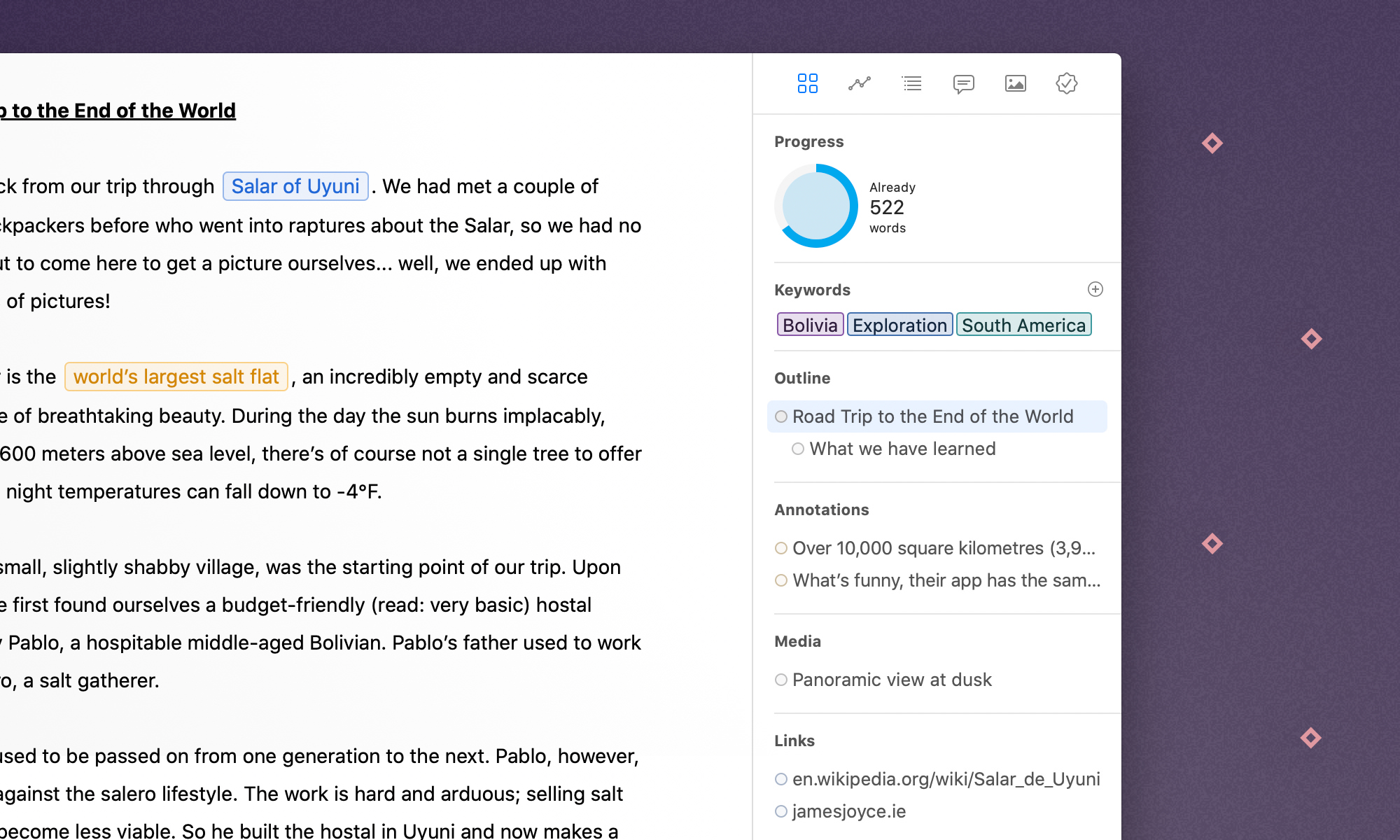
Let’s start with the dashboard. The new column is all about consolidating existing elements in a more cohesive interface. Previously, you could click on a button to see document statistics, click on another button to see the outline of your document and click on a clip-shaped button to access attachments, notes, tags but also your writing goal.

It was a bit confusing as you couldn’t see your statistics next to your goal. Or you couldn’t keep your outline next to your document unless you knew that you can drag the popover menu so that it doesn’t automatically closes.

Now, everything is consolidated under three buttons — a share menu, a formatting menu and the dashboard. There are multiple tabs within the dashboard and you can customize the widgets that you want to view in most tabs.

For instance, it’s much more comfortable to keep your outline in the right column next to your document. You can click on headlines and sub-headlines to jump to the right part of your work. You can also view a list of all your footnotes, images and links in that view. The new dashboard is also available on the iPad and iPhone.

Image Credits: Ulysses

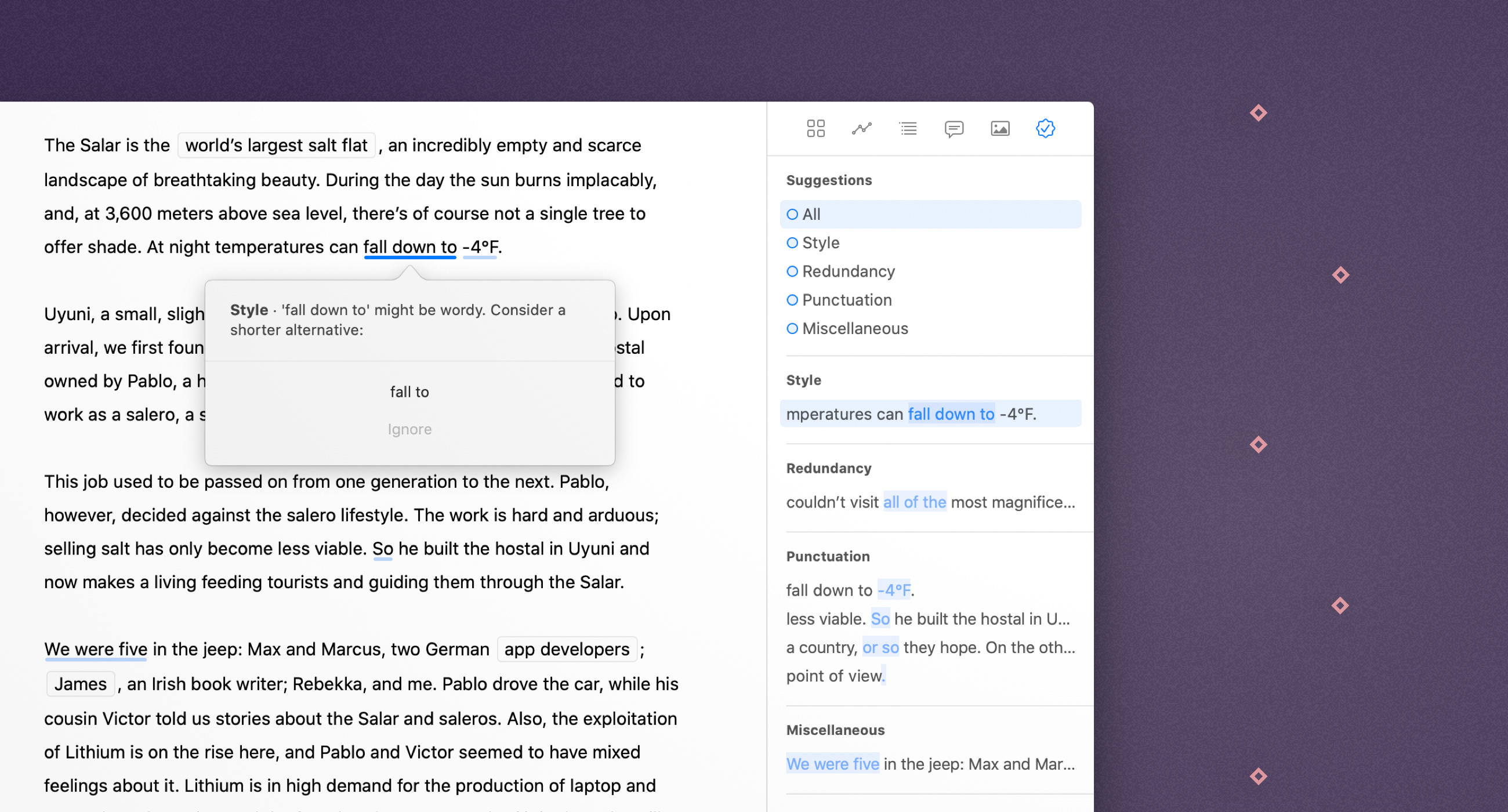
When it comes to spell checking, Ulysses has always taken advantage of the native features on Apple’s platforms — your words are underlined in red when there’s a typo.

But the new version of Ulysses goes one step further by integrating with LanguageTool Plus, a proofreading service that works in your browser and provides an API to third-party developers. The result is a new feature that lets you review your text before exporting it from Ulysses.

LanguageTool Plus is a freemium product with a paid subscription beyond 2,500 characters. You hit that limit pretty quickly as the article you’re reading is longer than 2,500 characters for instance. If you’re a Ulysses user, the grammar and style suggestions are included in your subscription.

It analyzes your text for typos, but also punctuation errors, redundancy, typography, style, etc. Compared to Grammarly, LanguageTool Plus supports more than 20 languages. You can approve or reject suggestions one by one or browse them by category in the dashboard.

Grammar and style suggestions are only available on the Mac version of Ulysses for now and will come to the iPhone and iPad later this year.

Image Credits: Ulysses

14 Jul 2020

Writing app Ulysses gets new document dashboard and advanced grammar and style check

Ulysses, a popular writing app for the Mac, iPhone and iPad, is receiving an update with some new features. The user interface has been slightly redesigned with a new right-hand column that acts as a dashboard. There’s also a new grammar and style check feature that goes beyond what’s provided on Apple’s platform by default.

Let’s start with the dashboard. The new column is all about consolidating existing elements in a more cohesive interface. Previously, you could click on a button to see document statistics, click on another button to see the outline of your document and click on a clip-shaped button to access attachments, notes, tags but also your writing goal.

It was a bit confusing as you couldn’t see your statistics next to your goal. Or you couldn’t keep your outline next to your document unless you knew that you can drag the popover menu so that it doesn’t automatically closes.

Now, everything is consolidated under three buttons — a share menu, a formatting menu and the dashboard. There are multiple tabs within the dashboard and you can customize the widgets that you want to view in most tabs.

For instance, it’s much more comfortable to keep your outline in the right column next to your document. You can click on headlines and sub-headlines to jump to the right part of your work. You can also view a list of all your footnotes, images and links in that view. The new dashboard is also available on the iPad and iPhone.

Image Credits: Ulysses

When it comes to spell checking, Ulysses has always taken advantage of the native features on Apple’s platforms — your words are underlined in red when there’s a typo.

But the new version of Ulysses goes one step further by integrating with LanguageTool Plus, a proofreading service that works in your browser and provides an API to third-party developers. The result is a new feature that lets you review your text before exporting it from Ulysses.

LanguageTool Plus is a freemium product with a paid subscription beyond 2,500 characters. You hit that limit pretty quickly as the article you’re reading is longer than 2,500 characters for instance. If you’re a Ulysses user, the grammar and style suggestions are included in your subscription.

It analyzes your text for typos, but also punctuation errors, redundancy, typography, style, etc. Compared to Grammarly, LanguageTool Plus supports more than 20 languages. You can approve or reject suggestions one by one or browse them by category in the dashboard.

Grammar and style suggestions are only available on the Mac version of Ulysses for now and will come to the iPhone and iPad later this year.

Image Credits: Ulysses

14 Jul 2020

Hello Robot emerges out of stealth to launch a mobile robotic gripping platform for the home

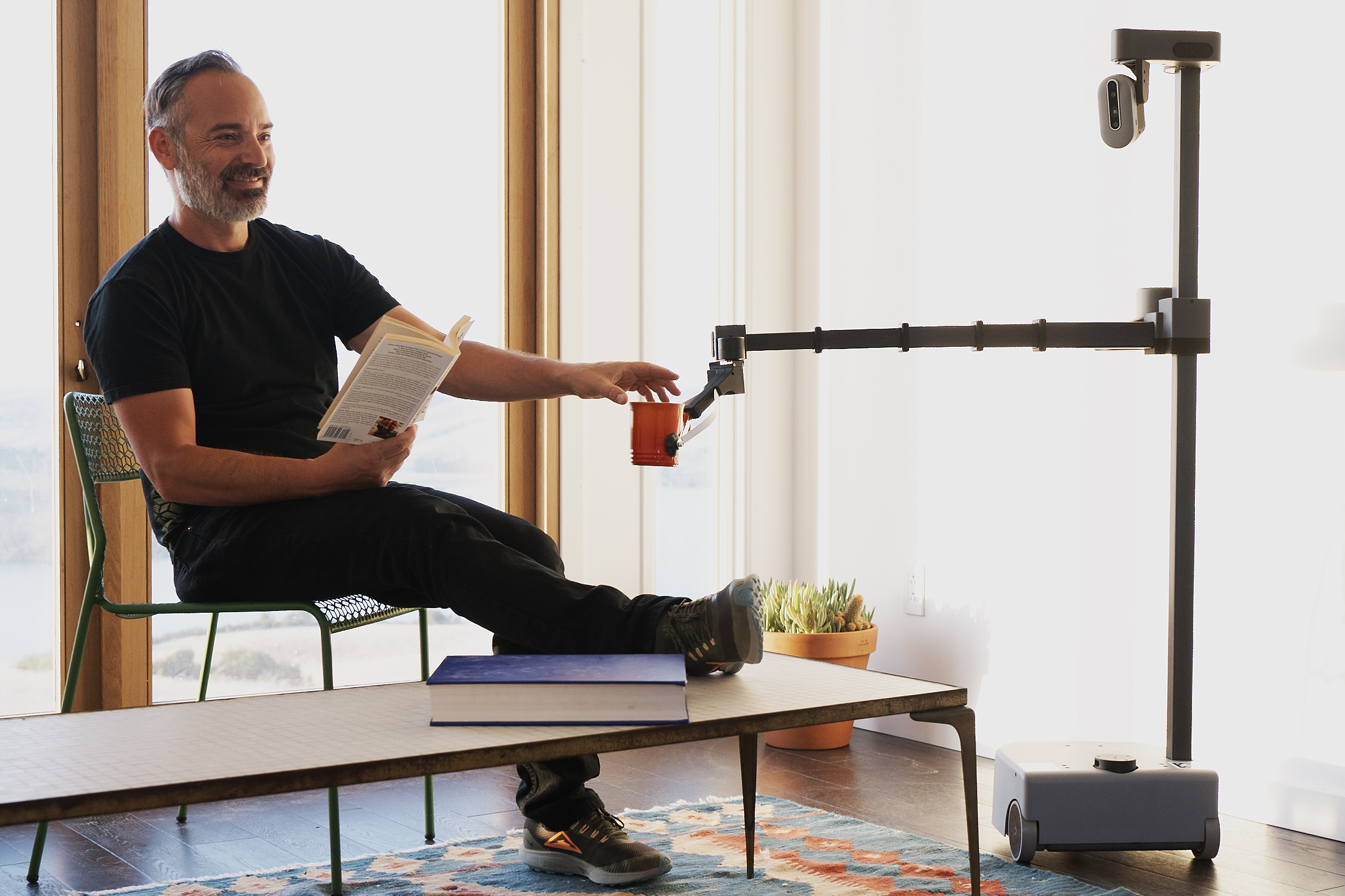
This is Stretch — or, more precisely, the Stretch Research Edition. The name certainly conveys the tall, skinny and minimalist design of the home helper robot. Stretch is different and somehow familiar, with a straightforward technical design that adapts a number of standard robotic elements designed to offer a versatile machine that’s capable of navigating a house and getting out of the way when necessary.

It’s the first product out of Bay Area-based Hello Robot. Fresh out of three years operating in stealth, the company was founded by CEO Aaron Edsinger, a Georgia Tech product who was previously the director of Robotics at Google after its acquisition of his company, Redwood Robotics, in 2013.

Image Credits: Hello Robot

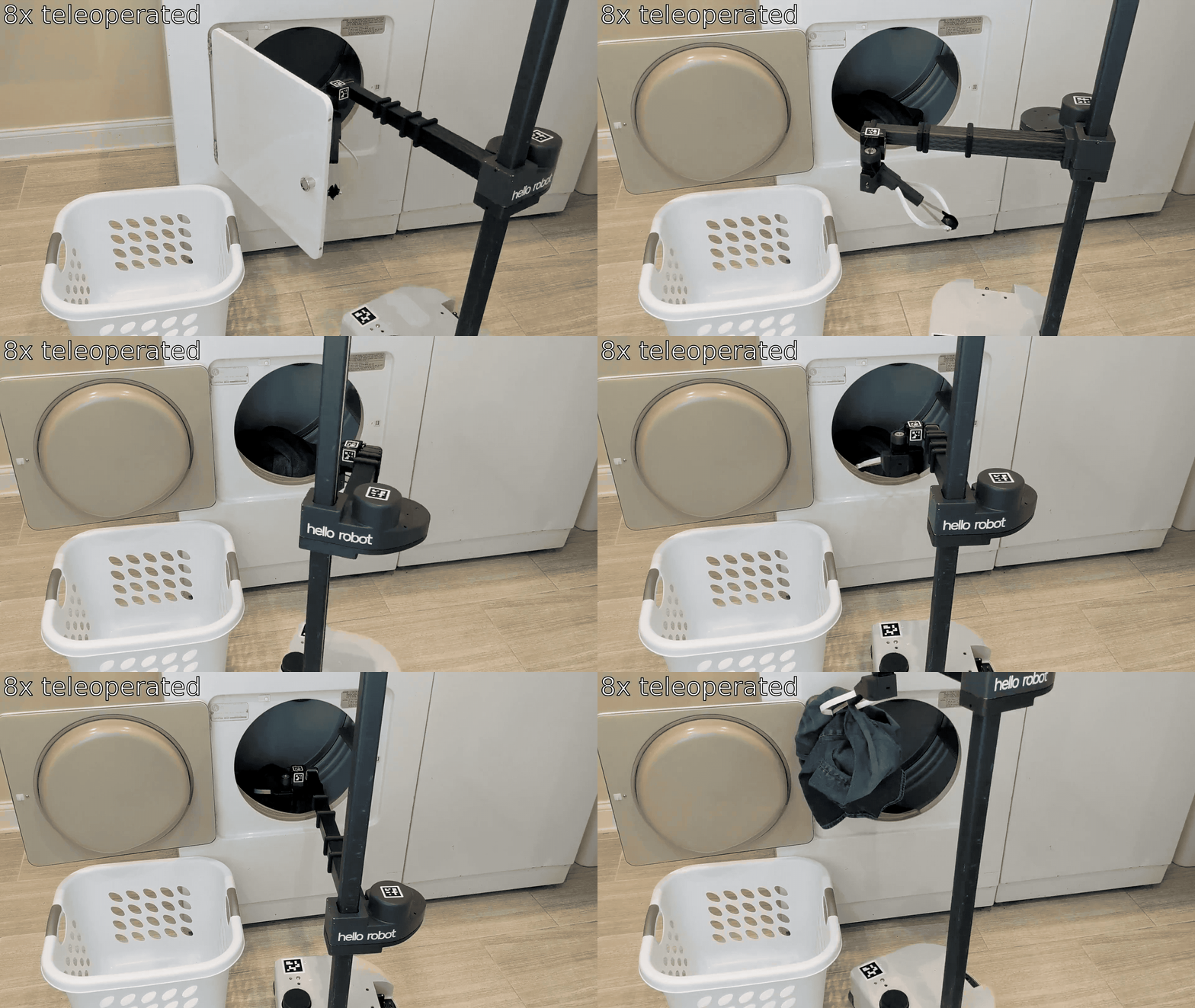
Stretch is still in quite early stages. At $17,950, it’s really more of a developer platform at the moment, but it’s easy to see how the company could ultimately spin it into something more commercial, with the right software. “Subsequent editions of Stretch will likely be targeted more directly at commercial applications,” says Edsinger, “but at this point we’re focused on providing the best customer experience possible with the Research Edition.” In addition to a gripper, the robot also sports a 3D camera and range finder for navigating and an on-board computer. On the software side, it uses a combination of ROS and Python.

It’s an open-sourced platform, designed to help robotics develop a unique range of potentially useful tasks for the home and retail setting.

Image Credits: Hello Robot

“What sets this robot apart is its extraordinary reach — which is why we named it Stretch,” Edsinger, says in a release. “Its patent pending design makes possible a range of applications such as assisting an older parent at home, stocking grocery shelves, and wiping down potentially infectious surfaces at the workplace. We see Stretch as a game-changing platform for researchers and developers who will create this future.”

Again, this is all still quite early. Hello Robot is still a small team — with a headcount of fewer than 10 employees at the moment. Thus far, the startup has been completely bootstrapped. Edsinger tells TechCrunch, “based on customer response so far we expect to have a healthy and profitable business.”

14 Jul 2020

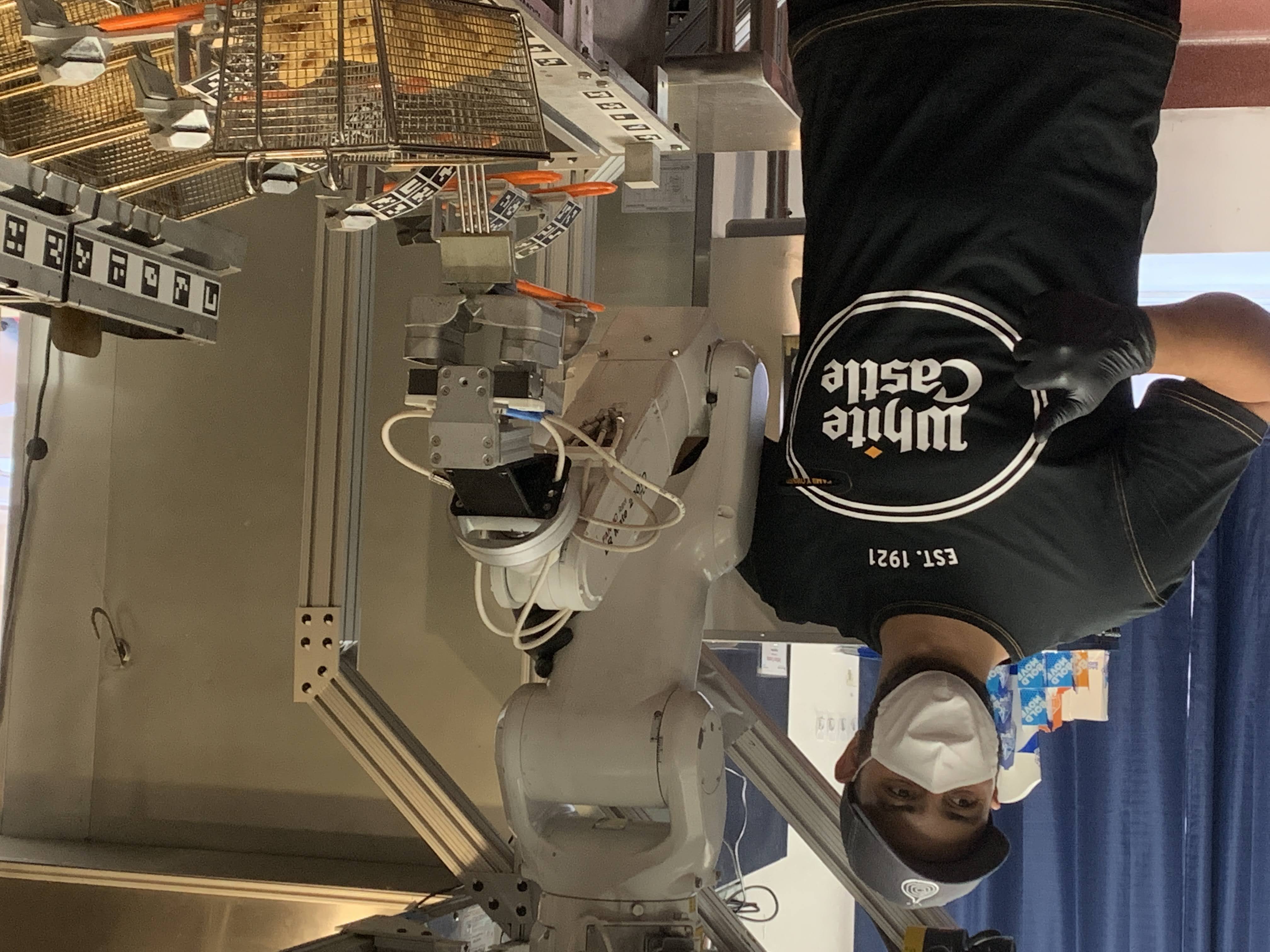
White Castle becomes the first fast food chain to test out the robot fry cook, Flippy, from Miso Robotics

The next time Harold and Kumar go to a White Castle, there may be a robot making their French Fries.

In one of the first trials of a robotic fry cook at a national burger chain, White Castle said it would work with Pasadena, Calif.-based Miso Robotics to test that company’s robotic chef at a restaurant in the Chicago area. It’s a  trial run for potentially bringing the robot to other White Castle kitchens across the country, the company said.

White Castle first began talking about using the Miso Robotics robots in its kitchens about nine months ago according to White Castle’s vice president of shareholder relations, Jamie Richardson. For the company, it was a question of, “How can we start to make the kitchen of tomorrow today?” 

Already a success on social media, where videos of Miso Robotics’ Flippy robot have racked up hundreds of thousands of views, White Castle was intrigued about the prospects of a burger flipping, chicken, onion, and french frying robot in its locations, Richardson said.

“I think automation is here to stay and this is the first example of a really large credible player starting down that journey,” said Miso Robotics chief executive Buck Jordan of the new collaboration with White Castle. 

White Castle has a fairly interesting track record when it comes to working with startups. The company was the first fast food chain to embrace Impossible Foods for its sliders.

At an undisclosed restaurant in the Chicago area, Miso Robotics is already working to install the latest version of its Flippy robot. The robotic fry cook will be integrated with the company’s point of sale system so that the robot can begin preparation as soon as an order is taken at the register.

That first robot will be coming online in September, according to Richardson.

And Richardson said that White Castle employees don’t need to worry about a robot coming for all of their jobs… yet. 

“It’s going to save us money in food costs because there will be less waste,” said Richardson.  “The other savings will be in terms of output… that’s going to be helpful.. If you maintain speed of service that’s getting a little bit better and a little better you do see more visits… that’s where we see it having the biggest impact… we’re not looking at this as a way to reduce people power.” 

A typical installation of a Miso Robotics system in a kitchen would cost a restaurant $30,000 upfront and then another $15,000 per year. However, with White Castle, the terms (which were undisclosed) were a little different.

Jordan said the goal is to bring the cost of the robotic system down to $15,000 for the entire system, obviating the need for any upfront costs, and convincing restaurants and franchisors that the robot can pay for itself right out of the gate.

There’s a clear path to getting that down to 20K,” said Jordan. “I’m trying to chisel that down to 15K,… at that kind of price and these things have lifetimes of seven to ten years we can afford to take the loss upfront.”

The robots have taken on new significance in the post COVID-19 era as restaurants like White Castle become essential services even as they struggle to keep the lights on with fewer customers. 

At White Castle that meant pay cuts for executives in order to retain staff. “We cut a lot of investment and we didn’t want to lose one job,” Richardson said. However, even with the strategic cuts, the implementation of at least this first robotic system remained a priority.

“There were things that we thought, COVID or no COVID were important,” Richardson said. “This project falls under that banner.”

White Castle’s decision to pilot Flippy in the kitchen creates an avenue for reduced human contact with food during the cooking process – reducing potential for transmission of food pathogens. The implementation also brings intelligence to cooking, tapping into sensors, intelligent monitoring and anticipated kitchen needs to keep food temperatures consistent, that ensure optimal quality and a perfect bite for customers. With Flippy in the kitchen automating repetitive, time consuming and dangerous tasks like frying, team members can be redeployed to more customer-experience driven tasks.

Image Credit: Miso Robotics

14 Jul 2020

Legaltech startup Orbital Witness scores £3.3M to create a ‘universal risk rating’ for real estate

Orbital Witness, a U.K.-based legaltech startup developing “AI-powered” software to transform the £4 billion U.K. property due diligence market, has raised £3.3 million in seed funding.

The round is led by LocalGlobe and Outward VC, with participation from previous investors, including Seedcamp and JLL Spark. It brings Orbital Witness’s total funding to £4.5 million.

Launched with its first customer in September 2018 and now used by numerous large law firms, including four of the five so-called “Magic Circle” firms, Orbital Witness’ long-term vision is to build a “universal risk rating” for real estate. “Think of a credit risk check for land and property,” Orbital Witness co-founder and COO Will Pearce tells me.

To do this, the startup is employing machine learning technology that it hopes can mirror the process a lawyer goes through when gathering and checking property information. The idea is to use AI to “predetermine” issues that constitute a potential risk.

“Our technology is adept at trawling through and extracting key issues from the wide range of sources that a property lawyer considers, including HM Land Registry and local authorities,” explains Pearce. “For example, a user is alerted to third party rights, charges and restrictions that might block a sale. In our current state of product development, this allows Orbital Witness to act as an ‘early warning system’ for property lawyers”.

Zooming out further, Pearce says real estate is the world’s largest asset class, but that the process of recording and reporting on property rights has not materially changed in 150 years. This sees real estate lawyers having to manually collect and review information from an array of disparate sources, which can often take weeks to arrive before they can even start. Meanwhile, the various real estate stakeholders — from banks making lending decisions, large commercial real estate PE funds, to residential homebuyers — can’t sign off transactions until the lawyers have completed their due diligence.

“Anyone who has ever bought a home will appreciate the frustrations of dealing with this legal due diligence process, and in commercial real estate, where Orbital Witness is initially focussed, many of these problems are amplified,” says Pearce.

The longer term plan is to ingest a broader range of data, so that Orbital Witness can eventually become trusted to provide a universal risk rating for real estate. This will see its risk modelling solutions wired to also include geographic information (e.g. flood risk), privately held information that can be uploaded to the platform (e.g. rights of lights reports), and also non-legal information (e.g. financial data from public records and ratings agencies).

Adds the Orbital Witness co-founder: “Very importantly, risk in real estate is dependent on the context of a transaction. For a real estate investor purchasing a block of flats, they are interested in understanding the security of rental income derived from the leaseholds. However, a property developer transacting on the same building, may be more interested in any hidden covenants that could prevent the ability to build or redevelop the site”.

14 Jul 2020

App Annie launches ad analytics product Ascend

App Annie is building on last year’s acquisition of analytics company Libring with the launch of a new version of Libring, rebranded as App Annie Ascend.

CEO Ted Krantz told me that while Ascend will be sold to existing App Annie customers, the real hope is to reach “a dramatically different market” as App Annie moves beyond just providing app market data by offering advertising analytics as well — particularly for game publishers and other companies on the supply side of the ad industry.

Krantz argued that with mobile platforms and browsers adding more limitations to user tracking (most recently with Apple’s announcement that it will give users the ability to decline app ad tracking), “the room is going to get pretty dark” for advertisers — creating an opportunity for App Annie’s approach of combining broader market data with a publisher’s own first party data.

To achieve this, Ascend offers what Krantz said are “hundreds of connectors” to pull data from the different platforms like AdColony, Unity and Chartboost, allowing customers to see these data sets “side by side.” Krantz emphasized that this data is very much for the customer’s own use and will be “quarantined” from App Annie’s larger market data, at least initially.

“Over time, we have the ability to open that up [for] benchmarking data,” he said, adding that this approach is part of what makes Ascend unique: “You’ve got to have that benchmarking data from your peer group. Without the market data, you can’t be certain you’re making the right calls.”

Companies already using Ascend include Reddit and Jam City.

”Ascend takes away the burden of integrating, maintaining and constantly updating dozens of APIs, allowing us to focus on what matters: achieving our KPIs and improving our campaigns,” said Reddit’s director of marketing Spiros Christakopoulos in a statement. “
Thanks to the critical insights Ascend provides, via its well designed reporting tools, it has become an essential part of our marketing analytics infrastructure.”

14 Jul 2020

TradeDepot adds $10 million to add financial services to its supply chain services for African SMBs

Nigeria’s e-commerce startup TradeDepot, which connects international brands to small businesses in Africa, has raised $10 million in a new round of funding to expand its business into financial services and credit offerings for retailers.

First launched in 2016, TradeDepot has built up a network of 40,000 small businesses in Nigeria and connects them to local distributors of global consumer brands like Nestlé, Unilever, GB Foods and Danone, according to a statement.

The initial business model managed to attract a $3 million investment led by Partech back in 2018. And now, as the firm invests from its largest African fund, Partech returned to co-lead TradeDepot’s latest round with the International Finance Corp., Women Entrepreneurs Finance Initiative and MSA Capital.

TradeDepot’s business depends on making a range of household supplies like milk, soap, and detergent more accessible and affordable for the street-side vendors and small shops that provide goods and services for hundreds of communities in cities like Lagos — where the company is headquartered.

Using the company’s mobile apps on Android or Whatsapp, USSD short code messaging or a toll-free phone number, retailers can place orders and have goods and services delivered through TradeDepot’s fleet of vans and tricycles. They can make payments, order stock, and manage inventory online or through the app as well.

For consumer brands, they have a central hub through which to distribute directly to vendors on the continent, along with data that can help them manage their relationship with these small vendors.

Image Credit: TradeDepot

Africa’s offline retail market is estimated at $1 trillion, and this new investment allows us to capture an even greater segment of that market,” said Onyekachi Izukanne, in a statement. “We will continue to use data to drive efficiencies and provide an easier stock acquisition service for our [over] 40,000 retailers, driving down costs for them by negotiating even better deals with our global manufacturing partners, whilst simultaneously providing a better, faster route to market for our suppliers.”

The company said that a new store comes online to use its services every three minutes and that the company receives an order from retailers every four seconds, on average.

Now, with the new capital, TradeDepot will expand into a suite of financial services and lending products for its retailers. Many of the company’s customers lack a credit rating, but TradeDepot has alternative ways to score credit based on the data it has from its existing trading relationships.

“The founders’ vision to build a digital platform that improves the unit economics of serving the mass market is one we feel privileged to support,” said Wale Ayeni, the head of Africa Venture Capital investment at the IFC.

That support disproportionately goes to helping women entrepreneurs, according to the company. Women account for over 75% of the retailers on the company’s platform. Now, with the help of its new investor We-Fi, TradeDepot will look to offer mentorship opportunities and link these business owners to global markets.

“Women play a pivotal role in driving economies across Africa, but lack of access to capital, limited market linkages, cultural norms and other challenges often prevent them from achieving the success they want,” saiid Hanh Nam Nguyen, who represents the We-Fi initiative with the IFC. “We-Fi financing will incentivize TradeDepot to build stronger women-led small and medium enterprises (SME) retailer and distributor networks, which will support them to become drivers of economic growth in their communities.”  

14 Jul 2020

Huawei posts revenue growth in H1 despite sanctions and pandemic

Huawei reported a 13.1% year-over-year revenue growth in the first half of 2020, even if countries around the world continued to weigh up bans on its equipment and smartphone sales shrink amid the pandemic, the telecom giant said in a brief on Monday.

The firm’s revenue reached 454 billion yuan ($64.88 billion) in the period, with its carrier, enterprise, and consumer businesses accounting for 35%, 8% and 56% of total revenue, respectively. It finished with a net profit margin of 9.2%, a slight increase from 8.7% in the same period last year.

The privately-owned company did not specify what contributed to its H1 growth, but said in the release that amid the COVID-19 pandemic, “information and communications technologies” — the main focus of its business — “have become not only a crucial tool for combatting the virus, but also an engine for economic recovery.”

The growth came amid the U.S.’s ongoing campaign urging allies to remove Huawei from their network infrastructure. The U.K. is reportedly scheduled to phase out Huawei gear in its 5G network as soon as this year, a plan that critics warn could cause network outages and other security risks.

Though Huawei does not break down its regional sales, it’s reasonable to expect China to be its bedrock of growth as it stumbles abroad. The company and its local competitor ZTE — which is also on the U.S. trade blacklistdivide up the bulk of 5G base station contracts from China’s main carriers. The network operators have also agreed to procure 5G phones from Huawei, which would naturally give the company a boost in sales.

14 Jul 2020

Luckin Coffee replaces chairman Charles Lu

Luckin Coffee has replaced co-founder and (now ex-) chairman Charles Zhengyao Lu, despite his efforts to maintain control over the troubled Beijing-based coffee chain. The company disclosed in an SEC filing on Monday that Jinyi Guo, another co-founder, board member and former acting chief executive of Luckin, has been appointed as its new chairman and chief executive officer.

In today’s SEC filing, Luckin also said a total of four directors have left the board (Lu, David Hui Li, Erhai Liu and Sean Shao) and two new independent directors have been appointed. The new additions are Jie Yang, vice dean of the business school at the China University of Political Science and Law, and Ying Zeng, who was a partner at law firm Orrick Herrington and Sutcliffe and previously served as El Paso Corporation’s vice president and country manager for China.

The company’s disclosure comes after weeks of strife during which Lu sought to hold onto control of Luckin. Earlier this month, an attempt by Luckin Coffee’s directors to remove Lu as chairman failed to get enough votes during a board meeting.

The proposal to oust Lu was made on June 26 after an internal investigation found that Luckin Coffee’s net revenue in 2019 was inflated by about RMB 2.12 billion (US $300 million) and that fabrication of transactions began in April 2019, with Lu, former chief operating officer Jenny Zhiya Qian and several other employees participating in the false reports.

Luckin Coffee disclosed last month that Nasdaq had decided to delist the company, a spectacular fall from grace after it raised $651 million in its United States public offering in May before allegations of fraud caused its stock to plummet.


14 Jul 2020

Ford blends tech and nostalgia in the 2021 Bronco

The Bronco is officially back. After 24 years, Ford relaunched the 2021 Bronco in a splashy reveal streamed Monday evening on ABC, ESPN and National Geographic, each short film showcasing a different member of the family: the Bronco 2-door, Bronco 4-door and Bronco Sport.

The Bronco 2021 — Ford’s flagship series of 4×4 vehicles — is a brand that leans heavily on nostalgia, customization, functional design and technology such as the automaker’s next-generation infotainment system and a digital trail mapping feature that lets owners plan, record and share their experiences via an app.

This is not the 1966 Ford Bronco, the first year that the rugged two-door off-roader came to market to compete with the Jeep CJ-5. However, the DNA from that heritage model is present in this modern take of the Bronco 2 as well as a new four-door version. The third model, the Bronco Sport, is a comfier spinoff that is designed to be capable off-road as well as function as a daily driver on the city streets and highways.

Production on the new Bronco series will begin in early 2021 with the first models arriving in dealerships next spring. All three of Bronco models will be built at Michigan Assembly Plant in Wayne, Michigan. Ford launched Monday a reservations page where prospective customers can plunk down $100 to hold their spot for the Bronco two- and four-door models.

Ford hasn’t released every detail on the three models — pricing on the Bronco Sport and Bronco 4, for instance. ( The base model Bronco 2 starts at $29,995, including $1,495 destination and delivery.)

There’s still plenty here. Let’s unpack it.  Before we really dig in, here’s some of the basics on the Bronco two-door and Bronco four-door vehicles.

Both models have a steel chassis and an independent front suspension, the aim here being to improve control. At the rear, the solid axle design features coil springs with five locating links to provide control off road and strength. The vehicles come with two possible engines — a 2.7-liter V6 or 2.3-liter four cylinder— and are available in 7-speed manual and 10-speed automatic transmissions. The 2.7-liter EcoBoost V6 engine is projected to produce 310 horsepower and 400 lb.-ft. of torque, while the 2.3-liter four cylinder engine has torque of 310 lb.-ft. with an expected 270 horsepower.

Ford gave Bronco 11.6-inch ground clearance, a 29-degree breakover angle and 37.2-degree departure angle. It also has water fording capability of up to 33.5 inches. Just to be safe, Ford designers added more protection and heft, including modular steel bumpers with integrated winch mount. Some of the higher-end versions of the Bronco comes with steel shields to protect critical hardware, including the engine, transmission, transfer case and fuel tank.

Oh, and how could I forget. Ford is making 35-inch off-road tires available in every trim level on the Bronco 2 and Bronco 4.

Nostalgia

Ford Bronco vintage 2021 Bronco 2

Pre-production 2021 Bronco two-door SUV takes its design cues from the first-generation 1966 Bronco.

While technologists might cast a bit of side eye at nostalgia, there’s no denying its power. As TechCrunch’s Matt Burns noted last week Ford is going to use the old Bronco to sell the new Bronco, just like Nintendo uses past games to sell new games.

The 2021 Bronco 2 is clearly new, particularly once you look inside. But glancing over the exterior it’s hard to miss inspirations from the original.

The Bronco 2 and Bronco 4 has square proportions, short overhangs and a wide stance, all aspects that make these vehicles primed for off roading. They also harken back to the original design. From the side, you’ll notice distinct edges and flared fenders, again a nod to the first Bronco.


Customization

Here’s where the 2021 Bronco series really shines. Ford has comes up with innumerable ways to customize the Bronco 2 or Bronco 4.

The automaker is offering seven different versions of the Bronco 2 and Bronco 4 with matching color and trim combinations. There are also 11 different paint choices and four content package. The options begin with the base no-frills version and ends with the Wildtrak and Badlands versions for for more extreme off-road adventuring. The Big Bend, Black Diamond and Outer Banks sit in the middle. And of course, there’s a limited-production First Edition that will be offered at launch.

The automaker also has more than 200 factory-based accessories.

The Bronco 2 and Bronco 4 are meant to be configured in multiple ways. For instance, the Bronco 2 models come with a standard three-section roof system. There’s also premium-painted modular top with four
sections that adds a removable panel over the rear seats and cargo area. The Bronco 4 has four removable roof sections, all which Ford promises can be removed by one person by unlocking the latches from the interior.

The models are also available in soft or hardtops, or can be optioned with both. Even the large open wheel wells are a modular design with a quick-release attachment for customization.

Bronco_4dr_features_anim-alt

Image Credits: Ford/TechCrunch gif

Technology

Much of the technological focus is on the four-wheel drive system and is at the heart of the brand’s so-called Terrain Management System. The Bronco 2 and Bronco 4 have up to seven driver-selectable modes for off-road driving, including Normal, Eco, Sport, Slippery and Sand, with Baja, Mud/Ruts and Rock Crawl.

Ford is offering two different 4×4 systems on all Bronco models, a base setup and an advanced system. The base system uses a two-speed electronic shift-on-the-fly transfer case. The optional advanced
system has a two-speed electromechanical transfer case that adds an auto mode for on-demand engagement that lets the driver select between 2H and 4H (two high and four high).

There is other technology in the vehicle though such as the next-generation Ford Sync 4 infotainment system, and the digital maps. The infotainment system features a multifunction color LCD instrument panel. Moving down the driver can interact with the transmission shifter/selector and G.O.A.T. Modes controller (off road modes) in the center console. Grab handles are actually integrated into the modular instrument panel and center console for those oh S—T moments.

Designers also included attachment points that are built into the instrument panel to mount pretty much any device you might want, including cameras, navigation units, phones or other devices.

2021 Bronco two-door features class-leading open-air design roof and instrument panel inspired by the first-generation Bronco, with intuitive, clearly visible gauges and controls in this prototype version (not representative of production model). Prototype not representative of production model. (Static display on private property with aftermarket accessories not available for sale.)

Design

Another big piece of the Bronco 2 and Bronco 4 is the focus on functional design. This is meant to be an off road vehicle, after all. And it should function as such.

For instance, the trail sights on the front fenders also can be used as tie downs and can handle longer items like canoes. Those trail sights are placed so a user can tie off a boat or other equipment without scratching the paint or lights. But they can also be taken off or replaced with other gear, Bronco chief designer Paul Wraith noted in a briefing before the reveal.

“You can swap them out or bolt on extra lights or Go Pros,” Wraith said. “And, especially if you’re shorter, you can simply use them to tell you where the corners of the truck are, which just goes to show that innovation doesn’t always need a microchip.”

The interior is also designed with an accessory-hungry owner in mind.
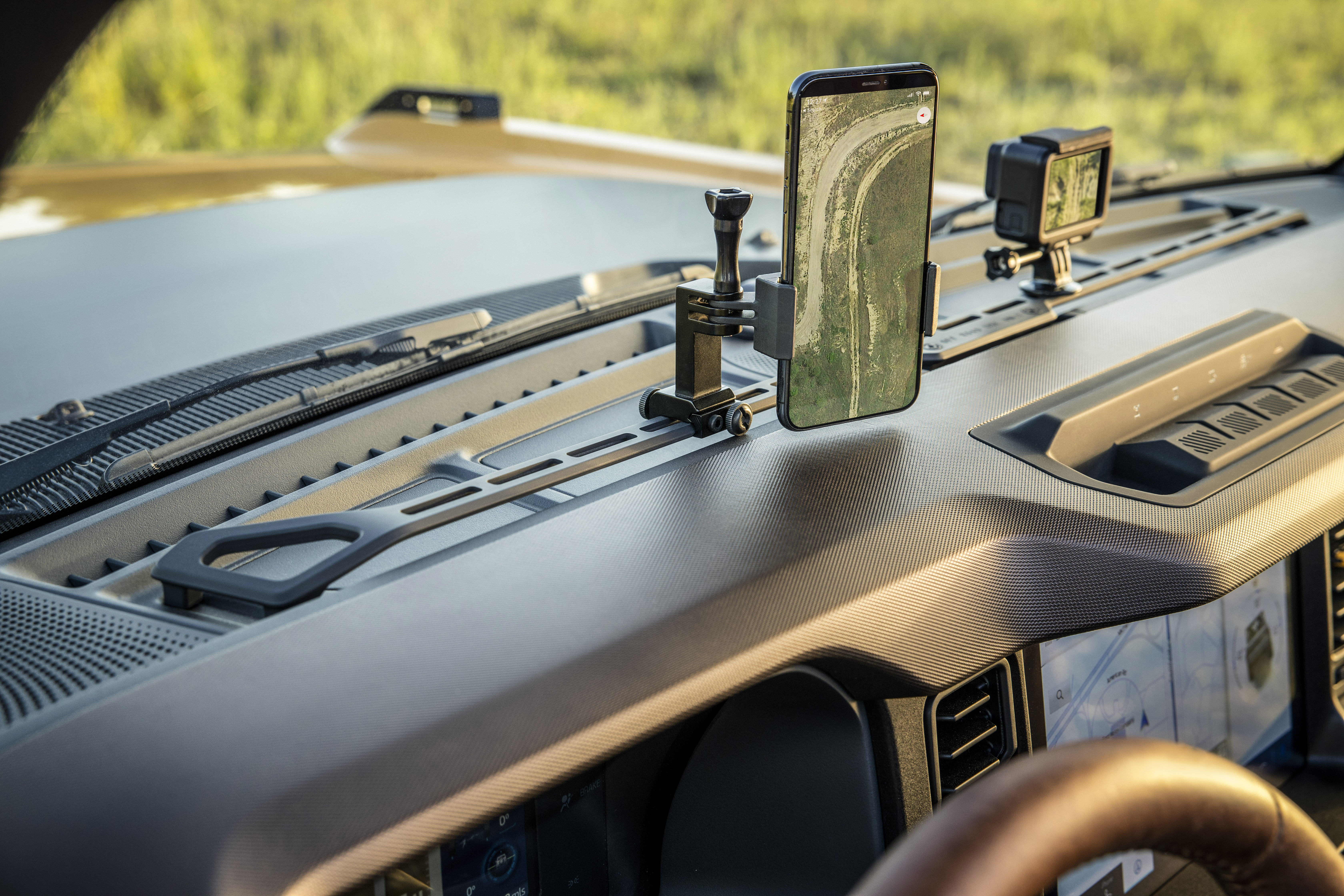
The instrument panel in the 2021 Bronco two- and four-door models is ready for installation of accessories such as a bring-your-own-device rack shown on this prototype.