Author: azeeadmin

09 Jul 2020

Joe Coffee raises another $1.3M to help more coffee shops take mobile orders

Gone — or at least on hold for a long while — are the days of hanging around a coffee shop, poking around the Internet on the free WiFi while sipping the same coffee for three hours. The entire idea feels kind of alien right now. A little anxiety-inducing, even.

But coffee shops still want to find ways to safely stay in business, and people still want their coffee. With many states limiting orders to pickup/to-go, mobile ordering is seeing a massive uptick across the food industry. That’s great for Starbucks and anyone else who already had mobile ordering in place, but it leaves many smaller shops scrambling for a solution. Building your own app is complicated – and getting people to download it can be its own challenge.

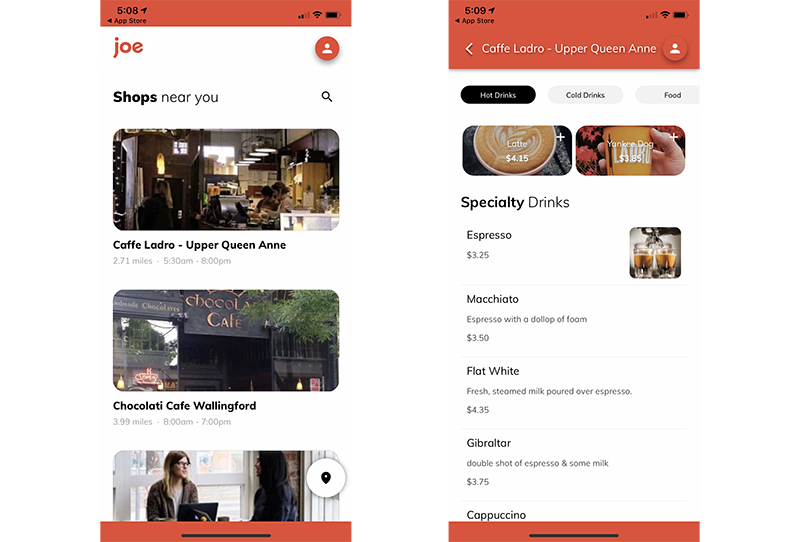
For the last few years, Seattle-based Joe Coffee has been building a mobile ordering “network” for indie coffee spots — basically, a one-stop app for ordering from nearby coffee shops that aren’t Starbucks. The team had raised $2.2M previously; after seeing a massive uptick in usage and interest from coffee shops in recent months, the company has raised another $1.3M to scale up with demand.

CEO Nick Martin tells me that they’ve seen sales volume increase by roughly 20x since March. He also notes that they’ve seen the average tip increase by over 200% during the pandemic — a nice sign that people are trying to show love to the folks behind the counter right now.

This round — a second seed, as the company calls it — is led by Craft Ventures, and backed by Flying Fish Partners (which also invested in Joe’s previous funding.)

Joe Coffee’s role here is a two-part one: on the consumer side, they provide the mobile app and web interface for taking orders and offering up promos, with a loyalty points system that works across the “Joe network”. On the coffee shop side, they’re providing signage to get customers into the app, the interface for baristas to process orders and set up deals, along with reporting/analytics to help figure out what’s working best. In exchange, they take 9% per order, which includes credit card processing fees.

Joe Coffee initially focused strictly on its home turf of Seattle, where it’s supporting around 300 coffee shops. They started to expand to other regions in August of last year, opening it up nationwide in January of 2020; today, Martin tells me, they’re working with over 1000 shops across the US.

09 Jul 2020

Google reportedly cancelled a cloud project meant for countries including China

After reportedly spending a year and a half working on a cloud service meant for China and other countries, Google cancelled the project, called “Isolated Region,” in May due partly to geopolitical and pandemic-related concerns. Bloomberg reports that Isolated Region, shut down in May, would have enabled it to offer cloud services in countries that want to keep and control data within their borders.

According to two Google employees who spoke to Bloomberg, the project was part of a larger initiative called “Sharded Google” to create data and processing infrastructure that is completely separate from the rest of the company’s network. Isolated Region began in early 2018 in response to Chinese regulations that mean foreign tech companies that want to enter the country need to form a joint venture with a local company that would hold control over user data. Isolated Region was meant to help meet requirements like this in China and other countries, while also addressing U.S. national security concerns.

Bloomberg’s sources said the project was paused in China in January 2019, and focus was redirected to Europe, the Middle East and Africa instead, before Isolated Region was ultimately cancelled in May, though Google has since considered offering a smaller version of Google Cloud Platform in China.

After the story was first published, a Google representative told Bloomberg that Isolated Region wasn’t shut down because of geopolitical issues or the pandemic, and that the company “does not offer and has not offered cloud platform services inside China.”

Instead, she said Isolated Region was cancelled because “other approaches we were actively pursuing offered better outcomes. We have a comprehensive approach to addressing these requirements that covers the governance of data, operational practices and survivability of software. Isolated Region was just one of the paths we explored to address these requirements.”

Alphabet, Google’s parent company, broke out Google Cloud as its own line item for the first time in its fourth-quarter and full-year earnings report, released in February. It revealed that its run rate grew 53.6% during the last year to just over $10 billion in 2019, making it a more formidable rival to competitors Amazon and Microsoft.

09 Jul 2020

This VC just closed on $60 million to fund “technical risk,” saying other VCs rarely do the same

Ashmeet Sidana, a longtime VC who struck out on his own in 2015 to form Engineering Capital, just closed his third and newest fund with $60 million in capital commitments from a university endowment, a fund of funds, and three foundations.

Sidana — who previously spent nearly nine years with Foundation Capital and received one of his first limited partner agreements  afterward from Foundation’s legendary founder, Kathryn Gould — says the fund came together despite the pandemic without too much pain.

That’s thanks in part to Sidana’s track record, including the sale of the cloud monitoring startup SignalFx to Splunk for $1 billion after it raised $179 million from VCs, and the sale of the cloud application monitoring startup Netsil by Nutanix for up for $74 million in stock after it raised just $5.7 million. (Engineering Capital was the first investor in both.)

Sidana’s day-to-day work in Palo Alto, Calif. –which centers on working with teams “that you can feed with two pizzas,” yet whose narrow technical insights can have broad applicability — was also an apparent draw. To learn more, we talked earlier today with Sidana, a self-described engineering nerd who studied computer science at Stanford about what “technical insights” have caught his attention most recently.

TC: You talk about pursuing founders with technical insights. Is that not true of most venture capitalists?

AS: No. Silicon Valley is a tech investing ecosystem, but most of its participants aren’t solving hard technical problems. They have market insights or consumer insights. It’s the difference between Google and Facebook. Google figured out how to index better, how to better prioritize a sorting problem. Facebook was started with the consumer insight that people want to be connected with each other. I focus on companies based on technical insights. Most VCs don’t.

TC: What are you looking for exactly?

AS: A team that’s using software or tech to solve a known problem that exists but for which there does not exist a solution. Many such problems exist. For example, we now the future will be multi cloud. Amazon has succeeded wildly with AWS. Microsoft is doing well with its cloud business. Google is catching up to them. Then you have the seven dwarves, including Digital Ocean. It’s a difficult way for enterprises to engage with infrastructure. Another technical problem is rooted in all of us wanting to give our infrastructure over to the cloud but not our data. How do we solve this? Some are solving it legally, some with publicity. But really, it’s a technical problem.

TC: What’s a recent bet you’ve made that has solved a technical problem?

AS: I’m the first investor in Baffle, which is a really interesting company that enables the user of a traditional relational database to see the data but not an administrator. [Editor’s note: the company says it enables the field level protection of data without requiring any application code changes.] Or Robust Intelligence is an even newer investment that’s solving the problem of data contamination in artificial intelligence.

TC: How so?

AS: When you run models and do machine learning, you do cybersecurity and protect them, but what about the data that the AI is working on? They have a killer demo that shows that when you deposit a check with your iPhone, your bank is of course using AI to recognize check and ensure the right amount goes into the proper account. [But a nefarious actor could] procure a small number of pixels that are invisible to the human eye in the photo of check and change the numbers and the routing number. What Robust does is protecting [both the bank and its customers] from that kind of data contamination.

TC: I know you tend to invest very early — often writing the first check. Are you hovering around Stanford all day? How do you find these nascent teams?

AS: I have good relationships with many schools, including [the University of] Michigan, Stanford, I’m involved with the University of Toronto’s Creative Destruction Lab; I keep active relationships with [schools in India]… I spend a lot of time with engineers in academia or industry.

TC: What size checks are you writing to get them started, and how much of their companies do you expect in return?

AS: Most people think investing in technical insights is expensive, but it can be very capital efficient if you are working with software. I’m also looking at companies where you can get to revenue with $1 million and $3 million and funding. That typically takes a small team of five to eight people who you can feed with two people.  Linux was ultimately written by one person. VMWare was started by a technical insight addressed by two people. Google had its earlier stuff working with just Larry and Sergey.

As for ownership, my job is to buy low and sell high. I’m as greedy as the next VC and would love to have as much ownership as I can, but there is no formula.

TC: What’s a mistake you tend to see with new teams?

AS: Gluttony. Most think they have to go after a big market and solve a big problem, but the magic of doing a startup is to focus on an incredibly narrow problem that has broad application. As Steve Jobs used to say it is difficult to throw away features, not to add them.


09 Jul 2020

This VC just closed on $60 million to fund “technical risk,” saying other VCs rarely do the same

Ashmeet Sidana, a longtime VC who struck out on his own in 2015 to form Engineering Capital, just closed his third and newest fund with $60 million in capital commitments from a university endowment, a fund of funds, and three foundations.

Sidana — who previously spent nearly nine years with Foundation Capital and received one of his first limited partner agreements  afterward from Foundation’s legendary founder, Kathryn Gould — says the fund came together despite the pandemic without too much pain.

That’s thanks in part to Sidana’s track record, including the sale of the cloud monitoring startup SignalFx to Splunk for $1 billion after it raised $179 million from VCs, and the sale of the cloud application monitoring startup Netsil by Nutanix for up for $74 million in stock after it raised just $5.7 million. (Engineering Capital was the first investor in both.)

Sidana’s day-to-day work in Palo Alto, Calif. –which centers on working with teams “that you can feed with two pizzas,” yet whose narrow technical insights can have broad applicability — was also an apparent draw. To learn more, we talked earlier today with Sidana, a self-described engineering nerd who studied computer science at Stanford about what “technical insights” have caught his attention most recently.

TC: You talk about pursuing founders with technical insights. Is that not true of most venture capitalists?

AS: No. Silicon Valley is a tech investing ecosystem, but most of its participants aren’t solving hard technical problems. They have market insights or consumer insights. It’s the difference between Google and Facebook. Google figured out how to index better, how to better prioritize a sorting problem. Facebook was started with the consumer insight that people want to be connected with each other. I focus on companies based on technical insights. Most VCs don’t.

TC: What are you looking for exactly?

AS: A team that’s using software or tech to solve a known problem that exists but for which there does not exist a solution. Many such problems exist. For example, we now the future will be multi cloud. Amazon has succeeded wildly with AWS. Microsoft is doing well with its cloud business. Google is catching up to them. Then you have the seven dwarves, including Digital Ocean. It’s a difficult way for enterprises to engage with infrastructure. Another technical problem is rooted in all of us wanting to give our infrastructure over to the cloud but not our data. How do we solve this? Some are solving it legally, some with publicity. But really, it’s a technical problem.

TC: What’s a recent bet you’ve made that has solved a technical problem?

AS: I’m the first investor in Baffle, which is a really interesting company that enables the user of a traditional relational database to see the data but not an administrator. [Editor’s note: the company says it enables the field level protection of data without requiring any application code changes.] Or Robust Intelligence is an even newer investment that’s solving the problem of data contamination in artificial intelligence.

TC: How so?

AS: When you run models and do machine learning, you do cybersecurity and protect them, but what about the data that the AI is working on? They have a killer demo that shows that when you deposit a check with your iPhone, your bank is of course using AI to recognize check and ensure the right amount goes into the proper account. [But a nefarious actor could] procure a small number of pixels that are invisible to the human eye in the photo of check and change the numbers and the routing number. What Robust does is protecting [both the bank and its customers] from that kind of data contamination.

TC: I know you tend to invest very early — often writing the first check. Are you hovering around Stanford all day? How do you find these nascent teams?

AS: I have good relationships with many schools, including [the University of] Michigan, Stanford, I’m involved with the University of Toronto’s Creative Destruction Lab; I keep active relationships with [schools in India]… I spend a lot of time with engineers in academia or industry.

TC: What size checks are you writing to get them started, and how much of their companies do you expect in return?

AS: Most people think investing in technical insights is expensive, but it can be very capital efficient if you are working with software. I’m also looking at companies where you can get to revenue with $1 million and $3 million and funding. That typically takes a small team of five to eight people who you can feed with two people.  Linux was ultimately written by one person. VMWare was started by a technical insight addressed by two people. Google had its earlier stuff working with just Larry and Sergey.

As for ownership, my job is to buy low and sell high. I’m as greedy as the next VC and would love to have as much ownership as I can, but there is no formula.

TC: What’s a mistake you tend to see with new teams?

AS: Gluttony. Most think they have to go after a big market and solve a big problem, but the magic of doing a startup is to focus on an incredibly narrow problem that has broad application. As Steve Jobs used to say it is difficult to throw away features, not to add them.
09 Jul 2020

This VC just closed on $60 million to fund “technical risk,” saying other VCs rarely do the same

Ashmeet Sidana, a longtime VC who struck out on his own in 2015 to form Engineering Capital, just closed his third and newest fund with $60 million in capital commitments from a university endowment, a fund of funds, and three foundations.

Sidana — who previously spent nearly nine years with Foundation Capital and received one of his first limited partner agreements  afterward from Foundation’s legendary founder, Kathryn Gould — says the fund came together despite the pandemic without too much pain.

That’s thanks in part to Sidana’s track record, including the sale of the cloud monitoring startup SignalFx to Splunk for $1 billion after it raised $179 million from VCs, and the sale of the cloud application monitoring startup Netsil by Nutanix for up for $74 million in stock after it raised just $5.7 million. (Engineering Capital was the first investor in both.)

Sidana’s day-to-day work in Palo Alto, Calif. –which centers on working with teams “that you can feed with two pizzas,” yet whose narrow technical insights can have broad applicability — was also an apparent draw. To learn more, we talked earlier today with Sidana, a self-described engineering nerd who studied computer science at Stanford about what “technical insights” have caught his attention most recently.

TC: You talk about pursuing founders with technical insights. Is that not true of most venture capitalists?

AS: No. Silicon Valley is a tech investing ecosystem, but most of its participants aren’t solving hard technical problems. They have market insights or consumer insights. It’s the difference between Google and Facebook. Google figured out how to index better, how to better prioritize a sorting problem. Facebook was started with the consumer insight that people want to be connected with each other. I focus on companies based on technical insights. Most VCs don’t.

TC: What are you looking for exactly?

AS: A team that’s using software or tech to solve a known problem that exists but for which there does not exist a solution. Many such problems exist. For example, we now the future will be multi cloud. Amazon has succeeded wildly with AWS. Microsoft is doing well with its cloud business. Google is catching up to them. Then you have the seven dwarves, including Digital Ocean. It’s a difficult way for enterprises to engage with infrastructure. Another technical problem is rooted in all of us wanting to give our infrastructure over to the cloud but not our data. How do we solve this? Some are solving it legally, some with publicity. But really, it’s a technical problem.

TC: What’s a recent bet you’ve made that has solved a technical problem?

AS: I’m the first investor in Baffle, which is a really interesting company that enables the user of a traditional relational database to see the data but not an administrator. [Editor’s note: the company says it enables the field level protection of data without requiring any application code changes.] Or Robust Intelligence is an even newer investment that’s solving the problem of data contamination in artificial intelligence.

TC: How so?

AS: When you run models and do machine learning, you do cybersecurity and protect them, but what about the data that the AI is working on? They have a killer demo that shows that when you deposit a check with your iPhone, your bank is of course using AI to recognize check and ensure the right amount goes into the proper account. [But a nefarious actor could] procure a small number of pixels that are invisible to the human eye in the photo of check and change the numbers and the routing number. What Robust does is protecting [both the bank and its customers] from that kind of data contamination.

TC: I know you tend to invest very early — often writing the first check. Are you hovering around Stanford all day? How do you find these nascent teams?

AS: I have good relationships with many schools, including [the University of] Michigan, Stanford, I’m involved with the University of Toronto’s Creative Destruction Lab; I keep active relationships with [schools in India]… I spend a lot of time with engineers in academia or industry.

TC: What size checks are you writing to get them started, and how much of their companies do you expect in return?

AS: Most people think investing in technical insights is expensive, but it can be very capital efficient if you are working with software. I’m also looking at companies where you can get to revenue with $1 million and $3 million and funding. That typically takes a small team of five to eight people who you can feed with two people.  Linux was ultimately written by one person. VMWare was started by a technical insight addressed by two people. Google had its earlier stuff working with just Larry and Sergey.

As for ownership, my job is to buy low and sell high. I’m as greedy as the next VC and would love to have as much ownership as I can, but there is no formula.

TC: What’s a mistake you tend to see with new teams?

AS: Gluttony. Most think they have to go after a big market and solve a big problem, but the magic of doing a startup is to focus on an incredibly narrow problem that has broad application. As Steve Jobs used to say it is difficult to throw away features, not to add them.

09 Jul 2020

Report says Quibi lost 92% of its earliest users after free trials expired

The Independence Day weekend was a big one for Quibi, it was time to see how many of their earliest subscribers would convert from free users to paid subscribers.

Early reports indicate that the streaming service held onto some subscribers through that period, but perhaps at a lesser rate than recently launched rival services. Data provided to TechCrunch by Sensor Tower estimates that around 8% of the 910,000 users who signed up for a free trial of Quibi in the app’s first three days stuck with the service past the expiration of the three-month free trial period. All-in-all Sensor Tower approximates that “a maximum of” 72,000 subscribers of that 910,000 subscriber number stuck with Quibi after their free trials expired.

It’s important to note that this is not the total number of Quibi’s users and only accounts for conversions for the first 3 days of sign-ups. For context, Sensor Tower shared that of the 9.5 million downloads for Disney+ in its first three days of sign-ups, about 1 million users (or 11% of the total) converted to paid subscriptions. The huge difference here is that Quibi opted for a lengthy three month free trial, whereas Disney+ launched with a 7-day free trial.

Sensor Tower estimates Quibi has been downloaded 4.5 million times in total since April 6. After April, Quibi transitioned from a three-month free trial to a 14-day free trial as it scaled back its early efforts to juice early momentum.

TechCrunch has reached out to Quibi for comment.

In a statement to The Verge regarding the same data, a spokesperson for Quibi pushed back on Sensor Tower’s findings, saying that “the number of paid subscribers is incorrect by an order of magnitude. To date, over 5.6 million people have downloaded the Quibi app. Our conversion from download to trial is above mobile app benchmarks, and we are seeing excellent conversion to paid subscribers — both among our 90-day free trial sign-ups from April, as well as our 14-day free trial sign-ups from May and June.”

In response to Quibi’s statement, a Sensor Tower spokesperson indicated that the cause of the mismatch between total download numbers could be, in part, due to the fact that its data only counts installs as “the first download of an app by a single Apple ID or Google account. As such, our figures won’t reflect if the app is installed again by the same user, such as after deletion or to another device.”

08 Jul 2020

Apple says it’s ‘committed’ to supporting Thunderbolt on new Macs after Intel details latest version

Earlier today, Intel offered some key insight into Thunderbolt 4, following an initial unveil at CES back in January. The latest version of the connection standard isn’t actually faster than its predecessor (still offering up the same 40 gbps as its predecessor), but there are some key improvements on-board, including some updated system requirements.

Here’s the rundown, per Intel,

    • Double the minimum video and data requirements of Thunderbolt 3.

      • Video: Support for two 4K displays or one 8K display.
      • Data: PCIe at 32 Gbps for storage speeds up to 3,000 MBps.
    • Support for docks with up to four Thunderbolt 4 ports.
    • PC charging on at least one computer port.
    • Wake your computer from sleep by touching the keyboard or mouse when connected to a Thunderbolt dock.Required Intel VT-d-based direct memory access (DMA) protection that helps prevent physical DMA attacks

The new version will be compatible with both Thunderbolt 3 and old USB connections, and it’s set to arrive at some point later in 2020 on laptops sporting Tiger Lake CPUs. One big question mark in all of this, however, is whether Apple will continue to support this latest connection on its upcoming line of ARM-based Macs. After all, the move marks a key rift in the longstanding relationship between Apple and Intel. 

In a statement offered to TechCrunch, the company restated its commitment to connection it’s been so invested in over the past several years, noting, “Over a decade ago, Apple partnered with Intel to design and develop Thunderbolt, and today our customers enjoy the speed and flexibility it brings to every Mac. We remain committed to the future of Thunderbolt and will support it in Macs with Apple silicon.”

08 Jul 2020

Daily Crunch: Facebook faces blistering civil rights audit

Auditors were not impressed by Facebook’s civil rights work, Tinder tests video chat and a new nasal spray could reduce the risk of COVID-19 transmission. Here’s your Daily Crunch for July 8, 2020.

The big story: Facebook faces blistering civil rights audit

The results are out in a multi-year audit of Facebook’s approach to civil rights issues. In recent weeks, as the company has faced an advertiser boycott over some of these same issues, executives have pointed to the audit as a sign that it’s taking civil rights concerns seriously. But the findings aren’t exactly positive.

“While the audit process has been meaningful and has led to some significant improvements in the platform, we have also watched the company make painful decisions over the last nine months with real world consequences that are serious setbacks for civil rights,” wrote former ACLU director Laura W. Murphy and attorneys from law firm Relman Colfax.

Meanwhile, Facebook executives met with the leaders of the boycott yesterday, but it sounds like little progress was made, with Color of Change President Rashad Robinson criticizing the company for “expecting an A for attendance.”

The tech giants

Tinder now testing video chat in select markets, including US — The feature will allow Tinder users to go on virtual dates when both of them opt-in (something that’s probably a lot more appealing during the current pandemic).

Slack snags corporate directory startup Rimeto to up its people search game — With this acquisition, Slack could potentially improve the experience of searching for employees across a company.

Microsoft makes Teams video meetings less tiring with its new Together mode — Instead of presenting all the attendees as little squares, Together mode shows them sitting together in an auditorium. Although it sounds silly, Microsoft says this is actually easier for the brain to process.

Startups, funding and venture capital

Permutive raises $18.5 million to help publishers target ads in a new privacy landscape — Rather than relying on third-party cookies, Permutive uses a publisher’s first-party data to deliver more targeted ads.

Swiftmile raises $5 million round led by Thayer Ventures for micromobility charging stations — Swiftmile makes charging stations for electric bikes and scooters, with 150 stations deployed throughout the United States to date.

Harvard biomedical engineering professor to launch nasal spray that could reduce COVID-19 transmission risk — The product is called FEND, and the startup Sensory Cloud plans to release it in September.

Advice and analysis from Extra Crunch

What India’s TikTok ban means for China — Manish Singh discusses how a recent order from the Indian government is shifting the market in favor of local companies.

As media revenue struggles, subscription startups see growth — It’s not exactly a rosy picture for media startups, but there have been some promising subscription success stories.

Ford’s Bronco relaunch demonstrates the power of nostalgia — Even if you don’t care about the Bronco, this week’s rollout has been a master class in how companies can use nostalgia for marketing.

(Reminder: Extra Crunch is our subscription membership program, designed to democratize information about startups. You can sign up here.)

Everything else

Trump’s sudden reversal on student visas will be felt in Silicon Valley — With international students no longer allowed to stay in the U.S. if their universities move their courses entirely online, there could be a big impact on technical talent and innovation.

The tech industry comes to grips with Hong Kong’s national security law — We interviewed a range of players to get a sense of what the new law will mean for internet freedom and entrepreneurship.

The Daily Crunch is TechCrunch’s roundup of our biggest and most important stories. If you’d like to get this delivered to your inbox every day at around 3pm Pacific, you can subscribe here.

08 Jul 2020

Fisker raises $50 million to bring its all-electric Ocean SUV to market in 2022

Electric vehicle startup Fisker Inc. said Wednesday it has raised $50 million, much needed capital that will go towards funding the next phase of engineering work on the company’s all-electric luxury SUV.

The startup is aiming to launch the Fisker Ocean SUV in 2022.

The Series C funding round was led by Moore Strategic Ventures LLC, the private investment vehicle of Louis M. Bacon, the billionaire hedge fund manager.

“Since we first showed the car at CES earlier this year, reaction from customers and investors has been extremely positive,” Fisker Inc. Chairman and CEO Henrik Fisker said in a statement. “We are radically challenging the conventional industry thinking around developing and selling cars and this capital will allow us to execute our planned timeline to start producing vehicles in 2022.”

The company is also beefing up its executive lineup to help push the project along.  Fisker said it has hired Burkhard Huhnke as its CTO. Huhnke was the former vice president of e-mobility for Volkswagen America and vice president of automotive at chipmaker Synopses.

As CTO, Huhnke will spread his time between the company’s R&D work in Los Angeles and its new Fisker Innovation Lab in Silicon Valley.

Building a car company isn’t easy. Just ask Fisker. The well-known automotive designer, who was behind the Aston Martin V8 Vantage, Aston Martin DB9 and BMW Z8 among others, launched a startup called Fisker Automotive that aimed to produce a luxury plug-in hybrid electric vehicles. The flagship vehicle, the Fisker Karma, debuted at the 2008 North American International Auto Show, and first deliveries were in 2011. But the company ran into numerous challenges and production was suspended in November 2012 and ended in bankruptcy a year later.

China’s Wanxiang Group purchased what was left of Fisker in 2014 and launched a new company called Karma Automotive . On a side note: Karma, which has had its own financial struggles, also announced Wednesday it had raised $100 million.

This time around, Fisker is focused on an SUV. The Fisker Ocean, which was officially revealed in January at CES 2020, starts at $37,499 before applying any federal income tax credit or state incentives.

08 Jul 2020

NASA injects $17M into four small companies with Artemis ambitions

NASA awards millions of dollars a year to small businesses through the SBIR program, but generally it’s a lot of small awards to hundreds of companies. Breaking with precedent, today the agency announced a new multi-million-dollar funding track and its four first recipients, addressing urgent needs for the Artemis program.

The Small Business Innovation Research program has various forms throughout the federal government, but it generally provides non-dilutive funding on the order of a few hundred thousand dollars over a couple years to nudge a nascent technology towards commercialization.

NASA has found, however, that there is a gap between the medium-size Phase II awards and Phase III, which is more like a full-on government contract; There are already “Extended” and “Pilot” programs that can provide up to an additional $1M to promising companies. But the fact is space is expensive and time consuming, and some need larger sums to complete the tech that NASA has already indicated confidence in or a need for.

Therefore the creation of this new tier of Phase II award: less than a full contract would amount to, but up to $5M — nothing to sneeze at, and it comes with relatively few strings attached.

The first four companies to collect a check from this new, as yet unnamed program are all pursuing technologies that will be of particular use during the Artemis lunar missions:

  • Fibertek: Optical communications for small spacecraft that would help relay large amounts of data from lunar landers to Earth
  • Qualtech Systems: Autonomous monitoring, fault-prevention, and health management systems for spacecraft like the proposed Lunar Gateway and possibly other vehicles and habitats
  • Pioneer Astronautics: Hardware to produce oxygen and steel from lunar regolith — if achieved, an incredibly useful form of high-tech alchemy
  • Protoinnovations: Traction control to improve handling of robotic and crewed rovers on lunar terrain

It’s important to note that these companies aren’t new to the game — they have a long and ongoing relationship with NASA, as SBIR grants take place over multiple years. “Each business has a track record of success with NASA, and we believe their technologies will have a direct impact on the Artemis program,” said NASA’s Jim Reuter in a news release.

The total awarded is $17M, but NASA, citing ongoing negotiations, could not be more specific about the breakdown except that the amounts awarded fall between $2.5M and $5M per company.

I asked the agency for a bit more information on the new program and how companies already in the SBIR system can apply to it or otherwise take advantage of the opportunity, and will update this post if I hear back.