Author: azeeadmin

08 Jul 2020

NASA injects $17M into four small companies with Artemis ambitions

NASA awards millions of dollars a year to small businesses through the SBIR program, but generally it’s a lot of small awards to hundreds of companies. Breaking with precedent, today the agency announced a new multi-million-dollar funding track and its four first recipients, addressing urgent needs for the Artemis program.

The Small Business Innovation Research program has various forms throughout the federal government, but it generally provides non-dilutive funding on the order of a few hundred thousand dollars over a couple years to nudge a nascent technology towards commercialization.

NASA has found, however, that there is a gap between the medium-size Phase II awards and Phase III, which is more like a full-on government contract; There are already “Extended” and “Pilot” programs that can provide up to an additional $1M to promising companies. But the fact is space is expensive and time consuming, and some need larger sums to complete the tech that NASA has already indicated confidence in or a need for.

Therefore the creation of this new tier of Phase II award: less than a full contract would amount to, but up to $5M — nothing to sneeze at, and it comes with relatively few strings attached.

The first four companies to collect a check from this new, as yet unnamed program are all pursuing technologies that will be of particular use during the Artemis lunar missions:

  • Fibertek: Optical communications for small spacecraft that would help relay large amounts of data from lunar landers to Earth
  • Qualtech Systems: Autonomous monitoring, fault-prevention, and health management systems for spacecraft like the proposed Lunar Gateway and possibly other vehicles and habitats
  • Pioneer Astronautics: Hardware to produce oxygen and steel from lunar regolith — if achieved, an incredibly useful form of high-tech alchemy
  • Protoinnovations: Traction control to improve handling of robotic and crewed rovers on lunar terrain

It’s important to note that these companies aren’t new to the game — they have a long and ongoing relationship with NASA, as SBIR grants take place over multiple years. “Each business has a track record of success with NASA, and we believe their technologies will have a direct impact on the Artemis program,” said NASA’s Jim Reuter in a news release.

The total awarded is $17M, but NASA, citing ongoing negotiations, could not be more specific about the breakdown except that the amounts awarded fall between $2.5M and $5M per company.

I asked the agency for a bit more information on the new program and how companies already in the SBIR system can apply to it or otherwise take advantage of the opportunity, and will update this post if I hear back.

08 Jul 2020

Facebook and Instagram boot close Trump ally Roger Stone for network of fake accounts

Facebook released its latest report detailing disinformation campaigns operating on its massive social network Wednesday and this one came with a few surprises. In the new report, Facebook disclosed that it had removed a network accounts linked to close Trump ally and former campaign advisor Roger Stone for “inauthentic” activity and coordinated fake accounts around the time of the 2016 presidential election. Facebook has since removed Stone’s own accounts from both Facebook and Instagram.

The accounts linked to Stone, who is set to go to prison next week, posted on a number of topics mostly from 2015 to 2017, including Florida politics, Wikileaks’ release of hacked Democratic National Committee emails, the 2016 races and Stone himself, “praising his political acumen, defending him against criminal charges.” Facebook removed 54 Facebook accounts, 50 Facebook pages, and four Instagram accounts linked to Stone and his close associates. The network ran related accounts on Twitter and YouTube as well.

Researchers at the social analytics firm Graphika dive into considerable detail in their own report on the newly unearthed campaign, which was discovered in connection with newly public search warrants from Special Counsel Robert Mueller’s investigation.

Facebook also noted that some of the pages it removed had links to the Proud Boys, the extremist group Facebook eventually banned in 2018 after the group leveraged the platform to recruit and grow its ranks for months if not years. It began looking into the network of accounts through suspected activity by Proud Boys members seeking to return to the platform, uncovering the broader network after the search warrants came to light in April.

Last November, Stone was found guilty of seven felony charges, including making false statements to Congress, obstructing Congress and witness tampering. President Trump has hinted that he plans to pardon his longtime associate. Trump’s Attorney General William Barr created a firestorm of scrutiny earlier this year when he took the highly unusual step of intervening in order to reduce Stone’s sentence, presumably due to the president’s closeness with Stone.

Stone wasn’t the only high profile political figure to be caught manipulating the social network. A parallel Facebook investigation into fake account networks in Brazil uncovered a cluster of accounts linked to the office of Brazil’s president Jair Bolsonaro and his sons, who had previously been investigated for running “a criminal fake news racket.”

08 Jul 2020

Facebook and Instagram boot close Trump ally Roger Stone for network of fake accounts

Facebook released its latest report detailing disinformation campaigns operating on its massive social network Wednesday and this one came with a few surprises. In the new report, Facebook disclosed that it had removed a network accounts linked to close Trump ally and former campaign advisor Roger Stone for “inauthentic” activity and coordinated fake accounts around the time of the 2016 presidential election. Facebook has since removed Stone’s own accounts from both Facebook and Instagram.

The accounts linked to Stone, who is set to go to prison next week, posted on a number of topics mostly from 2015 to 2017, including Florida politics, Wikileaks’ release of hacked Democratic National Committee emails, the 2016 races and Stone himself, “praising his political acumen, defending him against criminal charges.” Facebook removed 54 Facebook accounts, 50 Facebook pages, and four Instagram accounts linked to Stone and his close associates. The network ran related accounts on Twitter and YouTube as well.

Researchers at the social analytics firm Graphika dive into considerable detail in their own report on the newly unearthed campaign, which was discovered in connection with newly public search warrants from Special Counsel Robert Mueller’s investigation.

Facebook also noted that some of the pages it removed had links to the Proud Boys, the extremist group Facebook eventually banned in 2018 after the group leveraged the platform to recruit and grow its ranks for months if not years. It began looking into the network of accounts through suspected activity by Proud Boys members seeking to return to the platform, uncovering the broader network after the search warrants came to light in April.

Last November, Stone was found guilty of seven felony charges, including making false statements to Congress, obstructing Congress and witness tampering. President Trump has hinted that he plans to pardon his longtime associate. Trump’s Attorney General William Barr created a firestorm of scrutiny earlier this year when he took the highly unusual step of intervening in order to reduce Stone’s sentence, presumably due to the president’s closeness with Stone.

Stone wasn’t the only high profile political figure to be caught manipulating the social network. A parallel Facebook investigation into fake account networks in Brazil uncovered a cluster of accounts linked to the office of Brazil’s president Jair Bolsonaro and his sons, who had previously been investigated for running “a criminal fake news racket.”

08 Jul 2020

Garry Kasparov on AI: ‘People always called me an optimist’

Garry Kasparov is a political activist who’s written books and articles on artificial intelligence, cybersecurity and online privacy, but he’s best known for being the former World Chess Champion who took on the IBM computer known as Big Blue in the mid-1990s.

I spoke to Kasparov before a speaking engagement at the Collision Conference last month where he was participating in his role as Avast Security Ambassador. Our discussion covered a lot of ground, from his role as security ambassador to the role of AI.

TechCrunch: How did you become a security ambassador for Avast?

Garry Kasparov: It started almost by accident. I was invited by one of my friends, who knew the previous Avast CEO (Vince Steckler) to be the guest speaker at the opening of their new headquarters in Prague. I met the team and very quickly we recognized that we could work together very effectively since Avast wanted an ambassador.

I thought that it would be a great combination because it’s about cybersecurity, and it’s also about customers, about individual rights, which is related to human rights, and it also had a little bit of a political element of course. But most importantly, it’s a combination of privacy and security and I felt that with my record of working for human rights, and also writing about individuals and privacy and also having some experience with computers, that it would be a good match.

Now it’s my fourth year and it seems that many of the things we have been discussing at conferences when I have spoken about the role of AI in our lives, and many of the discussions that we thought were theoretical, have become more practical.

What were those discussions like?

One of the favorite topics that was always raised at these conferences is whether AI will be a helping hand or threat. And my view has been that it’s neither because I have always said that AI was neither a magic wand nor a Terminator. It’s a tool. And it’s up to us to find the best way of using it and applying its enormous power to our good.

08 Jul 2020

Strive School wants to increase the number of job-ready software engineers in Europe

College in the United States is expensive and, for many, comes with massive student debt. The price tag has led to the increase of coding bootcamps and alternative schooling options to help students gain employment, and a salary, without taking on millions of dollars in debt.

In Europe, the picture looks vastly different: A majority of universities are low-cost or free to attend. Students have to front the cost of living, textbooks and other externalities, but overall education in Europe comes with a lower price tag than the United States.

But accessibility doesn’t equate to effectiveness, according to Tobia De Angelis, the co-founder of Berlin-based Strive School.

De Angelis launched Strive School to address what he sees as an existing weakness in European universities: outdated STEM course material. The company, which is currently going through Y Combinator, connects students to a six-month coding program and then connects them to a job in exchange for a portion of their future salary, also known as income-sharing agreements (ISA).

“The market is demanding [from] universities something they’re not meant to deliver in the first place: more high quality, job-ready software engineers,” De Angelis told TechCrunch.

ISAs are often used by companies as a pitch to help students forgo the expensive price tag of a university or online degree. The idea is that students only need to pay for the education once it works, or once it leads to a job.

Strive School, with its focus on Europe, needs to convince students to pay for education they could otherwise get low-cost because of the job prospects.

It’s hard to do, but so far Strive School has placed five out of seven students in its inaugural class. The second class is being placed, and the third class is in session. The company is accepting applications for its fourth cohort, starting in late September.

The company uses Europe’s free education model to its advantage by going to STEM faculties around Europe to recruit talent and students. The first focus for Strive School programming is full-stack web engineering.

Beyond that, Strive School looks and feels like a digital bootcamp. Students, or “strivers,” learn to code with deadlines, in a team environment and within the scope of a project. Lessons are taught fully remote with a mix of synchronous and asynchronous communication. 

Strive’s curriculum, according to De Angelis, is more focused on soft skills (like applying code to real-life situations) than hard skills. The teachers on the platform are engineers, scientists and coders. 

Once a student completes the coursework, Strive School will help them get placed. Its ISA terms are that it charges 10% of salary for four years with a maximum total of €18,000.

The ISA space has grown considerably in recent years, bringing with it a whole bunch of regulatory and legal scrutiny. Another Y Combinator company, Lambda School, tackles the coding skills shortage through an ISA model and launched in 2017. Since, students have complained about the quality of education a company can bring when it demands venture-sized returns with an ISA model.

Lambda cut staff and executive pay in April, citing the coronavirus and a general dialing back of growth plans. Strive School’s De Angelis said that the coronavirus makes placing students into jobs harder due to layoffs, thus hurting the upstart’s main source of revenue, but he is hopeful of growth in sub-sectors within tech like e-commerce.

ISA struggles doesn’t mean companies are straying away just yet. Within the YC alumni network, Blair helps college students finance their education through income-sharing agreements. And VCs recently bet millions in Microverse, a Lambda School for the developing world.

De Angelis is confident that Europe is big and diverse enough to need a platform that is specialized in working for its student base.

De Angelis spent time working at two early-stage funds in Italy and Denmark, and his co-founder Diego Banovaz is a software engineer who worked at startups and taught postgraduate courses in Trieste, Italy.

The coronavirus has forced the world to rethink online education models and move past the status quo put in place by institutional universities. It has brought re-skilling networks into the mainstream and forced questions about inclusion to be dealt with head-on. But perhaps Jomayra Herrera, an investor with Cowboy VC, puts it best: “You can give someone access to something, but it’s not true access unless they have the tools and structure to really engage with it.”

08 Jul 2020

Raising $22.5 million, Liftit looks to expand its logistics services in Brazil, Mexico, Chile, and Ecuador

The Colombian trucking and logistics services startup Liftit has raised $22.5 million in a new round of funding to capitalize on its newfound traction in markets across Latin America as responses to the COVID-19 epidemic bring changes to the industry across the region.

“We’re focusing on the five countries that we’re already in,” says Liftit chief executive Brian York.

The company recently hired a head of operations for Mexico and a head of operations for Brazil as it looks to double down on its success in both regions.

Funding for the round was led by Cambridge Capital and included investments from the new Latin American focused firm H20 Capital along with AC Ventures, the venture arm of the 2nd largest coca-cola bottler in Latam; 10x Capital, Banyan Tree Ventures, Alpha4 Ventures, the lingerie brand Leonisa; and Mexico’s largest long haul trucking company, Grupo Transportes Monterrey. Individual investor, Jason Radisson the former chief operating officer of the on-demand ride hailing startup 99, also invested.

The new capital comes on top of Liftit’s $14.3 million Series A from some of the region’s top local investors. Firms like Monashees, Jaguar Ventures and NXTP Ventures all joined the International Finance Corp. in financing the company previously and all returned to back the company again with its new funding.

Investors likely responded to the company’s strong performance in its core markets. Already profitable in Chile and Colombia, Liftit expects to reach profitability across all of its operations before the end of the year. That’s despite the global pandemic.

Of the 220 contracts the company had with shippers half of them went to zero and the other half spiked significantly, York said. While Liftit’s major Colombian customer stumbled, new business, like Walmart, saw huge spikes in deliveries and usage.

“Managing truck drivers is incredibly difficult, and trucking, in our opinion, is not on demand,” said York. “At the end of the day the trucking market in all of Latin America is a majority of independent owners. They’re not looking for on-demand work… they’re looking for full time work.”

Less than one percent of the company’s deliveries come from on-demand orders, instead, it’s a service comprised of scheduled shipments with optimized routes and efficiencies that are bringing customers to Liftit’s virtual door. 

“We do scheduled trucking delivery so we integrate with existing systems that shippers have and start planning how many trucks they’re going to need and the routes they’re going to take and … tee it up exactly what is going to happen regardless what the traffic conditions are so we have been able to reduce the delivery times for the trucks,” said York. 

08 Jul 2020

Colvin raises $15M to rethink the flower supply chain

At first glance, Colvin — which recently announced that it has raised a $15 million Series B — might look like just another flower and plant delivery company, but co-founder and CEO Andres Cester said the startup has a much grander vision.

“We were born with the ambition the company that would redesign global flower trade,” he said.

Apparently, when Cester and his co-founder/COO Sergi Bastardas started researching the flower supply chain, they found an industry that was both “fragmented” in terms of growsers and sellers, but also surprisingly centralized, with the Aalsmeer Flower Auction in the Netherlands accounting for 77% of all flower bulbs sold globally.

With all the middlemen, Cester said flowers end up being more expensive (with the growers getting a smaller share of the overall payment), and it takes longer for the flowers to reach the consumer.

So the startup created a marketplace where consumers are buying flowers from straight the growers, with Colvin as the only intermediary. That results in average savings of 50% to 100% compared to online competitors, Cester said. (For example, the bouquets featured on the Colvin homepage all cost about €33 or €34).

And while the flower business is hurting overall due to the COVID-19 pandemic, Bastardas said consumers are turning to online options, with Colvin seeing a fourfold sales increase year-over-year, and delivery volumes worth $1 million in a single day. The challenge, he said, has been making sure to deliver those flowers within the promised time window.

Colvin founders

Image Credits: Colvin

Cester said Colvin started by selling directly to consumers because it was a good way to build the supply from growers, and that consumer sales should a become a profitable, “cash-generating business.” However, the company’s big focus moving forward is building out its sales to flower wholesalers, who in turn sell to the retailers.

“We’re envisioning the B2B part of the business is going to drive most of the returns and valuation,” Bastardas added.

Colvin was founded in Spain and currently operates in Spain, Italy, Germany and Portugal. There are no plans to come to the U.S. anytime soon, but Cester said, “We believe that if we really want to … redesign how the flower industry works, we’re going to have to land in U.S. sooner or later.”

The startup has now raised a total of $27 million. The new round was led by Italian investment fund Milano Investment Partners, with participation from P101 sgr and Samaipata.

And if you’re wondering about the name, Bastardas said the company was named for civil rights pioneer Claudette Colvin, who was arrested in several months before Rosa Parks in Montgomery, Alabama for refusing to give up her bus seat to a white person.

It’s an incongruous choice for a flower startup, but Bastardas said the founders took inspiration from Colvin’s story and the idea that “from several small actions, we can really change an industry.”

08 Jul 2020

Mercedes opts for more screens and fewer buttons in the 2021 S-Class

Teaser images and leaked photos of the 2021 Mercedes-Benz S-Class suggested the automaker was moving towards a more digital-centric interior. That might have been an understatement.

Mercedes-Benz revealed Monday its second-generation MBUX infotainment system and it is loaded with new technology, including touchscreens, augmented reality head-up display as well as improved voice and facial recognition. Gone are many of the physical switches found in the older version of the S-Class. Mercedes said it removed 27 mechanical switches for the 2021 model.

The upshot: Mercedes’ is linking technology with luxury. And while the entire interior of the new S-Class has yet to be revealed, it appears the company is transitioning away from a rather crowded dash and center console area that in previous models included every kind of analog button and switch as well as newer digital displays.

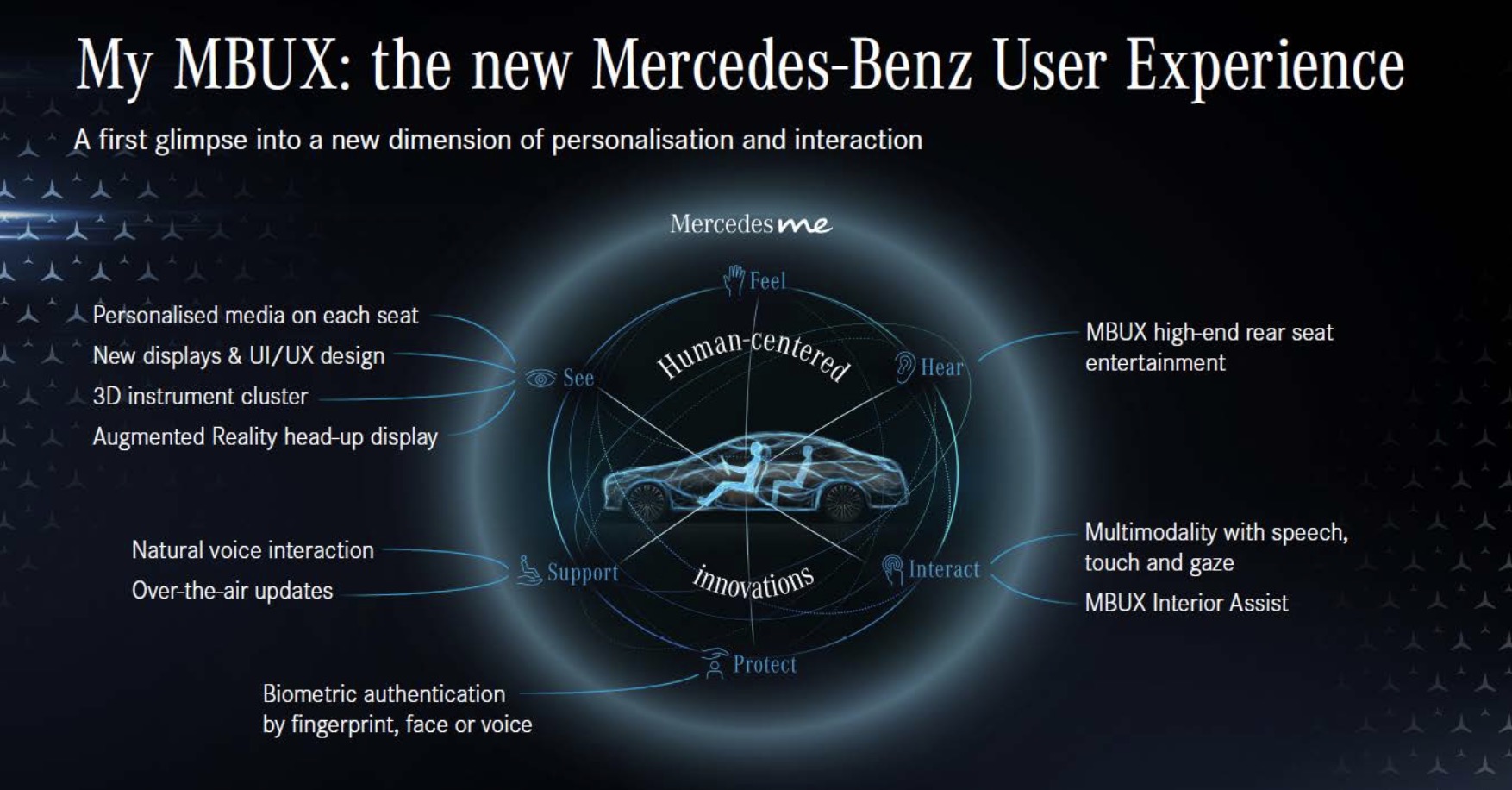
Before diving into the tech that stands out in the newest version of MBUX, here’s a handy graphic that provides an overview.

mercedes benz s class mbux

Image Credits: Mercedes-Benz

The first-generation Mercedes-Benz User Experience or MBUX system was unveiled in January 2018 at the CES tech trade show and debuted in the automaker’s A Class hatchback. That was a departure for Mercedes, which has historically reserved its best tech for its flagship model the S-Class. Mercedes is returning to that strategy with the new version of MBUX heading to the 2021 S-Class.

Here are the highlights.

5 touchscreens

You read that correctly. The 2021 Mercedes S Class will have up to five touchscreens, which includes displays for passengers. The S-Class will come standardly equipped with 12.8-inch OLED screens that include haptic feedback.

The user can control or access features on the displays by touching or swiping the actual screen or by using voice control, natural hand gestures and now gaze control.  Mercedes did hold back on keep some functions like lights and windshield wipers off of the touchscreen. The climate control panel is permanently at the lower edge of the display.

The system will provide the kind of customization an S-Class owner would expect. Preferences can be stored in the vehicle’s personal “Mercedes me” profile. Up to seven different profiles are possible in the vehicle.

The appearance of the screens can also be individualized with a choice of four display styles — discreet, sporty, exclusive and classic. The are three users modes as well to cover navigation, assistance and service. Screen content can also be shared with other passengers.

In the backseat, where up to three screens are optionally available, passengers can share select and amend navigation destinations.

3D display

Image Credits: Mercedes-Benz

Mercedes has adopted 3D technology into the vehicle, specifically for the driver display. The three-dimensional effect is possible without having to wear 3D glasses, the automaker said.

The company was able to achieve this effect by combining a conventional LCD display with a special pixel structure and a controllable LCD aperture grill. A barrier mask is placed a few millimeters in front of the LCD. The result is that the left and right eye see different pixels of the LCD, creating the illusion of depth.

The 3D display feature can be adjusted to a 2D or flatter graphic.

Voice

Mercedes-Benz put an early emphasis on voice in the first-generation of MBUX. The automaker said it has improved its voice assistant further. For instance, certain actions can be triggered without the ‘Hey Mercedes’ activation keyword to accept a phone call or display the navigation map. “Hey Mercedes” can now explain further in-car questions such as, where the first-aid kit is located or how to connect a smartphone via Bluetooth.

The voice assistant now understands commands and questions relating to infotainment sector and vehicle operation in 27 languages. It has also become far more natural and continues to learn — two areas we hope to test. For instance, the voice assistant understands indirect language such as if a user says “I am cold” instead of the clear command “Set temperature in footwell to 72 degrees.”

There’s also a new “Chit-Chat” feature that supplies the right answer to many questions — even questions about animal noises or general knowledge can be answered, Mercedes claims.

Security

Mercedes is all in on the security of this vehicle. The classic PIN entry is still on the S-Class. The automaker has added a new authentication method ensure a high level of security.

The system now combines fingerprint, face and voice recognition. This allows access to individual settings. That extra layer of security isn’t there to protect your seating preference, although perhaps that’s worth protecting. It’s also there to allow users to make payments digitally from within the vehicle.

Safety functions and assistants

Besides the voice assistant, the infotainment system is equipped with other tools to assist the driver.

For instance, there’s a special blind spot warning designed for drivers leaving their vehicle. Sensors and cameras can detect the driver’s intention to leave and will issue warning if there are road users and obstacles alongside the car. Another warning will alert of an unattached child seat on the front passenger seat.

The vehicle will also listen for cues to gauge the alertness level of the driver. If the driver says “I’m tired,” an activation program of energizing comfort control is started. The same sentence from the rear starts a well-being program.

08 Jul 2020

In pandemic era, entrepreneurs turn to SPACs, crowdfunding and direct listings

If necessity is the mother of invention, then new business owners are getting very inventive in the ways in which they access cash. Relying on some long-tested and some new avenues to raise money, entrepreneurs are finding more ways to get public market cash faster than they would have in the past.

Whether it’s from Reg A crowdfunding dollars, Special Purpose Acquisition Companies (SPACs) or direct listings, these somewhat arcane and specialized financing vehicles are making a comeback alongside a rise in new funding mechanisms to get to market quickly and avoid the dilution that comes from private market rounds (especially since those rounds are likely to come at a reduced valuation given market conditions).

Some of these tools have existed for a while and are newly popular in an era where retail investors are driving much of the daily fluctuations of the public markets. Wall Street institutions are largely maintaining their conservative postures with regard to new offerings, so secondary market retail volume growth is outpacing institutional. Retail investors want into these new issues and are pouring into the markets, contributing to huge pops to new public offerings for companies like Lemonade this Thursday and creating an environment where SPACs and crowdfunding campaigns can flourish.

The rise of zero-commission brokerages and the popularization of fractional trading led by the startup Robinhood and adopted by every one of the major online brokers including Charles Schwab, TD Ameritrade, E-Trade and Interactive Brokers has created a stock market boom that defies the underlying market conditions in the U.S. and globally. For instance, daily trades on Robinhood are up 300% year-over-year as of March 2020.

According to data from the BATS exchange, the total trade count in the U.S. was up 71% and May trading was up more than 43% over 2019. Meanwhile, E-Trade daily average revenue trades posted a 244% increase in May over last year’s numbers.

Don’t call it a comeback

The appetite for new issues is growing and if many of the largest venture-backed companies are holding off on going public, smaller names are using SPACs to access public capital and reach these new investors.

08 Jul 2020

PQShield raises $7M for quantum-ready cryptographic security solutions

A deep tech startup building cryptographic solutions to secure hardware, software, and communications systems for a future when quantum computers may render many current cybersecurity approaches useless is today emerging out of stealth mode with $7 million in funding and a mission to make cryptographic security something that cannot be hackable, even with the most sophisticated systems, by building systems today that will continue to be usable in a post-quantum future.

PQShield (PQ being short for “post-quantum”), a spin out from Oxford University, is being backed in a seed round led by Kindred Capital, with participation also Crane Venture Partners, Oxford Sciences Innovation and various angel investors, including Andre Crawford-Brunt, Deutsche Bank’s former global head of equities.

PQShield was founded in 2018, and its time in stealth has not been in vain.

The startup claims to have the UK’s highest concentration of cryptography PhDs outside academia and classified agencies, and it is one of the biggest contributors to the NIST cybersecurity framework (alongside academic institutions and huge tech companies), which is working on creating new cryptographic standards, which take into account the fact that quantum computing will likely make quick work of breaking down the standards that are currently in place.

“The scale is massive,” Dr Ali El Kaafarani, a research fellow at Oxford’s Mathematical Institute and former engineer at Hewlett-Packard Labs, who is the founder and CEO of PQShield said of that project. “For the first time we are changing the whole of public key infrastructure.”

And according to El Kaafarani, the startup has customers — companies that build hardware and software services, or run communications systems that deal with sensitive information and run the biggest risks from being hacked.

They include entities in the financial and government sectors that it’s not naming, as well as its first OEM customer, Bosch. El Kaafarani said in an interview that it is also in talks with at least one major communications and messaging provider exploring more security for end-to-end encryption on messaging networks. Other target applications could include keyless cars, connected IoT devices, and cloud services.

The gap in the market the PQShield is aiming to address is the fact that while there are already a number of companies exploring the cutting edge of cryptographic security in the market — they include large tech companies like Amazon and MicrosoftHub Security, Duality, another startup out of the UK focused on post-quantum cryptography called Post Quantum and a number of others — the concern is that quantum computing will be utilised to crack even the most sophisticated cryptography such as the RSA and Elliptic Curve cryptographic standards.

This has not been much of a threat so far since quantum computers are still not widely available and used, but there have been a number of signs of a breakthrough on the horizon.

El Kaafarani says that PQShield is the first startup to approach that predicament with a multi-pronged solution aimed at a variety of use cases, including solutions that encompass current cryptographic standards and provide a migration path the next generation of how they will look — meaning, they can be commercially deployed today, even without quantum computers being a commercial reality, but in preparation for that.

“Whatever we encrypt now can be harvested, and once we have a fully functioning quantum computer people can use that to get back to the data and the sensitive information,” he said.

For hardware applications, it’s designed a System on Chip (SoC) solution that will be licensed to hardware manufacturers (Bosch being the first OEM). For software applications, there is an SDK that secures messaging and is protected by “post-quantum algorithms” based on a secure, Signal-derived protocol.

Thinking about and building for the full spectrum of applications is central to PQShield’s approach, he added. “In security it’s important to understand the whole ecosystem since everything is about connected components.”

Some sectors in the tech world have been especially negatively impacted by the coronavirus and its consequences, a predicament that has been exacerbated by uncertainties over the future of the global economy.

I asked El Kaafarani if that translated to a particularly tricky time to raise money as a deep tech startup, given that deep tech companies so often work on long-term problems that may not have immediate commercial outcomes.

Interestingly, he said that wasn’t the case.

“We talked to VCs that were interested in deep tech to begin with, which made the discussion a lot easier,” he said. “And the fact is that we’re a security company, and that is one of the areas that is doing well. Everything has become digitised, and we have all become more heavily reliant on our digital connections. We ultimately help make the digital world more secure. There are people who understand that, and so it wasn’t too difficult to talk to them and understand the importance of this company.”

Indeed, Chrysanthos Chrysanthou, partner at Kindred Capital, echoed that sentiment:

“With some of the brightest minds in cryptography, mathematics and engineering, and boasting world-class software and hardware solutions, PQShield is uniquely positioned to lead the charge in protecting businesses from one of the most profound threats to their future,” he said. “We couldn’t be happier to support the team as it works to set a new standard for information security and defuse risks resulting from the rise of quantum.”