Author: azeeadmin

08 Jul 2020

Amazon U.S. sellers will have to display their name and address starting Sept. 1, 2020

Amazon on Wednesday informed its U.S. sellers they will soon have to display their business name and address on their Amazon.com seller profile page. For individual sellers, this will include the individual’s name and address. A similar system is already in place across Amazon’s stores in Europe, Japan, and Mexico, due to local laws. Amazon says it’s making the change to ensure there’s a more consistent baseline of seller information across its platform, so online shoppers can make informed buying decisions.

The change, of course, is not just about transparency.

Amazon’s U.S. marketplace is its oldest and largest, with 461,000 active U.S. sellers out of its 2.2 million worldwide actives. In total, there are 8.6 million registered sellers worldwide and Amazon adds around a million more per year, according to Marketplace Pulse data.

Amazon’s marketplace also accounts for around half the retailer’s sales. But as it’s grown, it’s been afflicted by a variety of issues and fraud, including problems with counterfeit goods.

Though Amazon has long been accused of avoiding these issues, it’s more recently pledged to spend billions to address the problem. Amazon even inserted itself into legal battles with fraudulent sellers and counterfeiters over the past couple of years, including those with designers and accessory makers, as well as others participating in the fake reviews economy.

Last year, Amazon also launched a set of tools for brands and manufacturers under its “Project Zero” initiative, which work to proactively combat counterfeiting.

And just this April, Amazon announced it was piloting a new system aimed at verifying the identity of third-party sellers over video-conferencing — a shift from its in-person verifications that had to stop due to the coronavirus outbreak. Through this system, Amazon checks that the individual seller’s ID matches the person and the documents they shared with their application, among other things.

Now Amazon is telling its U.S. sellers their business name and address will need to be on their profile by September 1, 2020.

The change will help businesses fighting fraud or taking legal action against sellers over counterfeit goods. Consumers will also have an address in case the product has caused harm and they need to contact the seller or even initiative legal action of their own.

Once the new system goes live in the U.S., the seller’s storefront on Amazon.com will display an expanded set of information about their business.

A photo from Marketplace Pulse shows how this may look, with a comparison of a U.K. seller page with its current U.S. counterpart:
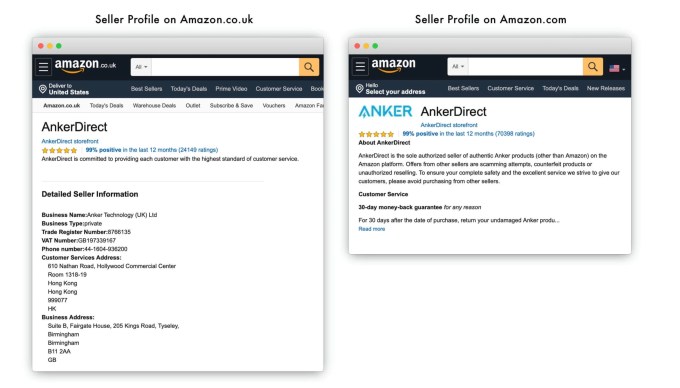
 

Image Credits: Marketplace Pulse

In a statement, Amazon says the change is about consistently, avoiding the topic of online fraud.

“Over the years, we have developed many ways for sellers to share more about their business, including through features like the seller profile pages, ‘Store’ pages for brand owners, and Handmade ‘Maker Profile’ pages,” an Amazon spokesperson said. “These features help customers learn more about sellers’ businesses and their products. Beginning September 1, we will also display sellers’ business name and address on their Amazon.com seller profile page to ensure there is a consistent baseline of seller information to help customers make informed shopping decisions,” they said.
08 Jul 2020

Microsoft makes Teams video meetings less tiring with its new Together mode

Video meetings. While the move to remote work during the COVID-19 pandemic may have made them mainstream, they are not without issues and more and more people are now opting out. And for good reason. As it turns out, it’s really hard for our brains to sustain concentration while we’re trying to focus on 20 people in neat squares, all with different backgrounds and never quite looking at the camera. While we’ve had quite a bit of anecdotal evidence for this, Microsoft today released some of the research it did in this area, as well as new features in Teams that it hopes will make video meetings easier and less tiring.

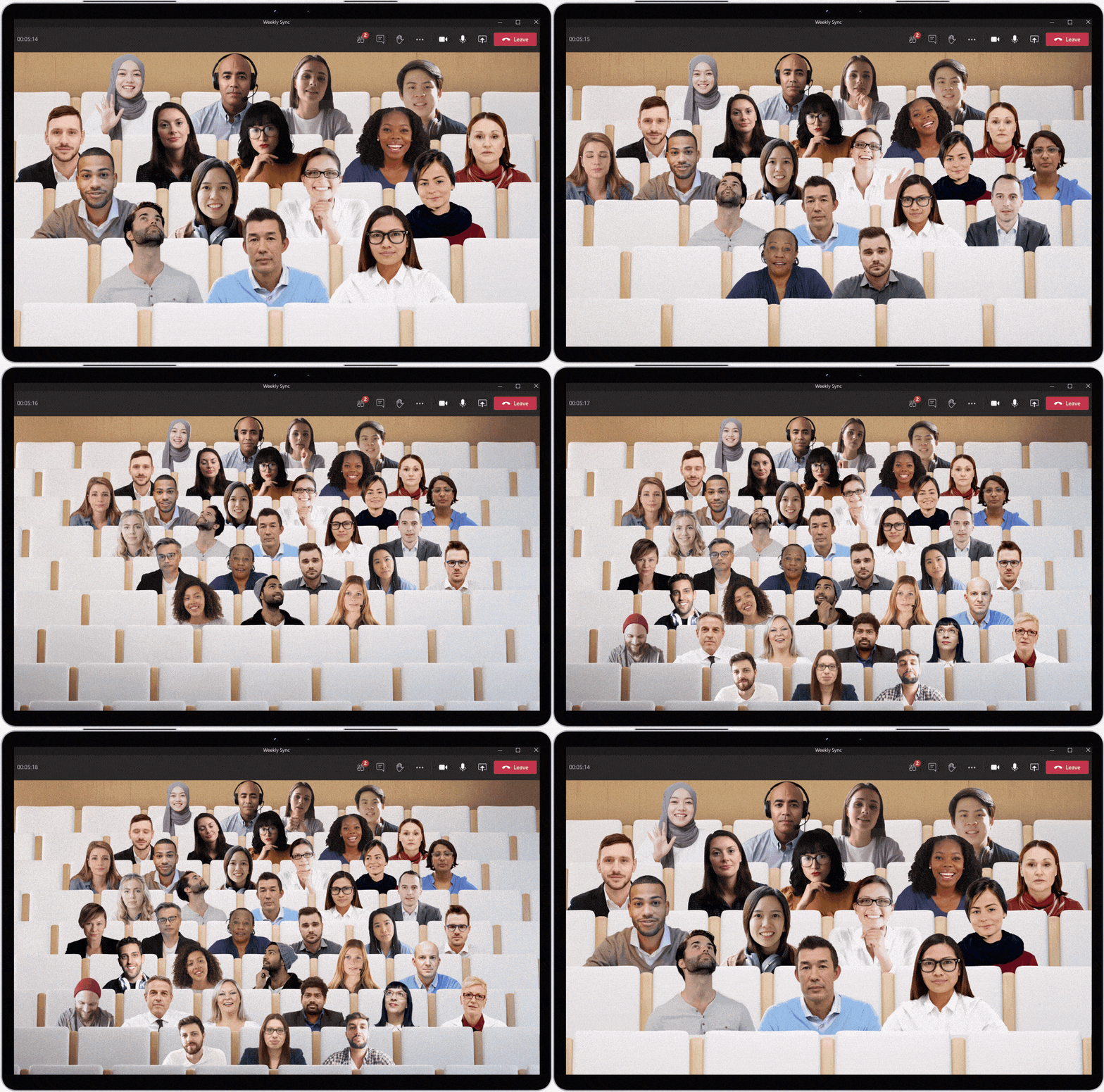
The first of these is Together mode. The idea here is actually pretty simple. To be able to change backgrounds or add background blur, Teams already features Microsoft’s AI segmentation technology to detect and cut out a participant’s image from the background. Now, with Together Mode, it is taking everybody’s images and putting them into a shared space, starting with an auditorium. So instead of lots of little squares, all of the meeting participants now sit in this auditorium. This, Microsoft’s research shows, is actually quite a bit easier on the brain to process than standard remote collaboration tools.

“In our preliminary research — and it’s only been preliminary thus far, this has only been around for a couple of months — we’ve noticed quite a few things,” Microsoft’s Melissa Salazar explained to me ahead of today’s announcement. “First and foremost, you’ll notice the way that we’re looking at each other is obviously very different than something we’re used to, not only are we out of the grid, but we’re looking at this, ‘mirror image’ of ourselves.” This view of ourselves, Microsoft argues, is something we’re quite used to from being at the barbershop, for example, where we talk to the mirror. This also tricks our brain into mitigating some of the eye contact problems we’ve all experienced in video meetings.

“Our research has also shown that people tend to be happier, be more engaged in meetings, feel more comfortable keeping their camera on longer — even if they’re not asked to in this mode. And then — I think most importantly — be able to pick up on the behavioral social cues that are so important to human interaction,” said Salazar.

Michael Bohan, a director in Microsoft’s Human Factors Engineering group, noted that just removing the grid view already makes a major difference here. “When you have a grid view, everybody’s boxed off and so your brain has to treat those as individual parts — it has to parse all information. When you remove those edges, then your brain can start to see a more unified view of things.”

For now, Together Mode only features the auditorium view, which can handle up to 49 participants, but Microsoft is already working on other views, including a more intimate coffee shop mode.

The other new mode Microsoft is introducing is Dynamic view. The idea here is that Together Mode is obviously not perfect for every kind of meeting, so this view provides more control over how you see shared content and the other participants in a meeting, including the ability to see content and specific participants side-by-side.

Also new in this update are video filters, to tweak your lighting levels, for example, and soon, Teams will add live reactions, which let you share your sentiment with emojis without interrupting the meeting. Coming soon, too, are PowerPoint Live Presentations to Teams, chat bubbles so you don’t have to keep a separate chat view open, and speaker attribution and translation for live captions and transcripts. For chats in teams, Microsoft is introducing Gmail-like suggested replies.

But there is more. Teams will soon let you bring the whole company together, with meetings that can support up to 1,000 participants. And for presentations, Teams will support up to 20,000 participants.

And since Cortana still lives, she is also now coming to the Teams mobile app to help you make calls, join meetings and more.

Microsoft also today re-introduced its dedicated Team Displays which it first announced at CES.

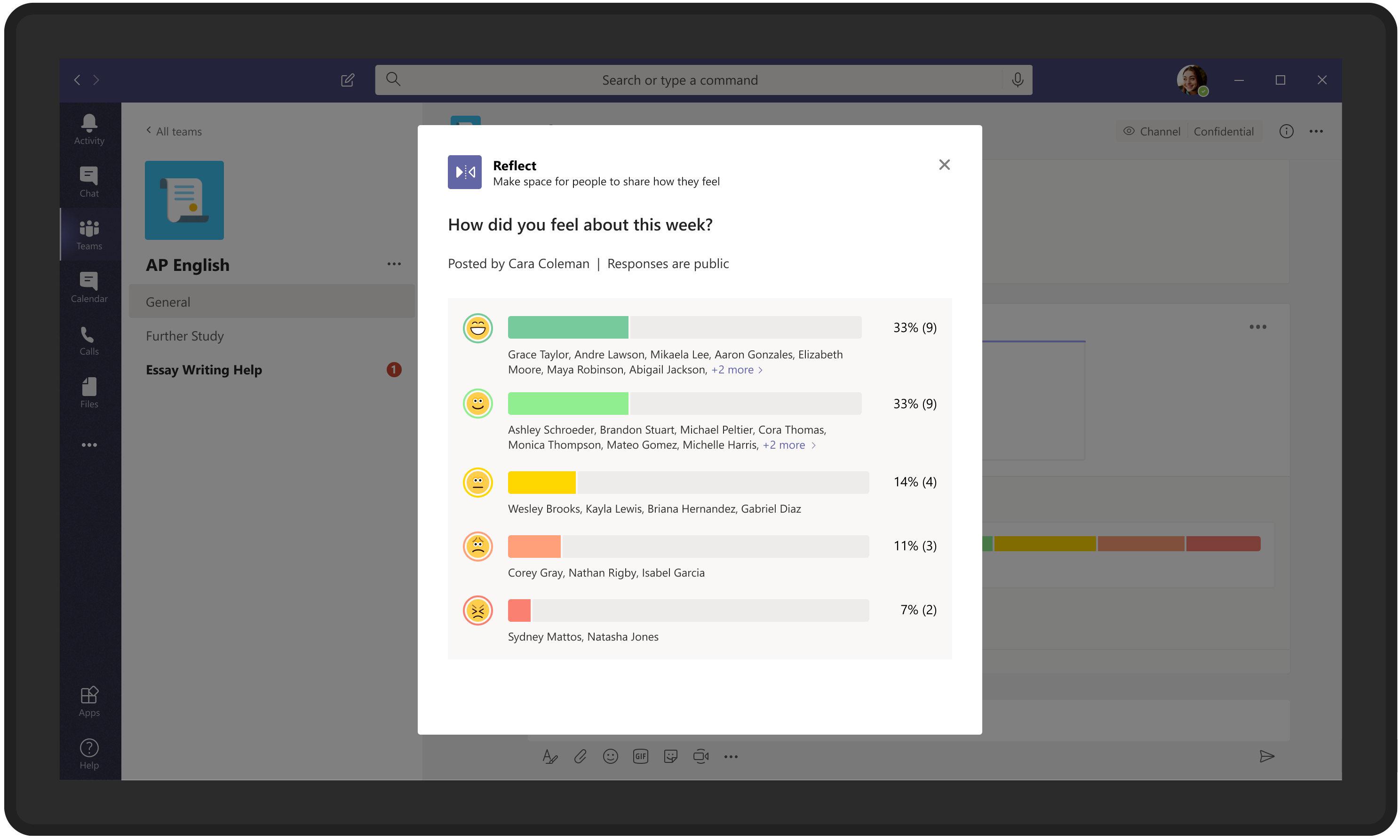
Another new feature Microsoft CVP Jared Spataro stressed when I talked to him ahead of today’s announcement was the new Reflect messaging extension. “This allows you to have a manager check in on the wellbeing of your team,” he explained. “You can do that anonymously or publicly. We’ve already been doing some of that on my team — just trying to check in with people — and this gives you a more structured way to do that. I think it’ll be really well received based on what I’m talking about with customers because this well-being  component is becoming very important.”

Image Credits: Microsoft

08 Jul 2020

In blistering audit, civil rights leaders raise alarms about Facebook’s ongoing policy failures

The results of a multiyear investigation into Facebook’s policies and their consequences for the civil liberties of its more than 2.5 billion users are out.

The audit, conducted by former ACLU director Laura W. Murphy and lawyers from law firm Relman Colfax set out by collecting concerns from a broad swath of civil rights organizations concerned about Facebook’s growing power and its potentially harmful reverberations through marginalized communities in particular and democratic society more broadly. The auditors also used concerns from some lawmakers, who have become increasingly critical of Facebook since the 2016 U.S. election, to steer their investigation. The ultimate goal of the project was to “make sure important civil rights laws and principles are respected, embraced, and robustly incorporated” into the social network.

As the report notes, the audit doesn’t situate Facebook’s decisions in the context of it competitors, instead evaluating the company’s behavior on its own. The approach is useful, because social media companies often get a pass for behavior that’s standard in the industry, an approach that lowers standards across the board rather than looking at real world impacts. The auditors make a point of giving Facebook credit for its cooperation in the audit, which the company itself undertook with pressure from outside groups concerned about its failings on issues like race-based hate, misinformation, voter suppression and extremism.

While the report has its positive moments of giving credit where credit is due, the auditors found that Facebook’s progress on civil rights issues has had many one step forward, two-steps-back moments over the last two years. Any sense of optimism about the company’s progress is tempered by frustration about Facebook’s policy missteps at the very top.

“While the audit process has been meaningful, and has led to some significant improvements in the platform, we have also watched the company make painful decisions over the last nine months with real world consequences that are serious setbacks for civil rights,” the auditors wrote.

As far as positive decisions go, they cite Facebook’s progress on changing policy in discriminatory housing and employment ads, expanded voter suppression policies, census interference prevention measures, more frequent meetings with civil rights leaders and changes to content moderation policies, like its prohibition of praise for white nationalism that went into effect last year.

In spite of some progress, the auditors say they still have a number of concerns. Specifically, they called for Facebook to implement its voter suppression policies more aggressively leading into the 2020 U.S. election, citing President Trump’s ominous false claims about voting in the 2020 election, which went untouched on the platform.

Facebook’s enforcement of its policies against white nationalism and white separatism (terms mostly synonymous with white supremacy) were also an area of concern, with the auditors calling for the company to forbid this kind of content even if it doesn’t use those terms specifically. The chalked some of these failures up to the company’s policies being “too reactive and piecemeal” rather than coherent, a statement that anyone paying attention to the company’s recent decisions can certainly relate to.

The audit cites a number of specific moments as failures for Facebook’s policies, including Nick Clegg’s deeply controversial assertion last year that politicians wouldn’t be subject to the company’s already shaky fact-checking program, a decision widely denounced by civil rights leaders and Facebook’s other critics for giving people in power “more freedom on the platform to make false, voter suppressive and divisive statements than the average user.”

Mark Zuckerberg’s Georgetown speech last October enshrining a very narrow and contentious conception of free speech at the expense of everything else was another major moment of departure for Facebook from its stated commitment to civil rights, the auditors write. “The prioritization of free expression over all other values, such as equality and non-discrimination, is deeply troubling.”

Facebook’s decision to this day to not reverse its course on posts from Trump that intentionally mislead the public about voting (in one he baselessly claimed vote-by-mail systems are “fraudulent”) also remains an ongoing source of frustration, undermining the company’s progress. The auditors wrote that they are confounded about why the company “has failed to grasp the urgency” of robust policy enforcement with fewer than five months to go before the U.S. presidential election, concluding that Facebook’s decision to keep the Trump posts up shows that civil rights and voting integrity fall far behind its expedient interpretation of free expression on the company’s list of values.

“This report outlines a number of positive and consequential steps that the company has taken, but at this point in history, the Auditors are concerned that those gains could be obscured by the vexing and heartbreaking decisions Facebook has made that represent significant setbacks for civil rights,” the report states.

The bits of the audit we’ve touched on here only scratch the surface of a fairly comprehensive and often clarifying examination of a complex company’s often troubling policy decisions, so we’ve embedded the full Facebook civil rights audit document below.

08 Jul 2020

GoHealth eyes multibillion-dollar valuation as it sets its initial IPO price range

GoHealth, a Chicago-based company that provides consumers with a digital portal to help them select insurance products, set an initial price range for its IPO today. The firm intends to price its equity between $18 to $20 per share in its debut.

As the company expects to sell 39.5 million shares in the offering, its IPO haul is huge. At the low-end of its range, GoHealth would raise $711 million, a figure that rises to $790 million at other end of its pricing spectrum. Including the 5.925 million shares the company will offer its underwriting team, its fundraise swells to between $817.65 million and $908.5 million.

Valuing the company at its IPO price range is a bit tough, as the firm was previously majority-sold to a buyout firm called Centerbridge in a deal that valued the firm at what Reuters reported as a $1.5 billion price-tag in 2019 (others confirmed the price). That transaction turned the company’s organization, and shareholding structure, into a muddle.

Parts of its shareholding structure are simple. The firm’s Class A shares, for example, at the top end of its IPO price, are worth around $1.7 billion, including equity offered to underwriters. So, regardless of what happens with its other interests and shares, the IPO looks set to be a win for Centerbridge.

Next, there are several hundred million Class B shares that come with votes, but no “economic interest in GoHealth, Inc.” And, finally, there are LLC interests in the company, which correspond with Class B shares. Holders of LLC interests can swap them for “newly-issued shares of our Class A common stock on a one-for-one” when they’d like.

So, how does that all square out? When we properly count all the shares for the firm and apply its IPO price range, GoHealth could be worth between $5.6 billion and $6.3 billion, figures that we are glad other publications arrived at as well.

That’s a big price tag, but one befitting a company looking to raise $711 million to $908.5 million in its public debut.

A financial reminder

In Q1 2020, GoHealth posted $141.0 million in revenue, and net income of $1.4 million. Not a fat profit margin to be sure, but it did make money in the period, which is always popular, if out-of-date in today’s IPO market.

The company has grown nicely in recent years, with its S-1 filing touting 139% “pro forma growth” from 2018 to 2019. That’s great, given that GoHealth has at least some history of making money as well.

Turning to the most recent quarter, however, we find some red ink. In the quarter ending June 30, 2020:

  • GoHealth had revenues of “between $118.0 million and $130.0 million,” up 66.4% at the midpoint of that range compared to the year-ago period.
  • That growth came at a cost, with GoHealth reporting that its “net loss is expected to be between $20.0 million and $26.0 million, as compared to net income of $15.3 million for the three months ended June 30, 2019.”
  • However, for the bulls out there, GoHealth’s adjusted EBITDA — a heavily tuned “profit” metric — should be between $24 and $28 million in the quarter, up from $17.2 million in the year-ago period.

How investors will parse all that out and place a proper valuation on the firm is their job; have fun, ya’ll.

What about startups?

Sure, GoHealth raised capital while it was a private company, and, sure, its business is digital. But it’s not really the core substance of TechCrunch’s coverage, namely startups. The company is around 19 years old, for heaven’s sake.

But what matters for our purposes is that earlier this year there was a boom in insurance marketplaces raising capital, leading TechCrunch to write a piece entitled “Why VCs are dumping money into insurance marketplaces.” GoHealth is a related entity to those younger companies. If it has a good IPO, that’s good for its smaller brethren. If it struggles, or only attracts a slim, unattractive multiple, it could partially chill the fundraising climate for companies looking to follow in its footsteps.

08 Jul 2020

What India’s TikTok ban means for China

For more than a decade, China has limited how foreign tech firms that operate inside its borders do business. The world’s largest internet market has used its Great Firewall to block Facebook, Twitter, Google and other services in the name of preserving its cyber sovereignty.

The walled-garden approach has helped homegrown giants like Tencent and Alibaba Group win the local market, while giving the Chinese government a better hold on what gets communicated on these platforms. China has even suggested that other nations deploy similar measures.

Be careful what you ask for: Last week, dozens of Chinese firms got a front-seat view to the challenges their global counterparts face in their territory. With a press release, India declared that the world’s second-largest internet market was shutting the door to dozens of Chinese firms for an indefinite period.

India said it would ban 59 apps and services, including ByteDance’s TikTok, Alibaba Group’s UC Browser and UC News, and Tencent’s WeChat over cybersecurity concerns.

New Delhi is open to meeting these firms and hear their defenses, but for now, local telecom operators and other internet service providers have been ordered to block access to these services. Google and Apple have already complied with India’s order and delisted the apps from their app stores.

India’s order is already shifting the market in favor of local firms, several of which have rushed to cash in on the app ban. A crop of recently launched short-form video sharing services have amassed tens of millions of users just this week.

But depending on how long the ban remains in place, the move could also derail a big funding source for thousands of Indian startups. The vast majority of India’s unicorns count Chinese VCs as some of their biggest and longest-term backers. New Delhi’s order could also change how American giants, many of which are already bullish on India, review the market moving forward.

Today, we will explore various ways India and China’s situation could play out and impact various stakeholders. But first, some background on how tension escalated between the two nuclear-armed nations.

08 Jul 2020

Ade Ajao, Maryanna Saenko, Charles Hudson, Ulili Onovakpuri, and Melissa Bradley are coming to Disrupt

At TechCrunch Disrupt, our Startup Battlefield event is the centerpiece of the event, the true heart of this signature program.

There’s good reason we take it so seriously. Over the years, our Startup Battlefield competition has helped launch dozens of nascent startups that have grown into game-changing brands, including Cloudflare, Dropbox, Vurb, Mint, GetAround, Fitbit, Yammer and more. Collectively, Battlefield participants have gone to raise $9 billion from investors, and to generate 115 exits.

With nearly 1,000 applicants already this year — just 20 of which will make it to our stage — we aim to get it right again. Still, the competition is as fierce as ever. It’s why we’ll be relying heavily on featuring the right mix of judges. It’s these investors whose expertise and questions and insights will be key in determining which company is anointed our winner this year.

Toward that end, we’re spotlighting just five investors who we’re thrilled will be joining us in September: Ade Ajao, Maryanna Saenko, Charles Hudson, Ulili Onovakpuri, and Melissa Bradley.

Ade Ajao has sat on both sides of the table. He is the cofounder and managing director of the early-stage, San Francisco-based venture firm Base10 Ventures. But before launching Base10 three years ago, Ajao spent several years as a VP with the HR giant Workday, as well as cofounded three notable companies, including one of the largest ride-sharing services in Latin America (Cabify); the data and analytics platform Identifed; and Tuenti, a social networking platform in Spain that was later acquired by Telefonica.

Maryanna Saenko, who in late 2018 cofounded the early-stage venture firm Future Ventures, has an equally diverse set of experiences. Focused today on robotics, quantum computing, biotechnology, aerospace, and the future of food, Saenko was was previously an investor with both Khosla Ventures, DFJ, and Airbus Ventures where she led a series of venture investments aligned with Airbus’ future-of-aerospace initiatives. Before Airbus, Maryanna was a consultant at Lux Research and a research engineer at Cabot Corporation.

Charles Hudson is the founder and managing partner of Precursor Ventures, a pre-seed, San Francisco-based venture firm that has built its brand by leading the first institutional funding round for numerous kinds of software and hardware companies whose vision it likes. And before launching Precursor,  Hudson spent eight years as a partner with Uncork Capital (formerly known as SoftTechVC),  a role he took after cofounding a mobile games studio called Bionic Panda, and  working in business development across a range of companies earlier in his career, including Google.

Uriridiakoghene “Ulili” Onovakpuri is a partner with Kapor Capital in Oakland, Ca., where she’s focused especially on startups that revolve around digital health and medical tech. Onovakpuri, who describes herself as a proud UC Berkeley alum (with a MBA from Duke) was previously the director global programs at Village Capital, the global accelerator program and venture firm with ties to Jeff Bezos, Bill Gates and Mark Zuckerberg, among many others. She also founded and ran for three years a startup called LifeKit that aimed to improve access to healthcare in the most rural regions of the world.

Last but not least, Melissa Bradley is the cofounder of Ureeka, a Washington, D.C.-based online platform where small businesses can come for professional training and coaching and that Bradley launched after spending roughly two years as a a managing director with the Washington-based accelerator 1863 Ventures. Bradley also previously cofounded a social impact agency called Sidecar Social Finance; was a managing director at Project 500, a business development program to help diverse businesses scale; and served as an adjunct professor at the McDonough School of Business at Georgetown University.

Based on what we’re already seeing from applicants, the Battlefield will feature some especially compelling founding teams and pitches this year. We don’t envy our judges their work, but we are very thankful that they can join us.

Do join us for this must-see event. Disrupt 2020 runs from September 14-18 and will be virtual this year. Get your front row seat to the Startup Battlefield competition and much more with a Disrupt Digital Pro Pass or a Digital Startup Alley Exhibitor Package. (Prices increase in a few short weeks.)


08 Jul 2020

Swiftmile raises $5 million round led by Thayer Ventures for micromobility charging stations

Swiftmile, the startup that makes and deploys charging stations for electric bikes and scooters in cities, has raised a $5 million round led by Thayer Ventures with participation from Verizon Ventures, Alumni Ventures Groups and WSGR. This round brings Swiftmile’s total funding to $11 million.

“What’s happening today is streets are being totally reimagined,” Swiftmile co-founder and CEO Colin Roche told TechCrunch. “If you talk to any city planner, the old rules are being thrown out and new ones are being written. Public transportation use has plummeted because people are scared of [COVID-19] transmission in closed environments. We went from being a nice to have to a need to have.”

Swiftmile works with cities to deploy charging hubs and charges the operators by the minute, but not to exceed a certain amount, depending on the market. Initially, the docking system will be open to all operators in order to show them how it works and how beneficial it can be. After a certain period of time, Swiftmile will only charge its customers’ scooters.

With the new funding, Swiftmile plans to deploy its systems in three additional cities in the U.S., as well as work on expanding into Europe. Currently, Swiftmile has 150 smart-charging stations deployed throughout the U.S.

08 Jul 2020

Fintech startup nCino targets ~$2B valuation in impending IPO

As IPO season continues, another venture-backed tech company is moving closer toward going public. This week nCino filed an updated S-1 filing, providing an initial price range for its equity of $22 to $24 per share.

Indeed, nCino, a fintech startup that provides operating software to banks, intends to sell 7.625 million shares in its debut, worth $167.75 million to $183 million at those prices. Including shares offered to its underwriters, its haul grows to between $192.9 million and $210.5 million.

Discounting the extra shares, nCino is worth between $1.96 billion to $2.14 billion at its current price range.

The startup’s software is what nCino calls a “bank operating system,” providing banking software to help financial entities with lending, customer resource management, account opening and more. It’s a rich space for innovation, given the banking industry’s complexity and wealth. Smaller startups are also working along related lines.

Normally at this point in an IPO process we compare the debuting company’s valuation range with its final private valuation. However, it’s hard to find out what nCino was worth. PitchBook and Crunchbase are bare regarding its last private round, as are other data sources we checked.

Notably, nCino has no preferred stock, so spelunking through different series of preferred equity sourced from S-1 data wasn’t possible. However, the company was healthy — and therefore, valuable — enough to raise more than $130 million across two rounds in 2018 and 2019, including an $80 million round from last October led by Chip Mahan and T. Rowe Price.

Regardless of where nCino priced toward the end of its life as a private company, its IPO is a likely win for both Salesforce and Insight Partners. The corporate venture arm of Salesforce and the well-known venture group own 13.2% and 46.6%, respectively, of nCino’s equity before IPO shares are counted; expected ownership for the two groups falls to 12.1% and 42.6%, respectively, when including anticipated IPO equity.

According to Crunchbase data, Insight Partners led nCino’s Series B and C in 2014 and 2015, while Salesforce Ventures led its $51.5 million 2018 round; Salesforce also took part in several of the company’s early rounds, helping to explain its double-digit stake in the firm.

So what?

Modern software companies, often called SaaS firms, set new valuation records this week on the public markets following earlier highs set in Q2. Their performance hints that nCino could find warm welcome from public investors.

Does that fact fit with the valuation that the above-detailed pricing indicates that nCino may achieve? Annualizing the company’s Q1 (the April 30, 2020 period) revenue results, nCino’s $178.9 million run rate would give it a revenue multiple of 11x to 12x at its expected IPO prices, a somewhat modest result by current standards.

Indeed, as nCino grew about 50% from Q1 2019 to Q1 2020, it feels light. The firm’s GAAP losses are slim compared to revenue as well for a SaaS business, though the company’s operating cash burn did grow from $4.6 million in its fiscal year ending January 31, 2019 to $9.0 million in its next fiscal year. Its numbers are mostly good, with some less-than-perfect results. Still, given its growth rate, an 11-12x revenue multiple feels modest; that figure rises, of course, if we use a trailing revenue figure instead of our annualized number.

It would not be a shock, then, if nCino targets a higher price interval for its shares before it formally prices. The firm is expected to price next Tuesday and trade the next day, the same time frame as GoHealth. More when we have it.

08 Jul 2020

Hear how to manage your enterprise infrastructure from Sam Pullara at TechCrunch Early Stage

In just over a decade, cloud-based platforms have completely reshaped the multi-hundred billion dollar enterprise IT market. Companies have thrown out their boxes and software-defined and microservice’d everything from the network stack to storage, compute, and application delivery and everything in-between.

It should be the most lucrative single slice of the startup world today, except for one (well, maybe three) major challenges whose their names are AWS, Google Cloud, and Azure.

The growth of these three platforms has been dizzying and they have driven much of the enterprise adoption of cloud technologies the past decade. But they also lock customers into their vertically-integrated offerings, leaving in some cases just table scraps for startups trying to find margin in an incredibly competitive world.

How can startups fend off the biggest cloud providers and still maintain growth? How can they offer differentiated offerings when AWS alone offers more services than are countable by the most advanced forms of artificial intelligence?

Thankfully, we have a long-time operator and veteran VC joining us at TC Early Stage online on July 21-22 to discuss this and more on how infrastructure startups can compete in platform-dominated world.

Sam Pullara is a managing director at Sutter Hill Ventures where he invests in enterprise infrastructure startups like application performance monitoring service Observe, DevOps platform Transposit, and anomaly detection startup Lacework.

He’s up-to-speed on the latest in the infra world, and informed from his previous experience at Twitter, where he was a senior technology advisor and a senior infrastructure engineer, and he was formerly Chief Technologist at Yahoo, which today is part of the Borg corporate entity that is Verizon Media, TechCrunch’s magnanimous and enigmatic parent company.

If you’re interested in the future of the enterprise, this is where you want to be.

TC Early Stage is our brand-new virtual event series that focuses on getting new founders the information, insight and advice directly from the experts — the founders, investors and lawyers who’ve been down these roads many times before. Schippers and Evans are joining an already incredible list of speakers, with sessions and talks from folks like Reid Hoffman, Brooke Hammerling, Dalton Caldwell, Garry Tan, Charles Hudson and Cyan Banister.

One catch: Each of the 50+ breakout sessions at TC Early Stage will be capped at just 100 people and will be filled on a first-come, first-serve basis. Buy your ticket today and you’ll be able to sign up for any breakout sessions we announce, plus any we’ve already announced that still have room.

It all goes down on July 21-22. The best news? This two-day event is all virtual, so you can tune in from the comforts of your couch. Want to know more? Find all the details you could ever want right here.

08 Jul 2020

Harvard biomedical engineering professor to launch nasal spray that could reduce COVID-19 transmission risk

A new product developed by Harvard professor of the Pracice of Biomedical Engineering David A. Edwards is set to launch this fall, and claims to be able to provide a nearly 100 percent reduction in the particles present in exhaled air – thus reducing the potential transmission of SARS-CoV-2 both into, and out of, the lungs while breathing. That could mean a significantly reduced risk of contracting COVID-19, particularly for frontline healthcare workers when used in combination with other PPE like face masks.

The product, called FEND, and produced by Edwards’ tech startup Sensory Cloud, is set to be available from September. It’s a saline mixture (essentially a “salty mist”) that contains no drugs, and is instead directed from naturally-occurring salts that are most often found in sea water. The mist, when delivered via deep nasal inhalation in misted form, has been shown in peer-reviewed research published on Tuesday by Sensory Cloud in medical journal QRB Discovery to clean upper human airways of particles that are less than a micron in size that aren’t typically filtered out by most conventional mask designs.

The study conducted by the company is based on a small-scale sample population of 10 volunteers, including five who are above 65, and five who are below that age, so it’s worth taking that into account when considering the results. Still, cross the sample group, the researchers found that it reduced transmitted particles per liter of air by around 99 percent – with most of those particles blocked being ones that would’ve been too small to be filtered by conventional masks.

Sensory Cloud contends that FEND could provide “anyone at risk of SARS-CoV-2” with additional protection – in terms of scrubbing the airways of both inhaled particles for those who don’t yet have the virus, and also for preventing the expulsion of viral particles for those that do. Accordingly, while the company plans to launch it to get general public through its online sales platform, it is also “committing to facilitating access” of FEND once it becomes available to “needy at-risk populations” including frontline workers around the world. Sensory Cloud is also debuting a number of clinical trials this summer, the results of which should go a long way in terms of supporting their early small-scale study results, if positive.

The startup plans to price Fend, including the mister delivery device, at $49 for a two-pack – with individual refill bottles priced at $6 each afterwards, with each refill providing around 250 total uses (each use provides the cleaning benefits described above for roughly 6 hours based on the company’s research).