Author: azeeadmin

24 Mar 2019

Hackers conquer Tesla’s in-car web browser and win a Model 3

A pair of security researchers dominated Pwn2Own, the annual high-profile hacking contest, taking home $375,000 in prizes including a Tesla Model 3 — their reward for successfully exposing a vulnerability in the electric vehicle’s infotainment system.

Tesla handed over its new Model 3 sedan to Pwn2Own this year, the first time a car has been included in the competition. Pwn2Own is in its 12th year and run by Trend Micro’s Zero Day Initiative. ZDI has awarded more than $4 million over the lifetime of the program.

The pair of hackers Richard Zhu and Amat Cam, known as team Fluoroacetate, “thrilled the assembled crowd” as they entered the vehicle, according to ZDI, which noted that after a few minutes of setup, they successfully demonstrated their research on the Model 3 internet browser.

The pair used a JIT bug in the renderer to display their message — and won the prize, which included the car itself. In the most simple terms, a JIT, or just-in-time bug, bypasses memory randomization data that normally would keep secrets protected.

Tesla told TechCrunch it will release a software update to fix the vulnerability discovered by the hackers.

“We entered Model 3 into the world-renowned Pwn2Own competition in order to engage with the most talented members of the security research community, with the goal of soliciting this exact type of feedback. During the competition, researchers demonstrated a vulnerability against the in-car web browser,” Tesla said in an emailed statement. “There are several layers of security within our cars which worked as designed and successfully contained the demonstration to just the browser, while protecting all other vehicle functionality. In the coming days, we will release a software update that addresses this research. We understand that this demonstration took an extraordinary amount of effort and skill, and we thank these researchers for their work to help us continue to ensure our cars are the most secure on the road today.”

Pwn2Own’s spring vulnerability research competition, Pwn2Own Vancouver, was held March 20 to 22 and  featured five categories, including web browsers, virtualization software, enterprise applications, server-side software and the new automotive category.

Pwn2Own awarded a total of $545,000 for 19 unique bugs in Apple Safari, Microsoft Edge and Windows, VMware Workstation, Mozilla Firefox, and Tesla.

Tesla has had a public relationship with the hacker community since 2014 when the company launched its first bug bounty program. And it’s grown and evolved ever since.

Last year, the company increased the maximum reward payment from $10,000 to $15,000 and added its energy products as well. Today, Tesla’s vehicles and all directly hosted servers, services and applications are now in scope in its bounty program

23 Mar 2019

Flying taxi startup Blade is helping Silicon Valley CEOs bypass traffic

One year after a $38 million Series B valued on-demand aviation startup Blade at $140 million, the company has begun taxiing Silicon Valley’s elite.

As part of a new pilot program, Blade has given 200 people in San Francisco and Silicon Valley exclusive access to its mobile app, allowing them to book helicopters, private jets and even seaplanes at a moments notice for $200 per seat, at least.

Blade, backed by Lerer Hippeau, Airbus, former Google CEO Eric Schmidt and others, currently flies passengers around the New York City area, where it’s headquartered, offering the region’s wealthy $800 flights to the Hamptons, among other flights at various price points. According to Business Insider, it has worked with Uber in the past to help deep-pocketed Coachella attendees fly to and from the Van Nuys Airport to Palm Springs, renting six-seat helicopters for more than $4,000 a pop.

Its latest pilot seems to target business travelers, connecting riders to the San Francisco International Airport and Oakland International Airport to Palo Alto, San Jose, Monterey and Napa Valley. The goal is to shorten trips made long by increasingly bad traffics in major cities like New York, Los Angeles and San Francisco. Recently, the startup partnered with American Airlines to better establish its airport transportation options, a big step for the company as it works to integrate with existing transportation infrastructure.

Blade, led by founder and chief executive officer Rob Wiesenthal, a former Warner Music Group executive, has raised about $50 million in venture capital funding to date. To launch at scale and, ultimately, to compete with the likes of soon-to-be-public transportation behemoth Uber, it will have to land a lot more investment support.

Uber too has lofty plans to develop a consumer aerial ridesharing business, as do several other privately-funded startups. Called UberAIR, Uber plans to offer short-term shareable flights to commuters as soon as 2023. The company has raised billions of dollars to turn this sci-fi concept to reality.

Then there’s Kitty Hawk, a company launched by former Google vice president an Udacity co-founder Sebastian Thrun, which is developing an aircraft that can take off like a helicopter but fly like a plane for short-term urban transportation. Others in the air taxi or vertical take-off and landing aircraft space, including Volocopter, Lilium and Joby Aviation, have raised tens of millions to eliminate traffic congestion or, rather, to chauffer the rich.

Blade’s next stop is India, the Financial Times reports, where it will conduct a pilot connecting travelers in downtown Mumbai and Pune. The company tells TechCrunch they are currently exploring one additional domestic pilot and one additional international pilot.

23 Mar 2019

A family tracking app was leaking real-time location data

A popular family tracking app was leaking the real-time locations of more than 238,000 users for weeks after the developer left a server exposed without a password.

The app, Family Locator, built by Australia-based software house React Apps, allows families to track each other in real-time, such as spouses or parents wanting to know where their children are. It also lets users set up geofenced alerts to send a notification when a family member enters or leaves a certain location, such as school or work.

But the backend MongoDB database was left unprotected and accessible by anyone who knew where to look.

Sanyam Jain, a security researcher and a member of the GDI Foundation, found the database and reported the findings to TechCrunch.

Based on a review of the database, each account record contained a user’s name, email address, profile photo and their plaintext passwords. Each account also kept a record of their own and other family members’ real-time locations precise to just a few feet. Any user who had a geofence set up also had those coordinates stored in the database, along with what the user called them — such as “home” or “work.”

None of the data was encrypted.

TechCrunch verified the contents of the database by downloading the app and signing up using a dummy email address. Within seconds, our real-time location appeared as precise coordinates in the database.

We contacted one app user at random who, albeit surprised and startled by the findings, confirmed to TechCrunch that the coordinates found under their record were accurate. The Florida-based user, who did not want to be named, said that the database was the location of their business. The user also confirmed that a family member listed in the app was their child, a student at a nearby high school.

Several other records we reviewed also included the real-time locations of parents and their children.

TechCrunch spent a week trying to contact the developer, React Apps, to no avail. The company’s website had no contact information — nor did its bare-bones privacy policy. The website had a privacy-enabled hidden WHOIS record, masking the owner’s email address. We even bought the company’s business records from the Australian Securities & Investments Commission, only to learn the company owner’s name — Sandip Mann Singh — but no contact information. We sent several messages through the company’s feedback form, but received no acknowledgement.

On Friday, we asked Microsoft, which hosted the database on its Azure cloud, to contact the developer. Hours later, the database was finally pulled offline.

It’s not known precisely how long the database was exposed for. Singh still hasn’t acknowledged the data leak.

23 Mar 2019

A week of game streaming and earthquakes

From Extra Crunch

Wide Angle

Photo by Antonio Masiello/Getty Images

Stories from outside the 280/101 corridor

23 Mar 2019

Planning for the uncertain future of work

In a recently published, roughly 75-page report, British non-profit organization The Royal Society for the Encouragement of Arts (RSA) outlined several scenarios for how the UK labor market will be impacted by frontier technologies such as automation, AI, AVs and more.

The analysis titled “The Four Futures of Work” was conducted in collaboration with design and consulting firm Arup and was spearheaded by the RSA’s “Future Work Centre”, which focuses on the impact of new technologies on work and is backed by law firm Taylor Wessing, the Friends Provident Foundation, Google’s philanthropic arm Google.org and others.

The report is less of a traditional research paper and more of a qualitative, theoretical and abstract exploration of how the world might look depending on how certain technological and sociological variables (immigration, political will, etc.) develop. The authors don’t try to estimate growth paths for new technologies nor do they try to reach a definitive conclusion on what the future of work will look like. The work instead looks to lay out multiple possible outcomes in order to help citizens prepare for transformations in labor and to derive policy recommendations to mitigate externalities in each scenario.

As opposed to traditional quantitative data-based methodologies, research was conducted using “morphological scenario analysis.” The authors’ worked with technologists, industry executives and academic researchers to identify the technological and non-technological uncertainties that will have a critical impact on the future of work, before projecting three (minimal impact, moderate impact, and severe impact) possible scenarios of how each will look by the year 2035. With input from the report’s collaborators, the researchers then chose the four most compelling and sensical scenarios for how the future of work look.

The value of the report depends entirely on how readers intend to use it. If one hopes to gauge market sizes or inform forecasts or is looking for scientific, quantitative research with data — they should not read this. The report is more useful as a way to understand the different ways new technologies may evolve through thought-provoking, fun-yet-probabilistic, and poetic narratives of hypothetical future economic structures and how they might function.

Rather than summarize the four detailed scenarios in the report and all the conclusions discussed, which can be found in the executive summary or full report, here are a few takeaways and the most interesting highlights in our view:

The underwhelming:

23 Mar 2019

Planning for the uncertain future of work

In a recently published, roughly 75-page report, British non-profit organization The Royal Society for the Encouragement of Arts (RSA) outlined several scenarios for how the UK labor market will be impacted by frontier technologies such as automation, AI, AVs and more.

The analysis titled “The Four Futures of Work” was conducted in collaboration with design and consulting firm Arup and was spearheaded by the RSA’s “Future Work Centre”, which focuses on the impact of new technologies on work and is backed by law firm Taylor Wessing, the Friends Provident Foundation, Google’s philanthropic arm Google.org and others.

The report is less of a traditional research paper and more of a qualitative, theoretical and abstract exploration of how the world might look depending on how certain technological and sociological variables (immigration, political will, etc.) develop. The authors don’t try to estimate growth paths for new technologies nor do they try to reach a definitive conclusion on what the future of work will look like. The work instead looks to lay out multiple possible outcomes in order to help citizens prepare for transformations in labor and to derive policy recommendations to mitigate externalities in each scenario.

As opposed to traditional quantitative data-based methodologies, research was conducted using “morphological scenario analysis.” The authors’ worked with technologists, industry executives and academic researchers to identify the technological and non-technological uncertainties that will have a critical impact on the future of work, before projecting three (minimal impact, moderate impact, and severe impact) possible scenarios of how each will look by the year 2035. With input from the report’s collaborators, the researchers then chose the four most compelling and sensical scenarios for how the future of work look.

The value of the report depends entirely on how readers intend to use it. If one hopes to gauge market sizes or inform forecasts or is looking for scientific, quantitative research with data — they should not read this. The report is more useful as a way to understand the different ways new technologies may evolve through thought-provoking, fun-yet-probabilistic, and poetic narratives of hypothetical future economic structures and how they might function.

Rather than summarize the four detailed scenarios in the report and all the conclusions discussed, which can be found in the executive summary or full report, here are a few takeaways and the most interesting highlights in our view:

The underwhelming:

23 Mar 2019

Corporate biotech venture funding rises again

Biotech venture funding has been on a tear for the past couple of years, and corporate investors in the space are doing their part to boost the totals.

Here at Crunchbase, we’ve put together an index of the largest pharma and biotech companies active in startup investment, along with their in-house venture arms. For the second year in a row, we’re tallying their venture investments by round count and dollar totals.

The broad finding? Corporate biotech investors sharply increased the sums put into startup rounds they led in 2018. Overall, they also participated in rounds that were valued at nearly twice year-ago levels.

These aren’t small sums either. In all of 2018, corporate venture investors participated in rounds valued at $8 billion. Rounds with a corporate bio VC as lead investor, meanwhile, totaled around $1.7 billion.

Below, we drill down into a bit more detail, looking at funding totals for the past five years, largest rounds and most active investors.

As bio deals balloon, corporate VCs get spendier

First, it’s worth noting that overall global biotech venture funding rose sharply last year and has been running at historically high levels for the past few years.

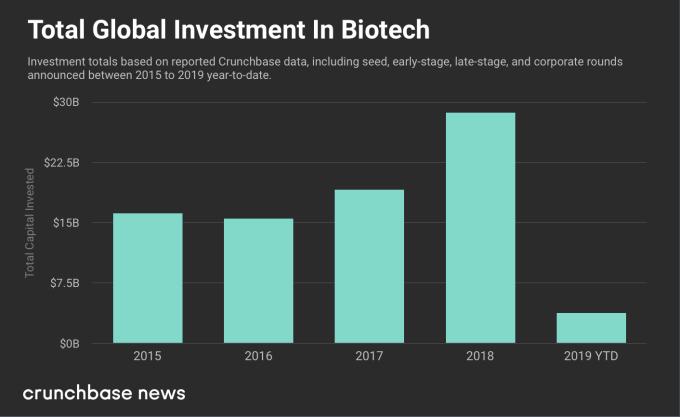
For 2018, biotech startups globally raised just shy of $29 billion in seed through late rounds from all investors, according to Crunchbase data. That’s up from $19 billion in 2017.1


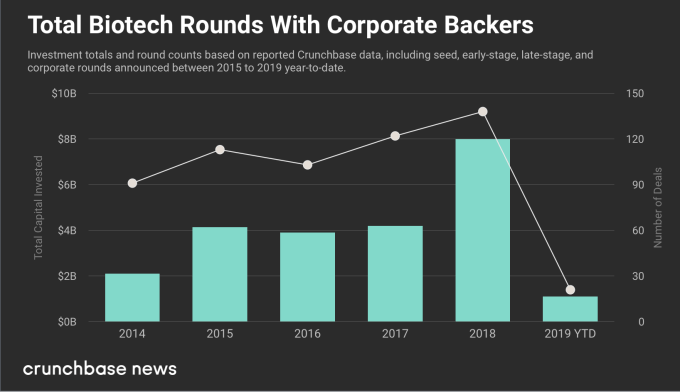
Most biotech deals do not include a corporate backer, but a pretty substantial minority do. In 2018, investors in our corporate biotech index participated in 138 seed, venture or growth-stage funding rounds, up from 122 in 2017.

Round counts did not rise as much as investment totals, as the average biotech deal has been getting bigger. The sector has not been immune from the rise of supergiant funding rounds, and deals valued in the hundreds of millions have become far more common.

That’s reflected in the funding totals. Altogether, 2018 rounds with a corporate backer were valued at $8 billion, including contributions from all investors. That’s up from $4.2 billion in 2017.

They’re leading more rounds, too

We also look specifically at bio funding rounds in which a corporate backer was the lead investor. In these cases, it’s safe to assume that the corporate investor put up a large portion, or possibly even all, of the reported funding.

For 2018, we saw corporate bio investors leading a larger number of deals, with a much larger aggregate value than prior years.

There were a few supergiant rounds in the mix. The largest was a $300 million late-stage round for personal genetic testing provider 23andMe, led by GlaxoSmithKline.

Two others were led by Celgene. One was a $250 million early-stage round last February for Celularity, a startup it spun out to focus on cancer treatments using placental cells. The other was a $101 million round last March for Vividion, developer of a proteomic drug discovery platform.

In all, corporate bio investors led at least 30 funding rounds in 2018, with an aggregate value of $1.7 billion. That’s approximately triple 2017 levels.

Active players

Of course, not all corporate bio players are equally exposed to startups. Some are far more active than others.

One example is Novartis and its Novartis Venture Fund, which has participated in 15 deals with an aggregate value of nearly $730 million since 2018. Over the past three years, it has done 40 deals, with an aggregate value of $1.6 billion.

Celgene, which agreed to be acquired by Bristol-Myers Squibb earlier this year (the deal hasn’t closed yet), is another really active venture player. The New Jersey company has participated in 30 deals valued at nearly $1.8 billion over the past three years, including 13 since the beginning of 2018.

Outsourcing innovation

The rise in corporate VC investment in pharma and biotech appears to reflect the continuation of a long-term trend toward supplementing and even supplanting in-house R&D with venture investment. Recent quarters, however, demonstrate that it’s becoming an increasingly expensive strategy, as round sizes grow and investors devote more dollars to funding hot startups.

  1. The numbers reported in this annual look at corporate biotech investment differ from a report on the same topic we put out a year ago. A few factors contributed to the differences, including some additions to the corporate investor list, changes in the Crunchbase data set around deal categorizations and adjustment to deal types.
23 Mar 2019

Corporate biotech venture funding rises again

Biotech venture funding has been on a tear for the past couple of years, and corporate investors in the space are doing their part to boost the totals.

Here at Crunchbase, we’ve put together an index of the largest pharma and biotech companies active in startup investment, along with their in-house venture arms. For the second year in a row, we’re tallying their venture investments by round count and dollar totals.

The broad finding? Corporate biotech investors sharply increased the sums put into startup rounds they led in 2018. Overall, they also participated in rounds that were valued at nearly twice year-ago levels.

These aren’t small sums either. In all of 2018, corporate venture investors participated in rounds valued at $8 billion. Rounds with a corporate bio VC as lead investor, meanwhile, totaled around $1.7 billion.

Below, we drill down into a bit more detail, looking at funding totals for the past five years, largest rounds and most active investors.

As bio deals balloon, corporate VCs get spendier

First, it’s worth noting that overall global biotech venture funding rose sharply last year and has been running at historically high levels for the past few years.

For 2018, biotech startups globally raised just shy of $29 billion in seed through late rounds from all investors, according to Crunchbase data. That’s up from $19 billion in 2017.1


Most biotech deals do not include a corporate backer, but a pretty substantial minority do. In 2018, investors in our corporate biotech index participated in 138 seed, venture or growth-stage funding rounds, up from 122 in 2017.

Round counts did not rise as much as investment totals, as the average biotech deal has been getting bigger. The sector has not been immune from the rise of supergiant funding rounds, and deals valued in the hundreds of millions have become far more common.

That’s reflected in the funding totals. Altogether, 2018 rounds with a corporate backer were valued at $8 billion, including contributions from all investors. That’s up from $4.2 billion in 2017.

They’re leading more rounds, too

We also look specifically at bio funding rounds in which a corporate backer was the lead investor. In these cases, it’s safe to assume that the corporate investor put up a large portion, or possibly even all, of the reported funding.

For 2018, we saw corporate bio investors leading a larger number of deals, with a much larger aggregate value than prior years.

There were a few supergiant rounds in the mix. The largest was a $300 million late-stage round for personal genetic testing provider 23andMe, led by GlaxoSmithKline.

Two others were led by Celgene. One was a $250 million early-stage round last February for Celularity, a startup it spun out to focus on cancer treatments using placental cells. The other was a $101 million round last March for Vividion, developer of a proteomic drug discovery platform.

In all, corporate bio investors led at least 30 funding rounds in 2018, with an aggregate value of $1.7 billion. That’s approximately triple 2017 levels.

Active players

Of course, not all corporate bio players are equally exposed to startups. Some are far more active than others.

One example is Novartis and its Novartis Venture Fund, which has participated in 15 deals with an aggregate value of nearly $730 million since 2018. Over the past three years, it has done 40 deals, with an aggregate value of $1.6 billion.

Celgene, which agreed to be acquired by Bristol-Myers Squibb earlier this year (the deal hasn’t closed yet), is another really active venture player. The New Jersey company has participated in 30 deals valued at nearly $1.8 billion over the past three years, including 13 since the beginning of 2018.

Outsourcing innovation

The rise in corporate VC investment in pharma and biotech appears to reflect the continuation of a long-term trend toward supplementing and even supplanting in-house R&D with venture investment. Recent quarters, however, demonstrate that it’s becoming an increasingly expensive strategy, as round sizes grow and investors devote more dollars to funding hot startups.

  1. The numbers reported in this annual look at corporate biotech investment differ from a report on the same topic we put out a year ago. A few factors contributed to the differences, including some additions to the corporate investor list, changes in the Crunchbase data set around deal categorizations and adjustment to deal types.
23 Mar 2019

The damage of defaults

Apple popped out a new pair of AirPods this week. The design looks exactly like the old pair of AirPods. Which means I’m never going to use them because Apple’s bulbous earbuds don’t fit my ears. Think square peg, round hole.

The only way I could rock AirPods would be to walk around with hands clamped to the sides of my head to stop them from falling out. Which might make a nice cut in a glossy Apple ad for the gizmo — suggesting a feeling of closeness to the music, such that you can’t help but cup; a suggestive visual metaphor for the aural intimacy Apple surely wants its technology to communicate.

But the reality of trying to use earbuds that don’t fit is not that at all. It’s just shit. They fall out at the slightest movement so you either sit and never turn your head or, yes, hold them in with your hands. Oh hai, hands-not-so-free-pods!

The obvious point here is that one size does not fit all — howsoever much Apple’s Jony Ive and his softly spoken design team believe they have devised a universal earbud that pops snugly in every ear and just works. Sorry, nope!

A proportion of iOS users — perhaps other petite women like me, or indeed men with less capacious ear holes — are simply being removed from Apple’s sales equation where earbuds are concerned. Apple is pretending we don’t exist.

Sure we can just buy another brand of more appropriately sized earbuds. The in-ear, noise-canceling kind are my preference. Apple does not make ‘InPods’. But that’s not a huge deal. Well, not yet.

It’s true, the consumer tech giant did also delete the headphone jack from iPhones. Thereby depreciating my existing pair of wired in-ear headphones (if I ever upgrade to a 3.5mm-jack-less iPhone). But I could just shell out for Bluetooth wireless in-ear buds that fit my shell-like ears and carry on as normal.

Universal in-ear headphones have existed for years, of course. A delightful design concept. You get a selection of different sized rubber caps shipped with the product and choose the size that best fits.

Unfortunately Apple isn’t in the ‘InPods’ business though. Possibly for aesthetic reasons. Most likely because — and there’s more than a little irony here — an in-ear design wouldn’t be naturally roomy enough to fit all the stuff Siri needs to, y’know, fake intelligence.

Which means people like me with small ears are being passed over in favor of Apple’s voice assistant. So that’s AI: 1, non-‘standard’-sized human: 0. Which also, unsurprisingly, feels like shit.

I say ‘yet’ because if voice computing does become the next major computing interaction paradigm, as some believe — given how Internet connectivity is set to get baked into everything (and sticking screens everywhere would be a visual and usability nightmare; albeit microphones everywhere is a privacy nightmare… ) — then the minority of humans with petite earholes will be at a disadvantage vs those who can just pop in their smart, sensor-packed earbud and get on with telling their Internet-enabled surroundings to do their bidding.

Will parents of future generations of designer babies select for adequately capacious earholes so their child can pop an AI in? Let’s hope not.

We’re also not at the voice computing singularity yet. Outside the usual tech bubbles it remains a bit of a novel gimmick. Amazon has drummed up some interest with in-home smart speakers housing its own voice AI Alexa (a brand choice that has, incidentally, caused a verbal headache for actual humans called Alexa). Though its Echo smart speakers appear to mostly get used as expensive weather checkers and egg timers. Or else for playing music — a function that a standard speaker or smartphone will happily perform.

Certainly a voice AI is not something you need with you 24/7 yet. Prodding at a touchscreen remains the standard way of tapping into the power and convenience of mobile computing for the majority of consumers in developed markets.

The thing is, though, it still grates to be ignored. To be told — even indirectly — by one of the world’s wealthiest consumer technology companies that it doesn’t believe your ears exist.

Or, well, that it’s weighed up the sales calculations and decided it’s okay to drop a petite-holed minority on the cutting room floor. So that’s ‘ear meet AirPod’. Not ‘AirPod meet ear’ then.

But the underlying issue is much bigger than Apple’s (in my case) oversized earbuds. Its latest shiny set of AirPods are just an ill-fitting reminder of how many technology defaults simply don’t ‘fit’ the world as claimed.

Because if cash-rich Apple’s okay with promoting a universal default (that isn’t), think of all the less well resourced technology firms chasing scale for other single-sized, ill-fitting solutions. And all the problems flowing from attempts to mash ill-mapped technology onto society at large.

When it comes to wrong-sized physical kit I’ve had similar issues with standard office computing equipment and furniture. Products that seems — surprise, surprise! — to have been default designed with a 6ft strapping guy in mind. Keyboards so long they end up gifting the smaller user RSI. Office chairs that deliver chronic back-pain as a service. Chunky mice that quickly wrack the hand with pain. (Apple is a historical offender there too I’m afraid.)

The fixes for such ergonomic design failures is simply not to use the kit. To find a better-sized (often DIY) alternative that does ‘fit’.

But a DIY fix may not be an option when discrepancy is embedded at the software level — and where a system is being applied to you, rather than you the human wanting to augment yourself with a bit of tech, such as a pair of smart earbuds.

With software, embedded flaws and system design failures may also be harder to spot because it’s not necessarily immediately obvious there’s a problem. Oftentimes algorithmic bias isn’t visible until damage has been done.

And there’s no shortage of stories already about how software defaults configured for a biased median have ended up causing real-world harm. (See for example: ProPublica’s analysis of the COMPAS recidividism tool — software it found incorrectly judging black defendants more likely to offend than white. So software amplifying existing racial prejudice.)

Of course AI makes this problem so much worse.

Which is why the emphasis must be on catching bias in the datasets — before there is a chance for prejudice or bias to be ‘systematized’ and get baked into algorithms that can do damage at scale.

The algorithms must also be explainable. And outcomes auditable. Transparency as disinfectant; not secret blackboxes stuffed with unknowable code.

Doing all this requires huge up-front thought and effort on system design, and an even bigger change of attitude. It also needs massive, massive attention to diversity. An industry-wide championing of humanity’s multifaceted and multi-sized reality — and to making sure that’s reflected in both data and design choices (and therefore the teams doing the design and dev work).

You could say what’s needed is a recognition there’s never, ever a one-sized-fits all plug.

Indeed, that all algorithmic ‘solutions’ are abstractions that make compromises on accuracy and utility. And that those trade-offs can become viciously cutting knives that exclude, deny, disadvantage, delete and damage people at scale.

Expensive earbuds that won’t stay put is just a handy visual metaphor.

And while discussion about the risks and challenges of algorithmic bias has stepped up in recent years, as AI technologies have proliferated — with mainstream tech conferences actively debating how to “democratize AI” and bake diversity and ethics into system design via a development focus on principles like transparency, explainability, accountability and fairness — the industry has not even begun to fix its diversity problem.

It’s barely moved the needle on diversity. And its products continue to reflect that fundamental flaw.

Many — if not most — of the tech industry’s problems can be traced back to the fact that inadequately diverse teams are chasing scale while lacking the perspective to realize their system design is repurposing human harm as a de facto performance measure. (Although ‘lack of perspective’ is the charitable interpretation in certain cases; moral vacuum may be closer to the mark.)

As WWW creator, Sir Tim Berners-Lee, has pointed out, system design is now society design. That means engineers, coders, AI technologists are all working at the frontline of ethics. The design choices they make have the potential to impact, influence and shape the lives of millions and even billions of people.

And when you’re designing society a median mindset and limited perspective cannot ever be an acceptable foundation. It’s also a recipe for product failure down the line.

The current backlash against big tech shows that the stakes and the damage are very real when poorly designed technologies get dumped thoughtlessly on people.

Life is messy and complex. People won’t fit a platform that oversimplifies and overlooks. And if your excuse for scaling harm is ‘we just didn’t think of that’ you’ve failed at your job and should really be headed out the door.

Because the consequences for being excluded by flawed system design are also scaling and stepping up as platforms proliferate and more life-impacting decisions get automated. Harm is being squared. Even as the underlying industry drum hasn’t skipped a beat in its prediction that everything will be digitized.

Which means that horribly biased parole systems are just the tip of the ethical iceberg. Think of healthcare, social welfare, law enforcement, education, recruitment, transportation, construction, urban environments, farming, the military, the list of what will be digitized — and of manual or human overseen processes that will get systematized and automated — goes on.

Software — runs the industry mantra — is eating the world. That means badly designed technology products will harm more and more people.

But responsibility for sociotechnical misfit can’t just be scaled away as so much ‘collateral damage’.

So while an ‘elite’ design team led by a famous white guy might be able to craft a pleasingly curved earbud, such an approach cannot and does not automagically translate into AirPods with perfect, universal fit.

It’s someone’s standard. It’s certainly not mine.
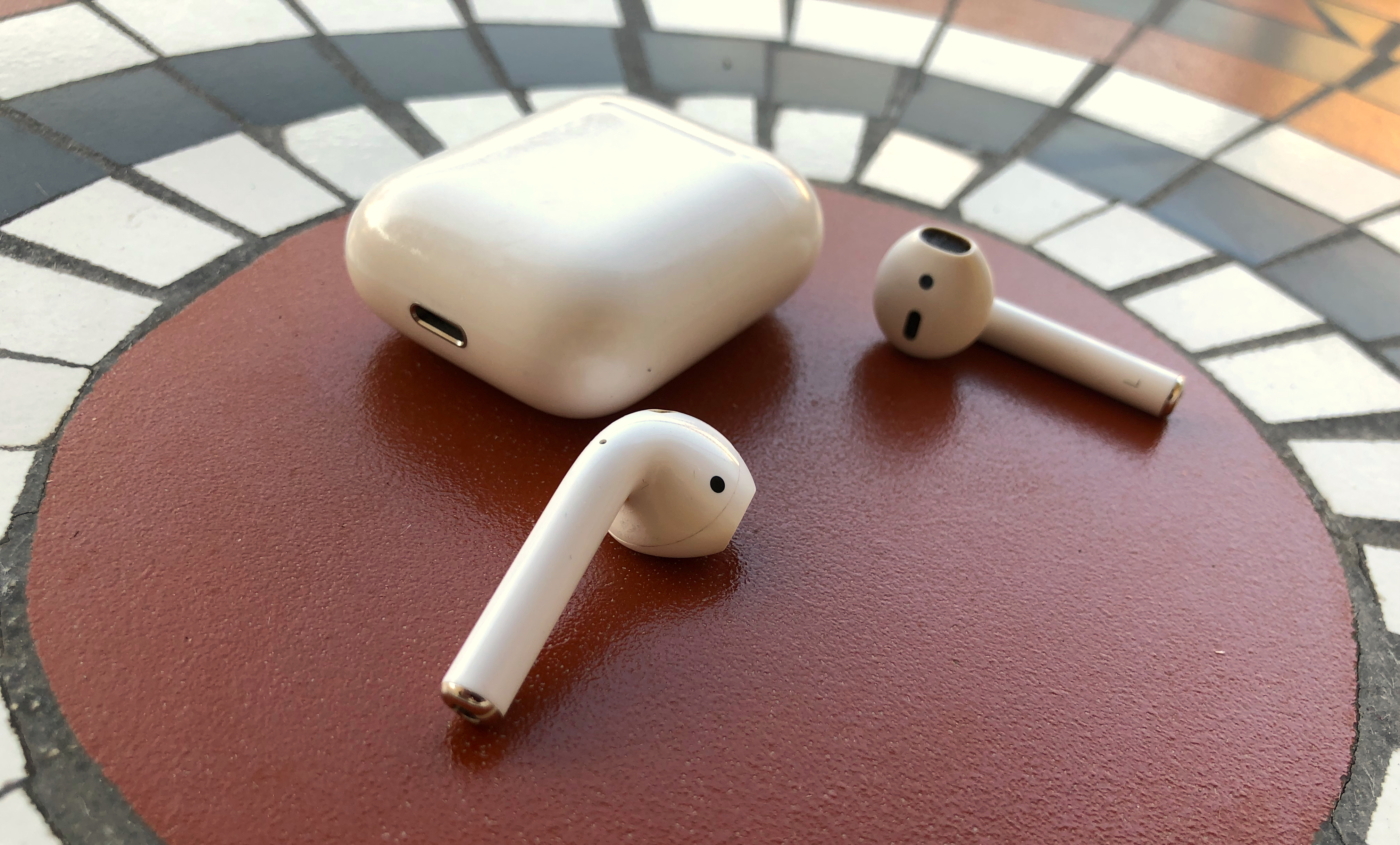
We can posit that a more diverse Apple design team might have been able to rethink the AirPod design so as not to exclude those with smaller ears. Or make a case to convince the powers that be in Cupertino to add another size choice. We can but speculate.

What’s clear is the future of technology design can’t be so stubborn.

It must be radically inclusive and incredibly sensitive. Human-centric. Not locked to damaging defaults in its haste to impose a limited set of ideas.

Above all, it needs a listening ear on the world.

Indifference to difference and a blindspot for diversity will find no future here.

23 Mar 2019

The damage of defaults

Apple popped out a new pair of AirPods this week. The design looks exactly like the old pair of AirPods. Which means I’m never going to use them because Apple’s bulbous earbuds don’t fit my ears. Think square peg, round hole.

The only way I could rock AirPods would be to walk around with hands clamped to the sides of my head to stop them from falling out. Which might make a nice cut in a glossy Apple ad for the gizmo — suggesting a feeling of closeness to the music, such that you can’t help but cup; a suggestive visual metaphor for the aural intimacy Apple surely wants its technology to communicate.

But the reality of trying to use earbuds that don’t fit is not that at all. It’s just shit. They fall out at the slightest movement so you either sit and never turn your head or, yes, hold them in with your hands. Oh hai, hands-not-so-free-pods!

The obvious point here is that one size does not fit all — howsoever much Apple’s Jony Ive and his softly spoken design team believe they have devised a universal earbud that pops snugly in every ear and just works. Sorry, nope!

A proportion of iOS users — perhaps other petite women like me, or indeed men with less capacious ear holes — are simply being removed from Apple’s sales equation where earbuds are concerned. Apple is pretending we don’t exist.

Sure we can just buy another brand of more appropriately sized earbuds. The in-ear, noise-canceling kind are my preference. Apple does not make ‘InPods’. But that’s not a huge deal. Well, not yet.

It’s true, the consumer tech giant did also delete the headphone jack from iPhones. Thereby depreciating my existing pair of wired in-ear headphones (if I ever upgrade to a 3.5mm-jack-less iPhone). But I could just shell out for Bluetooth wireless in-ear buds that fit my shell-like ears and carry on as normal.

Universal in-ear headphones have existed for years, of course. A delightful design concept. You get a selection of different sized rubber caps shipped with the product and choose the size that best fits.

Unfortunately Apple isn’t in the ‘InPods’ business though. Possibly for aesthetic reasons. Most likely because — and there’s more than a little irony here — an in-ear design wouldn’t be naturally roomy enough to fit all the stuff Siri needs to, y’know, fake intelligence.

Which means people like me with small ears are being passed over in favor of Apple’s voice assistant. So that’s AI: 1, non-‘standard’-sized human: 0. Which also, unsurprisingly, feels like shit.

I say ‘yet’ because if voice computing does become the next major computing interaction paradigm, as some believe — given how Internet connectivity is set to get baked into everything (and sticking screens everywhere would be a visual and usability nightmare; albeit microphones everywhere is a privacy nightmare… ) — then the minority of humans with petite earholes will be at a disadvantage vs those who can just pop in their smart, sensor-packed earbud and get on with telling their Internet-enabled surroundings to do their bidding.

Will parents of future generations of designer babies select for adequately capacious earholes so their child can pop an AI in? Let’s hope not.

We’re also not at the voice computing singularity yet. Outside the usual tech bubbles it remains a bit of a novel gimmick. Amazon has drummed up some interest with in-home smart speakers housing its own voice AI Alexa (a brand choice that has, incidentally, caused a verbal headache for actual humans called Alexa). Though its Echo smart speakers appear to mostly get used as expensive weather checkers and egg timers. Or else for playing music — a function that a standard speaker or smartphone will happily perform.

Certainly a voice AI is not something you need with you 24/7 yet. Prodding at a touchscreen remains the standard way of tapping into the power and convenience of mobile computing for the majority of consumers in developed markets.

The thing is, though, it still grates to be ignored. To be told — even indirectly — by one of the world’s wealthiest consumer technology companies that it doesn’t believe your ears exist.

Or, well, that it’s weighed up the sales calculations and decided it’s okay to drop a petite-holed minority on the cutting room floor. So that’s ‘ear meet AirPod’. Not ‘AirPod meet ear’ then.

But the underlying issue is much bigger than Apple’s (in my case) oversized earbuds. Its latest shiny set of AirPods are just an ill-fitting reminder of how many technology defaults simply don’t ‘fit’ the world as claimed.

Because if cash-rich Apple’s okay with promoting a universal default (that isn’t), think of all the less well resourced technology firms chasing scale for other single-sized, ill-fitting solutions. And all the problems flowing from attempts to mash ill-mapped technology onto society at large.

When it comes to wrong-sized physical kit I’ve had similar issues with standard office computing equipment and furniture. Products that seems — surprise, surprise! — to have been default designed with a 6ft strapping guy in mind. Keyboards so long they end up gifting the smaller user RSI. Office chairs that deliver chronic back-pain as a service. Chunky mice that quickly wrack the hand with pain. (Apple is a historical offender there too I’m afraid.)

The fixes for such ergonomic design failures is simply not to use the kit. To find a better-sized (often DIY) alternative that does ‘fit’.

But a DIY fix may not be an option when discrepancy is embedded at the software level — and where a system is being applied to you, rather than you the human wanting to augment yourself with a bit of tech, such as a pair of smart earbuds.

With software, embedded flaws and system design failures may also be harder to spot because it’s not necessarily immediately obvious there’s a problem. Oftentimes algorithmic bias isn’t visible until damage has been done.

And there’s no shortage of stories already about how software defaults configured for a biased median have ended up causing real-world harm. (See for example: ProPublica’s analysis of the COMPAS recidividism tool — software it found incorrectly judging black defendants more likely to offend than white. So software amplifying existing racial prejudice.)

Of course AI makes this problem so much worse.

Which is why the emphasis must be on catching bias in the datasets — before there is a chance for prejudice or bias to be ‘systematized’ and get baked into algorithms that can do damage at scale.

The algorithms must also be explainable. And outcomes auditable. Transparency as disinfectant; not secret blackboxes stuffed with unknowable code.

Doing all this requires huge up-front thought and effort on system design, and an even bigger change of attitude. It also needs massive, massive attention to diversity. An industry-wide championing of humanity’s multifaceted and multi-sized reality — and to making sure that’s reflected in both data and design choices (and therefore the teams doing the design and dev work).

You could say what’s needed is a recognition there’s never, ever a one-sized-fits all plug.

Indeed, that all algorithmic ‘solutions’ are abstractions that make compromises on accuracy and utility. And that those trade-offs can become viciously cutting knives that exclude, deny, disadvantage, delete and damage people at scale.

Expensive earbuds that won’t stay put is just a handy visual metaphor.

And while discussion about the risks and challenges of algorithmic bias has stepped up in recent years, as AI technologies have proliferated — with mainstream tech conferences actively debating how to “democratize AI” and bake diversity and ethics into system design via a development focus on principles like transparency, explainability, accountability and fairness — the industry has not even begun to fix its diversity problem.

It’s barely moved the needle on diversity. And its products continue to reflect that fundamental flaw.

Many — if not most — of the tech industry’s problems can be traced back to the fact that inadequately diverse teams are chasing scale while lacking the perspective to realize their system design is repurposing human harm as a de facto performance measure. (Although ‘lack of perspective’ is the charitable interpretation in certain cases; moral vacuum may be closer to the mark.)

As WWW creator, Sir Tim Berners-Lee, has pointed out, system design is now society design. That means engineers, coders, AI technologists are all working at the frontline of ethics. The design choices they make have the potential to impact, influence and shape the lives of millions and even billions of people.

And when you’re designing society a median mindset and limited perspective cannot ever be an acceptable foundation. It’s also a recipe for product failure down the line.

The current backlash against big tech shows that the stakes and the damage are very real when poorly designed technologies get dumped thoughtlessly on people.

Life is messy and complex. People won’t fit a platform that oversimplifies and overlooks. And if your excuse for scaling harm is ‘we just didn’t think of that’ you’ve failed at your job and should really be headed out the door.

Because the consequences for being excluded by flawed system design are also scaling and stepping up as platforms proliferate and more life-impacting decisions get automated. Harm is being squared. Even as the underlying industry drum hasn’t skipped a beat in its prediction that everything will be digitized.

Which means that horribly biased parole systems are just the tip of the ethical iceberg. Think of healthcare, social welfare, law enforcement, education, recruitment, transportation, construction, urban environments, farming, the military, the list of what will be digitized — and of manual or human overseen processes that will get systematized and automated — goes on.

Software — runs the industry mantra — is eating the world. That means badly designed technology products will harm more and more people.

But responsibility for sociotechnical misfit can’t just be scaled away as so much ‘collateral damage’.

So while an ‘elite’ design team led by a famous white guy might be able to craft a pleasingly curved earbud, such an approach cannot and does not automagically translate into AirPods with perfect, universal fit.

It’s someone’s standard. It’s certainly not mine.

We can posit that a more diverse Apple design team might have been able to rethink the AirPod design so as not to exclude those with smaller ears. Or make a case to convince the powers that be in Cupertino to add another size choice. We can but speculate.

What’s clear is the future of technology design can’t be so stubborn.

It must be radically inclusive and incredibly sensitive. Human-centric. Not locked to damaging defaults in its haste to impose a limited set of ideas.

Above all, it needs a listening ear on the world.

Indifference to difference and a blindspot for diversity will find no future here.