Author: azeeadmin

21 Mar 2019

Epic Games CEO says Apex Legends hasn’t made a dent in Fortnite

In the wake of Apex Legends, which has briskly grown to 50 million players, many have wondered whether Fortnite has felt the impact.

But Epic Games CEO Tim Sweeney told GamesBeat that Apex hasn’t really made a dent. Without being asked about Apex Legends, Sweeney said “an Apex Legends worth” of players have come over to Fortnite.

“We’re very close to hitting 250 million Fortnite players,” said Sweeney. “Since Apex Legends came out, we’ve gained an Apex Legends worth of Fortnite players, which is amazing.”

He went on to say that the only game that noticeably takes Fortnite gamers away from Fortnite is FIFA.

“We hit a Fortnite non-event peak twice after Apex was out,” said Sweeney. “We haven’t seen any visible cut into Fortnite. It’s a funny thing. The only game you can see where its peaks cut into Fortnite playtime is FIFA. It’s another game for everybody, wildly popular around the world.”

On the one hand, Apex only has about one-fifth of the players that Fortnite has. In a world where Netflix sees Fortnite as a greater threat than HBO, the scale of the two games isn’t comparable.

However, Apex is picking up some serious steam. It only took seven days for Apex to hit 25 million users (it took Fortnite 41 days), and one month to hit 50 million users (it took Fortnite more than four months).

As impressive as that is, it’s also to be expected that a game like Apex, a relative latecomer to the Battle Royale genre, would grow faster by reaping the benefits of the entire industry’s years of work and growth. It’s also worth noting that EA paid a pretty penny to successfully launch Apex Legends, with Ninja alone earning $1 million for streaming the game at launch.

“What Apex Legends has done is re-energized a lot of shooter players, people who come in and out of shooters depending on what’s popular,” said Sweeney. “It’s awesome to see other games picking up on battle royale, adding their unique spin to it and advancing the state of the industry.”

Adding a unique spin is exactly what Apex Legends has done. They’ve taken the fundamental building blocks of Battle Royale and the free-to-play model and tweaked them to be, in some ways, better.

Where play is concerned, Apex is a markedly team-oriented game, complete with a beautifully executed non-verbal comms system and a Jumpmaster mechanic to encourage teammates to land and play as a unit. Plus, Apex uses a hero system to give each character their own unique abilities.

This not only makes each fight interesting, but it gives Apex a different way to monetize beyond its recently launched BattlePass. The company just introduced its first new character, which can be unlocked with Apex Coins, the games virtual currency.

Only time will tell if Respawn and EA can build something as sticky as Fortnite, which has truly become a pop culture phenomenon. But there is one clear winner in this epic competition between Fortnite and Apex, and that’s gamers.

21 Mar 2019

UK’s Police Federation hit by ransomware

The U.K.’s Police Federation has confirmed it’s been hit by a cyberattack.

The union-like organization, which represents the 43 police forces across England and Wales, described the event as ransomware in a statement shared on Twitter.

The ransomware attack hit computers at the federation’s Surrey headquarters on March 9, but was only revealed Thursday. Several databases and email systems were encrypted, the organization said, leading to some disruption to its services. Its backup data had also been deleted.

“There is no evidence at this stage that any data was extracted from our systems but this cannot be discounted,” the organization said in a tweet.

None of the other 43 branches across the U.K. were affected, the statement said.

The National Crime Agency is investigating the attack, which the Police Federation said was “not targeted specifically” at the police organization but likely part of a wider campaign.

The organization reported the incident to the U.K.’s data protection regulator on March 11, within the required three days under European law.

A spokesperson for the Police Federation did not comment beyond the organization’s statements, and referred comment to the National Crime Agency, which did not immediately respond to questions.

The news comes two days after Norwegian aluminum manufacturer Norsk Hydro was hit by a strain of LockerGoga, a new kind of ransomware that first emerged earlier this year. The manufacturing giant said Thursday most of its operations have been restored.

21 Mar 2019

MoviePass co-founder’s new startup PreShow gives you free movie tickets for watching ads

As founding CEO of MoviePass, Stacy Spikes has already changed the way we think about paying for movie tickets. Now he’s pursuing a new approach — providing a free ticket to people who watch 15 to 20 minutes of ads.

Spikes told me that when it comes to watching movies outside the theater, there are three basic business models — pay-per-view, subscription and ad-supported. MoviePass brought a subscription approach into theaters, but Spikes (who stepped down as MoviePass CEO in 2016) said he kept wondering, “Well, why can’t you have an ad-supported version that will allow you to go to movies for free?”

It’s hard to imagine digital advertising being worth enough to really pay for that ticket, but Spikes insisted, “You’re paying your way. This is not going to be a loss leader model. It’s an ad-revenue based business.”

To make that work, he said the new service, called PreShow, is bringing a couple innovations to the table. First, there’s facial recognition technology that ensures you’re actually present and watching the ad.

Spikes demonstrated this feature for me last week, showing me how his face unlocked the PreShow app. Once he’d chosen the film he wanted to watch, he was presented with a package of video ads that were specifically selected to run with that movie — and any time he looked away from the screen or moved too far away from his phone, the ads would stop playing. (Apparently the sensitivity can be dialed up or down depending on user feedback.)

PreShow facial recognition

Spikes also said the ads should tie into the film in some way, whether that’s thematically, or by highlighting products that are also featured in the movie. And they’ll always include an opportunity to further engage with the advertiser.

So although 15 to 20 minutes might sound like a long time to watch ads,  it should be more interesting for the viewer than just watching a random collection of promotional videos. And for the advertisers who are already paying for product placement in a film, this could be a way to reinforce their message with consumers who are actually watching the movie. (Spikes also compared this to the marketing packages that usually play before showtime in theaters — hence the company name.)

By watching one of these 15- to 20-minute packages, you should earn enough points to purchase a ticket at the theater using a virtual credit card provided by PreShow. Technically, those points can be used to buy any movie ticket, but Spikes said you won’t be able to earn more than two tickets at once, “so people don’t stockpile.”

As for whether PreShow is competing with his old company, Spikes said, “I don’t think they’re competitive in any way. If you compare a subscription platform to an ad platform to a pay-per-view platform, they’re different animals.”

Stacy Spikes

Stacy Spikes

The plan is to start testing the service with a select group of users in the next three to six months, and to find those users, PreShow is launching a Kickstarter campaign today. Pledge levels range from $15 to $60, with the amount you pay determining how early you get access, and how many friend invites you receiving.

Spikes said he’s less interested in raising money (which is why the campaign’s official goal is only $10,000) and more in attracting film lovers who want to try out the app.

“It’s a way to have innovation happen more organically, versus if you just open it up for the general public,” Spikes said.

21 Mar 2019

Ludlow Ventures raises $45m for third fund

Ludlow Ventures raised another $45 million to invest in young startups. The Detroit-based venture firm is today announcing it closed its third fund since the firm’s founding in 2010. Founding and managing partner Jonathon Triest tells TechCrunch the firm set out to raise another $45M and were immediately oversubscribed.

Triest says Ludlow Ventures, with its two other partners of Brett deMarrais and Blake Robbins, are surfacing deals on the coasts before anyone else and is doing so from Detroit. Even though the firm is based in downtown Detroit, its past investments are scattered throughout the States from Boston to Detroit to Flagstaff to San Francisco. It seems the three partners will go anywhere to fund compelling startups.

Of its last ten investments, only two were from the Midwest (Bloomscape and Provi) while the rest were from the New York City-area and California. The firm has followed this strategy since its founding and it’s clearly working.

Like its second fund, Ludlow Ventures raised $45 million for this fund and intends to use it to keep investing in founders seeking pre-seed and seed funds. Triest tells us the firm could have raised more cash for this fund but choose to keep it at the same amount as its second fund as to not have to worry about deploying excess capital. This time around, the partners expect to write larger checks to fewer companies.

“We strongly believe that the currency of seed stage investing is all about relationships,” Triest told TechCrunch. “We seek to form the most authentic and deep friendships with the people we invest in — not some founder-friendly marketing vernacular, but real meaningful friendships. That gives us great transparency into a company, and sets us up to help the best we can.”

This relationship is on full display in Triest’s take on carpool karaoke. Called Carpool.VC, Triest, and deMarrais play host to founders and investors as they drive around Detroit and other cities. It’s a good show. Is it better than James Corden’s Carpool Karaoke? Yes. Most things are.

I first spoke to Triest in 2014. At the time, Ludlow was on its first fund though Triest had been investing as in angel prior to that. At the time he called Ludlow Ventures a VC without an ego and from everything I can see, that sentiment still properly describes the firm and its three partners.

21 Mar 2019

Taxes on VC and electric buses harming oil prices

From Extra Crunch

  • A lot of subscribers got to hear from TechCrunch hardware guru Brian Heater, who has been meeting with (too many) robotics companies as we prepare for TechCrunch Sessions: Robotics. If you weren’t able to join us, a transcript will be available in the next 48 hours.
  • We have Lucas Matney and Eric Peckham on the horn this Friday at noon PDT to talk about all things Game Developers Conference (GDC). Be sure to check your emails for details.

Wide Angle

zssp via Getty Images

Stories from outside the 280/101 corridor

  • Indian entrepreneurs are furious over a tax on venture investing, in which the government taxes the proceeds of an equity round.

21 Mar 2019

Xbox One S is reportedly getting a disc-free version in May

The writing has been on the wall for physical media for a while now. In May, Microsoft is reportedly set to hammer another nail into that coffin with the launch of the Xbox One S All-Digital. As advertised, the latest version of the console will drop the Blu-Ray drive, in favor of an all downloadable experience.

Rumors about the XOSAD have been floating around since last year — when the console still went by the decidedly Top Gunny name of “Maverick.” A new report from Window Central offers more insight into the system, along with a potential May 7 release date — that puts it roughly in line with those initial reports.

The system is said to offer up 1TB of storage, which should serve players well in the transition away from discs. It will also apparently be bundled with a handful of download codes to get started, including Minecraft, Forza Horizon 3 and Sea of Thieves.

Being the obvious lack of disc drive, the system looks more or less identical to the standard One S. As for pricing, we expect it to more affordable than its predecessor. The move is part of a broader push from Microsoft to wean games off of physical media. It’s a play that also includes digital-first services like the Xbox Game Pass.

21 Mar 2019

Slowdown or not, China’s luxury goods still seeing high-end growth

Despite well-documented concerns over an economic slowdown in China, the country’s luxury goods market is still seeing opulent growth according to a new study. Behind secular and demographic tailwinds, the luxury sector is set to continue its torrid expansion in the face of volatility as it’s quickly becoming a defensive economic crown jewel.

Using proprietary analysis, company data, primary source interviews, and third-party research, Bain & Company dug into the ongoing expansion of China’s high-end market in a report titled “What’s Powering China’s Market for Luxury Goods?

In recent years, China has become one of the largest markets for luxury good companies globally. And while many have raised concern around a drop-off in luxury demand, findings in the report point to the contrary, with Bain forecasting material growth throughout 2019 and beyond. The analysis provides a compelling breakdown of how the sector has seen and will see continued development, as well as a fascinating examination of what strategies separate winners and losers in the space.

The report is worth a quick read, as it manages to provide several insightful and differentiated data points with relative brevity, but here are the most interesting highlights in our view:

21 Mar 2019

LogRocket nabs $11M Series A to fix web application errors faster

Every time a visitor experiences an issue on your website, it’s going to have an impact on their impression of the company. That’s why companies want to resolve issues in a timely manner.  LogRocket, a Cambridge, MA startup, announced an $11 Million Series A investment today to give engineering and web development teams access to more precise information they need to fix issues faster.

The round was led by Battery Ventures with participation from seed investor Matrix Partners. When combined with an earlier unannounced $4 million seed round, the company has raised of total of $15 million.

The two founders, Matthew Arbesfeld and Ben Edelstein, have been friends since birth growing up together in the Boston suburbs. After attending college separately at MIT and Columbia, the two friends both moved to San Francisco where they worked as engineers building front-end applications.

The company idea grew from the founders’ own frustration tracking errors. They found that they would have to do a lot of manual research to find problems, and it was taking too much time. That’s where they got the idea for LogRocket .

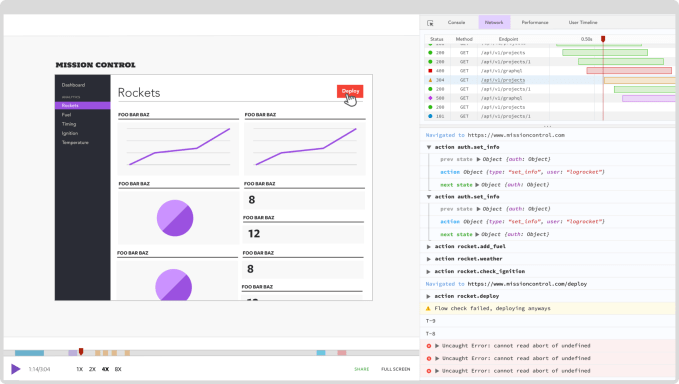
“What LogRocket does is we capture a recording in real time of all the user activity so the developer on the other end can replay exactly what went wrong and troubleshoot issues faster,” Arbesfeld explained.

Screenshot: LogRocket

The tool works by capturing low-resolution images of troublesome activity of each user and putting them together in a video. When there is an error or problem, the engineer can review the video and watch exactly what the user was doing when he or she encountered an error, allowing them to identify and resolve the problem much more quickly.

Arbesfeld said the company doesn’t have a video storage issue because it concentrates on capturing problems instead of the entire experience. “We’re looking at frustrating moments of the user, so that we can focus on the problem areas,” he explained.

Customers can access the data in the LogRocket dashboard, or it can be incorporated into help desk software like Zendesk. The company is growing quickly with 25 employees and 500 customers in just 18 months since inception, including Reddit, Ikea, CarGrus and Bloomberg.

As for the funding, they see this as the start of a long-term journey. “Our goal is to get out to a much wider audience and build a mature sales and marketing organization,” Arbesfeld said. He sees a future with thousands of customers and ambitious revenue goals. “We want to continue to use the data we have to offer more proactive insights into highest impact problems,” he said

21 Mar 2019

Review: Apple’s new iPad mini continues to be mini

The iPad mini is super enjoyable to use and is the best size tablet for everything but traditional laptop work. It’s very good and I’m glad Apple updated it.

Using Apple Pencil is aces on the smaller mini, don’t worry about the real estate being an issue if you like to scribble notes or make sketches. It’s going to fall behind a larger iPad for a full time artist but as a portable scratch pad it’s actually far less unwieldy or cumbersome than an iPad Pro or Air will be.

The only caveat? After using the brilliant new Pencil, the old one feels greasy and slippery by comparison, and lacks that flat edge that helps so much when registering against your finger for shading or sketching out curves.

The actual act of drawing is nice and zippy, and features the same latency and responsiveness as the other Pencil-capable models.

The reasoning behind using the old pencil here is likely a result of a combination of design and cost-saving decisions. No flat edge would require a rethink of the magnetic Pencil charging array from the iPad Pro and it is also apparently prohibitively expensive in a way similar to the smart connector. Hence its lack of inclusion on either Air or mini models.

Touch ID feels old and slow when compared to iPad Pro models, but it’s not that bad in a mini where you’re almost always going to be touching and holding it rather than setting it down to begin typing. It still feels like you’re being forced to take an awkward, arbitrary additional action to start using the iPad though. It really puts into perspective how fluidly Face ID and the new gestures work together.

The design of the casing remains nearly identical, making for broad compatibility with old cases and keyboards if you use those with it. The camera has changed positions and the buttons have been moved slightly though, so I would say your mileage may vary if you’re brining old stuff to the table.

The performance of the new mini is absolutely top notch. While it falls behind when compared to the iPad Pro it is exactly the same (I am told, I do not have one to test yet) as the iPad Air. It’s the same on paper though, so I believe it in general and there is apparently no ‘detuning’ or under-clocking happening. This makes the mini a hugely powerful tiny tablet, clearly obliterating anything else in its size class.

The screen is super solid, with great color, nearly no air gap and only lacking tap-to-wake.

That performance comes at a decently chunky price, $399. If you want the best you pay for it.

Last year I took the 12.9” iPad Pro on a business trip to Brazil, with no backup machine of any sort. I wanted to see if I could run TechCrunch from it — from planning to events to editorial and various other multi-disciplinary projects. It worked so well that I never went back and have not opened my MacBook in earnest since. I’ll write that experience up at some point because I think there’s some interesting things to talk about there.

I include that context here because, though the iPad Pro is a whole ass computer and really capable, it is not exactly ‘fun’ to use in non standard ways. That’s where the iPad mini has always shined and continues to do so.

It really is pocketable in a loose jacket or coat. Because the mini is not heavy, it exercises little of the constant torsion and strain on your wrist that a larger iPad does, making it one-handed.

I could go on, but in the end, all that can be said about the iPad mini being “the small iPad” has already been said ad nauseam over the years, beginning with the first round of reviews back in 2012. This really is one of the most obvious choices Apple has in its current iPad lineup. If you want the cheap one, get the cheap one (excuse me, “most affordable” one). And if you want the small one, get the iPad mini.

The rest of the iPads in Apple’s lineup have much more complicated purchasing flow charts — the mini does indeed sell itself.

Back even before we knew for sure that a mini iPad was coming, I wrote about how Apple could define the then very young small tablet market. It did. No other small tablet model has ever made a huge dent on the market, unless you count the swarm of super super crappy Android tablets that people buy in blister packs expecting them to eventually implode as a single hive-mind model.

Here’s how I saw it in 2012:

“To put it bluntly, there is no small tablet market…Two years ago we were talking about the tablet market as a contiguous whole. There was talk about whether anyone would buy the iPad and that others had tried to make consumer tablets and failed. Now, the iPad is a massive success that has yet to be duplicated by any other manufacturer or platform.

But the tablet market isn’t a single ocean, it’s a set of interlocking bodies of water that we’re just beginning to see take shape. And the iPad mini isn’t about competing with the wriggling tadpoles already in the ‘small tablet’ pond, it’s about a big fish extending its dominion.”

Yeah, that’s about right, still.

One huge difference, of course, is that the iPad mini now has the benefit of an enormous amount of additional apps that have been built for iPad in the interim. Apps that provide real, genuine access to content and services on a tablet — something that was absolutely not guaranteed in 2012. How quickly we forget.

In addition to the consumer segment, the iPad mini is also extremely popular in industrial, commercial and medical applications. From charts and patient records to point-of-sale and job site reference, the mini is the perfect size for these kinds of customers. These uses were a major factor in Apple deciding to update the mini.

Though still just as pricey (in comparison) as it was when it was introduced, the iPad mini remains a standout device. It’s small, sleek, now incredibly fast and well provisioned with storage. The smallness is a real advantage in my opinion. It allows the mini to exist as it does without having to take part in the ‘iPad as a replacement for laptops’ debate. It is very clearly not that, while at the same time still feeling more multipurpose and useful than ever. I’m falling in real strong like all over again with the mini, and the addition of Pencil support is the sweetener on top.

21 Mar 2019

Guesty, a tech platform for property managers on Airbnb and other rental sites, raises $35M

The growth of Airbnb — and likewise other platforms like Booking.com, VRBO and Homeaway for listing and renting short-term accommodation in private homes — has spawned an ecosystem of other businesses and services, from those who make money renting their homes, to cleaning companies that make properties “Airbnb-ready”, to those who help design listings that will get more clicks. Airbnb has seen some wild success so far, but it turns out that being a part of that ecosystem can be a lucrative business, too.

Today, Guesty — a Israeli startup that provides a suite of tools aimed at property managers that list on these platforms — is announcing that it has raised $35 million, money that it will use to fuel its growth, after seeing the number of properties managed in some 70 countries through its tech double to over 100,000 in the last year.

The company is not disclosing valuation with this round, which was led Viola Growth with participation also from Vertex Ventures, Journey Ventures, Kingfisher Investment Advisors, La Maison Compagnie d’Investissement, TLV Partners and Magma Ventures. But Amiad Soto, the CEO and co-founder, noted that it too has “more than doubled” since its last funding almost a year ago. PitchBook notes that round was around $90 million post-money, so this would put the current valuation at at least $180 million, likely more.

The idea for Guesty came about like many of the best startup ideas do: out of a personal need. In 2013, twin brothers Amiad and Koby were renting out their own apartments on Airbnb, and found themselves spending a lot of time doing the work needed to list and manage those properties.

Their first stab at a business was an all-in-one service to help hosts get their properties ready and subsequently tidied up for listings. “I was cleaning apartments, Koby was doing the business development, and my girlfriend was doing the laundry,” Soto told me in an interview. They quickly realised that this was never going to scale, “and also that our competitive advantage was building software. We are computer geeks.”

So the company quickly pivoted to building a platform that could provide all the tools that property managers — who work with individual property hosts/owners and had started emerging as key players as Airbnb itself scaled out — needed to juggle multiple listings. (That girlfriend is now his wife, so seems like they may have pivoted just in time.)

Guesty started as SuperHost and, like Airbnb, went through the Y-Combinator accelerator. It eventually rebranded to Guesty, and it now provides tools in a dozen areas that touch property managers and the job they do: Channel Manager (“channel” being the platform where the property is being listed), Multi-Calendar, Unified Inbox, Automation Tools, Mobile Management App, Branded Website Task Management, Reporting Tools, Owners Portal, Payment Processing, Analytics, Open API, 24/7 Guest Communication.

The plan is to complement that in coming years with more “smart” tools: the company is introducing AI and machine learning elements that will help it suggest more services to users, and for managers to use to do their jobs better. (One example of how this might work: if you have a property manager in New York City, and the city regulator changes something in the tax code for properties in Brooklyn, this will now be suggested through to managers whose properties are affected, and this can help with pricing modelling down the line if the manager, say, wanted to keep a specific margin on rentals.)

Perhaps because short-term property renting is a relatively new area of the accommodation and residential market, it’s fairly fragmented, and so Guesty is providing a clear move to consolidate and simplify some of that work.

“There are about 700 different services and other things that go into short-term property rentals,” Soto noted when I asked him about this. “It would take me hours to go through it all with you.”

And indeed, the market itself is much bigger than what Guesty is currently working with. Soto estimates that there are around 7 million properties now collectively getting listed on these short-term letting platforms, speaking to the opportunity ahead.

Guesty very much got its start with Airbnb and that helped it not only establish what property managers needed, but also to forge a close relationship with Airbnb at a time when it wasn’t yet building many bridges to third-party services. Soto said Guesty built its own private API to use with Airbnb, and subsequently helped inform how Airbnb eventually build an API that others could use.

It’s still a trusted partner in that regard. Now that Airbnb is moving into multi-dwelling arrangements — that is, rooms in hotels (which will now expand with its HotelTonight acquisition), plus multiple apartments in single buildings for big groups that might want to secure bookings at several places at once — it will very soon be launching a tool for these kinds of listings. Guesty has helped in the building of that, too.

Still, the opportunity for short-term lettings is bigger than Airbnb itself these days. Booking.com and its many subsidiary businesses have made a big move into this area, as have many other companies, and Guesty now handles bookings on a number of “channels”. Soto said on average, the number of bookings on its platform that are listing on Airbnb is 60 percent, with some vacation spots seeing the percentage much lower, and some urban markets seeing a much higher penetration.

This is one of those cases where being an early mover in identifying a market opportunity has worked in a startup’s favor. Guesty’s strong work with Airbnb has helped the startup build stronger ties with those companies that hope to compete with it and give Airbnb a run for its money: Booking.com, Soto notes, is a premier partner these days.

“Guesty was the first to recognize the potential of the property management market and has quickly become a category leader with its vertical-oriented, end-to-end approach,” said Natalie Refuah, partner at Viola Growth, in a statement. “Technology and AI continue to disrupt the innovation stack, acting as a catalyst to the digitization of “traditional” areas such as real estate and travel. Guesty is leading the charge, fostering a more seamless experience for property managers while providing clear advantages to customers and ultimately, their guests. We believe that with its experienced and elite executive team, Guesty is fully equipped to modernize and revolutionize the property management ecosystem.” Refuah is joining Guesty’s Board of Directors.