Author: azeeadmin

21 Mar 2019

Razer hooks up with Tencent to focus on mobile gaming

Razer is summoning a big gun as it bids to develop its mobile gaming strategy. The Hong Kong-listed company — which sells laptops, smartphones and gaming peripherals — said today it is working with Tencent on a raft of initiatives related to smartphone-based games.

The collaboration will cover hardware, software and services. Some of the objectives include optimizing Tencent games — which include megahit PUBG and Fortnite — for Razer’s smartphones, mobile controllers and its Cortex Android launcher app. The duo also said they may “explore additional monetization opportunities for mobile gaming” which could see Tencent integrate Razer’s services, which include a rewards/loyalty program, in some areas.

The news comes on the same day as Razer’s latest earnings,  which saw annual revenue grow 38 percent to reach $712.4 million. Razer recorded a net loss of $97 million for the year, up from $164 million in 2017.

The big name partnership announcement comes at an opportune time for Razer, which has struggled to convince investors of its business. The company was among a wave of much-championed tech companies to go public in Hong Kong — Razer’s listing raised over $500 million in late 2017 — but its share price has struggled. Razer currently trades at HK$1.44, which is some way down from a HK$3.88 list price and HK$4.58 at the end of its trading day debut. Razer CEO Min Liang Tan has previously lamented a lack of tech savviness within Hong Kong’s public markets despite a flurry of IPOs, which have included names like local services giant Meituan.

Nabbing Tencent, which is one of (if not the) biggest games companies in the world, is a PR coup, but it remains to be seen just what impact the relationship will have at this stage. Subsequent tie-ins, and potentially an investor, would be notable developments and perhaps positive signals that the market is seeking.

Still, Razer CEO Min Liang Tan is bullish about the company’s prospects on mobile.

The company’s Razer smartphones were never designed to be ‘iPhone-killers’ that sold on volume, but there’s still uncertainty around the unit with recent reports suggesting the third-generation phone may have been canceled following some layoffs. (Tan declined to comment on that.)

Mobile is tough — just ask past giants like LG and HTC about that… — and Razer’s phone and gaming-focus was quickly copied by others, including a fairly brazen clone effort from Xiaomi, to make sales particularly challenging. But Liang maintains that, in doing so, Razer created a mobile gaming phone market that didn’t exist before, and ultimately that is more important than shifting its own smartphones.

“Nobody was talking about gaming smartphones [before the Razer phone], without us doing that, the genre would still be perceived as casual gaming,” Tan told TechCrunch in an interview. “Even from day one, it was about creating this new category… we don’t see others as competition.”

With that in mind, he said that this year is about focusing on the software side of Razer’s mobile gaming business.

Tan said Razer “will never” publish games as Tencent and others do, instead, he said that the focus on helping discovery, creating a more immersive experience and tying in other services, which include its Razer Gold loyalty points.

Outside of gaming, Razer is also making a push into payments through a service that operates in Southeast Asia. Fuelled by the acquisition of MOL one year ago, Razer has moved from allowing people to buy credit over-the-counter to launch an e-wallet in two countries, Malaysia and Singapore, as it goes after a slice Southeast Asia’s fintech boom which has attracted non-traditional players that include AirAsia, Grab and Go-Jek among others.

21 Mar 2019

Nigerian fintech startup OneFi acquires payment company Amplify

Lagos based online lending startup OneFi is buying Nigerian payment solutions company Amplify for an undisclosed amount.

OneFi will take over Amplify’s IP, team, and client network of over 1000 merchants to which Amplify provides payment processing services, OneFi CEO Chijioke Dozie told TechCrunch.

The move comes as fintech has become one of Africa’s most active investment sectors and startup acquisitions—which have been rare—are picking up across the continent.

The purchase of Amplify caps off a busy period for OneFi. Over the last seven months the Nigerian venture secured a $5 million lending facility from Lendable, announced a payment partnership with Visa, and became one of first (known) African startups to receive a global credit rating. OneFi is also dropping the name of its signature product, Paylater, and will simply go by OneFi (for now).

Collectively, these moves represent a pivot for OneFi away from operating primarily as a digital lender, toward becoming an online consumer finance platform.

“We’re not a bank but we’re offering more banking services…Customers are now coming to us not just for loans but for cheaper funds transfer, more convenient bill payment, and to know their credit scores,” said Dozie.

OneFi will add payment options for clients on social media apps including WhatsApp this quarter—something in which Amplify already holds a specialization and client base. Through its Visa partnership, OneFi will also offer clients virtual Visa wallets on mobile phones and start providing QR code payment options at supermarkets, on public transit, and across other POS points in Nigeria.

Founded in 2016 by Segun Adeyemi and Maxwell Obi, Amplify secured its first seed investment the same year from Pan-African incubator MEST Africa. The startup went on to scale as a payments gateway company for merchants and has partnered with banks, who offer its white label mTransfers social payment product.

Amplify has differentiated itself from Nigerian competitors Paystack and Flutterwave, by committing to payments on social media platforms, according to OneFi CEO Dozie. “We liked that and thought payments on social was something we wanted to offer to our customers,” he said.

With the acquisition, Amplify co-founder Maxwell Obi and the Amplify team will stay on under OneFi. Co-founder Segun Adeyemi won’t, however, and told TechCrunch he’s taking a break and will “likely start another company.”

OneFi’s purchase of Amplify adds to the tally of exits and acquisitions in African tech, which are less common than in other regional startup scenes. TechCrunch has covered several of recent, including Nigerian data-analytics company Terragon’s buy of Asian mobile ad firm Bizsense and Kenyan connectivity startup BRCK’s recent purchase of ISP Everylayer and its Nairobi subsidiary Surf.

These acquisition events, including OneFi’s purchase, bump up performance metrics around African tech startups. Though amounts aren’t undisclosed, the Amplify buy creates exits for MEST, Amplify’s founders, and its other investors. “I believe all the stakeholders, including MEST, are comfortable with the deal. Exits aren’t that commonplace in Africa, so this one feels like a standout moment for all involved,”

With the Amplify acquisition and pivot to broad-based online banking services in Nigeria, OneFi sets itself up to maneuver competitively across Africa’s massive fintech space—which has become infinitely more complex (and crowded) since the rise of Kenya’s M-Pesa mobile money product.

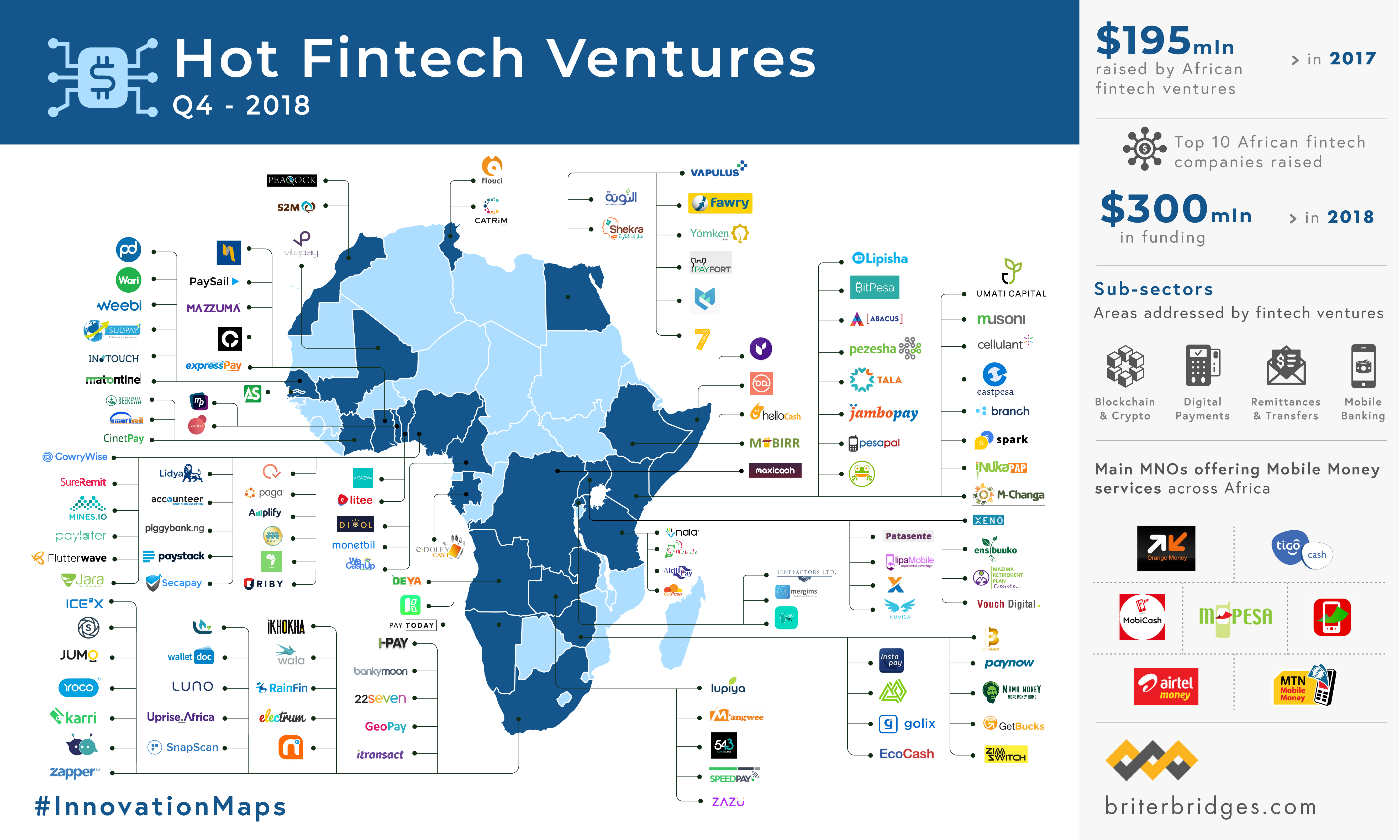
By a number of estimates, the continent’s 1.2 billion people include the largest share of the world’s unbanked and underbanked population. An improving smartphone and mobile-connectivity profile for Africa (see GSMA) turns that problem into an opportunity for mobile based financial solutions. Hundreds of startups are descending on this space, looking to offer scaleable solutions for the continent’s financial needs. By stats offered by Briter Bridges and a 2018 WeeTracker survey, fintech now receives the bulk of VC capital to African startups,

OneFi is looking to expand in Africa’s fintech markets and is considering Senegal, Côte d’Ivoire, DRC, Ghana and Egypt and Europe for Diaspora markets, Dozie said.

The startup is currently fundraising and looks to close a round by the second half of 2019. OnfeFi’s transparency with performance and financials through its credit rating is supporting that, according to Dozie.

There’s been sparse official or audited financial information to review from African startups—with the exception of e-commerce unicorn Jumia, whose numbers were previewed when lead investor Rocket Internet went public and in Jumia’s recent S-1, IPO filing (covered here).

OneFi gained a BB Stable rating from Global Credit Rating Co. and showed positive operating income before taxes of $5.1 million in 2017, according to GCR’s report. Though the startup is still a private company, OneFi looks to issue a 2018 financial report in the second half of 2019, according to Dozie.

21 Mar 2019

Windows Virtual Desktop is now in public preview

Last year, Microsoft announced the launch of its Windows Virtual Desktop service. At the time, this was a private preview, but starting today, any enterprise user who wants to try out what using a virtual Windows 10 desktop that’s hosted in the Azure cloud looks like will be able to give it a try.

It’s worth noting that this is very much a product for businesses. You’re not going to use this to play Apex Legends on a virtual machine somewhere in the cloud. The idea here is that a service like this, which also includes access to Office 365 ProPlus, makes managing machines and the software that runs on them easier for enterprises. It also allows employers in regulated industries to provide their mobile workers with a virtual desktop that ensures that all of their precious data remains secure.

One stand-out feature here is that businesses can run multiple Windows 10 sessions on a single virtual machine.

It’s also worth noting that many of the features of this service are powered by technology from FSLogix, which Microsoft acquired last year. Specifically, these technologies allow Microsoft to give the non-persistent users relatively fast access to applications like their Outlook and OneDrive applications, for example.

For most Microsoft 365 enterprise customers, access to this service is simply part of the subscription cost they already pay — though they will need an Azure subscription and pay for the virtual machines that run in the cloud.

Right now, the service is only available in the US East 2 and US Central Azure regions. Over time, and once the preview is over, Microsoft will expand it to all of its cloud regions.

21 Mar 2019

Microsoft Defender comes to the Mac

Microsoft today announced that it is bringing its Microsoft Defender Advanced Threat Protection (ATP) to the Mac. Previously, this was a Windows solution for protecting the machines of Microsoft 365 subscribers and assets the IT admins that try to keep them safe. It was also previously called Windows Defender ATP, but given that it is now on the Mac, too, Microsoft decided to drop the ‘Windows Defender’ moniker in favor or ‘Microsoft Defender.’

“For us, it’s all about experiences that follow the person and help the individual be more productive,” Jared Spataro, Microsoft’s corporate VP for Office and Windows, told me. “Just like we did with Office back in the day — that was a big move for us to move it off of Windows-only — but it was absolutely the right thing. So that’s where we’re headed.”

He stressed that this means that Microsoft is moving off its “Windows-centric approach to life.” He likened it to bringing the Office apps to the iPad and Android. “We’re just headed in that same direction of saying that it’s our intent that we can secure every endpoint so that this Microsoft 365 experience is not just Windows-centric,” Spataro said. Indeed, he argued that the news here isn’t even so much the launch of this service for the Mac but that Microsoft is reorienting the way it thinks about how it can deliver value for Microsoft 365 clients.

Given that Microsoft Defender is part of the Microsoft 365 package, you may wonder why those users would even care about the Mac, but there are plenty of enterprises that use a mix of Windows machines and Mac, and which provide all of their employees with Office already. Having a security solution that spans both systems can greatly reduce complexity for IT departments — and keeping up with security vulnerabilities on one system is hard enough to begin with.

In addition to the launch of the Mac version of Microsoft Defender ATP, the company also today announced the launch of new threat and vulnerability management capabilities for the service. Over the last few months, Microsoft had already launched a number of new features that help businesses proactively monitor and identify security threats.

“What we’re hearing from customers now, is that the landscape is getting increasingly sophisticated, the volume of alerts that we’re starting to get is pretty overwhelming,” Spataro said. “We really don’t have the budget to hire the thousands of people required to sort through all this and figure out what to do.”

So with this new tool, Microsoft uses its machine learning smarts to prioritize threads and present them to its customers for remediation.

To Spataro, these announcements come down to the fact that Microsoft is slowly morphing into more of a security company than ever before. “I think we’ve made a lot more progress than people realize,” he said. “And it’s been driven by the market.” He noted that its customers have long asked Microsoft to help them protect their endpoints. Now, he argues, customers have realized that Microsoft is now moving to this person-centric approach (instead of a Windows-centric one) and that the company may now be able to help them protect large parts of their systems. At the same time, Microsoft realized that it could use all of the billions of signals it gets from its users to better help its customers proactively.

21 Mar 2019

The Plum Guide raises $18.5M to expand its ‘vacation homes for the elite’ service

Fancy knowing how ‘the other half’ lives? Well, part of it is down to tools which have been built specifically for them. Michelin Guide will tell you about the best restaurants on the planet. Similarly the The Plum Guide bills itself as the “Michelin Guide for Homes” as it picks the world’s best vacation rentals, holiday homes, short term lets and Airbnbs from over 25 different sites, then puts them into one. It does this using a combination of data and human curation.

It’s now raised £14m ($18.5m) from some of Europe’s leading early-stage investors to support its rollout to 12 new cities this year.

The Plum Guide differs from mass market booking platforms by selecting only the top 1% of properties in any city to feature on its site. By the end of 2019 that will mean almost 12,000 verified homes in the most sought-after cities for holiday rentals.

The latest funding round is led by Talis Capital, with participation from Latitude and Hearst Ventures, as well as Octopus Ventures – who led the Series A funding round.

It needs all this money because as well as using a data approach, it also sends actual human beings to vet every property in person and apply a “scientific Plum Guide test” which covers 150 points from proximity to cafes and transport, to speed of WiFi.

Since launching in London in 2015, the company claims to have achieved year-on-year growth of three times revenues, for three years’ running, adding homes in five new cities to the platform and saw repeat bookings jump 27% after it opened in Paris, its second location after London. It says customer referrals drive a quarter of all bookings.

In a statement Doron Meyassed, Founder and CEO, said: “We are on a mission to build a marketplace of the world’s most beautiful holiday homes. This isn’t some vague qualitative ambition. We mean it. We are taking a systematic and obsessive approach to vetting every single home on the planet and accepting only the top 1%.”

“We are clearly targeting a highly discerning group of affluent professionals that live in global megacities, love to travel and value great design, quality and locations,” says Meyassed. “Previously they have stayed away from the open marketplace booking platforms, which they consider too risky compared with the reassurance that a hotel provides.”

In other words, the startup is eating away at the luxury hotel market.

Matus Maar, Managing Partner and Co Founder at Talis Capital, said: “The consumer market has entered into an age of curation where data, ratings and reviews need to be carved into useful information to support buying decisions. We see huge value in businesses and teams that create a competitive advantage by being strategically data driven.”

George Henry, partner at LocalGlobe, commented: “Travel and accommodation continues to be a fast-growing market but the supply has become incredibly fragmented, especially in the p2p market. As consumer travel has always suffered from a very low NPS, we believe that a differentiated brand offering a more hands-on service powered by expert curation and data is going to continue to deliver a very unique experience.

The Plum Guide is in direct competition with the big home booking platforms (Airbnb, Booking.com, Home Away etc.) but claims it competes by using its algorithm to build a database of all the homes available in the city, then systematically putting it through five rounds of filtration to come up with the top homes. It also competes by ‘matchmaking’ people with the best homes.

21 Mar 2019

PicsArt hits 130 million MAUs as Chinese flock to its photo editing app

If you’re like me, who isn’t big on social media, you’d think that the image filters that come inside most apps will do the job. But for many others, especially the younger crowd, making their photos stand out is a huge deal.

The demand is big enough that PicsArt, a rival to filtering companies VSCO and Snapseed, recently hit 130 million monthly active users worldwide, roughly a year after it amassed 100 million MAUs. Like VSCO, PicsArt now offers video overlays though images are still its focus.

Nearly 80 percent of PicsArt’s users are under the age of 35 and those under 18 are driving most of its growth. The “Gen Z” (the generation after millennials) users aren’t obsessed with the next big, big thing. Rather, they pride themselves on having niche interests, be it K-pop, celebrities, anime, sci-fi or space science, topics that come in the form of filters, effects, stickers and GIFs in PicsArt’s content library.

“PicsArt is helping to drive a trend I call visual storytelling. There’s a generation of young people who communicate through memes, short-form videos, images and stickers, and they rarely use words,” Tammy Nam, who joined PicsArt as its chief operating officer in July, told TechCrunch in an interview.

PicsArt has so far raised $45 million, according to data collected by Crunchbase. It picked up $20 million from a Series B round in 2016 to grow its Asia focus and told TechCrunch that it’s “actively considering fundraising to fuel [its] rapid growth even more.”

picsart

PicsArt wants to help users stand out on social media, for instance, by virtually applying this rainbow makeup look on them. / Image: PicsArt via Weibo

The app doubles as a social platform, although the use case is much smaller compared to the size of Instagram, Facebook and other mainstream social media products. About 40 percent of PicsArt’s users post on the app, putting it in a unique position where it competes with the social media juggernauts on one hand, and serving as a platform-agnostic app to facilitate content creation for its rivals on the other.

What separates PicsArt from the giants, according to Nam, is that people who do share there tend to be content creators rather than passive consumers.

“On TikTok and Instagram, the majority of the people there are consumers. Almost 100 percent of the people on PicsArt are creating or editing something. For many users, coming on PicsArt is a built-in habit. They come in every week, and find the editing process Zen-like and peaceful.”

Trending in China

Most of PicsArt’s users live in the United States, but the app owes much of its recent success to China, its fastest growing market with more than 15 million users. The regional growth, which has been 10-30 percent month-over-month recently, appears more remarkable when factoring in PicsArt’s zero user acquisition expense in a crowded market where pay-to-play is a norm for emerging startups.

“Many larger companies [in China] are spending a lot of money on advertising to gain market share. PicsArt has done zero paid marketing in China,” noted Nam.

Screenshot: TikTok-related stickers from PicsArt’s library

When people catch sight of an impressive image filtering effect online, many will inquire about the toolset behind it. Chinese users find out about the Armenian startup from photos and videos hashtagged #PicsArt, not different from how VSCO gets discovered from #vscocam on Instagram. It’s through such word of mouth that PicsArt broke into China, where users flocked to its Avengers-inspired disappearing superhero effect last May when the film was screening. China is now the company’s second largest market by revenue after the U.S.

Screenshot: PicsArts lets users easily apply the Avengers dispersion effect to their own photos

A hurdle that all media apps see in China is the country’s opaque guidelines on digital content. Companies in the business of disseminating information, from WeChat to TikTok, hire armies of content moderators to root out what the government deems inappropriate or illegal. PicsArt says it uses artificial intelligence to sterilize content and keeps a global moderator team that also keeps an eye on its China content.

Despite being headquartered in Silicon Valley, PicsArt has placed its research and development center in Armenia, home to founder Hovhannes Avoyan. This gives the startup access to much cheaper engineering talents in the country and neighboring Russia compared to what it can hire in the U.S. To date, 70 percent of the company’s 360 employees are working in engineering and product development (50 percent of whom are female), an investment it believes helps keep its creative tools up to date.

Most of PicsArt’s features are free to use, but the firm has also looked into getting paid. It rolled out a premium program last March that gives users more sophisticated functions and exclusive content. This segment has already leapfrogged advertising to be PicsArt’s largest revenue source, although in China, its budding market, paid subscriptions have been slow to come.

picsart 1

PicsArt lets users do all sorts of creative work, including virtually posing with their idol. / Image: PicsArt via Weibo

“In China, people don’t want to pay because they don’t believe in the products. But if they understand your value, they are willing to pay, for example, they pay a lot for mobile games,” said Jennifer Liu, PicsArt China’s country manager.

And Nam is positive that Chinese users will come to appreciate the app’s value. “In order for this new generation to create really differentiated content, become influencers, or be more relevant on social media, they have to do edit their content. It’s just a natural way for them to do that.”

21 Mar 2019

Amify raises its first venture round on promise: to boost revenue for third party sellers on Amazon

Small businesses have a complicated relationship with Amazon . While they fear the company because they have no control over it, Amazon’s platform is also a great way to reach shoppers, particularly small businesses that rise to the top of its results pages.

Amify, a nine-year-old, Alexandria, Va.-based company, says it can get them there, and investors are buying its pitch. As founder and CEO Ethan McAfee tells us, the 60-person company just raised $5.8 million in Series A funding — its first outside round — led by Mercury Fund, with participation from Dundee Venture Capital, CincyTech, SaaS Venture Capital and Capital One cofounder Nigel Morris.

It all started, McAfee says, with a shoestring operation run out of his suburban townhouse.

As a T. Rowe Price analyst straight out of college, McAfee went on to spend 11 years “doing the investment thing” before deciding that instead of investing in companies, he wanted to start his own. It was 2010 at the time, and Amazon was just beginning its evolution from a place to buy books and CDs into the everything store that it has become. At first, McAfee started selling pickleball paddles at the site from his home, before eventually adding various other items. When he’d established that “we’d gotten really good at it,” it occurred to him that he should sell what he’d learned about how to connect with shoppers on the platform, which was growing more crowded by the day.

Fast forward to today, and McAfee says Amify now works with a long line of customers, from brands you might not recognize to household names like Fender guitars and Brooks, the century-old maker of running shoes, all of which pay Amify a percentage of their revenue in exchange for its services.

What these include, says McAfee, is help with product pages (“10 great pictures versus one can increase sales”), advice on what not to sell (“drones are the worst”), management of sponsored ad campaigns, and a big assist with inventory. To wit, customers of Amify send their goods to the startup when they arrive by container ship from China, for example. Amify — which uses warehouses in Las Vegas and Cincinnati —  then sends the the goods on to one of Amazon’s warehouses so that if there is a return, Amazon sends the item back to Amify to deal with it and not the customer. (McAfee says most returns are donated or destroyed.)

It would seemingly get expensive for the companies, which already pay Amazon a 15 percent commission on their sales and up to 30 percent when orders are shipped through its Fulfilled by Amazon program. McAfee says the increase in sales that Amify is able to generate more than helps defray the cost.

Certainly, it’s an interesting proposition, which explains why Amify is hardly alone in chasing it. In addition to many small players trying to insert themselves into the big business of working with third party sellers – –  more than one million of which now make up more than 50 percent of Amazon’s total sales  — Amify’s more established competitors include Netrush and etailz.

McAfee doesn’t mind the other players, though. “It’s a $500 billion market,” he offers. In short, there’s enough to go around.

At least, there’s enough to go around for now. Asked if he worries about Amazon banishing companies like his or else competing more directly with it, McAfee say he doesn’t. Though he admits to having “had problems with Amazon” owing in part to its “many moving pieces,” he notes the company’s overarching objective is to make customers happy, an objective the two companies share and that Amify proves every day, he insists. Consider, he says, “With Amazon, you have to speak their lingo. You can spend hours on the phone with them to correct mistakes. But we can do it better than someone trying to figure it out for the first time,” which can presumably save both Amazon, and Amify’s customers, time and money.

Amify can also provide something to its stable of clients that Amazon does not, which is customer data and insights. Though Amify doesn’t offer the service today, McAfee says there may well come a time when it helps customers understand in a granular way what’s selling, what’s not, and why.

The new funding should help. On Amify’s own shopping list, says McAfee: a CTO.

20 Mar 2019

Dyson launches a vacuum with better battery, a desk lamp and a personal air purifier

Dyson’s got a very specific way of doing things. The British company makes super-high-quality products for a world where price isn’t an option. Using their devices is a bit like driving a sports car for the first time. You’ve got no idea why someone would pay that much money for something until you actually try them out.

Fittingly, it offered a few handfuls of reporters a chance to try out a trio of new products at a closed-door event this week. As the company noted, it doesn’t do much traditional advertising, so it relies on word of mouth and reviews to get the word out. As such, it was really intent on walking us through the thinking and development process behind each.

The new releases include two new product lines and an update to one of the company’s better-known products. The Cyclone V11 is an upgrade to last year’s V10 cordless vacuum. I tried the V10 out for a bit and was suitably impressed with its power (hence the sports car analogies) — impressed enough to want to keep using, mind, but not enough to recommend paying $400/$500.

Last year’s model does a good job cleaning up on various surfaces — even pet hair, which can be a real pain in the ass. It cleans quickly, and even has a satisfying kickback to it when you pull the trigger. The battery, on the other hand, is downright abysmal, which is something the V11 claims to fix.

The new model features a trio of different modes, including a battery-saving Econo and an auto feature that adjusts power as you switch surfaces. The battery itself is also larger and more robust, so you should be able to get ~40 minutes of use on a charge if you play your cards right. There’s also a new built-in display on the tank that tells you how much life is left and helps fix common problems with the stick vac.

The Cool Me personal air purifier basically adapts the company’s purification system into a smaller form factor (one that looks a bit humanoid). It looks to be a solid option for small rooms or places where you just want the thing pointed straight at you, like a desk or bed side. It’s quiet, but makes enough of a white noise whirr to lull you to sleep.

The direction of the airflow is adjusted manually — which seems like an odd choice. You’ll probably want to make sure you wash your hands before fiddling with a thing designed to blow directly into your face.

The Lightcycle, meanwhile, is pretty much what you’d expect from a Dyson desk lamp. It’s big. Like, too big to sit on my home desktop. But it’s fancy as hell, with a fully adjustable arm and white balance that adjusts based on time of day and other settings. Here’s more from Dyson:

Local daylight tracking offers several benefits, but if a light loses its brightness or color temperature over time, its ability to track daylight would be diminished. Dyson engineers addressed LED overheating Heat Pipe technology. A vacuum-sealed copper tube draws heat away. Inside, a drop of water evaporates, dissipating heat along the pipe as it condenses, before returning to the LEDs by capillary action. It provides a non-stop, energy-free cooling cycle. This means that brightness and light quality is maintained for 60 years. 

As for the pricing on all of this? It’s pretty steep, as you’d expect. The vacuum starts at $600, the air purifier runs $350 and the light goes for between $600 and $900.

20 Mar 2019

Ford will invest $850 million to add more production capacity for EVs

Ford plans to invest more than $850 million to add more production capacity at a second U.S. factory for its next-generation battery electric vehicle program.

The investment, which will be made through 2023, will focus on expanding Ford’s Flat Rock Assembly Plant in southeast Michigan. The plant investment also includes funding to build the next-generation Mustang and is part of a $900 million investment in Ford’s operations in southeastern Michigan.

The announcement is tied to Ford’s larger and previously announced plan to invest $11.1 billion in developing electric vehicles.

Ford’s all-electric performance SUV that’s coming in 2020, will be produced at its its Cuautitlan, Mexico plant. The next-generation of EVs, which will share a flexible architecture, will be produced at Flat Rock.

“We’ve taken a fresh look at the growth rates of electrified vehicles and know we need to protect additional production capacity given our accelerated plans for fully electric vehicles,” Joe Hinrichs, Ford’s president of global operations said in a statement. “This is good news for the future of southeast Michigan, delivering more good-paying manufacturing jobs.”

Ford also announced Wednesday it is building its next-generation North American Transit Connect small commercial and passenger van in Mexico, starting in 2021.

Ford’s $11 billion investment will be used to add 16 all-electric vehicles within its global portfolio of 40 electrified vehicles through 2022. At the heart of the company’s electrification effort is its Corktown project, a massive 1.2 million-square-foot space dedicated to its electric and autonomous vehicles businesses.

The goal of Corktown is to create a “mobility corridor” — Ford’s version of its own Sand Hill Road in Silicon Valley — that ties hubs of research, testing and development in the academic hub of Ann Arbor to Ford’s Dearborn headquarters, and finally to Detroit.

One of those EVs — and perhaps the most anticipated — will be Mustang-inspired electric crossover that it plans to bring to market in 2020. Ford shared a teaser image last year, depicting a sketch of the vehicle’s backside, which shows a leaning toward the Mustang profile.

The company has also announced plans to offer electrified options in its popular F-Series pickup line.

20 Mar 2019

Microsoft warns Windows 7 users of looming end to security updates

Microsoft has rolled out a patch that will warn Windows 7 users that security updates will soon come to an end.

The patch rolled out Wednesday warning users of the impending deadline, January 14, 2020, when the software giant will no longer roll out fixes for security flaws and vulnerabilities. The deadline comes some ten years after Windows 7 first debuted in 2009, more than half a decade before Microsoft’s most recent operating system Windows 10 was introduced.

Microsoft’s move to stop issuing security updates is part of the company’s ongoing effort to push users to its latest software, which stands on a greater security foundation and improvements to mitigate attacks.

Starting April 18, users on Windows 7 will begin receiving warnings about the approaching cut-off.

Windows 7 still commands some 40 percent of the desktop market, according to Net Applications. With exactly 300 days before the deadline, the clock is ticking on rolling over larger enterprises to Windows 10. For years, Microsoft allowed Windows 7 users to upgrade to Windows 10 for free to try to encourage growth and upgrades. With those incentives gone, companies only have the lack of security updates to look ahead to, which will put business data and systems at risk of cyberattack.

It’s almost unheard of for Microsoft to patch end-of-life software. In 2017, Microsoft released rare security patches Windows XP — retired three years earlier — to prevent the spread of WannaCry, a ransomware strain that piggybacked off leaked hacking tools, developed by the National Security Agency.

The ransomware outbreak knocked schools, businesses and hospitals offline.

Windows 7’s successor, Windows 8, will continue to receive updates until January 10, 2023.