Author: azeeadmin

20 Mar 2019

Skymind raises $11.5M to bring deep learning to more enterprises

Skymind, a Y Combinator-incubated AI platform that aims to make deep learning more accessible to enterprises, today announced that it has raised an $11.5 million Series A round led by TransLink Capital, with participation from ServiceNow, Sumitomo’s Presidio Ventures, UpHonest Capital and GovTech Fund. With this, the company has now raised a total of $17.9 million in funding.

The inclusion of TransLink Capital gives a hint as to how the company is planning to use the funding. One of TransLink’s specialties is helping entrepreneurs develop customers in Asia. Skymind believes that it has a major opportunity in that market, so having TransLink lead this round makes a lot of sense. Skymind also plans to use the round to build out its team in North America and fuel customer acquisition there.

“TransLink is the perfect lead for this round, because they know how to make connections between North America and Asia,” Skymind CEO Chris Nicholson told me. “That’s where the most growth is globally, and there are a lot of potential synergies. We’re also really excited to have strategic investors like ServiceNow and Sumitomo’s Presidio Ventures backing us for the first time. We’re already collaborating with ServiceNow, and Skymind software will be part of some powerful new technologies they roll out.”
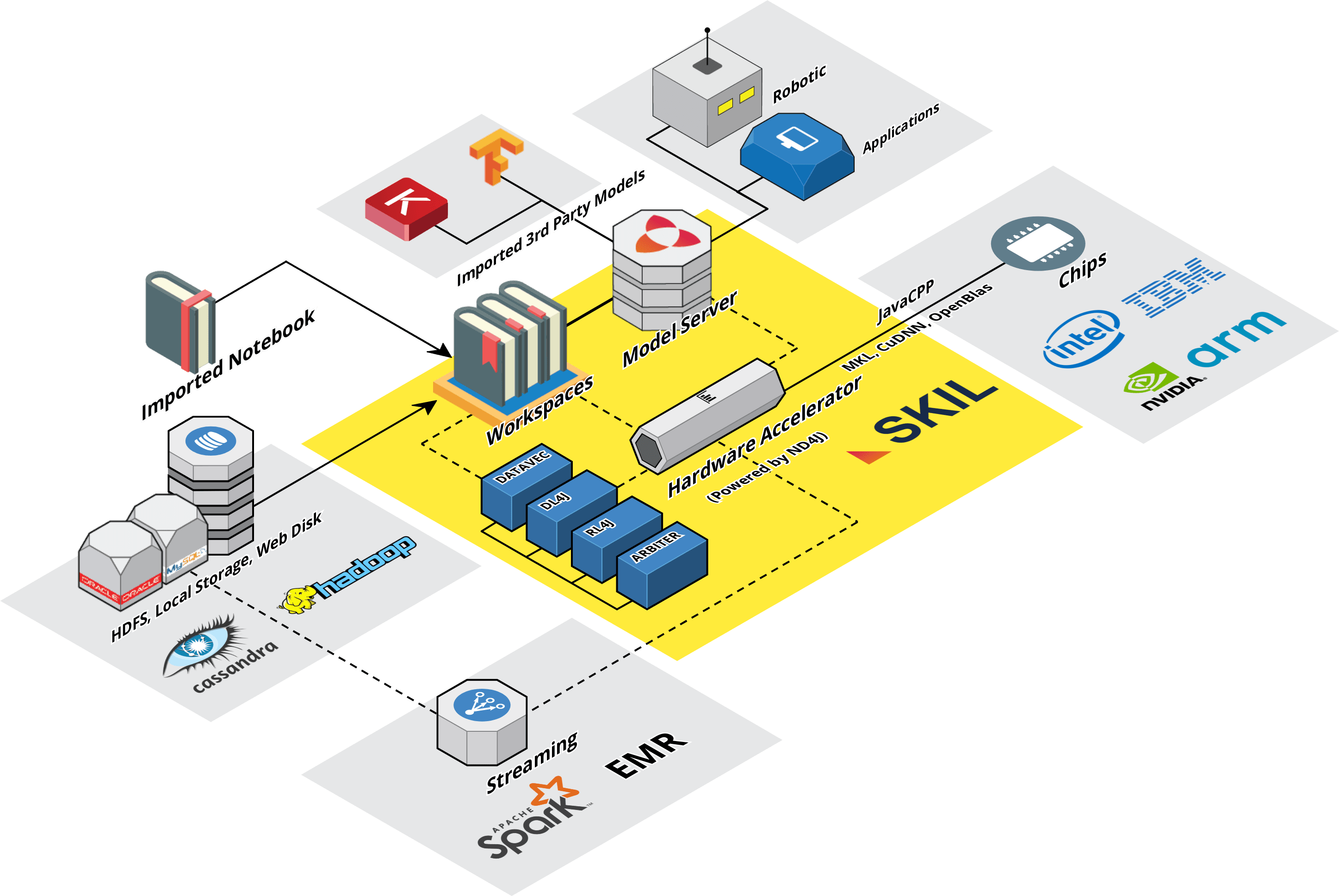
It’s no secret that enterprises know that they have to adapt AI in some form but are struggling with figuring out how to do so. Skymind’s tools, including its core SKIL framework, allow data scientists to create workflows that take them from ingesting the data to cleaning it up, training their models and putting them into production. The promise here is that Skymind’s tools eliminate the gap that often exists between the data scientists and IT.

“The two big opportunities with AI are better customer experiences and more efficiency, and both are based on making smarter decisions about data, which is what AI does,” said Nicholson. “The main types of data that matter to enterprises are text and time series data (think web logs or payments). So we see a lot of demand for natural-language processing and for predictions around streams of data, like logs.”

Current Skymind customers include the likes of ServiceNow and telco company Orange, while some of its technology partners that integrate its services into their portfolio include Cisco and SoftBank .

It’s worth noting that Skymind is also the company behind Deeplearning4j, one of the most popular open-source AI tools for Java. The company is also a major contributor to the Python-based Keras deep learning framework.


20 Mar 2019

Daily Crunch: Apple unveils new AirPods

The Daily Crunch is TechCrunch’s roundup of our biggest and most important stories. If you’d like to get this delivered to your inbox every day at around 9am Pacific, you can subscribe here.

1. Apple announces new AirPods

The new AirPods are fitted with the H1 chip, which is meant to offer performance efficiencies, faster connect times between the pods and your devices and the ability to ask for Siri hands-free with the “Hey Siri” command.

“They are powered by the new Apple -designed H1 chip which brings an extra hour of talk time, faster connections, hands-free ‘Hey Siri’ and the convenience of a new wireless battery case,” said Apple’s Phil Schiller in a press release.

2. Google fined €1.49BN in Europe for antitrust violations in search ad brokering

Speaking at a press conference today, EU competition commissioner Margrethe Vestager said the search giant — “by far the biggest” search ad broker in the region, with its AdSense platform taking a share in Europe of “well above 70% since 2006” — had engaged in illegal practices in order to “cement its dominant market position.”

3. All 88 companies from Y Combinator’s W19 Demo Day 2

And there were already 85 startups that pitched on Day 1!

4. The 9 biggest questions about Google’s Stadia game streaming service

Google’s Stadia is an impressive piece of engineering to be sure: Delivering high-definition, high frame-rate, low latency video to devices like tablets and phones is an accomplishment in itself. But the game streaming service faces serious challenges if it wants to compete with the likes of Xbox and PlayStation, or even plain old PCs and smartphones.

5. Disney closes its $71.3B Fox acquisition

The goal of the enormous acquisition is to help Disney position itself for a streaming-centric future.

6. Kickstarter CEO Perry Chen steps down

Chen says he will stay with the service as chairman of the board, focusing “on high-level and long-term company needs.” Kickstarter will be promoting its head of Design and Product, Aziz Hasan, as interim CEO, as Chen steps away from day to day operations.

7. The Oculus Rift S is indeed real and arrives in spring for $399

After years of high-profile onstage announcements, Oculus has decided to quietly deliver the successor to its flagship Rift virtual reality headset, confirming most of our October report with the release of the new Oculus Rift S.

20 Mar 2019

How CrunchMatch helped Yoolox increase distribution

German startup Yoolox, makers of a portable wireless charger for smartphones, tablets and laptops, exhibited in Startup Alley at Disrupt with the goal of spreading awareness of their first products, Yoolox 10k and 16k. Given Disrupt’s global brand exposure, Yoolox decided it would be the perfect place to debut what they had been working on:

TechCrunch Disrupt gave us the opportunity to exchange with potential distribution partners and investors. It was a great opportunity to get a direct feedback. — Pascal Bosten, co-founder, Yoolox

Through CrunchMatch, TechCrunch’s matchmaking tool, Yoolox had a number of meetings set up with various Disrupt attendees, outside of just investors, notably, U.S.-based CWO Distribution, which focuses on helping hardware startups with e-commerce distribution, retail strategies and more. They helped Yoolox get a listing on Amazon while both Walmart and Home Depot are currently underway. In addition, CWO also is handling their entire fulfillment process. Following the conference, Yoolox and CWO took the products to CES and were subsequently featured in Gizmodo and The Verge.

We met CWO at TechCrunch Disrupt in Berlin and since then we have been constantly increasing sales. Disrupt helped us to connect with the right people. The CrunchMatch networking app made it very easy to efficiently filter interests and find the right contact persons. — David Photien, co-founder, Yoolox

If you’re looking to connect with investors, partners or others at Disrupt, taking advantage of the CrunchMatch networking platform may connect you with the right people to propel your business. If you’re interested in exhibiting in Startup Alley, grab your exhibitor package here, which includes three Founder Passes. Or if you were thinking about bringing a group of startups to Disrupt, reach out to startupalley@techcrunch.com and someone from the TechCrunch team will be in touch with you.

20 Mar 2019

Disney closes its $71.3B Fox acquisition

As of 12:02am Eastern today, Disney has closed its acquisition of 21st Century Fox .

The goal of the enormous acquisition is to help Disney position itself for a streaming-centric future. The company has already taken a step in that direction with the ESPN+ streaming service, and it has plans to launch another service called Disney+ later this year, which will include new shows based on the Star Wars and Marvel universes, as well as Disney’s entire movie library.

With the Fox acquisition, Disney has even more films, TV shows and intellectual property to draw on — as indicated by the redesigned lead image on the on Disney corporate website, which now features “The Shape of Water,” “Avatar” and “Deadpool” (all Fox films), as well as “The Simpsons” and “Atlanta” (which are produced by Fox studios and air on Fox networks). It also becomes the majority owner of Hulu, with CEO Bob Iger (pictured above) saying that Disney will invest in more original content for Hulu and help it expand internationally.

In addition, the deal solidifies Disney’s already-dominant position in Hollywood — seemingly the one studio that can still reliably draw massive audiences to movie theaters. Thanks to its previous acquisitions of Marvel and Lucasfilm, Disney has had the number one movie at the worldwide box office for each of the past four years, and in 2018, it released all of the top three films, while Fox had two movies in the top 10.

Even after Disney won its bidding war with Comcast last year by making an offer of $71.3 billion, the deal has still taken nine months to gain all the necessary regulatory approval.

Meanwhile, Fox’s news and sports divisions — including Fox News, the Fox broadcast network and Fox Sports — have a spun out as a new Fox Corporation, and the acquisition is expected to result in more than 4,000 layoffs.

“I wish I could tell you that the hardest part is behind us; that closing the deal was the finish line, rather than just the next milestone,” Iger said in a staff memo. “What lies ahead is the challenging work of uniting our businesses to create a dynamic, global entertainment company.”

20 Mar 2019

Music’s next big startup Splice raises $57.5M to sell samples

Tech has a bad reputation for pulling money out of musicians’ pockets, but Splice is changing that. The audio sample marketplace and music production collaboration tool has now paid out $15 million to artists. Splice lets musicians sell their sounds for royalty-free use, and songs by Eminem, Ariana Grande, and Marshmello that were powered by those samples have topped the charts.

“Music is going through a beautiful moment” says Steve Martocci, Splice’s co-founder and CEO who former built and sold GroupMe. “The tailwinds from the success of streaming are great. As more people realize how big the market it, how much people want to create music,  there’s a huge opportunity here.”

Now Union Square Ventures and True Ventures are seizing on that opportunity, co-leading a $57.5 million Series C for Splice. “It’s all about scale” Martocci tells me. “We’re investing in ourselves. Continuing to build new products. Continuing to work with bigger artists. We think there’s so much about the creative process and ecosystem of musicians that needs to be fixed. We want to diviserify the content available so all artists in all genres feel like we have what they need.

The round which includes DFJ Growth, Flybridge, Lerer Hippeau, Liontree, Founders Circle Capital, and Matt Pincus brings Splice to $104.5 million in total funding. Splice wouldn’t disclose the valuation, but using the industry standard of selling 20 percent equity for a Series C, Splice could be valued in the ballpark of $285 million. That would make it one of the top music startups that isn’t selling streaming, tickets, or hardware.

Martocci confirms that artists receive the majority of Splice’s sample marketplace revenue, saying “they’re very favorable deals”. That’s especially great for the music production industry because a lot of Splice’s sample creators aren’t celebrity DJs, Martocci says the’rre audio engineers and other “people behind the scenes getting an oppportunity to step into the light with an amazing revenue opportunity, but also an oppportunity to be seen for their creative contributions.”

20 Mar 2019

The Oculus Rift S is indeed real and arrives in spring for $399

After years of high-profile onstage announcements, Oculus has decided to quietly deliver the successor to its flagship Rift virtual reality headset, confirming most bits of our October report with the release of the new Oculus Rift S.

As we first reported, the biggest improvements to the Oculus Rift S are a move to the company’s inside-out “Insight” camera tracking system and modest updates to the display resolution. The biggest surprise is that this headset is being built in partnership with Lenovo and the Rift S seems to have strongly inherited Lenovo’s design ethos for its VR products for better or worse…

When asked at a low-key private press event how they were framing the new device, Oculus co-founder Nate Mitchell called the Rift S an “evolution not a revolution” over the original Rift. That being said, the design is entirely new, but not all of the changes are ones VR fans will be happy about.

The Rift S will be replacing the Rift in the Oculus product lineup.

Here’s what’s different:

  • Small resolution increase from (1080 X 1200) to (1280 X 1440), improved lenses
  • Frame rate is dropping from 90hz to 80hz
  • Switched from OLED to the LCD panels used on Oculus Go
  • 5 onboard cameras for inside-out camera tracking
  • Ships with updated Oculus Touch controllers, same as what ships with Quest
  • Loses the on-ear headphones for cheaper-sounding near-ear speakers similar to Oculus Go
  • Ditches the flexible strap for a rigid “halo” design like the PlayStation VR headset
  • FoV is “slightly larger” on the Rift S compared to the Rift, Oculus tells us
  • No manual adjustment of distance between your eyes (IPD)
  • PC spec requirements are largely the same, though you may need a faster CPU we are told
  • More expensive than the last generation at $399 versus $349
  • Launching in spring 2019

As we reported last year, the Rift S is a product of tradeoffs. It was green-lit only after a more ambitious redesign was cancelled by the company.

This was a decision former-CEO and co-founder Brendan Iribe strongly disagreed with. A source told TechCrunch his departure was partially due to his lack of interest in “offering compromised experiences that provided short-term user growth but sacrificed on comfort and performance.”

The Rift S is certainly full of compromises.

The original Rift and Touch were shipped as a $798 combo that eventually had the price reduced to $349 as the result of round after round of price cuts. The Rift S is more expensive, but it feels cheaper with Lenovo’s hard plastic design and the loss of key features designed for comfort like on-ear headphones and IPD adjustment. That being said, most first time users will be thrilled by the easier setup process for the onboard cameras and not having to worry about things like USB bandwidth management for wired sensors. 

The tracking system is powerful, but it seems like Oculus had to make some controversial choices to end up with this product, so we’ll see what the broader reaction is. The headset and controllers are coming sometime this spring and will retail for $399.

20 Mar 2019

Skedulo raises $28M for its mobile workforce management service

Skedulo, a service that helps businesses manage their mobile employees, today announced that it has raised a $28 million Series B funding round led by M12, Microsoft’s venture fund. Existing investors Blackbird and Castanoa Ventures also participated in this round.

The company’s service offers businesses all fo the necessary tools to manage their mobile employees, including their schedules. A lot of small businesses still use basic spreadsheets and email to do this, but that’s obviously not the most efficient way to match the right employee to the right job, for example.

“Workforce management has traditionally been focused on employees that are sitting at a desk for the majority of their day,” Skedulo  CEO and Co-Founder Matt Fairhurst told me. “The overwhelming majority — 80 percent — of workers will be deskless by 2020 and so far, there has been no one that has addressed the needs of this growing population at scale.  We’re excited to help enterprises confront these challenges head-on so they can compete and lean into rapidly changing customer and employee expectations.”

At the core of Skedulo, which offers both a mobile app and web-based interface, is the company’s so-called ‘Mastermind’ engine that helps businesses automatically match the right employee to a job, based on the priorities the company has specified. The company plans to use the new funding to enhance this tool through new machine learning capabilities. Skedulo will also soon offer new analytics tools and integrations with third-party services like HR and financial management tools, as well as payroll systems.

The company also plans to use the new funding to double its headcount, which includes hiring at least 60 new employees in its Australian offices in Brisbane and Sydney.

As part of this round, Priya Saiprasad, Principal of M12, will join Skedulo’s Board of Directors. “We found a strong sense of aligned purpose with Priya Saiprasad and the team at M12 – and their desire to invest in companies that help reduce cycles in a person’s working day,” Fairhurst said. “Fundamentally, Skedulo is a productivity company. We help companies, the back-office and mobile workforce, reduce the number of cycles it takes to get work done. This gives them time back to focus on the work that matters most.”

20 Mar 2019

Serena Williams joins Bumble’s investment fund as an investor

Serena Williams, the global sports and fashion icon and investor, is doubling down on her relationship with the dating app Bumble with today’s announcement that she will serve as an investor in its Bumble Fund. 

Launched in 2018, the Bumble Fund backs early-stage businesses founded and led by women of color and underrepresented groups. The fund’s commitments range between $5,000 and $250,000 with an average check size of $25,000.

“In my life, and today more than ever, I’ve learned how impactful one woman’s voice can be when given a platform to speak and be heard,” said Serena Williams, in a statement. 

Williams, one of the greatest tennis players of all time, has been investing in women and minority-owned businesses through Serena Ventures since 2014. She also serves on the boards of the tech companies Poshmark and SurveyMonkey. 

She began her relationship with Bumble in January, culminating with a starring role in the company’s most recent Super Bowl commercial earlier this year and will be leading the Bumble Fund pitch competition next month, along with Bumble founder and CEO Whitney Wolfe Herd.

That competition launches today on Bumble Bizz and is open to U.S.-based entrepreneurs who identify as women, with a priority given to founders from diverse backgrounds, experiences and perspectives. Companies have until March 27, 2019 to submit.

“When we launched our #InHerCourt campaign with Serena Williams this past January, we were amazed by the overwhelming response we received from women globally who felt empowered by our message,” Wolfe Herd said in a statement. “In teaming up with Serena for the Bumble Fund, we want women everywhere to know that we are here, we are listening and we believe in you.”

Through Serena Ventures, Williams already has invested in over thirty companies while the Bumble Fund has made nine investments to date. Recent deal include investments in the business advisory service, Alice; the workout and training app, Gixo; diversity and inclusion training toolkit provider, Translator and the probation and parole support service, Promise.

“I am passionate about building on this progress and opening doors for women of all backgrounds, especially women of color, to share their message and trust in their potential to accomplish great things,” Williams said in a statement. “By joining forces with the Bumble Fund, we will continue amplifying female entrepreneurs and creating a place for them to personally and professionally champion their growth.”

20 Mar 2019

Peloton hit with $150 million music licensing suit

Streaming video is the key to Peloton’s success. But like any good spin class, it’s the soundtrack that really does the heavy lifting. A new suit filed by The National Music Publishers’ Association alleges that that the wild successful exercise startup used north of 1,000 songs in its classes without the proper licensing.

The suit features a laundry list of publishers: Downtown Music Publishing, Big Deal Music, Reservoir, Round Hill, Royalty Network, Pulse Music Publishing and TRO Essex Music Group. While the list of musicians is a who’s who of Top 40 musicians:  Rihanna, Bruno Mars, Lady Gaga, Katy Perry, Justin Timberlake, Shawn Mendes, Ed Sheeran, Wiz Khalifa, Thomas Rhett, Ariana Grande, Justin Bieber, Florida Georgia Line, Drake and Gwen Stefani, for starters.

The plaintiffs are seeking more than $150 million in damages over the improper use of songs.

“Unfortunately, instead of recognizing the integral role of songwriters to its company, Peloton has built its business by using their work without their permission or fair compensation for years,” President & CEO David Israelite said in a statement. “It is frankly unimaginable that a company of this size and sophistication would think it could exploit music in this way without the proper licenses for this long, and we look forward to getting music creators what they deserve.”

The association is quick to note that Peloton managed to pull in a $4 billion valuation last year, not a great look if the publishing claims turn out to be accurate.

We’ve reached out to Peloton for comment on the suit.

20 Mar 2019

Amazon Pay inks Worldpay integration as it branches out in the wider world of e-commerce

Amazon rules the roost when it comes to e-commerce marketplaces in countries like the US, but today it’s announcing a deal that it hopes will be a start its plan to have that same kind of ubiquity outside of its walled garden. The company has inked a deal with Worldpay for the latter to become its first acquirer.

This means that Worldpay — one of the more ubiquitous providers of payment technologies, processing 40 billion transactions worth some $1.7 trillion annually through 300+ payment options and 120 currencies — will now be offering Amazon Pay as part of that mix, so that any merchant can offer this as a payment and shipping option to its customers.

Importantly, this would also allow Amazon, over time, to layer on further services into the mix for merchants, which could potentially include netting third party merchants into its popular Amazon Prime subscription scheme for free shipping and more.

“It’s a good question, but we’d prefer not to speak about our future plans,” Patrick Gauthier, VP of Amazon Pay, told TechCrunch when asked about Prime and whether it could become a part of the Worldpay offering. “Today the announcement is about the extension of our footprint. It will lead us into more opportunities to grow the value proposition for buyers and merchants, but I will reserve discussion about that for the future.”

The deal is being announced the same week that Worldpay had some other news of its own: it’s getting acquired by Fidelity National Information Services in a $43 billion deal. Asif Ramji, chief product and marketing officer at Worldpay, speaking to TechCrunch about the Amazon Pay news confirmed that the acquisition will have no impact on this Amazon deal.

Gauthier said that the initial focus of the deal will be to cover digital payments mainly for online merchants, although not just on websites per se. “The focus is on the connected experience, and we are leaning into other kinds of connected devices TVs,” he said.

The lure for merchants goes something like this: linking into Amazon Pay gives buyers an option to select from a list of active addresses and payment options that they will already be using to buy on Amazon. This, in turn, will make it less onerous to fill out details to complete the transaction — and therefore less likely for the sale to fall prey to the “shopping cart abandonment” that scuppers many an online transaction. That would be even more the case on screens where a user might not have a keyboard and so inputting information is even more of a pain, such as on a TV.

To be clear, in a nutshell, this quicker process, added convenience, and increased security (no need to re-enter card details), are the promised benefits of all digital wallets. Amazon’s unique selling point, however, is that its particular set of data is already widely used, and therefore more likely to be used again.

The other 95%

We once reported on some research that found that Amazon accounted for nearly half of all online commerce in the US, but only five percent of all retail spend. As a long-term plan to continue growing its business, Amazon has been working on ways to extend its reach outside of the world of Amazon for a while now.

While some efforts in areas like point-of-sale services, for example, have largely fallen flat, what’s interesting in this Worldpay deal is how Amazon is willing to concede a bit of control in its effort to change that track record and tap into that bigger market.

Ramji noted that Worldpay actually built Amazon a custom API to integrate Amazon Pay on to its platform and to create the ability to tap into the data around shipping and cards that Amazon can subsequently provide to merchants. That implies that this will, for now at least, be something that only Worldpay will be able to provide to customers.

What’s also very notable in this news is how Amazon Pay / Worldpay might help Amazon bring in more transactions under its Amazon Prime subscription umbrella.

While Gauthier would not comment on whether Prime might be offered as an option at checkout at any point in the Worldpay integration, he did note that the company has quietly been testing using Prime outside of Amazon for a while now.

“As a matter of fact we have had instances of doing that already,” he said, noting that the fashion retailer All Saints currently provides the same Prime shipping benefits to its customers if they happen also to be Prime subscribers. “It has been very successful in terms of customer conversion and lift, and to capture new customers.” He also noted that the company ran tests during Prime Day in 2018, testing using Prime with third-party merchants to understand the potential opportunity it might have here. “Yes, we have had interest from merchants if and when we decide to go further with Prime.”