Author: azeeadmin

18 Mar 2019

Nvidia announces its next-gen RTX pods with up to 1,280 GPUs

Nvidia wants to be a cloud powerhouse. While its history may be in graphics cards for gaming enthusiasts, its recent focus has been on its data center GPUs for AI, machine learning inference, inference and visualization. Today, at its GTC conference, the company announced its latest RTX server configuration for Hollywood studios and others who need to quickly generate visual content.

A full RTX server pod can support up to 1,280 Turing GPUs on 32 RTX blade servers. That’s 40 GPUs per server, with each server taking up an 8U space. The GPUs here are Quadro RTX 4000 or 6000 GPUs, depending on the configuration.

NVIDIA RTX Servers — which include fully optimized software stacks available for Optix RTX rendering, gaming, VR and AR, and professional visualization applications — can now deliver cinematic-quality graphics enhanced by ray tracing for far less than just the cost of electricity for a CPU-based rendering cluster with the same performance,” the company notes in today’s announcement.

All of this power can be shared by multiple users and the backend storage and networking interconnect is powered by technology from Mellanox, which Nvidia bought earlier this month for $6.9 billion. That acquisition and today’s news clearly show how important the data center has become for Nvidia’s future.

System makers like Dell, HP, Lenovo, Asus and Supermicro will offer RTX servers to their customers, all of which have been validated by Nvidia and support the company’s software tools for managing the workloads that run on them.

Nvidia also stresses that these servers would work great for running AR and VR applications at the edge and then serving the visuals to clients over 5G networks. That’s a few too many buzzwords, I think, and consumer interest in AR and VR remains questionable, while 5G networks remain far from mainstream, too. Still, there’s a role for these servers in powering cloud gaming services, for example.

18 Mar 2019

Nvidia AI turns sketches into photorealistic landscapes in seconds

Today at Nvidia GTC 2019, the company unveiled a stunning image creator. Using generative adversarial networks, users of the software are able to sketch images that are nearly photorealistic with just a few clicks. The software will instantly turn a couple of lines into a gorgeous mountaintop sunset. This is MS Paint for the AI age.

Called GauGAN, the software is just a demonstration of what’s possible with Nvidia’s neural network platforms. It’s designed to compile an image how a human would paint, with the goal being to take a sketch and turn it into a photorealistic photo in seconds. In an early demo, it seems to work as advertised.

GauGAN has three tools: a paint bucket, pen and pencil. At the bottom of the screen is a series of objects. Select the cloud object and draw a line with the pencil, and the software will produce a wisp of photorealistic clouds. But these are not image stamps. GauGAN produces results unique to the input. Draw a circle and fill it with the paint bucket and the software will make puffy summer clouds.

Users can use the input tools to draw the shape of a tree and it will produce a tree. Draw a straight line and it will produce a bare trunk. Draw a bulb at the top and the software will fill it in with leaves producing a full tree.

GauGAN is also multimodal. If two users create the same sketch with the same settings, random numbers built into the project ensure that software creates different results.

In order to have real-time results, GauGAN has to run on a Tensor computing platform. Nvidia demonstrated this software on an RDX Titan GPU platform, which allowed it to produce results in real time. The operator of the demo was able to draw a line and the software instantly produced results. However, Bryan Catanzaro, VP of Applied Deep Learning Research, stated with some modifications, GauGAN can run on nearly any platforms, including CPUs, though the results might take a few seconds to display.

In the demo the boundaries between objects are not perfect and the team behind the project states it will improve. There is a slight line where two objects touch. Nvidia calls the results photorealistic but under scrutiny, it doesn’t stand up. Neural networks currently have an issue on objects it was trained on and what the neural network is trained to do. This project hopes to decrease that gap.

Nvidia turned to 1 million images on Flickr to train the neural network. Most came from Flickr’s Creative Commons, and Catanzaro said the company only uses images with permissions. The company says this program can synthesize hundreds of thousands of objects and their relation to other objects in the real world. In GauGAN, change the season and the leaves will disappear from the branches. Or if there’s a pond in front of a tree, the tree will be reflected in the water.

Nvidia will release the white paper today. Catanzaro noted that it was previously accepted to CVPR 2019.

Catanzaro hopes this software will be available on Nvidia’s new AI Playground but says there is a bit of work the company needs to do in order to make that happen. He sees tools like this being used in video games to create more immersive environments but notes Nvidia does not directly build software to do so.

It’s easy to bemoan the ease with which this software could be used to produce inauthentic images for nefarious purposes. And Catanzaro agrees this is an important topic, noting that it’s bigger than one project and company. “We care about this a lot because we want to make the world a better place,” he said, adding that this is a trust issue instead of a technology issue and that we, as a society, must deal with it as such.

Even in this limited demo, it’s clear that software built around these abilities would appeal to everyone from a video game designer to architects to casual gamers. The company does not have any plans to release it commercially but could soon release a public trial to let anyone use the software.

18 Mar 2019

Nvidia’s T4 GPUs are coming to the AWS cloud

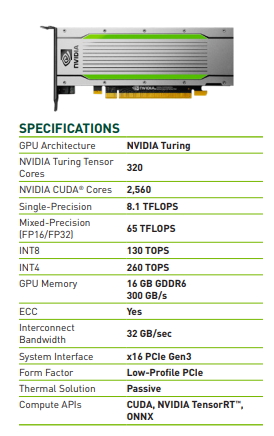
In the coming weeks, AWS is launching new G4 instances with support for Nvidia’s T4 Tensor Core GPUs, the company today announced at Nvidia’s GTC conference. The T4, which is based on Nvidia’s Turing architecture, was specifically optimized for running AI models. The T4 will be supported by the EC2 compute service and the Amazon Elastic Container Service for Kubernetes.

“NVIDIA and AWS have worked together for a long time to help customers run compute-intensive AI workloads in the cloud and create incredible new AI solutions,” said Matt Garman, vice president of Compute Services at AWS, in today’s announcement. “With our new T4-based G4 instances, we’re making it even easier and more cost-effective for customers to accelerate their machine learning inference and graphics-intensive applications.”

The T4 is also the first GPU on AWS that supports Nvidia’s raytracing technology. That’s not what Nvidia is focusing on with this announcement, but creative pros can use these GPUs to take the company’s real-time raytracing technology for a spin.

For the most part, though, it seems like Nvidia and AWS expect that developers will use the T4 to put AI models into production. It’s worth noting that the T4 hasn’t been optimized for training these models, but they can obviously be used for that as well. Indeed, with the new Cuda-X AI libraries (also announced today), Nvidia now offers an end-to-end platform for developers who want to use its GPUs fr deep learning, machine learning and data analytics.

It’s worth noting that Google launched T4 support in beta a few months ago. On Google’s cloud, these GPUs are currently in beta.

18 Mar 2019

Intel and Cray are building a $500 million ‘exascale’ supercomputer for Argonne National Lab

In a way, I have the equivalent of a supercomputer in my pocket. But in another, more important way, that pocket computer is a joke compared with real supercomputers — and Intel and Cray are putting together one of the biggest ever with a half-billion-dollar contract from the Department of Energy. It’s going to do exaflops!

The “Aurora” program aims to put together an “exascale” computing system for Argonne National Laboratory by 2021. The “exa” is prefix indicating bigness, in this case 1 quintillion floating point operations, or FLOPs. They’re kind of the horsepower rating of supercomputers.

For comparison, your average modern CPU does maybe a hundred or more gigaflops. A thousand gigaflops makes a teraflop, a thousand teraflops makes a petaflop, and a thousand petaflops makes an exaflop. So despite major advances in computing efficiency going into making super powerful smartphones and desktops, we’re talking several orders of magnitude difference. (Let’s not get into GPUs, it’s complicated.)

And even when compared with the biggest supercomputers and clusters out there, you’re still looking at a max of 200 petaflops (that would be IBM’s Summit, over at Oak Ridge National Lab) or thereabouts.

Just what do you need that kind of computing power for? Petaflops wouldn’t do it? Well, no, actually. One very recent example of computing limitations in real-world research was this study of how climate change could affect cloud formation in certain regions, reinforcing the trend and leading to a vicious cycle.

This kind of thing could only be estimated with much coarser models before; Computing resources were too tight to allow for the kind of extremely large number of variables involved here (or here — more clouds). Imagine simulating a ball bouncing on the ground — easy — now imagine simulating every molecule in that ball, their relationships to each other, gravity, air pressure, other forces — hard. Now imagine simulating two stars colliding.

The more computing resources we have, the more can be dedicated to, as the Intel press release offers as examples, “developing extreme-scale cosmological simulations, discovering new approaches for drug response prediction and discovering materials for the creation of more efficient organic solar cells.”

Intel says that Aurora will be the first exaflop system in the U.S. — an important caveat, since China is aiming to accomplish the task a year earlier. There’s no reason to think they won’t achieve it, either, since Chinese supercomputers have reliably been among the fastest in the world.

If you’re curious what ANL may be putting its soon-to-be-built computers to work for, feel free to browse its research index. The short answer is “just about everything.”

18 Mar 2019

Intel and Cray are building a $500 million ‘exascale’ supercomputer for Argonne National Lab

In a way, I have the equivalent of a supercomputer in my pocket. But in another, more important way, that pocket computer is a joke compared with real supercomputers — and Intel and Cray are putting together one of the biggest ever with a half-billion-dollar contract from the Department of Energy. It’s going to do exaflops!

The “Aurora” program aims to put together an “exascale” computing system for Argonne National Laboratory by 2021. The “exa” is prefix indicating bigness, in this case 1 quintillion floating point operations, or FLOPs. They’re kind of the horsepower rating of supercomputers.

For comparison, your average modern CPU does maybe a hundred or more gigaflops. A thousand gigaflops makes a teraflop, a thousand teraflops makes a petaflop, and a thousand petaflops makes an exaflop. So despite major advances in computing efficiency going into making super powerful smartphones and desktops, we’re talking several orders of magnitude difference. (Let’s not get into GPUs, it’s complicated.)

And even when compared with the biggest supercomputers and clusters out there, you’re still looking at a max of 200 petaflops (that would be IBM’s Summit, over at Oak Ridge National Lab) or thereabouts.

Just what do you need that kind of computing power for? Petaflops wouldn’t do it? Well, no, actually. One very recent example of computing limitations in real-world research was this study of how climate change could affect cloud formation in certain regions, reinforcing the trend and leading to a vicious cycle.

This kind of thing could only be estimated with much coarser models before; Computing resources were too tight to allow for the kind of extremely large number of variables involved here (or here — more clouds). Imagine simulating a ball bouncing on the ground — easy — now imagine simulating every molecule in that ball, their relationships to each other, gravity, air pressure, other forces — hard. Now imagine simulating two stars colliding.

The more computing resources we have, the more can be dedicated to, as the Intel press release offers as examples, “developing extreme-scale cosmological simulations, discovering new approaches for drug response prediction and discovering materials for the creation of more efficient organic solar cells.”

Intel says that Aurora will be the first exaflop system in the U.S. — an important caveat, since China is aiming to accomplish the task a year earlier. There’s no reason to think they won’t achieve it, either, since Chinese supercomputers have reliably been among the fastest in the world.

If you’re curious what ANL may be putting its soon-to-be-built computers to work for, feel free to browse its research index. The short answer is “just about everything.”

18 Mar 2019

Unity adds preview support for Nvidia’s ray tracing tech to push gaming realism

Ray tracing has been a major topic of conversation at both GDC and GTC so it seems fitting that that the overlapping conventions would both kick off with an announcement that touches both industries.

Today at GTC, Nvidia announced that it has built-out a number of major partnerships with 3D software makers including some apparent names like Adobe and Autodesk to integrate access with Nvidia’s RTX ray-tracing platform in their future software releases. The partnerships with Unity is perhaps the most interesting, given the excitement amongst game developers to bring real-time ray tracing to interactive works.

Epic Games had already announced Unreal Engine 4.22 support for Nvidia RTX ray-tracing, and it was only a matter of time before Unity made the plunge as well, but now the tech is officially coming to Unity’s High Definition Render Pipeline (HDRP) today in preview.

The technology is all focused on how games render lighting more realistically, showing how light interacts with the atmosphere and the objects it strikes. This technique has already been in use elsewhere but rendering all of this can be pretty resource-intensive which has made the advancements of the past few years to cement this as a real-time system such an entrancing prospect.

Nvidia has certainly been tooting the horn of this technology, but there have been some doubts whether this is just another technology that’s still a few years out from popular adoption amongst game developers.

“Real-time ray tracing moves real-time graphics significantly closer to realism, opening the gates to global rendering effects never before possible in the real-time domain,” a Unity exec said in a statement. In their announcement, Nvidia boasted that their system enabled “ray traced images that can be indistinguishable from photographs” that “blur the line between real-time and reality.”

While the prospect of added realism in gaming is certainly something consumers will be psyched about, engine-makers will undoubtedly also be promoting their early access to the Nvidia tech to customers in other industries including enterprise.

18 Mar 2019

General Catalyst just carved out an aggressive new seed-stage program — here’s what to know

General Catalyst is diving more seriously into the business of funding seed-stage startups. To wit, the venture firm is announcing today that it plans to invest at least $25 million each year in nascent teams that “can’t be too early” for the firm to see, according to Katherine Boyle, an investor with the firm who will be spearheading the effort with two other colleagues: Niko Bonatsos and Peter Boyce, who cofounded and continues to help oversee Rough Draft Ventures, a student-focused program fueled by General Catalyst.

We talked with the three on Friday morning to find out why their 19-year-old firm — which has sometimes invested in seed-stage firms in the past — felt the need to formalize its efforts with this new initiative, whose capital will come from the firm’s $1.4 billion ninth fund (closed in March of last year).

They said the decision arose from feedback they’ve received in recent years, including that it can take too long for decisions to get made in the earliest stages of a startup’s life; that many seed-stage and angel investors are now looking for some traction before they’ll write a check; and that fundraising is stressful and distracting.

GC’s solution to all three is to address them by promising founders a quick decision; by promising to work with founders who have “clarity of vision” if not actually proof of concept yet; and by assuring founders whose companies take off that it can continue to support them financially, thanks to its giant fund.

As Boyle explains it, the idea is to write initial checks of between $500,000 and $2 million to start, to respond within 48 hours of a meeting (though they won’t skip reference checks), and to invest in anywhere from 25 to 35 startups each year, though Boyce suggests they can easily invest more given the right opportunities. “This isn’t spray and pray,” adds Bonatsos. “We come in and we’re significant investors. The idea is to invest more in future rounds.”

Naturally, it’s not a novel concept, a giant firm investing in seed-stage companies. Plenty of heavyweight firms have done this in the past, including Greylock, which garnered attention by giving Reid Hoffman $20 million to invest in seed-stage funds back in 2010.

Andreessen Horowitz and Sequoia Capital are also among other very big firms known to invest in seed-stage companies, though firm founder Marc Andreessen expressed some ambivalence about the trend in conversation with us back in 2013. His concern at the time — and it’s one that venture firms, including his own, have since grown more comfortable with — was the potential for conflicts of interest.

Seemingly, the possibility isn’t keeping the General Catalyst team awake at night. “Historically, this hasn’t been an issue,” says Bonatsos. “Of course, business models evolve and conflicts can emerge [as portfolio companies begin to compete with one another]. But we go into these conversations with an open mind. Also, sometimes, what may look from the outside like a conflict isn’t, because startups are targeting other geographies or different types of customers.”

Neither is General Catalyst concerned with signaling risk, or the risk generated when a startup accepts seed funding from a top-tier VC and that VC doesn’t go on to lead, or even participate, in its Series A round. As Sequoia partner Bryan Schreier told us Sequoia’s thinking it launching its own $180 million seed-stage fund last year, the mere association with certain firms helps more than it hinders. Said Schreier: We’ve pulled data on this and a company that has raised seed funding from Sequoia is three times more likely to raise a venture round — no matter what. I think it shows that company building does matter a great deal at the early stages . . .”

One difference between GC and numerous other firms, including Sequoia, that pursue seed-stage deals: it does not have a formal “scouting” program, wherein it works with operators in its portfolio who seek out deals on its behalf and are rewarded financially for the work. “We don’t have that at the moment,” says Bonatsos, nothing that “things may change in the future.”

The seed team is also eschewing the “generalist” approach that many firms seem to embrace, with Bonatsos, Boyle, and Boyce telling us they have distinct, if sometimes overlapping, areas of expertise and interest. Boyle, for example, invests in heavily regulated industries, with a particular penchant for startups focused on defense tech and that sell to the government. Bonatsos has long focused on consumer deals, though he said he’s also interested in “frontier stuff” and startups that are trying to create new industries. As for his part, Boyce is most interested these days in consumer financial services and design.

Ultimately, says the Bonatsos, the three “want to be inspired.”

Adds Boyce, “We work with both first-time and experienced founders all the time. It’s less about experience and traction, and more about founders who have a point of view and can attract talent – – founders who we think can get to the IPO and beyond.”


18 Mar 2019

Apple Business Chat drives in-seat drink ordering at Quicken Loans Arena in Cleveland

With LeBron James hundreds of miles west plying his trade for the Los Angeles Lakers these days, Cleveland Cavalier fans haven’t had a lot to cheer about this season, but Aramark (the stadium food and beverage vendor) and the Cavs have teamed up with Apple Business Chat to let fans order drinks right from their seats.

It’s a nifty system, first introduced to Phillies fans last summer. In this iteration, Cleveland fans can access a menu, order drinks and get them delivered directly to their seats using iMessage on their iPhones.

You start by opening the Camera app and scanning the QR code on your seat back. That brings up a prompt in Messages to “Hit send to start your order.” From there, you can interact with the order bot to order your beverages. To make it easier, you access a menu and make your selections.

When you’re finished, the bot prompts you for your seat number. You pay for your order with Apple Pay, and the beverages will be delivered directly to you without having to miss any of the game action.

It’s not clear how long you have to wait for the drinks to be delivered, but it beats standing in long lines and brings an entirely digital ordering process to fans. Kevin Kearney, district manager for Aramark’s Sports and Entertainment division sees this as a way to integrate the mobile experience into the fan experience at the game in a highly accessible way.

“The integration of Apple Business Chat with the ordering process is not only fan-friendly and easily accessible, it’s reflective of fans’ changing expectations and behaviors and we’re looking forward to Cavs and Monsters (Cleveland’s AHL affiliate) fans giving it a try,” Kearney said in a statement.

The program is being piloted for the remainder of the season as the teams and Aramark see how the process works and how fans like using it. It may not take the sting of LeBron leaving town, but it is a convenient way to get drinks while taking in a game.

18 Mar 2019

Atlassian acquires AgileCraft for $166M

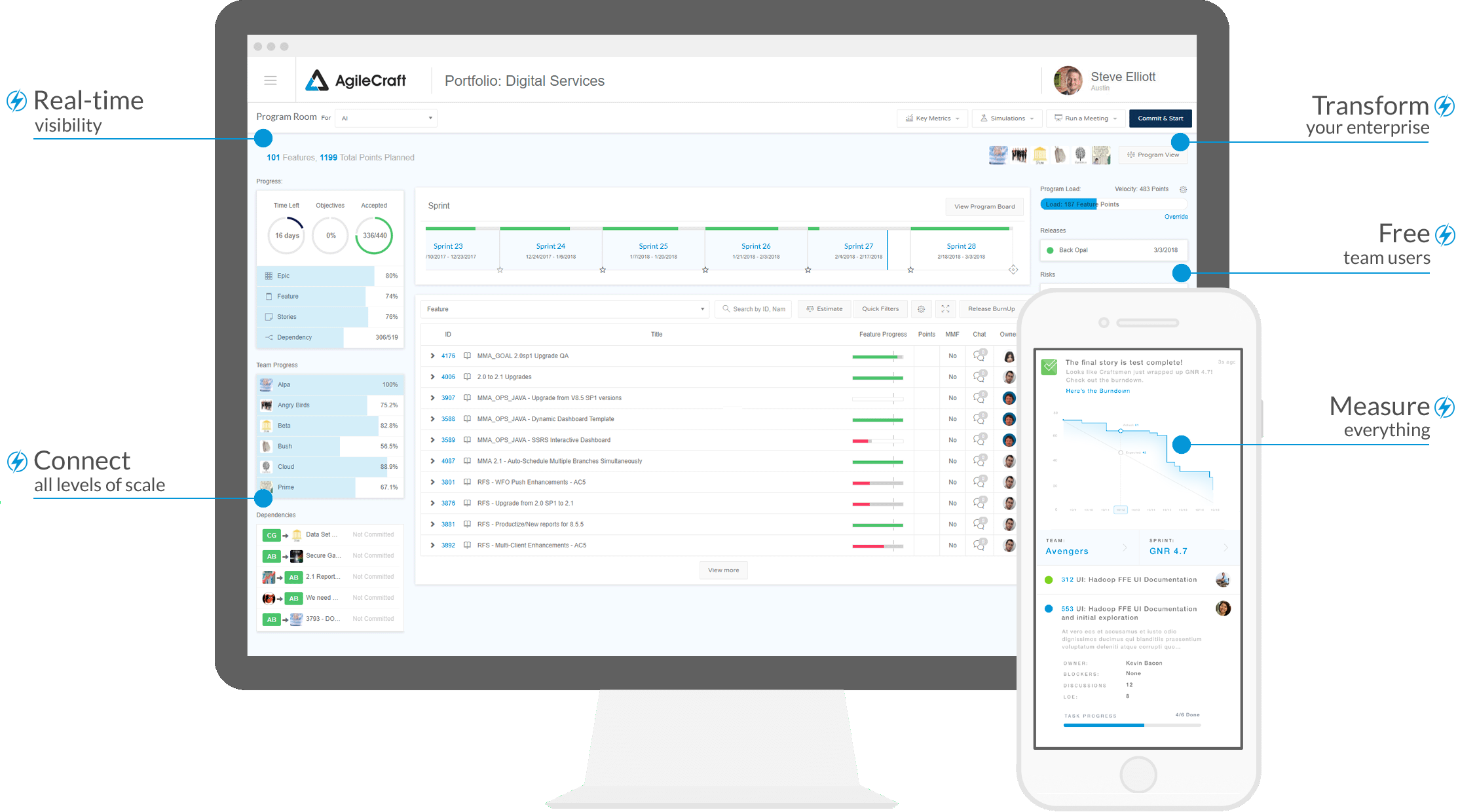
Atlassian today announced that it has acquired AgileCraft, a service that aims to give enterprises plan their strategic projects and workstreams. The service provides business leaders with additional insights into the current status of technical projects and gives them insights into the bottlenecks, risks and dependencies of these projects. Indeed, the focus of AgileCraft is less on technical teams than on the business teams that support them and help them manage the digital transformation of their businesses.

The price total of the acquisition is about $166 million, with $154 million in cash and the remainder in restricted shares.

“Many leaders are still making mission-critical decisions using their instincts and best guesses instead of data,” said Scott Farquhar, Atlassian’s co-founder and co-CEO, in today’s announcement. “As Atlassian tools spread through organizations, technology leaders need better visibility into work performed by their teams. With AgileCraft joining Atlassian, we believe we’re the best company to help executives align the work across their organization – providing an all-encompassing view that connects strategy, work, and outcomes.”

As the name implies, AgileCraft focuses on the Agile methodology, though it also offers a bit of flexibility there with support for frameworks like SAFe, LeSS, Spotify. It supports pulling in data from tools like Atlassian’s Jira, but also Microsoft’s Team Foundation Server, IBM’s RTC and other services.

Atlassian will continue to operate AgileCraft, which had raised about $10.1 million before the acquisition. as a standalone service. “We will continue to focus relentlessly on our customers’ success,” writes AgileCraft’s founder and CEO Steve Elliott. “We remain dedicated to pioneering enterprise agility and are thrilled to team up with the outstanding people at Atlassian to help our customers thrive.”

Over the years, Atlassian started embracing users and use cases for its tools that go beyond its core tools for development tools. Jira is a prime example for this. Today’s acquisition continues this trend in that AgileCraft aims to bring many of the methodologies that tech teams use to the rest of the company.

Atlassian doesn’t typically make a lot of acquisitions. Its pace is close to about one major buy per year. Last year, the company picked up OpsGenie for $295 million. In 2017, it acquired Trello for $425 million, the company’s biggest acquisition to date. Other major products the company acquired include StatusPage, BlueJimp, HipChat and Bitbucket (all the way back in 2010).

18 Mar 2019

misterb&b hits the equity crowdfunding trail to expand into hotels

Homosexuality is illegal in a third of the planet, and in eight countries, it is punishable by death. In the febrile atmosphere of today’s politics, hate crime incidents in the US increased by 17% between 2016 to 2017, according to the FBI.

Over 20 of those incidents were crimes against an individual’s sexual-orientation — the largest increase since 9/11. Similar hate crime statistics have increased in the UK and several other western countries.

It’s strange and saddening to think that men, women, and gender non-conforming people who “travel while gay” are now in a more dangerous – and potentially life-threatening – situation around the world, despite us being well into the 21st Century.

The key to the situation is knowing whether the place you’re staying at will be welcoming or not. There are many incidents where, at hotels, gay travelers have been rejected or forced to book separate rooms, and had to fall back on third-party, unverified, user-generated reviews.

Now, misterb&b, the short-term rental marketplace aimed at the Gay community, has a simple solution. Customers can book an entire home or rent a private room at the home of a gay or gay-friendly host, and with many located in gay-friendly neighborhoods. The startup competes with more home-spun sites like “Gay Home Stays“, however, misterb&b has already raised substantial amounts in VC.

The startup graduated from the 500 Startups accelerator and has raised US$13.5M from institutional investors like Project A and Ventech, and from angels like Joel Simkhai (founder of Grindr, which sold for $300M USD). The marketplace now has 310,000 hosts in over 135 countries, and claims to have 30% revenue growth YoY; with 60% of the business done organically by repeat customers.

misterb&b has now raised over half a million dollars inside a week via Wefunder to fund its expansion. This will allow guests, hosts, and the public to invest in the company’s push to launch its services into the hotel sector.

Investors are buying into a lucrative market. The niche of global gay tourism is estimated to be a $100Bn market, while gay people travel twice as much as other travelers. Its fund-raising may also benefit from the influx of new tech millionaires being created by the upcoming IPOs of Uber, Lyft, Postmates, and Airbnb.

CEO and founder Matthieu Jost says he wants to “build equality into the sharing economy and give back to a community that’s been historically economically marginalized,” providing its community “with the power of part ownership of the company”.

The idea for starting misterb&b was first conceived in 2013 after he had a negative experience while traveling with his partner and didn’t feel welcome by his host. “Six years ago, my partner and I traveled to and booked a room in Barcelona through a third party rental website,” he told me via email.

“Unfortunately, when we arrived there, we were faced with a host who was very much homophobic and asked me if we were seriously going to share a bedroom. This was a very sad thing to have to face. Straight, hetero folks never have to worry about something so humiliating as this while on a lovely vacation; they will never have to think about it or prepare for it.”

“When I returned home I felt dejected, but I felt I had do something to solve this horrific problem – yet common fear – that our community faces. I don’t want my community to be afraid of traveling anymore,” he said.

“We are reaching out to the most passionate people in the community: our hosts and our guests, as well as LGBTQ allies,” said Jost. “We want to provide the opportunity to financially benefit from our successes,” he added.

The crowdfunding is for a new selection of gay-friendly and gay-welcoming hotels that have been selected by the company’s editorial team for their quality, exclusive, and verified reviews from LGBTQ travelers. The idea is that travelers will also be able to connect with each other to explore the city together – especially because there’s safety in numbers.