Author: azeeadmin

18 Mar 2019

Lyft’s driver wage lawsuit in NYC continues

As Lyft gears up to list its stock on the NASDAQ, the transportation company is facing ongoing litigation regarding driver wages in New York City. Today, a judge denied Lyft’s motion for an injunction blocking the recent ruling that sets a minimum wage for drivers. Still, the judge said she’ll think it over and file a written ruling in the next 30 days. This comes shortly after a number of drivers protested Lyft’s lawsuit against the city of New York earlier this morning.

“We are pleased the judge denied Lyft’s motion to block the wage protection rules for now and we hope she will uphold the city’s rules in her written decision.” Independent Drivers Guild member and Lyft driver Tina Raveneau said in a statement. “Eighty thousand New Yorkers serve as professional drivers for apps like Lyft and we deserve the protection and the dignity of a livable minimum wage. It is like a punch in the gut to us, the drivers who helped build this company, that Lyft stood in court suing to block higher wages at the same time as they moved toward an IPO at a $23 billion valuation. We are finally making more than we have in years thanks to the new pay rules, but Lyft wants to bring it back to the way it was before, poverty wages.”

Lyft filed the lawsuit earlier this year, arguing the new rules give an advantage to Uber, will reduce driver earnings and exacerbate congestion. At the time, Lyft said its suit was “not directed at the law passed by New York City Council, but rather at the TLC’s complex formula for implementation.” Lyft is a proponent of a weekly pay standard but argues the TLC’s approach does not take into account things like drivers who use multiple apps and fluctuating demand.

“We support the New York City Council’s minimum earnings goal, but oppose the TLC’s specific rules because they actually hurt earning opportunities for drivers, and provide advantages to certain companies over others,” Lyft spokesperson Campbell Matthews said in a statement. “We appreciated the opportunity to make our case in court today, and look forward to the judge’s forthcoming ruling.”

The suit came after the NYC Taxi and Limousine Commission in December approved new rules to offer a minimum hourly wage of $17.22 (after expenses) to drivers who work for ride-hailing companies like Uber, Lyft, Via and Juno. The two-year-long campaign for minimum wage was spearheaded by The Independent Drivers Guild, a labor organization that advocates for drivers. The rules require companies to pay drivers according to a formula based on mileage, time and utilization rate (average percentage of time drivers have passengers in their cars),

Lyft has recently said that it is committed to increasing the earnings of drivers and supports the NYC council’s minimum earnings goal. But it filed the lawsuit, Lyft said in a recent blog post, “to correct the flawed implementation of the law by NYC’s Taxi & Limousine Commission.”

These rules legally went into effect in February. Since then, Lyft says there has been a negative impact on driver earnings. That’s because, Lyft says, the cost for passengers increased 24 percent, which led to rides dropping 26 percent and driver earnings dropping 15 percent. Lyft had to then take “action to stabilize the market largely through the use of passenger discounts. We won’t do this forever, but knew it was important for both the driver community and Lyft while the lawsuit progressed.”
18 Mar 2019

Kevin Tsujihara is stepping down as Warner Bros CEO

Kevin Tsujihara is leaving his role as chairman and CEO of Warner Bros. Entertainment.

He joined Warner Bros. back in 1994 and took charge of the film and TV studio in 2013. As part of broader leadership changes at WarnerMedia — which is now under the ownership of AT&T — his role was recently expanded to include Turner Classic Movies, digital-focused Otter Media and a new business unit that includes Warner’s properties for kids and young adults.

However, Tsujihara was also the subject of an exposé in the Hollywood Reporter earlier this month, which described his text messages with actress Charlotte Kirk. The two were apparently in a sexual relationship, and the messages show Kirk asking for Tsujihara’s help in landing film roles.

She was eventually cast in two small parts in two Warner Bros. films — “How to be Single” and “Ocean’s 8.” Tsujihara’s attorney insisted that he had “no direct role” in Kirk’s hiring on these films.

In a memo to sent to Warner Bros. staff, Tsujihara said, “After lengthy introspection, and discussions with John Stankey over the past week, we have decided that it is in Warner Bros.’ best interest that I step down as Chairman and CEO … The hard work of everyone within our organization is truly admirable, and I won’t let media attention on my past detract from all the great work the team is doing.”

The company has not yet announced a replacement.

18 Mar 2019

Trump’s views about ‘crazy’ self-driving cars are at odds with his DOT

President Donald Trump is an automated-vehicle skeptic, a point of view that lies in stark contrast with agencies within his own administration, including the U.S. Department of Transportation .

According to a recent scoop by Axios, Trump has privately said he thinks the autonomous-vehicle revolution is “crazy.” Trump’s point of view isn’t exactly surprising. His recent tweets about airplanes becoming too complex illustrates his Luddite leanings.

The interesting bit — beyond a recounting of Trump pantomiming self-driving cars veering out of control — is how his personal views compare to the DOT.

Just last week during SXSW in Austin, Secretary of Transportation Elaine Chao announced the creation of the Non-Traditional and Emerging Transportation Technology (NETT) Council, an internal organization designed to resolve jurisdictional and regulatory gaps that may impede the deployment of new technology, such as tunneling, hyperloop, autonomous vehicles and other innovations.

“New technologies increasingly straddle more than one mode of transportation, so I’ve signed an order creating a new internal Department council to better coordinate the review of innovation that have multi-modal applications,” Chao said in a prepared statement at the time.

Meanwhile, other AV-related policies and legislation are in various stages of review.

The DOT’s National Highway Traffic Safety Administration (NHTSA) announced Friday that automated-vehicle petitions from Nuro and General Motors are advancing to the Federal Register for public review and comment.

The parallel viewpoints have yet to collide. There’s no evidence that Trump’s personal views on autonomous-vehicle technology has been inserted into DOT policy. Of course, that doesn’t mean it won’t.

AV companies are hip to this eventuality and are taking steps now to educate the masses — and Trump. Take the Partners for Automated Vehicle Education (PAVE) coalition, as one example. PAVE launched in January with a founding group that included a number of major automakers, technology companies and organizations with a stake in autonomous vehicles, including Audi, Aurora, Cruise, GM, Mobileye, Nvidia, Toyota, Waymo and Zoox to spread the word about advanced vehicle technologies and self-driving vehicles. Their message: This tech can transform transportation and make it safer and more sustainable.

Waymo has also teamed up with AAA on a public education campaign to spread the word about autonomous-vehicle technology and how it could impact safety and help people get around. The partnership, announced recently, is with AAA Northern California, Nevada & Utah (AAA NCNU), a regional organization that oversees operations in seven markets, including well-known hubs of autonomous vehicle development such as Arizona and California.

18 Mar 2019

Y Combinator bets on the booming podcast industry

Podcasts are exploding in popularity and Y Combinator, the startup accelerator known for its long list of unicorn graduates, is throwing its support behind a business tackling the podcast monetization problem. Among its latest and largest-ever cohort is Brew, a subscription-based app complete with original content.

Though Brew’s founders, Jijo Sunny, Madhavan Ramakrishnan, Aleesha John and Joseph Sunny, call Brew the “Netflix for podcasts,” the app differs from Luminary, which made headlines with the same tagline and a $100 million round earlier this month. Luminary, which hasn’t yet launched, will similarly operate under a subscription model, charging $8 a month for access to its podcasts. Instead of opening its platform to creators of any stature, the business is striking deals with established voices in the podcast industry, like Guy Raz of “How I Built This,” Adam Davidson of “Planet Money” and celebrities Trevor Noah and Lena Dunham.

Brew, on the other hand, charges listeners $5 per month for access to a different demographic: upstart podcasters and rising stars alike. In other words, if you and your mom wanted to start a podcast — and get paid — you can sign up on Brew and instantly start raking in cash. That is, if you’re garnering an audience of listeners; Brew pays its creators based on their number of unique listens.

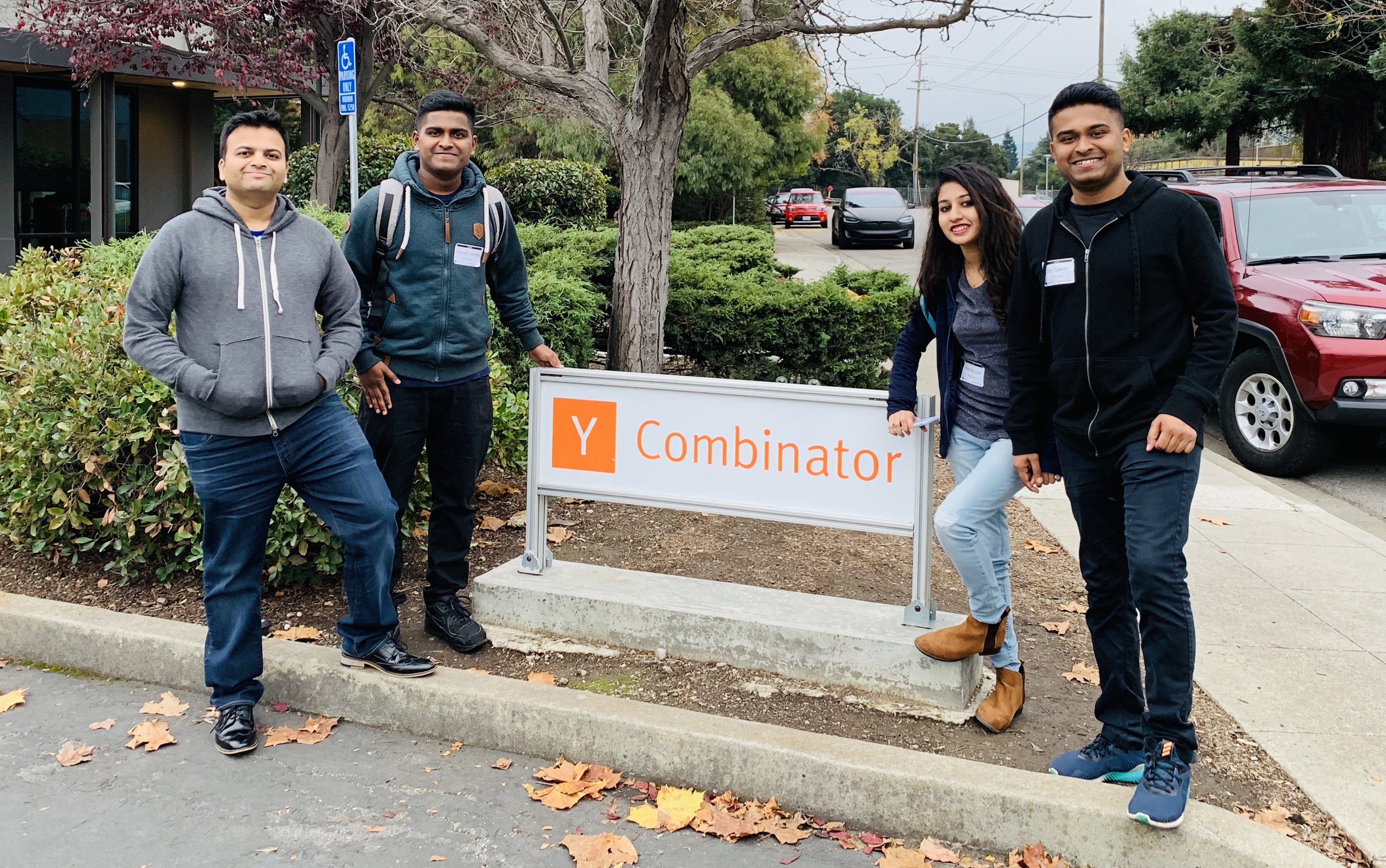
The founding team behind Brew, a startup tackling the podcast monetization problem.

“Podcasts, by nature, have a low barrier to entry and that’s the best thing about podcasts, right?,” Brew chief executive officer Jijo Sunny tells TechCrunch. “Anyone anywhere can set up a podcast. To be a Netflix for audio, it has to be for all creators, not celebrities like Trevor Noah.”

The app officially launched in the app store last week with several original ad-free shows, including original content from YouTubers Boogie2988 and Jack Vale, who boast a 4.5 million and 1.5 million following on YouTube, respectively. Next month, Brew will make its platform available for all podcasters to upload shows.

“Our vision is to help millions of creators earn a living doing what they love,” Ramakrishnan tells TechCrunch.

The startup’s long-term vision includes incorporating a tipping feature, much like Himalaya, another podcasting business that recently secured a $100 million check. Himalaya allows listeners to send micro-payments to creators to help subsidize their ad-based income.

Later, Brew plans to allow podcasters to operate online stores within the app, so they can earn additional money through merchandise sales. Live podcasts, publishing and production tools are also on the roadmap.

Podcast startups are taking off thanks to support from venture capitalists, but the people behind the content still struggle to earn a solid paycheck. Justine and Olivia Moore of CRV, an early-stage venture capital firm, say podcasts monetize at only a penny per listener hour, on average. Podcasting, in other words, makes 10x less money per hours consumed than radio, TV, magazines or any other major content medium. Meanwhile, 73 million people are enjoying podcasts every month, per Edison Research, and some 15 billion episodes are downloaded each year.

It’s clear there is an untapped opportunity to help content creators get rich. The Brew team’s experience — they previously built Buymeacoffee.com, a tipping platform for artists that has funded 40,000 people to date — coupled with VCs excitement for the growing medium puts Brew on a solid path for growth.

Brew’s team is originally from Kerala, India but plans to permanently set up shop in San Francisco. They’ve raised a total of $400,000, including Y Combinator’s $150,000 check. CrunchRoll founder Kun Gao and Teachable CEO Ankur Nagpal are amongst its early backers.

Brew, alongside some 200 other startups, will pitch to investors at YC Demo Days later today and tomorrow.

18 Mar 2019

Targeting payday lenders, Branch adds pay on-demand features for hourly workers

Branch, the scheduling and pay management app for hourly workers, has added a new pay-on-demand service called Pay, which is now available to anyone who downloads the Branch app.

It’s an attempt to provide a fee-based alternative to payday lending, where borrowers charge exorbitant rates to lenders on short term loans or cash advances. Borrowers can often wind up paying anywhere from 200 percent to over 3,000 percent on short term payday loans.

The Pay service, which was previously only available to select users from a waitlist at companies like Dunkin’, Taco Bell and Target (which are Branch customers), is now available to anyone in the United States and gives anyone the opportunity to get paid for the hours they have worked in a given pay period.

Branch, which began its corporate life as Branch Messenger, started out as a scheduling and shift management tool for large retailers, restaurants, and other businesses with hourly workers. When the company added a wage tracking service, it began to get a deeper insight into the financially precarious lives of its users, according to chief executive, Atif Siddiqi.

“We thought, if we can give them a portion of their paycheck in advance it would be a big advantage with their productivity,” Siddiqui says. 

The company is working with Plaid, the fintech unicorn that debuted five years ago at the TechCrunch Disrupt New York Hackathon, and Cross River Bank, the stealthy financial services provider backstopping almost every major fintech player in America.

“Opening Pay and instant access to earnings to all Branch users continues our mission of creating tools that empower the hourly employee and allow their work lives to meet the demands of their personal lives,” said Siddiqi, in a statement. “Our initial users have embraced this feature, and we look forward to offering Pay to all of our organic users to better engage employees and scale staffing more efficiently.”

Beta users of the Pay service have already averaged roughly 5.5 transactions per month and over 20 percent higher shift coverage rates compared to non-users, according to the company. Pay isn’t a lending service, technically. It offers a free pay-within-two-days option for users to receive earned, but uncollected wages, before a scheduled payday.

For users, there’s no integration with a back-end payroll system. Anyone who wants to use Pay just needs to download the Branch app and enter their employer, debit card or payroll card, and bank account (if a user has one). Through its integration with Plaid, Branch has access to almost all U.S. banks and credit unions.

“A lot of these employees at some of these enterprises are unbanked so they get paid on a payroll card,” Siddiqui said. “It’s been a big differentiation for us in the market allowing us to give unbanked users access to the wages that they earn.”

Users on the app can instantly get a $150 cash advance and up to $500 per pay period, according to the company. The Pay service also comes with a wage tracker so employees can forecast their earnings based on their schedule and current wages, a shift scheduling tool to pick up additional shifts, and an overdraft security feature to hold off on repayment withdrawals if it would cause ussers to overdraw their accounts.

Branch doesn’t charge anything for users who are willing to wait two days to receive their cash, and charges $1.99 for instant deposits.

Siddiqui views the service as a loss leader to get users onto the Branch app and ultimately more enterprise customers onto its scheduling and payment management SAAS platform.

“The way we generate revenue is through our other modules. It’s very sticky… and our other modules compliment this concept of Pay,” Siddiqui says. “By combining scheduling and pay we’re providing high rates of shift coverage… now people want to pick up undesirable shifts because they can get paid instantly for those shifts.”

18 Mar 2019

Successful launch propels OneWeb to $1.25B in new funding

Following the successful launch and deployment of the first six satellites in a planned constellation of hundreds, OneWeb has raised $1.25 billion in funding to kickstart mass production. It’s a powerful endorsement of and ambitious plan to create an entirely new layer of global connectivity.

To blanket the world in internet, OneWeb means to send up about 650 satellites at first, with a few hundred more later to expand and reinforce coverage. The original schedule has slipped considerably, as is expected in pretty much any space endeavor, but last month’s test launch means they’re ready to move to the next phase: mass manufacture and deployment.

“With the recent successful launch of our first six satellites, near-completion of our innovative satellite manufacturing facility with our partner Airbus, progress towards fully securing our ITU priority spectrum position, and the signing of our first customer contracts, OneWeb is moving from the planning and development stage to deployment of our full constellation,” said CEO Adrian Steckel in a press release.

It isn’t cheap filling low Earth orbit with satellites, though. OneWeb’s craft currently cost about a million dollars each, which when combined with all the other costs of launch and administration, quickly add up to the point where even a three comma round doesn’t cover things. (The company’s total raised is now $3.4 billion.)

But those costs should come down as the company moves to a more efficient manufacturing platform: its own special facility, built with partner Airbus. Part of the cash will be going to putting the finishing touches on that and getting it up to speed.

The current plan is to get enough birds in the air (at a rate of about 30 per monthly launch) to demo connections next year, then offer limited commercial service in 2021. And OneWeb already has its first customer: Talia, a telecom serving Africa and the Middle East.

Of course, OneWeb isn’t without competitors. SpaceX is perhaps the most visible, and plans a constellation of thousands, though with only a pair of prototypes in orbit it’s considerably far behind in logistics. And it may not be able to spare many rockets for its own purposes if it wants to remain solvent for its grander schemes of interplanetary travel and Mars colonization.

Swarm Technologies is aiming for an ultra-low-cost solution, and Ubiquitilink is leveraging new IP to bring satellite connections directly to existing phones — which may end up coexisting with the other satcom and terrestrial telecoms. Who knows? It’s something of an open field right now.

That said, the powers that be are definitely putting a lot of their chips on OneWeb, which has a great team, powerful partners, and a big lead on the competition. This $1.25 billion round was led by Softbank (which telegraphed its continuing investment at the time of the launch) with participation by Grupo Salinas, Qualcomm, and the Government of Rwanda.

18 Mar 2019

Successful launch propels OneWeb to $1.25B in new funding

Following the successful launch and deployment of the first six satellites in a planned constellation of hundreds, OneWeb has raised $1.25 billion in funding to kickstart mass production. It’s a powerful endorsement of and ambitious plan to create an entirely new layer of global connectivity.

To blanket the world in internet, OneWeb means to send up about 650 satellites at first, with a few hundred more later to expand and reinforce coverage. The original schedule has slipped considerably, as is expected in pretty much any space endeavor, but last month’s test launch means they’re ready to move to the next phase: mass manufacture and deployment.

“With the recent successful launch of our first six satellites, near-completion of our innovative satellite manufacturing facility with our partner Airbus, progress towards fully securing our ITU priority spectrum position, and the signing of our first customer contracts, OneWeb is moving from the planning and development stage to deployment of our full constellation,” said CEO Adrian Steckel in a press release.

It isn’t cheap filling low Earth orbit with satellites, though. OneWeb’s craft currently cost about a million dollars each, which when combined with all the other costs of launch and administration, quickly add up to the point where even a three comma round doesn’t cover things. (The company’s total raised is now $3.4 billion.)

But those costs should come down as the company moves to a more efficient manufacturing platform: its own special facility, built with partner Airbus. Part of the cash will be going to putting the finishing touches on that and getting it up to speed.

The current plan is to get enough birds in the air (at a rate of about 30 per monthly launch) to demo connections next year, then offer limited commercial service in 2021. And OneWeb already has its first customer: Talia, a telecom serving Africa and the Middle East.

Of course, OneWeb isn’t without competitors. SpaceX is perhaps the most visible, and plans a constellation of thousands, though with only a pair of prototypes in orbit it’s considerably far behind in logistics. And it may not be able to spare many rockets for its own purposes if it wants to remain solvent for its grander schemes of interplanetary travel and Mars colonization.

Swarm Technologies is aiming for an ultra-low-cost solution, and Ubiquitilink is leveraging new IP to bring satellite connections directly to existing phones — which may end up coexisting with the other satcom and terrestrial telecoms. Who knows? It’s something of an open field right now.

That said, the powers that be are definitely putting a lot of their chips on OneWeb, which has a great team, powerful partners, and a big lead on the competition. This $1.25 billion round was led by Softbank (which telegraphed its continuing investment at the time of the launch) with participation by Grupo Salinas, Qualcomm, and the Government of Rwanda.

18 Mar 2019

ClimaCell bets on IoT for better weather forecasts

To accurately forecast the weather, you first need lots of data — not just to train your forecasting models but also to generate more precise and granular forecasts. Typically, this has been the domain of government agencies, thanks to their access to this data and the compute power to run the extremely complex models. Anybody can now buy compute power in the cloud, though, and as the Boston and Tel Aviv-based startup ClimaCell is setting out to prove, there are now also plenty of other ways to get climate data thanks to a variety of relatively non-traditional sensors that can help generate more precise local weather predictions.

Now you may say that others, like Dark Sky, for example, are already doing that with their hyperlocal forecasts. But ClimaCell’s approach is very different, and with that has attracted as clients airlines like Delta, JetBlue and United, sports teams like the New England Patriots and agtech companies like Netafim.

“The biggest problem is that to predict the weather, you need to have observations and you need to have models,” ClimaCell CEO Shimon Elkabetz told me. “The entire industry is basically repackaging the data and models of the government [agencies]. And the governments don’t create the relevant infrastructure everywhere in the world. Even in the U.S., there’s room for improvement.”

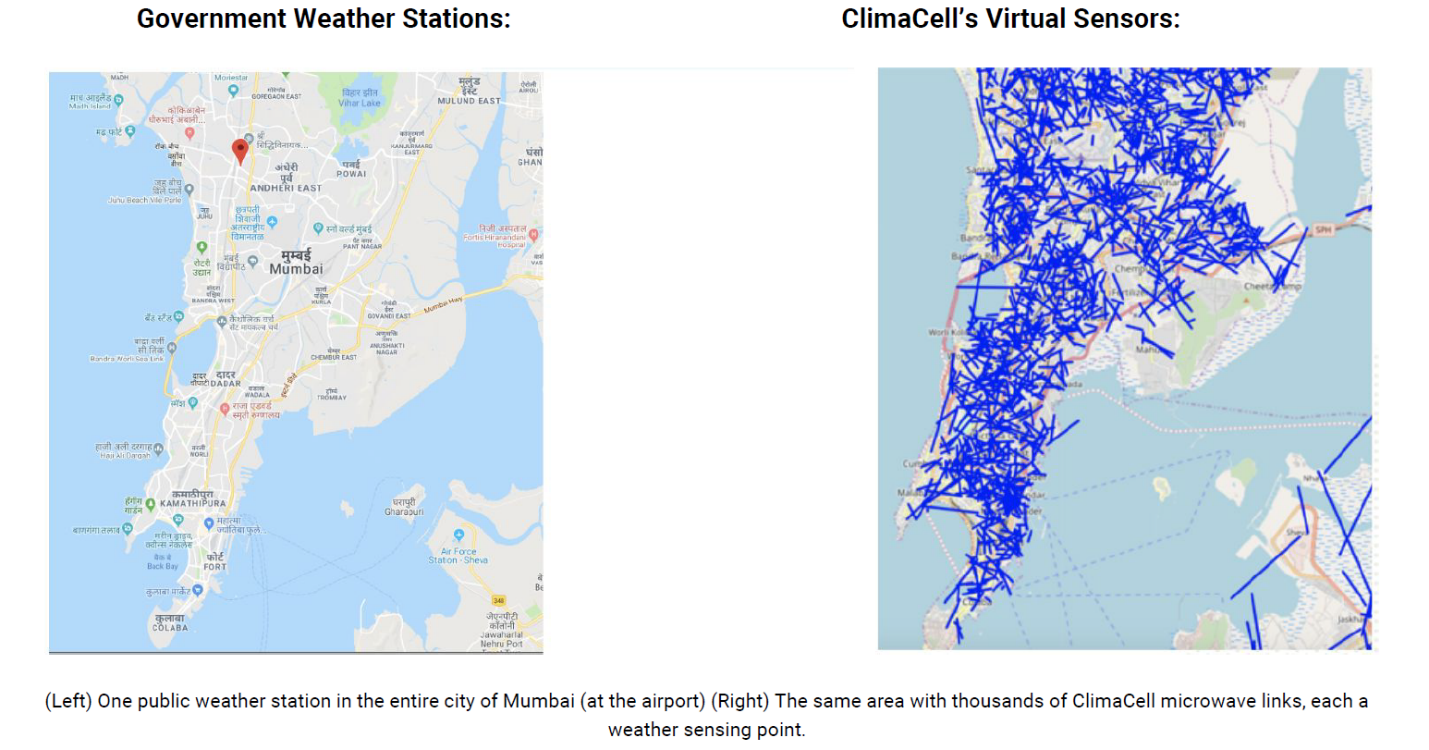
And that’s where ClimaCell’s main innovation comes in. Instead of relying on government sensors, it’s using the Internet of Things to gather more weather data from far more places than would otherwise be possible. This kind of sensing technology could turn millions of existing connected devices — like cell phones, connected vehicles, street cameras, airplanes and drones — into virtual weather stations. It’s easy enough to see how this would work. If a driver turns on a windshield wiper or fog lights, you know it’s probably raining or foggy. Often, these cars also relay temperature data. If a street camera sees rain, it’s raining.

What’s more complex is that ClimaCell has also developed the technology to gather data from how atmospheric conditions impact the signal propagation between cell phones and their base stations. And to take this one step further — and beyond the ground level — it has also figured out how to gather similar data from satellite-to-ground microwave signals.

“The idea is that everything is sensitive to weather and we can turn everything into a weather sensor,” said Elkabetz. “That’s why we call it the weather of things. It enables us to put in place virtual sensors everywhere.”

Using all this data, ClimaCell is providing its customers, like airlines, ridesharing companies and energy companies, with real-time weather data and forecasts.

Using all of this data the company also recently launched flood alerts for about 500 cities that can provide 24 to 48-hour warnings ahead of major flood events. To do this, the company combined its weather data with its own hydrological model.

For now, most of ClimaCell’s business model focuses on selling its data and predictions to other businesses. The company plans to launch a consumer app in May, though. I got a sneak peek of the app; while I can’t vouch for the forecasts, it’s a very well-designed application that you’ll probably want to look at, no matter whether you’re a weather geek or just want to see if you can get a quick bike ride in before the rain starts.

Why a consumer app? “We want to become the biggest weather technology company in the world,” Elkabetz said. To get to this point, the company has raised a total of $68 million to date from investors that include Clearvision Ventures, JetBlue Technology Ventures, Ford Smart Mobility,  Envision Ventures, Canaan Partners, Fontinalis Partners and Square Peg Capital.

18 Mar 2019

Daily Crunch: Apple updates the iPad Mini

The Daily Crunch is TechCrunch’s roundup of our biggest and most important stories. If you’d like to get this delivered to your inbox every day at around 9am Pacific, you can subscribe here.

1. Apple launches new iPad Air and iPad mini

The company is (finally) updating the iPad mini and adding a new iPad Air. This model sits between the entry-level 9.7-inch iPad and the 11-inch iPad Pro in the lineup.

All new models now support the first-generation Apple Pencil — but not the new Apple Pencil that supports magnetic charging and pairing.

2. Myspace may have lost more than a decade’s worth of user music

The once-dominant social network posted a note on its site reading, “As a result of a server migration project, any photos, videos, and audio files you uploaded more than three years ago may no longer be available on or from Myspace. We apologize for the inconvenience.”

3. Facebook failed to block 20 percent of uploaded New Zealand shooter videos

Facebook said it removed 1.5 million videos from its site within the first 24 hours after a shooter live-streamed his attack on two New Zealand mosques. In a series of tweets, Facebook’s Mia Garlick said a total of 1.2 million videos were blocked at the point of upload — but she did not say why the other 300,000 videos were not caught at upload.

4. Lyft’s imminent IPO could value the company at $23B

Ride-hailing firm Lyft will make its Nasdaq debut as early as next week at a valuation of up to $23 billion, The Wall Street Journal reports.

5. Moby’s new album is exclusive to the Calm meditation app

Album exclusives are nothing new in the age of Tidal, of course. But Moby’s latest is taking a circuitous route to the world’s mobile devices.

6. Slack hands over control of encryption keys to regulated customers

Slack announced today that it is launching Enterprise Key Management for Slack, a new tool that enables customers to control their encryption keys in the enterprise version of the communications app.

7. This week’s TechCrunch podcasts

The latest episode of Equity looks at Uber’s IPO plans, while the team at Mixtape talks to Angelica Ross of the FX show “Pose.”

18 Mar 2019

Daily Crunch: Apple updates the iPad Mini

The Daily Crunch is TechCrunch’s roundup of our biggest and most important stories. If you’d like to get this delivered to your inbox every day at around 9am Pacific, you can subscribe here.

1. Apple launches new iPad Air and iPad mini

The company is (finally) updating the iPad mini and adding a new iPad Air. This model sits between the entry-level 9.7-inch iPad and the 11-inch iPad Pro in the lineup.

All new models now support the first-generation Apple Pencil — but not the new Apple Pencil that supports magnetic charging and pairing.

2. Myspace may have lost more than a decade’s worth of user music

The once-dominant social network posted a note on its site reading, “As a result of a server migration project, any photos, videos, and audio files you uploaded more than three years ago may no longer be available on or from Myspace. We apologize for the inconvenience.”

3. Facebook failed to block 20 percent of uploaded New Zealand shooter videos

Facebook said it removed 1.5 million videos from its site within the first 24 hours after a shooter live-streamed his attack on two New Zealand mosques. In a series of tweets, Facebook’s Mia Garlick said a total of 1.2 million videos were blocked at the point of upload — but she did not say why the other 300,000 videos were not caught at upload.

4. Lyft’s imminent IPO could value the company at $23B

Ride-hailing firm Lyft will make its Nasdaq debut as early as next week at a valuation of up to $23 billion, The Wall Street Journal reports.

5. Moby’s new album is exclusive to the Calm meditation app

Album exclusives are nothing new in the age of Tidal, of course. But Moby’s latest is taking a circuitous route to the world’s mobile devices.

6. Slack hands over control of encryption keys to regulated customers

Slack announced today that it is launching Enterprise Key Management for Slack, a new tool that enables customers to control their encryption keys in the enterprise version of the communications app.

7. This week’s TechCrunch podcasts

The latest episode of Equity looks at Uber’s IPO plans, while the team at Mixtape talks to Angelica Ross of the FX show “Pose.”