Author: azeeadmin

18 Mar 2019

Lyft sets $62-68 price range for its IPO to raise up to $2.1B, will trade as LYFT on Nasdaq

Ride-sharing startup Lyft this morning announced that it is kicking off the roadshow for its IPO — setting the clock ticking for its IPO likely in around two weeks. Around that, it also filled in some more details. The stock will trade as “LYFT” on Nasdaq, and the IPO range is currently set for between $62 and $68 per share to sell 30,770,000 shares of Class A common stock, the company said, raising up to $2.1 billion at the higher end of that range, or $1.9 billion at the lower end.

Lyft also said in its updated S-1 that at the high end of the range, the maximum offering aggregate price — the maximum that it would raise at that range — will be $2,406,214,000 when considering the full range of Class A stock that will be registered, 35,385,500 shares.

(In addition to the 30,770,000 shares of Class A common stock, the company said it has an additional 4,615,500 shares in options for the underwriters, adding up to the 35 million share figure. J.P. Morgan Securities LLC, Credit Suisse Securities (USA) LLC, Jefferies LLC, UBS Securities LLC, Stifel, Nicolaus & Company, Incorporated, RBC Capital Markets, LLC and KeyBanc Capital Markets Inc. are book-running managers for the offering.)

The news kicks off the timer on Lyft’s public listing at a time when all eyes are on how ride-sharing companies will progress to the next stage of their growth, with Uber expected to file and also go public this year. Lyft’s revenues are growing fast — Lyft took $8.1 billion in bookings and made $2.1 billion in revenues in 2018, covering 30.7 million riders and 1.9 million drivers — but the company remains unprofitable. The company posted a net loss of $911.3 million in 2018, a figure that has grown in line with revenues, but notably shrunk proportionately. In 2016, revenues were $343.3 million while net loss was $682 million.

This public listing provides a road map for how Lyft can continue to fund its operations and growth while providing liquidity for investors as it continues working on getting into the black.

More to come.

18 Mar 2019

Meet eFounders’ next batch of startups that want to redefine the future of work

European startup studio eFounders has been relentlessly building new startups over the past few years. In 2019, the company plans to launch Bonjour, a demo tool for sales teams, Chilli, a recommandation service to help small and medium companies leverage modern software-as-a-service products, and Swan, a banking API to generate banking services on demand.

If you’re not familiar with eFounders, the team regularly comes up with ideas for new software-as-a-service companies and hires founding teams. In exchange for financial and human resources, eFounders keeps a significant stake in its startups. After a year or so, startups take off on their own, raise their own rounds of funding and leave the eFounders nest.

Many SaaS companies you’ve heard about first started as an eFounders projects, such as Front, Aircall, Forest and a dozen more. eFounders says that it wants to “build the future of work”, which means building the tools and services that companies use every day.

According to eFounders, the value of the portfolio is growing quite rapidly. Companies have raised $187 million in total and have a post-money valuation of $541 million. They generate $67 million in annual recurring revenue combined.

But let’s go back to this new batch of startups. I’m sure some of them will pivot and I’m not yet familiar with their visions, but here’s what I understand they plan on doing based on public information.

Bonjour

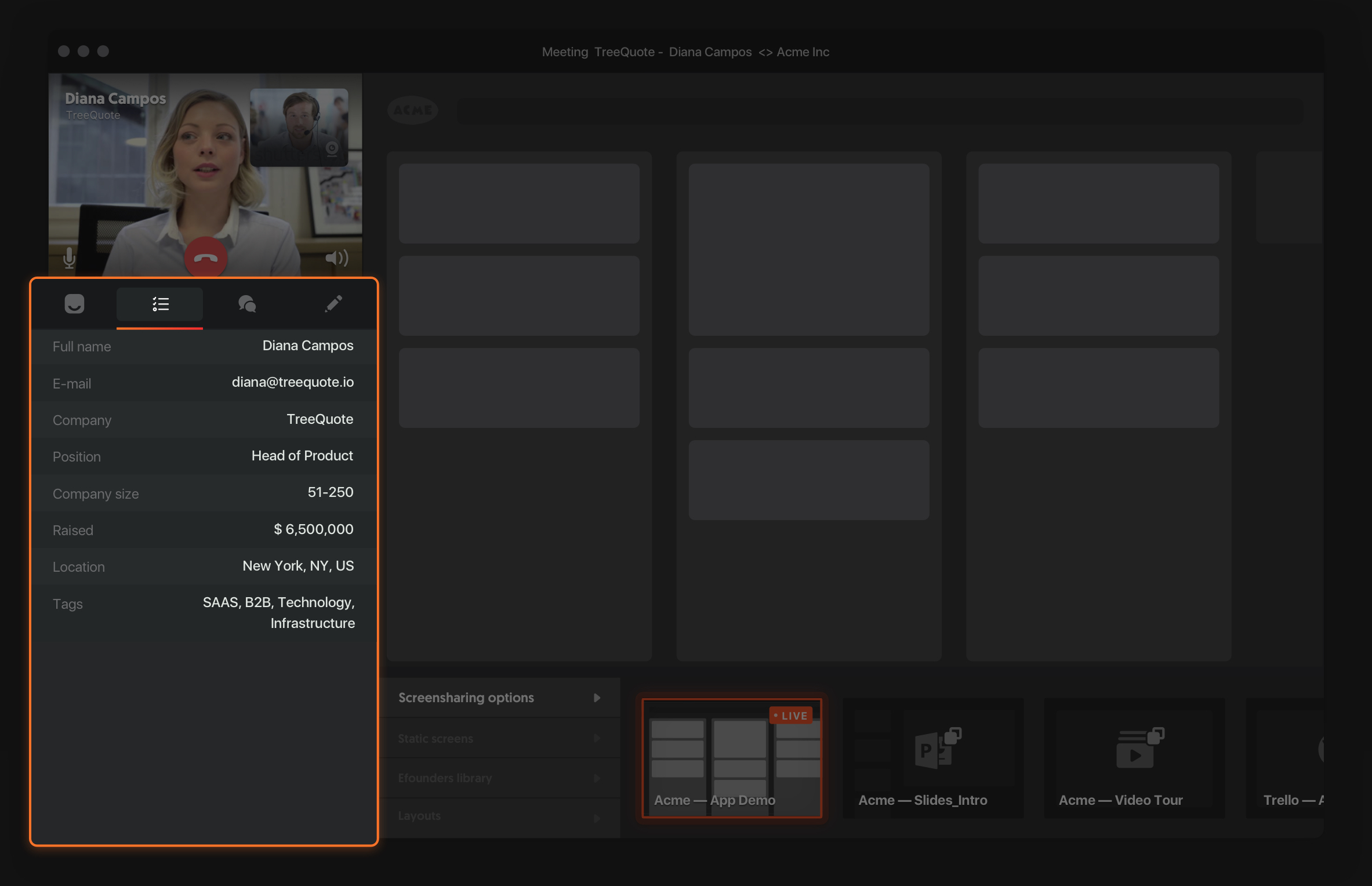
Bonjour is all about empowering sales teams with an all-in-one service to close a deal. Instead of scheduling a video call in Google Calendar, sharing your screen for a demo in Skype, get information from your CRM and losing a lead while juggling with all those services, you can do all your work in Bonjour.

It starts with a video call service that works in your browser. Your future client can just click to join a call. Sales reps can see CRM information right from their Bonjour interface. They can also start a screensharing session to show some slides or demo an app.

But Bonjour wants to go further and take care of everything that happens before and after the demo. For instance, I’m sure you’ve seen plenty of websites with a button that says “request a demo”. At best, you can fill out a form with your contact information so that the company can contact you later. At worst, you just get a phone number or an email address. Many of your potential leads may give up.

Some companies use services like Calendly so that you can pick the right day and time in a calendar view. Bonjour lets you do the same thing and customize your forms. After the demo, you can track conversion rates and improve your sales pitch.

Chilli

Many SaaS companies sell their products to startups, big enterprise clients and everything in between. But the vast majority of companies are still small and medium businesses operating in countless of industries. Some of them have been in business for a while and are still using outdated tools.

If you’re reading TechCrunch every day and working for a startup, you might not realize what it’s like to work for an independent movie production company, a small law firm or a traditional knife making company.

Many companies still rely on an old PC tower hiding in a corner of the office with a shared hard drive. They send Excel documents back and forth, store their todo lists on a post-it note and write expense reports on paper forms.

Chilli wants to help small companies change the tools and services they’re using to run their businesses. You can’t give those companies the same sales pitch. And many SaaS companies don’t even try to sell to SMBs because it’s too costly.

That’s why Chilli isn’t just selling one product, but many different SaaS products. They can spend some time with you to understand your needs and recommend some products to increase the productivity of your company. It’s still unclear how Chilli plans to generate revenue, but it’s an interesting idea.

Swan

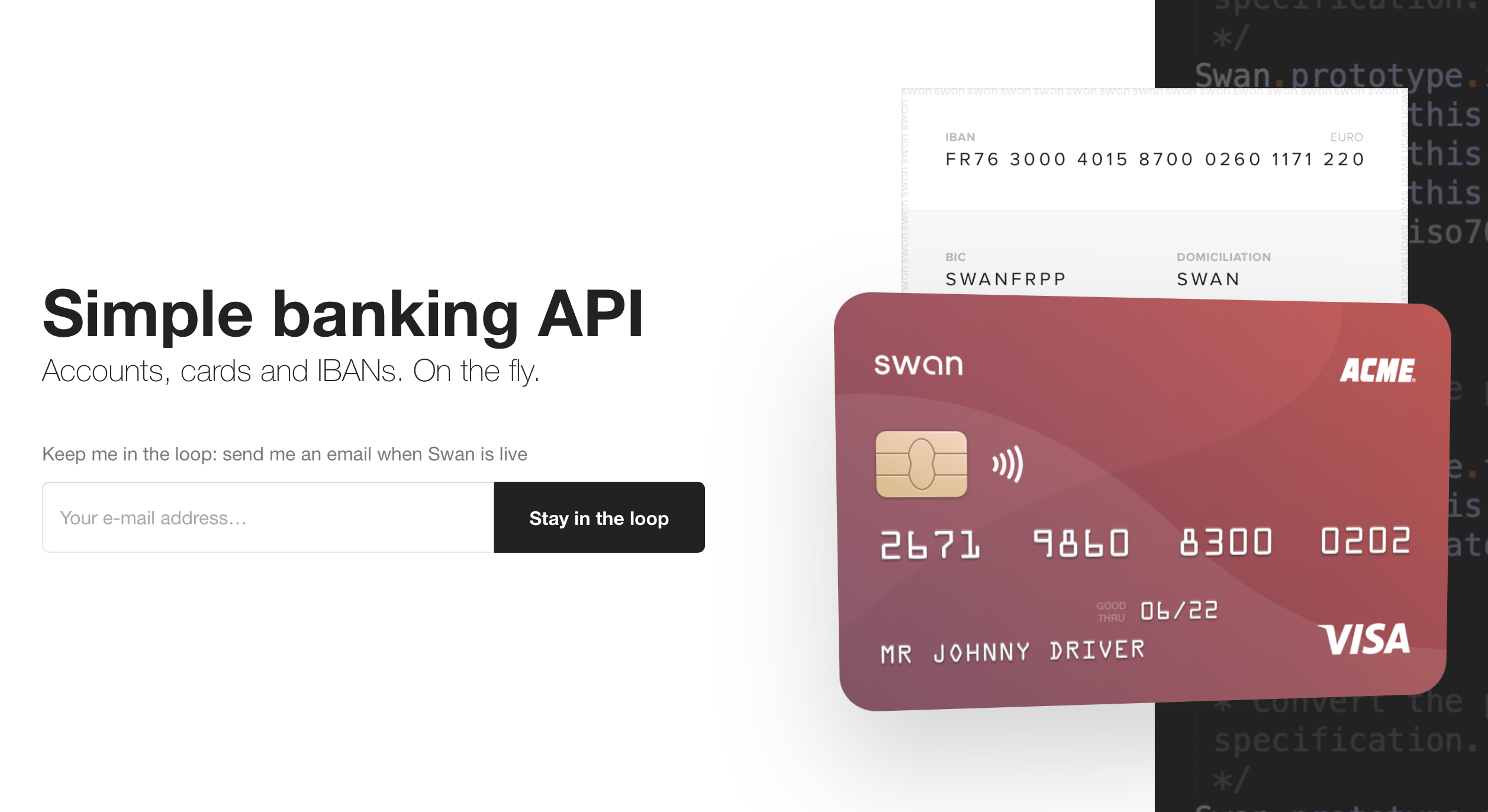
Details are still thin with Swan. It’s a fintech company that will let you add a banking layer to your service. The company says that you’ll be able to generate accounts, cards and IBANs on the fly.

I’m not sure how they plan to sell the product, but I think it could be particularly useful for marketplace companies and the gig economy in general. If you’re generating revenue because you’re renting your car on Drivy, delivering goods on Glovo or freelancing on Fiverr, you might want to cash out as quickly as possible. You could generate a card and spend your earnings straight from those platforms.

The ability to generate IBANs and accounts is also a great way to collect money and provide an alternative payment method in addition to card payments. But let’s see how the Swan team plans to position the product.

18 Mar 2019

KashFlow founder Duane Jackson has launched Staffology, a payroll SaaS and API

We already knew that serial entrepreneur Duane Jackson, who is best known for founding and exiting cloud accounting software KlashFlow, was working on his third venture after recently selling Supdate to Crowdcube. And today Staffology, which Jackson tells me he began developing just over a year ago, is launching publicly.

Dubbed Staffology Payroll, the U.K. company’s first product is cloud payroll software built on top of a “comprehensive” and open API. The idea is that anything the web-based application does can also be achievable programmatically via the API.

“A few companies I advise were in need of a web-based payroll app with an API and it just didn’t exist,” explains Jackson. “Xero had been talking about an API for their U.K. payroll for years but it just didn’t look like it was happening [it is now, although it’s still in beta]. I had the opportunity to move on from Supdate which meant I would have some time on my hands, so I thought I’d give it a go myself”.

Jackson says that development of Staffology Payroll started in March 2018 and after a period of private and public beta testing it has passed the important milestone of gaining recognition for RTI and CIS filing from HMRC, the U.K.’s tax authority. The next stage is to encourage other software vendors and platforms to provide payroll functionality via the startup’s API.

“Automation of business processes is on the increase,” notes Jackson, but with regards to payroll this hasn’t yet happened for a lot of companies. “A real bottleneck is payroll because there simply aren’t the APIs out there to do it well,” he says. “It’s no longer just large employers trying to take advantage of technology and the efficiencies it can bring. Whether you’re a construction company managing payments to thousands of subcontractors or an accountancy firm managing payroll for hundreds of small businesses, integration and automation can save you a small fortune”.

To that end, the Staffology founder says the product has been used by a range of customers while in beta. Typical customers include accountants, payroll bureaus and employers of various sizes. “The white-label option is proving attractive to challenger banks looking at how our product can help them compete in the SME market and to HR SaaS vendors who hope it’ll make their own offerings more attractive,” says Jackson.

Another current customer is a large construction company that is integrating Staffology Payroll into their in-house systems to save them “days of work every month”.

Meanwhile, Staffology has been funded by Jackson’s own cash to date and he sees no reason to raise venture capital. “I made enough from my other exits to not have to worry about taking a salary from the business,” he says. “And as a full-stack developer I’m able to do the majority of the development work myself. So the costs have been minimal and what costs there have been I can comfortably cover. I’ve already had interest from a couple of VCs, but I struggle to see why I need to go down that route”.

With that said, Jackson is under no illusion that a payroll SaaS will only make significant profits with scale. Payroll processing is priced as a commodity and therefore Staffology will be a business that requires high volumes.

“Making money is the bit I still have to prove,” he adds. “The maximum you can get away with charging per payslip is £1, therefore the only way to make good money is to do very high volume. High volume payroll is exactly what APIs are best placed to handle and our product and pricing is designed to work for that market”.

18 Mar 2019

Lyft’s imminent IPO could value the company at $23B

Ridehailing firm Lyft will make its Nasdaq debut as early as next week at a valuation of up to $23 billion, The Wall Street Journal reports. The business will reportedly price its shares at between $62 and $68 a piece, raising roughly $2 billion in the process.

With a $600 million financing, Lyft was valued at $15.1 billion in June.

Lyft filed paperwork for an initial public offering in December, mere hours before its competitor Uber did the same. The car-sharing behemoths have been in a race to the public markets, igniting a pricing war ahead of their respected IPOs in a big to impress investors.

Uber’s IPO, for its part, may top $120 billion, though others have pegged its initial market cap at around $90 billion. Uber has not made its S-1 paperwork public but is expected to launch its IPO in April.

Lyft has not officially priced its shares. Its S-1 filing indicates a planned $100 million IPO fundraise, which is typically a placeholder amount for companies preparing for a float. Lyft’s IPO roadshow, or the final stage ahead of an IPO, begins Monday.

San Francisco-based Lyft has raised a total of $5.1 billion in venture capital funding from key stakeholders including the Japanese e-commerce giant Rakuten, which boasts a 13 percent pre-IPO stake, plus General Motors (7.76 percent), Fidelity (7.1 percent), Andreessen Horowitz (6.25 percent) and Alphabet (5.3 percent). Early investors, like seed-stage venture capital firm Floodgate, also stand to win big.

Lyft will trade under the ticker symbol “LYFT.” JPMorgan Chase & Co., Credit Suisse  Group AG and Jefferies Financial Group Inc. will lead the IPO.

Lyft recorded $2.2 billion in revenue in 2018, more than double the $1 billion recorded in 2017. The company posted a net loss of $911 million on the $2.2 billion in revenue and a $688 million loss on 2017’s $1 billion.

Lyft declined to comment.

17 Mar 2019

Transportation Weekly: Uber’s spending habits, Tesla Model Y, scooters and AVs in Austin

Welcome back to Transportation Weekly; I’m your host Kirsten Korosec, senior transportation reporter at TechCrunch. We love the reader feedback. Keep it coming.

Never heard of TechCrunch’s Transportation Weekly? Catch up by reading the first edition here or check out last week’s edition, which offered the gamut of mobility news from Lyft and Bird to Waymo’s laser bears and cybersecurity.

As I’ve written before, consider this a soft launch. Follow me on Twitter @kirstenkorosec to ensure you see it each week. An email subscription is coming!

This week we’ll focus on the city of Austin, gain insight into Uber’s spending habits, do a little scooter number crunching, the Tesla Model Y, and the so-called “race” — an overused and inaccurate term — to develop autonomous vehicles.


ONM …

There are OEMs in the automotive world. And here, (wait for it) there are ONMs — original news manufacturers. (Cymbal clash!) This is where investigative reporting, enterprise pieces and analysis on transportation lives.uber atg pittsburgh office

Mark Harris is back with new details on Uber’s autonomous vehicle technology program. The upshot: Uber was spending $20 million a month to develop self-driving technologies.

The new information, gleaned from recently unsealed court documents, provides new insight into the company’s past activities and what that might mean for its upcoming IPO.

Harris writes: “The figures, dating back to 2016, paint a picture of a company desperate to meet over-ambitious autonomy targets and one that is willing to spend freely, even recklessly, to get there. As Uber prepares for its IPO later this year, the new details could prove an embarrassing reminder that the company is still trailing in its efforts to develop technology that founder Travis Kalanick called “existential” to Uber’s future.”

This historical look at Uber and its self-driving tech unit, Uber ATG, should be considered alongside more recent news, including that it’s in negotiations with investors, including the SoftBank Vision Fund, to secure an investment as large as $1 billion for its autonomous vehicles unit.


Dig In

After five days in Austin for SXSW, I headed to Los Angeles, actually Hawthorne, for Tesla’s Model Y unveiling. In many ways, this was like all the other Tesla events I’ve attended: the pumpy music and mood lighting, the designed-to-inspire kick off video, the Tesla superfans (pictured below), and the long lines for a brief test ride.

Tesla Model y unveiling

And yet, something was different. The Model Y unveil reminded me of other more traditional automaker reveals. There were mutterings at the event, and wild cries on Twitter, of disappointment (there were plenty of platitudes as well). Many expected something more exciting than this Model 3 doppelganger.

The Model Y is the kind of next act one might expect from an established and more cautious automaker. And while the market’s reaction was negative, there were folks who noted that the Model Y’s likeness to the 3 meant it was getting serious about selling vehicles.

And that’s not a bad thing — accept for two niggling details. First, the Model Y is so similar to the 3 that it could suffer from buyer malaise or cannibalization of one of the two vehicles. Secondly, even if everyone loved this vehicle and Tesla was poised to take advantage of these perceived efficiencies gained from sharing at least 75 percent of the parts with the Model 3, the Y isn’t coming until fall 2020.

That lengthy timeline raises a lot of questions that we’ll be (and surely others) digging into in the coming weeks and months. Where Tesla chooses to produce the Model Y is perhaps the most important, unanswered question.

Tesla Model Y prototype


A little bird …

We hear a lot. But we’re not selfish. Let’s share.

blinky-cat-bird

Welp, we didn’t anticipate this happening. Two tips turned into stories this week: Ford expanding its autonomous vehicle program to Austin and GM Cruise ramping up its hiring machine with plans to hire at least 1,000 more engineers by the end of the year.

What else are we hearing? There’s a new autonomous trucking company coming out of stealth. We’ll share more soon.

Got a tip or overheard something in the world of transportation? Email me or send a direct message to @kirstenkorosec.


Deal of the week

It’s not a done deal, yet. But it’s just an intriguing. Uber is in talks with Softbank Vision Fund and Toyota to raise $1 billion for its self-driving unit Uber ATG. This investment would give Uber ATG a valuation of between $5 billion and $10 billion, WSJ reported. The talks are fluid and could still fall apart, these people warned.

There is a lot of behind-the-scenes investment and partnership activity in the autonomous vehicle space these days. In short, these relationships are getting messy and hard to follow.

Let’s not forget that Softbank’s Vision Fund already has a nearly 20 percent stake in GM’s self-driving subsidiary GM Cruise following its $2.2 billion investment in 2018.

Then there’s Volkswagen AG, which is in continued talks with Ford to partner on self-driving car technologies. The framework of the agreement is expected to include VW making an investment into Ford-backed autonomous vehicle startup Argo AI.

VW already has other partnerships. VW Group, Intel’s  computer vision subsidiary Mobileye  and Champion Motors said in November they plan to deploy Israel’s first self-driving ride-hailing service in 2019 through a joint venture called New Mobility in Israel. VW also has a partnership with AV startup Aurora to integrate self-driving systems in custom-designed electric shuttles for VW’s new Moia brand.

Other deals:

  • Flight-hailing startup Blackbird raises $10 million
  • Drivezy, India’s vehicle-sharing startup is raising more than $100 million
  • BMW i Ventures invested in Bright Machines, a San Francisco-based company that has combined software and robotics to help automotive, computer and electronic brands improve product quality, throughput, and factory optimization.
  • Toyota Motor, DENSO Corporation, and Toyota Tsusho Corporation made a $15 million investment into connected vehicle services startup Airbiquity. The four parties will collaborate to accelerate the development and commercialization of an automotive grade over-the-air (OTA) system enabling remote vehicle software updates and management.

  • Freight railroad owner Genesee & Wyoming is considering a sale of all or part of itself, Bloomberg reported

Snapshot

I spent the week in Austin to participate in a number of SXSW-related events, including a couple of panels. As MRD notes in the micromobility section below, scooters were everywhere. And I used them a lot.

Here’s what many might not have considered as they zipped along the streets, and sidewalks of Austin. The new new new thing often kills off something else, or at least forces it to change.

Which brings me to pedicabs. The snapshot below is a long lineup of empty pedicabs in downtown Austin. I saw these pedicabs-sans-riders everywhere in Austin. I remember SXSW just one year ago and the pedicabs were full; I took them several times that week. But now, scooters and bike share are here, and the pedicabs seem to be the ones suffering the most. I hired a pedicab during my stay and the driver confirmed my observations: they’re waiting much longer for customers now.

Sometimes that disruption can hit the new new thing too. Take bike share. The Austin City Council on approved in February 2018 the creation of a “dockless” bike share pilot program. Some companies were already operating these services; this action created a regulatory framework. But then scooters came en masse.

City officials and one dockless mobility executive told me that scooters upended bike share, and prompted companies to take some of their bikes off the streets do to lack of demand.


Tiny but mighty micromobility

It seems like everyone is riding scooters now. Case in point, Austin during SXSW. MRD weighs in on what went down.

I wasn’t in Austin this week for SXSW. And it’s a good thing I wasn’t because there were reports of a tornado! Well, a tornado of scooters. According to The Verge, scooters and bikes were out and about, enabling the hundreds of thousands of conference goers to get from one bar to the next — and from one session to the other.

“Some of the astounding sights I’ve seen in the past few days include multiple vicious-looking wipeouts, a man cranking the accelerator and doing donuts in a crowded parking lot, and scooters littering the gutters of East 6th Street while throngs of people avoid tripping over them,” The Verge’s Nick Statt wrote. “At one point, I read that a man was found riding one down the shoulder of an Austin highway. Riders here are disregarding all manner of street signage and traffic lights; some people flagrantly speed the wrong way down streets.”

In other micromobility news

Micromobility data platform Populus raised some skrillz — $3.1 million, to be exact. That’s in part because, while cities are down for this new era of transportation and operators are down to share their data, cities still have to find out what to do with this data and how to extract learnings from it.

This is where Populus comes in. Populus raised the seed round from Precursor Ventures, Relay Ventures and others to help cities make sense of the influx of transportation data. This brings the startup’s total funding to $3.85 million.

And  … just because scooters are hot right now, doesn’t mean companies aren’t facing headwinds. The Information reported that Bird has laid off between 4 to 5 percent of its workforce.

Megan Rose Dickey


Notable reads

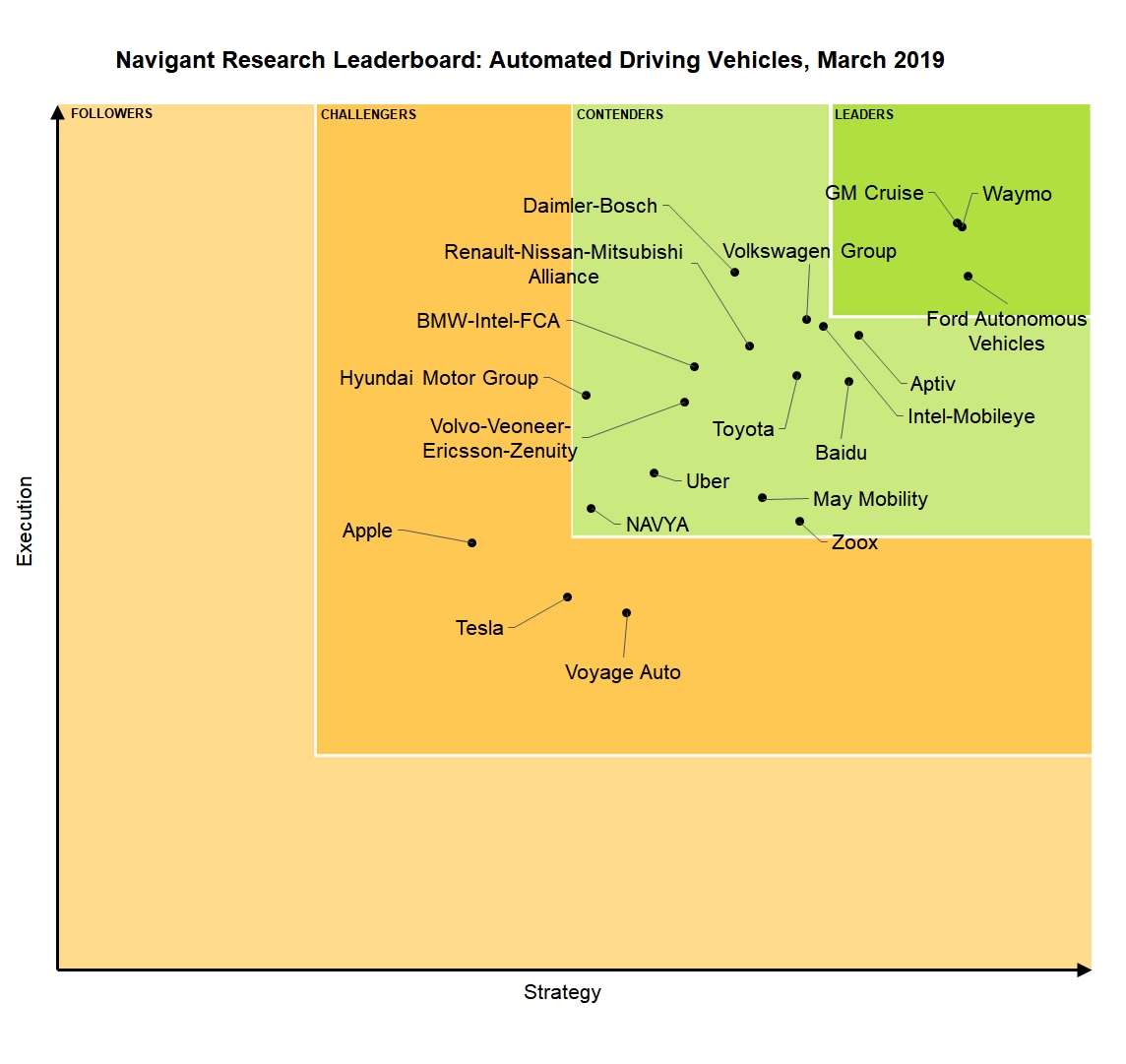
Navigant Research released its annual, and often controversial autonomous vehicle leaderboard report, by principal analyst Sam Abuelsamid. The Navigant Research Leaderboard examines the strategy and execution of 20 leading automated driving system companies and rates them based on 10 criteria, including vision; go-to market strategy; partners; production strategy; technology; sales, marketing, and distribution; product capability; product quality and reliability; product portfolio; and staying power.

The leaders, in Navigant’s view are:

  1. Waymo
  2. GM Cruise
  3. Ford autonomous vehicles
  4. Aptiv
  5. Intel-Mobileye
  6. Volkswagen Group
  7. Daimler-Bosch
  8. Baidu
  9. Toyota
  10. . Renault-Nissan-Mitsubishi Alliance

Other quotable notables:

With the rise of autonomous delivery bots — or at least news of all the capital they’re raising — it’s worth revisiting a white paper that KPMG put out in November called Autonomy Delivers: An oncoming revolution in the movement of goods. The report notes how e-commerce is pushing this delivery phenomenon forward. Two forecasts worth noting:

  • expecting no acceleration in e-commerce adoption trends, KMPG estimates that by 2040 e-commerce will reduce shopping trips in the U.S. by 30 percent. It could be as high as 50 percent.
  • as a result, delivery vehicle miles traveled will skyrocket from 23 billion annual miles to more than 78 billion by 2040.

Testing and deployments
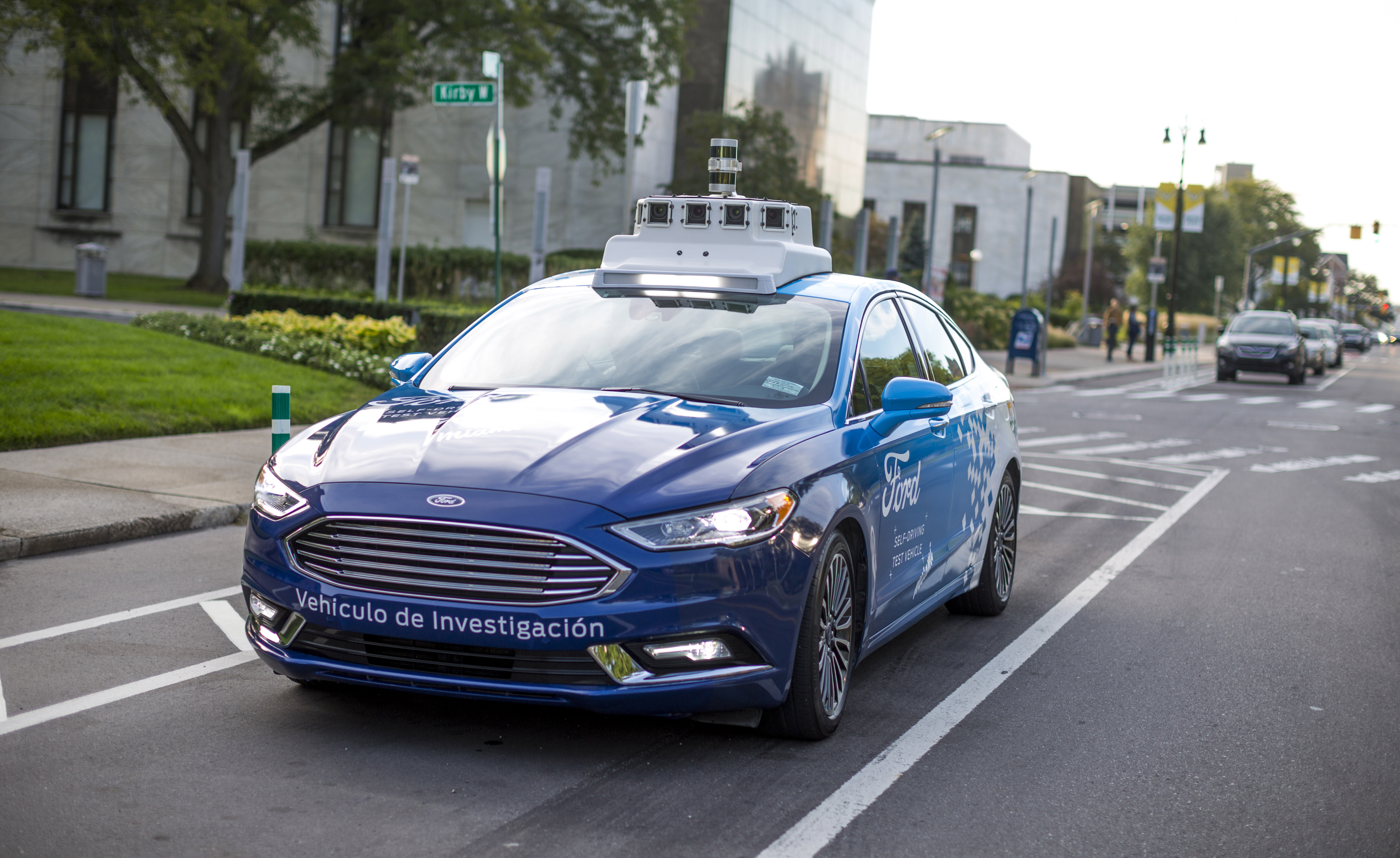

Ford continues to expand its autonomous vehicle program. This time, the automaker is
setting up shop in Austin. During my week in Austin for SXSW, I had heard rumors that Ford was preparing to open an autonomous vehicle program there. A number of Ford executives were on the ground in Austin during SXSW to participate in panels and other events including one I moderated at the Smart Mobility Summit.

That chatter was confirmed by a new job listing for an autonomous vehicles “market specialist” based in Austin. Austin is the fifth city to join the automaker’s testing program, which already includes Detroit, Miami, Pittsburgh and Washington D.C.

Meanwhile, Los Angeles is getting ready for a widespread deployment of scooters. About seven companies already have permission to operate on a conditional basis, according to Los Angeles Department of Transportation’s general manager Seleta Reynolds. Now it’s about to get bigger.

The city recently launched a one-year dockless on-demand personal mobility program. As part of that program, the LADOT accepted applications from companies seeking one-year permits. Eleven companies applied for permission to operate about 38,000 dockless devices. The city is prepping for coming deluge by creating designated parking areas and other signage.

That sounds like a lot; and it is. But it could have been a much higher number. If these companies had maxed out the total number allowed under the permit, it could have meant 160,000 scooters in Los Angeles.

Why wouldn’t Bird, Lime, Spin and others max out the allowable 10,500 scooters per permit? Here’s one thought: cost and supply.

The annual permit application fee is a non-refundable $20,000. Companies also most pay $130 fee per vehicle annually if they’re operating in non-disadvantage communities (DAC). LADOT is allowing companies a maximum of 3,000 scooters in non-DAC areas, 5,000 in DACs in San Fernando Valley and up to 2,500 in DACs in outside of San Fernando Valley. Permits for scooters in DACs are $39 per vehicle, a 70 percent reduction in that fee.

That means if a company could max out and hit the 10,500 scooter limit, which includes DACs, it would be looking at more than $700,000 in permitting fees to operate for a year.

Two car things

  • Gridwise, a mobile app designed to increases rideshare drivers’ hourly earnings by helping them find more rides and track their performance, launched in a number of cities, including Austin, Dallas, Houston, Los Angeles, and Phoenix. Gridwise app is already available in numberous U.S. cities such as Baltimore, Boston, Chicago, New York City, Pittsburgh, Philadelphia, and Washington DC.
  • And Citymobil, one of the largest Russian taxi aggregators, has teamed up with Gazprom to launch a taxi runs on natural gas. About 500 taxi cars that participate with Citymobil have already been converted to work on methane. By the end of the year, their number is expected to reach 10,000.

On our radar

There is a lot of transportation-related activity this month.

Nvidia GTC

TechCrunch will be at Nvidia’s annual GPU Technology Conference from March 18 to 21 in San Jose.

The 4th annualADAS Sensors 2019 conference and expo held March 20 to 21 in Detroit Michigan. See the full conference agenda at: http://www.adassensors.com/agenda.html

Self Racing Cars

The annual Self Racing Car eventwill be held March 23 and March 24 at Thunderhill Raceway near Willows, California. Sign up to participate or drop them a line at contact@selfracingcars.com.

Thanks for reading. There might be content you like or something you hate. Feel free to reach out to me at kirsten.korosec@techcrunch.com to share those thoughts, opinions or tips. 

Nos vemos la próxima vez.

17 Mar 2019

To get big faster, younger unicorns start buying startups sooner

In the name of getting big quick, it seems like some of the most valuable private tech companies are turning to mergers and acquisitions (M&A) as a way to accelerate business growth. So-called “unicorns”—privately-held technology companies which achieve billion-dollar valuations sometime before (or as a direct result of) going public or exiting via M&A—are chomping at the bit to make their first acquisitions, suggesting a mounting pressure on companies to grow even quicker.

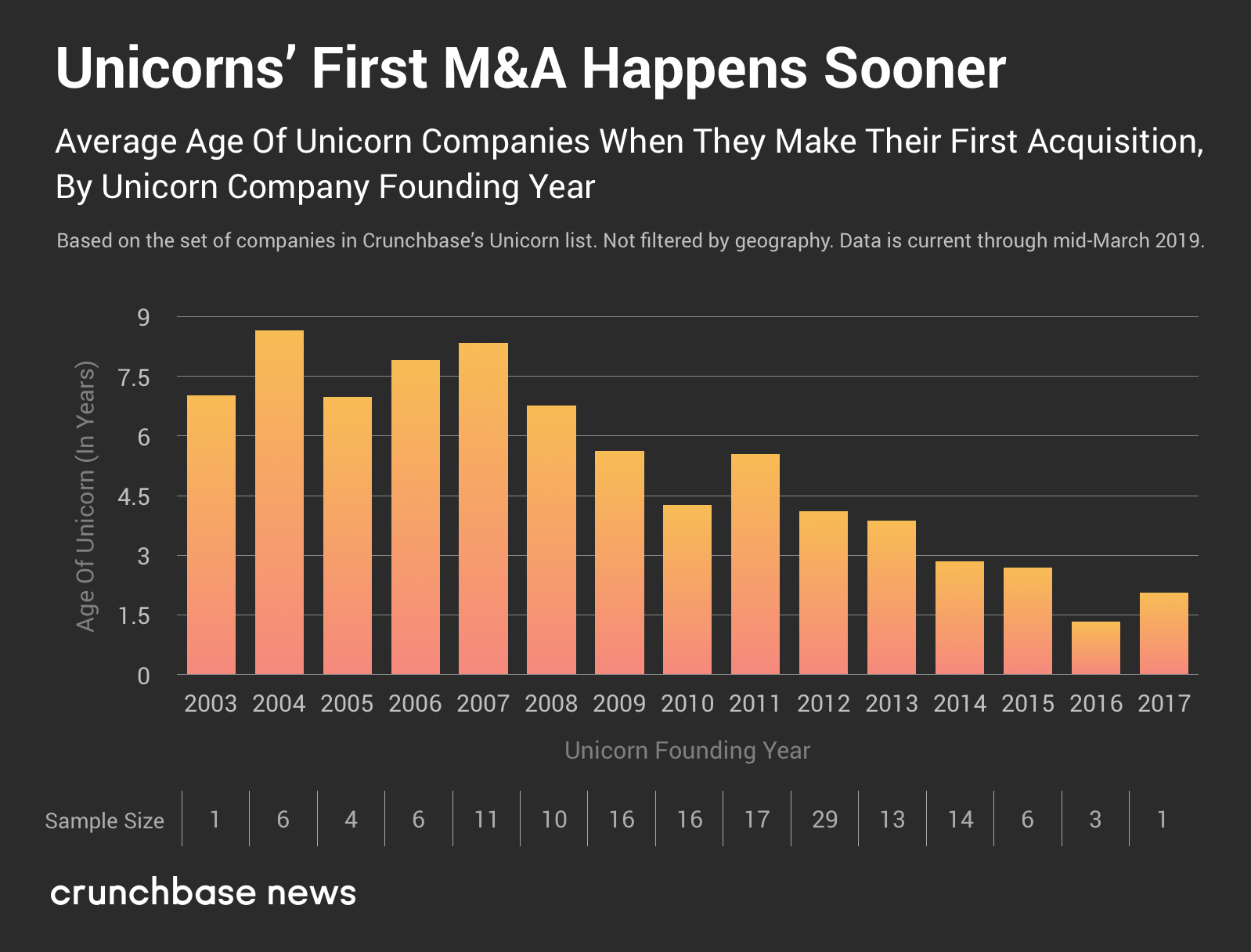
Analysis of Crunchbase data indicates that, on average, recently founded unicorn companies are more likely to make their first M&A transactions sooner after founding than their older counterparts. In other words, younger unicorns buy other companies earlier. Here’s the data.

The narrowing gap between founding and first M&A

Using M&A data for companies in Crunchbase’s unicorn list, we found out when unicorn companies made their first M&A transactions on average. (We detail a bit more of the methodology in a note at the end.) Companies founded in more recent years were quickest to hit the M&A trail.

Eleven unicorn companies founded in 2007 took an average of roughly 8.33 years before making their first acquisitions. At time of writing, 29 unicorns founded in 2012 have made their first startup purchases, averaging just 4.1 years before doing so.

Note that there’s a bit of a sampling bias here. To an extent, it’s expected that unicorn companies founded in more recent years will have a lower average age of first acquisition, because there are many unicorn companies which haven’t yet made their first M&A deals.

The bulk of all M&A transactions by unicorns (not just the first ones) occur within the first seven years after founding.

We should take recent years’ dramatic reduction in average time until first acquisition with a heftier grain of salt (again, there are plenty of unicorns which haven’t yet gone shopping for startups). Even with that caveat made, averages have steadily trended lower between 2007 and 2012, after remaining steady (across an admittedly small sample set) since the start of the unicorn era.

This suggests that younger unicorns are increasingly using M&A transactions as a way to accelerate their path to massive market power.

It’s a big move for a company to buy another one. There’s all the financial particulars to negotiate, the legal and regulatory hurdles to clear, and the inevitable friction of integrating teams and technology from one entity with another. And that’s when the process is amicable and goes smoothly. The amount of time and resources a company commits to carrying out an M&A strategy is nontrivial, so it’s understandable why a company would put this process off to a later date or eschew it entirely. That high-growth tech companies are pursuing such a time and energy-intense strategy earlier on in the venture life-cycle points to the benefits M&A can bring to startups seeking to scale speedily.

Methodology notes

We found this by analyzing the set of acquisitions made by companies in Crunchbase’s list of unicorns, which we used as a proxy for “high-performing private technology companies” as a collective whole. We found the time elapsed between unicorns’ listed founding dates (which, note, have varying levels of precision) and the date of their first-ever acquisitions, regardless of whether the acquirer had achieved unicorn status. We then plotted the resulting data in a couple of ways.

More information about Crunchbase News’s methodology can be found on a dedicated page on this site.

17 Mar 2019

These are the robots that help you get your Amazon packages on time

Months before the hard-fought battle for its second global headquarters in Queens, Amazon planted a massive, 855,000-square-foot flag in Staten Island. The $100 million JFK8 fulfillment center opened last fall, after an “on the spot” hiring spree, aimed at employing an eventual 2,250 people.

The new factory smell still permeated the air when we visited the space in February. Things were shiny and new, but still humming. It’s a 24-hour process designed to meet the standards of rapid package delivery the company has — for better and worse — set for the entire e-commerce world.

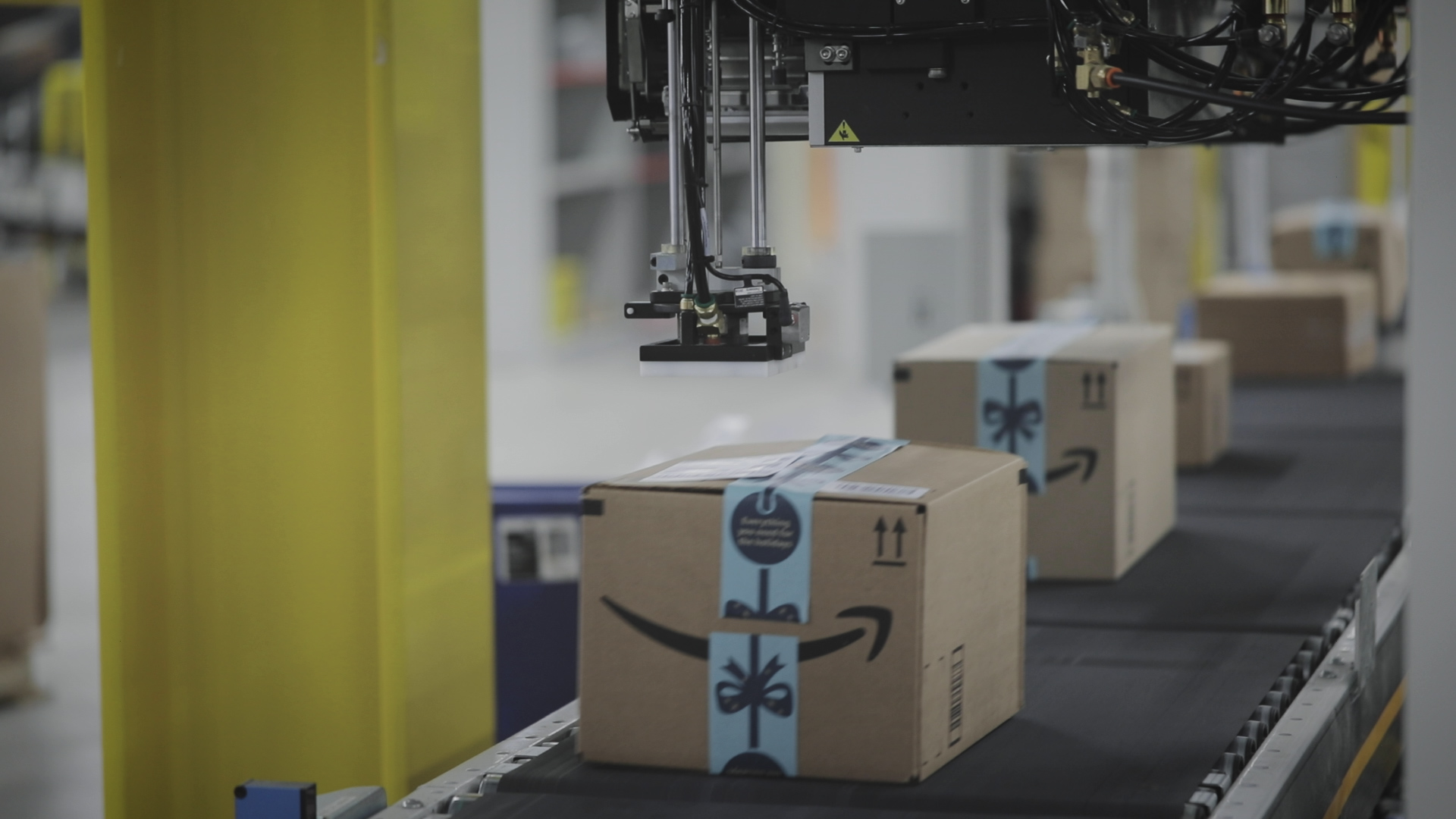
JFK8 stands as a kind of church to the world of early 21st century capitalism, and wherever you happen to land on the politics of Amazon, it’s an impressive sight to behold, as packages zip by on complex highway systems of conveyor belts, en route to next-day deliveries.

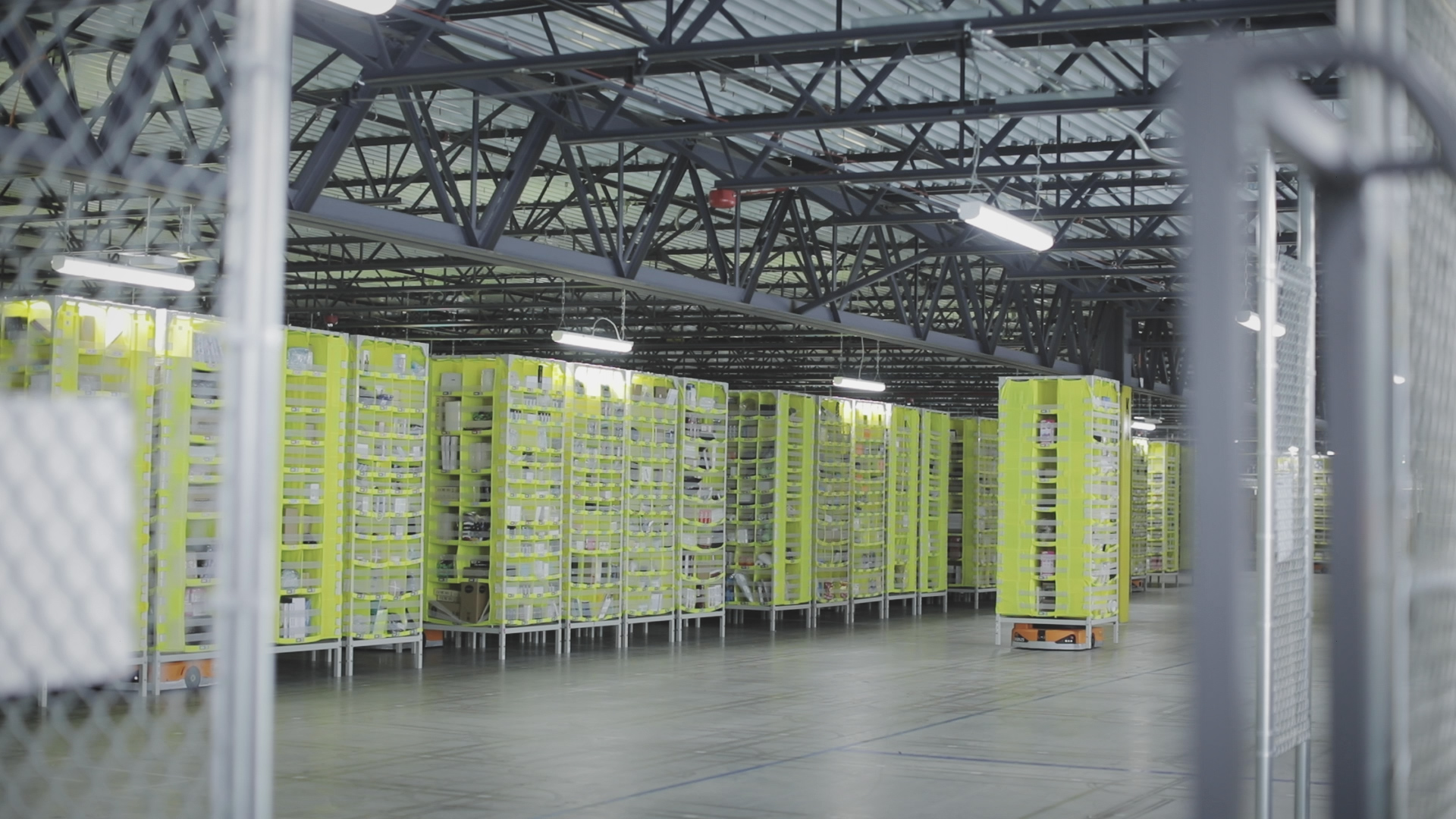
The space also offers a compelling glimpse into the factories of the future, where humans and robots work hand in hand, so to speak. The company currently has around 100,000 robotic systems deployed across more than 25 fulfillment centers, a number that it says has helped the company store an additional 40 percent of inventory in its fulfillment centers.

Those on display at the Staten Island facility run the gamut, from the ship sorters that whiz across conveyor belts booting packages into their proper chutes to giant palletizer robotic arms, developed in conjunction with Japanese automation giant, Fanuc.

All are working to the same end, with Amazon’s own in-house robots forming the system’s core. Up a few flights, robots zoom around the floor in a tightly controlled space, like giant-sized Roombas in closely choreographed movements.

The mobile robots were the heart of the company’s $775 million 2012 acquisition of Kiva, a Massachusetts-based startup it would rename Amazon Robotics three years later. The Kiva name still appears in some of the legacy signage, including labels that appear around the perimeter of the robot’s enclosed space, but Amazon was quick to incorporate what was at the time its second-largest acquisition.

“I think by the time Amazon looked at us, they were quite interested in the technology that we had developed and acquired us because they were interested in taking them into the fulfillment centers as we do today,” Scott Dresser, Amazon Robotics’ director of Software, Systems and Solutions tells TechCrunch. “It is the core storage system in a fulfillment center. It houses all of the inventory.”

The army of robots are walled in by fences that bring to mind nothing more than indoor batting cases. Around the edges, Amazon employees work at pick-and-stow stations, working alongside the robots to determine how best to store inventory on the shelving pods and how items will be shipped together.

Dresser quickly rejects the premise that robots will outright replace their human co-workers in the short term, noting that each has a separate, but complementary skill set.

“Associates and people in our builds are really good at finding where to put products in storage shelving,” he says. “Systems are not good at doing that. We’re able to leverage the things that people are good for and leverage the things that systems are good for. We see that pattern playing out in a lot of different applications. We certainly see that being an augmentation to what people are doing and helping them be as efficient as possible with what they’re doing.”

Floor safety is an increasing concern. A recent story about an exploding bear mace canister that sent 24 employees to the hospital at a Robbinsville Township, New Jersey warehouse has once again brought the issue to top of mind. While the incident was initially reported to involve an Amazon robot, the company denies that any were involved.

The fencing around the robots is designed specifically to keep associates out of harms way — an increasingly important concern as large machinery becomes an everyday part of life at these sorts of factories. Human employees are generally not allowed in this enclosed space for reasons of safety and efficiency, but an imperfect system requires the occasional interaction. Things fall out of pods, robots break down.

It’s for this reason the company introduced the Robotic Safety Vest. The bright orange mesh vest includes a belt containing a variety of sensors that add a few pounds to the employee’s get up.

“It complements the technology that’s in the robotic drive system,” says Dresser. “That vest is detectable by the robot. There’s a system that knows the associate is nearby and based on that signal.”

An employee demonstrates the vest, flicking a button, opening the fence and walking onto the floor. Robots at a distance slow down, while ones in the immediate vicinity stop altogether. It’s another added level of safety. If the bear mace incident showed anything, it’s how quickly news of robotics-related accidents spread, whether or not an actual robot was ultimately involved.

As more people buy more products online, these armies of robotics will no doubt play an increasingly central role in meeting that demand.

17 Mar 2019

Doorport wants to make your apartment building’s front door smarter

If you live in a big city, you’ve probably had your fair share of battles with apartment intercom systems. Those electronic gatekeepers with their tiny screens, sticky buttons, and seemingly endless lists of names to tap through in search of a friend who can buzz you in.

Doorport wants to make those existing systems a bit smarter. They’ve built a device that can be wired into existing buzzer systems, allowing you to use your smartphone to unlock your building’s door for yourself and your guests with a quick tap. Once installed, the existing intercom system works just as it did before — just now with a bit more smarts.

The company’s current prototype hardware is about the size of a deck of cards, and is meant to be tucked into the empty space within an already in-place intercom system. The company’s founders tell me it takes about 5 to 10 minutes to install. You clamp the device onto the inside of the intercom box with a magnet, run two wires for power, and two wires to let the device control the door lock mechanism.

When you open Doorport’s app, it uses Bluetooth to search for nearby doors you have access to. Tapping the on-screen padlock will unlock the door as if you’d scanned your key fob or punched in your code. If a friend arrives with Doorport’s app setup, they’re able to ping you through the app so you can buzz them through the door. When a resident moves out of the building, the property manager just removes that resident’s profile via the admin panel to prevent future access.

The company initially set out to build a full-fledge hardware replacement for existing intercoms, with things like video calling and temporary, single-day access codes. In testing the market, however, they found that landlords weren’t interested in something quite so intense. A whole new system meant ripping out the old hardware, re-training employees, giving all of the residents new key fobs, etc. So they shifted focus to something that sits on top of existing systems, instead.

It’s still pretty early days for the 3-person team. It’s iterating on prototypes, each unit contained within a 3d-printed shell. Just months ago, when the company first got into Y Combinator’s Winter 2019 class, co-founder Reggie Jean-Brice tells me “the hardware was literally on a breadboard.” The device I saw recently, meanwhile, was a sleek little package with “Mark II” emblazoned across the side.

As with most new companies, Doorport is still figuring out exactly how much their product will cost, and are testing different pricing models. Through one model, they’d charge landlords about $350 up front for install, then $1.50 per apartment unit per month. Another model shifts the cost (about $30 a year per unit) to residents, allowing landlords to pitch it as an optional amenity. Co-founder Ben Taylor tells me that the company currently has prototype devices being tested in San Francisco, Oakland, and New York.

17 Mar 2019

Doorport wants to make your apartment building’s front door smarter

If you live in a big city, you’ve probably had your fair share of battles with apartment intercom systems. Those electronic gatekeepers with their tiny screens, sticky buttons, and seemingly endless lists of names to tap through in search of a friend who can buzz you in.

Doorport wants to make those existing systems a bit smarter. They’ve built a device that can be wired into existing buzzer systems, allowing you to use your smartphone to unlock your building’s door for yourself and your guests with a quick tap. Once installed, the existing intercom system works just as it did before — just now with a bit more smarts.

The company’s current prototype hardware is about the size of a deck of cards, and is meant to be tucked into the empty space within an already in-place intercom system. The company’s founders tell me it takes about 5 to 10 minutes to install. You clamp the device onto the inside of the intercom box with a magnet, run two wires for power, and two wires to let the device control the door lock mechanism.

When you open Doorport’s app, it uses Bluetooth to search for nearby doors you have access to. Tapping the on-screen padlock will unlock the door as if you’d scanned your key fob or punched in your code. If a friend arrives with Doorport’s app setup, they’re able to ping you through the app so you can buzz them through the door. When a resident moves out of the building, the property manager just removes that resident’s profile via the admin panel to prevent future access.

The company initially set out to build a full-fledge hardware replacement for existing intercoms, with things like video calling and temporary, single-day access codes. In testing the market, however, they found that landlords weren’t interested in something quite so intense. A whole new system meant ripping out the old hardware, re-training employees, giving all of the residents new key fobs, etc. So they shifted focus to something that sits on top of existing systems, instead.

It’s still pretty early days for the 3-person team. It’s iterating on prototypes, each unit contained within a 3d-printed shell. Just months ago, when the company first got into Y Combinator’s Winter 2019 class, co-founder Reggie Jean-Brice tells me “the hardware was literally on a breadboard.” The device I saw recently, meanwhile, was a sleek little package with “Mark II” emblazoned across the side.

As with most new companies, Doorport is still figuring out exactly how much their product will cost, and are testing different pricing models. Through one model, they’d charge landlords about $350 up front for install, then $1.50 per apartment unit per month. Another model shifts the cost (about $30 a year per unit) to residents, allowing landlords to pitch it as an optional amenity. Co-founder Ben Taylor tells me that the company currently has prototype devices being tested in San Francisco, Oakland, and New York.

17 Mar 2019

Nala has built a hassle-free, offline mobile money payment platform for Africa

Benjamin Fernandes, the Tanzanian co-founder chief executive of Nala, spent hundreds of hours talking to local Tanzanians about their frustrations with mobile money payment services before he launched his new payment platform.

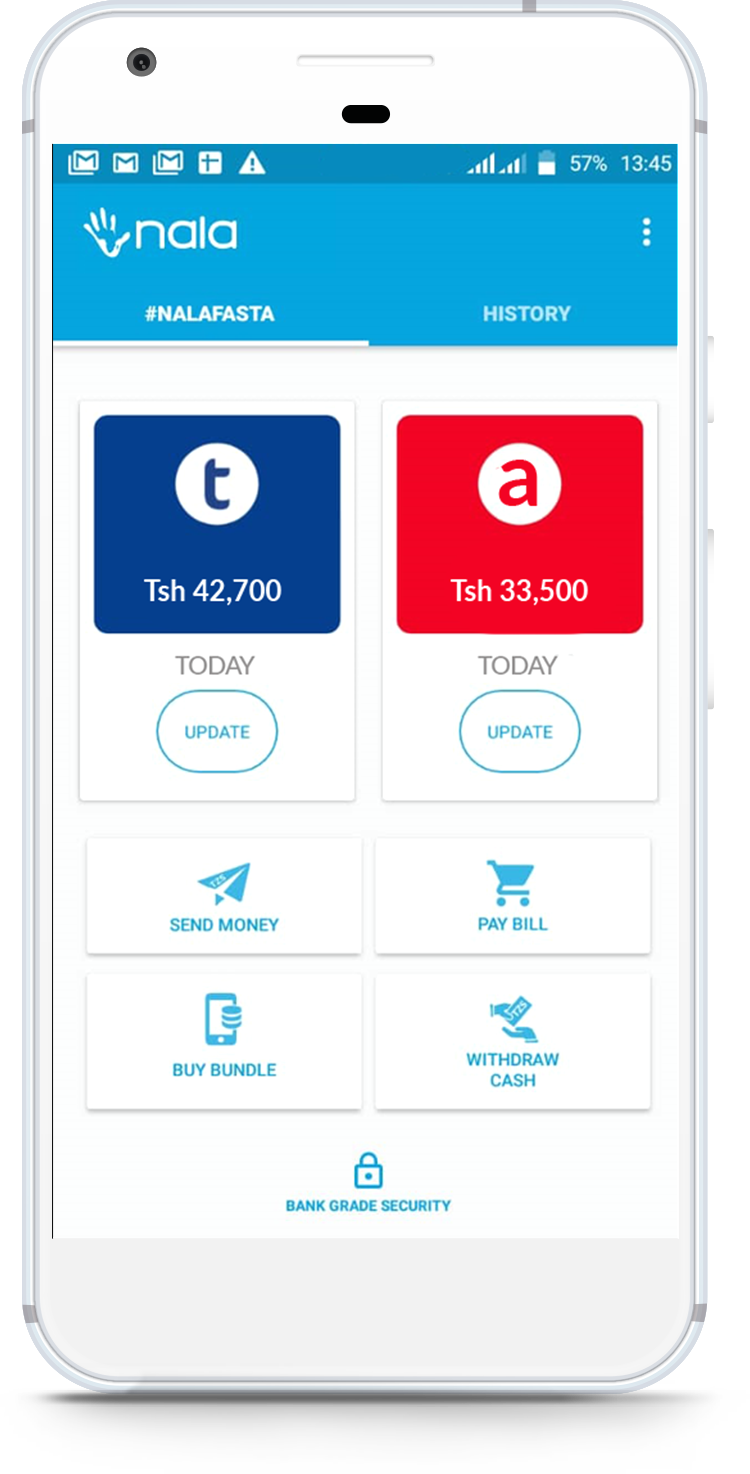
While at least a hundred million Africans hold mobile money accounts, the process of transacting over the services is difficult, so Tala made an application that acts as an interface on top of the unstructured supplementary service data layer to make money transfers and payments much easier.

Mobile payment services have swept across the African continent in the 12 years since the wireless carrier Safaricom launched M-Pesa in 2007. As of 2017, roughly half of the 282 mobile money services operating worldwide were in Sub-Saharan Africa, according to a McKinsey report. Nala’s founder estimates that there around 420 million Africans holding mobile money accounts, making the continent the leader in mobile money adoption by a wide margin. 

In Tanzania, making one send money payment requires a user to enter somewhere between 39-46 digits, a hard enough task for anyone, let alone someone who may be newly adjusting to mobile phone service.

Using Nala, users can make payments to anyone on any device, and it only requires a one-time download to start transacting, according to the company.

Think of Nala has taken all of the short codes from all of the transaction providers and created a router system that users can operate without having to memorize the different underlying coding. Currently live in Tanzania, with over 100,000 users, Fernandes says that his company has plans to expand to at least two other African countries over the course of 2019.

It’s been a long road for Fernandes, a former national television host of youth talk shows and sports shows in Tanzania, to financial services entrepreneur.

Fernandes moved to the U.S. for university, doing his undergrad degree at the evangelical Christian University of Northwestern in St. Paul. At the university, Fernandes developed an interest in economics and excelled. Encouraged by his business professor to apply to Harvard and Stanford for business school, Fernandes briefly returned home and did just that.

He received a full ride to Stanford through the school’s Africa MBA Fellowship in 2014 and moved back to America.

“I took the two years at Stanford to learn everything i can about fintech,” Fernandes recalled. “In the summer i started working at the Bill and Melinda Gates Foundation and that’s where i met Sam Castle. He was a PhD student at Washington doing research in mobile payments in MENA and Sub Saharan Africa.

Castle and Fernandes stayed in touch while the Tanzanian wrapped up his studies at Stanford, and when Fernandes graduated and received the Frances and Arjay Miller Prize for Social Entrepreneurship along with its attendant $20,000 bounty, he returned home and started working on Nala.

“It was such a hard decision to make to go home,” Fernandes recalls. “Most Africans don’t go home. We stay in the States. But I was 24 at the time and thought ‘We’ll figure this out.'”

As he began working on different prototypes and as the work progressed, he was able to convince Castle to come on board.

Now the company is generating some revenue from airtime sales and bill payments, although down the road Fernandes sees value in the data that the company collects across the multiple accounts that Nala services.

Eventually there’s a possibility for the company to get into other financial services like lending and savings.

What’s clear is the massive opportunity that exists in simplifying a transaction mechanism that’s wildly popular across the continent but also massively tricky for consumers to use.

Mobile payments have already revolutionized financial transactions in Africa, by building a simpler interface, Nala could take that revolution one step further.