Author: azeeadmin

17 Mar 2019

A huge trove of medical records and prescriptions found exposed

A health tech company was leaking thousands of doctor’s notes, medical records, and prescriptions daily after a security lapse left a server without a password.

The little-known software company, California-based Meditab, bills itself as one of the leading electronic medical records software makers for hospitals, doctor’s offices, and pharmacies. The company, among other things, processes electronic faxes for healthcare providers, still a primary method for sharing patient files to other providers and pharmacies.

But that fax server wasn’t properly secured, according to the security company that discovered the data.

SpiderSilk, a Dubai-based cybersecurity firm, told TechCrunch of the exposed server. The exposed fax server was running a Elasticsearch database with over six million records since its creation in March 2018.

Because the server had no password, anyone could read the transmitted faxes in real-time — including their contents.

According to a brief review of the data, the faxes contained a host of personally identifiable information and health information, including medical records, doctor’s notes, prescription amounts and quantities, as well as illness information, such as blood test results. The faxes also included names, addresses, dates of birth, and in some cases Social Security numbers and health insurance information and payment data.

The faxes also included personal data and health information on children. None of the data was encrypted.

Two leaked documents found on the fax server, redacted. (Image: TechCrunch)

The server was hosted on an subdomain of MedPharm Services, a Puerto Rico-based affiliate of Meditab, both founded by Kalpesh Patel. MedPharm was spun out as a separate company in San Juan to take advantage of tax breaks for those who set up businesses on the island.

TechCrunch verified the records by contacting several patients who confirmed their details from the faxes.

When reached about the security lapse, Patel said the company was “looking into the issue to identify the problem and solution,” but deferred comment to the company’s general counsel, Angel Marrero.

“We are still reviewing our logs and records to access the scope of any potential exposure,” said Marrero in an email.

We asked if the company planned to inform regulators and customers. Marrero said the company “will comply with any and all required notifications under current federal and state laws and regulations, as applicable.”

It’s not immediately known if anyone else discovered the exposed server, or how long the data was exposed.

Both Meditab and MedPharm claim to be compliant with HIPAA, the Health Insurance Portability and Accountability Act, which governs how healthcare providers properly manage patient data security.

Companies that expose data or violate the law can face hefty fines.

Last year was a year of “record” fines — some $25 million for several exposures and breaches, including $4.3 million in fines to the University of Texas for an inadvertent disclosure of encrypted personal health data, and a settlement by Fresenius was for $3.5 million following five separate breaches.

A spokesperson for the U.S. Department of Health and Human Services did not comment.

17 Mar 2019

Facebook failed to block 20% of uploaded New Zealand shooter videos

Facebook said it removed 1.5 million videos from its site within the first 24 hours after a shooter livestreamed his attack on two New Zealand mosques, killing 50 people.

In a series of tweets, Facebook’s Mia Garlick said a total of 1.2 million videos were blocked at the point of upload. Videos that included “praise or support” from the attack were also removed, she said, using a mix of automated technologies — like audio detection — and human content moderators.

Facebook did not say why the 300,000 videos were not caught at upload, representing a 20 percent failure rate.

The cherry-picked “vanity” statistics only account for the total number of uploaded videos that Facebook knows about. TechCrunch found several videos posted to Facebook more than 12 hours after the attack. Some are calling on Facebook to release the engagement figures — such as how many views, shares and reactions — were made before the videos were taken down, which critics say is a more accurate measure of how far the videos spread.

The attack on Friday targeted worshippers during morning prayers in Christchurch, New Zealand. Police said they apprehended the shooter about half an hour after reports of the first attack came in.

The 28-year old suspected shooter, charged with murder, livestreamed the video to Facebook using a head-mounted camera, typically used to record sporting events in first-person. Facebook closed the attacker’s account within an hour of the attack, but the video had already been shared across Facebook, Twitter and YouTube. The shooter described himself as a self-professed fascist, according to a “manifesto” he posted shortly before the attacks. The tech companies have faced criticism for not responding to the emerging threat of violence associated with white nationalism, compared to actions taken against content in support of the so-called Islamic State group and the spread of child abuse imagery,

New Zealand prime minister Jacinda Ardern said on Sunday that social media giants like Facebook had to face “further questions” about their response to the event. Facebook second-in-command Sheryl Sandberg reportedly reached out to Ardern following the attacks.

When reached, Facebook did not comment beyond Garlick’s tweeted comments.

17 Mar 2019

Welcome to the hub of all hubs: Cosmos has launched

Last week the Cosmos Network launched, which I believe to be a major event. Yes, it’s a blockchain initiative — but definitely not just another one. If I’m right, its repercussions will one day reach your life too, though it’s sufficiently bleeding-edge that those ripples probably won’t hit you for a decade. Maybe five years, for a cutting-edge TechCrunch reader like you.

(Yes, those are bold words, but if I do say so myself, my track record is pretty good with this sort of thing. The last blockchain launch I wrote about was Ethereum, which you may have since heard of … and I was the only non-specialist commentator / journalist to cover it at the time.)

This launch is an abstruse and extremely technical achievement, currently only important to those who already live amid that tiny, weird subculture of humanity which reveres blockchains as the path to a better, decentralized, fairer future. (Not to be confused with the much larger number of who view cryptocurrencies primarily as an opportunity to get rich quick, never mind how sketchily.) But it’s a highly impressive technical feat, with every chance to ultimately become important to many more people.

Cosmos calls itself “the Internet of Blockchains,” and it is that, but it’s also something else important: it is one of the first major decentralized Proof-of-Stake networks to launch. (No, EOS doesn’t count.) In this model, instead of being secured by “miners” who solve computationally hard problems at the cost of gigawatts-and-counting of electricity, blockchains are verified by “validators” who purchase (or are delegated) cryptocurrency which they “stake.”

These validators, per the name, then ensure that the chain’s transactions are valid, knowing that they will earn rewards if honest and accurate … but if they are dishonest, or in error, or offline, their stakes will be “slashed” i.e. they will lose money. (At present there are 100 validators; this number is due to triple.) It has been shown, at least in theory, that even if validators dishonestly collude, as long as at least two-thirds of them remain honest, the chain remains secure.

This is a very big deal because the enormously better efficiency and speed of Proof-of-Stake open a pathway to decentralized systems which support many many more actions than Proof-of-Work chains like Bitcoin or (today’s) Ethereum, with a vastly vastly smaller ecological footprint. If Proof-of-Stake succeeds in the harsh, cruel real world — admittedly a big if; its implementation is complicated, and has a much larger attack surface, both social and technical, than Proof-of-Work — then blockchains may finally be able to seriously scale, with acceptable security, without consuming a noticeable fraction of the world’s electricity.

Cosmos’s ambitions go much further, though. Cosmos isn’t intended as Just Another Blockchain. We have more than enough of those already. It’s intended as a hub which connects other blockchains to one another — hence “The Internet of Blockchains.” What’s more, it provides tools which, in theory, make it far easier for any software engineer to build a brand-new, custom-designed blockchain … which in turn can interoperate with an arbitrary number of others.

Why does this matter? Because if blockchains are to matter at all beyond cryptocurrencies — if they are to be used for applications such as namespaces, file storage, digital collectibles, supply chains, self-sovereign identities, and decentralized social media, to trot out the usual laundry list of desirable decentralized apps — those applications would benefit greatly from being able to interact with one another.

To a certain extent they can already. One can perform “atomic swaps” which trade Bitcoin for Zcash in a single indivisible transaction. But this kind of interoperability is difficult and restricted by the host chain’s limitations, whatever they may be. Cosmos offers a compelling alternate vision: instead of a single “world computer” chain on which all decentralized applications run, it proposes many blockchains, one for each application, speaking to one another, and passing assets, collectibles, data, and cryptocurrencies to and from one another, via agreed-upon “hubs.”

This week’s actual launch was the first of those, the Cosmos Hub. In principle, in the future, anyone can run a hub, A lot of the Cosmos vision remains “in principle, in the future.” At present no other blockchains are connected; in principle, in the future, Cosmos’s validators will vote to start interoperating with them. (Cosmos also includes built-in “governance,” in the parlance of blockchainers, i.e. on-chain voting.)

Even then, only certain kinds of blockchains, those with an architecture similar to Cosmos itself — with “fast finality,” to be precise — can connect via a hub. In principle, in the future, adapters for other chains, such as Bitcoin, Ethereum, and ZCash, can be constructed; this arguably makes Cosmos a Bitcoin “sidechain,” and/or a competitor / coopetitor to the Lightning Network, as if it wasn’t wearing enough hats and offering enough futures already.

Do I sound skeptical? Not moreso than usual: I’m just cautious about making pronouncements before vaporware becomes software. The Cosmos Hub which launched last week, though, is very much the latter not the former, and even if I’m wrong about its eventual real-world importance, it remains a major, significant technical achievement. Congratulations and kudos to its team. It may seem to investors and speculators that we remain in the grip of a seemingly endless crypto winter; but to engineers, the launch of Cosmos is a strong sign that spring is en route.

16 Mar 2019

Decade in review: Trends in seed- and early-stage funding

We’ve decided to step back from the breaking news for a minute to conduct a review of seed and early-stage funding trends over the last decade for U.S.-based companies.

I’m fairly certain we can all agree that the environment for startups has changed dramatically in the past 10 years, specifically in two major ways:

  1. The development of seed funding as its own class and;
  2. The expansion of growth stage investing.

What we’ve also seen are recent concerns raised about the decline in seed stage funding by Mark Suster, a partner at UpFront Ventures, as there has not been commensurate growth in early stage funding (Series A and B), to meet this growth in seed-financed companies. This is often expressed as the Series A crunch.

So with venture funding at an all-time high, along with increased growth in supergiant rounds, now seems like an appropriate time to conduct this kind of review.

Setting the stage

First, let’s set the stage for our analysis and explain where our data comes from with a few quick facts:

  • Rounds below $1 million can be the most difficult to capture adequately as many angel and pre-seed deals are not reported.
  • Luckily, Crunchbase has an “active founder community” that adds early stage financings.
  • By “active founder community” we are referring to many founders who are active on Crunchbase adding their company, themselves as founders, and their fundings.
  • Around 47 percent of fundings below $5 million in the U.S. are added by contributors, as distinct from our analyst teams who process the news, track Twitter, and work directly with our venture partners.
  • For this study, we bucket U.S. funding rounds by size to indicate stage.
  • Given the high percentage of self-reported seed financing, data added after the end of a quarter needs to be factored in.
  • For this reason we use projected data for many of the Crunchbase quarterly reports in order to more accurately reflect recent funding trends. For the charts below we are using actual data, with some provisions for the data lag when discussing the trends.

Now, let’s take a look at the trends.

Rounds below $1 million are slumping

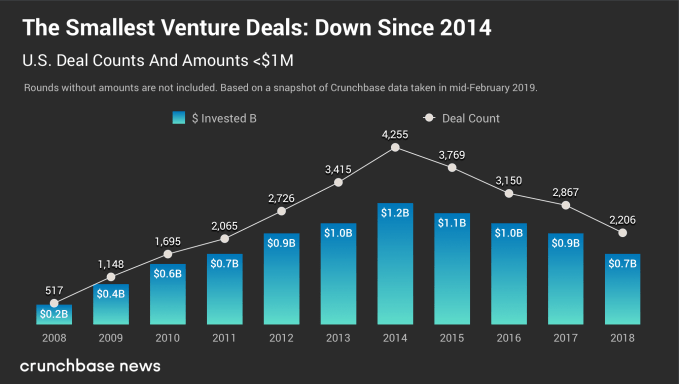
Since 2014 we have seen mostly double-digit declines in less than $1 million rounds each year – a strong pivot from 2008-2014 when we saw double-digit growth.

In 2018 seed funding counts and amounts below $1 million were down from 2015 at 41 and 35 percent respectively. Given that data at this stage can be added long after the round took place, we assess there could be a 20 percentage-point relative increase in 2018 compared to 2017.

If we factor this in, 2018 seed funding counts and amounts below $1 million are down from 2015 at 30 and 23 percent respectively. In other words, seed below $1 million are closer to 2012 and 2017 levels.

$1 million to $5 million rounds are flattening

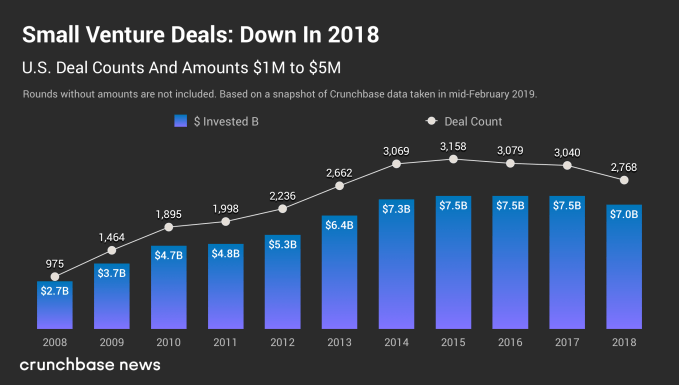
Round from $1 million to $5 million also experienced growth from 2008 through 2015, more than threefold for counts and close to threefold for amounts. Upward growth stalled from 2015. However, we do not see a substantial downward trend in the last three years. Dollars invested are stable at $7.5 billion from 2015 through 2017. Counts and amounts are down in 2018 from the 2015 height by 12 percent for deal count and 6 percent for amounts.

At Crunchbase we are always cautious about reporting downward trends for the most recent year or quarter, as data does flow in after the close of the most recent time period. If the trend is over a greater time period, that is a stronger signal for change in the market. Based on data continuing to be added after the end of a year for the previous year, we assess around 10 percentage point increase relative to 2017. This would make 2018 roughly equivalent  to 2017 on rounds and slightly up on amounts.

Seed funds take bigger stakes

Why is seed flattening? Seed investors report putting more dollars into fewer deals. Or as they raise more substantial subsequent funds, they are putting more dollars into the same number of transactions. Seed funds need to get enough equity for a meaningful stake, should a startup survive to raise subsequent rounds. Seed funds are investing in fewer startups for more equity.

Larger venture funds taking a less active role in seed

UpFront Ventures’ Suster (referenced earlier) also talks about larger venture firms becoming less active in seed, as investing at the seed stage can limit their ability down the road to invest in competitive startups who emerge as growing contenders in a specific sector. The growth of more substantial funds in venture allows firms to see deals mature before investing, perhaps paying more to get the equity they want, and allowing startups not growing as quickly to fail or get acquired.

As Fred Wilson from Union Square Ventures notes, “In the first five years of this decade, we saw the seed portion of the market explode. In the last five years of this decade we saw the growth portion of the market explode. But over those last ten years, the middle part, the traditional venture capital market, has not changed much.”

The middle is growing

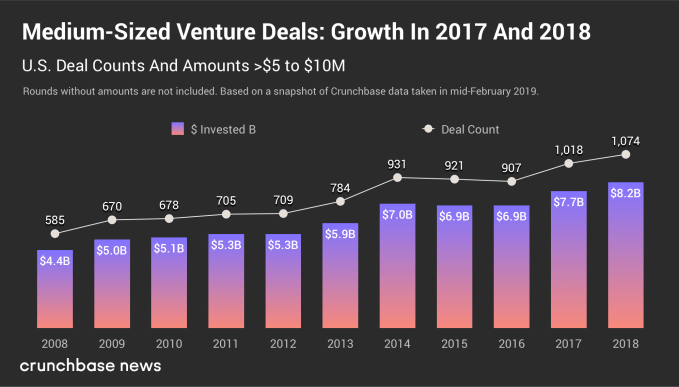
For the middle, Series A and B rounds (which used to be the first institutional money in), the market for $5 million to $10 million rounds has almost doubled, but it has taken from 2008 to 2018. In that same period, growth has been slower than round below $5 million. Growth has continued past 2015. Since 2015, rounds are down slightly for one year, and then continue to grow in 2017 and 2018. Counts are up from 2015 by 17 percent and dollars by 18 percent.

$10 to $25 million rounds are growing

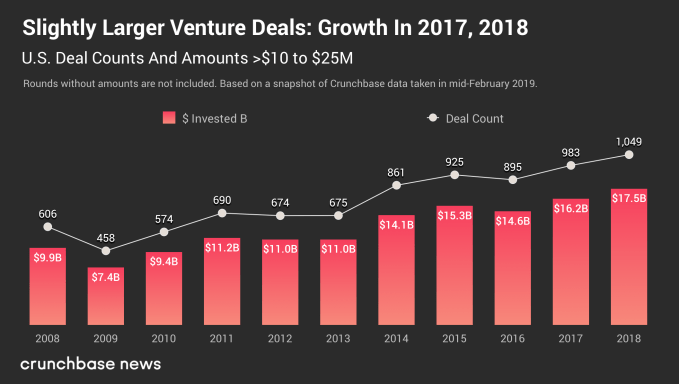
Rounds of $10 million to $25 million have grown over 11 years by 73 percentage points for counts, and 78 percentage points for amounts. This is a slower pace than $5 million to $10 million rounds, but continuing to edge up year over year.

Seed is maturing

Seed is its own class that is here to stay. Indeed pre-seed, seed and seed extension all seem to have specific dynamics. Of the 600-plus active seed funds who have raised a fund below $100 million, close to half have raised more than one fund. In the last three years in the U.S. we have not seen a slowing of seed funds raised for $100 million and below.

Conclusion

When we take into account the data lag, dollars for below $5 million is projected to be $8.5 billion, close to the height in 2015 of $8.6 billion. Deal counts are down from the height by a fifth, which does mean less seed-funded startups in the U.S. Provided that capital allocation is greater than $5 million continues to grow, less seed funded startups will die before raising a Series A. More companies have a chance to succeed, which is good for seed funds, and ultimately for the whole ecosystem.

16 Mar 2019

Vectordash’s cloud gaming service brings crypto-miners a new revenue stream

PC gaming has grown to be a pretty wide niche of people with some far-flung similarities and differences, one thing they all share are souped-up rigs that rely on beefy GPUs. This is fine for those with dedicated machines but PC gaming isn’t too friendly to those trying to pull double-duty on their everyday machine.

Vectordash, launching out of the latest Y Combinator batch, wants to turn your Macbook Air or other underpowered rig into a formidable machine through their cloud gaming service.

The service is charging customers $28 per month to render their games on a cloud machine so that they can be run on non-gaming laptops. The idea of running Fortnite on any machine seems to be a somewhat central idea for the service, though you’ll just as easily be able to log-in to Steam and play through titles that you own.

Launching a cloud-gaming service seems like an expensive proposition, you need a bunch of server centers to host streamers and that’s a lot of upfront cost for an upstart, so Vectordash is cheating a bit and paying users with heavy GPU power to contribute to the gaming hive-mind over the cloud. The service says they’ll pay these GPU renters about $.60 per day for the graphics processing real estate, a number that will cover the electricity but won’t make anyone rich. The trick is, Vectordash is entering a bear cryptocurrency environment where there are tons of GPUs ready to be put to work, so the company will have a market as long as it can stay competitive with crypto mining returns.

Relying on third-party GPU power will leave some difficulty in scaling with such high upfront costs alright taking a steep bite out of margins, but the startup seems to be fine with the tradeoffs and believes that plenty of gamers will see the use of the $28/month service if it means being able to run GPU-hungry games on their Mac or otherwise lightweight laptops.

This does leave the startup in a tricky position where they can likely be undercut on price by a tech giant that is willing to shift some data center power towards the product. At the same time, Vectordash’s distributed model of turning GPUs into sharing economy workers is probably more scalable when it comes to reaching the far-flung corners of the globe.

That’s because a major limiting factor for the technology is that it’s highly dependent on geographic proximity between game streamers and host hardware. As opposed to other streaming services, latency demands are pretty brutal due to the real-time input being sent to the host machines via keystrokes and mouse movements. If users aren’t getting feedback within 20-30ms, the lag grows noticeable and quickly feels unplayable if you’re firing away in something like a first-person shooter, co-founder Sharif Shameem tells TechCrunch.

This means that Vectordash is going to have to be very targeted with the markets they expand to as a game streamer needs to be within about 300 miles from the host machine. They’re kicking things off in the Bay Area and will be focusing efforts on the East and West coasts of the U.S. early-on. Gameplay can max out at 4K 60FPS if your internet connection is solid and can scale things down to 1080p if you’re missing some megabits.

Users can sign up on Vectordash’s site to get early access to the service.

16 Mar 2019

Equity transcribed: Uber IPO, Stash’s raise and more YC movement

Welcome back to this week’s transcribed edition of Equity, TechCrunch’s venture capital-focused podcast that unpacks the numbers behind the headlines. We’re running an experiment for Extra Crunch members that puts the words of our wildly popular venture capital podcast, Equity, in your eyes instead of your ears.

This week, along with guest Anu Duggal, the founder of Female Founders Fund, the team discussed Uber’s impending IPO, Q1’s IPO pace, Stash’s raise and more changes at Y Combinator that saw Sam Altman take a seat as the accelerator’s chairman.

So if you don’t like podcasts but still want the goodness that is Equity, you can have a read of this week’s episode below.

For access to the full transcription, become a member of Extra Crunch. Learn more and try it for free. 


Connie Loizos:
Hello and welcome to Equity. I’m TechCrunch’s Silicon Valley editor Connie Loizos. I’m joined today by Crunchbase News’s Alex Wilhelm.

Alex Wilhelm:
Hello.

Connie Loizos:
Hello. We also have a guest in studio today from New York. Anu Duggal, the co-founder of Female Founders Fund, which has backed a lot of really interesting companies from the wedding site platform Zola to the smartphone lending app Tala, which caters to people and underserved and emerging markets. Anu, thank you so much for swing by today.

Anu Duggal:
Thanks so much for having me.

Connie Loizos:
It’s really great to see you.

Anu Duggal:
You too.

Connie Loizos:
So we were going to talk about the week being sort of slow. In fact, until about an hour ago, we were sort of talking about discussing the fact that there’s been this … a lot of talk and no action yet on the IPO front. Then Reuters broke the news that Uber is planning to kick off its IPO in April, which is just next month. And it’s also just right on the heels of the expected IPO of Lyft, which apparently is coming out at the end of this month.

Alex Wilhelm:
Yes. And this is evidence that the news gods still hate this show because this is, every single week we get on and say well there was no, oh, all the news broke an hour ago. So Connie details here are that we expect the Uber IPO to hit the Road Show in April or to actually get live in April?

Connie Loizos:
I think it’s got an issue. It’s required public disclosure of the S-1 and launching its Investor Road Show. And after that, I’m not really sure how long it takes. Is it maybe like a week later?

16 Mar 2019

Pre- and Post-Money SAFEs: Choosing the right one for your startup

With Y Combinator’s Demo Day taking place at Pier 48 in San Francisco next week, its largest batch of companies ever is getting ready to present to an audience of select investors. Having taken Atrium through Demo Day myself, I have first-hand knowledge of the process. When the founders have finished their pitches, the time to talk numbers will closely follow. Chief among the many decisions founders will face during this time is whether to opt for the Pre-Money SAFE or the new Post-Money SAFE, the two standardized legal documents that YC has introduced in recent years.

Both versions are meant to make the process fast, easy and fair for both parties in the early-stage fundraising process. But there are crucial differences between the two that founders should examine carefully.

Essentially, the Pre-Money SAFE is exceptionally favorable to founders because it gets them pre-valuation funding like a convertible note, but debt-free. The Post-Money SAFE sweetens some of the terms for investors, like locking in their percentage ownership in a priced round later on.

Overall, we expect the Post-Money version to become more common, especially if the company is raising a round above $1 million or $2 million, and the investors have more leverage to ask for it in the negotiation.

(Note: This article is aimed at giving founders a general understanding of the changes from Pre-Money SAFEs to Post-Money SAFEs. The information provided is based on my professional experience and opinions, and should not be used without careful consideration and advice by qualified advisors and legal counsel. Also, to learn more and ask questions about Pre and Post-Money SAFEs, join me on April 16th for a webinar where I’ll dive in a bit deeper.)

Two structures for raising startup investment

Today there are two general ways of structuring a startup fundraising round. The first can be called a “priced equity round,” and is characterized by the sale of preferred stock with a fixed valuation.

16 Mar 2019

Apex Legends is prepping for a big Battle Pass launch

Apex Legends surprised the gaming world two months ago, bringing a new, frenetic dynamic to the Battle Royale genre of games that has already attracted 50 million players.

That first huge milestone didn’t come at a cheap price — EA reportedly paid Ninja $1 million to stream the game. But now the question concerns whether or not Respawn can keep and convert their new, voracious legion of players.

Luckily for Respawn, Fortnite has paved the way when it comes to monetizing this type of game, offering the game itself for free and generating revenue from a virtual items store and a Battle Pass. The Battle Pass concept lets users subscribe to level up and earn skins, camos and other cosmetic items.

Apex Legends, however, has a unique opportunity to make the Battle Pass even more attractive. For now, that opportunity is called Octane.

Octane is rumored to be the game’s Battle Pass character. We know nothing yet for certain, but a datamine and a few allegedly leaked photos have led folks to believe that Octane has a stim-shot style ability that lets him trade movement speed for his health, with another ability that lets him recover that health out of combat situations.

But his rumored ultimate is the one that people are excited about, should the rumors prove true. Octane’s ultimate ability is believed to be a launch pad, that would let the whole team (and enemies, one would assume) bounce around during a fight.

There’s one curious twist. As we wait for the launch of the Battle Pass, Respawn has placed a handful of the very same launchpads into the game around Marketplace on the map. These are static launchpads, but work nonetheless.

This begs the question: are the launchpads simply a static addition to the map itself, or is Respawn testing out the upcoming ultimate ability of Octane? In either case, Octane represents an interesting opportunity for Respawn and the Apex Battle Pass.

Because Apex Legends is built on a hero system, where individual characters bring unique skills, weapons and gear to the game, Apex can offer new hero characters as part of the Battle Pass. This deviates from Fortnite’s suite of virtual products that offer no in-game advantage and are only cosmetic.

A new character, complete with abilities and skills that could lead to your success, can brew up quite a bit of FOMO among folks undecided about the Battle Pass.

On the other hand, Respawn is potentially rushing out new, paid content when it has work to do on the game it already launched. The explosive growth of the game led to serious server issues early on, and lag has continued to infuriate top players. It also introduces yet another set of abilities/weapons to balance against the rest of the game.

That said, time is the company’s greatest enemy. New content and hopefully more enticing weapon camos should invite a new wave of growth as the core user base is re-invigorated. Balancing that urgency with the time needed to build a polished, beautiful season’s worth of content is the real question.

Respawn seems to be handling the pressure well, with some believing that the Battle Pass has already been delayed to ensure a polished launch. For now, it’s a waiting game.

16 Mar 2019

This YC-backed startup preps Chinese students for US data jobs

In recent years, data analysts have gone from optional to a career that holds great promise, but demand for quantitative skills applied in business decisions has raced ahead of supply as college curriculum often lags behind the fast-changing workplace.

CareerTu, a New York-based startup launched by a former marketing manager at Amazon, aims to close that talent gap. Think of it as Codecademy for digital marketing, data analytics, product design and a whole lot of other jobs that ask one to spot patterns from a sea of data that can potentially boost business efficiency. The six-year-old profitable business runs a flourishing community of 160,000 users and 500 recruiting patners including Amazon, Google and Alibaba, an achievement that has secured the startup a spot at Y Combinator’s latest batch plus a $150,000 check from the Mountain View-based accelerator.

In a way, CareerTu is helping fledgling tech startups on a tight budget train ready-to-use data experts. “American companies have a huge demand for digital marketing and data talents these days … but not all of them want to or can spend money on training, and that’s where we can come in,” said Xu, who made her way into Amazon after burying herself in online tutorials about digital marketing.

The gig was well paid, and Xu felt the urge to share her experience with people like her — Chinese workers and students seeking data jobs in the U.S. She took up blogging, and eventually grew it into an online school. CareerTu offers many of its classes for free while sets aside a handful of premium content for a fee. 6,000 of its users are actively paying, which translates to some $500,000 in revenue last year. The virtual academy continues to blossom as many students return to become mentors, helping their Chinese peers to chase the American dream.

CareerTu

Y Combinator founder Paul Graham (second left) with CareerTu founder Zhang Ruiwan (second right) and her team members / Photo: CareerTu

Securing a job in the U.S. could be a daunting task for international students, who must convince employers to invest the time and money in getting them a work visa. But when it comes to courting scare data talents, the visa trap becomes less relevant.

“Companies could have hired locals to do data work, but it’s very difficult to find the right candidate,” suggested Xu. LinkedIn estimated that in 2018 the U.S. had a shortage of more than 150,000 people with “data science skills,” which find application not just in tech but also traditional sectors like finance and logistics.

“Nationalities don’t matter in this case,” Xu continued. “Employers will happily apply a work visa or even a green card for the right candidate who can help them save money on marketing campaigns. And many Chinese people happen to have a really strong background in data and mathematics.”

A Chinese business in the US

Though most of CareerTu’s users live in the U.S., the business is largely built upon WeChat, Tencent’s messaging app ubiquitous among Chinese users. That CareerTu sticks to WeChat for content marketing, user acquisition and tutoring is telling of the super app’s user stickiness and how overseas Chinese are helping to extend its global footprint.

And it makes increasing sense to keep CareerTu within the WeChat ecosystem after Xu noticed a surge in inquiries coming from her homeland. In 2018, only 5 percent of CareerTu’s users were living in China, many of whom were export sellers on Amazon. By early 2019, the ratio has shot up to 12 percent.

Xu believes there are two forces at work. For one, Chinese exporters are leaving Amazon to set up independent ecommerce sites, efforts that are in part enabled by Shopify’s entry into China in 2018. The alternative path provides merchants more control over branding, margins and access to customer insights. Breaking up with the ecommerce titan, on the other hand, requires Chinese sellers to get savvier at reaching foreign shoppers, expertise that CareerTu prides itself on.

careertu

CareerTu offers online courses via WeChat / Photo: CareerTu

Next door, large Chinese tech firms are increasingly turning abroad to fuel growth. Bytedance is possibly the most aggressive adventurer among its peers in recent years, buying up media startups around the world including Musical.ly, which would later merge with TikTok. Indeed, some of CareerTu’s recent grads have gone on to work at the popular video app. Rising interest from China eventually paved Zhang’s way home as she recently set up her first Chinese office in her hometown Chengdu, the laid-back city known for its panda parks and witnessing a tech boom.

Just as foreign companies need crash courses on WeChat before entering China, Chinese firms going global must familiarize themselves with the marketing mechanisms of Facebook and Google despite China’s ban on the social network and search engine.

When American companies growth hack, they make long-term plans that involve “model building, A/B testing, and making discoveries from big data,” observed Xu. By comparison, Chinese companies fighting in a more competitive landscape are more agile and opportunist as they don’t have the time to ponder or test out the different variants in a campaign.

“Going abroad is a great thing for Chinese companies because it sets them against their American counterparts,” said Xu. “We are teaching Chinese the western way, but we are also learning the Chinese way of marketing from players like Bytedance. I’m excited to see in a few years whether any of these Chinese companies abroad will become a local favorite.”

16 Mar 2019

Apple kerfuffles, praise groups, and media layoffs

Lots of news and interesting tidbits to wrap up the week.

Apple kerfuffles

Apple has been vindicated (for a brief moment anyway) in its long-standing dispute with Qualcomm. From Stephen Nellis at Reuters:

A U.S. federal judge has issued a preliminary ruling that Qualcomm Inc owes Apple Inc nearly $1 billion in patent royalty rebate payments, though the decision is unlikely to result in Qualcomm writing a check to Apple because of other developments in the dispute.

Judge Gonzalo Curiel of the U.S. District Court for the Southern District of California on Thursday ruled that Qualcomm, the world’s biggest supplier of mobile phone chips, was obligated to pay nearly $1 billion in rebate payments to Apple, which for years used Qualcomm’s modem chips to connect iPhones to wireless data networks.

We have chronicled Qualcomm’s challenges for some time. This long simmering dispute is complicated since Qualcomm needs the revenues from its patents, while not pissing off its arguably most important customer. The sooner the situation is settled and the parties move on (regardless of financial outcome), the better.

Meanwhile, Spotify and Apple has been the big antitrust story this week. TechCrunch’s news editor Ingrid Lunden covered the latest turns in the saga:

In a lengthy statement on its site called “Addressing Spotify’s Claims”, Apple walks through and dismantles some of the key parts of Spotify’s accusations about how the App Store works, covering app store approval times, Spotify’s actual cut on subscription revenues, and Spotify’s rise as a result of its presence on iOS.

At the same time, Apple carefully sidesteps addressing any of Spotify’s demands: Spotify has filed a case with the European Commission to investigate the company over anticompetitive practices and specifically to consider the relationship between Apple and Spotify (and by association any app maker) in terms of whether it is really providing a level playing field, specifically in the context of building and expanding Apple Music, its own product that competes directly with Spotify on the platform that Apple owns.

2019 is the year that most of the app stores are going to break on their revenue models. And it isn’t just limited to Apple — Steam is also facing huge challenges in the gaming market. As Chris Morris wrote for Extra Crunch a few weeks ago:

So what’s the draw for game makers to sell via the Epic Games store? It is, of course, a combination of factors, but chief among those is financial. To convince publishers and developers to utilize their system, Epic only takes a 12 percent cut of game-sale revenues. That’s significantly lower than the 30 percent taken by Valve on Steam (or the amounts taken by Apple or Google in their app stores).

According to Morris, Epic learned that it can be profitable at 12% based on its own experience with Fortnite, and therefore it wanted to rejigger the standard economics of game stores. Apple has a monopoly with its App Store on its own devices though, and so this sort of competition isn’t available. Given that Apple wants to increase services revenues in its financial model going forward, this is an important battle to watch.

One interesting model for improving the internet: praise groups

Photo by Yiu Yu Hoi via Getty Images

When it comes to unique business models for the web, the Chinese internet market is absolutely the place to get inspiration from.

The What’s on Weibo folks have an article on a popular new form of online communication in China:

A new phenomenon has become a hot topic on Chinese social media these days. ‘Kua kua’ groups (夸夸群) are chat groups where people share some things about themselves – even if they are negative things – and where other people will always tell them how great they are, no matter what.

The team pays $7.50 for a five-minute session complete with 200 “participants.” Their experience:

How does it feel to be praised by some 200 people, receiving hundreds of compliments? It’s overwhelming, and even though you know it’s all just an online mechanism, and that it doesn’t matter who you are or what you say, it still makes you glow a little bit inside.

Although some experts quoted by Chinese state media warn people not to rely on these praise groups too much, there does not seem to be much harm in allowing yourself to be complimented for some minutes from time to time.

I just rely on Extra Crunch members.

Media job cuts & Tumblr traffic crash

Image by Bryce Durbin / TechCrunch

A lot of tech execs left their jobs yesterday (or were pushed out), but the same is also true in the media industry according to a new report:

Consolidation, declining revenue, combative language from the Trump Administration, and occasional violence marked 2018 for members of the media. It was also the year with the highest number of job cut announcements in the sector since 2009, according to the monthly Job Cut Report compiled by global outplacement and executive coaching firm Challenger, Gray & Christmas, Inc.

A huge challenge for traditional media and even some startups like Vice is that their cost structures are incompatible with their revenue models. We have heard this for years, and years, and years, and yet, we haven’t seen media companies rebuilding themselves from the ground up to be profitable today in 2019.

Red ink is not a business model.

Meanwhile, Tumblr (which is owned by TechCrunch parent company Verizon Media) seems to be heading for the abyss according to Shannan Liao at The Verge:

Tumblr’s global traffic in December clocked in at 521 million, but it had dropped to 370 million by February, web analytics firm SimilarWeb tells The Verge. Statista reports a similar trend in the number of unique visitors. By January 2019, only over 437 million visited Tumblr, compared to a high of 642 million visitors in July 2018.

As I wrote in a scathing review of the Tumblr decision (and my employer) a few months ago:

I get the pressure from Apple. I get the safety of saying “just ban all the images” à la Renaissance pope. I get the business decision of trying to maintain Tumblr’s clean image. These points are all reasonable, but they all are just useless without Tumblr’s core and long-time users.

Now the data is increasingly showing the high cost of these product decisions. And people wonder why media has layoffs.

Why can’t we build things? The inevitable vs the avoidable

Photo by Caiaimage/Rafal Rodzoch via Getty Images

Written by Arman Tabatabai

As we wind down our obsession with infrastructure development, it’s clear that there is no one answer to the question of “why can’t we build things?” Inefficiencies exist across all aspects of a project’s life cycle, from planning to financing to construction. While we can pin some of the difficulties to misaligned incentives, gamesmanship, or outdated business models, some of the friction in infrastructure development exist purely as a result of the deep complexity that underpins any project of such immense scale.

We’ve previously dug into issues on the infrastructure planning and financing side. This week, we sat down with structural engineer and author Roma Agrawal to learn more about the difficulties in the engineering and construction processes and how they came to exist, as she lays out in her 2018 book, Built: The Hidden Stories Behind Our Structures.

Built acts as a layman’s primer into the history and science behind structural engineering. Using historical and modern examples, Agrawal breaks down all the under-appreciated factors — from complex physics and wind conditions, to water and fire resistance — that engineers have to consider when planning the built infrastructure on which we all layer our lives.

In our conversation with Agrawal, we tried to get a better grasp of the major issues large project engineers encounter and which ones are actually avoidable. These are some of the most interesting highlights of our conversation:

  • Confirming a key dynamic we discussed with infrastructure expert Phil Plotch, Agrawal noted that misinformation and a lack of understanding between project participants can be an issue for many projects.
  • In her past life as a structural engineer, Agrawal noticed a palpable lack of knowledge about what the field of structural engineering was and what it actually entailed. And the unfamiliarity came not only from the public but from architects and project developers working alongside her on major development projects. Developers often didn’t know or care how their decisions impacted architects, and architects didn’t know or care about how they impacted engineers and so on so forth.
  • Agarwal discussed how historically, there was a lot more congruence between these careers:“If you go back in history — say the Roman times — there wasn’t a separation between architects and engineers. They used to be called Master Builders… [they] would talk about architecture but with discussions about forces and materials and wind.” However, while some tie the decentralization of information across these fields to complacency, laziness or ignorance, Agrawal explained how such conclusions are harsh oversimplifications of something that is really a product of…
  • * …The incredible, and growing, complexity that goes into the minutia of each project. For example, financiers may have to deal with unintelligible structuring of debt while engineers are forced to make precise calculations based off of conditions that are incredibly hard to measure, such as the quality of deep-buried soil and the historical chemical exposure of that soil.
  • “I would say that it’s near impossible today for one single person to understand all the different specializations in enough detail to get a modern structure constructed. So we started to naturally split up into the people that paid more attention to the steel and concrete compared to those that looked at the ventilation systems are those that looked at the drainage and those that looked at fire escapes. And obviously the architects themselves, and then the people funding it, and so on.” And with each development or change in technology, project size, climate or otherwise, it becomes more difficult for each person in the development process to understand how their decisions flow through a project and impact their counterparts.
  • Thus, misinformation and lack of mutual knowledge to some degree is inevitable. The success of many construction projects then becomes tied to coordination according to Agrawal. Similar to Plotch, Agrawal noted that since it’s incredibly difficult for people at one level of a project to understand what is going at another, poor communication and gamesmanship can cause one issue to quickly cascade into many and subsequently into cost overruns and delays.
    • “Generally there is a number of things that have to go wrong and add up. So if you think about if you had 100 steps that go into making a project work safe, and one, two, or maybe even five things are not quite 100% – the product will still probably be okay at the end. But when you get to that threshold whatever that number is that oh maybe 15 or 20 things have gone slightly wrong that’s where we start to run into some real issues.”
  • And while it seems like error compounding happens in almost every major project in the US, Agrawal noted that after her deep research into historical engineering and construction processes she believes we’re actually getting better at executing on projects than ever before. Agrawal pointed out that while mega projects and big hiccups get all the attention, generally most large construction projects are executed successfully.
    • “I think we tend to forget that we’ve now, at least, have these amazing debug procedurals. We go in and we think: ‘Oh my god, these are so huge? How do they stand up? How did the engineers get this right?’ But what we forget is that a number of these structures have collapsed and killed people before they got to the right one that worked… And if anything, we’re getting better and better at preventing the loss of that life — the accidents that happen now are much more manageable and occur at a tiny percentage compared to what we used to have.”

Thanks

To every member of Extra Crunch: thank you. You allow us to get off the ad-laden media churn conveyor belt and spend quality time on amazing ideas, people, and companies. If I can ever be of assistance, hit reply, or send an email to danny@techcrunch.com.

This newsletter is written with the assistance of Arman Tabatabai from New York