Author: azeeadmin

14 Mar 2019

Korean e-commerce unicorn Coupang hires Walmart’s former global chief compliance officer

Coupang, the unicorn that is defining e-commerce in Korea, announced today that it has hired Jay Jorgensen, Walmart’s former global chief ethics and compliance officer, to serve as its general counsel and chief compliance officer. Jorgensen will relocate to Seoul for the position.

Founded in 2010, with a total of $3.4 billion raised from investors including SoftBank and a valuation of $9 billion, Coupang currently operates only in Korea, where it is the largest e-commerce player, but has offices in Seoul, Beijing, Los Angeles, Mountain View, Seattle and Shanghai.

Known for building a tech infrastructure that gives it almost complete control over delivery fulfillment, including last-mile logistics, Coupang more than doubled its revenue over the past two years to about $5 billion in 2018. The company says more than 120 million products are available on its platform and half of Koreans have downloaded its mobile app, with millions of customers ordering from Coupang more than 70 times each year.

Prior to Walmart, Jorgensen was a partner in law firm Sidley Austin LLP. Earlier, he served as a judicial law clerk for the late Supreme Court Chief Justice William Rehnquist and a law clerk for Samuel Alito Jr. while he sat on the United States Court of Appeals for the Third Circuit.

Jorgensen told TechCrunch in a phone call that he wanted to join Coupang because of “the extent to which it is changing life in Korea. It is not just an e-commerce player, it is the e-commerce player.” The company also reminded Jorgensen of learning about Amazon and later on Alibaba in their early days, then watching them develop into the world’s biggest e-commerce players.

When a quickly growing startup unicorn hires a chief compliance officer, the obvious question is if that means a public offering is in the works. Coupang’s vice president of marketplace and customer experience, Dan Rawson, who was also on the call with TechCrunch, said the timing of company’s future IPO is “contingent on a number of factors, including everything from market conditions to company performance” and that it still sees many growth opportunities both in Korea and eventually other countries.

Rawson adds that Korea, already one of the five biggest e-commerce markets in the world, is set to become the third biggest, after only China and the United States, and there is still room for growth in the country. One of Coupang’s most important advantages is its control of the last-mile delivery and customer service experience (most packages are brought to customers by “Coupang men,” or the company’s delivery workers, while a some are performed by Coupang Flex, a peer-to-peer delivery program similar to Uber Eats).

More than four million products are available through its premium Rocket Delivery service, which, like Amazon Prime, offers faster shipment. Rocket Delivery’s options, however, are even faster than Amazon Prime’s. For example, one guarantees delivery by dawn if customers order by midnight. Rawson says Rocket Delivery has fulfilled more than one billion items since September 2018.

14 Mar 2019

AI photo startup Polarr raises an $11.5 million Series A

Bay Area photography startup Polarr announced this morning that it has raised an $11.5 million Series A. The new round of funding, led by Threshold Ventures with participation from Pear Ventures and Cota Capital, brings the startup’s total funding to around $12.5 million, according to the latest Crunchbase figures.

At the moment, the company is probably best known for its photography app for iOS and Android, which utilizes machine learning and AI to improve image editing. The company says it has around four million monthly active users.

This round of funding will go toward research and development, engineering and partnerships, the latter of which are starting to become a big business for Polarr. In fact, it’s using the news to highlight the fact that it was tapped to bring its technology to the Samsung Galaxy S10’s native camera app. Polarr has previously teamed with other big hardware names, including Qualcomm and Oppo.

“As deep learning compute shifts from the cloud to edge devices, there is a growing opportunity to provide sophisticated and creative edge AI technologies to mobile devices,” CEO Borui Wang said in a release tied to the news. “This new round of financing is a tangible endorsement of our approach to enable and inspire everyone to make beautiful creations.”

Polarr’s tech is becoming increasingly valuable as phone makers look to differentiate their handsets’ imaging outside of the hardware. Notable recent generations of handsets from top companies like Samsung, Apple and Google have leaned heavily on AI and ML updates to stand out from the crowd.

14 Mar 2019

SoftBank-backed Nuro launches autonomous grocery delivery service in Houston

On the heels of its massive $940 million funding from the SoftBank Vision Fund, Nuro is launching in its second market. Nuro first launched its self-driving grocery delivery service in Scottsdale, Ariz. in August. Now, Nuro is expanding its partnership with grocer Kroger to launch in Houston, Texas.

The service will be available through two of Kroger’s stores in Houston to reach customers in four local zip codes. Since first partnering with Kroger, Nuro has completed thousands of deliveries to customers.

“We’ve seen first-hand in Arizona how enthusiastic customers are about getting their Kroger groceries delivered by a Nuro self-driving vehicle,” Nuro co-founder Dave Ferguson said in a press release. “Texas has been a leader in encouraging self-driving innovation, and we’re excited to help deliver that future for Houston — a dynamic, diverse, and welcoming metropolitan city that we’re excited to soon explore and serve with this autonomous delivery service.”

Similar to Nuro’s approach in Scottsdale, it will first deploy self-driving Toyota Prius’ before deploying its custom driverless vehicles in the market. Nuro deployed its custom autonomous delivery bot, the R1, a few months after it started testing the service in Scottsdale.

Nuro’s long-term vision is to use its self-driving technology in the last mile for the delivery of local goods and services. In addition to groceries, that could be things like dry cleaning, an item you left at a friend’s house or really anything within city limits that can fit inside one of Nuro’s vehicles. Nuro has two compartments that can fit up to six grocery bags each.

When it came to going to market, Ferguson said groceries were most exciting to him, he told me last June. And Kroger particularly stood out because of its smart shelf technology and partnership with Ocado around automated fulfillment centers.

14 Mar 2019

Populus raises $3.1 million to help cities make sense of shared scooters and bikes

Cities are seemingly down for this new era of transportation, which entails micromobility services and ride-hailing, and operators are increasingly more down to share their data with cities. Now, cities just have to find out what to do with this data and how to extract learnings from it.

This is where Populus comes in. Populus, which just raised a $3.1 million seed round from Precursor Ventures, Relay Ventures and others, helps cities make sense of the influx of transportation data. This brings the startup’s total funding to $3.85 million.

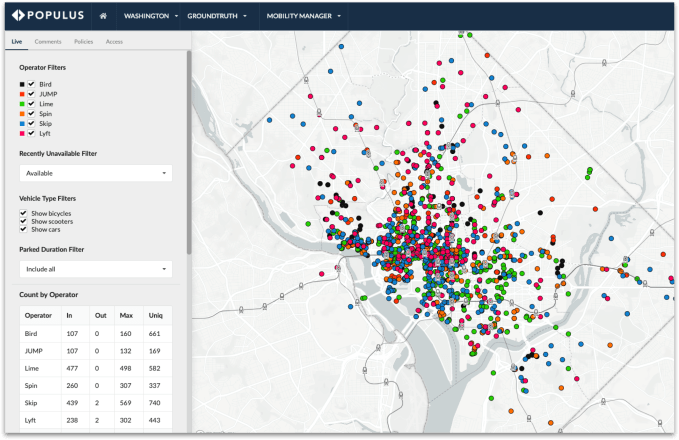
The platform is designed to enable cities to access vehicle and trip data from shared mobility operators. City planners can view where people park and ride scooters, for example, to better determine the best place to put scooter parking areas and dedicated lanes.

“One of the key issues that cities face around mobility services (in general), is that these services are arriving faster than most cities can keep up,” Populus CEO and co-founder Regina Clewlow told TechCrunch via email. “They are fundamentally changing transportation choices and travel patterns in ways that are unpredictable and unmeasured, making it very difficult for cities to design and manage public infrastructure (a job that only they can do). With access to better data and more importantly, information, we are finding that our customers, such as Arlington County in the D.C. area, are able to design infrastructure that can help shared mobility services grow safely and sustainably – such as new bike lanes and scooter corrals.”

To date, Populus works with Washington, D.C. and cities in the SF Bay Area and Los Angeles region. Given that most cities require shared transportation operators to share data with them, it’s easy for Populus to come in as a third party. Populus also offers real-time data from ride-share companies to inform curbside management and pricing. Back in December, Populus partnered with Lime to facilitate data-sharing from its car-share service, LimePod.

Populus works by having cities and operators purchase the platform on a subscription basis. Populus then securely ingests and hosts the data, and proceeds to offer tools to cities and operators to better understand how residents are using the transportation services in the city.

“Over the past decade we have seen an explosion of shared mobility services,” Precursor Ventures Managing Partner Charles Hudson said in a press release. “In order to fulfill their promises of delivering safer, equitable, and efficient streets, shared mobility operators will require platform partners like Populus to facilitate their continued growth. The Populus team’s deep technical and industry expertise are unparalleled. They’ve dedicated their careers to solving the worlds biggest urban problems, and they are building a game-changing platform that will transform the future of cities.”

Populus first launched its core product in September 2018. Clewlow says it was her work with co-founder Fletcher Foti back in 2012 that inspired this company. At the time, the two were working on software to help the Bay Area regional transportation agency forecast the next 30 years of travel. During that work, they witnessed cities struggle to understand what were new modes of transportation at the time offered by the likes of Uber and Lyft.

“We believed that with the rise of dockless mobility, cities would begin to start exerting their authority over managing city streets, and that data platforms would be essential to help private fleets and cities coordinate with one another to make progress on safety, efficiency, and equity goals,” Clewlow said.

14 Mar 2019

UK asks competition watchdog to put adtech market review top of its to-do list

The UK government has written to the country’s competition authority to ask the watchdog to respond to concerns about the lack of transparency in the digital advertising market and carry out a formal market study “as soon as possible”.

In a letter to the Competition and Markets Authority, chancellor Philip Hammond writes that the online ad sector “has been widely described as lacking transparency”.

“A Market Study would provide greater understanding of the existence, nature and potential solutions to any problems within the digital advertising market, and would further develop understanding of the operation of platform markets which rely on digital advertising for revenue,” he continues. “It would also enhance the CMA’s ability to detect and assess digital mergers when these may be of concern.”

The government’s move follows the publication of an independent review of competition policy this week which recommended ministers ask the CMA to examine the market.

The government-commissioned Furman review also called for wider policy changes to respond to competition and consumer problems created by ‘winner takes all’ tech platforms.

Hammond’s letter goes on to note that several UK parliamentary subcommittees have also called for regulatory scrutiny of online adtech practices in recent months, including the Digital Culture Media and Sport (DCMS) select committee, which called for the CMA to probe Facebook’s business practices.

Last year the UK’s data watchdog also called for an ethical pause of online political advertising — warning of risks to democratic debate and trust.

Reached for a response to the government’s call for it to prioritize a market review of online advertising a spokesperson for the CMA pointed us to its response to the Furman review yesterday — in which it says it has also been considering whether to undertake work in the digital advertising market.

Though it warns that its ability to launch new projects is “heavily dependent on the outcome of EU Exit negotiations” — a reference to the ongoing Brexit process in the UK, following the country’s 2016 referendum vote to leave the European Union .

In his letter Hammond accepts that anything other than “an orderly exit” from the EU might derail the watchdog’s ability to prioritize a review of the online ad market, as he would like it to.

“I wish to be clear that I recognise the potential challenges on CMA resourcing associated with scenarios relating to the UK’s departure from the European Union other than an orderly exit,” he writes. “For these reasons I am today writing to ask whether the CMA Board would prioritise a decision on whether to take forward a market study into digital advertising market, as soon as you consider it possible to do so, and come forward with recommendations.”

Neither the CMA nor the government make mention of how social media targeted ads might have impacted the Brexit vote itself in their respective statements of concern about the online ad market.

Yet, last year, the UK’s Electoral Commission found that the official Leave campaign had breached election campaign spending limits — with illegal spend going on targeting pro-Brexit ads at voters on social media, principally via Facebook.

Last month’s DCMS committee report was also especially trenchant in its criticism of Facebook’s business practices — with MPs singling the company out for what it dubbed “disingenuous” and “bad faith” responses to genuine democratic concerns about the misuse of people’s data.

The other digital adtech elephant in the room is of course Google — which has been accused of essentially running its own market given its hold on various key links in the digital adtech chain.

The key question, which any future CMA review would surely probe, is how Google’s dominance affects other players in the online ad market and the ecosystem as a whole?

We reached out to Google and Facebook for a response to Hammond’s request that the CMA prioritize carrying out a formal market review of online advertising.

At the time of writing Google had not responded to our request with a comment.

Facebook told us it’s not commenting on the Furman review — though that’s not actually what we asked it — saying it’s still reviewing the report itself. It added that it had valued the opportunity to contribute to the process.

In a follow up response Facebook’s spokeswoman told us she wasn’t sure whether it would have anything further to add vis-a-vis the government pushing forward with asking the CMA to review the ad market.

14 Mar 2019

WeWork Labs is launching a food tech accelerator

WeWork Labs, the coworking giant’s startup program that relaunched just over a year ago, is announcing a new initiative focused on food and agriculture startups — WeWork Food Labs.

Roee Adler, the global head of WeWork Labs, told me that there will be two main pieces to the Food Labs program.

First, there will be the space itself, at 511 W 25th in New York City, which Adler described as “a very inclusive workspace” for members who may be in “the very early stages” of pursuing a food-related startup idea, and who would benefit from introductions to commercial packaged goods brands, access to commercial kitchens and access to farmland — the kinds of things that Adler said WeWork can provide.

Second, there will be a startup accelerator. While we’ve compared WeWork Labs to an accelerator in the past, WeWork Food Labs is closer to a traditional accelerator, signing up a limited group of entrepreneurs up for a half-year program, and making an equity investment in their companies.

Adler said he’ll be revealing more details about Food Labs’ investments down the road, but initially, WeWork is committing $1 million to back the first batch of companies.

When asked whether this could provide a template for WeWork to launch other industry-focused programs, Adler said, “It is likely that there will be more verticalized Labs programs over time.”

But he added, “I do have to say, food carries a disproportionate amount of weight and attention. We think it is one of the most exciting areas in the world right now, because this isn’t merely about encouraging businesses — this is about the future of the world, no less than what our children will eat.”

While Adler portrayed the program as one driven by a clear mission, he also said he doesn’t want to get too narrow or prescriptive with startups.

“The initial approach we’re starting with is to go wide and inclusive and really allow people to think through the problem across its very intricate hierarchies,” he said. “We expect to have startups producing innovative products that you can eat, but we are also looking at startups that we expect to produce software that farmers can use or corporations can use.”

To help guide the program, WeWork has also created  an advisory board that includes by CHLOE. founder Samantha Wasser and acclaimed food scholar Marion Nestle.

Adler said the plan is to open a temporary Food Labs office on May 1, then move into the permanent “flagship” space on October 1. Applications for the accelerator are open now.

14 Mar 2019

Former Dropbox exec Dennis Woodside joins Impossible Foods as its first President

Former Google and Dropbox executive Dennis Woodside has joined the meat replacement developer Impossible Foods as the company’s first President.

Woodside, who previously shepherded Dropbox through its initial public offering, is a longtime technology executive who is making his first foray into the food business.

The 25-year tech industry veteran most recently served as the chief operating officer of Dropbox, and previously was the chief executive of Motorola Mobility after that company’s acquisition by Google.

“I love what Impossible Foods is doing: using science and technology to deliver delicious and nutritious foods that people love, in an environmentally sustainable way,” Woodside said. “I’m equally thrilled to focus on providing the award-winning Impossible Burger and future products to millions of consumers, restaurants and retailers.”

According to a statement, Woodside will be responsible for the company’s operations, manufacturing, supply chain, sales, marketing, human resources and other functions.

The company currently has a staff of 350 divided between its Redwood City, Calif. and Oakland manufacturing plant.

Impossible Foods now slings its burger in restaurants across the United States, Hong Kong, Macau and Singapore and is expecting to launch a grocery store product later this year.

14 Mar 2019

Telegram gets 3M new signups during Facebook apps’ outage

Messaging platform Telegram claims to have had a surge in signups during a period of downtime for Facebook’s rival messaging services.

In a message sent to his Telegram channel, founder Pavel Durov’s just wrote: “I see 3 million new users signed up for Telegram within the last 24 hours.”

It’s probably not a coincidence that Facebook and its related family of apps went down for most of Wednesday, as we reported earlier. At the time of writing Instagram’s service has been officially confirmed restored. Unofficially Facebook also appears to be back online, at least here in Europe.

Durov doesn’t offer an explicit explanation for Telegram’s sudden spike in sign ups, but he does take a thinly veiled swipe at social networking giant Facebook — whose founder recently claimed he now plans to pivot the ad platform to ‘privacy’.

“Good,” adds Durov on his channel, welcoming Telegram’s 3M newbies. “We have true privacy and unlimited space for everyone.”

A contact at Telegram confirmed to TechCrunch that the Facebook apps’ downtime is the likely cause of its latest sign up spike, telling us: “These outages always drive new users.”

Though they also credited growth to “the mainstream overall increasing understanding about Facebook’s abusive attention harvesting practices”.

A year ago Telegram announced passing 200M monthly active users. Though the platform has faced restrictions and/or blocks in some markets (principally Russia and Iran, as well as China) — apparently for refusing government requests for encryption keys and/or user information.

In Durov’s home country of Russia the government is also now moving to tighten Internet restrictions via new legislation — and thousands of people took to the streets in Moscow and other Russian cities this weekend to protest at growing Internet censorship, per Reuters.

Such restrictions could increase demand for Telegram’s encrypted messaging service in the country as the app does appear to still be partially accessible there.

Durov, who famously left Russia in 2014 — stepping away from his home country and an earlier social network he founded (VK.com) because of his stance on free speech — has sought to thwart the Russian government’s Telegram blocks via legal and technical measures.

The Telegram messaging platform has of course also had its own issues with less political downtime too.

In a tweet last fall the company confirmed a server cluster had gone down, potentially affecting users in the Middle East, Africa and Europe. Although in that case the downtime only lasted a few hours.

14 Mar 2019

Rakuten TV expands to 42 European countries, gets direct button on Samsung, LG, Philips and Hisense remotes

Rakuten TV, the Japanese e-commerce giant’s effort to take on Netflix and Amazon in the world of video streaming, has been something of a minor player when it comes to market share for online entertainment. Today, it’s unveiling two key pieces of news that it hopes will help reverse that. The company is adding 30 new countries in Europe where the service will operate, bringing the total across the region and Japan to 42. And it’s inked a deal with big names in connected TV entertainment systems — specifically Samsung, LG, Philips and Hisense — to embed a dedicated “Rakuten TV” button on their remotes.

The two moves together underscore how Rakuten may not have been among those riding the wave as video streaming has exploded in popularity, but it does not seem ready to throw in the towel on it, either.

“We are here to continue running the marathon,” Jacinto Roca, the CEO of Rakuten TV, said in an interview this week. “This is another step for us to become a global player in this industry.”

It’s about time that Netflix and Amazon had some competition in the over-the-top video market — that is, video entertainment delivered to consumers over their existing broadband connections to compete with costly cable or satellite packages — but if they are perhaps some of the most obvious competition, they’re not the only ones. Apple, Google, a number of content owners themselves, and device makers all believe they have a shot at muscling in and becoming the go-to destination for consumers’ video entertainment needs.

Rakuten TV in some ways looks directly like the Japanese e-commerce company’s answer to Amazon’s video service: both have moved into the area as a natural extension of their e-commerce businesses, which sell consumer electronics and already have extensive operations around content — namely books and e-books, and both would have already build a lot of the infrastructure needed to run these services as a by-product of those e-commerce operations. And, alongside other Rakuten-owned assets like Viber and Ebates, this is one more move by the company to diversify not just its revenues and services, but the ecosystem in which customers are interacting with its brand.

But Rakuten TV has taken a different approach in at least three important ways. The first of these is in how it prices the service. There are no monthly subscriptions, and people watch and pay for movies on an a la carte basis. Roca said that this is unlikely to change anytime in the future. 

“We think that the simplicity of our offer is one of the key value propositions for us so we have no plans to introduce monthly bundles,” he said. He added that in the case of Rakuten TV the company has found that customers watch more than one movie per month, and when you look at the average prices of its films — promotions might come in (in the UK) at 99 pence for one film, but a top release like the Crimes of Grindlewald costs £13.99 to view — “that is definitely a healthy ARPU for us,” he said. “The focus today is making sure that we have people enjoying at least one movie per month on our platform.”

He notes that the economics are ironically trickier in bundles for popular providers where multiple views are happening under one price, which can impact the margins on the overall service. (Something that has been argued with music streaming, too.)

The second area where Rakuten TV is trying to stand apart from others in the streaming video space is its decision not to create original content, or at least not on any scale. The company last year put out a film that it produced, Hurricane, which Roca described to me as an “experiment.”

“We will do three or four more films this year, to start learning about production, but we have no big strategy behind this right now,” he said, noting that content providers have some regulatory requirements in Europe to also contribute investment to grow the content production industry locally in the face of over-domination from the US. “It’s more an experiment, with but no strategic initiative.”

Content efforts can run into the hundreds of millions or even billions in terms of investment, as they collectively had for Rakuten TV’s competitors, and while there is clearly some glory and cred that comes with that, for a smaller player it may not be a tenable option given the challenges of distribution. It also puts Rakuten into a better bargaining position with other content rightsholders, who will not eye it as a rival for eyeballs who might also use their own might as a bargaining chip when agreeing on licensing.

That brings us to the third area where Rakuten is trying to be a bit different, and one excuse of Roca’s for why the company has taken so long to expand to more countries: localization. He says that Rakuten TV will stand out from the field by offering a wider and better selection of content for each local market, using data to see not just what locals like to watch on TV, but what were popular cinematic releases that Rakuten should definitely try to get for those markets. This takes time, he said.

I have to admit there is something to this: if you have ever travelled to various far-flung places and attempted to watch Netflix or Amazon Prime Video, you might notice that not only do you get a much more limited choice of titles, but they are nearly the same from country to country and put a heavy emphasis on the services’ original content — likely one other reason why they have created it in the first place, to populate their services without having to do lots of tricky licensing deals.

In any case, Rakuten is putting investment in another, more basic area first before it can start to double down more on original content. The company is not disclosing how much it had to pay the smart TV makers to create a button on their remotes, but said that it made the investment based on strong results on existing handsets from Roku and Hisense.

“We’ve had buttons on those for a couple of years, and we can see that we are bringing in new users from those buttons,” Roca said. “So after two years with those, we decided it was the right moment to invest and go into brands that have big market shares in Europe.” He says this will give Rakuten TV potentially access to buttons on TVs from providers that collectively have a 35 percent market share in the region. Of course, getting people handsets with those Rakuten buttons is predicated on consumers actually buying new TVs, so this is a bet that very much has yet to pay off.

The investment in smart TV placement is notable also because at the same time, Rakuten is not expanding its presence in any notable way on mobile. That also is down to data, Roca said: today, some 60 percent of its content is consumed on smart TVs. The company also touts that it has the largest catalog of 4K HDR movies in Europe and is about to start trialling 8K.

Looking forward, Roca said that Rakuten TV’s plan is to enter completely different markets now that it has largely covered Europe. That will include, most likely, Latin America, which has a cultural and linguistic synergy with Spain, the home market of Rakuten TV (the Japanese giant spearheaded its TV strategy around its 2012 acquisition of Wuaki.tv, founded by Roca, which it eventually rebranded). And it is also looking at which markets it might target in Asia. Another Rakuten acquisition, of Viki, which provides crowdsourced subtitles for online videos, could play a key part of its strategy in Asia, where Viki has a large usage base.


 

14 Mar 2019

Surging costs send shares of ecommerce challenger Pinduoduo down 17 percent

China’s new tech force Pinduoduo is continuing its race to upend the ecommerce space, even at the expense of its finances. The three-year-old startup earmarked some big wins from the 2018 fiscal year, but losses were even greater, dragging its shares down 17 percent on Wednesday after the firm released its latest earnings results.

The Shanghai-based company is famous for offering cheap group deals and it’s able to keep prices down by sourcing directly from manufacturers and farmers, cutting out middleman costs. In 2018, the company saw its gross merchandise value, referring to total sales regardless of whether the items were actually sold, delivered or returned, jump 234 percent to 471.6 billion yuan ($68.6 billion). Fourth-quarter annual active buyers increased 71 percent to 418.5 million, during which monthly active users nearly doubled to 272.6 million.

These figures should have industry pioneers Alibaba and JD sweating. In the twelve months ended December 31, JD fell behind Pinduoduo with a smaller AAU base of 305 million. Alibaba still held a lead over its peers with 636 million AAUs, though its year-over-year growth was a milder 23 percent.

But Pinduoduo also saw heavy financial strain in the past year as it drifted away from becoming profitable. Operating loss soared to 10.8 billion ($1.57 billion), compared to just under 600 million yuan in the year-earlier period. Fourth-quarter operating loss widened a staggering 116 times to 2.64 billion yuan ($384 million), up from 22 million yuan a year ago.

Pinduoduo is presenting a stark contrast to consistently profitable Alibaba, which generates the bulk of its income from charging advertising fees on its marketplaces. This light-asset approach grants Alibaba wider profit margins than its arch-foe JD, which controls most of the supply chain like Amazon and makes money from direct sales. Pinduoduo seeks out a path similar to Alibaba’s and monetizes through marketing services, but its latest financial results showed that mounting costs have tempered a supposedly lucrative model.

Where did the ecommerce challenger spend its money? Pinduoduo’s total operating expenses from 2018 stood at 21 billion yuan ($3 billion), of which 13.4 billion yuan went to sales and marketing expenses such as TV commercials and discounts for users. Administration alongside research and development made up the remaining costs.

Pinduoduo’s spending spree recalls the path of another up-and-coming Chinese tech startup, Qutoutiao . Like Pinduoduo, Qutoutiao has embarked on a cash-intensive journey by burning billions of dollars to acquire users. The scheme worked, and Qutoutiao, which runs a popular news app and a growing e-book service, is effectively challenging ByteDance (TikTok’s parent company) in smaller Chinese cities where many veteran tech giants lack dominance.

Offering ultra-cheap items is a smart bet for Pinduoduo to lock in price-intensive consumers in unpenetrated, smaller cities, but it’s way too soon to know whether this kind of expensive growth will hold out long-term.