Author: azeeadmin

14 Mar 2019

Breedr raises £2M led by LocalGlobe for its livestock data and trading platform

Breedr, a U.K. startup that wants to help farmers make better use of their livestock data to improve profitability, has raised £2.2 million in funding.

The seed round is led by London-based LocalGlobe, with participation from Mons Investment and a number of angel investors. They include Ian Hogarth, Darren Shapland, and Jonathan McKay. The company is previously backed by Forward Partners and Gumtree founder Michael Pennington, which both followed on.

Founded in early 2018 by Ian Wheal and later joined by co-founder Claire Lewis — both of whom grew up on a farm — Breedr aims to bring the livestock industry into the digital age. The company provides farmers with an app to lets them capture data on their livestock and then use that data to improve the efficiency of their farms and help ensure that they can sell the animals at the most optimum time and price.

This ranges from understanding which sires result in the most profitable offspring, to predicting the date of peak profit for each animal. More broadly, Breedr says that farmers using the app can benefit from a “measurable increase in profitability,” while also reducing the environmental impact and waste caused by overfeeding or poor breeding decisions.

“The current market for livestock operates the same way it has for centuries,” Wheal tells TechCrunch. “Most trading is completed with manual processes and at the last minute, with very little visibility for retailers, processors and buyers up and down the supply chain”.

This lack of visibility generates two main problems within the industry. The first is that too much guesswork leads to a mismatch in supply and demand. Unlike industries that use “just in time” manufacturing, Wheal says that in some parts of the world processors do not know on a Friday if enough animals will be available the following Monday.

The second problem is that farmers aren’t able to accurately buy, grow and sell animals on the metrics that drive the most value for their farms. By analysing profitability of individual animals, Breedr has already been able to demonstrate that the top 20 percent of profit is often wiped out by the bottom 20 percent of poor performing animals.

Linked to the startup’s data play is the Breedr marketplace, which uses the same livestock data to improve traceability and help farmers sell their livestock to meat processors and retailers. It is also ultimately where the startup will generate revenue by charging a small transaction fee and potentially up selling other financial products in the future, such as insurance or financing.

“Our data and trading platform is moving the industry from trading on how things look to the actual data that drives commercial return to the industry,” adds Wheal. “[We enable] farmers to utilise data to differentiate their livestock to customer requirements rather than seed the market as a commodity. Suppliers can for the first time have visibility of supply to buy animals at specification, and retailers can plan promotions and build premium brands based on a trusted supply chain”.

Meanwhile, in addition to the company’s seed round, Breedr has been given a grant from Innovate UK, the U.K.’s innovation agency, to lead a consortium developing a “Smart Contracts” system for the meat and livestock sector. Working with farming groups, Imperial College London, and Dunbia (one of Europe’s largest processors of red meat), it plans to use blockchain or distributed ledger technology (DLT) to capture the flows of data and transactions between multiple parties within the livestock industry.

14 Mar 2019

Google removed 2.3B bad ads, 1.5M bad apps and 28M bad pages, plans new Policy Manager this year

Google is a tech powerhouse in many categories, including advertising. Today, as part of its efforts to improve how that ad business works, it provided an annual update that details the progress it’s made to shut down some of the more nefarious aspects of it. Using both manual reviews and machine learning, in 2018, Google said removed 2.3 billion “bad ads” that it said violated its policies, which most generally forbid ads that mislead or exploit vulnerable people. Along with that, Google has increasingly started to tackle the “bad ads” conundrum on the other side: pinpointing and shutting down sites that violate policies that are profiting from using its ad network: it said it removed 1.5 million apps and nearly 28 million pages that violated publisher policies.

On the more proactive side, the company said today that it is introducing a new Ad Policy Manager in April to give tips to publishers to avoid listing non-compliant ads in the first place.

Google’s ad machine makes billions for the company — more than $32 billion in the previous quarter, accounting for 83 percent of all Google’s revenues. Those revenues underpin a variety of wildly popular, free services such as Gmail, YouTube, Android and of course its search engine — but there is undoubtedly a dark side, too: bad ads that slip past the algorithms and mislead or exploit vulnerable people, and sites that exploit Google’s ad network by using it to fund the spread of misleading information.

Notably, Google’s 2.3 billion figure is nearly 1 billion less ads than it removed last year for policy violations. The lower numbers might be attributed to two things. First, while the ad business continues to grow, that growth has been slowing just a little in competition with other players like Facebook and Amazon. Second — and this one gives the benefit of the doubt to Google — you could argue that it has improved its ability to track and stop these ads before they make their way to its network. (The more cynical question is whether Google removed less to improve its bottom line.)

Google’s director of sustainable ads, Scott Spencer, highlighted ads removed from several specific categories this year: there were nearly 207,000 ads for ticket resellers, 531,000 ads for bail bonds and 58.8 million phishing ads taken out of the network.

Part of this was based on the company identifying and going after some of these areas, either on its own steam or because of public pressure. In one case, for ads for drug rehab clinics, the company removed all ads for these after an expose, before reintroducing them again a year later. Some 31 new policies were added in the last year to cover more categories of suspicious ads, Spencer said. One of these included cryptocurrencies: it will be interesting to see how and if this one becomes a more prominent part of the mix in the years ahead. 

Because ads are like the proverbial trees falling in the forest — you have to be there to hear the sound — Google is also continuing its efforts to identify bad apps and sites that are hosting ads from its network (both the good and bad).

On the website front, it also created 330 “detection classifiers” to seek out specific pages that are violating policies. Google’s focus on page granularity is part of a bigger effort it has made to add more granular tools overall to its network — it also introduced page-level “auto-ads” last year — so this is about better housekeeping as it works on ways to expand its advertising business. The efforts to use this to ID “badness” at page level led Google to shutting down 734,000 publishers and app developers, removing ads from 1.5 million apps and 28 million pages that violated policies.

Fake news also continues to get a name check in Google’s efforts. The focus for both Google and Facebook in the last year has been around how its networks are used to manipulate democratic processes. No surprise there: this is an area where they have been heavily scrutinised by governments. The risk is that, if they do not demonstrate that they are not lazily allowing dodgy political ads on their network — because after all they still represent ad revenues — they might find themselves in regulatory hot water, with more policies being enforced from the outside to curb their abuses.

This past year, Google said that it verified 143,000 election ads in the US — it didn’t note how many it banned — and started to provide new data to people about who is really behind these ads. The same will be launched in the EU and India this year ahead of elections in those regions.

The new policies it’s introducing to improve the range of sites it indexes and helps people find are also taking shape. Some 1.2 million pages, 22,000 apps and 15,000 sites were removed from its ad network for violating policies as misrepresentative, hateful or other low-quality content. These included 74,000 pages and 190,000 ads that violated its “dangerous or derogatory” content policy.

14 Mar 2019

Google is reportedly shutting down its in-house VR film studio

Google is shutting down its Emmy Award-winning VR film division, Spotlight Stories, after six years of building out content, Variety reports.

We’ve reached out to Google for confirmation.

“Google Spotlight Stories means storytelling for VR. We are artists and technologists making immersive stories for mobile 360, mobile VR and room-scale VR headsets, and building the innovative tech that makes it possible,” the group’s site reads.

The Spotlight Stories team was part of the company’s Advanced Technologies and Products (ATAP) group. Much like Facebook’s ill-fated Oculus Story Studio, there was never a big focus on monetizing what was being created internally.

The studio’s best-received work, “Pearl,” was nominated for an Academy Award and won an Emmy in 2017. The group also worked with Wes Anderson to bring a VR behind-the-scenes featurette on the making of his film “Isle of Dogs.” In November, the group released its last major work, “Age of Sail,” a narrative film that could be watched on mobile and high-end VR systems.

Google has made significant investments in AR and VR, but has allowed competitors like Facebook and Apple to surpass their consumer efforts.

Google’s efforts on its VR program went full throttle in 2016 and early 2017 while the company sought to keep pace with Samsung which was aggressively hocking mobile hardware it had built alongside Oculus. It’s rumored the company made significant changes to its immersive divisions after Apple introduced ARKit in mid-2017, aggressively shifting resources from its VR division to AR projects like its ARCore mobile augmented reality platform.

The company has not updated its Daydream View VR headset since 2017, the company has ceded most of its ground to Oculus as its allowed products like Lenovo’s Daydream View to die on the shelf as its failed to make updates to its platform or direct significant resources to bringing new content on board. Now, with the reported shutdown of Spotlight Stories, the company is now making it clear that they don’t think building their own content is the right approach either.

14 Mar 2019

MIT’s deflated balloon robot hand can pick up objects 100x its own weight

Soft, biologically inspired robots have become one of the field’s most exciting offshoots, with machines that are capable of squeezing between obstacles and conforming to the world around them. A joint project between MIT CSAIL and Harvard’s Wyss converts those learnings into a simple, soft robotic gripper capable of handling delicate objects and picking up things up to 100x its own weight.

The gripper itself is made of an origami-inspired skeletal structure, covered in either fabric or a deflated balloon. It’s a principle the team recently employed on another project designed to create low-cost artificial muscles. A connector attaches the gripper to the arm and also sports a vacuum tube that sucks air out from the gripper, collapsing it around an object.

Like Soft Robotics’ commercial gripper, the malleable nature of the device means it grab hold of a wide range of different objects with less need for a complex vision system. It also means that it can grab hold of delicate items without damaging them in the process.

“Previous approaches to the packing problem could only handle very limited classes of objects — objects that are very light or objects that conform to shapes such as boxes and cylinders, but with the Magic Ball gripper system we’ve shown that we can do pick-and-place tasks for a large variety of items ranging from wine bottles to broccoli, grapes and eggs,” MIT professor Daniela Rus says in a release tied to the news. “In other words, objects that are heavy and objects that are light. Objects that are delicate, or sturdy, or that have regular or free form shapes.”

14 Mar 2019

Tiny claws let drones perch like birds and bats

Drones are useful in countless ways, but that usefulness is often limited by the time they can stay in the air. Shouldn’t drones be able to take a load off too? With these special claws attached, they can perch or hang with ease, conserving battery power and vastly extending their flight time.

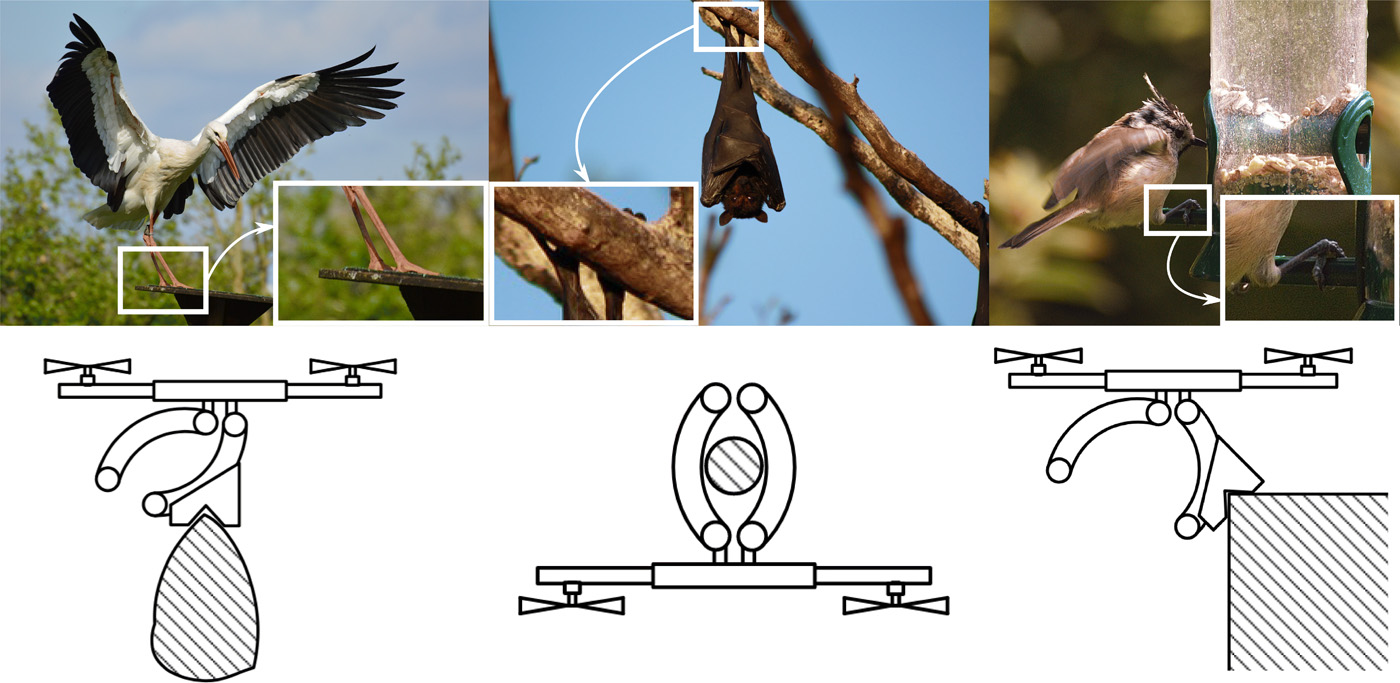
The claws, created by a highly multinational team of researchers I’ll list at the end, are inspired by birds and bats. The team noted that many flying animals have specially adapted feet or claws suited to attaching the creature to its favored surface. Sometimes they sit, sometimes they hang, sometimes they just kind of lean on it and don’t have to flap as hard.

As the researchers write:

In all of these cases, some suitably shaped part of the animal’s foot interacts with a structure in the environment and facilitates that less lift needs to be generated or that power flight can be completely suspended. Our goal is to use the same concept, which is commonly referred to as “perching,” for UAVs [unmanned aerial vehicles].

“Perching,” you say? Go on…

We designed a modularized and actuated landing gear framework for rotary-wing UAVs consisting of an actuated gripper module and a set of contact modules that are mounted on the gripper’s fingers.

This modularization substantially increased the range of possible structures that can be exploited for perching and resting as compared with avian-inspired grippers.

Instead of trying to build one complex mechanism, like a pair of articulating feet, the team gave the drones a set of specially shaped 3D-printed static modules and one big gripper.

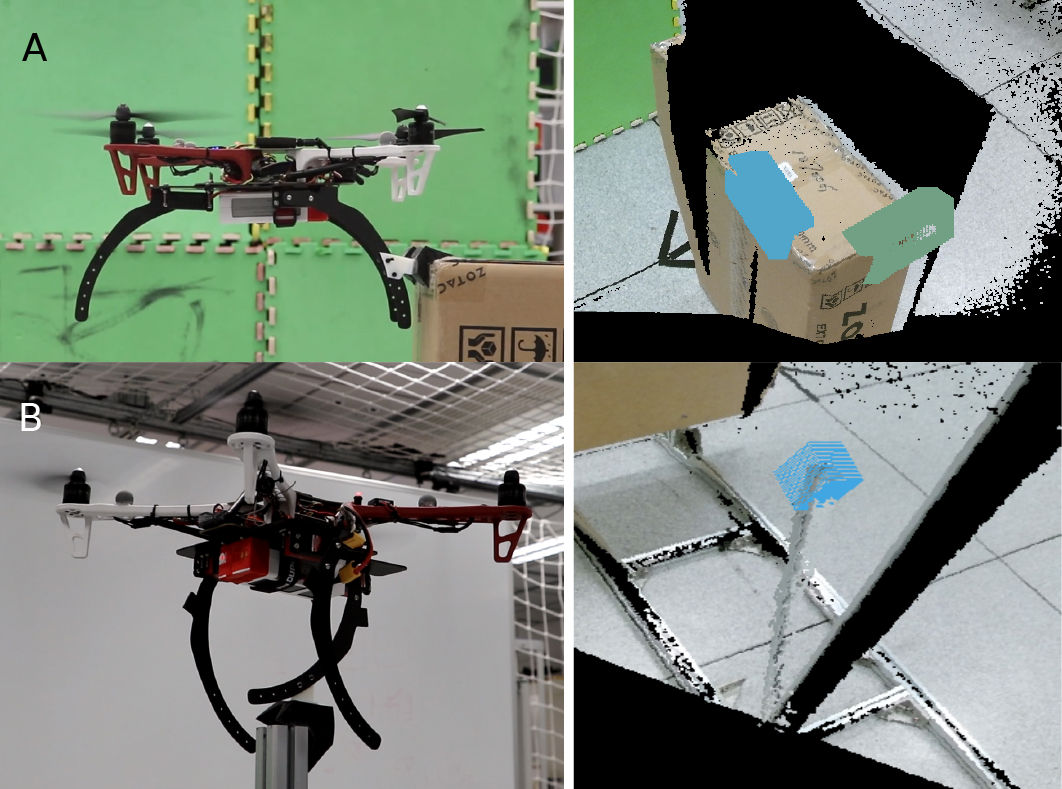
The drone surveys its surroundings using lidar or some other depth-aware sensor. This lets it characterize surfaces nearby and match those to a library of examples that it knows it can rest on.

Squared-off edges like those on the top right can be rested on as in A, while a pole can be balanced on as in B.

If the drone sees and needs to rest on a pole, it can grab it from above. If it’s a horizontal bar, it can grip it and hang below, flipping up again when necessary. If it’s a ledge, it can use a little cutout to steady itself against the corner, letting it shut off or all its motors. These modules can easily be swapped out or modified depending on the mission.

I have to say the whole thing actually seems to work remarkably well for a prototype. The hard part appears to be the recognition of useful surfaces and the precise positioning required to land on them properly. But it’s useful enough — in professional and military applications especially, one suspects — that it seems likely to be a common feature in a few years.

The paper describing this system was published in the journal Science Robotics. I don’t want to leave anyone out, so it’s by: Kaiyu Hang, Ximin Lyu, Haoran Song, Johannes A. Stork , Aaron M. Dollar, Danica Kragic and Fu Zhang, from Yale, the Hong Kong University of Science and Technology, the University of Hong Kong, and the KTH Royal Institute of Technology.

13 Mar 2019

Facebook won’t store data in countries with human rights violations — except Singapore

As soon as Mark Zuckerberg said in a lengthy 3,225-word blog post to not build datacenters in countries with poor human rights, he had already broken his promise.

He chose to ignore Singapore, which the Facebook founder had only months earlier posted about, declaring the microstate home to the company’s first datacenter in Asia to “serve everyone.”

Zuckerberg was clear: “As we build our infrastructure around the world, we’ve chosen not to build data centers in countries that have a track record of violating human rights like privacy or freedom of expression.”

If there are two things Singapore is known for, it’s that there’s no privacy or freedom of expression.

For all its glitz and economic power, Singapore’s human rights record falls far below internationally recognized norms. The state, with a population of five million, consistently falls close to the bottom in worldwide rankings by rights groups for its oppressive laws against freedom of speech, expression and assembly and limited rights to privacy under its expanding surveillance system. Worse, the country is known for its horrendous treatment of those in the LGBTQ+ community, whose actions are heavily restricted and any public act or depiction is deemed criminal. And even the media are under close watch and often threatened with rebuke and defamation lawsuits by the government.

Reporters Without Borders said Singapore has an “intolerant government,” and Human Rights Watch called some of the country’s more restrictive laws “draconian.”

We brought these points up Facebook, but the company doesn’t see Zuckerberg’s remarks as contradictory or hypocritical.

“Deciding where to locate a new data center is a multi-year process that considers dozens of different factors, including access to renewable energy, connectivity, and a strong local talent pool,” said Facebook spokesperson Jennifer Hakes. “An essential factor, however, is ensuring that we can protect any user data stored in the facility.”

“This was the key point that Mark Zuckerberg emphasized in his post last week,” said Hakes. “We looked at all these factors carefully in Singapore and determined that it was the right location for our first data center in Asia.”

Ironic, that Facebook’s own platform has been a target for Singapore’s government to crack down on vocal opponents of the state. Jolovan Wham, an activist, was jailed after organizing a public assembly from a Facebook page. The assembly’s permit was denied, so he switched the venue to a Skype call.

When asked, Facebook declined to comment on what it considers unacceptable human rights by a country, only referring back to Zuckerberg’s post.

Singapore remains be an important hub for the tech industry and business — particularly for Western companies, who have thrown human rights to the wind even as they tout their commitment to privacy and free speech at home. Amazon, Microsoft, Google, DigitalOcean, Linode, and OVH all have datacenters in the micro-state.

But only one to date have made public commitments to not store data in countries with poor records on human rights.

Why has Facebook made an exception for Singapore? It’s a mystery to everyone but Mark Zuckerberg

13 Mar 2019

The “splinternet” is already here

There is no question that the arrival of a fragmented and divided internet is now upon us. The “splinternet,” where cyberspace is controlled and regulated by different countries is no longer just a concept, but now a dangerous reality. With the future of the “World Wide Web” at stake, governments and advocates in support of a free and open internet have an obligation to stem the tide of authoritarian regimes isolating the web to control information and their populations.

Both China and Russia have been rapidly increasing their internet oversight, leading to increased digital authoritarianism. Earlier this month Russia announced a plan to disconnect the entire country from the internet to simulate an all-out cyberwar. And, last month China issued two new censorship rules, identifying 100 new categories of banned content and implementing mandatory reviews of all content posted on short video platforms.

While China and Russia may be two of the biggest internet disruptors, they are by no means the only ones. Cuban, Iranian and even Turkish politicians have begun pushing “information sovereignty,” a euphemism for replacing services provided by western internet companies with their own more limited but easier to control products. And a 2017 study found that numerous countries, including Saudi Arabia, Syria and Yemen have engaged in “substantial politically motivated filtering.”

This digital control has also spread beyond authoritarian regimes. Increasingly, there are more attempts to keep foreign nationals off certain web properties.

For example, digital content available to U.K. citizens via the BBC’s iPlayer is becoming increasingly unavailable to Germans. South Korea filters, censors and blocks news agencies belonging to North Korea. Never have so many governments, authoritarian and democratic, actively blocked internet access to their own nationals.

The consequences of the splinternet and digital authoritarianism stretch far beyond the populations of these individual countries.

Back in 2016, U.S. trade officials accused China’s Great Firewall of creating what foreign internet executives defined as a trade barrier. Through controlling the rules of the internet, the Chinese government has nurtured a trio of domestic internet giants, known as BAT (Baidu, Alibaba and Tencent), who are all in lock step with the government’s ultra-strict regime.

The super-apps that these internet giants produce, such as WeChat, are built for censorship. The result? According to former Google CEO Eric Schmidt, “the Chinese Firewall will lead to two distinct internets. The U.S. will dominate the western internet and China will dominate the internet for all of Asia.”

Surprisingly, U.S. companies are helping to facilitate this splinternet.

Google had spent decades attempting to break into the Chinese market but had difficulty coexisting with the Chinese government’s strict censorship and collection of data, so much so that in March 2010, Google chose to pull its search engines and other services out of China. However now, in 2019, Google has completely changed its tune.

Google has made censorship allowances through an entirely different Chinese internet platform called project Dragonfly . Dragonfly is a censored version of Google’s Western search platform, with the key difference being that it blocks results for sensitive public queries.

Sundar Pichai, chief executive officer of Google Inc., sits before the start of a House Judiciary Committee hearing in Washington, D.C., U.S., on Tuesday, Dec. 11, 2018. Pichai backed privacy legislation and denied the company is politically biased, according to a transcript of testimony he plans to deliver. Photographer: Andrew Harrer/Bloomberg via Getty Images

The Universal Declaration of Human Rights states that “people have the right to seek, receive, and impart information and ideas through any media and regardless of frontiers.”

Drafted in 1948, this declaration reflects the sentiment felt following World War II, when people worked to prevent authoritarian propaganda and censorship from ever taking hold the way it once did. And, while these words were written over 70 years ago, well before the age of the internet, this declaration challenges the very concept of the splinternet and the undemocratic digital boundaries we see developing today.

As the web becomes more splintered and information more controlled across the globe, we risk the deterioration of democratic systems, the corruption of free markets and further cyber misinformation campaigns. We must act now to save a free and open internet from censorship and international maneuvering before history is bound to repeat itself.
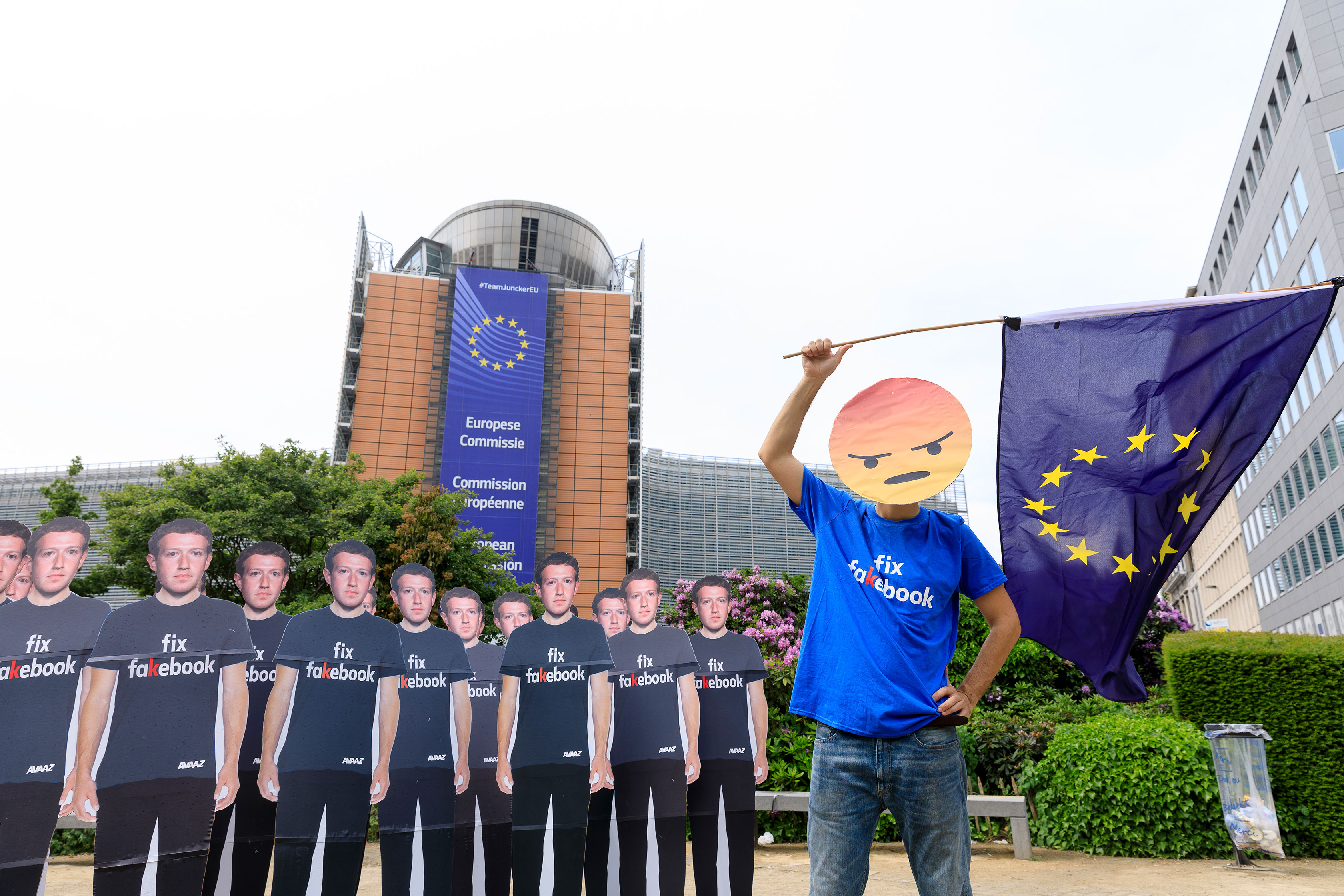
BRUSSELS, BELGIUM – MAY 22: An Avaaz activist attends an anti-Facebook demonstration with cardboard cutouts of Facebook chief Mark Zuckerberg, on which is written “Fix Fakebook”, in front of the Berlaymont, the EU Commission headquarter on May 22, 2018 in Brussels, Belgium. Avaaz.org is an international non-governmental cybermilitating organization, founded in 2007. Presenting itself as a “supranational democratic movement,” it says it empowers citizens around the world to mobilize on various international issues, such as human rights, corruption or poverty. (Photo by Thierry Monasse/Corbis via Getty Images)

The Ultimate Solution

Similar to the UDHR drafted in 1948, in 2016, the United Nations declared “online freedom” to be a fundamental human right that must be protected. While not legally binding, the motion passed with consensus, and therefore the UN was provided limited power to endorse an open internet (OI) system. Through selectively applying pressure on governments who are not compliant, the UN can now enforce digital human rights standards.

The first step would be to implement a transparent monitoring system which ensures that the full resources of the internet, and ability to operate on it, are easily accessible to all citizens. Countries such as North Korea, China, Iran and Syria, who block websites and filter email plus social media communication, would be encouraged to improve through the imposition of incentives and consequences.

All countries would be ranked on their achievement of multiple positive factors including open standards, lack of censorship, and low barriers to internet entry. A three tier open internet ranking system would divide all nations into Free, Partly Free or Not Free. The ultimate goal would be to have all countries gradually migrate towards the Free category, allowing all citizens full information across the WWW, equally free and open without constraints.

The second step would be for the UN to align itself much more closely with the largest western internet companies. Together they could jointly assemble detailed reports on each government’s efforts towards censorship creep and government overreach. The global tech companies are keenly aware of which specific countries are applying pressure for censorship and the restriction of digital speech. Together, the UN and global tech firms would prove strong adversaries, protecting the citizens of the world. Every individual in every country deserves to know what is truly happening in the world.

The Free countries with an open internet, zero undue regulation or censorship would have a clear path to tremendous economic prosperity. Countries who remain in the Not Free tier, attempting to impose their self-serving political and social values would find themselves completely isolated, visibly violating digital human rights law.

This is not a hollow threat. A completely closed off splinternet will inevitably lead a country to isolation, low growth rates, and stagnation.


13 Mar 2019

Uber said to be raising $1B at a $10B valuation for its self-driving car unit

Uber is in negotiations with investors, including the SoftBank Vision Fund, to secure an investment as large as $1 billion for its autonomous vehicles unit. The deal would value the business at between $5 billion and $10 billion, according to a Tuesday report from The Wall Street Journal.

Uber didn’t immediately respond to a request for comment.

The news comes shortly after TechCrunch’s Mark Harris revealed the ridehailing firm was burning through $20 million a month on developing self-driving technologies, which means, according to our calculations, that Uber could have spent more than $900 million on automated vehicle research since early 2015.

According to the WSJ, the deal could close as soon as next month, shortly before Uber is expected to complete a highly-anticipated initial public offering. Uber, in December, filed the necessary paperwork with the US Securities and Exchange Commission to go public in 2019. The documents were submitted only hours after its competitor Lyft did the same; Lyft, for its part, unveiled its S-1 earlier this month and will debut on the Nasdaq shortly.

Uber, to date, has raised nearly $20 billion in a combination of debt and equity funding, reaching a valuation north of $70 billion. The business is said to be seeking funding for its self-driving business in order to tout the unit’s growth and valuation. After all, a $10 billion sticker price on its AV efforts may bandage its reputation, damaged by continued reports questioning its progress.

Alphabet-owned Waymo, meanwhile, is reportedly looking to raise capital, too. This would be the first infusion of outside funding for the autonomous vehicle business, rolled out of Alphabet’s Google X. According to The Information, which broke this news on Monday, Waymo would raise capital at a valuation “several times” that of Cruise, the AV company owned by General Motors.

Raising capital from outside investors would help limit costs and would allow Alphabet the opportunity to display Waymo’s valuation for the first time in several years. Alphabet, however, does not want to relinquish too much equity in the business, justifiably. Waymo, years ago, was valued at $4.5 billion, though analysts claim it could surpass a valuation as high as $175 billion based on future revenue estimates.

Waymo didn’t respond to a request for comment.

Other investors in Uber’s purported round include an “unnamed automaker,” per the WSJ. Uber’s existing backers include Toyota, SoftBank, T. Rowe Price, Fidelity and TPG Growth.

Uber’s net losses were up 32 percent quarter-over-quarter as of late last year to $939 million on a pro forma basis. On an EBITDA basis, Uber’s losses were $527 million, up about 21 percent. The company said revenue was up five percent QoQ sitting at $2.95 billion and up 38 percent year-over-year.

13 Mar 2019

Ford is expanding its self-driving vehicle program to Austin

Ford is preparing to open an autonomous vehicle program in Austin as the automaker continues to ramp up testing ahead of launching a self-driving taxi and delivery service in 2021, according to sources familiar with the development.

A new job listing for an autonomous vehicles “market specialist” based in Austin, validates the information. Austin is the fifth city to join the automaker’s testing program, which already includes Detroit, Miami, Pittsburgh and Washington D.C.

Ford didn’t confirm or deny that Austin was the next city.

“We are on track to announce the next deployment city in which we plan to expand our self-driving technology and business testing efforts by the end of this year. We will provide more details at the appropriate time,” a Ford spokesperson said in an emailed statement.

The job posting for an “autonomous vehicles market specialist” in Austin reads:

We are seeking exceptional candidates to join our growing Autonomous Vehicle (AV) business team! AVs are an important part of Ford’s future and we’re looking for the best and brightest. The role will require critical thinking, problem solving capabilities, and a “get it done” attitude to help make strategic decisions that will enable Ford to be a leader in autonomy, connectivity, mobility, analytics and customer experience.

Ford is a bit different from other companies that have launched autonomous vehicle pilots in the United States. The automaker is pursuing two parallels tracks that will eventually combine ahead of its commercial launch in 2021. The automaker is testing and honing in on what its AV business model might look like, while separately developing autonomous vehicle technology.

Argo AI,  the Pittsburgh-based company into which Ford invested $1 billion in 2017, is developing the virtual driver system and high-definition maps designed for Ford’s self-driving vehicles. Meanwhile, Ford is testing its go-to-market strategy through pilot programs with partners like WalmartDomino’s and Postmates, and even some local businesses.

Ford will likely institute a similar rollout plan for Austin as it has in its previous cities. Argo AI first uses its AV vehicles to map the city. Meanwhile, Ford uses research vehicles to test various business cases, many of which have historically involved local companies.

Ford also opens terminals in each of the autonomous vehicle test program cities. These terminals, or operations centers, are where the AV test fleet vehicles will be stored. It also acts as a light maintenance facility and data center.

In the past, Ford has launched its mapping and testing before the terminal has been completed. It’s possible Ford will try to establish the autonomous vehicle operations terminal first, a slight departure from previous

Ford has spent the past year ramping up its autonomous vehicle program and plans to spend $4 billion through 2023 under an LLC created last year that’s dedicated to building out an autonomous vehicles business.

Ford Autonomous Vehicles LLC will house the company’s self-driving systems integration, autonomous-vehicle research and advanced engineering, AV transportation-as-a-service network development, user experience, business strategy and business development teams. The $4 billion spending plan includes a $1 billion investment in startup Argo AI.

The new LLC is primarily based at Ford’s Corktown campus in Detroit and will hold Ford’s ownership stake in Argo AI, the company’s Pittsburgh-based partner for self-driving system development.

13 Mar 2019

YSplit wants to make it so you never owe your friends money again

When you live with roommates or go out often with friends, it’s common for someone to front the payment — be that for utilities, the cable bill, rent or the restaurant bill — and have everyone else pay them back via cash, Venmo or Apple Pay. But YSplit, a company launching out of Y Combinator, wants to make it so you never have to owe anyone ever again.

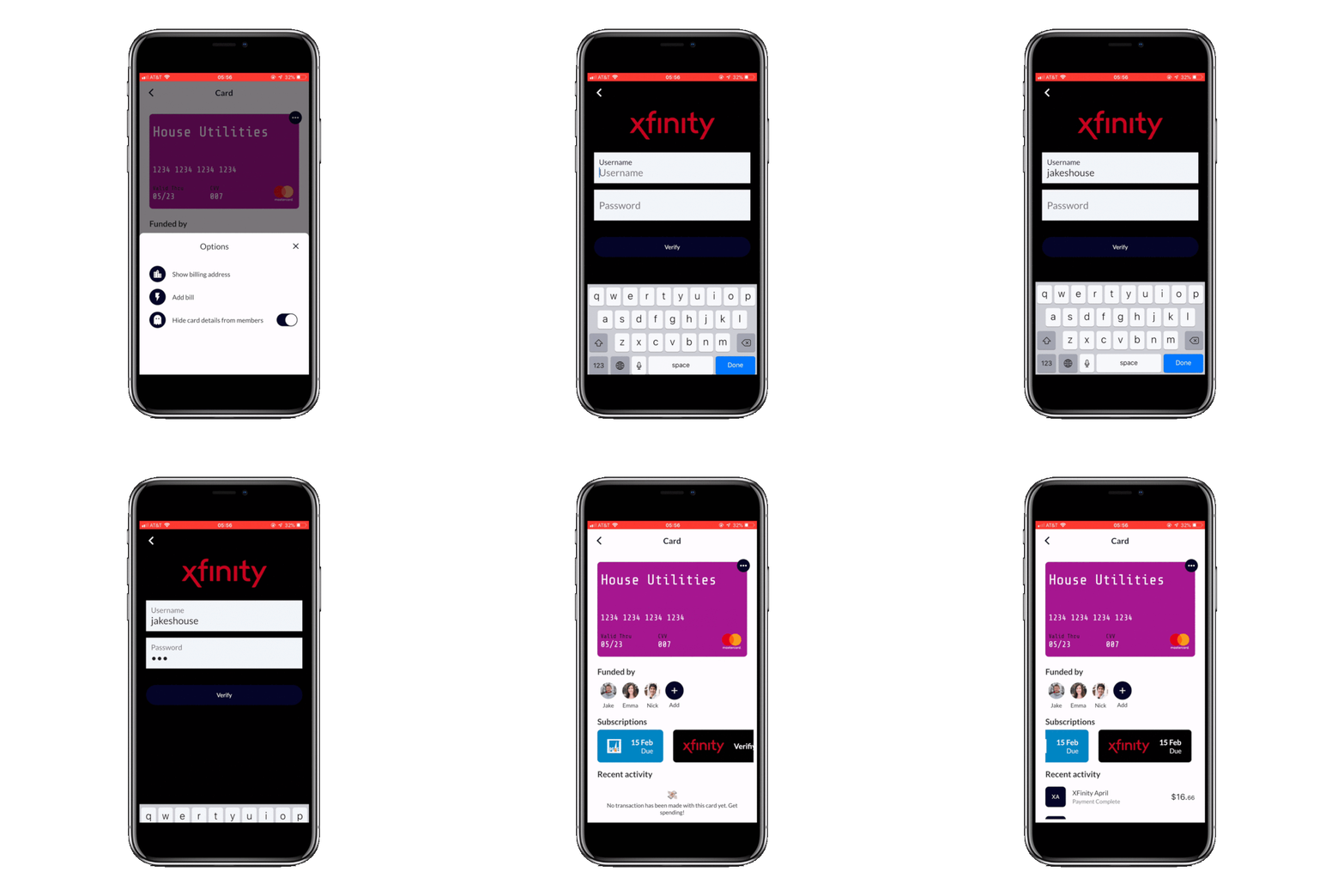
It works by creating a virtual card that automatically deducts money from everyone’s bank account. So, the person who usually fronts the payment would instead use YSplit’s virtual card.

“We front the payment and as we’re fronting payment, we’re ensuring everyone on the card has enough money,” YSplit co-founder Tunde Alao told TechCrunch. “We authorize the payment and then charge everyone at the same time.”

YSplit is totally free to users but makes money through interchange fees. Since the payment happens through YSplit’s card, it’s able to charge the utility provider between 1.3 to 2 percent of the transaction.

YSplit spun out of Alao and his co-founders first startup, Cluttr. While the three of them were interning at Google, they shared a house and came up with the idea to help them organize their shared finances.

“We created something to track how much we owed each other,” Alao said. “It got quite popular in the U.K. but we realized we’re not solving any problem by helping people track how much they owe each other. We wanted to stop people from owing each other entirely.”

Cluttr, which Alao said was similar to Splitwise, was basically Splitwise plus scheduling. Splitwise allows you to easily track bills and other expenses with friends. There are numerous other apps that make it easy to track how much you owe someone, but few — if any — that let so easily split the expenses upfront.

Ysplit is currently in closed beta with about 40 households using the product. After Y Combinator demo day next week, YSplit will roll out the app to an additional 500 people. YSplit is initially focused on utility payments for roommates but plans to add additional service providers to down the road.

“It scales into a lot of situations,” Alao said.