Author: azeeadmin

08 Mar 2019

‘Captain Marvel’ never quite takes flight

“Captain Marvel” isn’t a bad movie, exactly.

It seems, at this point, that Marvel’s moviemaking machinery is incapable of producing a genuinely terrible film. There’s no “Batman v. Superman: Dawn of Justice” or “Suicide Squad” in the Marvel filmography, just “Thor: The Dark World,” “Ant-Man” and “Doctor Strange” — movies that are fine but forgettable.

Still, I wanted more than that for “Captain Marvel,” and I suspect that I’m not alone.

That’s because after 20 films, Marvel Studios is finally giving a woman top billing. It’s “Captain Marvel,” full stop, and the film was also co-directed by a woman — Anna Boden, who directed and co-wrote the film with her regular collaborator Ryan Fleck. As a result (and also in response to star Brie Larson’s efforts to make the press tour more inclusive), the movie has predictably attracted its share of online trolls.

So it’d be nice to report that “Captain Marvel” is an absolute triumph. The fact that it’s not has nothing to do with Larson, who plays Carol Danvers (the current incarnation of Captain Marvel) with a winning mix of charm and determination. The problem, I suspect, lies in the movie’s depiction of the Captain Marvel character.

Nick Fury

Marvel Studios’ CAPTAIN MARVEL..Nick Fury (Samuel L. Jackson) ..Photo: Film Frame..©Marvel Studios 2019

When the story begins, she isn’t Captain Marvel per se. Instead, she’s an amnesiac soldier-in-training known as Vers, who serves an alien race known as the Kree in their war against their shapeshifting enemies, the Skrulls.

As the movie goes on, the story eventually brings us to Earth in the 1990s, where we eventually learn more about Vers. Still, both her backstory and her pryotechnic powers remain abstract: When the credits rolled, I still thought of her as a blank slate, and while Larson commits to the handful of big, heroic that the script gives her, the lines feel more like generic messages of empowerment, rather than dialogue that really shows us who the character is.

Luckily, though Captain Marvel remains a cipher, she’s surrounded by a strong supporting cast, including Samuel L. Jackson and Ben Mendelsohn, both of them transformed — Mendelsohn (who seems completely incapable of being boring on-screen) into a goblin-like Kree soldier, Jackson into a facsimile of his younger self.

In fact, the CGI technology that Marvel has been using to de-age its older actors is at its best here, largely avoiding the uncanny valley feeling that I got in “Captain America: Civil War” and “Ant-Man and the Wasp.” And the middle stretch, which pairs up Jackson and Larson on a buddy comedy-style road trip, is probably the film’s highlight.

Unfortunately, the genuinely funny character moments have to share screentime with by-the-numbers Marvel plot, and with tired jokes that harp on the ’90s setting. (Though the audience at my preview screening seemed to dig the period humor — maybe it depends on whether you find the sight of a Blockbuster Video, or of Brie Larson wearing a Nine Inch nails T-shirt, to be inherently funny.)

If anything, this feels like an illustration of how remarkable “Wonder Woman” and “Black Panther” were: They broke down barriers in on-screen representation, but they managed to be fun and memorable (and, in the case of “Black Panther,” a genuinely great film) at the same time.

With “Captain Marvel,” on the other hand, we get the first in what may be the new standard. Now women and minorities can star in their superhero films, and they can be just as middle-of-the-road as the ones featuring white guys.

08 Mar 2019

Flickr says all Creative Commons photos are protected from deletion, not just past uploads

Flickr announced today that all Creative Commons images will remain protected on its site – including those uploaded in the past and those that will be added in the future. The news follows Flickr’s November 2018 announcement where it had stated it wouldn’t delete Creative Commons photos already on its service, after switching over to a new business model which put an end to the free terabyte of storage in favor of a new subscription-based service.

There had been concern prior to Flickr’s statement in November that the photography site’s revamped business model would see works deleted from Creative Commons, as a result of its implementation.

That would have been a huge loss to the wider photography community and the web as a whole.

Creative Commons is a significant resource, as it makes creators’ works freely available through a variety of copyright licenses that respect how the owner wants them shared and/or attributed. Flickr, before being acquired by new owners SmugMug, had been a longtime Creative Commons partner, offering millions of photos under the CC license types on its site.

Though Flickr’s November decision to not delete the CC archive was a good step forward, it didn’t necessarily protect all the CC-licensed photos that would be uploaded to its site in the future. Instead, the company said only those CC photos uploaded prior to November 1, 2018 would be grandfathered in, so to speak.

At the time, CEO at Creative Commons, Ryan Merkley, expressed some concern about this decision. It wasn’t clear where future CC-licensed photos would end up.

Today, both organizations announce they’ve come to an agreement: all CC-licensed photos and public domain works will continue to be free on Flickr for anyone to upload and share. That’s a step further than simply protecting all the past uploads before the business model transition.

It means that Flickr has committed to continue to steward the Commons, as before.

Today, Flickr hosts more than 500 million CC-licensed works, and that number increases daily.

“Choosing to allow all CC-licensed and public domain works to be uploaded and shared without restrictions or limits comes at a real financial cost to Flickr, which is paid in part by their Pro users. We believe that it’s a valuable investment in the global community of free culture and open knowledge, and it’s a gift to everyone,” said Merkley today, in a blog post announcement about Flickr’s decision.

“We’re grateful for the ongoing investment and enthusiasm from the entire Flickr team, and their commitment to support users who choose to share their works,” he added.

Along with this news, Flickr says it has disabled bulk license change tools in its Settings, Camera Roll and Organizr for Flickr Free accounts in order to prevent users from switching large archives to a free license to take advantage of this decision. Instead, photos’ licenses can only be changed on the photo page itself.

The company additionally said it will now offer “in memoriam” accounts for Flickr members who have passed away, instead of deleting their works if or when a Pro subscription lapses.

Flickr has seen many transitions over the years. It had been bought by Yahoo, which then became a part of (TechCrunch parent) Verizon before being sold off last year to SmugMug. But that move meant the company had to come up with a more sustainable business model in order to survive.

It’s unclear if Flickr will have the resources to make this new commitment to the Creative Commons indefinitely without coming up with other monetization options beyond Pro subscriptions, but the company has committed on building out features focused on users’ needs, not on catering to advertisers. It hopes to make its service valuable and worth paying for, instead of being the “digital shoebox” that massive amounts of free storage led it to become over the years.


08 Mar 2019

UK military veteran launches crowd-funding for Pixie app to revive local stores

What if, instead of sitting on your phone on the sofa ordering stuff from Amazon, you could buy the same things locally from local stores that ultimately enliven and enrich your local neighborhood? What if by doing that, you wouldn’t be walking through deserted main streets, past boarded-up shops, dark alleys and graffiti? What if someone created a marketplace for independent businesses, local events and experiences that kept the money in the local economy rather than being siphoned off into global giants who don’t care about human-scale communities?

That’s the idea behind Pixie, a new take on the “shop-local app” startup model which, although it’s been tried before, has never quite managed to take off. Perhaps Pixie will have more luck?

Here’s how it works: The Pixie app connects people to independent businesses through a curated marketplace, incentivizing them to pay through the app and get rewarded for being loyal customers. Integrated into the app is Pixie Pay, a bespoke payment solution which keeps money in local hands.

The startup has a fascinating background. Whilst serving in the British Special Forces, Pixie’s founder Greg Barden understood that his mission was also to ‘win hearts and minds’ with the local population. Whether by buying bread from the local baker in a village in Afghanistan, or coffee from the market in Baghdad, he and his soldiers could tear down even the most hostile barriers.

He also realized that when more money stayed inside these the local economies rather than being sucked away by organized crime or large scale, globalized businesses, the local economy might flourish and the risk of the societies there becoming yet again destabilized could potentially diminish.

“Whether it was stalls in the bazaars of Baghdad or small boutiques on Bath high-street, I realized independent shop owners are linchpins in their community. They add variety to the mundane and nurture community spirit. Even local guardians need protecting sometimes, which is why we created Pixie.”

The threat to independent stores from globalization and digitization isn’t just happening in Afghanistan. Across the western world, ‘Main Street’ stores are closing at a prodigious rate. In the UK over 1,500 local stores closed in 2018. (And that was BEFORE Brexit…)

Pixie has stress-tested its idea in mid-sized town in the UK, including Bath, Frome and Sherbourne, completing transactions across 250 businesses, ranging from cafes to fashion boutiques, and spinning up 5,000 app users. It’s now going on the fund-raising trail, aiming to raise £500,000 in funding through its ‘Equity for Explorers’ campaign on Crowdcube a UK-based crowd-equity platform. The total addressable market for independent business in the UK is estimated to be £31.5bn in gross transactional value.

Barden — who last year spoke about his startup life at the launch of the military tech non-profit TechVets — says: “There might be thousands of independent businesses across the UK, but at the rate the high-street is disappearing they are severely under threat. Pixie isn’t here to turn people away from the bigger players on the high-street, but create opportunities for enriching discovery. Needless to say, in a world with increasing nationalism, Brexit, Trump and — dare I say it — Amazon, we feel Pixie has a huge part to play in countering the worst aspects of globalization.”

Pixie’s revenue comes from transaction fees taken when people use its ‘Pixie Pay’ payment mechanism. The payment system is designed to bypass Visa/Mastercard at the point of sale, whilst the loyalty scheme unites independent businesses under one umbrella, so the users can earn and spend their loyalty points (as money) across the entire Pixie community. If a store using Pixie is in Australia, a person from Bath could also use their points there. This keeps the money circulating inside local, independent stores, wherever they are on the planet.

Pixie distributes its own payment terminal that sits next to whatever the business has in place to take normal card payments (iZettle etc). The cards are contactless but don’t utilise visa MasterCard. It’s literally their own e-money system. Think PayPal where users can either add money to their balance by debit card or bank and/or link a debit card to Pixie if they don’t have a balance.

Obviously this also creates it an alternative to competitors like iZettle, Square, SumUp and WorldPay, but this time specifically aimed at local independent stores, not huge national and international chains.

The third element of Pixie is its discovery marketplace that gives its community of explorers (users) the ability to discover local businesses across the Pixie footprint of stores.

I’ve seen several startups try and tackle this problem, but it may well be that Pixie, under its charismatic leader, finally has a shot at cracking this idea around local markets.

08 Mar 2019

Lyft lays off up to 50 in bikes and scooters as it gears up for another wave of launches

As Lyft continues to prepare for its IPO, the on-demand transportation startup is trimming staff to cut costs ahead of another wave of expansion.

TechCrunch has learned and confirmed that Lyft has laid off around 50 staff in its bike and scooter division, mainly people who had joined the company when it acquired the electric bike sharing startup Motivate a deal that closed about three months ago. The cuts range from managers and through to technical people and those holding less senior roles, and have been made across a number of cities, including Boston, San Francisco and New York.

(The Information separately also published a short report about the layoffs last night.)

A spokesperson for the company told TechCrunch that Lyft is continuing to hire in its scooter and bike division. “This was part of our performance management process,” she said in a statement. “We are actively hiring for this part of the business with hundreds of hires planned this year.”

Given that Lyft currently employs around 5,000 people, the cuts work out to a small percentage of that, around one percent to be exact. But it’s notable because of where the cuts were made, and because they are coming as the company gears up for a public listing, after which it will be subject to more public scrutiny.

Lyft has made a big move in the last year to expand its transportation options beyond private cars. This has been done partly to meet consumer demand in different scenarios (for example, shorter routes that might otherwise be clogged with traffic, or options that let the rider get a little exercise in during the journey); partly because its competitors are also presenting alternatives, which could drive business away from Lyft if it doesn’t offer the same options; and — now that there is a public offering in sight — partly to present a more diversified business to the market. The Motivate acquisition was likely made for at least all of those reasons.

Before Lyft acquired it, Motivate had made its name in bikes alone. In fact, it had grown to be the biggest bike sharing company in the US, with its network including CitiBike in New York; Capital Bikeshare in Washington; Ford GoBike in San Francisco and many others.

Under Lyft, Motivate became part of Lyft’s bigger strategy to expand beyond private car services, which also included its scooter business. While Lyft is continuing to develop business for both transportation mediums — for example, it added 4,000 electric bikes recently to the New York City bike sharing operation — scooter sharing has most definitely had the bigger surge of industry interest in recent months.

One person who tipped us about these layoffs believes that they were made with a specific strategy in mind, to cut costs on the bike operation, which is a more established business, to help channel resources into the costly scooter business. “Lyft is going big on scooters and cutting bike people,” said the tipster. To be clear, though, Lyft itself did not characterise it that way.

Whether the two are directly related, it is true that in the next couple of weeks, the company will be kicking off a big scooter launch in multiple cities, with its SXSW presence this year all about the two-wheeled, electric-powered vehicles.

Other companies and investors are certainly putting their money on scooters right now. Lime is now valued at $2.4 billion after raising $310 million last month. Bird is also reportedly raising at a similar valuation. Uber, meanwhile, acquired Jump last year to spearhead its own scooter and bike strategy.

All that is despite what has been a very uneven path for scooters. Some of the issues have included controversy around safety (for example, Lime appears to have a persistent safety problem with some of its fleet; the after-effect of having gluts of them cluttering the streets and the regulatory issues that surround this; and the tough unit economics.

On the last of those, this essay outlines how difficult it is to make money right now on a scooter business, when you calculate the average price for a ride, the average lifespan of a scooter, and the average price to get one on the street. And that’s before you consider marketing and other costs, and before you have seen the basic premise proven out: that a critical mass of people will use hired electric scooters on a regular basis.

Our tipster estimated that a typical scooter rollout is making a loss of about $23 per scooter per ride ($2 per ride, versus $25 per ride cost). “Better design durability and more scale to get to operational efficiency will address that in theory,” the tipster said, which is likely why hires are still being made, and services are still being rolled out.

08 Mar 2019

Bike sharing pioneer Mobike is retreating to China

In a telling sign of the state of bike sharing, Mobike, a once red-hot startup that attracted billions in investment capital, is closing down all international operations and putting its sole focus on China.

On Friday, Mobike laid off its operations teams in APAC, which entailed more than 15 full-time employees and many more contractors and third-party agency staff across Singapore, Malaysia, Thailand, India and Australia. Those affected were told the company will “ramp down” the regional business without being provided specific reasons for the rollback, five people familiar with the matter told TechCrunch.

These layoffs are a key step towards the eventual goal of closing Mobike’s international footprint since the Asia Pacific region accounts for the majority of its non-China business. More staff cuts are impending outside Asia that can include Europe and the Americans, according to two sources. Eventually, Mobike will only be operational in its native China, which accounts for the majority of its overall global business.

The change of strategy encapsulates the struggle that Chinese bike sharing companies have experienced over the past year. Mobike was arguably the most successful from the camp. Before it was ultimately bought by Chinese delivery giant Meituan for $2.7 billion 11 months ago, it had raised over $900 million from investors such as Tencent, Foxconn, Hillhouse Capital and Warburg Pincus as bike-sharing became the hot topic in 2017. Ultimately, though, Mobike wasn’t able to find a sustainable business model amid tough competition and tight financials.

mobike

Photo source: Mobike

Employees were taken aback by Friday’s announcement as they had been under the impression that Mobike’s prospects were bright and there had not been issues with salaries or other financial concerns. In Singapore, specifically, the bike app claims to be the top player and is working closely with the government to make the city-state greener.

“I was shocked. The business is doing well from my perspective,” one source told TechCrunch. “But just because one country does well doesn’t mean the whole region will survive. Mobike ran a lot of analysis on profits and losses in the [overseas] region and came to the conclusion that there is no way it would turn profitable.”

Things were rosier just a year ago. When Meituan, the one-stop app for neighborhood services in China, acquired Mobike, the buyout was widely seen as a triumph for the young startup as its Chinese peer Ofo suffered mounting financial pressures standing as an independent company. Ofo started to phase out its international operations last year and was reportedly preparing for bankruptcy recently.

Before long, Meituan also started to show its restraint over the mobility segment. In an effort to cut costs, the Hong Kong-listed firm focusing on food delivery and hotel booking announced it would pause expansions on dockless bikes and car-hailing. Its bike unit is also facing growing competition from Hellobike, which is Alibaba’s latest attempt to crack China’s two-wheel transport industry.

Despite the hurdles, Mobike’s APAC employees told TechCrunch that they had believed the overseas business would stick it out as they had generated “a lot of cost-saving and progresses” in recent months after being assigned to boost the company’s operational efficiency.

mobike 3

Photo source: Mobike

Those affected won’t have much time to ponder but feel “unbalanced” and “upset” about the company’s “one-sided” decision. TechCrunch understands that staff weren’t given a chance to negotiate and most will leave by mid-April with a limited number of “key” employees asked to stay until the “ramping down” is completed. Severance packages vary on people’s termination dates, while some employees received no compensation altogether as the notice had arrived before the 30-day period required by the contract.

Meituan’s decision to close down the regional business has also come as a risky move for the company. In Singapore, Mobike’s largest market outside China, bike-sharing companies are required to file an exit plan with the government before they pull the trigger. Mobike has not informed the Singapore Land Transport Authority of its layoff as of Friday, according to two sources, although it has been in talks with the transportation regulator regarding a potential shutdown. Mobike told employees to keep news of the job cuts private before it announces them officially to the LTA.

Meituan declined to comment for this story. The company is scheduled to report earnings on Monday which may shed more light on the situation.

08 Mar 2019

Here’s a sneak peek at HBO’s Elizabeth Holmes documentary, The Inventor

The story of Elizabeth Holmes and Theranos has inspired quite a bit of content, including a NYT Best Seller, an ABC podcast, a movie starring Jennifer Lawrence, and now an HBO documentary directed by Going Clear director, Alex Gibney.

The documentary is called The Inventor: Out For Blood In Silicon Valley.

The tech world was shocked when the WSJ broke the news that Theranos, the biotech startup founded by Elizabeth Holmes, wasn’t what it appeared to be.

Promising to revolutionize healthcare, Theranos wanted to accomplish the impossible by creating a device that could significantly speed up the time it takes to test blood and diagnose disease. This, it turns out, was actually impossible.

Elizabeth Holmes, the world’s youngest self-made female billionaire, was at the helm of the Theranos fantasy, which ballooned to a $9 billion valuation before being identified as a fraud by the SEC.

HBO documentary The Inventor: Out For Blood In Silicon Valley debuts on Monday, March 18, and catalogs the story through interviews with the reporters who documented it, whistleblowers, former Theranos employees and experts.

This includes John Carreyrou, author of “Bad Blood”; journalists Ken Auletta (The New Yorker) and Roger Parloff (Forbes), who wrote profiles of Holmes; Theranos whistleblowers Tyler Shultz and Erika Cheung; former Theranos employees Dave Philippides, Douglas Matje, Ryan Wistort and Tony Nugent; behavioral economist Dan Ariely; and Dr. Phyllis Gardner, MD, professor of medicine at Stanford University.

TechCrunch’s Josh Constine reviewed The Inventor after its Sundance premiere.

The documentary will be available on HBO, HBO NOW, HBO GO, HBO On Demand and partners’ streaming platforms.

[Video courtesy of HBO]

08 Mar 2019

Who are the next billion users and what do they want?

Entrepreneurs and tech executives are widening their gazes outside of developed nations for their next source of growth. Ubiquitous cheap phones and increasingly affordable phone plans such as Jio in India are helping another billion users join the internet. What do those users want though, and how are they the same and different than existing internet users?

That’s the subject of a critical book by Payal Arora, entitled The Next Billion Users: Digital Life Beyond the West. The compact thesis encompasses a range of argumentative vignettes on how Western tech founders and non-profit executives misinterpret the needs of the global poor — and what internet access really means to them.

“Let’s drop the morality and let’s start engaging with the reality,” Arora explained in an interview with TechCrunch. “Let’s celebrate the mundane over the grand.” That’s the summation of more than two decades working with the global poor and engagement with issues of technology, social media, and entrepreneurship.

In her book, Arora, who today is a professor at Erasmus University Rotterdam in the Netherlands, argues against narratives that make it hard to see the global poor for who they really are. “The various templates about the global poor today — as blank slates, criminals, deviants, virtuous beings, entrepreneurs, self-organizers, victims, and more — is testament to the mystification strategies at play in the framing of this vast populace.”

As she discussed with TechCrunch, “[The internet is] basically an always ongoing project, and it’s constantly going to be shaped by the people who use it.”

You’re reading the Extra Crunch Daily. Like this newsletter? Subscribe for free to follow all of our discussions and debates.

The global poor really want to “play”

Far from being “exotic,” these users need many of the same things found in the West: entertainment, education, and romance. In fact, there is a huge intellectual gap between what Western product leaders believe these next users want, and what they really desire. When youth (and a huge proportion of these new users are young given demographics in emerging markets) acquire digital devices, their top priorities are often listening to music and communicating on social media like Facebook .

Indeed, the entire expansion of technology in many parts of the world are driven not by necessity, but by a desire to have fun. “From Jio to Facebook, these initiatives have at least one thing in common: they promote leisure usage to motivate people to adopt these new technologies,” Arora writes.

She emphasizes the importance and challenges of notions of “play” in regard to this new digital divide. As she writes, “The concept of jugaad, or ‘frugal innovation,’ has become pervasive. How to get more from less is the name of the game.” The bottoms-up innovation seen in places like India are a positive form of play, where users remix their technology to meet their needs.

Yet, that innovation is not always looked upon favorably by Western executives. Piracy can be rampant in developing economies due to the lack of resources available to pay for Western-priced media. “Legitimizing the ingenuity of the poor in creating a marketplace for digital leisure through pirated goods comes at the cost of disrupting the core business model of the Western media industries.”

Privacy is much more complicated in these emerging markets

Every day in the West, there is news of data breaches and privacy violations. Europe has passed one of the most comprehensive policies to protect user privacy in the world with GDPR, and concerns around privacy on platforms like Facebook are hot issues in Silicon Valley policymaking circles these days.

Arora sees a much more complicated relationship with privacy for the global poor though. For these users, “privacy is not such a big issue, not because they don’t care about privacy, not because they don’t quite get it. […] But the fact that it is still — in relation to their actual lives — far more private,” she said. In her book, she writes, “They are savvy hiders when they need to be, and active seekers when they need to be, especially when seeking happiness online.”

These new users are often coming from very conservative and gendered societies, where even showing a woman’s face can be grounds for punishment. Yet, women and men often use social networks like Facebook and Twitter as pathways around these rules, purposely using technology to intermediate their social lives. Plus, they can be fun. “Facebook is a ‘happy’ place. This matters a lot in [Brazil’s slums known as] favelas, where young people’s day-to-day lives are entrenched in poverty and violence.”

Technology of course creates new sets of problems. Location-based technologies can help gangs target individuals for harassment or kidnapping. Romance scams are proliferating as young men and women try to find a relationship online. A scandalous image can be distributed to the shame of families and entire communities. Yet, these simple connections made through tech can make the burdens of living poor just a bit less hard.

For entrepreneurs, focus on the mundane

Arora’s most trenchant criticism is when she analyzes the obsessive focus of Silicon Valley and its entrepreneurs on grand projects rather than on core needs.

She heavily criticizes Nicholas Negroponte and his One Laptop Per Child program (an argument that at this point feels redundant), along with Sugata Mitra of the Hole-in-the-Wall experiment that plopped computers in villages with the belief that it would transform education. In our interview, Arora said that “I’m not saying they were not inspirational, but they were brazen in the sense that it was so deeply arrogant.”

Instead of looking for rocket ships and novel technology, she recommends that product designers simply offer the poor the dignity of meeting the needs they already express. Talking about the success of Jio in India, Arora writes that it’s strategy “was motivated by the ‘ABCD principle’ dictating the online market in India — based on the fact that most Indian consumers use most of their data to access content on the Astrology, Bollywood, Cricket, and Devotion sites.”

Some founders, government agencies, and aid groups find that conclusion hard to accept. They want to castigate such leisure pursuits and frivolity, arguing that users should be educating themselves and trying to “rescue themselves” out of poverty. Arora argues passionately that self-expression, the ability to explore sexuality, to engage with political opinions in a safer space, and more are absolutely the right of the poor to pursue. Memorizing molecular biology facts can take a back seat.

Next Billion Users doesn’t have a single thesis to offer, to its credit and also detriment. Instead, Arora offers a selection of anecdotes, data, and perspectives to try to open the reader to a wider world. In that project, she has succeeded, and it is worth anyone who has users outside of SoMa to take in her cultivated point-of-view.

Our infrastructure problem is also a data problem

Image by 31moonlight31 via Getty Images

Written by Arman Tabatabai

We’ve been trying to dig deeper into how we got to such a broken system of infrastructure development and why we can’t build anything.

This week, we spoke to Benjamin Schmidt, CTO of RoadBotics, a startup that collects visual imagery from a smartphone or dashcam and uses an AI / ML platform to identify all the deficiencies in the surrounding infrastructure. RoadBotics helps over 100 different governments in the U.S. — from big cities like Detroit all the way down to small towns — monitor, manage and understand the state of their roads and infrastructure.

The conversation offered great background on the misinformation – or the lack of information altogether – that muddies the infrastructure development process in the U.S.

Traditionally, governments monitor the state of their physical infrastructure manually – as in they literally have someone drive around and mark down how things look. So monitoring an entire system of infrastructure can be quite costly, and collecting clean data can be incredibly time-consuming. Given the expense, Schmidt said that some governments wait five and even ten years to resurvey their infrastructure, meaning they’re planning, developing, and operating on outdated information.

The most poignant takeaway from the conversation came when Schmidt lamented how, after talking to more than 200 governments, he was shocked that practically none had a complete understanding of the state of their road networks. “Yet, when governments are asked how much money would be needed to upgrade their roads, they still offer up some definitive number even though they could not possibly know the cost.”

The misinformation governments have on the state of their infrastructure, as Schmidt observed, is a huge issue for infrastructure planning and costs:

  • On the planning side, without accurately knowing what and where specific deficiencies lie throughout their systems, governments can’t really develop infrastructure through the “minimal operable segments” model we discussed recently – where they work on smaller projects that can be built cheaper, more quickly and more efficiently. Instead, policymakers opt for megaprojects and overhauls of entire systems, which are hard to coordinate and have huge costs and geographic exposure that lead to the scope creep and political gamesmanship infrastructure expert Phil Plotch described in our recent conversation.
  • Schmidt pointed out that since many governments are severely behind collecting data on their infrastructure, it’s now a massive undertaking for them to try to resurvey and understand it. Therefore, projects are often proposed and started without a fully comprehensive execution plan in place, with developers instead surveying and studying the infrastructure after approval, leading to the route and plan revisions that inflate costs by billions of dollars seen with California’s high-speed rail project.
  • Even at a higher level, if governments don’t know the state of their infrastructure, they don’t know how much it’s going to cost to fix. With no accurate idea of what the real bill may ultimately come out to, policymakers underestimate costs to push projects through and we see the drastic cost overruns that dwarf estimates in initial proposals or early plans.

Silicon Valley loves to analogize data as the “new oil,” but governments still need to build their first wells if they are ever to bring infrastructure costs back to earth.

Obsessions

  • Perhaps some more challenges around data usage and algorithmic accountability
  • We have a bit of a theme around emerging markets, macroeconomics, and the next set of users to join the internet.
  • More discussion of megaprojects, infrastructure, and “why can’t we build things”

Thanks

To every member of Extra Crunch: thank you. You allow us to get off the ad-laden media churn conveyor belt and spend quality time on amazing ideas, people, and companies. If I can ever be of assistance, hit reply, or send an email to danny@techcrunch.com.

This newsletter is written with the assistance of Arman Tabatabai from New York

You’re reading the Extra Crunch Daily. Like this newsletter? Subscribe for free to follow all of our discussions and debates.

08 Mar 2019

Daily Crunch: Airbnb is acquiring HotelTonight

The Daily Crunch is TechCrunch’s roundup of our biggest and most important stories. If you’d like to get this delivered to your inbox every day at around 9am Pacific, you can subscribe here.

1. Airbnb agrees to acquire last-minute hotel-booking app HotelTonight

Once the deal is complete, the HotelTonight app and website will continue to operate independently, with co-founder and CEO Sam Shank reporting to Airbnb’s president of homes, Greg Greeley.

“Together, HotelTonight and Airbnb can give guests more choices and the world’s best boutique and independent hotels a genuine partner to connect them with those guests,” Shank said in a statement.

2. Elizabeth Warren wants to break up Google, Amazon and Facebook

The Massachusetts senator and presidential hopeful is targeting what she characterizes as the consolidation of economic power in a few big tech companies. The key components of her plan include passing legislation that would designate certain companies as “platform utilities,” prohibiting them from owning participants on their platforms.

3. YC’s latest moonshot bet is a startup building a $380K ‘flying motorcycle’

Jetpack Aviation launched pre-orders this week for the moonshot of moonshots — the Speeder, a personal vertical take-off and landing vehicle with a svelte concept design that looks straight out of Star Wars or Halo.

HIALEAH, FL – AUGUST 08: Barbara Dale, a school nurse, prepares an immunization needle for a child August 8, 2007 in Hialeah, Florida. The free immunization is part of the Miami-Dade County Health Department’s program to help children heading back to school. (Photo by Joe Raedle/Getty Images)

4. Facebook will downrank anti-vax content on News Feed and hide it on Instagram

To achieve a reduction in the spread of anti-vax propaganda, Facebook will downrank groups and pages that spread this kind of content across both News Feed and its search function. Facebook will also reject ads promoting anti-vaccination misinformation.

5. Netflix star and tidying expert Marie Kondo is looking to raise $40M

Marie Kondo, the woman who stole millions of Netflix viewers’ hearts this year with her show, “Tidying Up,” is in talks to raise up to $40 million in venture capital funding to scale KonMari, the business behind her personal brand, books and TV series.

6. Cookie walls don’t comply with GDPR, says Dutch DPA

Cookie walls that demand a website visitor agrees to their internet browsing being tracked for ad-targeting as the price of entry to the site are not compliant with European data protection law, according to the Dutch data protection agency.

7. Salesforce at 20 offers lessons for startup success

The company that was once a tiny irritant going after giants in the CRM market of the ’90s has grown into a full-fledged SaaS powerhouse, and it celebrates its 20th anniversary today.

08 Mar 2019

Over a quarter of U.S. adults now own a smart speaker, typically an Amazon Echo

U.S. smart speaker owners grew 40 percent over 2018 to now reach 66.4 million – or 26.2 percent of the U.S. adult population – according to a new report from Voicebot.ai and Voicify released this week, which detailed adoption patterns and device market share. The report also reconfirmed Amazon Echo’s lead, noting the Alexa-powered smart speaker grew to a 61 percent market share by the end of last year – well above Google Home’s 24 percent share.

These findings fall roughly in line with other analysts’ reports on smart speaker market share in the U.S. However, because of varying methodology, they don’t all come back with the exact same numbers.

For example, in December 2018, eMarketer reported the Echo had accounted for nearly 67 percent of all U.S. smart speaker sales in 2018. Meanwhile, CIRP last month put Echo further ahead with a 70 percent share of the installed base in the U.S.

Though the percentages differ – the overall trend is that Amazon Echo remains the smart speaker to beat.

While on the face of things this appears to be great news for Amazon, Voicebot’s report did note that Google Home has been closing the gap with Echo in recent months.

Amazon Echo’s share dropped nearly 11 percent over 2018 while Google Home made up for just over half that decline with a 5.5 percent gain, and “other” devices making up the rest. This latter category, which includes devices like Apple’s HomePod and Sonos One, grew last year to now account for 15 percent of the market.

That said, the Sonos One has Alexa built in, so it may not be as bad for Amazon as the numbers alone seem to indicate. After all, Amazon is selling its Echo devices at cost or even a loss to snag more market share. The real value over time will be in controlling the ecosystem.

The growth in smart speakers is part of a larger trend towards voice computing and smart voice assistants – like Siri, Bixby and Google Assistant – which are often accessed on smartphones.

A related report from Juniper Research last month estimated there will be 8 billion digital voice assistants in use by 2023, up from the 2.5 billion in use at the end of 2018. This is due to the increased use of smartphone assistants as well as the smart speaker trend, the firm said.

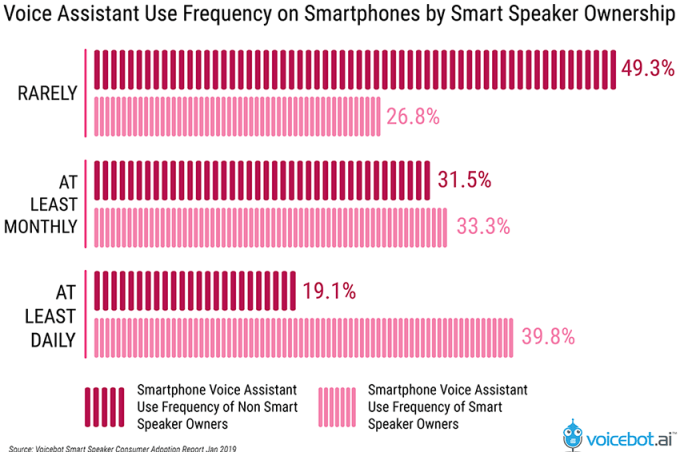
Voicebot’s report also saw how being able to access voice assistance on multiple platforms was helping to boost usage numbers.

It found that smart speaker owners used their smartphone’s voice assistant more than those who didn’t have a smart speaker in their home. It seems consumers get used to being able to access their voice assistants across platforms – now that Siri has made the jump to speakers and Alexa to phones, for instance.

The full report is available on Voicebot.ai’s website here.

08 Mar 2019

Foursquare’s Hypertrending helps you spy on the coolest local happenings

Ten years after the launch of Foursquare at SXSW, the company is laying its technology bare with a futuristic version of its old app that doesn’t require a check-in at all. The godfather of location apps is returning to the launchpad with Hypertrending, but this time it hopes to learn what developers might do with real-time info about where people are and where they aren’t.

Hypertrending uses Foursquare’s Pilgrim technology, which is baked into Foursquare’s apps and offered as an third-party enterprise tool, to show where phones are in real time over the course of SXSW in Austin, TX.

This information is relayed through dots on a map. The size of those dots is a reflection of the number of devices in that place at a given time. Users can filter the map by All places, Food, Nightlife, and Fun (events and parties).

Hypertrending also has a Top 100 list that is updated in real time to show which places are super popular, with arrows to show whether a place is trending up or down.

Before you throw up your hands in outrage, the information on Hypertrending is aggregated and anonymized (just like it is within Pilgrim), and there are no trails showing the phone’s route from one place to another. Dots only appear on the map when the phone arrives at a destination.

Hypertrending was cooked up in Foursquare’s skunkworks division, Foursquare Labs, led by the company’s cofounder Dennis Crowley .

The feature is only available during SXSW and in the Austin area, and thus far Foursquare has no plans to launch this publicly. So… what’s the deal?

First and foremost, Hypertrending is about showing off the technology. In many ways, Hypertrending isn’t new at all, in that it runs off of the Pilgrim technology that has powered Foursquare since around 2014.

Pilgrim is the tech that recognizes you’ve just sit down at a restaurant and offers up a tip about the menu on Foursquare City Guide, and it’s the same tech that notices you’ve just touched down in a new city and makes some recommendations on places to go. In Swarm, it’s the tech that offers up a list of all the places you’ve been in case you want to retroactively check in to them.

That sounds rather simple, but a combination of Foursquare’s 10 years worth of location data and Pilgrim’s hyper-precision is unparalleled when it comes to accuracy, according to Crowley.

Whereas other location tech might not understand the difference between you being in the cafe on the first floor or the salon on the second floor, or the bar that shares a wall with both, Pilgrim does.

This is what led Foursquare to build out the Pilgrim SDK, which now sees more than 100 million user-confirmed visits per month. Apps that use the Pilgrim SDK offer users the ability to opt-in to Foursquare’s always-on location tracking for its mobile app panel in the U.S., which has grown to 10 million devices.

These 10 million phones provide the data that powers Hypertrending.

Now, the data itself might not be new, per se. But Foursquare has never visualized the information quite like this, even for enterprise customers.

Whereas customers of the Foursquare Place Insights, Pinpoint and Attribution get snapshots into their own respective audiences, Hypertrending represents on a large scale just what Foursquare’s tech is capable of in not only knowing where people are, but where people aren’t.

This brings us back to SXSW, which happens to be the place where Foursquare first launched back in 2009.

“This week has felt a little nostalgic as we try to get this thing ready to go,” said Crowley. “It’s not that dissimilar to when we went to SXSW in 2009 and showed off Foursquare 1.0. There is this curious uncertainty and my whole thing is to get a sense of what people think of it.”

Crowley recalled his first trip to SXSW with cofounder Naveen Selvadurai. They couldn’t afford an actual pass to the show so they just went from party to party showing people the app and hearing what they thought. Crowley said that he doesn’t expect Hypertrending to be some huge consumer app.

“I want to show off what we can do with the technology and the data and hopefully inspire developers to do interesting stuff with this raw visualization of where phones are at,” said Crowley. “What would you do if you had access to this? Would you make something cool and fun or make something obnoxious and creepy?”

Beyond the common tie of SXSW, Hypertrending brings Foursquare’s story full circle in the fact that it’s potentially the most poignant example of what Crowley always wanted Foursquare to be. Location is one of the most powerful pieces of information about an individual. One’s physical location is, in many ways, the most purely truthful piece of information about them in a sea of digital clicks and scroll-bys.

If this data could be harnessed properly, without any work on the side of the consumer, what possibilities might open up?

“We’ve long talked about making ‘a check-in button you never had to press’,” said Crowley in the blog post. “Hypertrending is part of that vision realized, spread across multiple apps and services.”

Crowley also admits in the blog post that Hypertrending walks a fine line between creepy and cool, which is another reason for the ephemeral nature of the feature. It’s also the exact reason he wants to open it up to everyone.

From the blog post:

After 10 years, it’s clear that we (Foursquare!) are going to play a role in influencing how contextual-aware technologies shape the future – whether that’s apps that react to where you are and where you’ve been, smarter virtual assistants (e.g Alexa, Siri, Marsbot) that understand how you move through cities, or AR objects that need to appear at just the right time in just the right spot. We want to build a version of the future that we’re proud of, and we want your input as we get to work building it.

And…

We made Hypertrending to show people how Foursquare’s panel works in terms of what it can do (and what it will not do), as well as to show people how we as a company think about navigating this space. We feel the general trend with internet and technology companies these days has been to keep giving users a more and more personalized (albeit opaquely personalized) view of the world, while the companies that create these feeds keep the broad “God View” to themselves. Hypertrending is one example of how we can take Foursquare’s aggregate view of the world and make it available to the users who make it what it is. This is what we mean when we talk about “transparency” – we want to be honest, in public, about what our technology can do, how it works, and the specific design decisions we made in creating it.

We asked Crowley what would happen if brands and marketers loved the idea of Hypertrending, but general consumers were freaked out?

“This is an easy question,” said Crowley. “If this freaks people out, we don’t build stuff with it. We’re not ready for it yet. But I’d go back to the drawing board and ask ‘What do we learn from people that are freaked out about it that would helps us communicate to them’, or ‘what are the changes we could make to this that would make people comfortable’, or ‘what are the things we could build that would illustrate the value of this that this view didn’t communicate?'”

As mentioned above, Hypertrending is only available during the SXSW conference in the Austin area. Users can access Hypertrending through both the Foursquare City Guide app and Swarm by simply shaking their phone.