A blockchain-based mobile voting app called Voatz is getting put to the test again.
The city of Denver revealed today that it has agreed to implement a mobile voting pilot in its May municipal election using the four-year-old, Boston-based startup’s technology. It will be offered exclusively to active-duty military, their eligible dependents and overseas voters using their smartphones.
All were notified that they could use Voatz via a newsletter this morning, along with a link to sign up to participate if they so choose.
Voatz — which had raised $2.2 million in funding led by the venture arm of Overstock.com last year — says it has conducted more than 30 successful pilots already. Two of these in West Virginia attracted the financial backing of Tusk Philanthropies, the philanthropic operation of investor, operator, and strategist Bradley Tusk, who was featured last year in the New Yorker for his involvement in both efforts.
One was a small pilot project in West Virginia that gave overseas citizens and members of the military stationed abroad access to Voatz to cast ballots on their phones, though it was open only to residents of two counties. The technology was put to the test again in last November’s mid-term elections, in which nearly 150 people voted from 24 out of state’s 55 counties.
We talked with Tusk in early December about both efforts and about Voatz more generally, which Tusk hasn’t but whose mission of enabling more people to vote, more easily, he aggressively advocates. Though mobile voting, blockchain-based apps, and Voatz in particular have been criticized as potentially vulnerable to hacking, Tusk spent the first 20 years of his career in politics, and in his view, unless more people are empowered to “advocate politically” from their phones, politicians will continue to respond to the far smaller number of voters who actually show up at the polls.
Tusk also believes Voatz works, having hired outside examiners to assess the first West Virginia pilot, including Andre McGregor, a former F.B.I. cyber special agent who is now the global head of security for TLDR, a company that specializes in blockchain technology. It may explain why, in partnering with the city of Denver and the National Cybersecurity Center, a federal agency that was created as an office within the U.S. Department of Homeland Security back in 2008, Tusk Philanthropies again invited Voatz as a partner in Denver’s mobile voting endeavor. (A spokesperson for Tusk Philanthropies tells us that Colorado has also explored developing an open source mobile voting platform but that it simply doesn’t exist yet.)
Certainly, it’s conceivable that Voatz is no less secure than existing options for overseas military personnel, who often submit their votes via email. With Voatz, ballots are transmitted between up to 32 “permissioned” computers that have to agree algorithmically that a ballot is legitimate before it gets recorded and counted, and this only after a voter has been identified through numerous other steps. Among these: a voter must provide a phone number, an eight-digit pin, and submit a photo of his or her driver’s license. The voter must then they shoot and submit a video of their face, which is then processed by facial recognition technology that can confirm (or not confirm) that the face in the video belongs to the same person registered as a state voter.
To assuage any lingering concerns, the city of Denver will additionally conduct its own audit. Meanwhile, Tusk Philanthropies will work with a cybersecurity partner, ShiftState, to conduct an independent audit, in addition to the internal audit done by of Voatz.
The city of Denver says that 4,000 international voters are eligible to use the app.
Interestingly, despite the efficiencies Voatz promises, the voting process still won’t be an easy one. Fully 65 candidates have tossed their hats in the ring for public offices, according go the region’s city magazine, 5280. And while far-flung military personnel may be using a blockchain-based app, the placement of each mayoral candidate on the ballot is being determined in decidedly old-school fashion – – by drawing names out of a bingo ball turner.
It’s the FCC’s official duty to promote connectivity throughout the U.S., and as part of that it issues a yearly report on improvements to broadband deployment. The latest report, however, seems to contain an error large enough to throw its numbers completely off what Chairman Ajit Pai has already claimed. His office says that they are “looking into the matter.”
The information comes from advocacy organization Free Press, already a thorn in this administration’s side for having pointed out the highly questionable nature of economic claims used to justify the Commission’s new, weaker net neutrality rules.
In a comment (PDF) filed in the upcoming 2018 Broadband Deployment Report’s docket, the organization points out a single huge outlier that vastly, and incorrectly, inflates the numbers of new broadband connections in the country.
These official FCC documents are based on “Form 477” paperwork self-reporting broadband availability, submitted by internet providers abiding more or less by the honor system — which critics already point out is completely a inadequate one on which to base policy.
In the last batch of 477s was one from a company called BarrierFree, an ISP based in the Northeast that was submitting its data for the first time ever. Unfortunately there is a slight discrepancy between the numbers on its form and the numbers in reality.
As Free Press summarizes (very slightly modified for clarity; emphasis theirs):
[BarrierFree] claimed deployment of fiber-to-the-home (“FTTH”) and fixed wireless services (each at downstream/upstream speeds of 940 Mbps/880 Mbps) to Census blocks containing nearly 62 million persons. This claimed level of deployment would make BarrierFree the fourth largest U.S. ISP in terms of population coverage.
We further examined the underlying Form 477 data and discovered that BarrierFree appears to have simply submitted as its coverage area a list of every single Census block in each of eight states in which it claimed service: CT, DC, MD, NJ, NY, PA, RI, and VA.
Further investigation strongly suggests BarrierFree grossly misreported its deployment. BarrierFree claims to offer speed tiers topping out at 940 Mbps/880 Mbps in all of its blocks, using both fiber-to-the-home and fixed wireless services. This speed combination is unique to Verizon’s FiOS FTTH service, and Verizon is the only other 477 filer to claim such a speed tier. But according to BarrierFree’s own website, it does not market fiber-to-the-home service at any speed. Furthermore, the maximum advertised speed for its residential fixed wireless service is 25 Mbps symmetrical.
In other words the company claimed to have gigabit speeds going to 62 million people when really, it has 25 megabit speeds at best going to a few thousand. These enormous discrepancies seem to have heavily shifted national averages in the report.
In a statement to Ars Technica, which has followed the broadband report drama closely (including some good analysis last month), BarrierFree COO Jim Gerbig admitted that “There is indeed an error in the Form 477 filings for BarrierFree, and it doesn’t reflect our current level of broadband deployment. A portion of the submission was parsed incorrectly in the upload process.” He claims the government shutdown prevented correction of this issue.
Unfortunately, Chairman Pai, understandably excited to share good news on broadband, already bruited some statistics from the draft report that, if this massively erroneous form were excluded, would be totally incorrect — and incorrect in an unflattering way to the current administration.
Without BarrierFree’s phantom customers, nearly two million more people than reported lack access to fixed broadband – 21.3 versus 19.4 million in Pai’s press release. This is still well below the 26 million from the previous report, but it’s still a major correction. Of 5.6 million newly served rural broadband customers Pai highlights, 2 million were supposedly on BarrierFree.
And a huge reported increase to people on a sub-gigabit but high speed tier (250/50 Mbps) would have been largely attributable to these non-existent connections — tens of millions of them.
While there is surely good news to share from this report, it seems that the good news the Chairman chose to present may in fact not be nearly as good as he claimed.
Activists and government officials alike have questioned the accuracy of previous reports and warned that the incoming one was likely as untrustworthy as those that came before. But this massive single outlier seems like a new and much more avoidable form of inaccuracy.
It seems that in collating and analyzing the forms submitted by ISPs, it would ring a few alarm bells that an ISP with no presence in 2016 would suddenly be serving more than 60 million people with speeds only offered by decades-old competitors. The error is BarrierFree’s to begin with, of course, although I am suspicious of the “parsing” issue blamed by the COO. But surely spotting an error of that magnitude is the FCC’s responsibility.
When contacted for comment, a representative for Chairman Pai’s office said “we are looking into the matter.”
“Free Press’s allegations are troubling,” he said in a statement. “The FCC’s maps are frequently criticized for being inaccurate and overstating broadband coverage. The maps and deployment data are becoming a repeat offender.”
“Without getting to the bottom of this, the FCC should not proceed with its current draft broadband report. It is the FCC’s job to have accurate data and to make available maps based on it. Without performing that basic function, we are woefully unprepared to make a number of critical policy decisions that will impact the future of our communications infrastructure.”
Commissioner Jessica Rosenworcel, who has spoken out on the broadband report issue recently and been an outspoken critic of the FCC’s policies of late, also called for closer scrutiny:
“The FCC’s draft report concludes that broadband deployment is reasonable and timely across the country. This is hard to believe when millions of Americans have no high-speed service at home. Now there are allegations that the FCC’s numbers in this report may be based on faulty data,” she said in a statement. “This is not good. It absolutely deserves a closer look.”
While the publication of this report was hitherto expected daily, this issue seems likely to push it out by a few weeks at least — and, though it may be too much to hope — could cause the agency to question the basis on which it is built in the first place.
David Mayman has a vision for personal aviation that he’s spent the past dozen years and millions of his personal fortune chasing. He hasn’t accepted the convention that jetpacks were just a misguided fantasy for the future; his company, Jetpack Aviation, has been building them and he’s been zooming around in publicity-grabbing stunts in a plea to the public that there’s room to dream when it comes to human flight.
And while an eight-person startup aiming to build out a fleet of $380,000 “flying motorcycles” might seem like a tall order, Y Combinator, a top accelerator known for its occasionally bizarre bets, is gambling on the company and its jet engine-obsessed CEO in one of its latest investments.
Jetpack Aviation is about to become a very different company. The startup has launched pre-orders this week for the moonshot of moonshots, the Speeder, a personal vertical take-off and landing vehicle with a svelte concept design that looks straight out of Star Wars or Halo.
Deep-pocketed, sci-fi-minded buyers are going to have to fork over $10,000 just to get a spot in the pre-order line for the first vehicles to ship, but the startup’s founder seems to see the campaign as less about the money than it is about the confirmation that there are people interested in planting a stake in his wild company’s future success.
“I think it’s a validation statement for all of us,” Mayman tells TechCrunch.”If you look at how long Tesla took to deliver the Model 3 to customers, I think people understand that this is not something that’s a Kickstarted pre-delivery campaign where at the tail-end of it we’re immediately going to be delivering product.”
There are gambles and then there are flying motorcycles. This is frankly an atypical startup for YC to fund, but it is also an unconventional business path for Mayman’s who has largely been self-financing his jetpack-building obsession for the past 12 years. For the Australian CEO, the YC investment is mainly about gaining access to Silicon Valley’s network of VCs though he also acknowledges it’s a fair assumption that SF breeds the type of executive that might be interested in pre-ordering something so seemingly outlandish.
“I can’t imagine someone not being excited about a flying motorcycle,” YC Partner Jared Friedman told TechCrunch in an email. “Jetpack Aviation created the future with Speeder, and I look forward to seeing how this technology transforms the dreaded commute, vacation travel, and everyday errands.”
While much of the excitement Mayman has raised for his company’s jetpacks have relied on the spectacle of prototype demos in front of throngs of news networks (Jetpack Aviation has unsurprisingly partnered with Red Bull), the company has yet to build a full-scale prototype of the Speeder, though he says their new round of funding should get them there.
Mayman flying a jetpack around the Statue of Liberty in 2015.
Can they actually build this? That’s seems to be a pretty valid question.
In our conversation, Mayman acknowledges upfront that:
The Speeder is “at least” two years of development time away from ending up in customer hands.
The company will have to raise “tens of millions” of dollars to ship this design.
There are still plenty of unknowns.
Jetpack Aviation’s current design is more ambitious than most helicopter-shaped concept VTOL vehicles being pursued by companies like Uber, namely due to its relatively sleek design where the human rider is directly above a set of several gimbal-mounted jet engines.
The company claims finished designs will move faster than 150mph at altitudes up to 15,000 feet. The flight time is still a limiting factor, max flight times for the models are estimated to be around 30 minutes. The company is planning out a number of versions including an ultralight model that complies with some federal regulations and won’t require a pilot’s license, the company says.
The startup’s most pertinent problem is creating the autonomous stabilization technologies that will make flying the Speeder effortless and safe. Mayman notes that most VTOL designs look like quadcopters simply because the physics of putting weight directly on top of the thrust system is so challenging. “It’s like trying to balance a pencil on your finger,” he says.
His team has been training people to use their jetpacks –now in their 11th design iteration– and say it takes about a week to get potential flyers up-and-running with the particulars of the system. But Mayman says he wants this to be a device that just works, a design concept that made a lot of sense when Steve Jobs was using it to refer to the simplicity of the iPad, but feels a tad more aggressive when presented with the rendered images of someone flying this thing over city centers:
A lot of the industry’s existing work around autonomous flight and stabilization for drone aircraft really doesn’t account for Jetpack Aviation’s design, though Mayman says they’ve already made some significant progress with their 1:3 scale prototype. He also notes that the company does have a “less elegant-looking” plan-B design if they determine the centrally-clustered jet engines are too much of a stabilization liability.
Indeed, the key for getting a concept like this off-the-ground and ensuring the company doesn’t miserably fail is being flexible about how this vision matures, Mayman says, noting that they’re approaching the vehicle with multiple designs and multiple considerations for how the regulatory environment for certification shapes up, including work on a separate military version and consideration for designs more focused on emergency response like rapid medical evacuation.
Asked whether pre-orderers plunking down $10k might be disappointed by a different looking product, the founder said that they’ve done enough modeling to know that what they build will fall into a roughly similar design. “It may not look exactly like what we’ve rendered, but I’m confident that it’s still going to be the same sort of concept, a motorcycle or jet-ski size and shape.”
It is certainly a unique choice for the company to launch its pre-orders already with so much in the air, but it’s fairly apparent that they are looking to emulate Tesla here and if people with nearly $400k to throw around want to buy a jet-engine jet-ski, then by all means, let the free market do its thing.
Y Combinator’s $150,000 investment is an early step for the moonshot effort and a vote of confidence that places them on others’ radar. Mayman, for his part, does seem genuinely thrilled about expanding the ambitions of his passion project even if the road ahead is crowded with obstacles for realizing the vision.
“If you don’t start it, you’re never going to get there,” Mayman says. “If our guys weren’t able to wake up every morning saying, ‘Holy shit, this would be freaking amazing if we can build this,’ then it’s sort of not worth doing. We might as well go do something else.”
Melissa Kaufman is the executive director of The Garage at Northwestern. She is a former Googler, startup veteran and entrepreneur. She is a committee member of ChicagoNEXT, a member of P33 and a venture partner at Chicago Ventures.
Women in tech.
In addition to turning up nearly two billion Google search results, those three words are music to the ears of every informed CEO or human resources manager across the U.S. And while most executives are under pressure to portray and speak in the vernacular of diversity, there’s one slight problem.
Bridging the gender gap in tech starts long before a woman joins the workforce: it starts in the classroom.
When I studied computer science at Dartmouth, there were times when I was one of the only women in the classroom. This didn’t affect my studies or my ambition, but it was frustrating because I knew other women who were capable of being in those classes, but they felt like outsiders.
Whether it’s middle school, high school or college, the time young women spend in classrooms is formative — it’s where passions are ignited and life paths are plotted. Needless to say, bridging the gender gap in tech at this source is an imperative. But this isn’t about meeting quotas, sharing platitudes on social media and trumpeting hollow awards. Reversing the brogramming trend and cultivating a more diverse tech workforce requires a tangible, scalable model to see that idea come to fruition.
During my career at Google, I had my finger on the pulse of the tech industry and realized that a realistic plan to get more women into tech would be far different than what journalists and authors were talking about. As Whitney Wolfe, the CEO and founder of the dating app Bumble, pointed out, we don’t need to criticize the workplace — we need to criticize the classroom.
With that said, here are three essential strategies that educators must embrace to get to the root of gender imbalance in tech.
Mentorship is a must
Many undergraduate women are under the impression that getting their foot in the doors of tech companies necessitates more classes or more hard skills. These are helpful, but even more important for young women is having an actual human being who can help them navigate foreign territory.
Social media influencers and sugar-bomb self-help authors are not mentors.
Let’s be clear: Social media influencers and sugar-bomb self-help authors are not mentors. In order to have a lasting impact, mentors must formalize relationships with young women, not haphazardly come in to deliver rah-rah talks. That’s why we have Entrepreneurs-in-Residence at The Garage like Northwestern alumnae Lilia Kogan, a Chicago angel investor, for students to bounce ideas off of. This transparent access to another woman who has been in their shoes, and gone on to succeed, often gives them the extra nudge they need to go from idea to execution.
Less preaching, more opportunities
Simply telling a young woman, “You can do it!” or “We value diversity!” is a cop-out. Uprooting years of gender inequity in tech requires more than saccharine speeches and corporate platitudes. It requires giving young women not just permission, but tangible opportunities to experiment, build and explore.
For example, we launched the Propel Program at Northwestern, which provides grants of up to $1,000 for women students to experiment with their ideas. The six-month program allows students to demonstrate what they did with the funding and what they learned. The most engaged participants are invited to guide the following year’s participants, reinforcing the mentorship and community components.
Collaboration with women’s student organizations
Entering an environment in which you’re the minority can be discouraging, but if young women see their peers launching startups, writing code and leading teams, that confidence has a viral impact. Nearly every school has a variety of women’s student organizations, and uniting them under a common bond is far more effective than relying on them to do so alone.
In 2015, only 25 percent of students incubating startups in The Garage were women. But once we partnered with groups on campus like The Society of Women Engineers and Women in Business, we saw a spike in women. Today, half of our student-founders are women.
Sure, “strength in numbers” sounds cliché, but camaraderie has profound psychological benefits that can inspire people, especially young women, to break through barriers. Getting more women into innovative environments is no exception.
Why are these steps so important? Because diverse teams — especially in tech — are unequivocally better equipped to solve problems and ultimately give organizations a competitive advantage. It’s just that simple.
If we want to get serious about reversing the brogramming trend, we have to go beyond quotas or playing the blame game with history, companies and “the system.” Instead, we must connect with young women early on, through mentorship, tangible opportunities and communities in which they can thrive.
It’s not a great time to be a live venue. Once the only game in town, clubs, arenas and other live event spaces now have to compete with the seemingly endless on-demand entertainment options. Competing with the convenience of 4K Netflix on a 50-inch screen is a big ask, even for the biggest stars.
It’s a perfect market opening for a startups. A technology company that can sufficiently augment the live experience for a connected audience stands to make a lot of money outfitting venues and touring acts. It’s no wonder the category has gotten crowded in recent years, with a number of players looking to bring personalized augmented audio experiences to concertgoers.
London-based Peex has risen in the ranks quickly, courtesy of one prominent celebrity endorsement: Last year, the company announced that Sir Elton John’s Farewell Yellow Brick would be the first tour to publicly utilize its technology. It’s a bit of a baptism by fire for the startup.
Granted, Peex’s headsets will only be available in limited quantities to attendees who opt into the VIP package for the show, but live music events don’t get much higher-stakes than the farewell tour for one of the most beloved entertainers of the 20th century.
The value proposition, meanwhile, is pretty simple. Live music is tough. Even the most technologically sophisticated venues find it impossible to deliver the perfect music mix to every seat in the house. The idea of attempting to accomplish that for a capacity of 20,000 boggles the mind, even for a crew like the folks at Madison Square Garden.
The company was on hand at last night’s show. It was John’s 70th — and for now, at least, final — appearance at the legendary venue. To prep for the event, Peex set up four transmitters in the arena, primarily on lighting rigs. The whole process takes about a day and offers enough coverage to fill the whole space — an impressive feat in and of itself.
Backstage, there’s a small (in MSG terms, at least) production setup, including a mixing board that separates the live show’s feed into five channels. Upon entry, VIPs are handed the RX, a device that sits around the neck. There’s a large disc up front and two headphone cables that dangle down on either side. It’s a little strange and a bit dorky — as the company ushered us backstage before the show, I overhead some bystanders rightfully wondering aloud what were the things around our necks?
Wearers must download the Peex app to an iOS or Android device for the full experience. The handset is paired to the device via Bluetooth. From there, users customize the listening experience on a per-channel basis. Generally that’s broken down by instrument — of course, things get a bit more complicated with larger bands, so the artists get the final say.
For the case of John’s band, the channels were vocals/keyboards (John), guitar, bass, second keyboard and percussion/drums (which incorporated three musicians). As the music plays, users can adjust the different channels with the five graphic sliders on the app.
The experience was responsive, though I ran into issues with the app. It ended up crashing a few times, even while the connection remained constant with the headset. Some early bugginess is to be forgiven for what is essentially a very public beta. The company’s CEO David Johnson, who walked us through the process, noted that there may have been some issue with the fact that I brought an S10 to the show. The unreleased Samsung is still untested with the program. Fair enough.
The tech is impressive overall here. I couldn’t detect any latency between the performers and the headphones. Johnson noted that the tech is designed to augment the live audio, rather than replace it. As such, the headphones don’t offer much of a buffer with the ambient noise in the venue, but on a whole, the two tend to complement each other fairly well.
One of the perks of getting access to the show through Peex was some stupidly good seats — 11th row, center to be exact. Sir Elton was within sweating distance for the 2.5-hour performance. That’s great from the standpoint of seeing a rock and roll show, but I’ve got the sneaking suspicion it’s not the ideal case use for the product. That’s arguably the part of the venue that least needs augmentation. Freaking Michael Stipe was sitting two seats away, enjoying the hell out of the show without a headset — and I generally trust that dude’s opinions on live music.
For the first time in forever, I had to eschew the earplugs in order to get the full Peex experience. I found myself upping the volume in order to isolate elements of the music above the ambient sound. When we headed to the lobby mid-set, I was a bit shocked to hear how loud my headphones had gradually gotten. I would never listen to music on headphones at that volume outside of a venue.
That’s going to be a tough nut for the company to crack, as awareness about hearing loss becomes an increasingly important issue among aging show-goers. Johnson notes that the Peex wearable has an aux input where people can plug in their own third-party headphones, so if you have ones that effectively seal out ambient noise, that’s certainly an option — albeit an imperfect one.
At one point during the set we were ushered up to the MSG nosebleeds. Here the effect is far more pronounced. I got a couple of breaks in my audio stream, like an FM radio being subjected to a tunnel, but it was mostly good and definitely clear. Certain elements like acoustic guitar, which are traditionally buried in the mix, were able to shine.
This, I think is the value proposition for the company, but it’s going to be a tough one to balance. Peex plans to announce a number of venue and artist partners soon, as it begins to offer the service to the public. But the company is primarily going after a small share of the overall audience with its rental devices.
For the time being, it will be open to VIP attendees, who will be charged a relatively small fee to hold onto the device for the night. But aside from those who are far away from the source in luxury boxes, this is the chunk of the audience who requires this technology the least.
From that perspective, at least, it might be tough to compete with a company like MIXhalo, which brings their technology to the smartphone without the need for a secondary hardware product. One of the things a company like Peex does have going for it versus a MIXhalo, however, is the relatively scalability of a product that operates a lot like an encrypted form of FM radio.
There’s also another important stigma both companies face. This was made painfully clear to me about three-fourths of the way through last night’s set, when John pleaded with audience members to “put down the social media for one fucking second.” At that precise moment, I had a pair of headphones in my ears, while looking down at my mini Android mixing board.
It’s true that John and any other artist participating will have to opt in to the service, but it’s hard to fight the feeling that this is a sort of slippery slope when it comes to experiencing the world through our mobile devices. In some ways products like Peex and MIXhalo bring you closer to the source by effectively plugging you directly into the soundboard.
At the same time, however, it can feel like the aural equivalent of the dude a few rows ahead of me, who busted out his phone to FaceTime the show to some family member back home. Sometimes you’ve just got to pull out the headphones and live in the moment.
We’re excited to announce that iRobot co-founder and CEO Colin Angle will be joining us on stage in April.
Angle co-founded iRobot 28 years ago, alongside fellow roboticist Rodney Brooks and Helen Greiner. In 2002, the company struck robotics gold with the launch of the first Roomba. The device became the first truly successful home robot and has since gone on to become the best selling vacuum in the U.S.
Earlier this year, iRobot announced the upcoming release of Terra, the company’s first venture into lawn care. Angle will join us to discuss the creation of a home robotics ecosystem and the ten years of research and development that went into creating its new lawnmower.
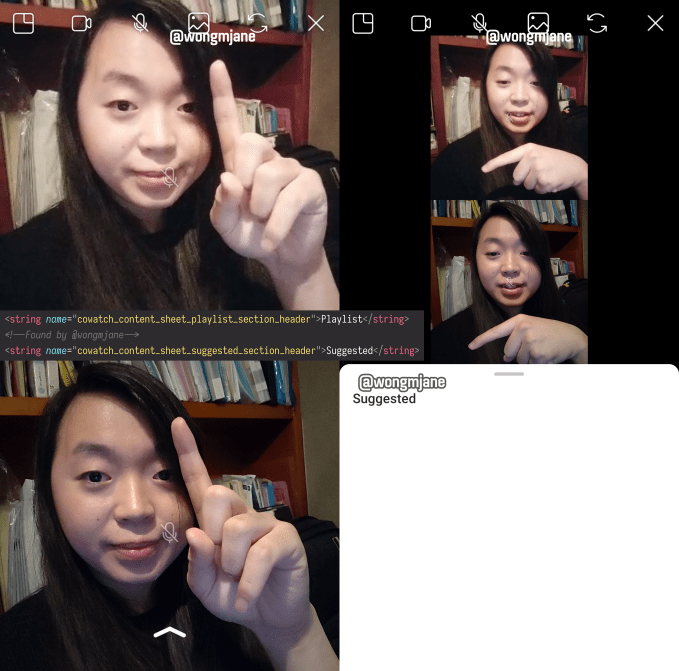
The next phase of social media is about hanging out together while apart. Rather than performing on a live stream or engaging with a video chat, Instagram may allow you to chill and watch videos together with a friend. Facebook already has Watch Party for group co-viewing and in November we broke the news that Facebook Messenger’s code contains an unreleased “Watch Videos Together” feature. Now Instagram’s code reveals a “co-watch content” feature hidden inside Instagram Direct Messaging.
It’s unclear what users might be able to watch simultaneously, but the feature could give IGTV a much-needed boost, or just let you laugh and cringe at Instagram feed videos and Stories. But either way, co-viewing could make you see more ads, drive more attention to creators that will win Instagram their favor, or just make you rack up time spent on the app without forcing you to create anything.
The Instagram co-watch code was discovered by TechCrunch’s favorite tipster and reverse engineering specialist Jane Manchun Wong, who previously spotted the Messenger Watch Together code. Her past findings include Instagram’s video calling, music soundtracks, and Time Well Spent dashboard months before they were officially released. The code mentions that you can “cowatch content” that comes from a “Playlist” similar to the queues of videos Facebook Watch Party admins can tee up. Users could also check out “Suggested” videos from Instagram, which would give it a new way to promote creators or spawn a zeitgeist moment around a video. It’s not certain whether users will be able to appear picture-in-picture while watching so friends can see their reactions, but that would surely be more fun.
Instagram declined to comment on the findings, which is typically of the company when a feature has been prototyped internally but hasn’t begun externally testing with users. At this stage, products can still get scrapped or take many months or even over a year to launch. But given Facebook’s philosophical intention to demote mindless viewing and promote active conversation around videos, Instagram co-watching is a sensible direction.
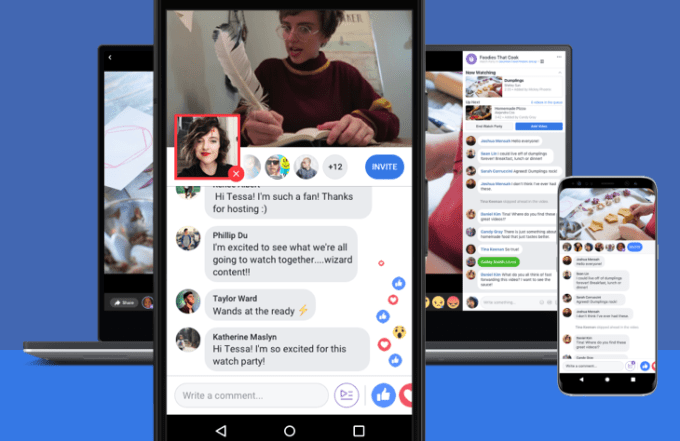
Facebook launched Watch Party to this end back in July and by November, 12 million had been started from Groups and they generated 8X more comments than non-synced or Live videos. That proves co-watching can make video feel less isolating. That’s important as startups like Houseparty group video chatrooms and Squad screenshare messaging try to nip at Insta’s heels.
It’s also another sign that following the departure of the Instagram founders, Facebook has been standardizing features across its apps, eroding their distinct identities. Mark Zuckerberg plans to unify the backend of Facebook Messenger, WhatsApp, and Instagram to allow cross-app messaging. But Instagram has always been Facebook’s content-first app, so while Watch Party might have been built for Facebook Groups, Instagram could be where it hits its stride.
Speaking of the Instagram founders Kevin Systrom and Mike Krieger, this article’s author Josh Constine will be interviewing them on Monday 3/11 at SXSW. Come see them at 2pm in the Austin Convention Center’s Ballroom D to hear about their thoughts on the creator economy, why they left Facebook, and what they’ll do next. Check out the rest of TechCrunch’s SXSW panels here, and RSVP for our party on Sunday.
After indicating that it was exploring its options for fighting the potentially deadly rise of anti-vaccination content on its platform last month, Facebook is making a plan of attack.
Facebook’s strategy in the effort is to both minimize the spread of vaccination misinformation and to point users away from inaccurate anti-vaccination propaganda and toward “authoritative information” i.e. info corroborated by the health and scientific establishment.
To achieve a reduction in the spread of anti-vax propaganda, Facebook will downrank groups and pages that spread this kind of content across both News Feed and its search function. Facebook will also reject ads promoting anti-vaccination misinformation. Repeat offenders attempting to promote this content through ads may see their accounts disabled. On Instagram, Facebook “won’t show or recommend content that contains misinformation about vaccinations on Instagram Explore or hashtag pages,” effectively burying that content from public-facing spaces. Facebook noted that it would also remove anti-vax adjacent ad targeting descriptors including the term “vaccine controversies.”
Facebook’s role in the rise of anti-vaccination or “anti-vax” conspiracy theories came into the spotlight last month. In light of reporting pointing to the responsibility of Facebook and YouTube in spreading this particularly dangerous form of misinformation, prominent California Rep. Adam Schiff wrote to the two companies demanding “additional information on the steps that you currently take to provide medically accurate information on vaccinations to your users.”
Last month, Bloomberg reported that Facebook was “exploring additional measures to best combat the problem” including “reducing or removing this type of content from recommendations, including Groups You Should Join, and demoting it in search results, while also ensuring that higher quality and more authoritative information is available.”
Like other dangerous forms of online disinformation, the prevalence of anti-vax content has destructive real world implications. The U.S. is currently experiencing an outbreak of measles, an entirely preventable infectious disease that is threatening the health of children and vulnerable populations and creating broad school closures in places like Clark County, Washington.
When Facebook directs its attention toward reducing the public spread of a particular strain of conspiracy theory or otherwise pernicious content, it tends to do a pretty thorough job. The problem of course is that such efforts from Facebook and other major tech platforms remain reactionary rather than proactive, meaning that Facebook’s next major outbreak of harmful, even deadly algorithmically-fueled disinformation is likely just around the corner.
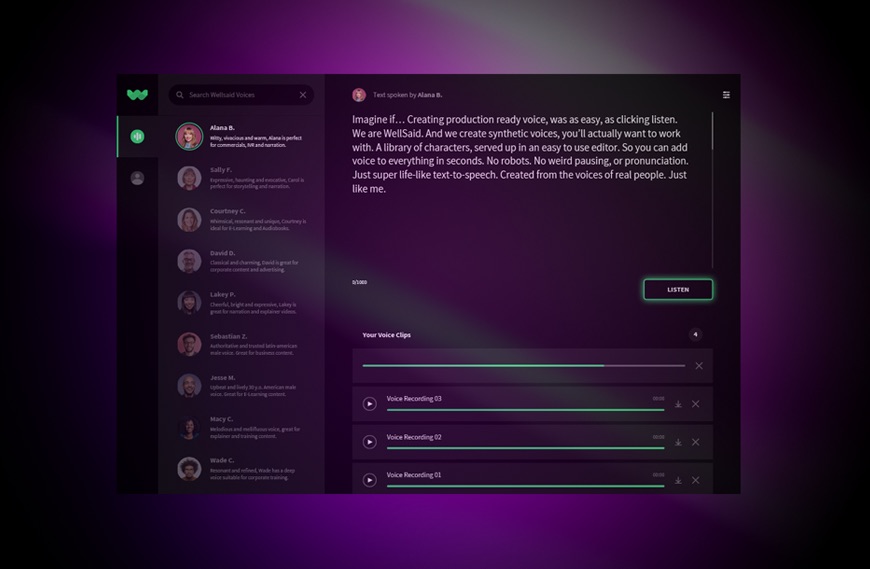
Many things are better said than read, but the best voice tech out there seems to be reserved for virtual assistants, not screen readers or automatically generated audiobooks. WellSaid wants to enable any creator to use quality synthetic speech instead of a human voice — perhaps even a synthetic version of themselves.
There’s been a series of major advances in voice synthesis over the last couple years as neural network technology improves on the old highly manual approach. But Google, Apple, and Amazon seem unwilling to make their great voice tech available for anything but chirps from your phone or home hub.
As soon as I heard about WaveNet, and later Tacotron, I tried to contact the team at Google to ask when they’d get to work producing natural-sounding audiobooks for everything on Google Books, or as a part of AMP, or make it an accessibility service, and so on. Never heard back. I considered this a lost opportunity, since there are many out there who need such a service.
So I was pleased to hear that WellSaid is taking on this market, after a fashion anyway. The company is the first to launch from the Allen Institute for AI (AI2) incubator program announced back in 2017. They do take their time!
I talked with the co-founders CEO Matt Hocking and CTO Michael Petrochuk, who explained why they went about creating a whole new system for voice synthesis. The basic problem, they said, is that existing systems not only rely on a lot of human annotation to sound right, but they “sound right” the exact same way every time. You can’t just feed it a few hours of audio and hope it figures out how to inflect questions or pause between list items — much of this stuff has to be spelled out for them. The end result, however, is highly efficient.
“Their goal is to make a small model for cheap [i.e. computationally] that pronounces things the same way every time. It’s this one perfect voice,” said Petrochuk. “We took research like Tacotron and pushed it even further — but we’re not trying to control speech and enforce this arbitrary structure on it.”
“When you think about the human voice, what makes natural, kind of, is the inconsistencies,” said Hocking.
And where better to find inconsistencies than in humans? The team worked with a handful of voice actors to record dozens of hours of audio to feed to the system. There’s no need to annotate the text with “speech markup language” to designate parts of sentences and so on, Petrochuk said: “We discovered how to train off of raw audiobook data, without having to do anything on top of that.”
So WellSaid’s model will often pronounce the same word differently, not because a carefully manicured manual model of language suggested it do so, but because the person whose vocal fingerprint it is imitating did so.
And how does that work, exactly? That question seems to dip into WellSaid’s secret sauce. Their model, like any deep learning system, is taking innumerable inputs into account and producing an output, but it is larger and more far-reaching than other voice synthesis systems. Things like cadence and pronunciation aren’t specified by its overseers but extracted from the audio and modeled in real time. Sounds a bit like magic, but that’s often the case when it comes to bleeding-edge AI research.
It runs on a CPU in real time, not on a GPU cluster somewhere, so it can be done offline as well. This is a feat in itself, since many voice synthesis algorithms are quite resource-heavy.
What matters is that the voice produced can speak any text in a very natural sounding way. Here’s the first bit of an article — alas, not one of mine, which would have employed more mellifluous circumlocutions — read by Google’s WaveNet, then by two of WellSaid’s voices.
The latter two are definitely more natural sounding than the first. On some phrases the voices may be nearly indistinguishable from their originals, but in most cases I feel sure I could pick out the synthetic voice in a few words.
That it’s even close, however, is an accomplishment. And I can certainly say that if I was going to have an article read to my by one of these voices, it would be WellSaid’s. Naturally it can also be tweaked and iterated, or effects applied to further manipulate the sound, as with any voice performance. You did’t think those interviews you hear on NPR are unedited, did you?
The goal at first is to find the creatives whose work would be improved or eased by adding this tool to their toolbox.
“There are a lot of people who have this need,” explained Hocking. “A video producer who doesn’t have the budget to hire a voice actor; someone with a large volume of content that has to be iterated on rapidly; if English is a second language, this opens up a lot of doors; and some people just don’t have a voice for radio.”
It would be nice to be able to add voice with a click rather than just have block text and royalty-free music over a social ad (think the admen):
I asked about the reception among voice actors, who of course are essentially being asked to train their own replacements. They said that the actors were actually positive about it, thinking of it as something like stock photography for voice; get a premade product for cheap, and if you like it, pay the creator for the real thing. Although they didn’t want to prematurely lock themselves into future business models, they did acknowledge that revenue share with voice actors was a possibility. Payment for virtual representations is something of a new and evolving field.
A closed beta launches today, which you can sign up for at the company’s site. They’re going to be launching with five voices to start, with more voices and options to come as WellSaid’s place in the market becomes clear. Part of that process will almost certainly be inclusion in tools used by the blind or otherwise disabled, as I have been hoping for years.
Sounds familiar
And what comes after that? Making synthetic versions of users’ voices, of course. No brainer! But the two founders cautioned that’s a ways off for several reasons, even though it’s very much a possibility.
“Right now we’re using about 20 hours of data per person, but we see a future where we can get it down to 1 or 2 hours while maintaining a premium lifelike quality to the voice,” said Petrochuk.
“And we can build off existing datasets, like where someone has a back catalog of content,” added Hocking.
The trouble is that the content may not be exactly right for training the deep learning model, which advanced as it is can no doubt be finicky. There are dials and knobs to tweak, of course, but they said that fine-tuning a voice is more a matter of adding corrective speech, perhaps having the voice actor reading a specific script that props up the sounds or cadences that need a boost.
They compared it with directing such an actor rather than adjusting code. You don’t, after all, tell an actor to increase the pauses after commas by 8 percent or 15 milliseconds, whichever is longer. It’s more efficient to demonstrate for them: “say it like this.”
Even so getting the quality just right with limited and imperfect training data is a challenge that will take some serious work if and when the team decides to take it on.
But as some of you may have noticed, there are also some parallels to the unsavory world of “deepfakes.” Download a dozen podcasts or speeches and you’ve got enough material to make a passable replica of someone’s voice, perhaps a public figure. This of course has a worrying synergy with the existing ability to fake video and other imagery.
This is not news to Hocking and Petrochuk. If you work in AI this kind of thing is sort of inevitable.
“This is a super important question and we’ve considered it a lot,” said Petrochuk. “We come from AI2, where the motto is ‘AI for the common good.’ That’s something we really subscribe to, and that differentiates us from our competitors who made Barack Obama voices before they even had an MVP [minimum viable product]. We’re going to watch closely to make sure this isn’t being used negatively, and we’re not launching with the ability to make a custom voice, because that would let anyone create a voice from anyone.”
Active monitoring is just about all anyone with a potentially troubling AI technology can be expected to do — though they are looking at mitigation techniques that could help identify synthetic voices.
With the ongoing emphasis on multimedia presentation of content and advertising rather than written, WellSaid seems poised to make an early play in a growing market. As the product evolves and improves, it’s easy to picture it moving into new, more constrained spaces, like time-shifting apps (instant podcast with 5 voices to choose from!) and even taking over territory currently claimed by voice assistants. Sounds good to me.
Is it happening? Is it not happening? After years of back and forth, it looks like the new tax on tech giants in France is about to become a law. Big tech companies that generate significant revenue in France will be taxed on their revenue generated in France.
France’s Economy Minister Bruno Le Maire has been lobbying for a new tax so that tech giants would stop optimizing their European corporate structure to lower their effective tax rate. Originally, Le Maire wanted to convince other European countries to get on board.
But you need a unanimous vote when it comes to tax reforms in Europe. And Le Maire couldn’t convince everyone.
Le Maire still wanted to do something. So here we are, with a new tax on tech companies that generate over €750 million in revenue globally and €25 million in France.
If you’re operating a marketplace (Amazon’s marketplace, Uber, Airbnb…) or an advertising business (Facebook, Google, Criteo…), you will have to pay 3 percent of your French revenue in taxes. The government says that it isn’t against American companies as European and Asian companies are also about to get taxed.
It’s a weird taxation model as it is based on revenue and not profit. It’ll also require some work from the taxation administration as French revenue means that it involves all transactions with somebody with a French mailing address or a French IP address. France expects to generate €400 million in revenue with this new tax in 2019.
I’ve been talking about this new tax with people in the French tech ecosystem and they think it’s a publicity stunt more than anything else. The OECD has been working on a way to properly tax tech companies with a standardized set of rules.
It could still take a couple of years, but it would be based on profit and it would clarify the situation across dozens of countries. It would replace today’s new tax.
Don’t get me wrong. Taxing tech giants is important and tech companies have been fined for tax avoidance for too many years. But this feels a bit rushed.