Author: azeeadmin

02 Mar 2019

Facebook sues four Chinese companies over trademark infringement

Facebook is taking legal action against a cluster of Chinese websites that sell fake accounts, likes and followers both on Facebook itself and on Instagram. The company announced the legal action in a short blog post late Friday afternoon (a move unusual enough to pique our curiosity a little). Of course, the fact that Facebook isn’t allowed in China might be a complexifier, in Bezos-speak.

The lawsuit, filed with the Northern District of California, alleges that starting in 2017 four Chinese companies and three individuals based in China “operated a series of websites promoting the sale of fake accounts (e.g. using fake names or other false identifiers) and inauthentic accounts (e.g. used for inauthentic activity),” infringing on Facebook and Instagram’s trademarks and terms of service in the process.

The lawsuit names Xiu Network Science and Technology Company, Xiu Feishu Science and Technology Company, Xiufei Book Technology Co., Home Network (Fujian) Technology Co., Ltd. and three people affiliated with those operations. TechCrunch reached out to Facebook for clarification about the scope of the fraudulent activity and the reason behind its decision to escalate these concerns, though didn’t receive much clarification.

Trademark infringement is certainly nothing new for the biggest social network on the planet, so our guess is that the activity must have been on a fairly large scale to attract Facebook’s legal ire. The company is asking for $100,000 in damages each for six websites it lists in the complaint for trademark infringement, terms of service violations and cybersquatting domains using its name. At the time of writing, the domains in question mostly still appeared online and operational — another factor that may have contributed to Facebook’s choice to pursue legal action. Some of the websites also sell accounts for services from Google, Twitter other American tech companies.

As Facebook notes in the filing, “According to their websites, these Defendants… engage in the registration and sale of accounts, in bulk, for various social networking sites.” When we looked into one of the websites, 9xiufacebook.com, we found that most people discovered it through a Chinese web search for “Facebook account purchase.”

The court filing is embedded below.

02 Mar 2019

NEA is raising its biggest fund ever – – again

New Enterprise Associates, the 41-year-old venture firm with offices in Menlo Park; San Francisco; Boston; New York; Chevy Chase, Md.; and Washington, D.C., is raising its biggest fund ever, shows a new SEC filing that shows target of $3.6 billion.

The fund, its seventeenth, is just slightly bigger than the $3.3 billion fund the firm closed in 2017, which was its biggest fund at the time. Indeed, NEA has been known for many years for raising among the biggest funds in the industry, though these once brow-raising amounts have become somewhat less remarkable in a world where venture firms routinely close on record-breaking amounts of capital.

It wasn’t always that way. NEA closed its very first fund with $16 million in 1978. It has since come to manage more than $18 billion in assets altogether.

The filing lists the firm’s 10 general partners, including Scott Sandell, who became the sole managing general partner of NEA in 2017. The other nine include Forest Baskett, Tony Florence, Mo Makhzoumi, Joshua Makower, David Mott, Pete Sonsini, and Paul Walker, along with Carmen Chang, who heads up the firm’s Asia practice and was promoted to GP last year, and Ali Behbahani, a healthcare investor who was also promoted to GP last year.

NEA, which has both a giant technology and healthcare practice, also has a vast network of partners, including Jonathan Golden, a former director of product at Airbnb who joined the firm last summer and who joined us for TC’s “Equity” podcast just yesterday.

Unlike some firms that have had something of a star system at various points of their firm’s history – – think Jim Breyer during an earlier era at Accel or the celebrity that John Doerr of Kleiner Perkins long enjoyed —  NEA has always operated in a less public-facing way despite its immense reach into the startup industry. According to Pitchbook, it has made more than 2,100 investments over the last four decades and has 431 active portfolio companies.

In February alone, its portfolio company ThirdLove, the lingerie maker, announced $55 million in fresh funding. NEA also joined the $93 million Series B round for Oyster Point Pharma, a 3.5-year-old, Princeton, N.J.-based clinical-stage pharmaceutical company with an initial focus on developing novel therapies to treat dry eyes. And it wrote a follow-on check to Databricks, a 5.5-year-old, San Francisco-based company founded by the original team behind the Apache Spark big data analytics engine, which closed on $250 million in Series E funding.

NEA completed a spinout of a new fund called NewView Capital last year, closing it with $1.35 billion, including from Goldman Sachs and the fund of funds firm Hamilton Lane.

As of early December, the firm — which is being led by former NEA general partner Ravi Viswanathan — held stakes in 31 of NEA’s late-stage portfolio companies that aren’t ready to go public or exit but that NEA wanted to find a way to continue supporting while also providing some liquidity to its investors. TC has more on that effort here.

02 Mar 2019

Ava Duvernay releases the first trailer for her Netflix series about the Central Park Five

Celebrated director Ava DuVernay has released a harrowing first teaser trailer for her highly anticipated Netflix series about the Central Park rape case from the 1980s.

The true story of the five African American and Hispanic teens who were wrongfully accused and convicted of the rape of a jogger in Central Park made headlines in 1989 in the wake of the attack and over the course of the subsequent trial.

Now, with When They See Us, DuVernay will tell the stories of Anton McCray, Kevin Richardson, Yusef Salaam, Raymond Santana and Korey Wise, who were accused of the rape and assault of Trisha Ellen Meili in the spring of 1989.

In development since 2017, the five-part series will cover the 25 years from their trial and conviction to their exoneration and the $41 million settlement they received from New York City.

The cast for the Netflix series includes Vera Farmiga, Felicity Huffman, John Leguizamo, Niecy Nash, and Michelle Williams. Producers on the show include Oprah Winfrey and Robert De Niro.

02 Mar 2019

Koala-sensing drone helps keep tabs on drop bear numbers

It’s obviously important to Australians to make sure their koala population is closely tracked — but how can you do so when the suckers live in forests and climb trees all the time? With drones and AI, of course.

A new project from Queensland University of Technology combines some well-known techniques in a new way to help keep an eye on wild populations of the famous and soft marsupials. They used a drone equipped with a heat-sensing camera, then ran the footage through a deep learning model trained to look for koala-like heat signatures.

It’s similar in some ways to an earlier project from QUT in which dugongs — endangered sea cows — were counted along the shore via aerial imagery and machine learning. But this is considerably harder.

A koala.

“A seal on a beach is a very different thing to a koala in a tree,” said study co-author Grant Hamilton in a news release, perhaps choosing not to use dugongs as an example because comparatively few know what one is.

“The complexity is part of the science here, which is really exciting,” he continued. “This is not just somebody counting animals with a drone, we’ve managed to do it in a very complex environment.”

The team sent their drone out in the early morning, when they expected to see the greatest contrast between the temperature of the air (cool) and tree-bound koalas (warm and furry). It traveled as if it was a lawnmower trimming the tops of the trees, collecting data from a large area.

Infrared image, left, and output of the neural network highlighting areas of interest.

This footage was then put through a deep learning system trained to recognize the size and intensity of the heat put out by a koala, while ignoring other objects and animals like cars and kangaroos.

For these initial tests, the accuracy of the system was checked by comparing the inferred koala locations with ground truth measurements provided by GPS units on some animals and radio tags on others. Turns out the system found about 86 percent of the koalas in a given area, considerably better than an “expert koala spotter,” who rates about a 70. Not only that, but it’s a whole lot quicker.

“We cover in a couple of hours what it would take a human all day to do,” Hamilton said. But it won’t replace human spotters or ground teams. “There are places that people can’t go and there are places that drones can’t go. There are advantages and downsides to each one of these techniques, and we need to figure out the best way to put them all together. Koalas are facing extinction in large areas, and so are many other species, and there is no silver bullet.”

Having tested the system in one area of Queensland, the team is now going to head out and try it in other areas of the coast. Other classifiers are planned to be added as well, so other endangered or invasive species can be identified with similar ease.

Their paper was published today in the journal Nature Scientific Reports.

01 Mar 2019

WeWork confirms it has laid off 300 employees

Co-working juggernaut WeWork (now known as the We Company) has laid-off 3 percent of its global workforce or roughly 300 employees, the company told TechCrunch. The heavily-funded business, most recently valued at a whopping $47 billion, employs 10,000 people around the world.

Headquartered in New York, the lay-offs were performance-related, part of the company’s perfunctory process of shedding dead weight. Among the departments impacted by the cuts were WeWork’s engineering team, product and user experience design.

“Over the past nine years, WeWork has grown into one of the largest global physical networks thanks to the hard work and dedication of our team,” the company said in a statement provided to TechCrunch. “WeWork recently conducted a standard annual performance review process. Our global workforce is now more than 10,000 strong, and we remain committed to continuing to grow and scale in 2019, including hiring an additional 6,000 employees.”

WeWork has raised more than $8 billion in venture capital funding since it emerged to disrupt office-sharing. The business is backed significantly by the SoftBank Vision Fund, which invested $2 billion in WeWork as recently as January.

01 Mar 2019

Alpha, the geek-friendly streaming service from Nerdist and Geek & Sundry, is shutting down

Another overly niche streaming service is closing up shop. On Friday, Alpha – a geek-friendly streaming service that focused on TV, pop-culture, sci-fi, comics, video games and more – announced it was shutting down. The subscription-based streaming service had been a joint venture between Nerdist and Geek & Sundry, and offered $4.99-per-month access to a mix of exclusive original content and other fan favorites from both brands.

Launched in 2016 by Legendary Digital Networks, the company had claimed a year ago it had a “six-figure” subscriber base that had grown by 200 percent over the past year. But even then, its potential reach would have remained small – Nerdist and Geek & Sundry combined had 8 million monthly uniques. Only a fraction of that audience would have likely converted to paying customers.

The company says today Alpha customers watched a cumulative 600 million minutes.

In an announcement to subscribers, the company said Alpha will no longer be active as of March 31, 2019. As of today, it will no longer accept subscriptions and renewals. However, existing subscribers can continue to watch until the end.

Some of the service’s content will move to Twitch, while others will become VOD (video on demand.)

“This is the end of an era that we will remember fondly, but it’s also the beginning of a future where more of the premium Nerdist and Geek & Sundry content featured on Alpha will be available to more viewers than ever,” the company wrote in an email to subscribers.

The decision to close up Alpha appears to have been fairly recent. In August 2018, the company acquired a sci-fi drama “Sona” starring Ashley Clements for the service, and commissioned a new sci-fi series “Orbital Redux” which was to be streamed live, as a twist to get viewers to watch.

But at the end of the day, there’s a lot of competition for consumers’ dollars on the wider streaming market, and plenty of bingeable sci-fi and pop culture content to be found elsewhere.

The full email to subscribers is below:

Dear Valued Alpha Member,

We regret to announce that effective March 31, 2019, we will be closing Alpha. All of us at Nerdist and Geek & Sundry are so thankful to you for being a part of this amazing community. Since Alpha launched in November of 2016, we have watched over 600 million minutes of content together. We’ve laughed. We’ve cried. We’ve GIFed. And we’ve cherished the friendships we’ve made. And while Alpha is going away, we have some exciting news to share.

First things first, starting today, new subscriptions/renewals will no longer be accepted, however all accounts that are active on March 1, 2019, will continue to be active until the service closes. If you have remaining months on an annual subscription after March 31, 2019, we will refund any prepaid amounts on a prorate basis to your payment method on file.

But here’s the good news! As part of an ongoing partnership with Twitch, the library of Alpha content will be streamed to the Twitch platform effective immediately. Some titles are already being shown on the Geek & Sundry Twitch Channel, and episodes that have been streamed will remain viewable as VODs to subscribers. We would love for you to come join us on Twitch, so we can continue entertaining each other. Don’t worry. If you’re not already a Twitch account-holder, signing up is a breeze!

This is the end of an era that we will remember fondly, but it’s also the beginning of a future where more of the premium Nerdist and Geek & Sundry content featured on Alpha will be available to more viewers than ever.

Thanks for coming along with us on this continuing adventure.

Your Friends at Alpha


01 Mar 2019

Rackspace announces it has laid off 200 workers

Rackspace, the hosted private cloud vendor, let go around 200 workers or 3 percent of its worldwide workforce of 6600 employees this week. The company says that it’s part of a recalibration where it is trying to find workers who are better suited to their current business approach.

A Rackspace spokesperson told TechCrunch that it is “a stable and profitable company.” In fact, it hired 1500 employees in 2018 and currently has 200 job openings. “We continue to invest in our business based on market opportunity and our customers’ needs – we take actions on an ongoing basis in some areas where we are over-invested and hire in areas where we are under invested,” a company spokesperson explained.

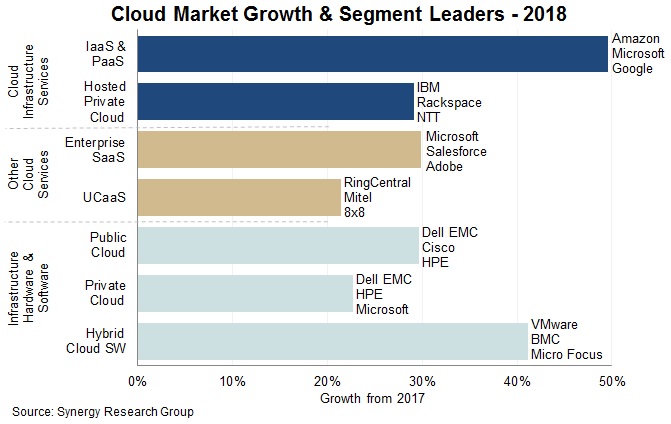
The company, which went public in 2008 and private again for $4.3 billion in 2016, has struggled in a cloud market dominated by giants like Amazon, Microsoft and Google, but according to Synergy Research, a firm that keeps close watch on the cloud market, it is one of the top 3 companies in the Hosted Private Cloud category.

It’s worth noting that the top company in this category is IBM and Rackspace could be a good target for Big Blue if it wanted to use its checkbook to get a boost in marketshare. IBM is in third or fourth place in the cloud infrastructure market, depending on whose numbers you look at, but it could move the needle a bit by buying a company like Rackspace. Neither company is suggesting this, however, and IBM bought Red Hat at the end of last year for $34 billion, making it less likely it will be in a spending mood this year.

For now the layoffs appear to be a company tweaking its workforce to meet current market conditions, but whatever the reason, it’s never a happy day when people lose their jobs.

01 Mar 2019

How I podcast: Effectively Wild’s Ben Lindbergh

Last month, Spotify announced that it had paid $340 million for Gimlet and Anchor in a push to make its mark on podcasting. But while it’s encouraging to see media giants throw weight and money behind the medium, the beauty of the format has always been its accessibility.

It’s the rare form of entertainment that’s nearly as easy to create as it is to consume. And now, thanks to the proliferation of devoted hardware and software solutions, it’s never been easier. Podcast studios run the range from NPR to Skype chat and every variation in-between, with recording rigs every bit as diverse as the shows themselves.

After receiving some great feedback from my writeup of my own setup, I’ve reached out to some of my favorite podcasters to see what they’re working with. I’ll be highlighting some of those in the coming weeks, beginning with Ben Lindbergh, the host of my favorite baseball podcast, Effectively Wild.

For six and a half years and 1,341 episodes, the Fangraphs-produced show has offered an idiosyncratic look at the world of sabermetrics — statistically fueled baseball analytics. Host Ben Lindbergh is also a baseball writer at The Ringer, who has formerly written for Baseball Prospectus, Grantland and FiveThirtyEight.

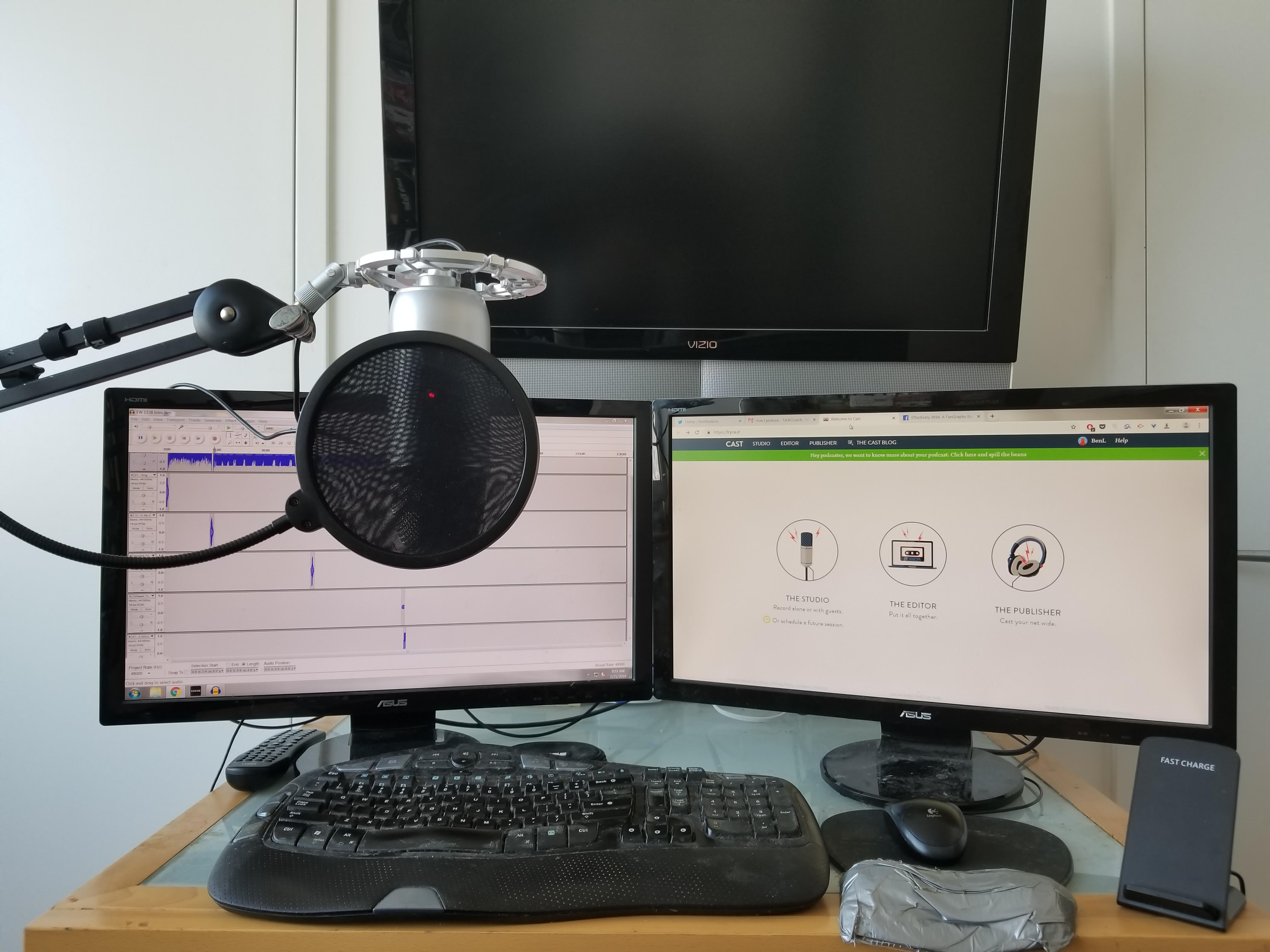
[Above: Ben’s rig.]

I’m an East Coaster who’s been putting out podcasts with West Coast co-hosts for several years, recording roughly 1,500 episodes of various shows for The Ringer and via independent, Patreon-supported pursuits. I don’t have a whole lot of gear, relying largely on the ubiquitous Blue Yeti with a $30 shock mount (attached to a boom arm) and a $20 pop filter, both from Auphonix. (I do have a TASCAM, which occasionally comes in handy for more narrativereported pods.)

I use Cast to talk to and pull local audio from guests who can connect via computer, resorting to Skype and MP3 Skype Recorder when necessary for phone conversations. I use Audacity to edit, which works fine for me. My employers have helped with hosting and promotion, and Facebook has been best for building a community.

All told, it’s a simple, inexpensive setup, but with some care in the production process, it still sounds good. Remote recording has its hurdles, but given chemistry between co-hosts, repetition, practice and judicious editing, cross-country conversations can sound as intimate and natural as in-studio discussions. Sometimes it’s freeing to be far apart.

I’ve been working this way for so long that it now seems strange to be able to see the person(s) I’m podcasting with. If we’re doing it right, though, the listener won’t notice or mind that there’s a continent between us.

01 Mar 2019

Canadian government allows Huawei CFO’s US extradition case to proceed 


Late last year, Huawei CFO Meng Wanzhou was arrested in Vancouver, Canada over alleged violations of U.S. trade sanctions with Iran. This week, the Canadian government announced that it will allow for the executive’s extradition to proceed

Officials in the Department of Justice Canada have issued an Authority to Proceed, a proclamation that officially begins the extradition process, which could send Wanzhou to the U.S. to face charges.

Wanzhou, who is also the daughter of Huawei founder Ren Zhengfei, has found herself at the center of an on-going dispute between the smartphone maker and the U.S. government. In January, an indictment was unsealed linking Wanzhou to alleged bank fraud designed to help the company circumvent U.S./Iranian sanctions.

“The decision follows a thorough and diligent review of the evidence in this case,” the Canadian DOJ writes in a statement. “The Department is satisfied that the requirements set out by the Extradition Act for the issuance of an Authority to Proceed have been met and there is sufficient evidence to be put before an extradition judge for decision.”

It goes on to note that this is just the first step toward extradition. A judge will hear the case, following by the Minister of Justice, who will ultimately decide whether Wanzhou should be surrendered.

We’ve reached out to Huawei for comment.

01 Mar 2019

WSJ: Amazon to open new U.S. grocery chain separate from Whole Foods

A report from The Wall St. Journal today claims Amazon is preparing to open a new chain of grocery stores across the U.S. that won’t be associated with Whole Foods. The retailer is expected to open the first of these stores in L.A., possibly by the end of 2019, and has signed leases for at least two other locations opening next year, the report claims.

The stores will be separately operated from Whole Foods, but it’s not clear yet how they’ll be branded or even if they’ll carry the Amazon name. The longer-term plan involves opening “dozens” of these stores in major U.S. cities, and Amazon may even consider an acquisition strategy related to this goal which would see it pickup regional grocery chains with about a dozen stores under operation, the report said. It may also target retail space vacated by Kmart.

Other cities that could be seeing the new stores in the future include San Francisco, Seattle, Chicago, D.C., and Philadelphia.

The stores would carry a different product assortment than Whole Foods, including items at lower price points. They may carry a mix of groceries, health and beauty products, and would include a parking lot area for grocery pickup.

They’ll be smaller than a typical grocery store at 35,000 sq ft instead of the usual 60,000 sq ft, The WSJ said.

The news comes at a time when Amazon’s grocery delivery business is facing steep competition. Its rival Walmart has capitalized on its brick-and-mortar footprint and years of testing. Today, Walmart’s grocery pickup service is available at more than 2,100 locations and delivery is offered at nearly 800. It expects to offer pickup at 3,100 locations and delivery at 1,600 locations by the end of fiscal year 2020. The company even attributed its strong Q4 sales, in part, to the growing online grocery business.

Target, meanwhile, picked up same-day grocery delivery service Shipt for $550 million in 2017, and has been expanding its own drive-up, in-store pickup, and next-day delivery services to cater to shoppers’ other household needs.

Amazon also competes on grocery delivery with Instacart, Postmates, and services from other grocery chains.

However, its own grocery strategy is a bit mixed. In addition to Whole Foods, which offers grocery pickup and delivery in some locations, Amazon continues to offer delivery service through AmazonFresh, and in select markets, Prime Now.

Meanwhile, it’s simultaneously invested in cashierless, grab-and-go convenience stores, under the Amazon Go brand. For consumers, that means there’s not one single point of access for ordering groceries from Amazon, which can lead to confusion.

Reached for comment about The WSJ report, an Amazon spokesperson said the company doesn’t comment on rumors or speculation.